Just in time for the Labor Day, here’s a short film from 1949 about How To Keep A Job!
Edward is kind of a dummy. He goes to a job interview and spends the whole time not only trashing his former employer but also trying to avoid admitting that he was fired from his previous job. Fortunately, the man interviewing him can tell that Edward still has potential, despite the fact that he’s kind of a squirmy idiot.
The interviewer tells Edward the story of twin brothers who worked in shipping. One brother was smart and responsible and always a good worker. That bother is now on the verge of being promoted. The other brother, Walter, was irresponsible and more concerned with getting ready for a date than actually doing his job. The message would seem to be that Edward is running the risk of turning into Walter but wait a minute! There’s a twist!
This is certainly an earnest short film. Of course, when seen today, it’s more goofy than educational. I have to admit that films like this always used to make me feel guilty because they’re like, “You must follow these exact steps to get and keep a job,” and I’m over here like, “Or you can just wait for a friend of your mom’s to give you a job!” But anyway, here’s How To Keep A Job!
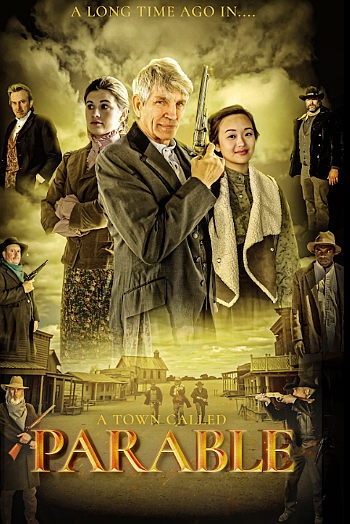
In 2021’s A Town Called Parable, Eric Roberts plays Reverend John Corell. He’s a pastor who lives in a small frontier town called Parable. It’s a town that’s full of gunslingers, gamblers, and businessmen. It’s the Old West, as long as you’re willing to overlook the fact that most of the characters have modern haircuts and wear clothes that look like they were purchased from the neighborhood costume shop.
John Corell is having a crisis of faith, due to the fact that some gunslingers gunned down his brother in the middle of the night. Corell is not sure how he can possibly be expected to forgive the men that killed his brother. He wants revenge but he knows that seeking revenge will mean rejecting everything that he believes in.
Now, to be honest, the idea of Eric Roberts playing a morally conflicted, old west preacher-turned-gunfighter actually does have some potential and I was totally looking forward to the sight of Roberts walking down a dusty street and demanding that his enemies “Draw!” Unfortunately, the majority of that potential is unrealized. The film only runs for a little over 70 minutes and most of Eric Roberts’s scenes feature him performing a monologue in his church. As Corell speaks, he remembers things that have happened to other citizens of Parable. Needless to say, there’s a lesson to be found in every flashback. The town isn’t called Parable for nothing.
For instance, Corell remembers the starving man who kept knocking at everyone’s door until he finally found someone willing to give him some food. He remembers the widow who kept demanding that the sheriff do something about the men who killed her husband and how she refused to stop demanding until justice was served. He also remembers the drunken employee who was forgiven once by his employer but who didn’t change his ways and who was savagely beaten as a result. (His wife and child were also sold to the highest bidder …. YIKES!) The stories all roughly correspond to a Biblical parable but, at the same time, they don’t offer up much of a solution as to what Corell should do when the men who killed his brother gather outside of his church.
It’s a disappointing film and one that does not take advantage of the presence of Eric Roberts. I mean, if you can actually convince Eric Roberts to spend more than day on your set, you need to do something more with him than just have him pace around one location. Fortunately, there are other Eric Roberts westerns out there that make better use of his unique talents.
Previous Eric Roberts Films That We Have Reviewed:
Since this is Labor Day weekend, it seems like an appropriate time to share a short film about one of our most valuable professions, teaching.
In 1947’s Maintaining Classroom Discipline, Mr. Grimes is a Math teacher who is disappointed in his stupid, stupid students. How should he deal with them? This short film gives us two options. The first half of the film (which, if we’re going to be honest, is the more fun half of the film), Mr. Grimes is hard-nosed and sarcastic, telling the students that he’s very disappointed in them and giving them all detention when they make fun of him. (One of them even misses football practice!) This approach does not work and, instead, leads to montage of Mr. Grimes giving detention to student after student. One student is kicked out of class and told not to return until he’s ready to apologize. I mean, seriously, Mr. Grimes is basically telling him that he can just leave the school if he wants.
The second half of the film features Mr. Grimes instead being polite about the low test score and patiently explaining to his students how ratio works. When one student tries to make fun of Mr. Grimes, the entire class rolls their eyes. Earth-2 Mr. Grimes is a good teacher and his class would die for him!
Personally, if I was a teacher, I have no idea how I would maintain discipline. I’d probably just make sure that my classroom was near the principal’s office so I can pull him in whenever I wanted to. To me, the worst thing about giving a student detention isn’t the fact that the student will resent you for it but that apparently, you’re required to stick around until detention has been served. Seriously, I enjoy working and all but I also like going home.
Anyway, let’s all learn from Mr. Grimes, shall we?
Since we are entering the Labor Day weekend, this seems like a good time to share a blast from the past that comes us all the way from 1947.
In The Secretary’s Day, viewers are told and shown what it takes to be a secretary. Do you know how to take dictation? Do you know how to carefully open up letters? Do you know how to be courteous to random people who wander into the office? More importantly, do you know how to make sure that Marge the Stenographer never gets into her head to try to seal your job away from you?
I watched this short film with a bit more interest than usual because I actually have worked as an administrative assistant in the past. Watching the film’s lead character obsess over her desk calendar brought back some memories but I think that just has more to do with the fact that I’m obsessed with calendars than anything else. To me, the main message of this film seemed to be, “A secretary’s day is pretty dull but at least she can bully the stenographer.”
Anyway, here’s a trip back to 1947! The war is over, the Great Depression was now a memory, and Americans, flush with victory, were looking for jobs! Check out The Secretary’s Day!
The 1992 film, Project Shadowchaser, takes place in the near future. It’s a time when cyborgs are a common sight and criminals are frozen and sent to a cryogenic prison. At the same time, it’s close enough to the present that the FBI is still America’s main law enforcement agency and the President is still a powerful enough figure that terrorists would want to abduct his daughter. It’s also close enough to the present that terrorists are still learning how to do their job from watching Die Hard.
Romulus (Frank Zagarino) is a cyborg who takes a hospital hostage, all to track down the president’s daughter, Sarah (Meg Foster). The FBI feels that only the hospital’s architect, Mr. Dixon, can figure out the best way for the FBI’s strike force to enter the hospital. Unfortunately, Mr. Dixon broke the law and has been put on deep freeze. When the stoner who runs the cryogenic prison is told to thaw out Mr. Dixon, he screws up and accidentally unfreezes DeSilva (Martin Kove), a former football quarterback.
Knowing a good thing when he sees it, DeSilva pretends to be Dixon but, once he and the strike force enter the building, it become apparent that DeSilva/Dixon has no idea what he’s talking about. All of the members of the strike force are killed when an elevator explodes. Only DeSilva survives and now, whether he wants to or not, he’s going to have to battle the terrorists and save the President’s daughter! It’s a good thing that she’s a football fan.
What a dumb movie this turned out to be! Seriously, you can add all of the sci-fi elements to your Die Hard rip-off that you want to, a Die Hard rip-off is still a Die Hard rip-off and it’s hard to think of any other film (with the possible exception of No Contest) that so slavishly follows the Die Hard formula. There’s nothing particularly surprising to be found in Project Shadowchaser. The minute that Kinderman (Joss Ackland) shows up and declares that he’s taking over the operation from FBI agent Trevanian (Paul Koslo), it’s obvious that he’s going to turn out to be the one behind Romulus’s actions. And from the minute that DeSilva meets Sarah, it’s obvious that they’re destined to fall in love.
I like Martin Kove on Cobra Kai and Kove brings a similar self-awareness to his role as DeSilva. At times, Kove appears to almost be winking at the audience, as if he’s saying, “Hey, I can’t believe I’m in this movie either. What are you going to do?” Unfortunately, Kove often seems to be the only person in the film who is really in on the joke. Needless to say, Project Shadowchaser is no Cobra Kai.
That said, I did appreciate the fact that the film’s entire plot hinged on a government employee accidentally unfreezing the wrong guy. As a portrait of bureaucratic incompetence, Project Shadowchaser works perfectly. I mean, let’s be honest. If there ever was a cryogenic prison, the wrong people would probably be getting unfrozen all the time. No one’s going to keep track of who is in which pod.
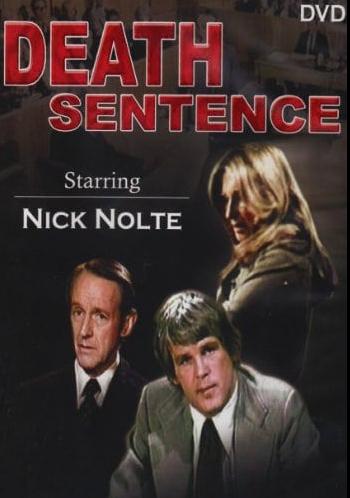
Welcome to Retro Television Reviews, a feature where we review some of our favorite and least favorite shows of the past! On Sundays, I will be reviewing the made-for-television movies that used to be a primetime mainstay. Today’s film is 1974’s Death Sentence! It can be viewed on YouTube!
There’s been a murder!
A young woman has been strangled in her own home. The nosy neighbor (Hope Summers) testifies that the woman often argued with her woman and that she heard the woman yelling on the night of the murder. The husband, John Healy (Nick Nolte), is found in a neighborhood bar and, when he’s brought back to his house, his drunken reaction to seeing his dead wife doesn’t do much to keep him from looking totally guilty.
However, the viewer knows that John is innocent because the viewer has already seen that the woman was murdered by Don Davies (Laurence Luckinbill), the man with whom she was having an affair. She demanded that he leave his wife for her and Don, realizing that his cheating was about to revealed, responded by strangling her.
Don’s wife is Susan Davies (Cloris Leachman), who knows that she and Don have been going through a rough patch but who certainly had no idea that Don was cheating on her. Shortly after the murder, Susan is called up for jury duty. She’s placed on the jury and told that she will be an important part of a major trial. As a result, she and the other jurors will be sequestered in a hotel….
And who is the defendant in this trial? John, of course!
As opposed to the other members of the jury, who are ready to convict John even before the first bit of testimony is heard, Susan pays attention to what is said in the courtroom. She listens to Lubell (Alan Oppenheimer), the prosecutor. She listens to Tanner (William Schallert), the defense attorney. She comes to believe that John is innocent but will she be able to hold her own against the rest of the jury? And will she ever figure out that the murder was actually committed by her husband?
It’s an intriguing premise, even if it is a bit far-fetched. I mean, it really is an amazing coincidence that Susan just happened to end up on the jury for a case involving a murder that was actually committed by her husband. However, this is a made-for-television movie and, as soon as “Produced by Aaron Spelling” appears on the screen, most viewers should be savvy enough to know what they’re getting into. Instead, the main problem with the film is that it opens by showing us who the murderer is. Therefore, there’s really zero suspense as to who actually committed the crime. Instead, the viewer spends the entire movie waiting for Susan to catch up. Since the majority of the film takes place in court, it’s a very talky film but there’s no joy to be found in paying close attention to every word said and picking up on the details that will allow you to solve the crime for yourself. This is a case where the film spoils its biggest twist and, despite good performances from Leachman and Luckinbill, it’s a bit dull.
(Nick Nolte, for his part, spends most of the movie silently sitting in the courtroom. He’s not bad and his look of anguish is believable but it’s hardly a starring role, regardless of what the film’s video packaging might otherwise claim.)
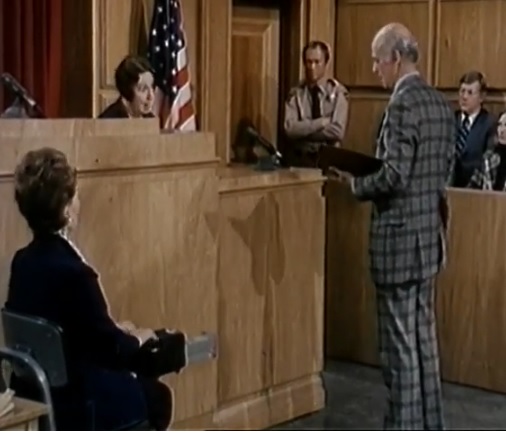
In the end, what I’ll mostly remember about Death Sentence were the atrocious fashion choices made by the prosecutor. Seriously, would you trust a man wearing this suit?
Asteroid City opens with black-and-white footage of Bryan Cranston, wearing a suit and speaking in the authoritative tones of someone who has made his living on television. Cranston informs us that we are about to see a televised production of a play by the famed but enigmatic playwright named Conrad Earp (Edward Norton).
The play, which is seen in stylized color, opens with Augie Steeback (Jason Schwartzman) driving his family through the desert. He is taking his son, Woodrow (Jake Ryan), to a Junior Stargazers convention that is being held at Asteroid City, a tiny town that is best-known for being the location of an impact crater. Along for the ride are Augie’s three daughters, who are all pretending to be witches. What Augie hasn’t told his children is that their mother has died, her cremated remains are in a Tupperware container, and that they will be moving in with their wealthy grandfather (Tom Hanks).
There’s not much to the town of Asteroid City. There’s a motel that’s managed by a man (Steve Carell) who sells land deeds out of a refurbished Coke machine. There’s a diner. There’s a group of helpful cowboys, led by the polite and helpful Montana (Rupert Friend). There’s a mechanic (Matt Dillon) who is called into duty when Augie’s car breaks down. The Junior Stargazer convention is the event of the year for Asteroid City. Young geniuses from all around the country have descended on the town and have brought their parents. One of them, Dinah (Grace Edwards), is the daughter of actress, Midge Campbell (Scarlett Johansson). When an alien (played, at one point in the film, by Jeff Goldblum) shows up and steals the town’s meteorite, General Gibson (Jeffrey Wright) declares a quarantine. Some people handle the lockdowns better than others. Augie takes pictures and thinks about his wife. Midge rehearses for her next role, one that is centered around her character dying. The genius children play a memory game that they realize will never end because they’re all geniuses. A teacher (Maya Hawke) tries to teach her students about the Milky Way, just to discover that the kids only want to talk about the alien. One of the fathers (Liev Schreiber) ends up with a useless plot of desert land and the death ray that his son recently invented.
Throughout it all, Bryan Cranston appears in black-and-white footage that gives us a look into what went on behind the scenes during the production of Asteroid City. The director (Adrien Brody) was a lech. The actor playing Augie struggled to understand what the play was about and who his character was meant to be while the actress (Margot Robie) hired to play his wife ended up in another play after her scenes were cut from Asteroid City. Only once does Bryan Cranston’s host appear in the color sections of Asteroid City, just to sheepishly admit that he’s not supposed to be there before ducking off camera.
Even if his name wasn’t in the opening credits, the viewer could probably easily guess that this is a Wes Anderson film. It features all of Anderson’s trademarks, all of the things that viewers will automatically love or hate depending on how they feel about Anderson’s quirky aesthetic. It’s a visually impressive, pop art-flavored, all-star comedy with an undercurrent of profound melancholy, one in which the fanciful strangeness of the alien’s “invasion” is compared and contrasted with the very real-life strangeness of how humans deal with life, loss, death, and uncertainty. Scenes of clever wordplay are mixed with scenes in which we see Augie still very much struggling to come to terms with the death of his wife and the actor Augie very much struggling to understand what is actually going on in his character’s head. As far as recent Anderson films go, Asteroid City is not quite as humanistic as Rushmore or Grand Budapest Hotel but, at the same time, it’s still more accessible than The French Dispatch.
If you’re not a fan of Anderson’s style, this film won’t convert you. That said, I am a fan of Anderson’s style and I absolutely loved Asteroid City. As with so many of Anderson’s films, the main focus is on how we try to deal with the uncertainties of life by trying to maintain an illusion of control over every aspect of our lives. Playwright Conrad Earp writes because that way he can have a world that follows his own rules. The actors follow a script that tells them how to react to everything that happens around them. In the play, the Junior Stargazers fall back on science while Augie’s father-in-law falls back on religion and Augie’s daughter convince themselves that spells will bring back or, at least, protect their mother. Even General Gibson falls back on his belief in the government and the military to deal with the sudden appearance by the alien. The alien is the unknowable and his arrival reminds everyone that life is unpredictable, regardless of how much you try to control your own story. Indeed, while the film takes place in the 50s and is full of comments about the Red Scare and atomic bomb testing, it’s hard not to see Asteroid City as being a commentary on the recent COVID lockdowns and the debate over whether people could ever go back to living the way that they did before the pandemic. Much as with the Coen Brothers’s similarly stylized A Serious Man, the ultimate message seems to be that the only way to deal with the unpredictability of life is to embrace it.
It’s also a very funny film, one that is full of small details that reward repeat viewing. If one focuses on the background characters, it quickly becomes apparent that there are actually several stories unfolding in the film and, much as with life, the viewer just has to be willing to look for them. (I particularly enjoyed the romance between The Teacher and Montana.) Jason Schwartzman is compelling as both Augie and the actor playing Augie and Scarlett Johansson plays both Midge and the actress playing Midge with the perfect amount of cool detachment. To the film’s credit, none of the character’s become caricatures. They remain individuals, regardless of how bizarre the film’s story may sometimes seem. Everyone gets a moment to reveal a little depth, from Jeffrey Wright’s sincere (if misplaced) faith in the lockdown policy to the moment when Tom Hanks’s previously unsympathetic father-in-law reveals that he’s as much in mourning as Augie. The all-star cast also includes Tilda Swinton, Liev Schrieber, Stephen Park, Willem DaFoe, Hong Chau, and Margot Robbie and all of them add to the film’s portrait of quirky but ultimately relatable humanity.
Again, with this film, it undoubtedly helps to already be familiar with and to like Wes Anderson’s way of doing things. If you’re not a fan of his film, this one probably won’t change your mind. That said, for those of us who do enjoy his style, this is Anderson at his best.
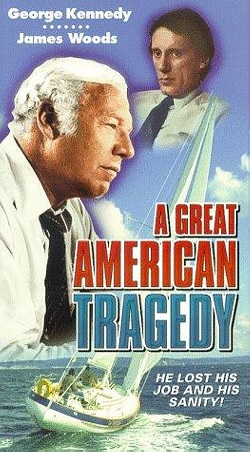
Welcome to Retro Television Reviews, a feature where we review some of our favorite and least favorite shows of the past! On Sundays, I will be reviewing the made-for-television movies that used to be a primetime mainstay. Today’s film is 1972’s A Great American Tragedy! It can be viewed on YouTube!
Brad Wilkes (George Kennedy) had a good career, working as an aerospace engineer. He was able to buy a nice house. With his wife, Gloria (Vera Miles), he was able to raise a good family. He was even able to buy a sailboat, one that is the pride of the entire marina. But then, one day, he’s told that the company is letting him go.
Returning to his home, Brad tells Gloria that he’s lost his job but that everything’s going to be okay because not only does he have a $10,000 pension but he’s sure he can find a new job. “Of course, I might not be making $35,000 a year….” he says.
(Watching at home, I said, “Pfffft! I make more than that!” But, of course, Brad is talking about $35,000 in 1972 money, which would be the equivalent of a quarter of a million today.)
However, Brad soon discovers that getting a new job will not be as easy as he assumed. It turns out that there are a lot of people out there looking for work and most of them are younger, cheaper, and better educated than Brad. The bills start to pile up. His former boss (Robert Mandan) informs Brad that his pension is going to be $7,000 less than he thought. Brad forces himself to go down to the unemployment office so that he can collect $25 a week and then suffers the humiliation of being offered a loan by his well-meaning son-in-law (played by a youngish James Woods). Gloria gets a job at the same clothing store where she used to shop and her lecherous boss (Kevin McCarthy) starts to hit on her.
For Brad, the final humiliation comes when he has to sell the boat. A younger boat owner (Tony Dow, with a huge mustache) puts Brad in contact with a woman named Paula (Natalie Trundy). Paula wants to buy the boat and, after they take it out on the water, Brad finds himself tempted to cheat on his wife. It all gets to be too much for Brad and soon, he’s on a plane to Nevada where hopefully one good night at the craps table will be enough to pay his bills….
Watching this film, I found myself feeling very sorry for Brad while, at the same time, becoming very frustrated with him. On the one hand, his company tossed him out after years of loyal service and then tried to screw him out of his pension. On the other hand, Brad spent almost the entire movie in denial about how bad things actually were. It’s one thing to be proud and it’s another to just be stubborn. Knowing that he has next to no money, Brad still insists on throwing his annual 4th of July party and he even invites his former boss to come over and celebrate. Brad simply cannot bring himself to admit that his old life is over but really, who can blame him? He’s not the one who chose to be fired.
A Great American Tragedy was directed by J. Lee Thompson, who also did Cape Fear, The Guns of Navarone, the Planet of the Apes sequels, and several Charles Bronson films. There are no fight scenes to be found in A Great American Tragedy but Thompson does get good performances from his cast and the film makes great use of George Kennedy’s likability. The viewer remains sympathetic to Brad, even when he makes mistake after mistake. A film about a formerly secure family suddenly discovering just how much the economy sucks, A Great American Tragedy remains just as a relevant today as when it was first made.
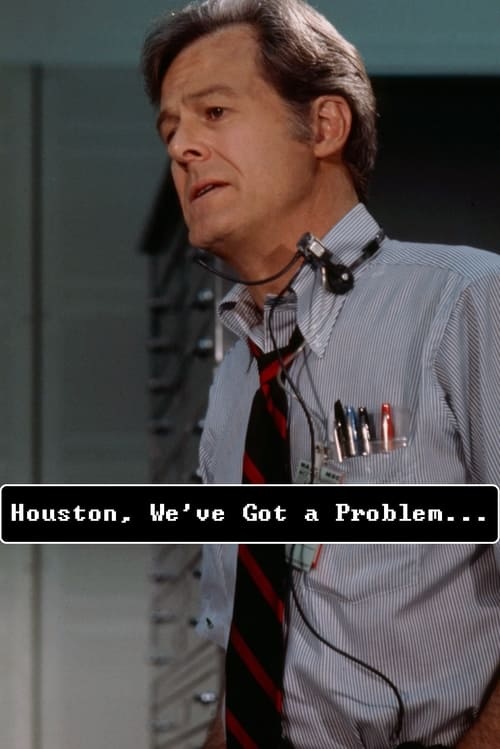
Welcome to Retro Television Reviews, a feature where we review some of our favorite and least favorite shows of the past! On Sundays, I will be reviewing the made-for-television movies that used to be a primetime mainstay. Today’s film is 1974’s Houston, We’ve Got A Problem! It can be viewed on YouTube!
The year is 1970 and Apollo 13 is the latest manned NASA mission into space. The head of the mission of Jim Lovell and the destination is the Moon. Unfortunately, the American public has gotten so used to the idea of men going to the Moon that hardly anyone is paying attention to Apollo 13. That changes when Lovell contacts mission control in Houston and utters those famous words, “Houston …. we’ve had a problem.” An oxygen tank has exploded, crippling the spacecraft and leaving the three men in danger. If Houston can’t figure out how to bring them home, Apollo 13 could turn into an orbiting tomb.
Yes, this film tells the story of the same crisis that Ron Howard recreated in Apollo 13. The difference between Houston, We’ve Got A Problem and Apollo 13 (beyond the fact that one was a big budget Hollywood production and the other a low-budget made-for-TV movie), is that Apollo 13 largely focused on the men trapped in space while Houston, We’ve Got A Problem is totally Earthbound. In fact, Jim Lovell does not even appear in the ’74 film, though his voice is heard. (The film features the actual communications between the crew and Mission Control.) Instead, the entire film follows the men on the ground as, under the leadership of Gene Kranz (Ed Nelson), they try to figure out how to bring the crew of Apollo 13 home. Houston, We’ve Got A Problem is a far more low-key film than Apollo 13, one that features narration from Eli Wallach to give it an effective documentary feel but one that also lacks the moments of wit and emotion that distinguished Apollo 13.
NASA cooperated with the making of the film and it works best when it focuses on the men brainstorming on how to solve the biggest crisis that the American space program had ever faced to that date. The film is less effective when it tries to portray the effects of the men’s work on their home lives. Sandra Dee is wasted as the wife who can’t understand why her engineer husband (reliably bland Gary Collins) can’t spend more time at home. Clu Gulager plays the guy who fears he’s missing out on time with his son. Robert Culp plays the man with a heart condition who places his hand over his chest whenever anything stressful happens. Steve Franken has to choose between his religious obligations and his obligation to NASA. The melodrama of those fictional moments are awkwardly mixed with the based-in-fact moments of everyone calmly and rationally discussing the best way to save the crew. Jim Lovell, as a matter of fact, complained that Houston, We’ve Got A Problem did a disservice to the flight controllers by presenting them all as being hopelessly inept in their lives outside of mission control. (Lovell was reportedly much happier with Apollo 13.)
Because it features the actual conversations between the crew and Mission Control, Houston, We’ve Got AProblem is interesting as a historical document but it never escapes the shadow of Ron Howard’s better-known film.
Yesterday, I finally watched the hit film of March 2023, John Wick: Chapter Four. It left me overwhelmed and I mean that in the best possible way.
The film picks up where the last film left off. John Wick (Keanu Reeves), the dog-loving, formerly retired professional hit man, is still traveling the world and killing the leaders of the High Table. As becomes apparent from the start of the film, it’s a bit of a fool’s errand as killing one leader only leads to another leader being installed. When John travels to Morocco to kill the leader known as “The Elder,” he discovers that the Elder he knew is gone and has been replaced with a new Elder. He still kills the new Elder because that’s what John Wick does. He kills people. He’s a literal killing machine, one who audiences like because he loves dogs, is still mourning for his dead wife, and he’s played by Keanu Reeves. On paper, the relentless and ruthless character of John Wick is horrifying. But, when he’s played by Keanu Reeves, he becomes the killing machine that audiences can’t help but love.
The arrogant and brilliantly named Marquis Vincent Bisset de Gramont (Bill Skarsgard, giving a wonderfully hissable performance) is currently in charge of the efforts to track down and kill John. The Marquis establishes himself as being evil by not only killing Charon (Lance Reddick) but also blowing up the Continental. Upset by the murder of Charon and the destruction of his business, Winston (Ian McShane, playing his role with the perfect amount of wounded dignity) tells John that he can end his entire war with the High Table by challenging the Marquis to a duel. Unfortunately, to do that, John has to convince another criminal organization to sponsor him and just about criminal organization on the planet wants John did. To make things even more difficult, the Marquis has brought the blind assassin, Caine (the incredible Donnie Yen), out of retirement to track down John. Caine and John are old friends but Caine knows that his daughter will be killed unless he kills John.
Clocking in at 169 minutes, John Wick: Chapter Four is a big, flamboyant, and at times overwhelming production. John Wick travels across the world and every country in which he finds himself is home to someone who wants him dead. And since everyone that John Wick knows seems to have a unlimited supply of guards and henchmen, the fights are nonstop and the violence is over the top but the film is so energetic and cheerfully excessive that it’s never boring. Each fight scene feels like it could be a separate film on its own, with each member of the cast getting a chance to show off what they can do. The water-filled fight in a Berlin night club is the film’s best moment but it’s closely followed by an extended combat sequence that’s set in a hotel in Japan. With its vivid cinematography and ornate production design and its spectacular stunts, John Wick Chapter 4 is a work of pure cinema, an thrill ride of glorious excess. Along with providing an ending to John Wick’s story, it also pays tribute to everything that audiences love about action cinema. It’s a film for people who love action and, even more importantly, it’s film that has as much love for its audience as it does for itself.
The film ends on a note of apparent finality, one that becomes more ambiguous the more that one examines it. This may be the last chapter of John Wick’s story or it may not. (Considering the film’s box office and critical success, I suspect that it will not be the last.) John Wick Chapter Four serves as a fitting (if perhaps temporary) end to the saga and also a tribute to both the action aesthetic and Keanu Reeves’s innate likability.





 Through the Shattered Lens