October True Crime: The Frozen Ground (dir by Scott Walker)


In the early 80s, Robert Hansen was a respected businessman in Anchorage, Alaska.  He owned a restaurant.  He was known for being a family man.  He held several local hunting records.  Almost everyone who met him described him as being friendly and good-natured.  In those days before the Internet, it wasn’t as if someone could do a Google search and discover that Hansen had a long criminal record in both Iowa and Alaska.  There was no way to know that Hansen had been a teenage arsonist and that had been arrested and charged with rape in the early 70s.  (The charges were ultimately plea bargained down to assault.)  Even those who did know about his background felt that Hansen had turned his life around and was now an upstanding member of society.

At the same time that Hansen was a respected member of the Anchorage community, he was abducting young women and, after holding them prisoner and raping him at his cabin, flying them into the Alaskan wilderness where he would then hunt them in his own version of The Most Dangerous Game.  It’s known, for sure, that Hansen murdered at least 18 women.  It’s felt that the number is much higher.  Along with his own good reputation, Hansen was protected by the fact that many of his victims were transients and sex workers.  Their disappearances were rarely reported to the police and, when they were, the police didn’t go out of their way to find them.  Much as happened with the Green River Killer in Washington State, Hansen was able to get away with his crimes for over 20 years not because he was particularly clever but because his victims were considered to be on the fringes of society.

The 2011 film, The Frozen Ground, is a fictionalized account of the investigation that led to Hansen’s arrest.  John Cusack plays Robert Hansen.  Nicolas Cage plays Jack Holcombe, a weary Alaskan state trooper who has to deal with uncooperative witnesses and beaurocratic indifference while investigating Hansen’s crimes.  Vanessa Hudgens plays Cindy Paulson, a 17 year-old sex worker who survives her encounter with Hansen but whose story is originally ignored by the police because of what Cindy does for a living.  Both Jack and Hansen comes to realize that Cindy is the only person who can positively identify the killer but Cindy has disappeared into the Anchorage underworld, working as a stripper and being manipulated by her pimp, Clate Johnson (50 Cent).

Taking full of advantage of the chilly atmosphere and the isolation of the Alaskan wilderness, The Frozen Ground is an effective journey into the heart of darkness, featuring excellent performances from Nicolas Cage and John Cusack.  Cusack smoothly alternates between being the arrogant hunter and the desperate prey while Cage’s weary expression captures the psychological toll of investigating the crimes of someone like Robert Hansen.  Of course, when the film came out, it received a lot of attention for featuring Vanessa Hudgens in a dramatic role.  Hudgens’s performance here continues the tradition of former Disney (and Nickelodeon) actresses trying to prove their range by playing an edgy role.  Though there’s a few scenes where she does seem to be trying too hard to make sure that we all know she’s capable of more than High School Musical, Hudgens is convincing for the most part.

As for the real-life Robert Hansen, he was sentenced to spend 461 years in prison for his crimes.  (Alaska has no death penalty.)  In 2014, three years after the release of this film, the 75 year-old Hansen died of natural causes while still incarcerated.

Guilty Pleasure No. 67: Aerobicide (dir by David A. Prior)


It doesn’t get more 80s than 1987’s Aerobicide, a rather ludicrous slasher film that is also known as Killer Workout.

The clients and the staff at Rhonda’s Work-Out are in danger.  People are being murdered inside the gym, left and right.  One member of the gym is slashed to death in the showers.  Another one is beaten to death with a barbell while his friend is killed with a very large safety pin.  One instructors ends up hanging in a closet while another is stabbed to death in a locker room.  A group of teens show up to spray graffiti on the outside of the club and they all end up getting murdered as well.

Most people would assume that, with all of those murders going on, that the place would be closed down or, at the very least, people would stop frequenting the gym.  But no, the opposite happens.  Every murder is followed by an aerobics class, in which the camera shamelessly lingers on the lycra-clad participants, none of whom seem to be particularly concerned about working out at a crime scene.  ( If your body’s looking too big, one of the film’s many songs tells us, Like a hippo or a pig/ Gotta workout/ gotta work out….) The gym’s owner, Rhonda Johnson (Marica Karr), doesn’t seem to be particularly concerned about the gym getting a bad reputation as a result of all the murders.  Instead, she’s more annoyed with her surviving instructors, snapping at one, “Stop showing off your tits and that tight little ass!”  Personally, I would think looking good would be a top priority for someone working at a gym but apparently, Rhonda feels differently.

(Then again, if people were being murdered at my gym, I’d probably cancel my membership, despite the fact that my gym is only a few blocks away from my house and most of the people who go there are relatively cool.  That said, the main reason why I signed up for a membership was so my sister could get a discount on her membership fees.  Personally, I prefer running.)

Even if Rhonda refuses to close the gym, you would think that Lt. Morgan (David James Campbell) would make sure that the gym had a full-time police presence.  Eventually, Morgan does assign one policeman to watch the gym but that’s only after several murders have already occurred and that one policeman’s presence doesn’t really do much good.  Then again, Lt. Morgan never comes across as being a particularly good cop.  Morgan is spectacularly bad at his job, which wouldn’t be a huge problem if not for the fact that Morgan is also the hero of the film.  Eventually, he does figure out that the murders are connected to a tragic tanning bed accident but it’s hard to say how exactly he managed to do that.  Rather than actually showing us Lt. Morgan gathering  clues and drawing conclusions, the film just has him randomly blurt stuff out.

It’s all pretty ridiculous but, because the film is such a film of it’s time, it’s also rather fascinating.  Killer Workout may not have been the only or even the first film to combine Flashdance with slasher chills but it is the first one to feature a song with lyrics like, “It’s the perfect body you’re looking for/it’s aerobocide.”  This is one of those films where you come for the big hair and the 80s fashions and the bass-heavy score and you stay for the ludicrous plot twists, the overacting, the overheated dialogue, and the out-of-nowhere plot twists that dominate the film’s final 30 minutes.  It’s not necessarily a “good” film but I defy anyone to look away once it begins.

Previous Guilty Pleasures

  1. Half-Baked
  2. Save The Last Dance
  3. Every Rose Has Its Thorns
  4. The Jeremy Kyle Show
  5. Invasion USA
  6. The Golden Child
  7. Final Destination 2
  8. Paparazzi
  9. The Principal
  10. The Substitute
  11. Terror In The Family
  12. Pandorum
  13. Lambada
  14. Fear
  15. Cocktail
  16. Keep Off The Grass
  17. Girls, Girls, Girls
  18. Class
  19. Tart
  20. King Kong vs. Godzilla
  21. Hawk the Slayer
  22. Battle Beyond the Stars
  23. Meridian
  24. Walk of Shame
  25. From Justin To Kelly
  26. Project Greenlight
  27. Sex Decoy: Love Stings
  28. Swimfan
  29. On the Line
  30. Wolfen
  31. Hail Caesar!
  32. It’s So Cold In The D
  33. In the Mix
  34. Healed By Grace
  35. Valley of the Dolls
  36. The Legend of Billie Jean
  37. Death Wish
  38. Shipping Wars
  39. Ghost Whisperer
  40. Parking Wars
  41. The Dead Are After Me
  42. Harper’s Island
  43. The Resurrection of Gavin Stone
  44. Paranormal State
  45. Utopia
  46. Bar Rescue
  47. The Powers of Matthew Star
  48. Spiker
  49. Heavenly Bodies
  50. Maid in Manhattan
  51. Rage and Honor
  52. Saved By The Bell 3. 21 “No Hope With Dope”
  53. Happy Gilmore
  54. Solarbabies
  55. The Dawn of Correction
  56. Once You Understand
  57. The Voyeurs 
  58. Robot Jox
  59. Teen Wolf
  60. The Running Man
  61. Double Dragon
  62. Backtrack
  63. Julie and Jack
  64. Karate Warrior
  65. Invaders From Mars
  66. Cloverfield

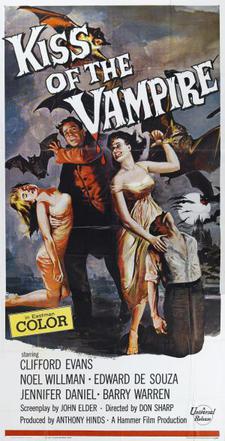
Horror Film Review: Kiss of the Vampire (dir by Don Sharp)


The 1963 Hammer film opens with a funeral in early 20th century Bavaria.  It’s a solemn affair, full of mourning villagers and taking place in an atmospheric cemetery.  However, just as the wooden coffin is being lowered into the grave, the stern Prof. Zimmer (Clifford Evans) walks through the funeral party, carrying a stake and a hammer.  Without bothering to open the coffin, he hammers the stake through the lid.  As the members of the funeral party wail and scream, bright red blood bubbles up from the coffin.

Yep, it’s a Hammer vampire film!  That means that once again, we’ve got a small village, we’ve got superstitious townspeople, we’ve got an aristocratic vampire and his vampire brides, and we’ve got a mix of red blood and cleavage.  What we do not have is Christopher Lee, despite the fact that Kiss of the Vampire was originally planned to be a Dracula film.  Lee, who was a serious student of the occult and a  fan of Bram Stoker’s version of the legendary vampire, was very much not a fan of Hammer’s interpretation of the character and, whenever he could get out of doing a Hammer Dracula film, he would.

As a result, Kiss of the Vampire features not Dracula but instead Dr. Ravna (Noel Willman), a vampire who lives in a castle and who has a loyal cult of followers.  Both his son (Barry Warren) and his daughter (Jacquie Wallis) are also vampires.  When two British newlyweds drive into town on their honeymoon, Dr. Ravna hopes to turn Marianne Harcourt (Jennifer Daniel) into a vampire as well.  Marianne’s husband, Gerald (Edward de Souza), teams up with Prof. Zimmer to keep that from happening.  It’s vampire doctor versus human professor!

This was director Don Sharp’s first horror film for Hammer and he does a pretty good job of creating an appropriately gothic atmosphere.  Almost all of the things that we love about Hammer films is present in Kiss of the Vampire, from the cobblestone streets to the imposing castles to the elaborate masquerade ball that allows Dr. Ravna to abduct Marianne in the first place.  There’s also a lot of blood, including a wonderfully grisly scene where Prof. Zimmer deliberately sets his arm on fire in order to cauterize a vampire bite.  Visually, the film is full of macabre images and operatic horror.  In fact, one could argue that the absence of Dracula and Van Helsing allows Kiss of the Vampire to go in a direction that the other Hammer vampire films could not.  The finale, which featured the heroes using black magic to battle the vampires, was originally meant to be the finale of The Brides of Dracula until Peter Cushing objects that Prof. Van Helsing would never use dark magic to battle a vampire.  Prof. Zimmer, on the other hand, had no such qualms.

That said, the film really does suffer from the fact that Noel Willman does not have the evil charisma of Christopher Lee and Dr. Ravna and Prof. Zimmer do not share the long history of Dracula and Van Helsing.  Kiss of the Vampire is a good film but it’s hard not to mourn what it could have been.

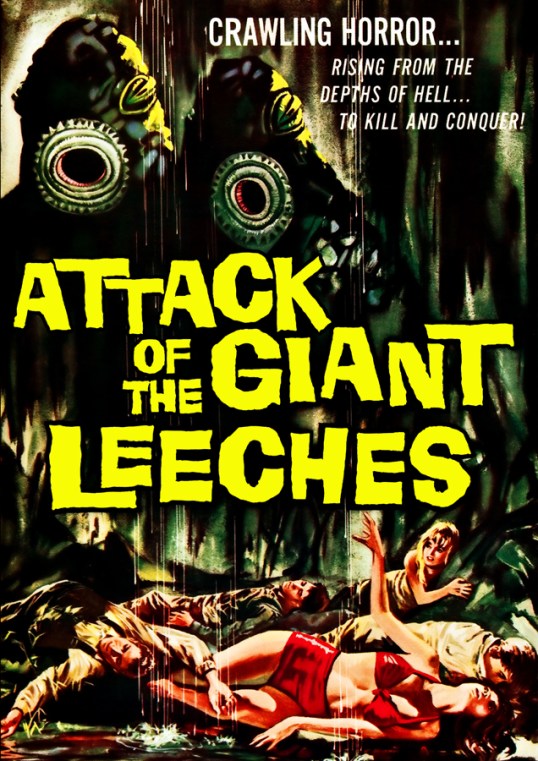
Horror On The Lens: Attack of the Giant Leeches (dir. by Bernard Kowalski)


For today’s public domain horror film, I present to you 1959’s Attack of the Giant Leeches. This 60-minute film is a classic Drive-in film.  It features an iconic performance from Yvette Vickers, who is one of my favorites of the strong, confident, unapologetically sexy women who dominated the old B-movies. (Plus, she was only 5’3 and it’s not easy being brave when you’re having to look up at everyone. Trust me, I know.) This short little film is steamier than Louisiana in August and is full of bayou atmosphere.

I have to admit that I’m kinda freaked out by the scenes of people floating underwater in this film. And leeches .… agck! Don’t even get me started on leeches. Especially giant leeches….

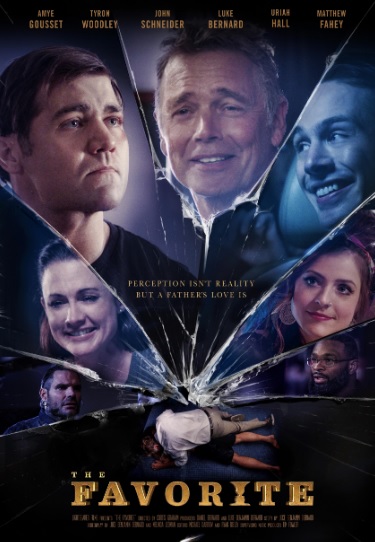
October Positivity: The Favorite (dir by Curtis Graham)


The 2019 film, The Favorite, tells the story of two brothers.

Benjamin Bernard (Luke Benjamin Bernard) is an MMA fighter, an up-and-comer who never gives up in the ring and has won the loyalty of his fans as a result.  His nickname is “The Favorite” because the crowd loves to watch him fight.  What the crowd doesn’t know is that Benjamin rarely feels like the favorite in his everyday life.  Instead, he’s lived his life overshadowed by his brother and, as a result, he’s grown up to be angry and insecure.

Benjamin’s brother is Luke (Matthew Fahey).  Luke is a star soccer player, one who is destined to go pro as soon as he graduates.  (At one point, he’s projected to be the number one draft choice.)  Luke has always been a good son and a good friend and a good brother.  He and Benjamin love each other but Benjamin just cannot get over his jealousy towards the strong relationship between Luke and their father, Daniel (John Schneider).

The tensions between the two come to a head one night while the two of them are on a double date.  Luke is driving when Benjamin punches him.  Luke loses control of the SUV, resulting in a catastrophic crash.  Luke’s girlfriend is killed.  Benjamin’s girlfriend may never walk again.  Luke is taken to the hospital in a coma and the doctors are forced to remove a part of his skull in order to save his life, causing half of the top of Luke’s head to cave in.  Somehow, Benjamin survives the accident with only a few minor cuts and bruises.

After spending days in a coma, Luke finally opens his eyes.  It quickly becomes apparent that he’s suffered severe brain damage.  He can barely walk or speak but Luke also makes it clear that he intends to recover.  With the help of Benjamin and Daniel, Luke makes quick progress.  But when Benjamin confesses that it was his actions that led to the car crash and the death of Luke’s girlfriend, will Luke ever be able to forgive him?

The Favorite ends with an interesting postscript.  As the end credits roll, the viewers are informed that the film’s star, Luke Benjamin Bernard, was in a similar car accident in 2013.  The accident left him in a stage 3 coma and, just as happened to Luke in the film, the doctor’s had to remove a portion of Bernard’s skull in order to save his life.  Bernard was given little chance of recovery but, to the shock of everyone, he did eventually wake up from his coma.  He had to learn how to walk, talk, and write again.  He even had to re-learn how to swallow and eat solid food.  Much like the film’s Luke, the real Luke made remarkable progress in his recovery, completing rehab in three weeks.  While in the hospital, Bernard had a dream about two brothers who were dealing with the same thing that he was dealing with.  That dream led to Bernard writing the script for The Favorite, with Benjamin and Luke representing two sides of himself and his recovery.  The film ends with a shot of him giving a motivational speech and I don’t care how cynical you may be, it’s incredibly touching.

It’s a touching film as well.  Yes, the budget is low and there are a few scenes that are a bit overwritten.  A subplot about Benjamin trying to win the MMA championship felt like it was lifted from a dozen other films.  But, in the end, it doesn’t take away from the power of the film’s story or the excellent performances of Bernard, Fahey, and Schneider.  This is a heartfelt movie, one that celebrates the love of family and the promise of hope.

The TSL Horror Grindhouse: The Psychotronic Man (dir by Jack M. Sell)


If you can figure out what’s going on in 1979’s The Psychotronic Man, you’re definitely doing better than most people who have sat through this film.

Filmed on location in Chicago (at a time when the original Mayor Richard Daley was supposedly encouraging filmmaker to shoot anywhere but Chicago because he didn’t want anyone to film anything that could make his city look bad), The Psychotronic Man tells the story of an alcoholic barber named Rocky (Peter Spelson).  One day, after work, Rocky decides to drive the long way home, which apparently means driving through every inch of rural Illinois.  Seriously, you really do have to wonder just where exactly Rocky lives.  Rocky decides to pull over so that he can get some sleep.  Suddenly, his car is floating in the air.  Was Rocky just having a dream or were aliens trying to abduct him?  Rocky’s concerned and so is his wife and so is his mistress.

Rocky goes to a doctor but the doctor has nothing useful to tell him, beyond prescribing his some aspirin for his headaches.  Rocky tries to investigate on his own but this just leads to him getting a shotgun pulled on him by a suspicious farmer.  This is when Rocky discovers that he can kill people with his mind.

How has Rocky developed the power to kill people with his mind?  Your guess is as good as mine, though the film does feature an professor at the University of Chicago who suggests that Rocky’s power is one that we all have, buried deep in our subconscious.  Perhaps Rocky’s meeting with the aliens caused this powers to be unlocked.  I mean, it’s as good an explanation as any, though you have to wonder why aliens would suddenly want to give an unappealing barber the ability to kill people with his mind.  That seems pretty irresponsible on the part of the aliens.

Well, no matter!  Rocky’s in a lot of trouble now and he’s got not only the police but also a government agent after him.  (The government would like to learn how Rocky developed his “psychotronic powers.”)  This leads to several scenes of Rocky and the police walking around Chicago, looking for each other.  I would say that probably about 75% of this film is just filler.  The plot gets repetitive in record time, as does the bell-dominated soundtrack.  Every few minutes, a bell rings as if we need to be reminded that Rocky is one step closer to meeting his psychotronic destiny.

Personally, I enjoyed seeing the location footage of Chicago and the surrounding countryside.  It was obvious that the film was shot without bothering to get permits so the majority of the people in the background were probably just people trying to either shop or get to work.  That said, The Psychotronic Man plays out a torturously slow pace and Rocky is not at all an appealing main character.  Even before he turns into a psycho mind killer, he’s a drunk who slips from a flask while driving and who is cheating on his wife.  As far as I’m concerned, Rocky deserved whatever he got!

Finally, this film has lived on due to the fact that it introduced the word Psychotronic to the world.  Michael J. Weldon later borrowed the term for The Psychotronic Encyclopedia of Film, The Psychotronic Video Guide, and Psychotronic Video magazine.  Psychotronic is usually a term used to describe low-budget B-movies, the majority of which are better than The Psychotronic Man.

Cruella’s Castle (2010, directed by Fred Olen Ray)


Dr. Bikini Jones (Christine Nguyen) is a world-famous adventurer and archeologist who is willing to brave any danger and sleep with any security guard or spy in her hunt for treasure.  She has just recovered a golden idol that contains a code that will lead to the Temple of Eros and a tiara that, when worn, makes the wearer the Empress of Moronica.

Evilla Cruella (Heather Vandeven) may have born in Hoboken but her family came from Mornica and she is determined to be Queen of the Morons.  She sends her lover Drago (Frankie Cullen) and her other lover, Carol (Rebecca Love), to steal the idol.  Working with CIA agent Mark X (Tony Marino), Bikini must keep Cruella from being the first to find the Temple of Eros.  It won’t be easy because the Temple itself is guarded by a hungry dinosaur!

Cruella’s Castle started life as an 82-minute softcore film called Bikni Jones and The Temple of Eros.  When the film moved to streaming, it was edited to remove all of the explicit sex and most of the nudity and renamed Cruella’s Castle.  (Without the sex and boobs, Cruella’s Castle is only 40 minutes long.)  I imagine many would say that the editing took the main reason why anyone would want to watch this movie in the first place but, even in edited form, Cruella’s Castle has got enough double entendrees and intentionally dumb jokes to be entertaining.  The dinosaur is surprisingly effective, considering that the budget for this movie was undoubtedly not high and Christine Nguyen has so much energy and enthusiasm as Bikini Jones that it’s hard not to mourn that she hasn’t had any more adventures.  This is a typical Fred Olen Ray joint, dumb but inoffensive and even a little fun if you’re in the right mood.

Retro Television Reviews: The Failing of Raymond (dir by Boris Sagal)


Welcome to Retro Television Reviews, a feature where we review some of our favorite and least favorite shows of the past!  On Sundays, I will be reviewing the made-for-television movies that used to be a primetime mainstay.  Today’s film is 1971’s The Failing of Raymond!  It  can be viewed on YouTube!

Poor Raymond!

Played by a young Dean Stockwell, Raymond is patient at a mental hospital who blames everything that has gone wrong on his life on one failed test.  During his senior year of high school, he got a 61 on an English test and, as a result, he not only only failed the class but he also wasn’t allowed to graduate.  The test was administered by a substitute teacher named Mary Bloomquist (Jane Wyman), one who did not know that Raymond had a reputation for being a bit eccentric.  When Raymond tried to ask her whether or not the final two questions were for extra credit, Mary refused to call on him because she was more preoccupied with her failed affair with another teacher (Dana Andrews).  Raymond didn’t answer the final two questions, even though he believed that he had the correct answers.  Now, locked away in a hospital, Raymond comes across an article announcing that beloved teacher Mary Bloomquist will soon be retiring and moving to England.

Seeking revenge, Raymond escapes from the hospital.  While police Sgt. Manzek (Murray Hamilton) search for Raymond, Raymond returns to his old school.  When he finds Mary in her classroom, Mary mistakes Raymond for a mover responding to a classified ad asking for help in getting all of her things packed up.  Raymond may be a homicidal but he also craves direction and praise so he helps Mary with her packing.  As he packs, Mary talks about her decision to retire and it turns out that she’s not quite the monster that Raymond imagined her to be.  Mary is retiring because she feels that she has never made a difference as a teacher.

That said, Raymond is still determined to get his revenge.  He wants Mary to give him the test a second time and to give him a passing grade.  And if she doesn’t, he’s prepared to kill her.  Unfortunately, despite claiming to have spent years studying the material, Raymond still thinks that Robert Browning wrote the Rhyme of the Ancient Mariner.

As the old saying goes, you never know how much your actions might effect someone else’s life.  Mary is a dedicated and well-meaning teacher who cares about her students but her decision to fail Raymond, made on a day when she was distracted by her own personal problems, is something that Raymond has never forgotten or forgiven.  Mary can barely remember it happening but Raymond has based his entire life around that moment and, as the film progresses, it becomes clear that he’s incapable of understanding that the entire world doesn’t revolve around what happened to him during his senior year.  On the one hand, Mary definitely should have answered Raymond’s question about whether or not the final two questions were multiple choice.  On the other hand, Raymond has clearly been using the incident as an excuse to justify every mistake that he’s made sense.  Ironically, Raymond’s quest for revenge gives Mary the chance to finally be the teacher that she truly wants to be.

It’s an intriguing premise.  Unfortunately, like so many made-for-TV movies from the early 70s, The Failing of Raymond is occasionally a bit too stagey for its own good.  Despite only being 73 minutes long, it never really develops any sort of narrative momentum.  That said, Dean Stockwell gives a performance that makes clear why Alfred Hitchcock was planning on casting him as Norman Bates if Anthony Perkins somehow fell through.  As played by Stockwell, Raymond is unfailingly polite and so obviously wounded that it’s impossible not to feel sympathy for him, even when he’s threatening to kill his former teacher.  Jane Wyman, as well, gives a sympathetic performance as Mary, who, despite that one bad day with Raymond, really is the type of teacher we all wish we could have had.

This film was directed by Boris Sagal, who did several made-for-TV movies and also directed Charlton Heston in The Omega Man.  His daughter, Katey Sagal, makes her film debut in a small role as one of Raymond’s fellow patients.

October True Crime: Winter of Frozen Dreams (dir by Eric Mandlebaum)


The 2009 film, Winter of Frozen Dreams, opens with a young woman named Barbara Hoffman (Thora Birch) in a Wisconsin courtroom in 1980.  She is on trial, having been accused of committing two murders.  The jury reads their verdict and the film flashes back three years to show us how how Barbara ended up in that courtroom.

It’s a bit of an odd way to open the film, one that robs the story of any suspense.  The story of Barbara Hoffman is a true one but, unlike other true crime stories, it’s not a commonly known one.  I had not heard of Barbara Hoffman until I watched this film and, after the film ended, I immediately went to Google to make sure that the film was actually telling the truth when it claimed to be based on a true story.  Barbara Hoffman and her trial apparently were a big deal in 1980.  (Her trial was the the first murder trial to ever be televised.)  But it is now so obscure that it doesn’t even have a Wikipedia entry.

As seen in the film, Barbara Hoffman was a genius.  She had a 145 IQ and was the valedictorian of her high school class.  She went to college to study chemistry and was doing quite well academically.  However, when she got a job answering the phones in a massage parlor, she realized that she could make a lot more money as a sex worker than as a chemist.  She dropped out of college before starting her final semester and went to work for a pimp named Ken Curtis (Dean Winters).

Barbara was engaged to two different men.  One was Harry Berge (Dan Moran), who has a taste for bondage and being ritually humiliated.  At first, his co-workers thought he was kidding when he started introducing the much younger Barbara as being his fiancée but Harry actually signed over all of his property to her and allowed Barbara to take out a life insurance policy on him.

It was Barbara’s other fiancé, a mild-mannered video clerk named Jerry Davies (Brendan Sexton III), who Barbara called on Christmas to tell him that she had discovered Harry’s dead and battered body in her bathroom.  Convinced that Harry had been murdered by Ken, Jerry helped Barbara to hide the body in the Wisconsin snow.  Of course, even while Jerry was helping Barbara cover up Harry’s death, Barbara was taking out a considerable life insurance policy on him.

After Jerry has an attack of conscience and leads the police to the body, it falls to the pipe-smoking Detective Lulling (Keith Carradine) and his partner (Leo Fitzpatrick) to figure out who was responsible for Harry’s murder.  Lulling’s instinct is to suspect Barbara but everyone else seems to think that either Ken or Jerry is the more obvious suspect.  After all, Barbara’s a genius.  Why would she kill someone?

It’s an interesting story, though Winter of Frozen Dreams is never quite as compelling as one might wish.  Some of that is because, despite her genius IQ, Barbara herself never becomes that interesting of a character and Thora Birch never seems to be that invested in her performance.  She delivers her lines in a rather flat manner, never really showing the charisma necessary to be convincing as a real-life femme fatale.  That said, you do feel sorry for the two men, especially Brendon Sexton III.  And Keith Carradine and Leo Fitzpatrick make for an amusing detective team.  I almost wish the two of them had starred in their own series, where they traveled the Pacific Northwest and solved small town murders.

Of course, the biggest problem with this movie is that it opens with the verdict so we already know what’s going to happen.  We know who is going to die and we know what’s going to happen to Barbara as a result.  There’s zero suspense as to how things are going to work out.  It’s an error on the part of the filmmakers and an unfortunate one.

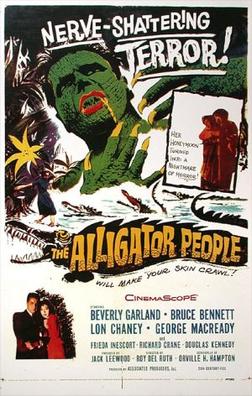
Horror Film Review: The Alligator People (dir by Roy Del Ruth)


You know what the worst bayou is?

Bayouself.

Thank you!  I’ll be here all night and don’t forget to tip your server!

Anyway, the 1959 film, The Alligator People, largely takes place in the bayous of Louisiana.  Nurse Jane Marvin (Beverly Garland) is suffering from amnesia so she allows two psychiatrist to give her a dose of truth serum and then, when she’s in a hypnotized state, she proceeds to remember her former life as Joyce Webster.

Joyce married a handsome and seemingly perfect man named Paul Webster (Richard Crane) but, right when they were about to go on their honeymoon, he received a telegram that disturbed him.  After he made a phone call, he vanished from Joyce’s life.  Joyce did some research of her own and discovered that Paul’s former home was the Cypresses Plantation in the small town of Bayou Landing, Louisiana.

When Joyce travels down to Bayou Landing, she discovers that there’s really not much there, other than a bunch of hungry alligators.  She meets the owner of the plantation, Lavinia Hawthorne (Frieda Inescort).  She also meets the handyman, Manon (Lon Chaney, Jr.), a one-handed brute who spends most of his day shooting at alligators.  And, eventually, Joyce comes across her husband but Paul is no longer the man that she remembers.

Paul’s skin is scaly and he only comes out at night.  It turns out that Paul was, long ago, injected with a serum that would allow him to grow back a missing limb.  The serum worked as far as the limb was concerned but an unfortunate side effect is that Paul is now turning into an alligator!  Dr. Mark Sinclair (George Macready), the man who came up with the serum in the first place, is hopeful that he can reverse the process but, to do so, he’s going to need a lot of radioactive material.

Complicating things is that Manon has decided that he wants Joyce for himself and he’s certainly not going to compete with some alligator man for her attention.  Of course, Joyce despises Manon from the first moment she sees him but Manon’s not that smart.  Can Paul be cured before Manon destroys everything?

The Alligator People is one of those 1950s B-movies that is probably better-known for its name than anything else.  That said, when taken on its own terms, it’s an entertaining watch.  It was one of the final films to be directed by Roy Del Ruth, who had previously been one of Hollywood’s top directors of musicals and comedies.  There’s not much music or deliberate comedy to be found in The Alligator People but Del Ruth does manage to capture the humid stillness of the bayous.  As always, Beverly Garland gives a strong performance as a determined woman who isn’t going to be told what to do and Richard Crane is about as convincing as one can be while turning into an alligator.

As for Lon Chaney, Jr, he plays Manon as being a total monster and he gives a convincing performance, even if it is hard not to mourn the loss of the shadings that he brought to his monster roles while he was with Universal.  Manon is a rough and determinedly unintelligent character, one who exists only to destroy.  Significantly, he’s not one of the Alligator People.  Instead, he’s just a man who doesn’t care about anyone but himself.

The Alligator People is an effective B-movie, full of a bayou atmosphere.