14 Days of Paranoia #5: Payback (dir by Brian Hegeland)


The 1999 film, Payback, opens with Porter (Mel Gibson) lying on a kitchen table while a grubby-looking doctor digs two bullets out of his back.  The scene takes place in almost nauseating close-up, with the emphasis being put on the amount of pain that Porter endures to get rid of those bullets.  Immediately, we know that Porter is not someone who can safely go to a regular hospital.  Porter is someone who exists in the shadows of mainstream society.

He’s also someone who spends a lot of time getting beaten up.  Even back when he was still a big star, Mel Gibson always seemed to spend a good deal of his films getting beaten up and tortured in various ways and that’s certainly the case with Payback.  Porter gets punched.  Porter gets shot.  Porter has a encounter with an over-the-top dominatrix (played by Lucy Liu).  At one point, Porter allows two of his toes to be smashed by a hammer, just so he can trick the his enemies into doing something dumb.  As played by Gibson, Porter stumbles through the film and often looks like he’s coming down from a week-long bender.  It’s interesting to think that Payback is a remake of 1967’s Point Blank, which starred Lee Marvin as Walker, an unflappable career criminal who never showed a hint of emotion or weakness.  Porter, on the other hand, is visibly unstable and spends the entire film on the verge of a complete mental collapse.  A lot of people try to kill Porter and Porter kills almost all of them without a moment’s hesitation.

(Of course, both Porter and Point Blank‘s Walker are versions of Parker, a career criminal who was at the center of several crime novels written by Donald “Richard Stark” Westlake.)

After helping to pull off a $140,000 heist from a Chinese triad, Porter was betrayed and left for dead by his former friend Val Resnick (Gregg Henry) and his wife, Lynn (Deborah Kara Unger).  Porter, who just wants the $70,000 cut that he was promised, starts his quest for the money by tracking down Val and Lynn, and then continues it by going after the three bosses (played by William Devane, James Coburn, and Kris Kristofferson) of “The Outfit,” a shadowy organization that Val had gotten involved with.  Along the way, Porter deals with a motely crew of corrupt cops, violent criminals, and sleazy middlemen.  (David Paymer has a memorable bit as a low-level functionary with atrocious taste in suits.)  Porter also hooks up with a prostitute named Rosie (Maria Bello), who might be the only person that he can actually trust.

I have mixed feelings about Payback.  (So did director Brian Hegeland, who was reportedly fired towards the end of shooting and later released a far different director’s cut.)  Though the film does a good job of capturing the visual style of a good neo-noir, the story itself is so violent and grim that it actually gets a little bit boring.  The film’s advertising encouraged audiences to “Get ready to root for the bad guy,” but there’s really no reason to root for Porter.  He’s an inarticulate and ruthless killer with no sense of humor.  If anything, the people that he kills seem to be far more reasonable and likable than he does.  In Point Blank, Lee Marvin may have been a bastard but he was good at what he did and you at least got the feeling that he wouldn’t go after any innocent bystanders.  In Payback, Porter is such a mess that his continued survival is largely due to dumb luck.  It’s hard to root for an idiot.

That said, the film does do a good job of capturing the feeling of people living on the fringes of society.  The Outfit is not a typical Mafia family but instead, a collection of businessmen who work out of nice offices and, in the case of William Devane’s Carter, come across as being more of a senior executive than a crime boss.  (James Coburn and Kris Kristofferson, meanwhile, come across as being two former hippies who made it rich on Wall Street.  They’re elderly versions of Abbie Hoffman and Jerry Rubin.)  The film does a good job of creating a world where no one trusts anyone and everyone is being watched by someone.  In one memorable scene, the three men sent to watch for Porter discover that he’s been watching them the entire time.  Never forget to look over your shoulder to see who might be following.

Flaws and all, this 1999 film does a good job of capturing the atmosphere of paranoia that, for many, would come to define the early part of the 21st Century.

14 Days of Paranoia:

  1. Fast Money (1996)
  2. Deep Throat II (1974)
  3. The Passover Plot (1976)
  4. The Believers (1987)

Smokey Bites The Dust (1981, directed by Charles B. Griffith)


Sheriff Hugh “Smokey” Turner (Walter Barnes) of Cyco County, Arkansas is determined to capture teenage car thief and prankster, Roscoe Wilton (Jimmy McNichol).  Roscoe is determined to disrupt the high school homecoming dance by abducting the homecoming queen, Peggy Sue (Janet Julian).  Peggy Sue is, at first, determined to escape from Roscoe but changes her mind as they flee from her father, who just happens to be Sheriff Turner.

From producer Roger Corman, Smokey Bites The Dust is an 88-minute car chase film where the most spectacular getaways and crashes are lifted from other Roger Corman productions.  Eagle-eyed viewers will spot footage from Eat My Dust, Grand Theft Auto, and Moving Violations.  In order to explain why the cars keep changing from scene to scene, the chase moves from county-to-county where both Roscoe and Sherriff Turner inevitably end up ditching (or crashing) their old car and then stealing a new vehicle to continue the pursuit.

That’s not much of a plot so the run time is padded out with several subplots.  A local moonshiner tries to sell his special brew to a group of Arabs.  Peggy Sue’s boyfriend, Kenny (William Forsyth, in one of his first films), joins in the chase.  Dick Miller flies around in a helicopter and also gets involved in the chase.  None of it makes any sense and none of it is particularly amusing but Roger Corman undoubtedly made a lot of money pushing this thing into Southern drive-ins and letting people assume it was some sort of a sequel to Smokey and the Bandit.

Most of the acting is pretty bad.  When it comes to being an incompetent sheriff, Walter Barnes is no Jackie Gleason.  Jimmy McNichol comes across as being seriously disturbed.  Of the main cast, Janet Julian is alone in giving an appealing and naturalistic performance as Peggy Sue.  While Julian (who has since retired from acting) never became the star she deserved to be, she is remembered for her later turn as Christopher Walken’s lawyer and girlfriend in 1990’s King of New York.

14 Days of Paranoia #4: The Believers (dir by John Schlesinger)


When it comes to unfortunate and dumb ways to die, getting electrocuted while standing in a puddle of spilled milk would seem to rank fairly high on the list.  Unfortunately, it’s exactly what happens to the wife of Cal Jamison (Martin Sheen) during the first few minutes of 1987’s The Believers.

Traumatized by his wife’s death (and probably also by all of the people asking, “Wait a minute, she was standing in milk?”), Cal relocates from Minneapolis to New York City.  Accompanying him is his young son, Chris (Harley Cross).  Upon arriving in New York, Cal starts a tentative new relationship with artist Jessica Halliday (Helen Shaver) and he also gets a job working a psychologist for the NYPD.

And several members of the NYPD are going to need a good psychologist because they are investigating a series of brutal and ritualistic murders.  All of the victims are children around Chris’s age and the murders are so grisly that even a hardened cop like Lt. Sean McTaggart (Robert Loggia) finds himself traumatized.  When Detective Tom Lopez (Jimmy Smits, in one of his first roles) discovers one of the bodies, he has an apparent mental breakdown and starts to rant and rave about an all-powerful cult that Tom claims is committing the murders.

After Tom commits suicide, his ravings are dismissed as being the product of a mentally ill man.  However, Cal is not so sure and starts to investigate on his own.  What he discovers is a cult made up of a motely mix of wannabe gangsters and members of high society.  While his friends and lovers either die or lose their minds around him, Cal discovers that the cult is actually closer to both him and his son than he ever realized.

An odd film, The Believers.  On the one hand, there’s plenty of creepy scenes, including one in which Jessica gets a truly disturbing skin condition.  The scenes in which Cal discovers that his friends have lost their minds as a result of the Cult are frequently sad and difficult to watch.  Robert Loggia has scene that brought tears to my eyes.  The mix of street witchery and upper class power lust is nicely handled and, as always, Harris Yulin makes for an effective villain.  The Believers creates an ominous atmosphere of paranoia, one in which you really do come to feel that no one in the film is quite who they say they are.

And yet, it’s obvious that director John Schlesinger — whose previous films included Darling and the Oscar-winning Midnight Cowboy — had more on his mind than just making an effective Omen-style horror film.  He also tries to deal with Cal coming to terms with the death of his wife and Chris coming to terms with the idea of Cal dating someone new and all of those scenes of straight-forward domestic drama feel out-of-place in what should have been an energetic and grisly B-movie.  In those ploddingly earnest scenes, Schlesinger seems to be trying almost too hard to remind us that he’s not really a horror filmmaker and they just feel out of place.

If there was ever a movie that called for the unapologetic and wickedly sardonic directorial vision of David Cronenberg, it was The Believers.  As it is, The Believers is an intriguing but frustratingly uneven mix of paranoia, witchcraft, and domestic melodrama.

14 Days of Paranoia:

  1. Fast Money (1996)
  2. Deep Throat II (1974)
  3. The Passover Plot (1976)

Woman They Almost Lynched (1953, directed by Allan Dwan)


At the height of the Civil War, the small town of Border City, Missouri has declared itself to be neutral ground.  Mayor Delilah Courtney (Nina Varela) announces that anyone who enters her town looking to recruit for either the Union or the Confederacy will be arrested and will face the possibility of being hung from the noose in the middle of Main Street.

That doesn’t stop Charles Quantrill (Brian Donlevy) from coming to town.  Quantrill is a former Confederate officer who now terrorizes the Arkansas/Missouri border with his gang of thieves.  Accompanying Quantrill is his wife, Kate (Audrey Totter), who once lived in Border City and who still enjoys singing a song at the saloon.

Another new arrival is Sally Maris (Joan Leslie), who comes down from Michigan to help her no-account account, Bitterroot Bill (Reed Hadley), run his saloon.  Sally attempts to bring some order to the rowdy saloon, which makes an enemy out of Kate.  When Bill is killed in a gunfight, Sally takes over the saloon and soon, she is being challenged first to a fight and then to an actual duel by Kate.  With the disapproving Mayor Courtney watching all of the action from her office, it is obvious that one of the women is eventually going to be taken to the noose in the middle of the street but which one?

This is one of the best of the many B-westerns that Allan Dwan directed in the 1950s.  Though much of the emphasis is on the usual western action — Quantrill wants to take over a mine, there’s a Confederate spy in town, and both Frank and Jesse James appear as supporting characters — the film is really about the rivalry and eventual partnership between a group of strong-willed woman who aren’t going to let anyone tell them how to live their lives.  As tough as Kate is, Sally proves to be stronger than she looks and, in the end, they realize that they are stronger working together for a common goal than trying to tear each other down.  Audrey Totter and Joan Leslie both give sexy and tough performances as Kate and Sally.  They’re equally believable hanging out in a saloon, flirting with a cowboy, or drawing guns on each other in the middle of the street.

Along with taking a strong stand against vigilante justice, Woman They Almost Lynched features an exciting stage coach robbery, an intriguing story, and two very interesting lead characters.  It’s a western that deserves to be better known.


Icarus File No. 14: Last Exit To Brooklyn (dir by Uli Edel)


Welcome to Brooklyn!

The year is 1952 and one neighborhood in Brooklyn is on the verge of exploding.

A thug named Vinnie (Peter Dobson) holds court at a local bar.  (His associates include the moronic Sal, who is played by a very young Stephen Baldwin.)  Some nights, Vinnie and his associates mug people for money.  Sometimes, they just attack people for fun.

A strike at the local factory has entered its sixth month, with management showing no sign of compromising and Boyce (Jerry Orbach), the head of the union, showing little concern for the men who are now struggling to feed their families.  The local shop steward, Harry Black (Stephen Lang), is a self-important braggart who never stops talking about how he’s the one leading the strike.  At home, Harry ignores his wife, with the exception of a violent quickie.  On the streets, Harry embezzles money from the union and uses it to try to impress the men that he would rather be spending his time with.  But even the men who Harry considers to be friends quickly turn on him when he is at his most pathetic.

Big Joe (Burt Young) is a proud union member who is shocked to discover that his teenage daughter (Ricki Lake) is 8-months pregnant.  Despite being out-of-work and not caring much for Tommy (John Costelloe), Joe puts together the wedding that appears to be the social event of a shabby season.  But even at the reception, violence lurks below the surface.

Georgette (Alexis Arquette) is a transgender prostitute who loves Vinnie, even after he and his idiot friends stab her in the leg while playing with a knife.  Beaten at home by her homophobic brother (Christopher Murney), Georgette sinks into drug addiction.

Tralala (Jennifer Jason Leigh) is an amoral prostitute, one who specializes in picking up military men and then arranging from them to be mugged by Vinnie and his gang.  Sick of being exploited by Vinnie, Tralala heads to Manhattan and meets Steve (Frank Military), an earnest soldier from Idaho.  For the first time, Tralala is treated decently by a man but Steve is set to ship out to Korea in a few days and, as he continually points out, there’s a chance that he might not return.  For all of the happiness she finds in Manhattan, Tralala is continually drawn back to her self-destructive life in Brooklyn.

First released in 1989 and directed by Uli Edel (who directed another film about desperation, Christiane F.), Last Exit To Brooklyn is based on a controversial novel by Hubert Selby, Jr.  In fact, it was so controversial that the novel was banned in several countries and, for a while, was listed as being obscene by the U.S. Post Office.  I read the novel in the college and it is indeed a dark and depressing piece of work, one that offers up very little hope for the future.  It’s also brilliantly written, one that sucks you into its hopeless world and holds your interest no matter how bleak the stories may be.  Due to its reputation, it took over 20 years for Last Exit to Brooklyn to be adapted into a film.

The film is actually a bit more positive than the book.  One character who appears to die in the book manages to survive in the film.  The wedding subplot was a minor moment in the book but, in the film, it’s made into a major event and provides some mild comedic relief.  That said, the film is definitely dark.  Almost every character is greedy and angry and those who aren’t are victimized by everyone else.  Unfortunately, the film lacks the power of Selby’s pungent prose.  As a writer, Selby held your attention even when you want to put the book away.  When it comes to the film, the lack of Selby’s voice makes it very easy to stop caring about the characters or their stories.  Even with the attempts to lighten up the story, the film is still so dark that it’s easy to stop caring.  The non-stop bleakness starts to feel like a bit of an affectation.

And that’s a shame because there are some brilliant moments and some brilliant performances to be found in Last Exit To Brooklyn.  An extended sequence where the police fight the striking workers is wonderfully directed, with the police becoming an invading army and the men on strike being transformed from just factory workers to rebels.  The scene where Boyce informs Harry that he’s not as important as he thinks is wonderfully acted by both Jerry Orbach and Stephen Lang.  As Tralala, Jennifer Jason Leigh gives a raw and powerful performance, whether she’s shyly accepting Steve’s kindness or drunkenly exposing herself to a bar full of lowlifes.  In many ways, Tralala is the most tragic of all the characters to be found in Last Exit to Brooklyn.  She’s tough.  She’s angry.  But, in the end, she’s ultimately the victim of men who are too stupid to understand anything other than aggression.  The neighborhood applauds her when she confidently walks past a line of cops and strikebreakers but the same people who cheered for her later try to destroy her.

The film ends on an ambiguous note, with a peace that feels very temporary.  The message seems to be that men are at their worst when they’re bored so perhaps it’s best to keep them busy, whether with a job or perhaps a wedding.  It’s a flawed film but it sticks with you.

Previous Icarus Files:

  1. Cloud Atlas
  2. Maximum Overdrive
  3. Glass
  4. Captive State
  5. Mother!
  6. The Man Who Killed Don Quixote
  7. Last Days
  8. Plan 9 From Outer Space
  9. The Last Movie
  10. 88
  11. The Bonfire of the Vanities
  12. Birdemic
  13. Birdemic 2: The Resurrection 

Blast From The Past: Warren G. Harding Is Sworn In As Our Greatest President


Happy Presidents Day!

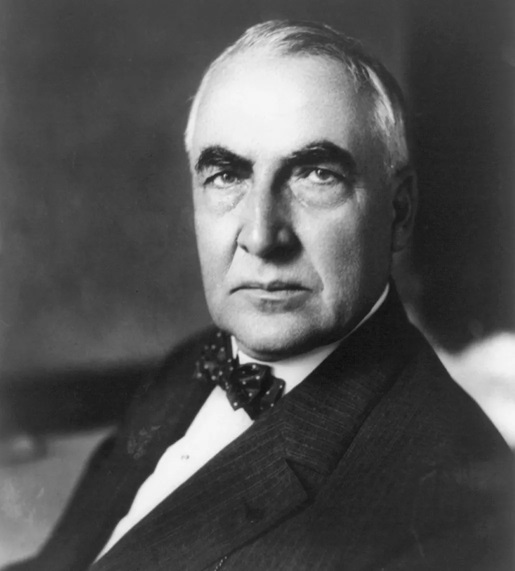
Since today is Presidents Day, I wanted to take a moment to acknowledge and honor my favorite president, Warren G. Harding of Ohio.  The former newspaper editor-turned-Senator was elected in 1920, by one of the largest landslides in American history.  (Interestingly enough, his opponent was another newspaper man from Ohio, James Cox.)  Harding was elected on a platform that promised a “return to normalcy” after the authoritarian excesses of Woodrow Wilson.  He was the first president to be elected in a national election in which all states allowed women to vote and he overwhelmingly won their vote.  A politician who remembered his friends and who had little trouble entertaining his constituents in his office, Warren Harding epitomized everything that was fun about the early 1920s.

And we have actual newsreel footage of Warren Harding’s inauguration!  For today’s blast of the past, here is newsreel footage of my favorite President renewing America’s greatness.  This footage is over 100 years old and, in all seriousness, it shows why film is so important.  The video below is not just a short movie of someone taking the oath of office in Washington, D.C.  Instead, it’s a portal into the past.  At a time when history itself is often altered to fit whatever the current narrative may be, it’s good that we can still see things for ourselves.

14 Days of Paranoia #3: The Passover Plot (dir by Michael Campus)


First released in 1976 and based on a book that had come out ten years previously, The Passover Plot is a film that asks, “What if Jesus was a political revolutionary who faked his own death?”

Even when the film was first released, that wasn’t a particularly novel or new theory.  Ever since the Crucifixion, there have been conspiracy theorists who have claimed that the entire thing was staged.  Indeed, the early days of the Church were defined by conflicts between different sects debating the true nature of Jesus, with those who believed that he was the son of God and that he had risen from the dead eventually winning out over sects who claimed that Jesus was not divine or that he had actually escaped from the Romans and was instead hiding out in Egypt or even on the island that would eventually become known as Britain.  (The fact that so many Gnostics and other heretics were executed by the Church and their texts suppressed only served to lend them credibility with future theorists.)  Still, every few decades, some new book or film will claim that Jesus faked his death or married Mary Magdalene and gullible people will act as if this is somehow a new argument.  It’s been over 20 years since all of that Da Vinci Code nonsense convinced bored suburbanites across America that they could be experts on both boxed wine and historical conspiracy theories.  We’re about due for a new version of the old story.

As for The Passover Plot, it features Zalman King as Yeshua of Nazareth, an angry young man who dreams of the day when Judea will be free of the Romans.  Having a knowledge of the prophecies of a messiah and also knowing that he is descended from King David, Yeshua specifically patterns his life after the prophecies and presents himself as being not just another revolutionary but instead as being sent by God.  However, he is also aware that it will be necessary for him to “die” and “rise from the dead,” so he goes out of his way to force the hand of Pontius Pilate (Donald Pleasence).  Having seen plenty of crucifixions when younger, Yeshua arranges for the local revolutionaries to drug him so that he’ll appear to be dead.  When he later wakes up, everyone will believe that he has returned from the dead.  The film ends with several title cards, all arguing that the Gospels were written long after Yeshua’s death (“Mark lived in Italy!” one title card proclaims with almost comical indignation) and were subsequently rewritten by “unknown” hands.

The Passover Plot is a weird combination of biblical epic and conspiracy thriller.  Scenes of Yeshua preaching feel as if they could have come from any traditional Biblical epic but they are awkwardly placed with scenes of Yeshua having secret, melodramatic meetings with various conspirators.  It would make for an interesting contrast if not for the fact that the film itself is so slowly paced and boring.  Zalman King, who is best-known for his subsequent career as a softcore filmmaker, spends a lot of time yelling and smoldering intensely but he still doesn’t have the charisma or screen presence necessary to be convincing in the role.  In the scene were he’s meant to be passionate, he shrieks with such abandon that he makes Ted Neeley’s performance in Jesus Christ Superstar feel restrained.  This film asks us to believe that people would not only abandon their previous lives to follow Yeshua but that they would also take part in an elaborate conspiracy that could have gone wrong at any time.  For that to be believable, Yeshua needs to be played by someone who doesn’t come across like the drama student that everyone dreads having to do a scene with.  Far more impressive is Donald Pleasence, whose portrayal of a ruthless and unfeeling Pilate is a marked contrast to some of the more sympathetic interpretations of the character that tend turn up in the movies.

On the plus side, the film does look good.  It was shot on location in Israel and there is a certain authenticity to the film’s recreation of the ancient world.  Along with Pleasence, character actors like Scott Wilson (as Judas!) and Dan Hedaya get a chance to shine.  But otherwise, The Passover Plot is too slowly paced and kooky for its own good.  Conspiracy theorists never seem to understand that the more elaborate a conspiracy theory becomes, the less convincing it is to anyone who isn’t already a true believer.  In the end, how one feels about the film’s conclusions will probably be connected to how one already views Jesus and the Church.  The Passover Plot is not a film that’s going to convince anyone who wasn’t already convinced.

14 Days of Paranoia:

  1. Fast Money (1996)
  2. Deep Throat II (1974)

Retro Television Reviews: Live Again, Die Again (dir by Richard A. Colla)


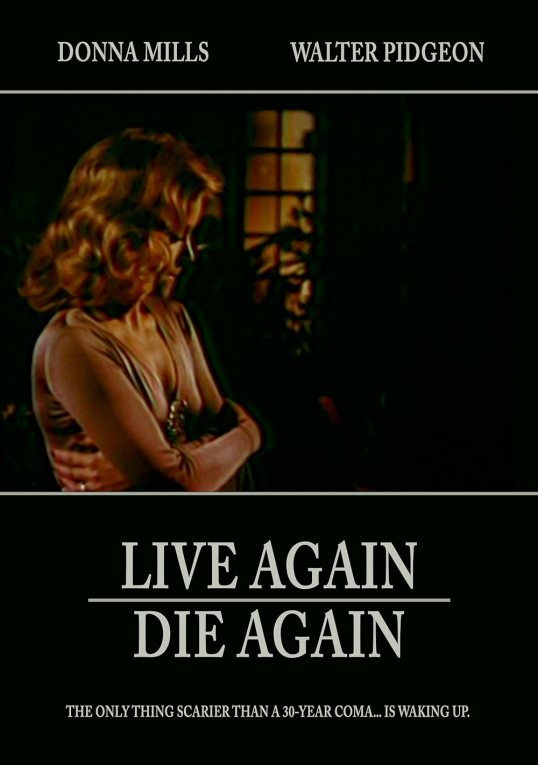
Welcome to Retro Television Reviews, a feature where we review some of our favorite and least favorite shows of the past!  On Sundays, I will be reviewing the made-for-television movies that used to be a primetime mainstay.  Today’s film is 1974’s Live Again, Die Again!  It  can be viewed on YouTube.

30 years ago, Caroline Carmichael (Donna Mills) died.

Except, she really didn’t.  Instead, when on the verge of death, she was put into cryogenic suspension.  She has spent the last three decades in suspended animation and, as a result, she has not aged in all that time.  In fact, her hair still looks perfect.  (I have some doubts about the scientific validity of any of this but let’s just go with it.)  As this movie begins, Caroline Carmichael finally wakes up.

Caroline has an entirely new world to discover.  At a party to celebrate her awakening, Caroline is shocked to discover that, while she still appears to be young, all of her friends are now in their 60s. Her husband, Thomas (Walter Pidgeon), is now old and sickly.  Her beautiful home is now looked after by a strict and suspicious housekeeper (Geraldine Page).    Her two children (played by Mike Farrell and Vera Miles) both appear to be older than her.  In fact, her daughter was so traumatized by Caroline’s “death,” that she is now terrified of being left alone with her mother.

You might expect that this film would be dedicated to Caroline adjusting to the world of the 70s and that it might feature some thoughts on whether it’s ethical to keep someone in suspended animation for 30 years.  And there are elements of that.  Caroline is amazed by all the tall buildings.  Her daughter’s reaction to Caroline’s return is hardly heart-warming and even Caroline’s whiny son doesn’t seem to be quite as happy about it as one might expect.  Her husband has spent the last 30 years of his life waiting for Caroline to wake up and it’s hard not to consider how many opportunities for happiness or success that he missed as a result.

That said, the film itself quickly becomes more of a gothic murder mystery, as Caroline comes to realize that someone is trying to kill her.  That’s kind of a shame because I actually found all of the cryogenic stuff to be much more interesting and the idea that one could basically just stop aging for 30 years was an intriguing one.  It’s an interesting question.  If it could save your life at some undetermined point in the future, would you be frozen?  Myself, I think I would be reluctant to do so because you never know what type of world you might wake up in.  Caroline is lucky enough to wake up wealthy in the 70s but what if you woke up and discovered that your entire family had died while you were in your coma?  What if you woke up and discovered that your country had become some sort of socialist Hellhole?  Imagine if someone went into hibernation in 1994 and then woke up in 2024?  They would probably want to go back to sleep.

The film was written Joseph Stefano, who also did the script for Psycho and was one of the producers behind The Outer Limits.  Not surprisingly, the script is full of snappy dialogue and the cast features two Psycho cast members, Vera Miles and Lurene Tuttle.  Director Richard Colla keeps the action moving and, early on in the film, he does a good job of depicting Caroline’s disorientation with finding herself in an entirely new world.  The film is well-acted by the entire cast, with Donna Mills especially doing a good job as Caroline.  This was an intelligent, well-made, and — most importantly — short made-for-TV movie.  At a time when almost all movies and TV shows seem to be too long for their own good, it’s hard not appreciate Live Again, Die Again‘s 73-minute runtime.

14 Days of Paranoia #2: Deep Throat Part II (dir by Joseph Sarno)


First released in 1974, Deep Throat II (also known as Linda Lovelace, Secret Agent) is the R-rated sequel the legendary X-rated film, Deep Throat.  I should, at this point, confess that I have never seen Deep Throat, though I have seen the 2005 documentary about the making of the film and its subsequent cultural impact, Inside Deep Throat.  I’ve also read Legs McNeil’s oral history of the adult film industry, The Other Hollywood.  Perhaps most importantly, I’ve watched Boogie Nights a dozen times.

Anyway, Deep Throat II….

The star of the original film, Linda Lovelace, returns as …. Linda Lovelace!  Linda is working as a nurse for a perpetually turned-on sex therapist (Harry Reems) who, when told that he got laid just last night, whines, “Last night was a long time ago!”  Among the therapist’s patients is nerdy Dilbert Lamb (Levi Richards), who is obsessed with black lingerie and his aunt, Juliet.  Dilbert has built a giant super computer named Oscar.  In its electronic voice, Oscar says stuff like, “Why do you want to talk to me, baby?”

The plot is not particularly easy to follow but, as far as I could tell, the head of the CIA (played by adult film vet Jamie Gillis) is concerned that Dilbert has been compromised by either the Russians or by a bunch of do-gooder activists led by a Ralph Nader-style journalist named Kenneth Whacker (David Davidson).  (The journalist’s followers call themselves Whacker’s Attackers.)  The decision is made to recruit Linda Lovelace to investigate because Lovelace apparently has a mysterious technique that she can use to get men to tell her anything.

When Linda is first approached by the CIA, she thinks that she is being drafted into the Army so that she can fight in Vietnam.  “But I have asthma and I need new reading glasses!” she says.  Hey, me too!  Anyway, Linda is relieved to discover that she will not being going to Vietnam and that her new codename is Agent — wait for it — 0069.  (Just in case you were wondering what the level of humor was in this particular film….)

Despite the film’s cast of veteran adult performers and the fact that it’s a sequel to the movie that some people went to jail for transporting across state lines, Deep Throat II is an incredibly tame movie.  The film is edited so haphazardly that it feels as if at least half of it was left on the cutting room floor.  At first, I assumed that I was watching a heavily edited version of the original film but a few minutes of research online revealed that I was watching the original.  (Apparently, director Joe Sarno directed the film so that more explicit scenes could be directed by another filmmaker and inserted into the action but, for whatever reason, those scenes were never filmed.  Sarno was usually one of the more aesthetically interesting and thematically daring of the directors working in the adult film industry.  You would not necessarily know that from his work on this film.)  The actors struggle to keep a straight face while delivering their lines, Harry Reems enthusiastically jumps up and down in almost every scene in which he appears, and Linda Lovelace seems to be trying really hard but she just has a blah screen presence.  Unlike Marilyn Chambers in Rabid or Sasha Grey in The Girlfriend Experience, Linda Lovelace does not come across as having been a particularly good actress.

That said, there is one interesting aspect to Deep Throat II.  Kenneth Hacker worries that Oscar could become smarter than the human being who programmed it and that the computer’s creation could be the first step to the creation of a permanent surveillance state, one in which even private thoughts will be used against the citizens of the United States.  In the film, everyone laughs him off.  50 years later, it no longer sounds that fanciful.

14 Days of Paranoia:

  1. Fast Money (1996)

14 Days of Paranoia #1: Fast Money (dir by Alex Wright)


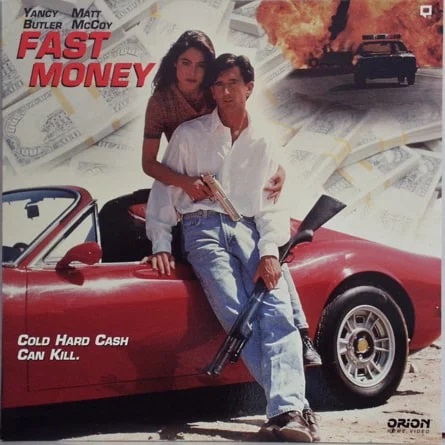
First released in 1996, Fast Money opens with Francesca March (Yancy Butler) stealing a car.

This is what Francesca does for a living.  She steals cars and she’s good at it.  She’s the type of who can look in any trashcan and find something that she can use to pick a lock.  She’s master at hot-wiring a car.  I personally have no idea how to hot-wire a car but, judging from the movies that I’ve seen, it appears to be the easiest thing in the world to do.  Francesca doesn’t just steal cars for the money.  She sincerely enjoys doing it, to the extent that it’s a compulsion for her.  If she sees a car, she has to steal it.

This has not made her popular with the LAPD.  In fact, an entire taskforce has been set up to stop her.  Realizing that she has to get out of town, she rushes to the airport.  It’s there that she runs into Jack Martin (Matt McCoy), a nerdy journalist who is working on a story that could take down a powerful U.S. Senator.  Jack is looking to catch a flight to Reno.  For reasons that aren’t particularly clear, Francesca rushes up to Jack and pretends to be his wife and the recently widowed Jack goes along with it.

Further complicating matters is that Francesca impulsively decides to seal one last car and the one that she picks just happens to have 3 million dollars in mob money and a bunch of counterfeit printing plates in the trunk.  The evil Sir Stewart (Jacob Witkin) wants his money back and he sends Regy (Trevor Goddard) and corrupt detective Lt. Diego (John Ashton) to track down Francesca and Jack.

Soon, Francesca and Jack are desperately trying reach the Mexican border while dodging corrupt cops, FBI agents, and mobsters.  It leads to a lot of car chases, explosions, helicopters, and shoot-outs.  (The otherwise meek Jack turns out to be a surprising good shot.  Neither he nor Francesca freaks out after he shoots multiple people, which is the sort of thing that I would probably freak out about.)  Francesca and Jack also find themselves falling in love but wondering just how much they can trust each other.  Stolen money does that to people.

Fast Money is a cheerfully dumb but entertainingly fast-paced movie, one in which the chase never stops long enough for the viewer to have too much time to try to figure out why the ultracool Francesa would be willing risk her freedom for a relationship with someone as whiny as Jack.  Yancy Butler plays Francesca as being so confident and so fearless that it’s hard not to admire her but there’s also no way that she seems like she would ever have much use for someone as meek and repressed as Jack, regardless of how deadly his aim might be.  One gets the feeling that the only thing keeping this couple together is the adrenaline rush of being hunted.  If Jack and Francesca do make it to safety, their relationship will probably be over by the end of the week.

Though Fast Money is ultimately a fun but somewhat generic direct-to-video action film, I appreciated the film’s vision of a world where everyone from the mob to the police to the FBI were basically working together to track down one career criminal and one innocent man.  When even the usually likable John Ashton is trying to murder you in a cheap motel, you know you have reached the other side of the looking glass.  Jack learns what Francesca has always understood, which is that one should be suspicious of authority.  Though it may not have been the film’s intent, Fast Money‘s ultimate message becomes, “Trust no one but yourself.”