Review: The Walking Dead Volume 8 (by Robert Kirkman)


[Some Spoilers Within]

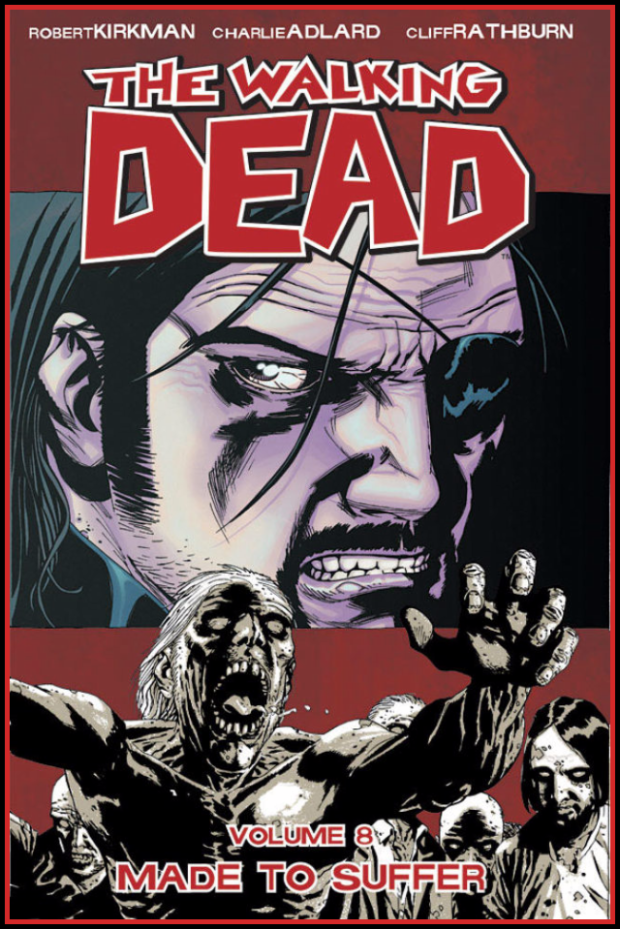
Robert Kirkman ended The Walking Dead‘s seventh volume in what I could only say as one major cliffhanger. The seventh volume of this series definitely lived up to it’s title of “The Calm Before” as the series took a breather from all the stress which built and built in the past two collections. Now that calm has now been shattered with this eight volume aptly titled, “Made to Suffer”.

A title which puts Rick and his band of survivors through its paces. The Woodbury group definitely do their best to make Rick and his people suffer for what they see as transgressions against their walled town. While most of the invading group do so in the belief that they’re protecting Woodbury from a band of bloodthirsty killers there’s a few who follow the lead of Woodbury’s tyrannical and sociopathic Governor. A man who has spun out lies about Rick and his group to his people to get them in the proper mindset to take down the prison.

The volume does a brief flashback of how the Governor and his trust inner cirle were able to find the prison. It also explains how he was able to survive the ministrations of Michonne during the prison group’s escape from Woodbury. Michonne really put the screws on the Governor for the rape and torture he had inflicted on her. To say that Michonne went medieval on the Governor would be a major understatement.

This volume would end like most of the best zombie films and stories before it. Two groups determined to fight to the death to keep what theirs or take what they want. Casualties abound on both sides as Kirkman almost wipes the slate clean as he prepares to move the series into a new uncertain narrative path. Characters fans have come to love meet their end while others who have worn out their welcome in some way survive to live another day. The last few panels of “Made to Suffer” were shocking and heartbreaking.

I’ve read from fan feedback of how they hated Kirkman for he did, but at the same time became even bigger fans of the series for its unpredictability. Kirkman would pull no punches in how he makes the characters suffer throughout the six-issues of this volume. He definitely backs up his works when he said that this story-arc would leave no one safe from his killing pen. This volume would break some readers in that they may not want to continue reading the series after the punch to gut of the last issue in this volume. Others will be just as determined to stick it out to see how the remnants of the original group continue on with what and who they’ve lost.

One thing that I am sure of is that this eight collected volume of the series will not be the usual and same old, same old. After reading this book one may just end up hating and admiring Kirkman in equal amounts for what he has done.
Review: The Walking Dead Volume 7 (by Robert Kirkman)


[Some Spoilers Within]

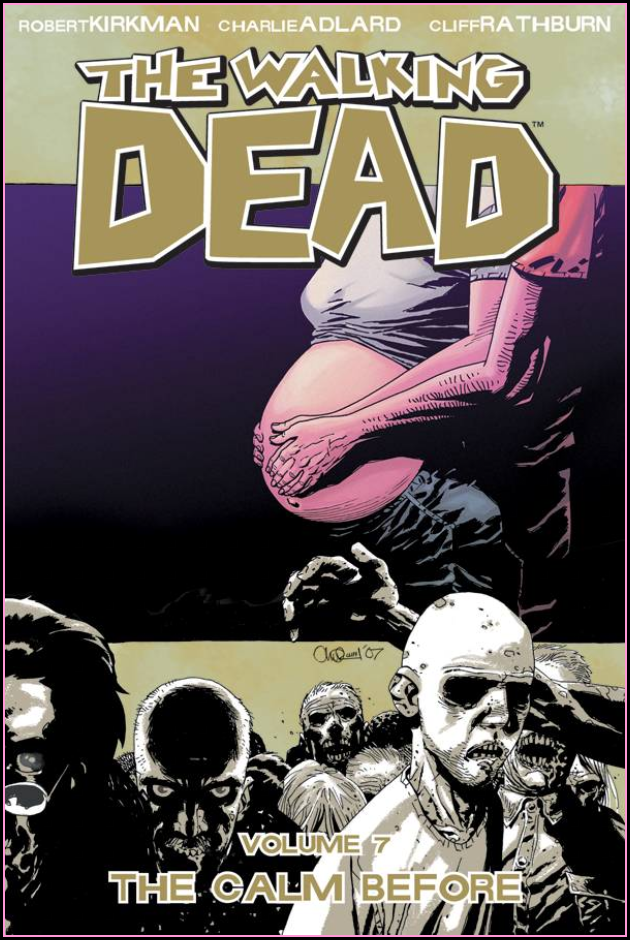
The last volume of The Walking Dead continued the “Woodbury” story arc which began in volume 5. This latest volume sees Rick and his group back in their prison home with the axe of Woodbury and the Governor hanging over their heads throughout the six issues which encompassed volume 7. A volume with the title of “The Calm Before” definitely doesn’t know the meaning of the term.

While the travails of Rick, Glenn and Michonne during their stay at Woodbury would be horrific in every sense of the word the calm which comes after their return to the prison is nothing but. The group gains a new member in the form of Alice who happened to be Woodbury’s former nurse/doctor-in-training. Her inclusion into the group becomes a boon for everyone in the prison especially for Lori and Dale. While her addition to the group has been mostly beneficial the group does suffer a loss of one of their first members due to a decision made by the latest member. I won’t disclose exactly who and what happened to this original member of the group, but her loss would be felt by everyone.

This volume brings back some of the soap opera elements which dominated the fourth volume, but not to the level that would annoy readers who had gotten tired of all the internal conflicts and bickerings. There’s still tension between certain individuals, but they’ve kept things civil and have even begun attempts to fix the bridges burned by those very conflicts.

This calm before the storm also sees the group prepare for the inevitable attack by the Woodbury group. Though knowing that they’re outgunned and outmanned they still draw first blood during one of the forays to find more supplies. This gives the group some hope for the coming storm to the point that the prison and the group return to a semblance of normalcy. A normalcy that doesn’t last long as the very last panel ends the volume on a major cliffhanger worthy of some of the best tv drama series.

The Walking Dead – Behind the Scenes Sizzle Reel (AMC)


It’s now just a little over a month to go before one of the most anticipated new shows on TV hits the airwaves. AMC’s tv series adaptation of Robert Kirkman’s critically-acclaimed and fan favorite comic book series The Walking Dead will premiere on Halloween night 2010 at 10pm. The show will also premiere within days in over 40-plus countries which would be an unprecedented feat for a first time tv series.

Frank Darabont and his band of writers seem to have taken Kirkman’s story and made the necessary changes to make it work on tv. One aspect of Kirkman’s storytelling was how some people thought it to be too expositionary. This left each page with too much talking while at the same time not fleshing out each character to be distinct from each other. While I can see that I don’t buy into that particular flaw in the story too much. This is a story of the end of the world and stress definitely plays a key role in how everyone reacts to their new environment.

From the AMC “sizzle” reel the network has released just in the last few days it looks like the show’s writers have taken Kirkman’s story, ideas and dialogue and made them flow much more naturally. Final judgement on whether this actually happens will have to wait until the show premieres, but Darabont has always been a writers first and filmmaker second so I definitely have much faith that he and his team will come out with a great product that takes the best from the comic book and trims the fat and gristle off by the wayside.

There’s also one thing the “sizzle” reel above shows which should answer the trepidations that some of the comic book’s fans have had since hearing th news of the adaptation. This was whether AMC will keep the gore and violence from the comic books or will it be toned down. From the looks of some of the scenes shown in the reel above the gore and violence is on-hand and from the look of things this may be the most gory thing on tv that’s not premium cable. I see blood, gore, viscera and all the nice gooey things that happens when a body’s insides are exposed to the environment. YUM!

Halloween 2010 needs to come now, but until then revisiting the comic books the series is adapting is a good way to pass the time.

Source: io9

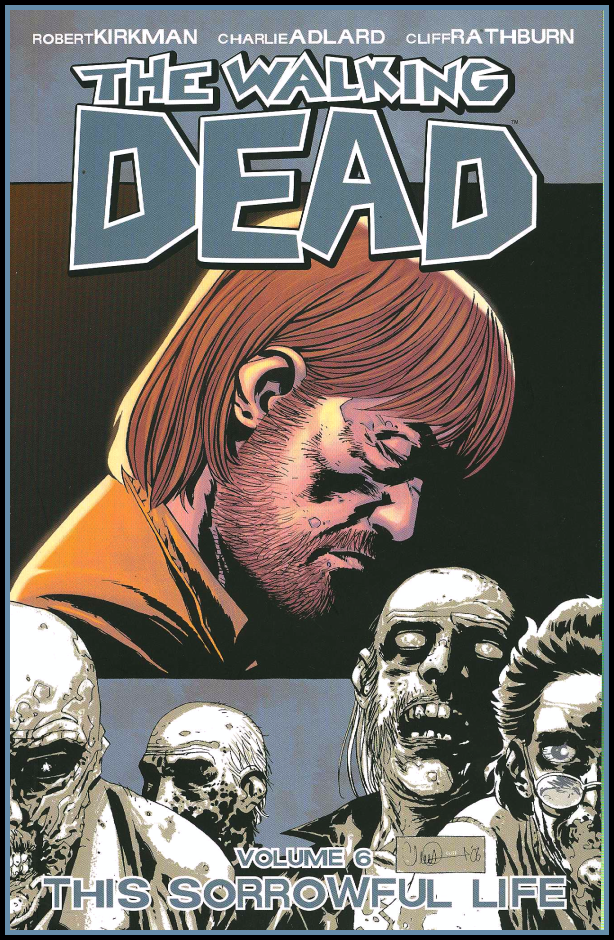
Review: The Walking Dead Volume 6 (by Robert Kirkman)


[Some Spoilers Within]

The Walking Dead follows-up the 5th volume with This Sorrowful Life and Kirkman sure does hit it right on the nail with the title. The book tells the second half of the story arc begun in the previous volume. To recap in the previous volume Rick and his group make way to investigate a crashed helicopter only to run into another group of survivors who have holed up in the partially walled off and fortified town of Woodbury. Whatever joy they find in knowing there are other survivors other than themselves was short-lived as they finally meet the person who runs and rules Woodbury.

This Sorrowful Life takes the story up with Rick, Michonne and Glenn in even a worse situation than being stuck outside with the zombies. The book introduces the people of Woodbury as not just survivors but also the polar opposite of those surviving in the prison. While the book makes a point to not paint the whole Woodbury population as losing their humanity it also points out that they’ve sacrificed their humanity to those promising them safety. They’ve pretty much given up their rights to the one who calls himself the Governor who rules Woodbury through intimidation and so-called bloodsports involving gladiator-like fighters and corralled zombies. We see who the difference between Rick and the Governor’s way of keeping their people safe also show the kind of people the are. Where Rick tries to keep his people safe and together without losing their humanity the Governor goes the opposite way and grabs a hold of power even at the cost of everyone.

Kirkman does a great job of showing the two groups and how its probably inevitable that the two will have a confrontation either in Woodbury or back in the prison. While not everyone in Woodbury were out for themselves, a few manage to sympathize with Rick and his group, the rest of the town could easily be considered as the biggest threat hanging over the prison survivors. Again Kirkman shows that sometimes its not the zombies themselves who’re the biggest threat to humanity’s survival. It’s people and their flaws to always get into conflict with each other instead of pulling together for the greater good and survival of everyone.

The book ends with Rick having to make another decision where he has to sacrifice some of his own ideals in order to keep his family and friends safe. Will this sacrifice end up costing him down the line will be up to Kirkman to tell us. I hope he continues to expand on this Woodbury angle but at the same time not go overboard on the extreme end of the emotional spectrum. It’s great that he’s limited the amount of soap opera-style stortelling which dominated volume 4, but going for just action and action and action without plot would be just as bad. So far, volume 6 and it’s predecessor in volume 5 tells me he’s got a great hold on the story.

Review: The Walking Dead Volume 5 (by Robert Kirkman)


[Some Spoilers Within]

The first four volumes of Robert Kirkman’s have led Rick Grimes and his group from the encampment right outside of Atlanta to an abandoned prison which have now become their new sanctuary from the dangers of the outside world. We’ve seen the group lose people to the dangers of the zombies which have now claimed the world. They’ve also gained some new people which in turn has also caused some major conflicts to the group dynamics.

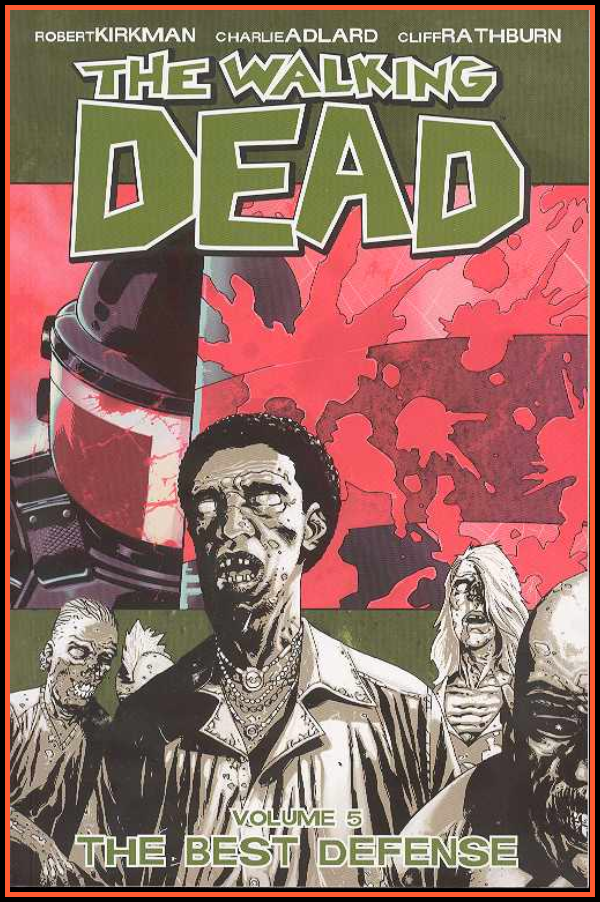
The series’ 5th collected volume (titled The Best Defense) takes place sometimes after the dramatic revelation by Rick Grimes to the group which ends the 4th volume. The Best Defense begins a new story-arc which would last right up to the very last pages of the 8th volume of the series. This was the volume which helped bring back some of the series’ fans who had begun to leave due to the overly dramatic and soap opera-ish narrative of the last volume. While the conflict which began between major characters in the last volume still remain a new surprising discovery of other possible survivors and another fortified compound brings the group back together for a common purpose. While this return towards cooperation was welcome development I did like the fact that Kirkman still kept the conflicts hanging in the air like a sword about to drop at the first wrong step.

Some fans and critics have spoken about how Kirkman’s writing style is actually very bad when compared to other top writers in the comic book industry. Yes, he’s not in the same league as a Warren Ellis, Grant Morrison, Garth Ennis and Alan Moore, but in the type of story he’s trying to tell his style seems to work. He does have a way to put up a lot of exposition with every page in the series. For some this was a sign of a lazy and weak writer who doesn’t allow the images to help tell the story. While at times I will agree as the series can get heavy with dialogue in the end it doesn’t bother me as much. Zombie films, even the best ones, rely and lean heavily on exposition. It’s actually such a surprise for a horror subgenre to have so much dialogue and people actually expect it. The same could be said for this series. The heavy exposition is not a bother for most and actually welcomed by its readers.

With this volume introducing a new outside force as the big baddie for the next major story-arc, Kirkman has easily shown he understands the zombie genre and how the zombies themselves don’t even count as the main danger for humans trying to survive this new apocalyptic world. This is especially true with the new character of The Governor who, in just a handful of issues in this volume, has cemented himself as one of the best villains to appear in any entertainment media in the past 10 years. Here’s to hoping that Frank Darabont in his tv adaptation of this series for AMC doesn’t mess around too much with this character. The Governor definitely makes one wonder if humanity actually deserves to continue as a species and not just march towards extinction.

Review: 100 Bullets Vol. 1 – First Shot, Last Call


I missed out on the initial release for 100 Bullets, but I’ve since rectified that problem.

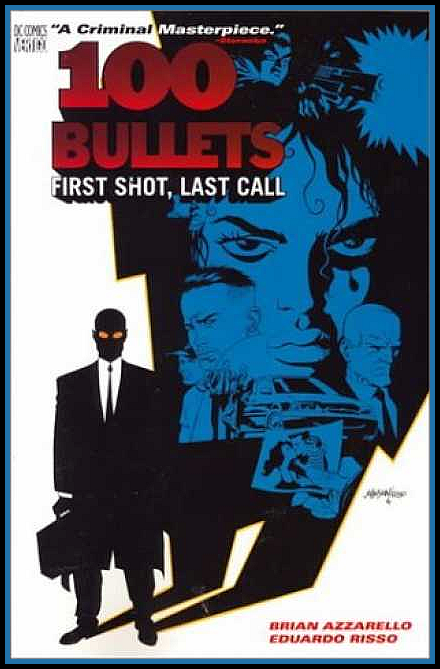
Brian Azzarrello’s 100 Bullets continues the long line of excellent mature comic titles from DC Comic’s Vertigo line. Azzarrello’s hardboiled, crime-thriller noir series brings to mind classic detective-noir works by Hammett, Spillane and Chandler. It’s a more complex continuation of the hyper-noir series Frank Miller began with his Sin City series. I’ve heard people say that this series was better than Sin City and to some respect it was. The stories in each issue contained in this first volume (issues 1 through 5) were abit more complex in nature and execution than Miller’s more simple noir tales. The five stories in this collected volume also laid the basic groundwork for what’ll turn out to be one long-running series lasting exactly 100-issues. Where Sin City‘s simplicity in its storytelling and artwork lay its strength, it’s in the complexities in the tales and the detailed, but economical artwork that 100 Bullets shined through.

In First Shot, Last Call we’re introduced to the gamemaster of the tale: Agent Graves. Looking like an ever-present government agent who has seen all that life has thrown at him and ready for more, Agent Graves picks a recently paroled Latino lass by the name of Dizzy Cordova with a proposition. He offers Dizzy an attache case with a gun and 100 bullets that’re untraceable and definite proof that certain individuals caused her heartache and grief that has ruined her life. He only offers her the attache case, its content and the proof within. The choice is Dizzy’s to make on what she should do with what’s offered her. This set-up and premise is the beauty of 100 Bullets. The story’s basically a morality tale of choices offered to the characters. Will they use the offer to exact vengeance and get away with it scott-free, or will they refuse the offer and live on with their life. The choice of revenge really doesn’t bring back lost time and loved ones and only feeds the need for retribution. Agent Graves doesn’t really force Dizzy’s hand, but a supporting character knowledgable of the offer does — for his own agenda not yet known — prods, pushes and guides her to picking the more primal choice. Dizzy’s choice in the end was both understandable and in the end inevitable.

The second story arc deals with Lee Dolan who also has had his life turned upside-down by people unknown to him. His life and family taken away by the stink of a child pornography accusation in the past. Agent Graves makes him the same offer of the attache case and its untraceable 100 bullets. Dolan’s reaction to this offer is different from that of Dizzy’s, but in the end his ultimate choice doesn’t give him the same resolution and new life path that Dizzy made. It’s a tribute to Azzarrello’s great writing that the decision both Dizzy Cordova and Lee Dolan made were understandable when taken into context of their personalities and yearning to fix the problem that led them to their current state in their lives.

To complement Azzarrello’s words perfectly were Eduardo Risso’s artwork. It would be a misnomer to say that Risso’s art style was minimalist like those of Frank Miller’s woodcut-engraving style for Sin City or Mike Mignola’s chiasroscuro-style for his Hellboy series. There’s a sense of the cinematic in Risso’s work. The scenes were always drawn with a mind for action even when it’s just people standing around. Risso has quite the filmmaker’s eye in how he’s drawn 100 Bullets which just adds to its noirish feel. The characters and environment were drawn not to scale and real-world proportion, but just enough not to look cartoonish. I would agree that there’s an abundance for cleavage on the women drawn, but Risso doesn’t do it gratuitously. Instead he uses this detail to showcase the sexuality of the strong female characters. It paints the female characters like Dizzy Cordova and Megan Dietrich with a sense of both strength and sensuality without pandering to the teenage boy demographic. Plus, he gives these ladies their own personality and character with how he draws them. Dizzy truly has the Latina sensual curves while Megan has the icy-cold Aryan beauty that serves her well.

100 Bullets: First Shot, Last Call was a great discovery and a wonderful beginning to a very mature, intelligent and hardhitting comic series. Congratulations must got to its creator Brian Azzarrello for writing such great characters and memorable stories. I can’t forget the work of his artist and partner-in-crime, Eduardo Risso. Risso’s artwork has stamped themselves in my mind as the only way to see 100 Bullets in. Both Azzarrello and Risso complement each other well and their continued collaboration right up to the end of the series helped make this series one of the best of the past decade.

Review: The Walking Dead Volume 4 (by Robert Kirkman)


[Some Spoilers Within]

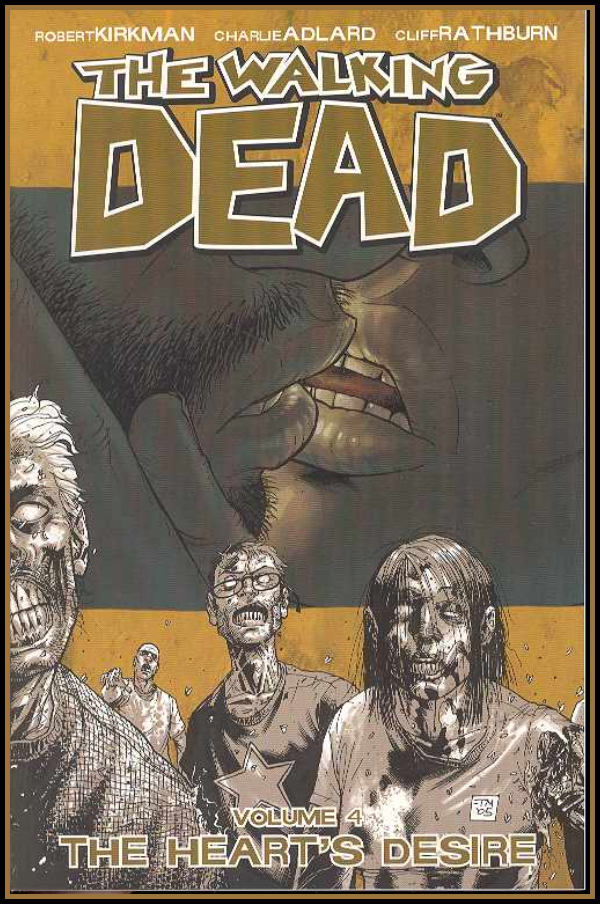
I’ve loved and obsessed over Kirkman’s The Walking Dead series and the previous three collected volumes have not disappointed at any level. This fourth volume collects issues 19 through 24 and is appropriately titled The Heart’s Desire. We pick up from the cliffhanger that ended the third volume (Safety Behind Bars) as Dexter gives Rick and his group a choice that bodes nothing but death either way he chooses: stay and be shot or leave and take their chances with the zombies outside the fences.

The book starts things off with a bang as Rick realizes that Dexter’s success in getting guns of his own has let loose a bigger set of problems as zombies from a locked wing of the prison was accidentally let out. What happens next as Rick’s group and Dexter’s group fight to stay alive shows a new side to Rick that surprised me alot. It puts a new wrinkle on Rick’s rule of “you kill, you die” and will have long-reaching ramifications deeper in the story. It is also in this heart-pounding sequence that a new face is added to the mix in the form of a female survivor whose mode of survival, to say the very least, is interesting.

The rest of the book really deals less with the zombies but the emotional consequences of many of the characters’ actions from the very start of the series all the way to point of this volume. I can fully understand the disappoint many fans have with the direction the series took with all the drama and sopa opera kind of twists nd turns of the heart, but I think people fail to realize that Kirkman is writing about the human condition rather than just about zombies. Sure I got abit impatient with all the emotional crisis and the meltdowns by almost everyone involved, but I can also understand why they’ve been acting the way they have. I think if Kirkman had written abit more of zombies and death in this part of the series people wouldn’t be complaining much.

Kirkman himself has already admitted that zombies wasn’t what the story was all about, but just a part of it. With the group in relatively safety within the secured fences of the prison and some sort of artificial normalcy starting to come back to the group he needed a way to continue the conflicts that make for good drama. What else but let the pent-up emotional baggage everyone has been carrying since issue 1 to finally come to boil. Part of me didn’t fully enjoy this new arc in the series, but not enough to be disappointed with the end result. Hell, even with all the drama Kirkman still came up with one of the best fight scenes in the series a la Carpenter’s They Live and South Park’s “Cripple Fight” episode.

The Heart’s Desire was not as great as the previous three collected volumes in the series, but it still told a good story though with a bit more drama than most fans of the book were willing to take. I myself enjoyed the book enough that it wasn’t a waste and I was a bit surprised and shocked at the observation Rick finally made and shared with everyone at the end of the volume. I know that after all the emotional trials and tribulations everyone in the series went through in The Heart’s Desire and how the arc ended there’s nothing left but up for the series.

Review: The Walking Dead Volume 3 (by Robert Kirkman)


[Some Spoilers Within]

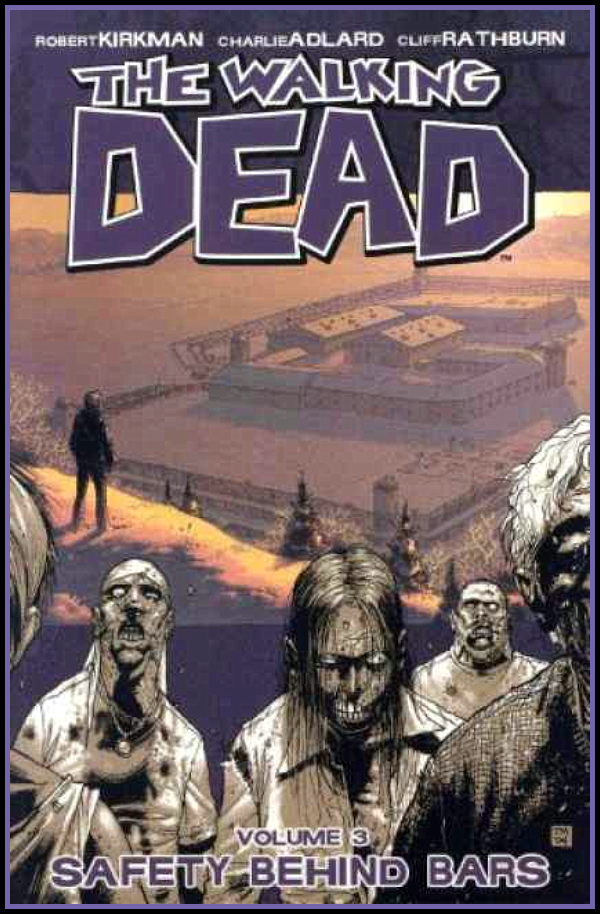
Safety Behind Bars is the third collected volume of Robert Kirkman’s excellent The Walking Dead comic book series from Image Comics. This volume collects issues 13 through 18 and it continues that journey and travails of surviving in a world overrun by the undead. As the tagline of the books proclaim, in a world ruled by the dead we are forced to finally start living. This is so true in Safety Behind Bars as Kirkman and returning artist Charlie Adlard tell the story of Rick Grimes and his band of survivors as they come across what they think will be their salvation from the threat of the hungry dead: an abandoned prison complex.

The last we saw Rick, Tyrese, Lori and their ragtag band of survivors they had just been forced off the the presumably safety of the Herschel farm after the tragic events which transpired within its fences. But Safety Behind Bars starts off with the group discovering an abandoned prison complex that may just solve their shelter, safety and food problems. Once again, Kirkman’s writing is tight and to the point. The characters of Rick and the rest of the survivors continue to evolve as the days and months pass by in the journey to survive. What they find in the abandoned prison is both safety and danger, but not in the way of most people thought it would come in. Sure there are still zombies both inside and outside of the prison’s security fences, but as the enormity of the crisis finally crashes on everyone — that there won’t be a rescue — the survivors reach the threshold of their breaking points to the detriment of everyone involved. It’s especially tragic for Tyrese as a tragedy pushes him to act on his base instincts in an act of vengeance that is both understandable and horrifying.

More people are introduced to the group in the form of surviving group of inmates left behind by fleeing prison guards. This new group acts to change the group dynamics and even add more conflict to what Rick and his group thought was going to be safety from the dead. Instead, human nature — as Kirkman sees it — causes more problems and danger than the dead represent. The events of The Walking Dead has really changed everyone involved and we lose more people to both living and the dead.

The volume ends in an even bigger cliffhanger than the previous two collected volumes. Like the best drama series on TV, The Walking Dead hooks you in with great writing, well-drawn characters and a great hook that pulls the reader in and doesn’t let go. Whether the upcoming AMC and Darabont-produced tv adaptation of this series follows this particular story-arc is still up in the air. To deviate from the prison would definitely involve a new story-arc that surpasses what Kirkman has written in these 6-issues and that would be quite a tall order.

Review: The Walking Dead Volume 2 (by Robert Kirkman)


[Some Spoilers Within]

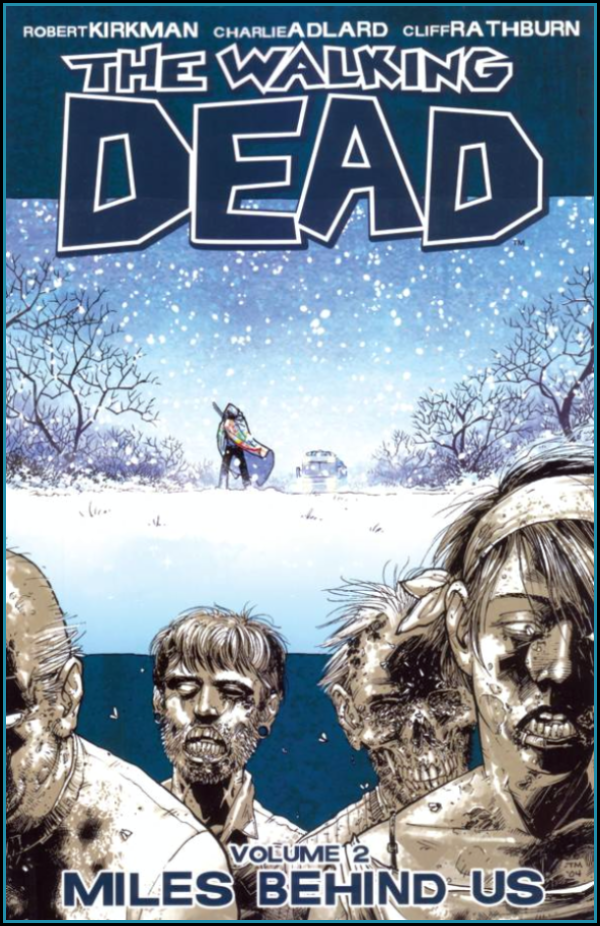
Robert Kirkman’s The Walking Dead Vol.2 – Miles Behind Us puts together issues 7 through 12 into one collection. The first six issues introduce the reader to the main character of Rick Grimes and his discovery of a world turned upside-down and inside-out as the legions of undead walk and prowl the streets, fields and by-ways. The rest of that first volume reunites Rick with his wife and son and a ragtag bunch of other survivors just looking for a safe place to stay. I loved how Kirkman used the backdrop on a world of the undead to tell a story of survival and how extreme situations can have surprising and lasting effects on those left behind.

In Miles Behind Us, Robert Kirkman’s story has a new artist in Charlie Adlard. Adlard’s style has a different look to that of previous artist Tony Moore. Where Moore’s pages and panels had a smoother and more cinematic feel to them, Adlard’s rougher, sketchy style actually fits the mood and feel of the story Kirkman is writing. I love Moore’s work and the gory detail he put in the first issues, but Adlard’s just seems to resonate a bit more with the subject matter of survival and doing what it takes to survive. There’s certain scenes in Miles Behind Us where its hard to tell the difference between the survivors and the zombies. I like this technique in how it shows that the zombies and the survivors may have alot more in common after all in relation to the title of the story.

Kirkman introduces in this volume quite a bit of new characters to the group Rick is leading as they leave the campground at the outskirts of Atlanta. They’ve lost three of their numbers in the previous volume. Two of them to the predations of the undead who stumbled into their campground and another to the stress and jealousy that weighed on the mind of one of their own.

Miles Behind Us brings in two groups of survivors. One is a father, his daughter and the girl’s boyfriend. Tyrese is an interesting character right from the get-go and hints of problems with the daughter and boyfriend are gradually doled out to help bring in new conflicts to the group dynamic. The other group is a farmer and his children and some neighbors from down the road. The introduction of Herschel and his family helps in showing how not everyone reacted the same way to the undead crisis. To say that Herschel’s reaction and temporary solution to how to handle the undead crisis was a bad idea all-around was an understatement. Hershel’s actions helps lead to the biggest sequence event in this volume and how far-reaching its ramifications are. While new characters are introduced some of the people in Rick’s group fall by the wayside as their search for a safe place to stay in becomes more and more dangerous and people are lost and/or nearly lost along the way.

I agree with the assertion that The Walking Dead is really not all about the zombies and the gore (it helps that it has them in abundance), but that its about the effects of extreme events and situations on the personality, psyche and behavior of those left behind trying to survive. From the Dale (the oldest) all the way down to Carl (one of the youngest), the survivors are affected right down to their bones with all that has happened to them. Sometimes the result makes each individual stronger and at times it just leads to conflicts and brings out the baser nature of man as an individual.

Miles Behind Us continued to impress me in how well Kirkman has taken the zombie apocalypse theme and ran with it. It’s a testament to his storytelling and imagination that I consider The Walking Dead series as equal to anything Romero has done. I think from fans of zombie and apocalyptic stories that’s high praise indeed.

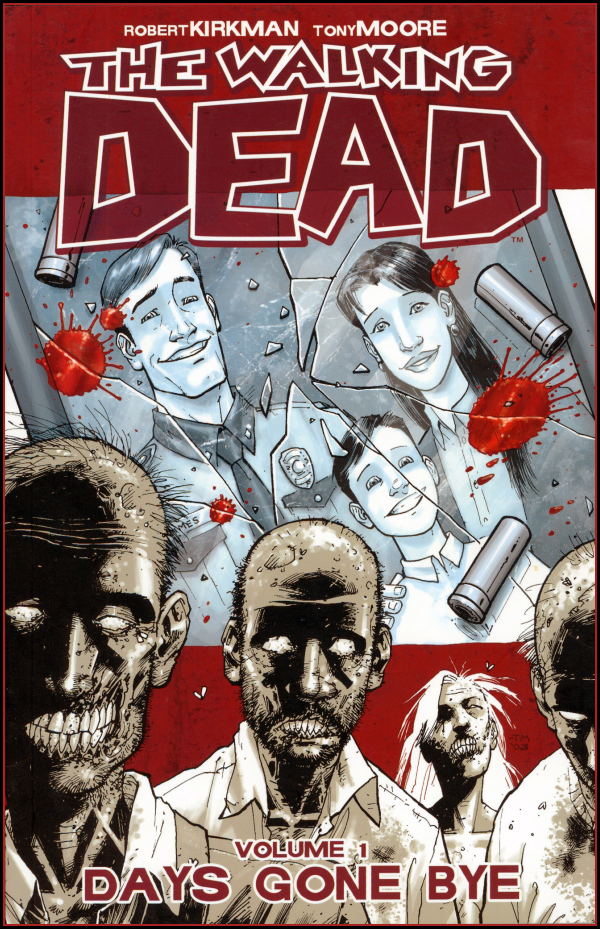
Review: The Walking Dead Volume 1 (by Robert Kirkman)


One of the geek properties that had been building a major hype and buzz at this year’s San Diego Comic-Con was Image Comics and Robert Kirkman’s long-running and critically-acclaimed zombie series, The Walking Dead.  It’s time at the Con didn’t just push the title to a new batch of fans, but also made a major showing at it’s very own panel with the cast and crew of AMC’s tv series adaptation of the comic book. It would be an understatement to say that by the  time The Con was over the series (both comic book and the upcoming tv series) walked away a clear winner and put the property into hype/buzz overdrive.

With the series set to premiere on AMC this coming October 2010 I thought it was high-time that I went back to my reviews of the collected trade paperbacks of the series. Each trade paperback collection were 6-issues long and usually started a current story-arc or finished an on-going one. This comic book series is one of the few in the market currently running which could was able to keep releasing its trades in 6-issue collected formats and not lose any impact that particular arc had when read as single-issues. It was by finding the first trade that I was initially introduced to Kirkman’s zombie opus.

It was 2005 and I was what one might call a lapsed comic book fan. I had burned myself out on the neverending flood of superhero titles even as independent ones quickly got cancelled, died out or just outright didn’t end but left its readers hanging. But it took a passing glance of The Walking Dead‘s first trade volume to get my interest in comic books rekindled. Kirkman’s foray into creating the zombie film that never ends made comic books fun for me again. The fact that Kirkman didn’t jump onto the fast-zombie bandwagon that became the rage of the mid-2000’s was a major plus in my eyes.

Using the same slow, shambling zombies that George A. Romero first made popular with Night of the Living Dead and its subsequent sequels, Kirkman continued the zombie story where Romero usually ended his films. All those times people have wondered what happened to those who survived in zombie films need not imagine anymore. Kirkman has created a believable world where the dead have risen to feast on the living, but has concentrated more on the human dynamic of survival in the face of approaching extinction.

I won’t say that the story-arc collected in this first volume has little or no zombies seen, but they’ve taken on more as an apocalyptic prop. One can almost substitute some other type of doom in place of zombies and still get a similar effect (as was done in Brian K Vaughn’s equally great series, Y: The Last Man). What Kirkman has done was show how humanity’s last survivors were now constantly, desperately trying to adapt to a familiar world through unfamiliar circumstances. Characters from the start make the sort of mistakes regular people would make when they don’t know exactly everything that was happening around them. Instead of chiding these people as one reads their story, we sympathize and hope for their continued survival.

The artwork by Tony Moore is another reason why people should check out this first volume. While it is only in this volume (the first 6-issues of the series which is now deep into the 70’s) Tony Moore’s art puts the horrific in the story Kirkman has written. His zombies and their look were quite detailed and for fans of the series his departure after issue 6 and staying to just make the covers to each single-issue has rubbed them the wrong way. While I subscribe to the opposite viewpoint that Moore’s work was a nice bonus to bring in the readers in the end his artwork was gravy to what was already a fulfilling story that would’ve been as effective if the artwork was mediocre at best. It’s a good thing that follow-up and series regular artist Charlie Adlard more than holds his own in drawing the rest of the series.

This first volume was a great beginning which should automatically pull in the hardcore zombie fans (pretty much any of those types should’ve been reading the books for years now) while giving newbie fans to the zombie genre a reason not to dismiss it as just another gorefest lacking in drama and great storytelling. Already Kirkman has done more to realizing the universe Romero created than a lot of the hack filmmakers who have taken Romero’s idea and cannibalized it for their own profit. I consider The Walking Dead as a must-read for anyone looking to find something different from all the costumed superhero titles. It is also a great starting point for those awaiting the start of the tv series, but have never read the original comic book source.