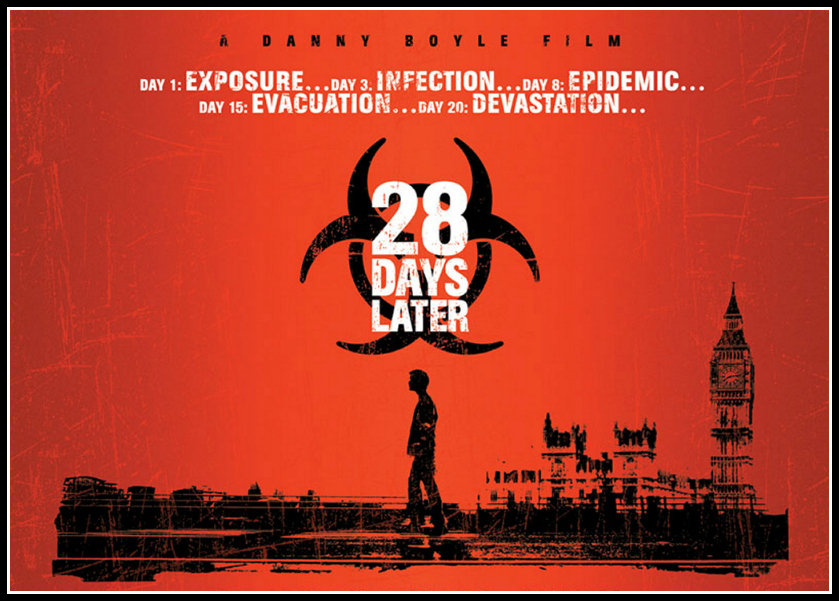
Horror Review: 28 Days Later (dir. by Danny Boyle)


For decades, the zombie film genre has been defined by the rules established by the grandfather of the modern zombie story, George A. Romero. His 1968 landmark horror film Night of the Living Dead transformed what had once been a gothic creature rooted in the voodoo folklore of Haiti and the Caribbean into an apocalyptic force symbolizing social collapse and human weakness. The film not only terrified audiences but also laid the foundational blueprint for every zombie movie that followed. Romero’s zombies weren’t merely monsters — they were a reflection of humanity’s fears, prejudices, and inner decay. His influence has remained so pervasive that, even today, filmmakers working in horror are inevitably responding to his legacy, whether they realize it or not.

Through the years, there have been numerous attempts to deviate from Romero’s formula. The most prominent early success came in the 1980s with the Return of the Living Dead series — a clever horror-comedy franchise that infused dark humor and punk aesthetics into the genre. Yet even that beloved cult entry eventually lost steam. True reinvention did not arrive until 2002, when British filmmaker Danny Boyle and screenwriter Alex Garland collaborated on 28 Days Later, a project that both revitalized the zombie genre and split its devoted fan base down the middle. Was it truly a “zombie” film, or something else entirely? That very debate remains unresolved more than twenty years later.

Boyle’s film begins not with a supernatural curse or the reanimation of the dead, but with a catastrophic act of human arrogance. A group of naïve animal-rights activists break into a research laboratory to rescue chimpanzees subjected to bureaucratic cruelty. However, they find that these animals have been injected with a rage-inducing virus — the product of bioengineering rather than black magic. One of the activists, horrified by what she witnesses, ignores the pleas of a desperate scientist and frees a chimp, unleashing a pandemic that will decimate Britain within weeks. This opening sequence is both economical and horrifying: the origins of the apocalypse come from compassion twisted into recklessness. Boyle establishes his tone immediately — quick editing, grainy digital video, and an oppressive sense of realism create a world that feels disturbingly possible.

The narrative then leaps forward twenty-eight days. In a now-iconic sequence, the protagonist Jim (played by Cillian Murphy) awakens from a coma in an abandoned London hospital. His disorientation mirrors that of the audience: sterile hallways littered with trash, flickering lights, a haunting silence broken only by the hum of wind through the empty city. When Jim emerges into the sunlight, the camera captures a London entirely devoid of people, its majestic landmarks standing as hollow monuments to civilization’s sudden collapse. This is one of cinema’s most unforgettable depictions of isolation. The haunting score by John Murphy and the use of Godspeed You! Black Emperor’s instrumental “East Hastings” heighten the apocalyptic stillness, transforming London into a ghost metropolis.

Jim’s bewilderment only deepens when he seeks refuge in a church — a setting traditionally associated with salvation — only to find it desecrated by carnage. His presence awakens a horde of infected individuals who charge at him with terrifying speed. Unlike Romero’s slow, lumbering undead, Boyle’s infected are human beings transformed by a virus that amplifies their aggression to animalistic extremes. They move like predators, sprinting at prey with berserk fury. Jim narrowly escapes thanks to two survivors, Selena (Naomie Harris) and Mark (Noah Huntley), who introduce him to the brutal new rules of existence: infection spreads through blood contact, turning victims within seconds, and hesitation means death.

The trio’s uneasy alliance soon crumbles after Mark becomes infected, forcing Selena to kill him without hesitation. This harrowing moment establishes her as one of the film’s strongest and most pragmatic characters — a refreshing departure from the damsel archetype that has long haunted horror cinema. Jim and Selena later encounter Frank (Brendan Gleeson), a good-natured taxi driver, and his teenage daughter Hannah (Megan Burns), who have been surviving in a fortified apartment building. Together they form a fragile surrogate family and travel in search of a military broadcast promising safety and a potential cure.

Boyle deftly blends moments of human warmth amid horror. Scenes like the group’s scavenging trip through an abandoned grocery store — a darkly comic echo of Dawn of the Dead’s consumer satire — offer glimpses of joy and normalcy. The countryside sequences, shot with a painterly eye, contrast the urban decay of London with the serene beauty of a world reclaiming itself from human control. Nature, the film quietly suggests, endures long after people have vanished.

Their journey leads them to a fortified mansion commanded by Major Henry West (Christopher Eccleston), a British officer whose soldiers claim to have “the answer to infection.” The supposed sanctuary quickly reveals a darker truth. West’s band of men have descended into moral depravity, promising their commander that the promise of “women” will restore morale. The film shifts from survival horror to psychological thriller as the real threat emerges — not the infected outside, but the monstrousness within human beings when order collapses. In this descent into militaristic patriarchy and madness, Boyle channels the spirit of Romero’s Day of the Dead, where the military’s illusion of control becomes the true source of terror.

Boyle and Garland’s reinvention of the zombie mythos was revolutionary. Longtime fans of Romero’s shambling undead initially resisted the notion that 28 Days Later even qualified as a zombie movie. After all, its creatures weren’t reanimated corpses but living people overtaken by an uncontrollable virus. Yet their function within the story — relentless, dehumanized embodiments of contagion and rage — served the same thematic role as zombies always had: mirrors for society’s breakdown. The debate over whether the infected “count” as zombies is less important than the fact that Boyle redefined the genre’s emotional and kinetic language. His infected didn’t just pursue victims; they hunted them. Their blistering speed and screams injected pure chaos into what had once been slow, creeping dread.

The technical and artistic choices heightened the film’s intensity. Shot largely on digital video with handheld cameras, 28 Days Later looked raw and immediate, more like found footage than polished fiction. This realism bridged the gap between old-school horror and the new century’s fixation on viral outbreaks and global instability. Coming in the post-9/11 era, its images of deserted cities and military lockdowns felt eerily prescient, foreshadowing later fears of pandemics and authoritarian control.

The performances ground the film emotionally. Cillian Murphy’s portrayal of Jim evolves from bewildered innocence to hardened survivor, serving as the audience’s emotional compass. Naomie Harris delivers one of the genre’s most capable female performances, blending vulnerability with ferocity. Brendan Gleeson, always magnetic, brings compassion and tragedy to Frank — a man whose paternal instincts ultimately lead to heartbreak. Christopher Eccleston’s Major West stands as a chilling embodiment of human corruption in crisis: the soldier who insists he is saving civilization while replicating its worst impulses.

Despite being produced on a modest budget of roughly eight million dollars, Boyle’s film achieved a scale and impact far greater than its resources suggested. The empty London shots — achieved by closing key streets at dawn for only minutes at a time — remain astonishing feats of logistical precision and cinematic audacity. More importantly, the film’s minimalist production enhanced its believability. Everything about 28 Days Later feels lived-in, grimy, and plausible.

Two decades on, 28 Days Later continues to stand as one of the most influential horror films of the 21st century. Its success reinvigorated a genre that had grown stale and inspired a wave of imitators across film, television, and video games, from Zack Snyder’s Dawn of the Dead remake to AMC’s The Walking Dead. Beyond its cultural impact, it remains a haunting meditation on rage — personal, societal, and political. Boyle and Garland transformed horror into a canvas for existential dread, exploring how quickly civility unravels when survival becomes the only law.

Whether one calls it a zombie film or not hardly matters anymore. 28 Days Later breathed new life into the undead myth, shattering old rules and redefining what modern horror could be. The debate it sparked continues, but one truth is undeniable: the genre has never been the same since Jim first walked through that silent, ruined London — a world devoured not by the dead, but by the terrifying rage of the living.
Scenes I Love: Zombie


Lisa Marie picked her favorite scene from Lucio Fulci’s classic Zombie (aka Zombi, Zombie Flesh Eaters) and now I counter with my own favorite scene from this film.

This scene has a simple set-up. The wife of the doctor researching zombification on the island of Matool gets herself in a sort of a pickle. Zombies have laid siege to her island home and most of her servants have either fled into the night or have become zombie chow. She’s barricaded herself in a room as zombie begin to batter down doors to get to her. It’s in the sequence where she has thought herself safe as she’s barricaded the door to her room when the hand and arm of a zombie breaks through the door (for some reason quite flimsy and prone to splintering) and grabs her by the hair and begins to pull her out through the splintered hole in the door.

I could continue to describe the scene, but I think it’s better for people to see why this scene is the one I love from Lucio Fulci’s Zombie.

Trailer: Battlefield 3 “Above and Beyond the Call w/ Jay-Z”


(All video footage ACTUAL GAMEPLAY)

The time for the final push to hype up the upcoming first-person shooter from EA and DICE has begun.

Battlefield 3 gets a brand-new TV ad spot which touts the title’s actual gameplay and the strength of it’s new graphics engine with Frostbite 2.0. To better give the ad a particular hook it uses Jay-Z’s “99 Problems” track to some great effect. The video shows the three different gameplay choices a player can have during single-player and multiplayer gaming: foot soldier, helicopter gunship and fighter pilot and tank driver.

As the tv spot has pointed out — plus the video below showing some multiplayer gameplay — Battlefield 3 has been the consensus best shooter to be seen by industry people at all the gaming shows and conventions this year. Whether the title will knock Activision’s Call of Duty franchise off it’s lofty perch still has to be seen, but if there’s a game that could begin the process of doing it then Battlefield 3 may just be it.

Battlefield 3 slated for an October 25, 2011 release date for the Xbox 360, Windows PC and PS3.

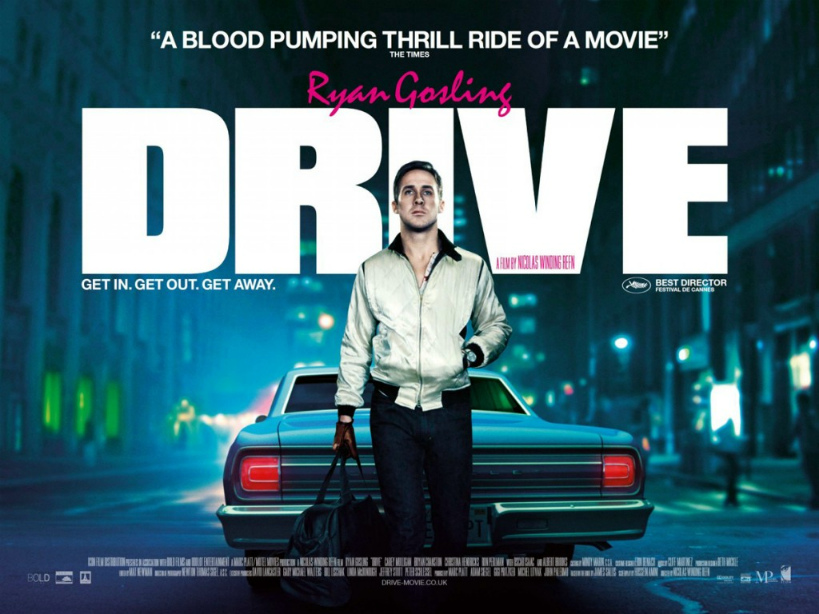
Review: Drive (dir. by Nicolas Winding Refn)


Danish filmmaker Nicolas Winding Refn has made just a handful of films with most staying under the radar of most of the general film-going public. He first caught the attention of indie film fans with his Pusher Trilogy over in Denmark, but he really caught the attention of these fans with his explosive collaboration with Tom Hardy on the Bronson biopic. He would follow that film with the violent existentialist Viking film Valhalla Rising. It would take another major collaboration with another rising star in Ryan Gosling for Winding Refn to finally have his major breakout film which has caught the attention of not just the indie film fans and cineaste crowd, but the general public at-large.

Drive was first screened over at this year’s 2011 Cannes Film Festival where it premiered “in competition” for the Palme d’Or. While the film didn’t win the top prize for best film at Cannes it didn’t garner Nicolas Winding Refn “Best Director” award and his work on this film more than merits such an accolade. The film would begin to screen at other major film festivals before landing at the Toronto International Film Festival before making it’s major public release in North America. Everywhere the film went the consensus reaction to the film has ranged from positive to calls for the film as one of 2011’s best.

So, it would seem most everyone has been quite positive with their reaction to Refn’s Drive. Is this film just another indie arthouse title which the elitist film fans have begun to hype up to levels that would border on cosmic? Or is this film actually as good as it has been talked up to be by such film fans and those of the general public who have seen it? I think the answer lies somewhere in-between.

Drive has been called an action-drama to crime-thriller to film noir and even an existentialist meditation of the film variety. Some have even called it a modern urban fairy tale from the many traditional tropes and themes inherent in fairy tales. The film actually seems to defy genre labels as it’s all those and even more. Nicolas Winding Refn has made a film with so much variety in its cinematic DNA from other classic films and storytelling styles that watching the film once is not enough to find them all.

The film makes a strong statement with it’s introduction of the character who remains nameless but could be called “The Driver” or “The Kid”. Ryan Gosling’s performance in this opening sequence will set the foundation for his character from beginning to end. His driver role is not much for chit-chat and unnecessary talking with those who have hired him to be their expert getaway driver. He’s meticulous with his equipment and intractable when it comes to the rules he has set down for his clients. He would be theirs for the five minutes they need him to drive them away from their criminal acts. Whatever they do before or after those five minutes doesn’t matter to him and he sticks to this rule explicitly. Another rule which he lays down is that he will not be carrying a firearm. These rules have had some audiences bring to mind Jason Statham’s Transporter character and they would not be totally wrong to say so. What Gosling’s driver has over Statham’s is the air of realism to the role. It’s a realism that borders on hyper-reality as the film moves on to it’s climactic conclusion, but real nonetheless. Gosling’s “driver” will not do extensive and elaborate fighting skills the way Statham’s would.

The film would move from it’s powerful introduction and into a much more calm and somewhat serene section as the nameless driver gradually gets to know his next door neighbor in the form of Irene as played by Carey Mulligan. Their relationship will form the core of the film’s narrative and it’s the driver’s growing affection not just for Irene but her young son that would dictate some of the decisions he would make right up to the end of the film. It’s a relationship built not on extensive dialogue banter but mostly on meaningful glances and silent understanding between two characters who seem to have found a kindred kinship between them. It’s this growing relationship between the two and Irene’s son which almost look like a familial unit forming until the return of Irene’s incarcerated and newly-released husband Standard. This is a character played by Oscar Isaac as a man desperate to take full advantage of his last chance at normalcy and redemption, but ultimately doomed to fail.

Standard doesn’t just become the only wrench in the happy life Gosling’s character seems to want to have with Irene and her son. Into the picture also happens to come in is his mentor and business partner Shannon (Bryan Cranston doing a great job as the good-natured, but opportunistic fool character many Shakespearean tragedies always seem to have) and Shannon’s even seedier acquaintances in Hollywood mogul-turned-mob boss Bernie Rose (Albert Brooks in a chilling performance) and his more boisterous, but not as smart partner in Nino (Ron Perlman).

The film seems to settle on the low gears for the first hour of the film, but it’s during a botched robbery attempt where the driver becomes embroiled in that Drive finally moves into the high gears and stays there until the very end. Refn’s decision to use the first hour to round out and build the characters in this film definitely pays off in the end. The audience becomes quite clear as to who the players are and what motivates them to do what they do the rest of the film. Even the most secondary and tertiary roles in this film has a part to play. Even Christina Hendricks in the role of a low-level moll to a gang of criminals gets to have her time to shine if just briefly.

Once the narrative shifts from character study to an almost Cronenbergian exercise in violence and brutality does the film finally able to hook in the last few audiences who may have still been iffy about Drive. Not to say that the final 45-minutes of the film was a non-stop action film, but it does move at a consistently higher gear pace than the first hour. We see the driver having to show to the audience that he’s not just an expert wheelman for Hollywood (stunt driver by day) and the criminal underground (getaway driver by night). It serves the film well that Gosling’s character has the barest minimum of lines of dialogue. We see all we need to know about this character through his behavior that brings to mind roles played by such past luminaries as Steve McQueen and Clint Eastwood.

Most likely it would be in the second half of the film that should satisfy the action junkies. While the action scenes are not of the Michael Bay-type they do show that Refn has a fine grasp of what makes an action scene thrilling. Whether the scene calls for some of the most well-done car chase on film since Frankenheimer showed everyone how to properly do it in Ronin or scenes of sudden brutal violence which calls to mind similar scenes from Cronenberg’s last two films (A History of Violence and Eastern Promises). Both types of action were done efficiently with little to no glamour to gloss over things. The burst of violence actually adds to the mystique of Gosling’s “Man With No Name” role. One particular scene in the apartment elevator where Gosling, Mulligan and a goon sent by the mob makes for one of the best scenes in the film and of 2011.

As much as these scenes of action and violence will be the ones to get the most attention from the general film-going public in the end it’s the excellent screenplay by Hossein Amini of the James Sallis’ novel of the same name which really holds everything together in conjunction with some top-notch performances from everyone involved. The film makes or breaks itself on Gosling’s performance as the driver and he delivers on all cylinders. His performance was quite reminiscent of past performances such as James Caan as Frank in Michael Mann’s Thief, Steve McQueen also as Frank in Bullitt, but in my opinion Gosling’s work in this film brings to mind young Clint Eastwood as “The Man With No Name” in Sergio Leone’s spaghetti western trilogy. Both characters were the type to let their actions speak for them and were both full of quiet confidence not to mention restrained violence which would erupt when needed.

Much has been said about Albert Brooks’ turn as the mob boss Bernie Rose. how the role was quite the 180-degrees from people’s perception of the actor who usually did comedic roles. I say that Albert Brooks always had a dark side to his comedic talent. I mean he was and is megamaniacal villain Hank Scorpio from The Simpsons. In all seriousness, Brooks’ as the mob boss was the other pillar which held all the other performances focused. In fact, Gosling’s character and Brook’s Bernie Rose could almost be considered mirror-images of each other. They were characters who had found their place in the world and the role they would play and didn’t struggle against it. Everyone else in the film struggled against their lot in life. It was also these characters who had the bulk of the film’s dialogue.

Drive has been hyped (for some overhyped) since it first premiered at this year’s Cannes Film Festival, but it’s one of those rare films which has more than earned and surpassed the hype which has preceded it’s general release to the general public. It’s a film which bucks traditional genre labels by combining the themes, ideas and foundations from many different film and storytelling genres. For fans of action there’s enough thrilling action to sate them. For those who are fans of film noir this film definitely carries within it the DNA set down by the film noir of the 40’s, 50’s and 60’s. For some who wish to watch a film which explore existential themes then Refn’s film has that too. In the end, Drive manages to be a film which caters to so many different audiences without ever pandering to them or dumbing the story down. It’s a film made by a filmmaker who continues to impress and who has made his best film to date.

Drive is a film that is not for everyone, but it’s also a film that everyone should see and experience at least once. It is also one of the year’s best films and, so far, my top film of 2011.

Song of the Day: Angel of Mine (by Monica)


The latest “Song of the Day” is old-school for many. Seems anything that was released and played after the year 2000 people consider old-school now. For me this song is a more recent old-school. It’s only 13 years since it first played the radio waves. My choice is the ballad “Angel of Mine” by R&B singer Monica.

While this song was released in 1998 as one of the singles for Monica’s This Boy Is Mine album it definitely sounds like a much older R&B ballad from the late 80’s and early 90’s which I consider the true old-school. While it does have some of the more technical gloss which R&B albums began to show in the late 90’s and onward (which in my opinion hasn’t been to its benefit) the singing by Monica and the sweet-natured romantic lyrics brings to mind R&B acts like En Vogue from my high school days.

This song also happens to be the bridge for me and probably many others of my generation when young romance began to give way to mature romance as we all entered out late 20’s and with the big 3-0 just around the corner. The lyrics speaks of finding true love but it also didn’t have that juvenile, puppy love feel to it.

“Angel of Mine” marked one of the last few true R&B ballads which focused on love and romance instead of physical love (looking at you Chris Brown and Ne-Yo). They sure don’t make them like this anymore.

Angel of Mine

When I first saw you I already knew
There was something inside of you
Something I thought that I would never find
Angel of mine

I looked at you, lookin’ at me
Now I know why they say the best things are free
I’m gonna love you boy you are so fine
Angel of mine

How you changed my world, you’ll never know
I’m different now, you helped me grow
You came into my life sent from above
When I lost all hope you showed me love
I’m checkin’ for you boy you’re right on time
Angel of mine

Nothing means more to me than what we share
No one in this whole world can ever compare
Last night the way you moved is still on my mind
Angel of mine

What you mean to me, you’ll never know
Deep inside I need to show
You came into my life sent from above
(Sent from above)

When I lost all hope, you showed me love
(Boy you showered me love)
I’m checkin’ for you, boy you’re right on time
[ From : http://www.elyrics.net/read/m/monica-lyrics/angel-of-mine-lyrics.html ]
(Right on time)
Angel of mine
(Angel of mine)

I’ll never knew I could feel each moment
As if it were new
Every breath that I take, the love that we make
I only share it with you
(You, you, you, you)

When I first saw you I already knew
There was something inside of you
Something I thought that I would never find
Angel of mine

You came into my life sent from above
(Came into my life)
When I lost all hope you showed me love
(Boy you showed me love)
I’m shakin’ for you, boy you’re right on time
(But boy your right on time)
Angel of mine
(Angel of mine, oh mine)

How you changed my world, you’ll never know
I’m different now, you helped me grow

I look at you, lookin’ at me
Now I know why they say the best things are free
I’m checkin’ for you, boy you’re right on time
Angel of mine

AMV of the Day: Death Romance


Time for a new “AMV of the Day” and this time it was the AMV that was the consensus hit of this past summer’s Anime Expo 2011.

“Death Romance” is the creation of youtube user KaitoKid99 and from the reaction I’ve read about his entry at the AMV contest at Anime Expo 2011 this anime music video was something to have seen with a huge crowd reacting to it. The video took two so very different things and actually ended up quite funny and well-done: Death Note anime and Lady Gaga’s song “Bad Romance”.

Just watching the video I could very well imagine how well this video would’ve gone over. The fact that it won not just Best In Show at Anime Expo 2011, but also Best Comedy should put this video as one of the top one’s for 2011. KaitoKid99 didn’t use too much effects trickery and gimmicks. This video just was edited and synched quite well with a minimum of fuss and in the end those tend to be the best ones since there’s not too much to distract from the video.

I really regret not being able attend Anime Expo 2011 now if just to have seen this AMV on the theater screen at the Nokia Theater with a crowd of a couple thousand otaku.

Anime: Death Note

Song: “Bad Romance” by Lady Gaga

Creator: KaitoKid99


Song of the Day: Nightcall (by Kavinsky & Lovefoxxx)


The latest “Song of the Day” choice is the other song used in the film Drive which made quite an impression on while I watched the film. It’s the 2010 electro house track “Nightcall” from a similarly titled EP from electro house artist Kavinsky.

“Nightcall” was the song chosen by Drive filmmaker Nicolas Winding Refn and it’s film composer Cliff Martinez to begin the film. The choice of this song was pretty much a perfect one as it made for a great intro to the film. The song plays as the film introduces us to the lead character (played by Ryan Gosling) as he drives down the late-night streets and alleys of Los Angeles. The song’s 80’s sound gives the film an almost old-school drama feel to it. For anyone who grew up in the 1980’s this song definitely would sound familiar as it style was used many times over to score many action-dramas.

With “A Real Hero” this song helps bookend song-wise one of the more interesting and, in my opinion, one of the best films of 2011.

Nightcall

I’m giving you a night call to tell you how I feel
I want to drive you through the night, down the hills
I’m gonna tell you something you don’t want to hear
I’m gonna show you where it’s dark, but have no fear

There something inside you
It’s hard to explain
They’re talking about you boy
But you’re still the same

There something inside you
Its hard to explain
They’re talking about you boy
But you’re still the same

I’m giving you a night call to tell you how I feel
I want to drive you through the night, down the hills
I’m gonna tell you something you don’t want to hear
I’m gonna show you where it’s dark, but have no fear

There something inside you
It’s hard to explain
They’re talking about you boy
But you’re still the same

There something inside you
It’s hard to explain
They’re talking about you boy
But you’re still the same

There something inside you (there something inside you)
It’s hard to explain (it’s hard to explain )
They’re talking about you boy (they’re talking about you boy)
But you’re still the same

Trailer: The Thing (prequel) Red Band


One of the films which I’m looking forward to with some trepidation, but also some excitement is the prequel to John Carpenter’s The Thing that was released in 1982. This prequel will show the initial unearthing of the “Thing” from the Antarctic ice by Norwegian researchers from the 1982 film (shown only as video recordings) and how it got loose and destroyed the Norwegian Camp.

Dutch filmmaker Matthijs van Heijningen Jr. was the one picked to direct the film with Mary Elizabeth Winstead (known by many as Ramona from Edgar Wright’s Scott Pilgrim vs. The World) taking the lead role. Many fans of the Carpenter film feel this prequel should never have been made. As a hardcore of the Carpenter film I can’t say that I agree with the decision to create this prequel, but I also won’t say that I’m not looking forward to it.

There had always been noise to create a sequel to Carpenter’s classic and at times even the master himself was involved in trying to get it done. This prequel became the final stab at continuing the story first started by Carpenter and I’m interested in how this new cast and crew will tell a story only hinted at in the original film.

The Thing is set for an October 14, 2011 release date.

Trailer: J. Edgar (dir. Clint Eastwood)


Every year since he retired from acting we seem to get one film from Clint Eastwood and this year it’s going to be one major prestige picture due this November. The film is J. Edgar and it’s a biopic detailing the life of the FBI’s founder and first director, J. Edgar Hoover.

This film will be the first time Leonardo DiCaprio and Eastwood will be working together. From the look of the cast assembled Eastwood has surrounded DiCaprio with some talented performers from Dame Judi Dench, Naomi Watts right up to Jeffrey Donovan, Geoff Pierson and Stephen Root.

The trailer shows just how much the film just screens “Awards Picture” from beginning to end. It’s not a suprise that J. Edgar has become one of the films this coming fall/winter to be a major frontrunner for the many film circles awards and, most likely, for the next Academy Awards. Here’s to hoping that this film will be a major bounce back for Eastwood after 2010’s very uneven and dull Hereafter.

J. Edgar is set for a limited release this November 9, 2011 before going worldwide a couple days later on November 11.

Song of the Day: A Real Hero (by College feat. Electric Youth)


For the latest “Song of the Day” I only had one choice in mind. No other song has wormed it’s way into my waking consciousness than the song I chose. It’s the 80’s-like synth-pop song “A Real Hero” by the band College feat. Electric Youth.

To say that Nicolas Winding Refn’s first Hollywood film (though still quite modestly budgeted) was something that stuck to me would be an understatement. One of the factors which just made the film one of the best films of 2011 has to be the 80’s retro synthpop soundtrack by Cliff Martinez and some perfectly chosen licensed songs. The one song which definitely has become a favorite and also one which has stuck itself in my mind since I saw the film is “A Real Hero” which we fully hear in the end of the film and into the end credits (the song get a brief appearance in the middle of the film).

This song perfectly encapsulates the restrained love story between the characters played by Ryan Gosling and Carey Mulligan. It explores the dynamic between The Kid (Gosling’s role) and Irene the young mother (Mulligan’s role) as heard through the song’s sparse lyrics which intersperse itself between the electronic synth keyboard play. It’s inclusion in two spots in the film adds different meanings to the song. The first time we hear it the song adds a soft layer of old-school romanticism to Gosling and Mulligan’s characters, but when we finally hear it in full in the end that romanticism takes on an ambiguous tone with just a tinge of bittersweet to the romance.

There’s another song from the Drive soundtrack which also made quite an impact not just in the film’s overall quality but in me as a listener and an audience. That would be explored in a day or so.