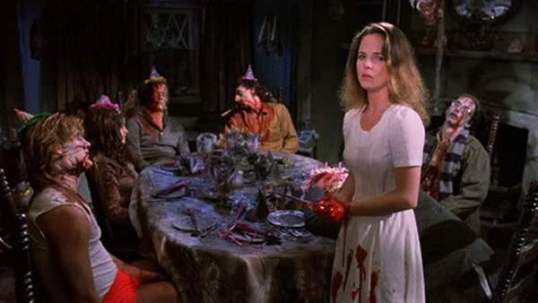
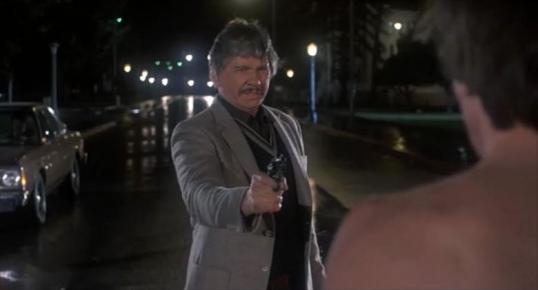
4 Or More Shots From 4 Or More Films is just what it says it is, 4 shots from 4 of our favorite films. As opposed to the reviews and recaps that we usually post, 4 Shots From 4 Films lets the visuals do the talking!
83 years ago today, Wes Craven was born in Cleveland, Ohio. Craven started his career as an academic, teaching high school English. However, realizing that there was more money to be made in the film industry, Craven changed careers. By his own admission, he started his career directing “hardcore, X-rated films” under a pseudonym and it has been rumored that he was a member of the crew of the first “porno chic” film, Deep Throat. Eventually, Craven broke into the mainstream with some of the most influential and often controversial horror films ever made. From being denounced for the original Last House On The Left to changing the face of horror with A Nightmare on Elm Street to becoming something of a revered statesman and a beloved pop cultural institution with the Scream franchise, Wes Craven had a truly fascinating career.
In honor his films and legacy, it’s time for….
4 Shots from 4 Wes Craven Films
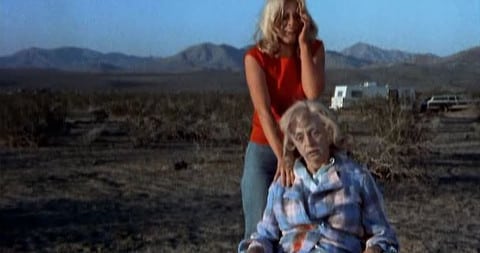
The Hills Have Eyes (1977, dir by Wes Craven, DP: Eric Saarinen)
A Nightmare on Elm Street (1984, dir. by Wes Craven, DP: Jacques Haitkin)
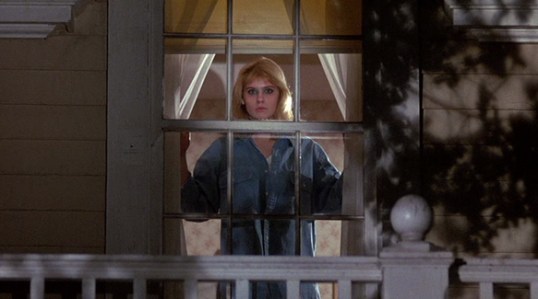
Deadly Friend (1986, dir by Wes Craven, DP: Philip H. Lathrop)
The People Under The Stairs (1991, dir by Wes Craven, DP: Sandi Sissel)
Cars is the only PIXAR franchise that has never made me cry. This is largely because it’s about talking cars. It’s easy for me to get emotionally worked up over toys fearing that they’ll be forgotten or WALL-E losing its personality and returning to collecting trash. Don’t even get me started on some of the emotional trauma that I suffered from UP and Inside Out. But Cars …. I mean, I know that cars don’t talk to each other so it’s difficult for me to get too emotionally involved in their issues. In PIXAR’s defense, though, the Cars films have always been pretty honest about the fact that they’re just meant to be silly fun. No one is going to mistake Cars for Toy Story but then again, PIXAR has never asked anyone to.
Cars on the Road is the latest entry in the franchise. This original series will be premiering on Disney Plus on September 8th. Here’s the trailer:
The upcoming Disney+ original series, Star Wars: Andor, is a prequel to Rogue One, which was itself the fourth prequel to Star Wars: A New Hope. If Andor is a success, I’m sure it will lead to another prequel and then a prequel to that and then a prequel to that and eventually, we’ll have a Star Wars series that takes place right before the Big Bang.
(As you may have guessed from the tone of that last paragraph, I’m a bit skeptical of prequels in general. It’s rare that they’re ever worth the trouble. Better Call Saul is really the only prequel that I can I think of that actually enriches the experience of watching the show from which it was spun off.)
Anyway, Star Wars: Andor will be available to stream on September 21st. Here’s the trailer:
Just to state the obvious, this trailer definitely has a Top Gun feel to it. I imagine that can be said about any film that features aerial combat. Plus, Top Gun: Maverick‘s Glen Powell has a role in this film as well. However, unlike Top Gun, Devotion is based on a true story and it takes place during the Korean War.
Devotion is due to be released in November, which is typically the Oscar season. I have a feeling that, fairly or not, Devotion might be overshadowed by the monster success of Top Gun: Maverick but you never know. Audiences might show their devotion to another film about planes and the pilots who fly them.
Marshall Everett was an undercover DEA agent who spent years infiltrating the drug cartels of South America. When he got too close to the people that he was supposed to be investigating, he was yanked from the assignment and sent to work for the Secret Service. After he took a bullet protecting the President’s wife, he retired to Paris, a city that is known for being welcoming to former members of American law enforcement.
Ariana Gregory was the daughter of the U.S. Ambassador to Argentina. When she was kidnapped by communist revolutionaries, she tried to resist the charms of their charismatic leader. But, before you could say Patty Hearst, she was pregnant and brainwashed. Fortunately, she was eventually rescued by the American forces. Unfortunately, her lover died, her father died, and she eventually had a miscarriage. A year has passed and she’s still dealing with the trauma. And where better to deal with trauma than in Paris?
When Marshall and Ariana meet …. THEY SOLVE CRIMES!
Well, actually, they bond over the fact that neither one of them feels as if they belong in their home country anymore. Both of them lost their identities in South America and now, in Europe, they can build brand new identities. They can also fall in love! Yay! Unfortunately, they’re also going to have watch their step because the brother of Ariana’s revolutionary lover is looking to kill both of them.
This a typical Danielle Steel novel, one that I found in my aunt’s collection of paperbacks and which I read two weeks ago. Though I do enjoy a good romance, I’ve never been a huge fan of Danielle Steel’s. Her prose rarely sings. The dialogue rarely crackles. The characters never really feel all that developed. That said, it’s kind of hard not to appreciate the shamelessness of Steel’s plotting. Any romance writer could come up with a story of two lost souls meeting in Paris and finding personal and spiritual redemption through their love. However, it takes a Danielle Steel to make them two lost souls who are recovering from being brainwashed in South America. It takes a Danielle Steel to ask, “What if Donnie Brasco and Patty Hearst met and fell in love?” It takes a Danielle Steel to write about the inner workings of both an international drug cartel and a left-wing revolutionary cell, despite apparently not knowing much about either. There’s an almost random, “just toss it in” feeling to the plot of Undercover that is definitely entertaining.
I guess my point is that, while I was reading Undercover, there were a lot of moments where I dramatically rolled my eyes. (Anyone who has ever watched me read a book can tell you about how much I enjoy rolling my eyes.) But the story held my interest and I certainly didn’t put the book down until I finished it. Whatever else you may want to say about the book and Steel’s style of writing, it definitely got the job done and, it should be noted, I didn’t get brainwashed while reading it. That’s the important thing.
What better way to celebrate the start of a new month and a new beginning than an AMV featuring a lot of dancing?
Anime: Noragami, Uta No Prince Sama, Pretty Rhythm Aurora Dream, The Melacholy Of Haruhi Suzumiya, K-ON, Lucky Star, Soul Eater, Kyoukai No Kanata, The Idolm@ster, Sengoku Basara, Vocaloid, Noucome, Nichijou, Magi, Da Capo III, Acchi Kocchi, Avatar The Last Air Bender, Love Live!, Brothers Conflict, Super Sonico, Toradora, Haikyuu, Angel Beats, Nourin, Ouran Highschool Host Club, Shugo Chara, Free, Blue Exorcist, Kuroko No Basket, Engaged To The Unidentified, Dance In The Vampire Bund, Gurren Lagann, Air, Code Geass, Nisemonogatari, Yosuga no Sora, Highschool DxD
Song: Shake It Off (by Taylor Swift)
Creator: Michi Peachy AMVS (as always, please subscribe to this creator’s channel)
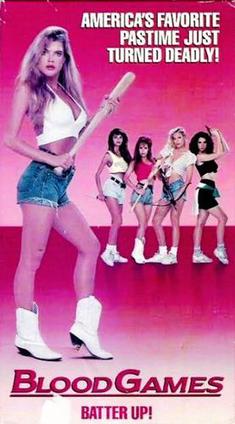
First released in 1990, Blood Games opens with a birthday celebration gone terribly wrong.
Somewhere in the rural South (at least, I assume it’s meant to be the South if just because of the big Confederate flag that appears in one scene), Roy Collins (Gregory Cummings) is celebrating his birthday. Roy’s father, Mino (Ken Carpenter), has invited Babe and the Ball Girls, a women’s softball team, to come to town to play an exhibition game against Roy and the local boys. When Babe (Laura Albert) and her team not only beat but also thoroughly humiliate the hometown team, Mino doesn’t take it well. He yells at Roy and Roy and his idiot friend, Holt (Don Dowe), decide to get revenge. After Roy is killed while trying to assault one of the girls, Mino gathers all of the rednecks together and declares, “I WANT JUSTICE!” Everyone in town grabs a shotgun, jumps in a pickup truck, and heads off in pursuit of the Babe and the Ball Girls tour bus.
It shouldn’t come as a surprise to anyone that the bus itself breaks down in the middle of the woods and the team is forced to hike to safety while being pursued by Mino, Holt, and all of the rest of the shotgun toting locals. It turns out that Mino is a deadly shot with a crossbow and Holt, at times, seems to be close to indestructible. However, it also turns out that Babe and the Ball Girls are far tougher than any of the men expected. The film reaches its bloody conclusion at a deserted farm, complete with a dramatically-scored flashback montage that reminds us of everyone whose life was lost during Roy’s birthday weekend.
Just to state the obvious, Blood Games is just as exploitive as it sounds. This is the type of film where, early on, the action stops so the camera can linger on Babe and the Ball Girls in the locker room after they win their game. (George “Buck” Flower shows up as the redneck who inevitably ends up peeking in at them.) The team’s uniforms were probably popular with the film’s target audience but short shorts and crop tops don’t really seem practical for a game that would involve sliding through the dirt and the weeds on the way to home plate and, as a Southern girl who spent many a summer in the country while growing up, I cringed a bit when I thought about all the bugs that were probably in the grass and the dirt, waiting for a chance to hop onto a bare leg. (It didn’t help that the game was apparently just being played in some random field.)
And yet, as exploitive as many viewers will undoubtedly find Blood Games to be, the film definitely works. The rednecks are so loathsome and they overreact so severely to losing one game to a team of girls that it’s impossible not to cheer when Babe and the Ball Girls turn the tables on their pursuers. “Batter up!” the film’s trailer announces and it is true that the Ball Girls use the same teamwork that won them the game to survive in the wilderness. At the same time, they also use baseball bats, ropes, guns, and anything else they can get their hands on.
The acting is a bit inconsistent, though Don Dowe and Ken Carpenter are both well-cast as the main villains. Dowe plays Holt as being someone who knows that he’s in over his head but who is too weak-willed to go against the mob. The fact that he’s weak makes him all the more dangerous because a weak man will do anything to try to convince others that he’s strong. Carpenter, meanwhile, is chillingly evil as Mino, who quickly goes from mourning his son to taking a sadistic pleasure out of hunting down human beings. The film’s real strength is to be found in Tanya Rosenberg’s direction. Along with keeping hte movie moving at a fairly steady pace, Rosenberg also captures the atmosphere of being lost in the country in the summer. Watching the film, you can literally feel the heat rising from the ground and hear the cicadas in the distance.
Incidentally, I convinced my sister to watch this film with me because I assumed it was a baseball movie. However, as Erin quickly pointed out to me, it instead turned out to be a softball movie. I have no idea what exactly the difference is between baseball and softball but Erin assures me that there is one. Well, no matter! Whether it was softball or baseball, Babe and the Ball Girls did a good job striking out the hometown boys.
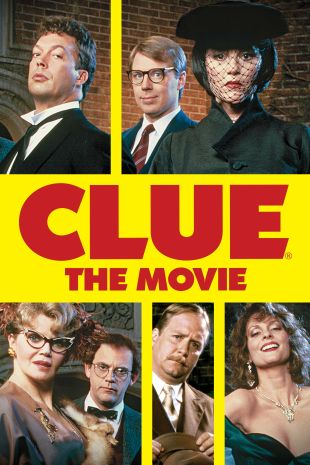
The 1985 comedy, Clue, opens with a set of six strangers arriving at an ominous mansion in New England. They’re meet by Wadsworth (Tim Curry), an oddly charismatic butler who explains that all six of the strangers have a few things in common. They all work in Washington D.C. They are all, in some way, involved with the government. And they’re all being blackmailed by Mr. Boddy (Lee Ving), the owner of the house.
The six strangers have all been assigned nicknames for the night.
Miss White (Madeleine Khan) is the enigmatic widow of a nuclear physicist who may have had communist sympathies. Actually, Miss White is a widow several times over. All of her husbands died in circumstances that were a bit odd. Is Miss White a black widow or is she just unlucky? And what about the flames of jealousy that she occasionally mentions?
Professor Plum (Christopher Lloyd) is a psychiatrist who once worked for the World Health Organization and who has an unfortunate habit of sleeping with his patients.
Mr. Green (Michaele McKean) explains that he works for the State Department and that he is also secretly gay. If his secret got it, he would be deemed a security risk or perhaps even a communist agent.
Mrs. Peacock (Eileen Brennan) is the wife of a U.S. Senator who forced to resign after getting caught up in a bribery scandal.
Colonel Mustard (Martin Mull) is a somewhat stuffy war hero-turned-arms dealer.
And finally, Miss Scarlet (Lesley Ann Warren) is Washington D.C.’s most powerful and most witty madam.
Once everyone is in the house, Wadsworth explains that the police have been called and will arrive in 45 minutes, at which point Mr. Boddy will be arrested and everyone’s secrets will be exposed. Mr. Boddy’s solution is to suggest that one of the six kills Wadsworth. After tossing everyone a weapon, Mr. Boddy turns out the lights. When the lights come back on, Wadsworth is still alive but Mr. Boddy is not. But who murdered Mr. Boddy? And in what room? And with what weapon? And what to make of the other people who were either in the house or show up at the front door, like the maid, Yvette (Collen Camp), or the motorist (Jeffrey Kramer) who shows up to use the phone or the traveling evangelist (Howard Hesseman)? Can the mystery be solved before the police show up and presumably arrest everyone?
Based on the old board game, Clue is a hilariously exhausting film, one that mixes smart wordplay and broad physical comedy to wonderful effect. It’s not often that you see a film that gets equal laughs from two people colliding in a hallway and from characters accusing each other of being communists. In fact, it’s so easy to marvel at the physical comedy (especially the lengthy scene where Tim Curry runs from room to room while explaining his theory about who committed the murders) that it’s easy to forget that the film is also a sharp satire on political corruption, national paranoia, 50s morals, and the McCarthy era in general. Since all of the characters are already convinced that they’re either surrounded by subversives or in danger of being accused of being a subversive themselves, it’s not a great leap for them to then assume that any one of them could be a murderer. I mean, if you’re willing to betray your country than who knows what you might be willing do in the study with a candlestick?
The cast is full of comedy veterans, all of whom know how to get a laugh out of even the mildest of lines and none of whom hold back. Madeline Kahn, in particular, is hilarious as Miss White though my favorite suspect, in both the game and the movie, has always been Miss Scarlet. Not only is she usually portrayed as being a redhead in the game but, in the movie, her dress is to die for. In the end, though, it’s perhaps not a surprise that the film is stolen by Tim Curry’s energetic performance. The film’s final 15 minutes are essentially a masterclass in physical comedy from Tim Curry but he’s just as funny when he’s delivering his frequently snarky dialogue. Both Wadsworth the character and Tim Curry the actor appear to be having a blast, running from room to room and shouting out accusations.
When Clue was originally released, it was released with three different endings. Apparently, the audience wouldn’t know which ending they were going to get before the movie started. I guess that the idea was to get people to go the movie three times to see each ending but I imagine few filmgoers had the patience to do that and who knows how many viewers went to multiple showings just to discover that the randomly selected ending was one that they had already seen. I’m surprised that I haven’t come across any reports of riots breaking out. Fortunately, the version of Clue that is now available for viewing features all three endings. Of course, none of the endings make much sense. Hercule Poirot would demand a do-over, especially if he was being played by Kenneth Branagh. But the fact that it’s all so ludicrous just adds to the comedy. I watched Clue two Fridays ago with a group of friends and we had a blast. It’s definitely a movie that’s more fun when you watch it with other people.
(That said, as far as incoherent solutions are concerned, the third one was my favorite and I think Poirot would agree.)
As for the board game itself, I used to enjoy playing it when I was a kid. We had really old version from the 60s and I always used to imagine what all of the suspects were like when they weren’t being accused of murder. I always imagined that Mr. Green and Miss Scarlet probably had something going on. Today, I’ve got a special Hitchcock edition of the game. It’s all good fun, this never-ending murder mystery.
Today, the Shattered Lens wishes a happy birthday to director Sam Mendes!
Now, it’s true that Sam Mendes won an Oscar for directing American Beauty and he probably came close to winning a second one for his work on 1917. However, my favorite Mendes film remains Skyfall.Skyfall is one of the best of the Bond films and I say this as someone who was not really a fan of Daniel Craig’s mopey interpretation of the character. Based on his previous films, Sam Mendes may not have been the first name that come to mind when people talked about someone who could make a great Bond film but, with Skyfall, he did just that.
Here, in a scene that I love, James Bond pursues Silva (Javier Bardem) through the London Underground. It’s very suspenseful, very droll, and, most importantly, very British.
4 Or More Shots From 4 Or More Films is just what it says it is, 4 shots from 4 of our favorite films. As opposed to the reviews and recaps that we usually post, 4 Shots From 4 Films lets the visuals do the talking!
108 years ago today, the director J. Lee Thompson was born in Bristol, England. Thompson started his career making social realist films before he moved into making genre pictures. He was nominated for Best Director for his work on 1961’s The Guns of Navarone. That said, during his lifetime, Thompson was never exactly a critical favorite. When they were first released, critics were dismissive of his entries in the original Planet of the Apes franchise and they were downright hostile to his work with Charles Bronson. However, all of those films were better appreciated by audiences and they remain cult classics to this day. Conquest of the Planet of the Apes, with its themes of protest and revolution, has especially been the subject of much recent critical reevaluation. Thompson may have been a genre director but that didn’t mean that his film were devoid of subtext. If anything, Thompson was a master of sneaking subversive themes into the least likely of works.
Thompson was a filmmaker who knew how to tell a story and who always did the best with whatever he had to work with. To be honest, many aspiring and working directors could learn a lot from spending a weekend watching some of Thompson’s films.
In honor of the man and his legacy, here are….
4 Shots From 4 J. Lee Thompson Films
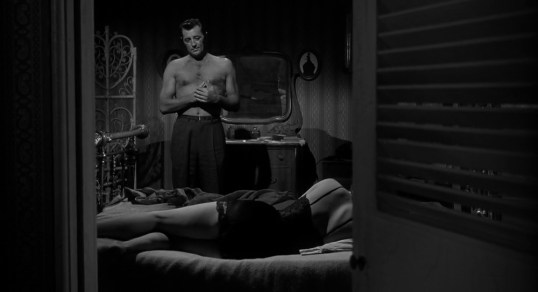
Cape Fear (1962, dir by J. Lee Thompson, DP: Sam Leavitt)
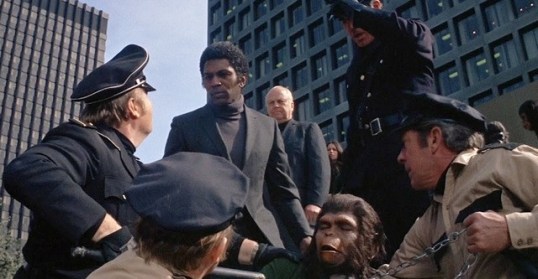
Conquest of the Planet of the Apes (1972, dir by J. Lee Thompson, DP: Bruce Surtees)
Happy Birthday To Me (1981, dir by J. Lee Thompson, DP: Miklos Lente)
10 To Midnight (1983, dir by J. Lee Thompson, DP: Adam Greenberg)