Since it’s the 50th anniversary of Woodstock right now, it seems appropriate to share this music video.
This is a cover of a song that Joni Mitchell wrote about the festival. It’s a song that’s been covered by many different groups and, as is typical of the boomer folk music of the late 60s and early 70s, it’s a bit too self-serious for my taste. That said, it’s definitely better than that Big Yellow Taxi song and Miya Folick brings a dream-like edge to her version of the song. When you hear Folick’s version, it sounds like it’s possible that she’s being sarcastic when she sings about meeting a “child of God,” and that alone makes it better than most other versions of this song.
After, which was released back in April, tells the story of the world’s most boring college romance.
Tessa (Josephine Langford) is a beautiful, intelligent, but shy good girl who has just started college and who is struggling to fit in with her fellow students. Her new roommate has tattoos and a nose ring and Tessa’s just not sure if she can keep up with a group of campus rebels who drink, vape, and play extremely anodyne games of truth or dare. Tessa’s roommate demands to know why Tessa has so many old books. It’s because Tessa loves to read but we soon discover that her literary tastes seem to be dominated by her old high school reading list. In her lit class, she says that Pride and Prejudice is a “revolutionary feminist novel,” in a tone of voice that indicates that she googled “revolutionary feminism” for the first time the previous night.
Hardin (Hero Fiennes-Tiffin) is a bad boy because he has tattoos and he tends to smirk before leaving a room. Hardin seems like he’s …. well, I guess he’s supposed to be dangerous. He’s cynical and he says there’s no such thing as love but actually, he just needs someone to help tend to his emotional wounds. We know that he’s not really a bad dude because he likes Jane Austen and he has a copy of Wuthering Heights in his room, one that’s full of book marks, indicating that he is an actual serious student of literature. He also says that The Great Gatsby was all a dream. (Seriously, you know he’s serious about literature when he owns copies of both Wuthering Heights and The Great Gatsby. I imagine if the movie had lasted a few minutes longer, he would have said, “Hemingway was the poor man’s Hemingway,” and everyone’s mind would have been totally blown.)
Anyway, from the minute that a towel-clad Tessa returns to her dorm room from taking a shower and discovers Hardin sitting in the corner (and reading, of course!), it’s pretty obvious that they’re destined to fall in love. (Of course, considering that Hardin refused to leave the room so Tessa could get dressed, it was perhaps just as likely that she would end up filing a harassment complaint.) Of course, the path to true love never runs smoothly. Tessa has a sweet boyfriend that she’ll need to dump. Hardin has all sorts of emotional baggage that he needs someone to unpack for him. Still, while Hardin and Tessa are swimming in the nearby lake, Hardin says, “We could never be just friends….”
If this all sounds like bad fanfic, that’s because it is. After is based on a novel by Anna Todd. The novel started out as fan fiction and Hardin was originally named Harry Styles. Anyway, the novel sold a lot of copies and developed a reputation for being an innocent version of Fifty Shades of Grey so I guess it’s inevitable that it would later be adapted into an amazingly bad movie. I mean, the sex was the only good thing about Fifty Shades so I’m not sure why someone would say, “Let’s make a chaste version of this book!”
The main problem with After is that both Tessa and Hardin are such inherently boring characters and all the soft-focus shots in the world can’t make them interesting. It doesn’t matter how much time they spend interlocking their fingers, they never seem like people who you’d want to get stuck in a conversation with. Tessa may claim to be into “revolutionary feminism” but she only exists to find a man. She’s defined by how she feels about Hardin and Hardin seems to be the only thing she’s interested in. Meanwhile, Hardin is the worst type of phony intellectual, the self-centered rich boy who has a convenient tragedy for every occasion. Josephine Langford and Hero Fiennes-Tiffin are both attractive in a “I just shot a pilot for the CW” sort of way but neither has much screen presence and, together, they generate so little chemistry that they might as well be two wax figures staring into each other’s glass eyes.
“I’m a mess,” Hardin says and Tessa agrees, “I think we’re both a mess,” and everyone who is a real mess replies, ‘Oh, fuck off, you two.”
Today is the 50th anniversary of the first day of the famous (or infamous, depending on how you feel about hippies, nudity, mud, and Crosby Stills Nash) 1969 musical festival, Woodstock. Today’s music video of the day is taken from Michael Wadleigh’s 1970 documentary about that event.
Arlo Guthrie was the son of folk singer, Woody Guthrie. He’s best known for the Thanksgiving anthem, Alice’s Restaurant. I enjoy his performance here because Arlo is both playing up to the crowd while, at the same time, remaining rather detached from them as well. He understands the audience and allows them to think that he’s one of them while remaining a bit above it all. (And if you have any doubt, just look at him flying over Woodstock in a helicopter.) It’s the same feeling that one gets from watching Arlo in the film version of Alice’s Restaurant and it makes him a more intriguing figure than the artists who unambiguously embraced the counter culture.
Wadleigh, of course, uses Guthrie’s song as a way to acknowledge that, believe it or not, a lot of weed was smoked at Woodstock.
Finally, it’s a pretty good song. Rhyming “Los Angeles” with “a couple of keys” guarantees that.
I always worry a little bit about Chloe Grace Moretz.
Seriously, it seems as if every film in which she appears features her either losing her entire family or getting stalked by some psycho or both. It’s rare that she ever gets to play someone who is happy with their life. Even when she was cast against type as a spoiled, vacuous brat in Clouds of Sils Maria, she still came across as being the saddest spoiled, vacuous brat imaginable. Obviously, Mortez has the dramatic talent necessary to play these type of roles and, out of all the young actresses working today, she seems the most likely to still have an interesting career 30 years from now. Still, it’s hard not to wish that she could just do a nice, romantic comedy at some point in the future, if just to give her a break from constantly being menaced on screen.
This year’s Chloe Moretz Gets Stalked film was Greta. In this one, Moretz plays Frances McMullen, a waitress living in New York City. Frances lives in a nice loft, has a fantastic roommate and best friend named Erica (Maika Monroe), and a strained relationship with her wealthy father (Colm Feore). As is typical of any character played by Chloe Moretz, Frances is still struggling to come to terms with the recent death of her mother.
After Frances finds an expensive handbag on the subway, she returns it to its owner, a piano teacher named Greta Hibeg (Isabelle Huppert). Greta claims to be French and says that she’s been lonely ever since her daughter left home to study music in France. Frances needs a substitute mother. Greta needs a substitute daughter.
Can you tell where this is going?
If you said, “Together, they solve crimes!,” — well, you’re wrong but you’re still my hero. Instead, what all this leads to is Greta becoming rather obsessed with Frances. When Frances discovers that Greta has a whole closet full of handbags and that she’s not even French, Frances decides to end their friendship. However, Greta will not take no for an answer. Soon, Greta is following both Frances and Erica all around New York City. Greta even goes to Frances’s place of employment and makes a scene that leads to Frances losing her job. (Considering the amazingly ugly waitress uniform that Frances was required to wear, I’d say that Greta was doing her a favor.) Eventually, it all leads to a kidnapping, a drugging, and an unexpected visual gag involving the Eiffel Tower.
About 30 minutes into Greta, there’s a scene in which Isabelle Huppert spits a piece of chewing gum into Chloe Moretz’s hair and it was at that moment that I knew that I was going to absolutely love this film. I mean, there have been a lot of films made about people being stalked but it takes a certain amount of demented genius to have one of the world’s most acclaimed actresses actually spit a piece of gum into someone’s hair. Brilliantly, the film follows this up with a scene of Frances and Erica trying to press assault charges against Greta, all because of the gum incident. The cop is so cynical and unimpressed by their story that you just know that Frances is probably like the hundredth person to get attacked by chewing gum in just that day.
My point here is that there’s absolutely nothing subtle about Greta and we’re all the better for it. As directed by Neil Jordan, Greta is a thoroughly excessive and deliberately campy little film and definitely not one to be taken too seriously. Everything, from the lush cinematography to Greta’s sudden rages, is wonderfully over-the-top. While Moretz wisely underplays her role (because, after all, someone has to keep things at least vaguely grounded in reality), Maika Monroe and especially Isabelle Huppert dive head first into the film’s melodramatic atmosphere. Huppert, especially, deserves a lot of credit for her ferocious performance as Greta. Whether she’s cheerfully celebrating a murder by doing an impromptu dance or suddenly screaming in Hungarian, Huppert is never less than entertaining while, at the same time, remaining credible as a very threatening individual. One of the great joys of Greta is watching this masterful French actress play a Hungarian who is obsessed with Paris. (It’s also probably not a coincidence that Greta is obsessed with someone named Frances.)
There’s an interesting subtext to the Greta and Frances relationship, one that goes beyond a girl who needs a mother and a woman who needs a daughter. In many of the scenes where Greta stalks Frances, Huppert plays her as if she’s a spurned lover, crying out, “I love you!” and demanding that Frances return her phone calls. As for Frances, she’s portrayed as being an almost absurdly repressed single girl who spends all of her personal time with two very different women, the accepting and fun-loving Erica and the predatory and destructive Greta. (When Erica tells Frances that a guy who is interested in her is throwing a party, Frances says that she already has plans with Greta.) Watching Greta, it occurred to me that the film was really about Frances coming to terms with her own sexuality, with Greta representing her fears and Erica representing the peace of accepting who you are. The film may be about Greta stalking Frances but it’s also about Frances struggling to decide whether to give in to her fears or to accept her own identity.
Then again, it’s also totally possible that there’s no intentional subtext at all to this film. It might just be an entertaining film about Isabelle Huppert stalking Chloe Moretz. And that’s fine, too! Either way, it’s a fun movie.
About 75 minutes into the American remake of Miss Bala, Gloria (played by Gina Rodriguez) is inadvertently responsible for getting a totally innocent women killed by a Mexican drug cartel.
After I finished watching Miss Bala and I was trying to figure out why exactly this remake did not work for me, my mind kept returning to that scene. It’s a very dramatic scene and yet, at the same time, it has almost no emotional impact. Some of that’s because the woman only appears in one other scene before she gets executed and it’s obvious that the only reason the character was included in the film was so she could be killed. The film itself doesn’t really seem to care about the innocent woman. Instead, its focus remains on Gloria and how she feels about the violence. While we get some scenes of Gloria looking distraught and, at one point, vomiting over a balcony, it still doesn’t seem as if Gloria is really that upset about the fact that the woman’s been executed. Instead, she mostly seems to be annoyed by the fact that she had to witness it. In the scene afterwards, you never really get the feeling that Gloria’s carrying around any sort of lingering guilt for the role that she played in the woman’s death.
However, I think that what really bothered me was that, in this film that took place almost entirely in Mexico, the executed woman was one of the few positively-portrayed Mexican characters and she was killed off as almost an afterthought. The film was more concerned with how the American Gloria felt about the woman’s death than about the woman herself.
Miss Bala is a remake of a Mexican film. The original Miss Bala came out in 2011 and it starred Stephanie Sigman as Laura Guerrero, an aspiring beauty queen who finds herself caught in the middle of the never ending war between the DEA and the Mexican drug cartels. The original Miss Bala was a violent and often lurid film but it was also an unusually powerful examination of what it’s like to be an innocent trapped in the middle of war. Stephanie Sigman played Laura with the sad-eyed stoicism of someone who knew that she had little choice but to do whatever the cartel ordered her to do. In the original Miss Bala, Laura stood-in for every innocent who had been victimized by either side of the War on Drugs. The film ended up a note of cynical ambiguity, suggesting that survival had less to do with skill and everything to do with luck.
In the remake, Laura is transformed into Gloria, an American makeup artist from Los Angeles who comes to Tijuana to help her friend compete for the title of Miss Baja. By changing the lead character’s nationality, the remake also changes the story’s focus. It’s no longer the story of someone trying to survive living in a war zone. Instead, it becomes just another film about an American getting into trouble while traveling abroad. Interestingly enough, Lino (Ismael Cruz Cordova), the aspiring drug lord who kidnaps Gloria, is also an American who happens to live in Tijuana. I assume this was done so the film would have an excuse to have everyone speaking English but it still feels odd to watch a movie about the Mexican drug war in which we rarely hear anyone having a substantive conversation in Spanish.
Gina Rodriguez plays the role of Gloria with a sort of open-faced blandness that occasionally makes Miss Bala feel as if it’s an extended episode of Jane The Virgin. While the remake tries to make Gloria into a more proactive character than the original’s Laura, Rodriguez never suggests that there’s much going on below the surface. Far more impressive is Ismael Cruz Cordova, who plays Lino with a sexy and dangerous swagger. Cordova bring so much charisma to the role that it’s not until the end credits role that you realize that nothing Lino did made much sense.
Director Catherine Hardwicke is responsible for one of my favorite film of all time (Thirteen). She also directed the enjoyably melodramatic Red Riding Hood. And, of course, she’ll always be known for directing the first Twilight. With Miss Bala, though, Hardwicke seems to just going through the standard action film motions. She never captures the original’s outrage about what the never ending drug war is doing to the people of Mexico. Instead, for the most part, the remake of Miss Bala shrugs off any intentional subtext and instead focuses on building up to a sequel that will probably never come.
Skip the remake of Miss Bala. The original is all you need.
So, is this video a celebration of hanging out with friends or is it the final vision of a dying person whose life is flashing before their eyes. I tend to assume it’s the latter but then again, you know that I always tend to lean towards the morbid when it comes to interpreting things.
It’s been a long week and it’s also been ludicrously hot. At least I bought a lot of stuff during our tax-free weekend. Here’s what else I did over the week:
About 12 minutes into Fallen Hearts, the perpetually aggrieved Heaven (Annalise Basso) goes to the local circus so she can taunt her stepfather, Luke (Chris William Martin), over the fact that 1) Heaven looks exactly like her mother, Angel and 2) Angel’s dead.
Upon arriving at the circus, Heaven runs into her stepbrother, Tom (Matthew Nelson-Mahood), but it takes her a while to recognize him because he’s wearing a big red clown nose. It’s not until he takes the nose off that she recognizes Tom and then asks him why he’s dressed up like a clown. It turns out that Tom is a clown now! I guess he got a promotion. Tom then asks why Heaven has made herself up to look exactly like Angel….
Unfortunately, Luke has already spotted Heaven and, apparently not understanding how death works, becomes convinced that Angel has returned to life and is standing in the middle of a low-rent circus in West Virginia. Unfortunately, Luke is apparently now a lion tamer and he’s so shocked to see his dead wife that he loses track of his lion.
And, of course, the lion promptly kills Tom. Would the lion have spared Tom if he hadn’t removed his red clown nose? We may never know.
Now, of course, everyone in the film treats this as being a great tragedy. Strangely enough, no one blames Heaven, even though none of this would have happened if not for the Heaven’s apparent obsession with mentally tormenting everyone from her past. But I have to admit that I laughed out loud as soon as I saw that lion in the background because I knew there was no way the scene was going to end without Tom getting pounced on….
And really, that’s the type of film that Fallen Hearts is. It’s the third film in Lifetime’s adaptation of V.C. Andrews’s Casteel Saga (the previous two were Heaven and Dark Angel) and, from the minute that lion pounces at Tom, everyone should know better than to take anything that happens too seriously. Fallen Hearts somehow manages to be even more melodramatic than the first two films and, as directed by Jason Priestley, Fallen Hearts appears to be fully in on the joke.
Priestley not only directs but he also appears in the film, once again playing Tony Tatterton. Tony is not only Heaven’s unacknowledged father but he’s also her stepgrandfather as well. When Heaven finally ends up marrying Logan Stonewall (James Rittinger), Tony invites them to come up to Massachusetts for their honeymoon. Heaven says no but Logan, being a simple boy from the West Virginia hills, is all about family. While up in Massachusetts, Heaven discover that her first husband, Troy (Jason Cermak), isn’t dead after all. He’s just been in hiding for the past five years, mostly because, after the wedding, he discovered that he was also Heaven’s uncle and that type of relationship just isn’t right. Of course, that doesn’t stop Troy and Heaven from having sex after they run into each other while wandering around a hedge maze. Troy vanishes the morning afterward but soon, Heaven discovers she’s pregnant. Is the baby Troy’s or Logan’s?
Actually, speaking of babies, Heaven’s trashy and bitter sister, Fanny (Jessica Clement, stealing the entire damn movie) is also pregnant! And it turns out that Fanny’s been having an affair with Logan so he might be the father. Then again, there’s also scene where the town’s preacher looks at Fanny and shouts, “WHORE!,” so who knows for sure. The one thing we do know for sure is that all of this is going to lead to two pregnant sisters facing off in a court room. These things always do.
Anyway, Fallen Hearts is not a film that’s really meant to be taken seriously and, as I said before, the film itself is obviously in one the joke. The melodrama is turned up to 11 and the actors tear through the overripe dialogue like a moonshiner trying to outrun the cops. Annalise Basso again manages to keep things somewhat grounded as Heaven but the film is totally dominated by Jessica Clement, who brings the wonderfully trashy Fanny to vivid life. The townsfolk and the hillfolk might not think much of Fanny but she keeps Fallen Hearts beating.
The fourth part of the Casteel Saga, Gates of Paradise, will air on Lifetime next Saturday.
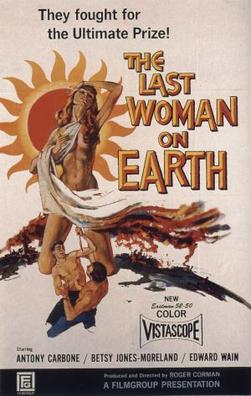
The title character of the 1960 Roger Corman film, Last Woman On Earth, is Evelyn Gern (Besty Jones-Moreland). When a vaguely defined apocalypse occurred and apparently wiped out almost every living person on the planet, Evelyn was on vacation in Puerto Rico and scuba diving. Because she had her own oxygen tank, she was able to survive while everyone on the surface was asphyxiated by a sudden change in the atmosphere. (Or something like that. To be honest, I never quite understood what the apocalypse was about or if it had occurred worldwide or just in Puerto Rico.)
Evelyn may potentially be the last woman on Earth but, unfortunately for her, there’s at least two men left. There’s her husband, Harold (Antony Carbone). Harold is a brutish businessman who, before the world ended, was constantly under the threat of indictment. And then there’s Martin (Robert Towne, who also wrote the script), who is Harold’s attorney. With the world apparently ending, Harold decides that he’s in charge while Martin decides that he’s in love with Evelyn. Evelyn, for her part, ends up spending a lot of time praying in the local church. At the end of 71 minutes, someone is dead and the survivors are left to consider an uncertain future. It’s not a particularly happy film, though, at the same time, it’s not really well-made enough to be that depressing.
It’s perhaps not a coincidence that this film opens with everyone watching a cock fight because, despite its title, Last Woman On Earth is all about the extremes to which men will go to assert their authority. There’s absolutely no reason for Harold and Martin to end up trying to kill each other, beyond the fact that they both want to be in charge and they both want the same woman. Honestly, though, if you’re one of the last three people on Earth, I would think that you might be inspired to rethink certain traditional and patriarchal concepts. That, of course, doesn’t happen in Last Woman On Earth. It’s hard not to be disappointed with the fact that, even with society no longer existing, Evelyn’s reaction to most conflict is to retreat to the background and let the man fight it out among themselves. I mean, we expect no better from Harold and Martin but Evelyn’s passivity in the face of everything gets rather frustrating very quickly.
Of course, it could be argued that I may be expecting too much from a film that was shot over a week and only made because Corman happened to be shooting another movie in Puerto Rico at the time. Corman rarely went on location so, when he went down to Puerto Rico to do Creature of the Haunted Sea, he decided to get the most out of the location as he could by shooting a second film. Screenwriter Robert Towne was cast as Martin because he was already getting paid to write the script while the film was being shot. By casting Towne, Corman saved money that would have otherwise been spent on a professional actor. Towne, who is credited as Edward Wain, ends up giving a rather bizarre performance, alternating between stiff underacting and eye-bulging overacting. You kind of find yourself regretting that apparently it was decided that it would have been too expensive to fly Dick Miller or Peter Graves down to Puerto Rico.
The film doesn’t add up too much, beyond serving as a document of an era’s paranoia about the impending end of the world. (Two years after the release of this film, the Cuban Missile Crisis would bring the world to the brink of a real-life apocalypse.) Corman does manage to get a few haunting shots of the deserted streets of San Juan, though one gets the feeling that this would more due to luck than any specific intention on his part. Last Woman On Earth was released on a double bill with Little Shop of Horrors and, when seen today, it really can’t start to compete with Seymour and his talking plant.