Film Review: Barquero (1970, directed by Gordon Douglas)


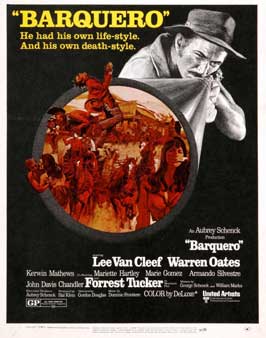
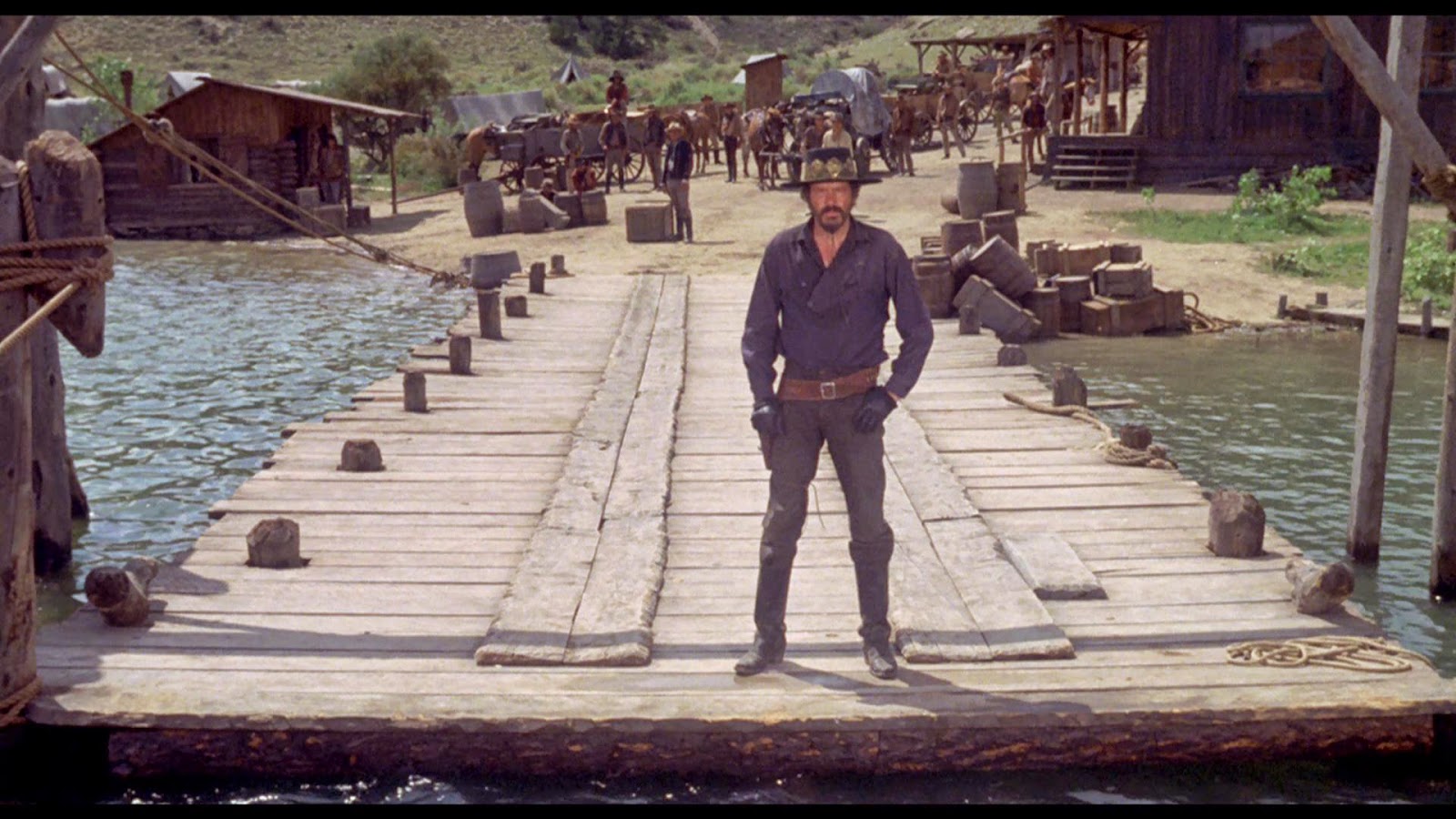
barquero-movie-poster-1970-1010695655Travis (Lee Van Cleef) is a former gunslinger who now makes his living taking settlers across a river on his small barge.  When we first meet him, he is telling a child to shut up and stop bothering him while he is guiding the barge.  He depends on the settlers on the other side of the river for his livelihood and they depend on him for transportation but he doesn’t like them and they don’t like him.  Travis only cares about two people, his Mexican lover, Nola (Maria Gomez) and an eccentric hunter named Mountain Phil (Forrest Tucker).

After stealing a shipment of silver, outlaw Jake Remy (Warren Oates) and his army of mercenaries need to cross the river to escape into Mexico.  To prevent anyone from following, they plan to destroy the barge afterward.  However, Travis and Phil find out that Remy is on the way and take the barge to the other side of the river.  When Jake and his gang arrive, a tense stand-off ensues, with the outlaws on one side of the river and Travis and the settlers trapped on the other.

Though Barquero was directed by the veteran American director Gordon Douglas (Douglas’s best known film is the 1950s giant ant film, Them!),  it was heavily influenced by contemporary Spaghetti Westerns and Sam Peckinpah’s The Wild Bunch.  This can be seen in both its graphic violence and in the casting of Lee Van Cleef and Warren Oates in the leading roles.

Travis was a perfect role for Van Cleef, a talented actor who was ignored by Hollywood until he found fame playing ruthless villains in European westerns.  Surly and unsmiling, Travis may seem like an unlikely hero but, like many of the best Spaghetti westerns, there are no traditional good guys in Barquero.  Travis is more interested in saving his boat than protecting the settlers.  He is a hero of circumstance.

As Jake, Warren Oates is a great villain.  In his very first scene, he and a prostitute watch as his gang massacre the citizens of a small town.  When the prostitute asks if she can come with them, Jake calmly replies, “I don’t think so” and shoots her dead.  Stuck on his side of the river, Jake smokes the local weed and starts to have violent hallucinations.  Soon, he is shooting bullets into the river.

Also doing good work are Forest Tucker as Mountain Phil and Kerwin Mathews.  Mathews, who is best remembered for starring in The 7th Voyage of Sinbad, plays the Marquette, a disgraced French nobleman who has started a second life as Jake Remy’s right-hand man.

Barquero starts with a bang but it struggles to keep up the momentum over its entire running time.  The opening shoot out is exciting but things slow down almost too much during the stand-off at the river.  It is an interesting but flawed western that deserves to be better known than it is and worth watching to see Lee Van Cleef and Warren Oates at their best.
Barquero-Oates-on-dock

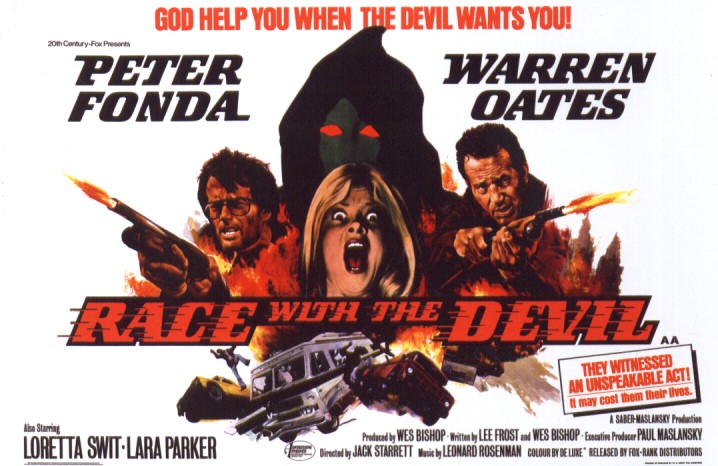
Film Review: Race With The Devil (1975, directed by Jack Starrett)


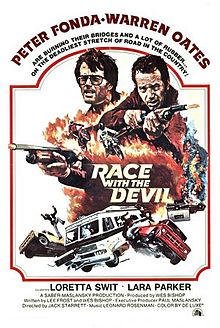
220px-RaceWithTheDevilWarren Oates and Peter Fonda versus …. SATAN!

Roger (Peter Fonda) and Frank (Warren Oates) are lifelong friends and business partners who, along with their wives Kelly (Lara Parker) and Alice (Loretts Swit), are planning on taking the “best damn vacation we ever had.”  Traveling to Colorado in Frank’s RV, they decide to camp for a night next to a river.  Not only do Frank and Roger witness what appears to be a human sacrifice but they also have to run for their lives when they are spotted.  The local sheriff (R.G. Armstrong) tells them that they probably just saw a bunch of hippies killing an animal but Peter Fonda knows hippies and those were not hippies.  Taking some blood-stained dirt so it can be analyzed by the authorities, Roger and Frank try to drive on but find themselves being pursued by Satanists.

A relentless and entertaining B-movie, Race With The Devil is a hybrid of Rosemary’s Baby, Smokey and the Bandit, and Easy Rider, with some Parallax View-style paranoia mixed in as well.  Eventually, it seems as if everyone in rural Texas — from the sheriff to the gas station attendant to the residents of an RV park where our heroes try to spend the night — is a Satanist.  (Even a wrecked school bus turns out to just be an excuse to get the RV to slow down so the Satanic rednecks can attack, leading to Warren Oates’s classic line, “I don’t believe in a school bus on Sunday.”)

A big part of the fun of Race With The Devil is getting to watch Peter Fonda and Warren Oates acting opposite each other.  (A lot of drive-in patrons probably left Race With The Devil with a crush on the lovely Lara Parker as well.)  Friends both on and off-screen (Oates previously co-starred in Fonda’s directorial debut, The Hired Hand), Fonda and Oates are a lot of fun to watch playing off of each other in Race With The Devil, with Warren Oates’s natural intensity providing a good contrast to Fonda’s laid back style.

It may not rank up there with the movies that he appeared in for Sam Peckinpah and Monte Hellman but Race With The Devil is still one of Warren Oates’s most entertaining films.

race-with-the-devil-1

Film Review: Prime Time (1977, directed by Bradley R. Swirnoff)


Prime TimeThe great character actor Warren Oates appeared in a lot of fairly obscure movies but none are as obscure as Prime Time.

With a running time of barely 70 minutes, Prime Time is a comedic sketch film that was meant to capitalize on the then-recent success of The Groove Tube, Tunnelvision, The Kentucky Friend Movie, and the first season of Saturday Night Live.  According to the Unknown Movies Page, Prime Time was financed independently and was picked up for distribution by Warner Bros.  After the Warner execs saw the finished film, they decided it was unreleasable so the film’s production team sold the film to Cannon Pictures, who were famous for being willing to release anything.  The movie played in a few cities under the terrible title American Raspberry and then went straight to VHS obscurity.

Sketch comedies are usually hit-and-miss and Prime Time is definitely more miss than hit.  The majority of the film is made up of commercial parodies but, since most of the commercials being parodied are no longer on the air, the humor has aged terribly.  There is also a wrap-around story.  The President (George Furth) and a general (Dick O’Neill) try to figure out where the commercial parodies are coming from and stop them before the broadcast leads to a riot.   There are a few funny bits (including Harry Shearer as a stranded trucker looking for a ride and Kinky Friedman singing a song about “Ol’ Ben Lucas who has a lot of mucus”) but, for the most part, the film is epitomized by a skit where people literally get shit dumped on their head.  The film’s opens with an incredibly racist commercial for Trans Puerto Rican Airlines and it’s all downhill from there.

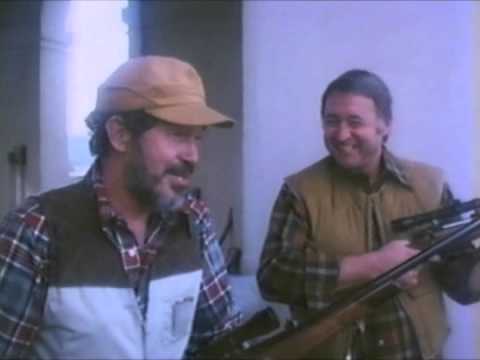
As for Warren Oates, he appears in an early skit.  He and Robert Ridgely (best known for playing Col. James in Boogie Nights) play hunters who take part in the Charles Whitman Celebrity Invitational, climbing to the top of the Tower on the University of Texas campus and shooting at the people below.  It’s even less funny now than it probably was in 1977.

How did Warren Oates end up in a movie like Prime Time?  Even great actors have bills to pay.  As for Prime Time, it is the one Warren Oates film that even the most dedicated Warren Oates fan won’t regret missing.

Warren Oates and Robert Ridgely in Prime Time

Warren Oates and Robert Ridgely in Prime Time

Film Review: Kid Blue (1973, directed by James Frawley)


KidBlueFor the past week and a half, I have been on a major Warren Oates kick.  The latest Oates film that I watched was Kid Blue, a quirky western comedy that features Warren in a small but key supporting role.

Bickford Warner (Dennis Hopper) is a long-haired and spaced-out train robber who, after one failed robbery too many, decides to go straight and live a conventional life.  He settles in the town of Dime Box, Texas.  He starts out sweeping the floor of a barber shop before getting a better job wringing the necks of chickens.  Eventually, he ends up working at the Great American Ceramic Novelty Company, where he helps to make ashtrays for tourists.

He also meets Molly and Reese Ford (Lee Purcell and Warren Oates), a married couple who both end up taking an interest in Bickford.  Reese, who ignores his beautiful wife, constantly praised Greek culture and insists that Bickford take a bath with him.  Meanwhile, Molly and Bickford end up having an affair.

Bickford also meets the local preacher, Bob (Peter Boyle).  Bob is enthusiastic about peyote and has built a primitive flying machine that he keeps in a field.  The town’s fascist sheriff, Mean John (Ben Johnson), comes across Bob performing a river baptism and angrily admonishes him for using “white man’s water” to baptize an Indian.

Bickford attempts to live a straight life but is constantly hassled by Mean John, who suspects that Bickford might actually be Kid Blue.  When Bickford’s former criminal partner (Janice Rule) shows up in town and Molly announces that she’s pregnant, Bickford has to decide whether or not to return to his old ways.

Kid Blue is one of a handful of counterculture westerns that were released in the early 70s.  The film’s biggest problem is that, at the time he was playing “Kid” Blue, Dennis Hopper was 37 and looked several years older.  It’s hard to buy him as a naïve naif when he looks older than everyone else in the cast.  As for Warren Oates, his role was small but he did great work as usual.  Gay characters were rarely presented sympathetically in the early 70s and counter-culture films were often the worst offenders.  As written, Reese is a one-note (and one-joke) character but Warren played him with a lot of empathy and gave him a wounded dignity that was probably not present in the film’s script.

Kid Blue plays out at its own stoned pace, an uneven mix of quirky comedy and dippy philosophy.  Still, the film is worth seeing for the only-in-the-70s cast and the curiosity factor of seeing Dennis Hopper in full counterculture mode, before he detoxed and became Hollywood’s favorite super villain.

o_kid-blue-dvd-dennis-hopper-warren-oates-5cdc

Film Review: Capone (1975, directed by Steve Carver)


capone-poster-1Over the course of his legendary career, filmmaker Roger Corman produced two films about the life of Al Capone.  The St. Valentine’s Day Massacre, which starred Jason Robards as the famous Chicago mobster and featured Jack Nicholson in a two-line role, is the one that everyone remembers.  The other one was simply titled Capone and starred Ben Gazzara.

Capone opens in 1918, with Al Capone as a cunning young criminal who cons his way into the trust of Chicago racketeers Johnny Torio (Harry Guardino) and Frankie Yale (John Cassavetes, appearing in two scenes and probably using his salary to produce The Killing of a Chinese Bookie).  The tough and streetwise Capone works his way up, becoming Torio’s right-hand man before eventually betraying his boss and taking over the Chicago rackets himself.  Al rules Chicago with an iron fist and has an affair with a flapper named Iris (Susan Blakely).  After killing nearly all of his enemies, Al is taken down on a tax evasion charge and, after contracting syphilis, he ends up a pathetic and lonely man, sitting by his pool and ranting about his enemies.

Despite being one of the few movies to depict Al’s final days, Capone makes little effort to be historically accurate.  Instead, it’s a gangster film in the tradition of Little Caesar, The Public Enemy, and both versions of Scarface, complete with nudity, tough talk, and plenty of tommy gun action.  (Since this is a Roger Corman film, Capone also features Dick Miller and footage that was lifted directly from St. Valentine’s Day Massacre.)  There is nothing surprising about Capone but it’s still entertaining.

Al Capone has been played by everyone from Rod Steiger to Robert De Niro to F. Murray Abraham.  Ben Gazzara may not have been the most subtle Capone but he was one of the most watchable.  Gazzara played Al Capone like a snarling animal, always ready to bite anyone who gets too close.  My favorite Gazzara moments come at the end of the film, when a syphilitic Capone bugs his eyes and starts to rave about Bolsheviks.

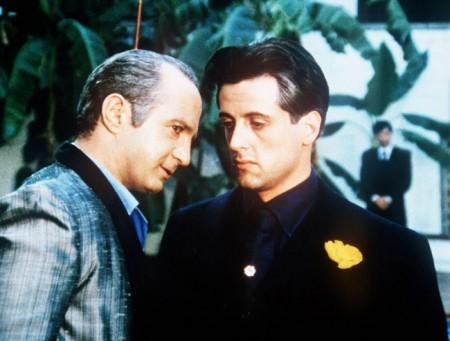
Today, Capone is best remembered for featuring Sylvester Stallone in the role of Frank Nitti, Al’s right-hand man and eventual successor.  One year later, Rocky would turn Stallone into a superstar and his days of working for Roger Corman would be over.

12839047-l


In Praise of Stripes’ Sergeant Hulka


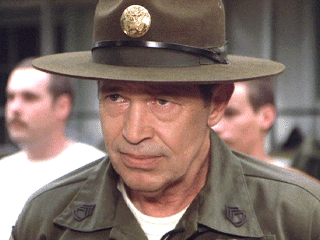
HulkaIn the army comedy Stripes, we never learn Sgt. Hulka’s first name but we do learn to never call him “sir.”  As Hulka himself puts it, “You don’t say sir to me, I’m a sergeant, I work for a living!”

It’s true.  Sgt. Hulka never stops working.  He’s the toughest drill sergeant this side of R. Lee Ermey and he’s going to turn this latest raw batch of recruits into a worthy collection of soldiers.  When he tells you to move, you’ll move fast.  When he tells you to jump, you’re going to ask, “How high!?”  And make no mistake. He don’t care where you come from, he don’t care what color you are, he don’t care how smart you are, he don’t care how dumb you are, ’cause he’s gonna teach every last one of you how to eat, sleep, walk, talk, shoot, shit like a United States soldier. Understand!?

I have lost track of how many times I have watched Stripes.  It’s one of my favorite comedies, a movie that can be quoted in almost every situation.  (“Lighten up, Francis.”)  Not only does it star Bill Murray and Harold Ramis at their anarchistic best but it also features everyone from John Candy to Judge Reinhold to John Larroquette.  Sean Young and P.J. Soles make for two of the sexiest MPs in military history.  But, for me, the best thing about Stripes is Sgt. Hulka and the man who played him.

Ironically, considering that he was famous for being a pot-smoking wild man who hung out with fellow anti-establishment rebels like Peter Fonda, Dennis Hopper, and Sam Peckinpah, Warren Oates played his share of no-nonsense military men.  (Oates actually had experience, having served in the Marines before becoming an actor.)  Of all the army roles that Warren Oates played, Sgt. Hulka is the best remembered.

And why not?  His performance in Stripes is a master class of good film acting.  Watch him as he does a stone-faced double take at the latest bit of insubordination from Murray and Ramis.  Watch the way he grins as he barks out his tough drill sergeant dialogue, hinting that Sgt. Hulka understands and has come to accept the lunacy of army life.  Originally, Hulka was supposed to be killed halfway through Stripes but both Warren Oates and his performance proved to be so popular with the film’s cast and crew that Hulka was given a reprieve.

Warren Oates and Bill MurrayIn Stripes, Sgt. Hulka accomplishes something that few other film characters have done.  He gets one over on Bill Murray.  After spending almost all of basic training dealing with John Winger (Bill Murray) and his bad attitude, Hulka confronts Winger in the latrine.  Hulka tells Winger that he’s concerned with “discipline and duty and honor and courage” and that Winger “ain’t got none of it!”  Hulka dares Winger to take a swing at him.  When Winger does it, Hulka floors him with one punch.

This is the only dramatic scene in Stripes.  It was so dramatic that nervous Columbia studio execs asked director Ivan Reitman to cut it.  Wisely, Reitman did not listen to them and the latrine scene is one of the best in the film.  When John eventually emerges as enough of a leader that he is able to invade Czechoslovakia in an armor-plated RV, we all know that it goes back to getting punched in the latrine.

(This was also the first “serious” scene that Bill Murray ever appeared in.  His subsequent work in films like Rushmore, Lost in Translation, and St. Vincent can all be linked back to that tense confrontation he played with Warren Oates.)

At the end of Stripes, Sgt. Hulka retires from the army and opens up a chain a Hulkaburger restaurants.  Here’s hoping that Sgt. Hulka had a happy retirement.  He earned it.

2013-07-04-warren_oates_sgt_hulka-533x299


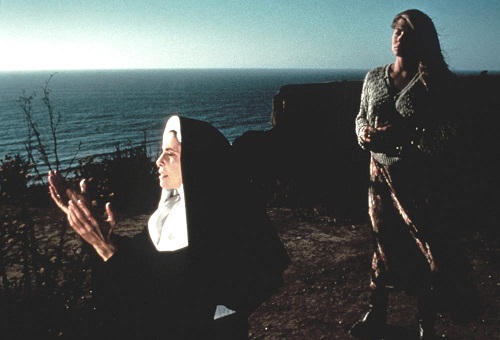
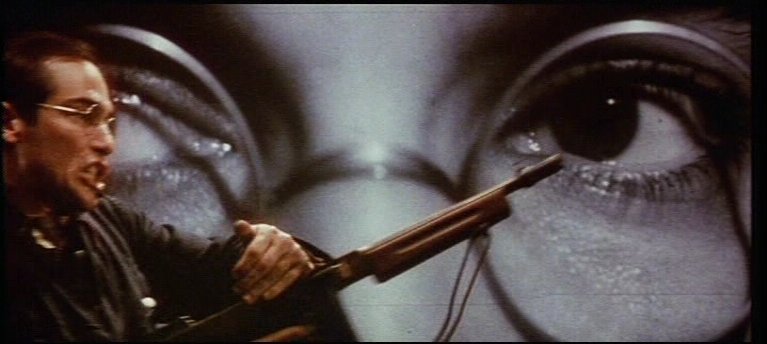
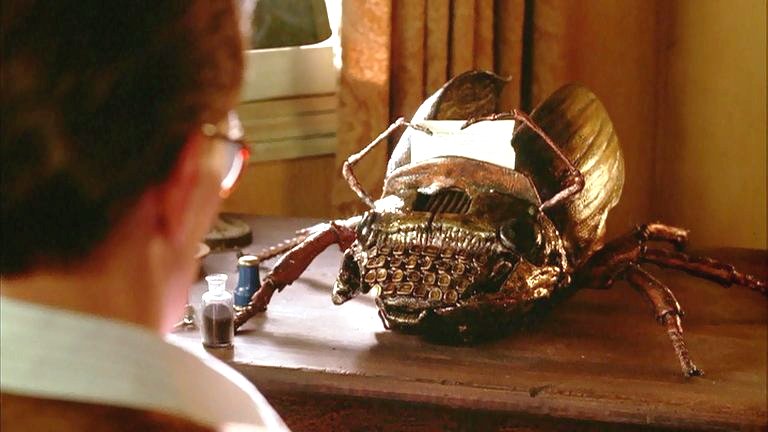
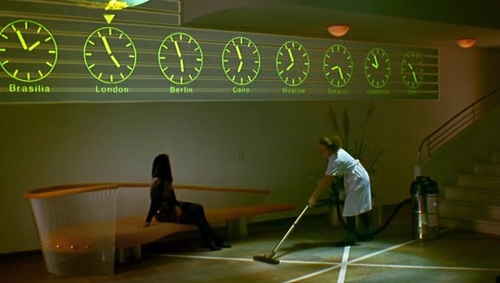
4 Shots From 4 Films: Cold Heaven, Europa, Naked Lunch, Until The End of the World


4 Shots From 4 Films

 Cold Heaven (1991, directed by Nicolas Roeg)

Cold Heaven (1991, directed by Nicolas Roeg)

Europa (1991, directed by Lars Von Trier, released as Zentropa in North America)

Europa (1991, directed by Lars Von Trier, released as Zentropa in North America)

Naked Lunch (1991, directed by David Cronenberg)

Naked Lunch (1991, directed by David Cronenberg)

Until the End of the World (1991, directed by Wim Wenders)

Until the End of the World (1991, directed by Wim Wenders)

Film Review: Chandler (1971, directed by Paul Magwood)


C1971chandler1handler (Warren Oates) is a former private investigator who quits his job as a security guard and gets back into the detective game.  An old friend of his, Bernie Oakman (Charles McGraw), hires Chandler to follow and protect a woman named Katherine Creighton (Leslie Caron).  Katherine is scheduled to testify against gangster John Melchior (Gordon Pinset) and Oakman tells Chandler that he believes Melchior may be planning on murdering her.  What Chandler does not know is that Oakman is being manipulated by a corrupt federal agent, Ross Carmady (Alex Dreier), who is planning on duping Chandler into killing Melchior so that Carmady can take over Melchior’s racket.  Though Chandler tries not to get emotionally involved in his cases, he ends up falling for Katherine.

In case you are keeping count, Chandler is the sixth Warren Oates film that I’ve reviewed this week.  Some of that is because TCM devoted all of Monday to showing his films but it’s also because Warren Oates was a really cool actor who died too soon and never got as much credit as he deserved.  Warren Oates combined the talent of a leading man with the face of a character actor and, as a result, he played some of the most memorable supporting roles of the 60s and 70s.  He was the tough guy who could talk a mile a minute and his upturned grin always showed up at the most unexpected of times.  Warren Oates brought humanity to outcasts and sympathy to villains.

Chandler is one of Warren Oates’s few leading roles.  Unfortunately, it’s not much of a showcase.  Director Paul Magwood and producer Michael Laughlin felt that the then-head of MGM, James Thomas Aubrey, interfered with the production of the film.  After the film’s release, Magwood and Laughlin took out a full-page, black-bordered ad in Variety that read:

Regarding what was our film Chandler, let’s give credit where credit is due. We sadly acknowledge that all editing, post-production as well as additional scenes were executed by James T. Aubrey Jr. We are sorry.

Chandler is a strange film to watch.  The plot is complicated but nothing really happens until the downbeat ending.  Much like Robert Altman’s far more successful The Long GoodbyeChandler tries to contrast the title character’s old-fashioned 1940s style and moral code with the 70s.  Chandler, who always wears a suit and drives an old car, is meant to be a man out of time.  Warren Oates does a good job, giving a Humphrey Bogart-style performance.  But since Chandler doesn’t seem to be sure what it is trying to say about either the 40s or the 70s, it’s all for naught.

Chandler is a forgettable film, one that is only worth watching for the rare chance to see Warren Oates as a leading man.

Warren Oates in Chandler

Warren Oates as Chandler


Film Review: There Was a Crooked Man… (1970, directed by Joseph L. Mankiewicz)


Crooked_manI first saw There Was A Crooked Man as a part of TCM’s tribute to the great actor Warren Oates.  Warren Oates was rarely cast in the lead but, as a character actor, he appeared in supporting roles in several great films.  Unfortunately, There Was A Crooked Man is not one of them.

Directed by Joseph L. Mankiewicz and written by the screenwriting team of Robert Benton and David Newman (best known for writing Bonnie and Clyde), There Was A Crooked Man is meant to be a comedic western.  Outlaw Paris Pittman (Kirk Douglas) is arrested while visiting a bordello.  Paris is sent to an Arizona prison, where everyone tries to get him to reveal where he has hidden the stash from a $500,000 robbery.  Pittman uses everyone’s greed to manipulate them into helping him attempt to escape.  Standing in Pittman’s way is the new warden, a liberal reformer played by Henry Fonda.

There Was A Crooked Man is a long movie that features a lot of familiar faces.  Burgess Meredith plays The Missouri Kid, who has been in prison for so long that he is now an old man.  Hume Cronyn and John Randolph play a bickering gay couple who eventually become a part of Pittman’s scheme to escape.  Even Alan Hale, the skipper from Gilligan’s Island, shows up as a guard named Tobaccy!  There Was A Crooked Man is a big movie but it’s also not a very good one.  It’s not serious enough to be a good drama but it’s not funny enough to be a good comedy either.

At least the movie has Warren Oates going for it.  Oates plays Harry Moon, a prisoner who is drafted into Pittman’s escape plot.  It is a typical Warren Oates supporting role but he steals every scene that he appears in.  Even in the smallest of roles, Warren Oates was worth watching and he’s the best thing about There Was A Crooked Man.

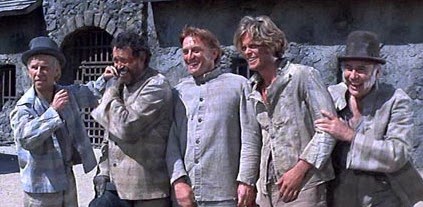
Hume Cronyn, Warren Oates, Kirk Douglas, Michael Blodgett, and John Randolph in There Was A Crooked Man

Hume Cronyn, Warren Oates, Kirk Douglas, Michael Blodgett, and John Randolph in There Was A Crooked Man

Film Review: Badlands (1973, directed by Terrence Malick)


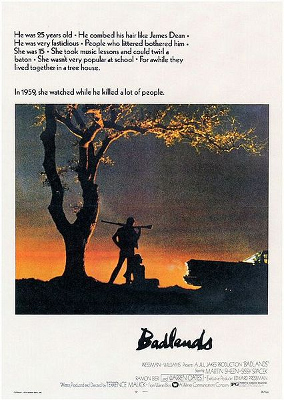
Badlands_movie_posterTerrence Malick is such an influential director that it is easy to forget that he has only directed nine films over the past 42 years.  (One of those ten, Knight of Cups, will be released later this year.  Two other are currently in postproduction.)  He has received Oscar nominations for The Thin Red Line and The Tree of Life but, for me, Malick’s best work remains his directorial debut, Badlands.

Badlands is based on the real-life murder spree of Charles Starkweather and his girlfriend, Caril Ann Fugate.  In 1958, 20 year-old Starkweather murdered 11 people in Nebraska and Wyoming.  14 year-old Fugate was with Starkweather at the time of the murders but has always claimed that she was Starkweather’s hostage.  After the two of them were captured, Starkweather was sent to the electric chair while Fugate served 17 years of a life sentence.

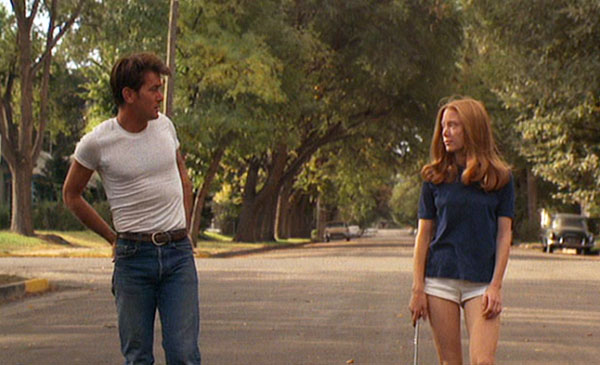
In Badlands, 25 year-old Kit (Martin Sheen) is a garbage man who has a huge chip on his shoulder.  One day, Kit spots 15 year-old Holly (Sissy Spacek) outside, twirling a baton.  Kit starts to talk to Holly, who thinks that he looks like her favorite actor, James Dean.  Kit and Holly start dating.  Holly’s father (Warren Oates), a sign painter who has never recovered emotionally from the death of his wife, tells Kit to stay away from his daughter.  After Kit murders her father, Holly joins him in fleeing from the scene of the crime.  With the police and bounty hunters chasing them, the two young lovers head across the midwest and leave a trail of bodies in their wake.

Badlands sticks pretty close to the facts of the real-life Starkweather/Fugate case but, at the same time, it is definitely the product of Terrence Malick’s artistic vision.  It is interesting to see how, even in his first film, Malick was already exploring the themes and using the techniques that would later distinguish both The Thin Red Line and The Tree Of Life.  Like those two films, Badlands is full of majestic scenery, contrasting the beauty of nature with the ugliness of humanity.  Like all Malick films, Badlands also features a narrator.  Holly tells us her story but, in contrast to the philosophical narrators from Malick’s later films, Holly speaks exclusively in romantic clichés and delivers her narration in a flat, unemotional style.

badlands-1973-starkweather-holly-kit-martin-sheen-sissy-spacek

When we first see Holly, her white shorts, blue shirt, and red hair add up to an all-American tableau.  When Holly falls in love with Kit because of his resemblance to James Dean and then either justifies or ignores every destructive thing that he does, she is predicting the rise of our current celebrity-dominated culture.  Meanwhile, Kit is so determined to be James Dean that he even imitates Dean’s performance from Rebel Without A Cause while talking to the police.

Badlands is one of Malick’s most accessible films.  Sissy Spacek is amazing as the childlike Holly and Martin Sheen has probably never been better than in his role here.  And, of course, you have the great Warren Oates in the small but crucial role of Holly’s harsh father.  Badlands is an American classic and still the best film of Terrence Malick’s legendary career.