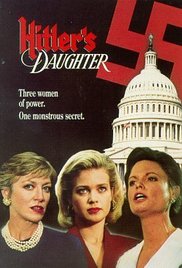
A Movie A Day #65: Hitler’s Daughter (1990, directed by James A. Contner)


Ted Scott (Patrick Cassidy), a White House press aide, is contacted by his former professor, Dr. Bauman (Donald Davis).  Bauman gives Ted a file that he claims will prove that not only did Adolf Hitler have a daughter but she was subsequently smuggled into America and is now on the verge of occupying the White House.  Ted thinks that Bauman’s crazy but then Bauman is murdered and Ted is framed for the crime.  With both the police and the bad guys after him and with time running out, Ted must now figure out who is Hitler’s daughter.  Is it Sharon Franklin (Melody Anderson), the famous TV anchorwoman who is having an affair with a Senator?  Is it Patricia Benedict (Veronica Cartwright), the wife of the Vice President?  Or is it Senator Leona Crawford Gordon (Kay Lenz), who has just been put on the opposition party’s presidential ticket?

Hitler’s Daughter was originally made for the USA Network and, throughout the 1990s, it would frequently air late at night.  As far as the film’s quality is concerned, Kay Lenz was beautiful as ever but otherwise, Hitler’s Daughter was a typically forgettable low-budget made-for-tv thriller, complete with bad guys who can shoot everyone but the main character, exploding cars, and villains who carefully explain their plans before trying to kill the heroes.  It does end on a down note, with almost everyone dead.  This probably seemed edgy in 1990 but it seems predictable today.  Exactly ten years after this otherwise forgotten movie aired, Hitler’s Daughter was briefly again in the public spotlight a group of online conspiracy nuts claimed that Hillary Clinton was trying to suppress the movie’s release on video would harm her chances of getting elected to the Senate.

Far better than the movie is the novel on which it was based.  Written by Timothy B. Benford, the literary Hitler’s Daughter is an entertaining and enjoyably pulpy page turner.  Benford was the former police commissioner of Mountainside, New Jersey when he wrote Hitler’s Daughter in 1983 and the book touched with an nerve with at least a few readers.  According to a story in The New York Times, shortly after the novel was published, Benford woke up to discover a wooden swastika burning on his front lawn.  The movie stick closely to the book’s plot but never translates what worked on the page to the screen.
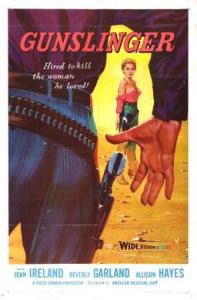
A Movie A Day #64: Gunslinger (1956, directed by Roger Corman)


gunslinger_posterWelcome to Oracle, Texas.  It’s a dusty little town in the old west.  Marshal Scott Hood (William Schallert) may uphold the law but everyone knows that the town is actually run by Erica (Allison Hayes), the owner of the local saloon.  Erica knows that a railroad may be coming to town so she comes up with a plan to buy all the land around Oracle.  She sends her lackey, Jake (Jonathan Haze), to each landowner.  Jake buys the land then murders the landowner so that he can get the money back.
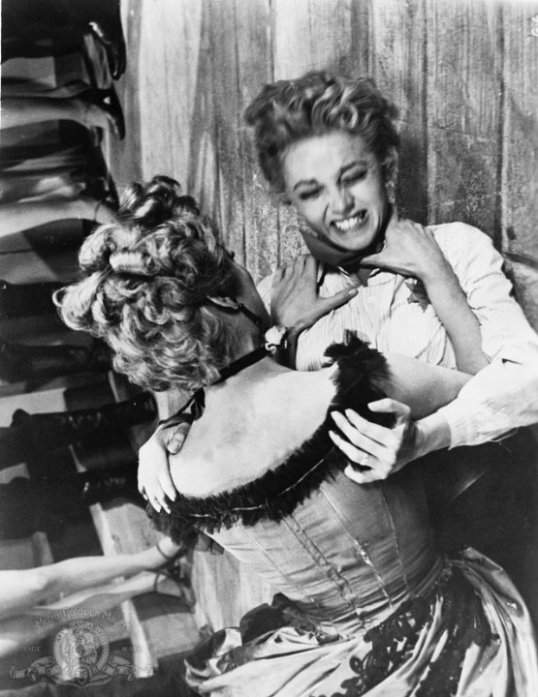
When Scott is gunned down by two outlaws, his widow, Rose (Beverly Garland), takes over as temporary marshal.  Rose has two weeks until the new marshal arrives but that is just enough time for nearly everyone in town to get killed.  It starts when Rose orders Erica to close her saloon at three in the morning.  Erica loses the epic catfight that follows so she hires her former lover, Cane Miro (John Ireland), to come to town and kill Rose.  Cane is more interested in killing the town’s mayor (Martin Kingsley), a former Confederate who abandoned Cane and his brothers to Union forces during the Civil War.  Even more complications arise when Cane and Rose fall in love.

Roger Corman has described Gunslinger as being his most miserable experience as a director.  He filmed it in six days and it rained for five of them, causing cameras and lights to sink into the mud.  Both Allison Hayes and Beverly Garland were injured during filming, with Hayes breaking her arm after falling off a horse and Garland spraining her ankle while running down the stairs of the saloon.  During the filming of an outdoor love scene, both Ireland and Garland were attacked by fire ants.

Gunslinger is usually savaged by reviewers and it was featured on an early episode of Mystery Science Theater 3000.  But how can any film be that bad if it features an epic cat fight between Beverly Garland and Allison Hayes?  Gunslinger is proof that Beverly Garland and Allison Hayes were actress who could make something entertaining out of even the least inspiring material. Garland gives a serious, heartfelt performance while Hayes goes all out as evil Erica.  Years before he played Seymour in Corman’s Little Shop of Horrors, Jonathan Haze is intensely weird as Jake. As with many Corman films, part of the fun is watching for members of the Corman stock company, like Dick Miller and Bruno VeSota, in small roles.   Gunslinger may not be a classic but I like it.

9ae25d8b1273fa14bdeb9fa58ff79235

A Movie A Day #63: Showdown (1973, directed by George Seaton)


showdown_1973_film

Stop me if you’ve heard this one before.

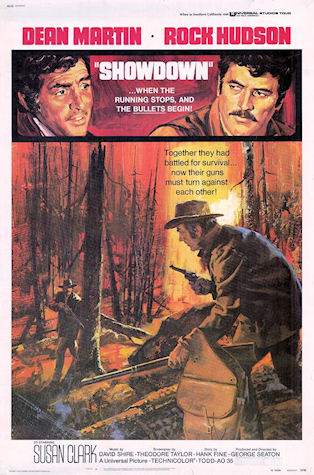
The time and the place is the old west.  Growing up, Chuck Jarvis (Rock Hudson) and Billy Massey (Dean Martin) were best friends.  When the lovely Kate (Susan Clark) chose Chuck over Billy, the two of them go their separate ways.  Billy becomes a notorious train robber.  Chuck becomes the sheriff of their hometown.  After Billy returns home, it is up to Chuck to not only capture him but to also protect him from not only his former partners but a gang of vigilantes as well.

There’s nothing surprising about Showdown, a strictly by the numbers western that, if not for a few bloody gunshot wounds and some dialogue about cattle “humping,” could have just as easily been released in 1953 as 1973.  The only thing that makes Showdown special is that it was the last western made by both Rock Hudson and Dean Martin.  Dino is his usual fun-loving, half-soused self but Rock Hudson looks absolutely miserable here.  If Rock’s role had been played by Frank Sinatra (or even Peter Lawford), Showdown would probably be remembered as a minor classic.  As it is, it’s for Dean Martin completists only.


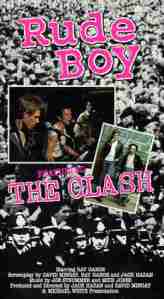
A Movie A Day #62: Rude Boy (1980, directed by Jack Hazan and David Mingay)


rude_boy_filmLondon.  1980.  Ray (Ray Gange) is an alcoholic who lives in a council block, one that is decorated by the type of racist graffiti that, years later, is still a distressingly common site in London.  Ray spends his days working at a Soho sex shop and his nights drinking.  One night, at the pub, he drunkenly shares his opinion that politics is all “bollocks.”  The man that Ray is talking to is Joe Strummer of The Clash.  Soon, Ray (whose sympathies make him a natural supporter of the National Front) is a roadie for punk rock’s most prominent socialists.  “I’m watching you!” Mick Jones snarls at Ray.  At another point, he yells at Ray to “Get off the fucking stage!” during a show.  The perpetually drunk Ray struggles with even the slightest of duties but he loves The Clash, even though they seem to hate him.
Rude Boy is an odd one and, watching it, it’s not surprising to learn The Clash subsequently disavowed the movie.  Whenever The Clash are off-stage, they simply do not come across well.  For a proponent of world revolution, Mick Jones seems a little too comfortable with his role as a decadent rock star.  Joe Strummer, one of the most incendiary political lyricists of all time, struggles to articulate his views whenever he’s not performing and is often reduced to mumbling clichés about the people’s struggle.  Fortunately, the majority of Rude Boy is taken up by footage of The Clash performing, whether in the studio recording Give ‘Em Enough Rope or on tour or at a Rock Against Racism concert.  The footage of The Clash performing is never less than amazing, though it is easy to see what Johnny Lydon meant when he complained that The Clash were so high energy and undisciplined that they always burned themselves out three or four songs into a show.

As for the rest of the movie, it was largely improvised, with only a few scripted scenes.  While I think Rude Boy would have made a stronger statement if it had just been a straight concert film, its documentary style does capture the bleak lives of despair that inspired a thousand punk songs.  Because of Rude Boy‘s uneven structure, the life of Ray the Roadie may not seem to add up to much, especially when compared to everything else going on around him.

Maybe that was the point.

A Movie A Day #61: Kickboxer (1989, directed by Mark DiSalle and David Worth)


kickboxer_poster

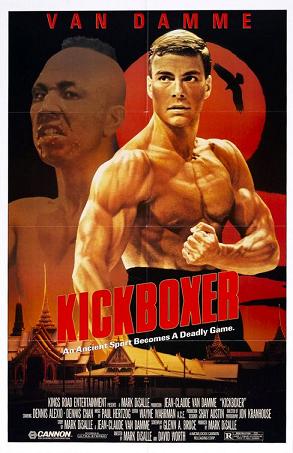
Of the second tier action stars of the late 80s and 90s, Jean-Claude Van Damme was perhaps the best.  Dolph Lundgren may have been a better actor but he could not match Van Damme’s athleticism.  Steven Seagal, in the years of before the weight gain, was rumored to be a more authentic martial artist but everyone knew he was also an asshole and couldn’t act worth shit.  Van Damme was always fun to watch, especially if you were a kid at the time his movies were in the theaters or showing up on a cable.  Everyone wanted to be Jean-Claude Van Damme after watching one of his best movies.  So what if he was a stiff actor with a thick accent?  That hadn’t hurt Schwarzenegger or Stallone.

Kickboxer was the film that introduced most people to Van Damme.  Kurt Sloane (Van Damme!) is the cornerman for his brother, Eric (Dennis Alexio), America’s kickboxing champion.  Eric is lured to Thailand to fight the viscous Tong Po (Michel Qissi, a childhood friend of Van Damme’s).  How evil is Tong Po?  He is so evil that, when Kurt tries to throw the towel and end the fight, Tong kicks the towel out of the ring.  That’s evil!

What are you doing here, Duke!?

What are you doing here, Duke!?

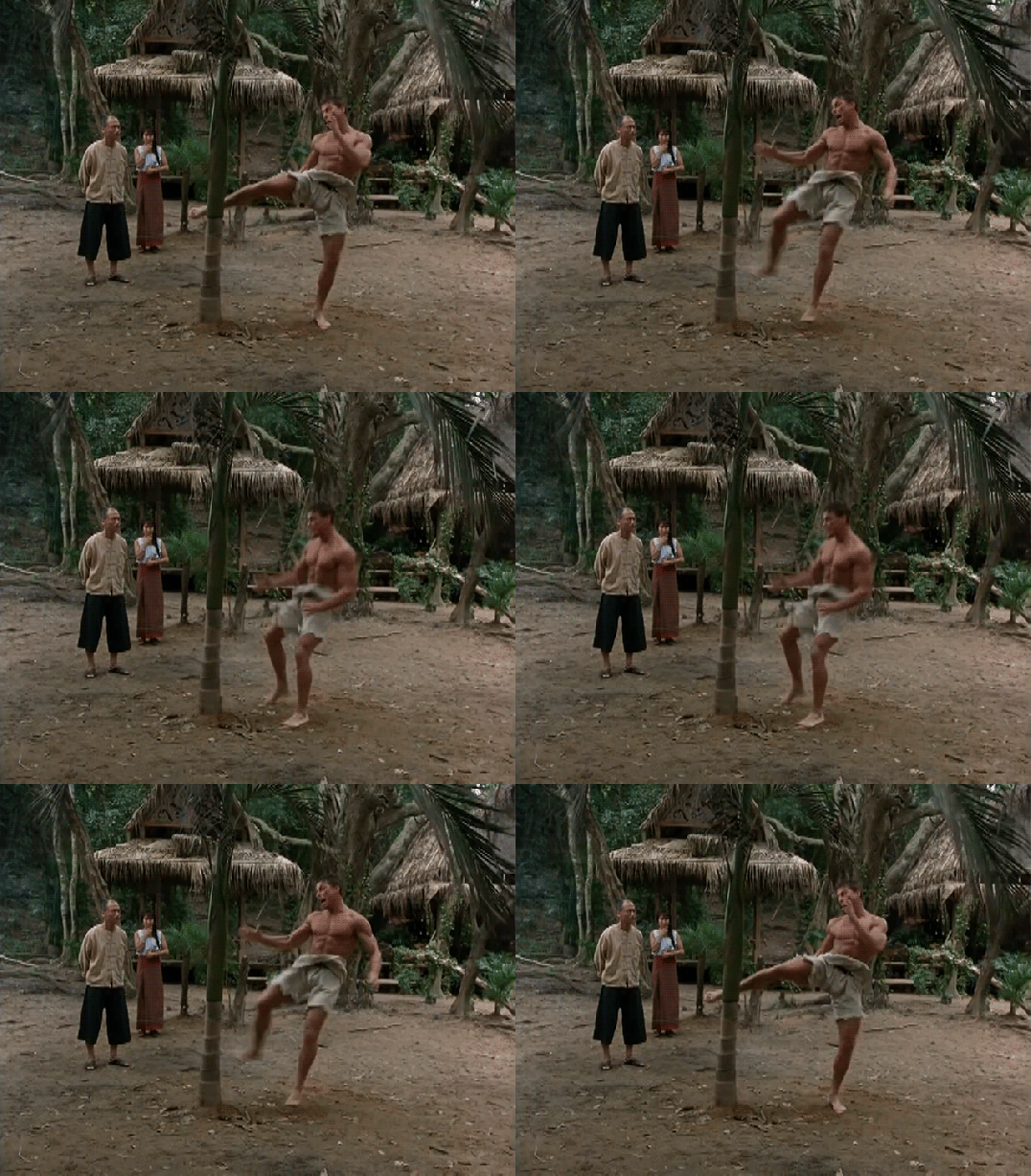
After the fight leaves Eric crippled, Kurt gets revenge the only way he can.  He enters the ring and takes on Tong Po, himself!  They fight the ancient way, with both of their hands covered with broken glass.  When you’re 12 years old and watching an R-rated film on HBO, that is really cool.  Of course, before Kurt can enter the ring, he has to go through a training montage with Xian Chan (Dennis Chan) and fight off Tong Po’s sponsor, local gangster Freddy Li (Ka Ting Lee).

Rewatching Kickboxer, I saw it was even more predictable than I remembered.  At the same time, it was impossible not to, once again, get caught up in that final fight between Kurt and Tong Po.  The montages may have been silly.  The soundtrack may have been cheesy.  Van Damme may have been even more uncertain of an actor than I remembered but it did not matter.  Kickboxer may be dumb but it’s still really cool.  Within a few minutes of watching Kickboxer, I was a kid again and I was having the time of my life.

As for Jean-Claude Van Damme, he went through some well-publicized troubles but he emerged from it all as a far better actor.  Just check out JCVD if you get the chance.

jean-claude-van-damme

A Movie A Day #60: Outland (1981, directed by Peter Hyams)


outlandIt’s High Noon in space!

In the future, Marshal O’Neil (Sean Connery) has been hired, by Conglomerates Amalgamated, to enforce the law on a mining outpost that’s located on one of the moons of Jupiter.  Why are all the miners going crazy, taking off their spacesuits, and exploding?  Are they being hypnotized by that big red spot on Jupiter?  Or is the mining supervisor, Sheppard (Peter Boyle), forcing his workers to take amphetamines that cause them to have psychotic episodes?  O’Neil suspects the latter so Sheppard summons three intergalactic gunslingers to come and kill the marshal.  With no one, except for the outpost’s doctor (Frances Sternhagen), willing to stand behind him, O’Neil must stand up to three gunmen by himself.

The comparison between High Noon and Outland is obvious but the movie also owes much to Alien.  With its corrupt corporation, claustrophobic sets, and its blue-collar space workers, Outland seems like it could be taking place in the same movie universe as the Alien movies.  Like a lot of the films that Peter Hyams has directed, Outland is ambitious but slow.  It is never as much fun as something like Moon Zero Two.  The best thing about Outland is Sean Connery, convincingly cast as Gary Cooper in space.

A Movie A Day #59: Moon Zero Two (1969, directed by Roy Ward Baker)


moon_zero_two

Earlier today, I was reading a now-deleted tweet from Congressional candidate Brianna Wu, in which she speculated that private companies would militarize the moon and use it as a place to launch rocks at the Earth.  According to Wu, “Rocks dropped from there (the moon) have power of 100s of nuclear bombs.”

This, of course, immediately brought to mind Moon Zero Two, a “space western” that Hammer Films produced in the wake of 2001: A Space Odyssey.

The year is 2021 and the moon is being colonized by private companies.  The Americans and the Russians have made peace and now jointly run the Moon Hilton.  Bill Kemp (James Olson) was one of the first men in the moon but, having grown disillusioned with working for heartless corporations, Kemp is now an independent operator, salvaging meteorites with his Russian partner, Korminski (Ori Levy).  With his flight license about to be revoked by his enemies in the Corporation, Kemp has been grounded by his own girlfriend, Sheriff Elizabeth Murphy (Adrienne Corri).

Possible financial salvation comes when Kemp is hired by J. J. Hubbard (Warren Mitchell) to help him illegally salvage a sapphire asteroid that is orbiting the far side of the moon.  At the same time, a young woman named Clementine (Catherine Schell, who later starred in another science fiction epic about the moon, Space: 1999) wants Kemp to help her search for her brother, who went missing while also working on the far side of the moon.

Moon Zero Two starts with some Schoolhouse Rock-style animation that shows how the U.S. and the Russians originally landed on the moon:

Though the animated opening seems more appropriate for an Ealing comedy, the rest of Moon Zero Two is a fairly straight western, with claim jumpers, shootouts, and a few moments of comedy coming from the story being set on the moon instead of Arizona.  For instance, there’s a barroom brawl that takes place in zero gravity.  Even while paying homage to old westerns, Moon Zero Two also tries to predict the future, which looks a lot like 1969.  This means psychedelic costumes and a Vegas style dance revue at the Moon Hilton, one that is reminiscent of the USO show in Apocalypse Now.  The mix of styles is enjoyably absurd and everyone seems to be having fun playing cowboy.

vlcsnap-00005

James Olson is the token American in the cast but, for fans of British comedy, the most interesting thing about Moon Zero Two will be seeing Warren Mitchell, who played Alf Garnett in Til Death Do Us Part and inspired All In The Family‘s Archie Bunker, playing ruthless claim jumper, J. J. Hubbard.  Hubbard’s main henchman is played by Bernard Bresslaw, who some viewers may recognize from the Carry On films.  Also, Monty Python fans will want to keep an eye out for Carol Cleveland, who has a very small role as a stewardess.

Years after it was first released, Moon Zero Two was one of the first movies to be featured on Mystery Science Theater 3000.  This was one of the earliest episodes, from before even TV’s Frank joined the show.  I have not seen the MST 3K version but it is available both on YouTube and as a part of Shout Factory’s 25th Anniversary Box Set.

Here’s an artist’s rendering of Crow and Tom Servo having a Moon Zero Two-style shootout.

moonzero2dvd

Tomorrow’s movie a day will be another space western, Peter Hyams’s Outland.

c5vlntuu4aariuy

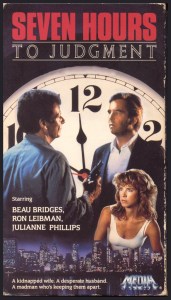
A Movie A Day #58: Seven Hours to Judgment (1988, directed by Beau Bridges)


7hrs_to_judgement-frntWhen I saw that Erin has picked Judge Not My Sins for her artwork of the day, I was reminded of Seven Hours to Judgment, a movie that used to occasionally show up on HBO.

David Reardon (Ron Liebman) owns an electronics store and is professionally known as “Crazy Dave.”  When three gang members, led by Chino (Reggie Johnson), are arrested for pushing Dave’s wife off of a subway platform, it looks like the legal system might let them go.  Because Dave’s wife is in a coma, she cannot testify that they pushed her.  However, Dave has tracked down a witness who saw what Chino did.  But the witness is not immediately available to testify.  Dave begs Judge John Eden (Beau Bridges) for an extension but the judge is one of those bleeding heart, by-the-book types.  Even though he believes Chino to be guilty, Judge Eden dismisses the case.  At the same time, Dave’s wife dies and Crazy Dave starts to live up to his nickname.

With the help of one of his employees, the hulking and child-like Ira (Tiny Ron), Dave kidnaps both Judge Eden and his wife (Julianne Phillips).  Dave tells Judge Eden that he has seven hours to track down the witness and get the evidence that would have convicted Chino.  If Eden doesn’t find the evidence, his wife will be blown up.  Judge Eden is dumped in the worst part of town, without any money, identification, or credit cards.  Dave tells him, “You helped create these streets!”

The rest of the movie is Eden running through the mean streets of wherever the movie is supposed to be taking place.  (It was filmed in Seattle but the city is never specifically named.)  Everyone who meets Eden tries to beat him up, which is one way to put a judge who is soft on crime in his place.  The only person who doesn’t beat up Eden is a homeless woman who licks his face.  Soon, Eden even has Chino after him.  The normally laid back and affable Beau Bridges isn’t usually thought of as being an action star and this movie shows why.  Judge Eden is such a wuss of a hero that it seems appropriate that he eventually has to hitch a ride in the back of a garbage truck.

Along with the miscasting of Beau Bridges, the other major problem with Seven Hours to Judgment is that it requires us to believe that Dave, even if he is “crazy,” could come up with such an intricate and elaborate plan and set it all up within just a few hours of his wife dying and Chino being released.  “Smug liberal get mugged by reality” was a successful theme for many low-budget action films in the 1980s but Seven Hours to Judgment is ultimately just as dumb and implausible as it sounds.

Seven Hours to Judgment was a reunion for Leibman and Bridges, who previously co-starred in an excellent and overlooked road movie called Your Three Minutes Are Up.  For some reason, Beau Bridges also directed Seven Hours to Judgment.

A Movie A Day #57: Here Comes The Navy (1934, directed by Lloyd Bacon)


here_comes_the_navy_posterLisa asked me to review an old best picture nominee for today’s movie a day so I picked Here Comes The Navy, because hardly anyone has ever heard of it and I usually like old service comedies.

Chesty O’Connor (James Cagney) is a construction worker who thinks that he is tougher than anyone in the Navy.  When Chesty gets into a fight with Chief Petty Officer Biff Martin (Pat O’Brien), Chesty enlists in the Navy just to get on his nerves.  Chesty brings his friend Droopy (Frank McHugh) with him.  With Biff determined to force him out of the service, Chesty bristles against the rules of the Navy.  But then Chesty meets and falls in love with Dorothy (Gloria Stuart), Biff’s sister.  Chesty loses his bad attitude, proves that his shipmates can depend on him, saves Biff’s life when an airship landing goes wrong, and even gets to marry Biff’s sister.

Here Comes The Navy is a typical 1930s service comedy, distinguished mostly by the wiseguy presence of James Cagney.  It is the type of movie where men have names like Chesty, Biff, and Droopy.  Warner Bros. made a hundred versions of this story and Here Comes The Navy was certainly one of them.

Here Comes The Navy was produced with the full cooperation of the U.S. Navy, so it’s not surprising that it feels like a recruiting film.  The sailors are all happy to do their bit to protect the American way of life and the commanding officers are all tough but fair.  The majority of the movie was filmed on the USS Arizona, which would be sunk seven years later during the Japanese attack on Pearl Harbor.  Here Comes The Navy also features some scenes shot on the USS Macon, an airship that would crash a year later.

It’s hard to guess how Here Comes The Navy came to be nominated for best picture.  It’s okay but, for the most part, it’s for James Cagney completists only.


A Movie A Day #56: The White Buffalo (1977, directed by J. Lee Thompson)


whitebuffalo1977The year is 1874 and James Otis (Charles Bronson) is traveling through the Dakota Territory.  Everywhere that James Otis goes, someone tries to shoot him.  This is because James Otis is actually the infamous Wild Bill Hickcock and everyone this side of Deadwood has a reason to want him dead.  Hickcock has returned to the territory because he is losing his eyesight and he fears that he may be dying.  Hickcock has been having nightmares about a giant albino buffalo and believes that it is his destiny to either kill it or be killed himself.

Meanwhile, a young indian chief (Will Sampson) is also seeking the White Buffalo.  The buffalo previously attacked his village and killed his son.  The chief must now get revenge or lose his power in the tribe.  He is now known as Worm.  Before the buffalo attack, his name was Crazy Horse.

Crazy Horse eventually teams up with Hickcock and a one-eyed hunter named Charlie Zane (Jack Warden).  They work out an uneasy alliance but who, of the three, will finally get the chance to kill the buffalo?

When Dino De Laurentiis produced The White Buffalo, he was hoping to combine the popularity of Jaws with the star power of Charles Bronson.  It should have been a hit but instead, The White Buffalo was one of the many flops that temporarily killed the western as a commercial genre.  (Before there was Heaven’s Gate, there was The White Buffalo.)  The reason why is obvious: while audiences loved to watch Bronson shoot muggers in New York, they were less willing to sit through a pseudo-intellectual western version of Moby Dick that featured more conversation than gunplay.  The obviously fake buffalo did not help matters.

I still like The White Buffalo, though.  Because of the movie’s cheap sets, fake snow, and some inconsistent rear projection work, The White Buffalo is sometimes so surreal that it could pass for a Spaghetti Western.  (When I saw Bronson, Sampson, and Warden huddled in a cardboard cave while it fake snowed outside, I immediately thought of Sergio Corbucci’s The Great Silence.)  Charles Bronson, always an underrated actor, gave one of his best performances as the haunted Hickcock.  The White Buffalo was, up until his small role in Sean Penn’s The Indian Runner, the last time that Bronson would allow himself to appear as anyone other than Charles Bronson on-screen.

When watching The White Buffalo, keep an eye out for several Hollywood veterans in minor roles.  Kim Novak plays a prostitute.  Stuart Whitman is a thief.  Slim Pickens drives a stagecoach.  Clint Walker’s an outlaw and Ed Lauter plays the younger brother of Gen. Custer.  The town’s undertaker is John Carradine.  The cameos don’t add up too much but it’s still good to see everyone.