 Travis Graham (Stephen Baldwin, before he found God) is a doofus who owns a farm. His late father sent all of the family’s money to a crooked televangelist but he did leave Travis a valuable coin collection. But then two blondes enter his life. Kelly Ann (Jennifer Rubin) is a penniless hitchhiker who needs a place to stay and a bed to sleep in. Jolene (Patsy Kensit) is a British realtor who says she wants to help Travis sell his farm. Faster than you can say “I don’t know the exact pronunciation but I believe it’s ménage à trois,” that’s exactly what happens. Travis can’t believe his luck but it turns out that Kelly Ann and Jolene have plans of their own. Then, in a strangely unrelated subplot, a banker robber who shot the local sheriff (M. Emmett Walsh) shows up at the farm. Travis kills the bank robber but then Kelly Ann and Jolene start pressuring him to use the robber’s plan to rob a bank himself.
This is one of the many strange movies from the increasingly strange career of Stephen Baldwin. Now that he’s best known for evangelizing and appearing in celebrity-themed reality shows (including, most infamously, two seasons of The Celebrity Apprentice), it is easy to forget that Stephen Baldwin was once a good character actor who, with the exception of The Usual Suspects, apparently could not pick a good script if his life depended upon it. His performance as the socially backward Travis is often strange (at times, he seems to be channeling Lenny from Of Mice and Men) but always interesting. Fans of 90s neo-noir will also be happy to see Delusion’s Jennifer Rubin, playing yet another mysterious and dangerous temptress. Unfortunately, Bitter Harvest falls apart because of an implausible script and too many loose ends but, until it does, the sultry combination of Jennifer Rubin and Patsky Kensit keeps things watchable.
One final note: The sheriff’s son is played by Adam Baldwin. Even though the two are not actually related, everyone in the 90s assumed that they were and this makes Bitter Harvest a double Baldwin film.
 George O’Brien (Jim Metzler) is a former executive at a San Diego computer company who is driving across Nevada. He is heading to Reno, where he plans to set up a company with the embezzled millions that he has hidden in his trunk. When he spots former Vegas showgirl Patti (Jennifer Rubin) standing on the side of the road, he stops to pick her up. She explains that her car broke down and she needs a lift. George is happy to give her a ride. The only problem is that Patti is traveling with her boyfriend, Chevy (Kyle Secor). At first, Chevy just seems to be a goofy guy who talks too much. However, Chevy is actually a hitman, traveling to Vegas to kill a gangster (Jerry Orbach). After the hit, Chevy abandons George in the desert and steals his car. Determined to get his money, George pursues Chevy and Patty across the desert.
 Monroe (C. Thomas Howell) is a young lawyer who moves to California and gets a job working for his Uncle Max (Terry Kiser). Max wants Monroe to concentrate on evicting beach bums. Monroe wants to play beach volleyball. Together, they solve crimes. No, actually, Max orders Monroe to evict Zack (Peter Horton), a former volleyball champion who was once “king of the beach.” Zack agrees to coach Monroe and his goofball friend, Wiley (Christopher Rydell) in a volleyball tournament. But when Zack misses a match because he is having underlit, PG-13 sex with his ex-wife (Harley Jane Kozak), uncoached Monroe accidentally breaks Wiley’s arm. Now, Zack has to step in as Monroe’s partner and reclaim his status as king of the beach!
 Sometimes, you watch a movie and all you cay say, at the end, is “What the Hell were they thinking?”
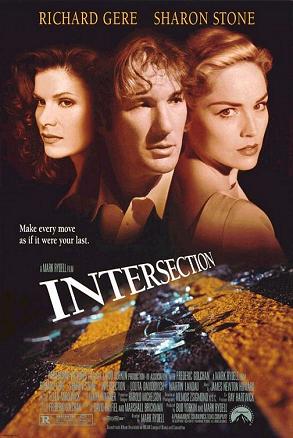 This one is just dumb.
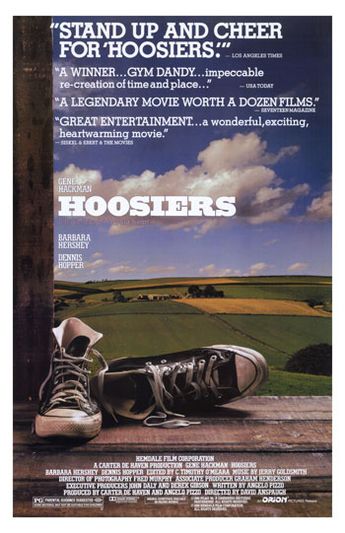 In 1951, Norman Dale (Gene Hackman) arrives in the small Indiana town of Hickory. He is a former college basketball coach who has been hired to coach the high school’s perennially struggling basketball team. Emphasizing the fundamentals and demanding discipline from his players, Dale struggles at first with both the team and the townspeople. When he makes an alcoholic former basketball star named Shooter (Dennis Hopper) an assistant coach, he nearly loses his job. Eventually, though, the Hickory team starts winning and soon, this small town high school is playing for the state championship against highly favored South Bend High School.
 Edward Furlong is Ron Decker, a spoiled 18 year-old from a rich family who is arrested and sent to prison when he’s caught with a small amount of marijuana. Being younger and smaller than the other prisoners, Ron is soon being targeted by everyone from the prison’s Puerto Rican gang to the sadistic Buck Rowan (Tom Arnold). Fortunately, for Ron, prison veteran Earl Copen (Williem DaFoe) takes him under his wing and provides him with protection. Earl is the philosopher-king of the prison. As he likes to put it, “This is my prison, after all.” If he can stay out of trouble, Ron has a chance to get out early but, with Buck stalking him, that’s not going to be easy.
 Seven strangers are invited to a remote island by a mysterious billionaire named Osiris. There is a doctor, a dancer, an auto mechanic, a mercenary, a football player and his agent, and a member of the Yakuza. The auto mechanic points out that, in Egyptian mythology, Osiris judged mankind’s sins. For some reason, none of the seven think twice about going to the island but, once they arrive, they soon discover that they should have. Osiris is willing to give them seven million dollars but to get it, they have to reach the other end of the island without being killed by Osiris or his men.
 Through the Shattered Lens