Movie A Day #178: Kinjite: Forbidden Subjects (1989, directed by J. Lee Thompson)


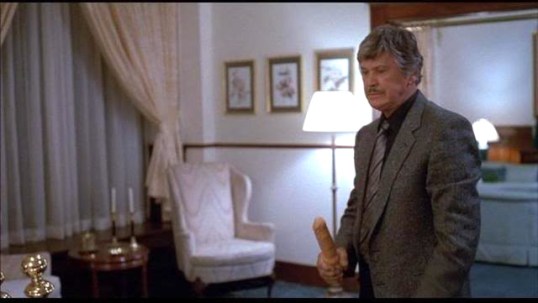
This is the one where Charles Bronson sodomizes a guy with a dildo.

Don’t worry, though.  Bronson does it off-screen and the guy was abusing Nicole Eggert so he had it coming.

In Kinjite, Bronson plays Lt. Crowe, a tough LAPD vice cop who hates two groups of people: pedophiles (which is cool, who doesn’t hate them?) and the Japanese (which is not cool).  Not only does Crowe sodomize a pervert but he also forces a pimp to eat a gold watch and later, with the help of his partner, he holds another man over the edge of a balcony, just to have that man accidentally slip out of his shoes and plunge to his death.  Finally, Crowe tosses a convict into a prison cell, where another prisoner (played by Danny Trejo, in what may have been his film debut) announces that he’s “got something big and long for you.”  Crowe chuckles, “That’s justice” and then walks away.
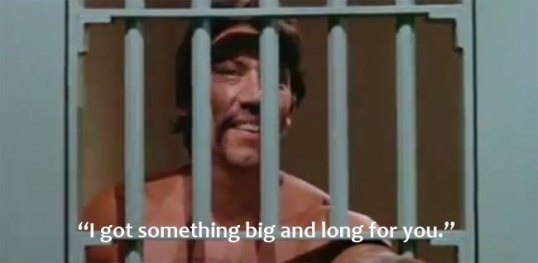
Danny Trejo in Kinjite

Of the many strange films that Bronson made for Cannon Films, Kinjite may be the strangest.  The main plot involves Crowe searching for and rescuing the kidnapped daughter of a Japanese businessman (James Pax).  Before his daughter was kidnapped, the businessman groped Crowe’s fifteen year-old daughter on a city bus.  The entire movie seems to be building up to the moment that Crowe, who is portrayed as being overprotective of his daughter, discovers what the businessman did but that moment never comes.  There are numerous scenes of the businessman in Japan but they do not have anything to do with the rest of the plot.  Strangely, neither Crowe’s daughter nor his wife (played by Peggy Lipton) are ever menaced by the bad guys.  What type of Charles Bronson movie is this?

In Bronson’s defense, he was 71 year-old when he made this movie and, off screen, his wife Jill Ireland was battling the cancer that would eventually take her life.  Bronson can be excused for not appearing to be overly invested in Kinjite: Forbidden Subjects.  (Since Kinjite means Forbidden Subjects in Japanese, the actual title of this movie is Forbidden Subjects: Forbidden Subjects.)  No one appears to have made much of an effort on Kinjite, though Bronson’s stunt double gets a good work out.  Kinjite is full of scenes where Bronson throws a punch in close-up but his first in never actually shown connecting with anyone.  Most of the action scenes are clumsily filmed so that Crowe keeps his back to the camera.   All Kinjite needs is a supporting turn from Troy McClure and a cameo from McGarnagle and it would be perfect viewing for The Simpsons.

Kinjite would be the final film that Bronson made for Cannon Films.  It would also be the last Bronson film to be directed by J. Lee Thompson.  After Kinjite, Bronson appeared in two more feature films: Sean Penn’s The Indian Runner (which, if not for Penn’s pretentious direction, could have launched Bronson on a second career as a first-rate character actor) and a final Death Wish film.  Bronson returned to television, appearing in three made-for-TV movies before retiring in 1999.  Bronson died in 2003 but, as long as there are people who enjoy a good action movie, he will never be forgotten.

This scene is not from Kinjite but it’s still pretty fucking cool.

A Movie A Day #177: Murphy’s Law (1986, directed by J. Lee Thompson)


What is Murphy’s Law?

Let’s ask LAPD Detective Jack Murphy.

“Don’t fuck with Jack Murphy.”

Normally, having a law named after you would be pretty cool but it appears that this is just a law that Jack came up with himself.  Having to come up with your own law is kind of like having to come up with your own nickname.  Dude, it’s just lame.  Since Jack Murphy is played Charles Bronson, we can cut him some slack.

Murphy’s Law was one of the many film that, towards the end of his career, Bronson made for Cannon Films.  He played a detective in almost all of them.  Jack Murphy is Dirty Harry without the fashion sense.  He is also an alcoholic who cannot get over his ex-wife (Angel Tompkins) and her decision to become a stripper.  Not only has Murphy managed to piss off his superiors with his bad attitude but the mob is out to get him.  Everyone has forgotten Murphy’s Law.  Everyone is fucking with Jack Murphy.

Jack’s main problem, though, is Joan Freeman (Carrie Snodgress).  Years ago, Murphy sent Joan to prison for murder but, because it’s California and Jerry Brown appointed all of the judges, Joan gets out after just a few years.  Joan starts to systematically murder everyone that Murphy knows, framing Murphy for the murders.  Murphy’s arrested by his fellow cops, all of whom need a refresher on Murphy’s Law.  Though handcuffed to a young thief (Kathleen Wilhoite), Murphy escapes from jail and set off to remind everyone why you don’t fuck with Jack Murphy.

Murphy’s Law is a typical Cannon Bronson film: low-budget, ludicrously violent, borderline incoherent, so reactionary than it makes the Dirty Harry films look liberal, and, if you’re a fan of Charles Bronson, wildly entertaining.  Bronson was 65 years old when he played Jack Murphy so he cannot be blamed for letting his stunt double do most of the work in this movie.  What’s interesting is that, for once, Bronson is not the one doing most of the killing.  Instead, it is Carrie Snodgress, in the role of Joan Freeman, who gets to murder nearly the entire cast.  There is nothing subtle about Snodgress’s demonic performance, which makes it perfect for a Cannon-era Bronson film.  In fact, Carrie Snodgress gives one of the best villainous performances in the entire Bronson filmography.  There is never any doubt that Snodgress is capable of killing even the mighty Charles Bronson, which makes Murphy’s Law a little more suspenseful than most of the movies that Bronson made in the 80s.

Whatever else can be said about Murphy’s Law, it does feature one of Bronson’s best one liners.  When Joan threatens to send him to Hell, Murphy replies, without missing a beat, “Ladies first.”  Only Bronson could make a line like that sound cool.  That’s Bronson’s Law.

A Movie A Day #176: Honor Among Thieves (1968, directed by Jean Herman)


It’s Bronson and Delon, trapped in an airless vault!
While serving in the French Foreign Legion during the Algerian War, Dino Barran (Alain Delon) and Franz Propp (Charles Bronson) became unlikely friends.  Dino is a doctor while Franz is both a pimp and a mercenary.  When the war ends, both return to Paris.  Dino is ready to get on with his life but then he’s approached by Isabelle (Olga Georges-Picot), the lover of a man who Dino got killed in Algeria.  Isabelle has a job for Dino.  She has some files that she needs to return to a safe in an office building.  All Dino has to do is arrange a medical screening in the building and, when no one is looking, open the safe and drop off the documents.  Feeling guilty, Dino agrees.

The problem is that Franz has been following Dino and he has found out that Dino will be opening the safe.  While Dino just wants to put something in, Franz plans to take much more out.  After a fist fight, the two of them find themselves accidentally tapped inside the vault.  Working together, they have to both crack the safe and find a way out of the vault before they run out of the air.

Charles Bronson nearly did not make Honor Among Thieves.  Alain Delon wanted an American actor to co-star with him in the film and he specifically requested that Bronson be offered the part.  Up until this point, with the exception of a few B-movies like Machine Gun Kelly, Bronson had been a supporting player in Hollywood and had always resisted the temptation to follow the lead of Clint Eastwood and go to Europe in search of stardom.  When the film’s producer approached Bronson, he argued that only in Europe would an unconventional actor like Bronson be appreciated.  Though still skeptical, Bronson eventually accepted the offer.

It is a good thing that he did because Honor Among Thieves proved to be a huge hit and it made Bronson a star in Europe.  As a result of his tough and charismatic performance in Honor Among Thieves, Bronson went on star in films like Once Upon A Time In The West and other European hits.  It would be another 5 years before Death Wish made Bronson a star in America but, if not for Honor Among Thieves, Death Wish could very well have ended up starring Jack Lemmon (who was the choice of Death Wish‘s author, Brian Garfield).

As for Honor Among Thieves, it is an overlong and overly complicated heist film, the type that was very common in the 60s and which made a comeback with Steven Soderbergh’s remake of Ocean’s 11.  Ultimately, Honor Among Thieves does not work because the plot has too much padding (the subplot about Franz’s career as a pimp goes nowhere) and unanswered questions (it’s never explained what’s in the documents that need to be returned to the safe) but it is easy to see why Bronson became a star.  Bronson was already in his fifties by the time he made his best-known American films so Honor Among Thieves is a chance to see a younger and more energetic Bronson.  For once, Bronson actually seems to be enjoying himself, even smiling a few times.  For those of us who best know Bronson as the grim-faced avenger who gunned down criminals in countless film for Cannon, it is interesting to see Bronson playing someone who is actually having fun.

Honor Among Thieves was finally given an American release in 1973, following the success of Death Wish.  The original French title was Adieu l’ami.


A Movie A Day #175: Telefon (1977, directed by Don Siegel)


Across America, strange things are happening.  Seemingly ordinary, middle-aged citizens are, without explanation, attacking formerly top secret government facilities.  The attackers are from all different walks of life.  One was an auto mechanic.  Another was a priest.  There was even a housewife who, after blowing up a power station, committed suicide with a poison pill that the KGB stopped issuing a decade ago.  Before launching their attacks, each one of them received a phone call in which a Russian man recited a poem by Robert Frost.

The Americans may not understand what is happening but the Soviets do.  Immediately after the Cuban Missile Crisis, the KGB planted sleeper agents across the United States.  They hypnotized and brainwashed the agents so thoroughly that they no longer remember that they are agents.  The Frost poem was the trigger designed to activate the agents, all of whom were meant to attack what were then valuable parts of America’s infrastructure.  With the arrival of détente, the program was abandoned and the sleeper agents were simply left behind in the United States.  But now, a former hardliner (Donald Pleasence), is activating the agents one by one.  Because he has a photographic memory, KGB colonel Charles Bronson is sent to the United States to track down and kill Pleasence before the United States discovers the truth about what is happening.  Lee Remick, as an American KGB agent, is assigned to work with him but is also ordered to kill him once the assignment has been completed.

That Telfon is one of Charles Bronson’s better post-Death Wish films is largely due to the presence of Don Siegel in the director’s chair.  As a director who specialized in intelligent genre films and who helped to make Clint Eastwood one of the world’s biggest stars with Dirty Harry, Coogan’s Bluff, The Beguiled, and Escape from Alcatraz, Don Siegel was the ideal director to bring out the best in Bronson.  Like St. Ives, Telefon features Bronson in an uncharacteristically cerebral role.  For once, he spends more time analyzing clues than he does shooting people and Bronson is surprisingly credible as a man with a photographic memory.

As directed by Siegel, Telefon is almost a satire of the type of violent action films that Bronson usually made for directors like Michael Winner. In Telefon, both the bad guys and the good guys are equally clueless.  All of the KGB sleeper agents are dumpy and middle-aged and the film continually emphasizes that they’ve all been brainwashed to attack targets that are no longer strategically important.    Donald Pleasence, playing one of his raving villains, wears a blonde, Beatles-style wig for much of the film.

Though the ending is a let down, Telefon is still one of the best of Bronson’s late 70s films.

A Movie A Day #174: St. Ives (1976, directed by J. Lee Thompson)


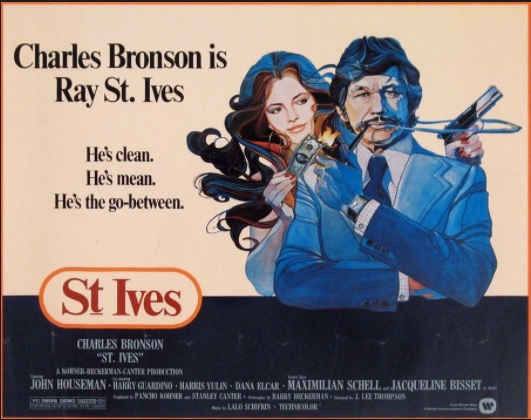
Raymond St. Ives (Charles Bronson) is a former cop-turned-writer who desperately needs money.  Abner Procane (John Houseman) is a wealthy and cultured burglar who needs someone to serve as a go-between.  Five of Procane’s ledgers have been stolen.  The thieves are demanding a ransom and Procane believes that St. Ives is just the man to deliver the money.  But every time that St. Ives tries to deliver the money, another person ends up getting murdered and St. Ives ends up looking more and more like a suspect.  Who is the murderer?  Is it Janet (Jacqueline Bisset), the seductive woman who lives in Procane’s mansion?  Is it Procane’s eccentric psychiatrist (Maximillian Schell)?  Could it be the two cops (Harry Guardino and Harris Yulin) who somehow show up at every murder scene?  Only Ray St. Ives can solve the case!

Charles Bronson is best remembered for playing men of few words, the type who never hesitated to pull the trigger and do what they had to do.  St. Ives was one of the few films in which Bronson got to play a cerebral character.  Ray St. Ives may get into his share of fights but he spends most of the film examining clues and trying to solve a mystery.  The mystery itself is not as important as the quirky people who St. Ives meets while solving it.  St. Ives has a great, only in the 70s type of cast.  Along with those already mentioned, keep an eye out for Robert Englund, Jeff Goldblum, Dana Elcar, Dick O’Neill, Daniel J. Travanti, Micheal Lerner, and Elisha Cook, Jr.  It’s definitely different from the stereotypical Charles Bronson film, which is why it is also one of my favorites of his films.  As this film shows, Bronson was an underrated actor.  In St. Ives, Bronson proves that, not only could he have played Mike Hammer, he could have played Philip Marlowe a well.

St. Ives is historically significant because it was the first Bronson film to be directed by J. Lee Thompson.  Thompson would go on to direct the majority of the films Bronson made for Cannon in 1980s, eventually even taking over the Death Wish franchise from Michael Winner.

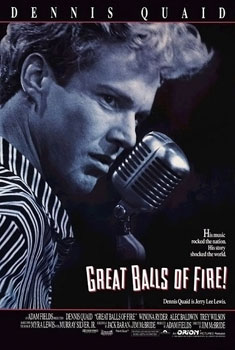
A Movie A Day #173: Great Balls of Fire! (1989, directed by Jim McBride)


In the 1950s, Jerry Lee Lewis (Dennis Quaid) plays what his cousin, Jimmy Swaggart (Alec Baldwin), calls the devil’s music.  After signing a contract with Sam Phillips (Trey Wilson), Jerry becomes a star with his wild man persona and crazed piano playing.  When Elvis is drafted, it appears that Jerry is destined to take over as the new King of Rock and Roll.  But, then, while touring England, the press discovers that Jerry is married to his 13 year-old cousin, Myra (Winona Ryder).  When Jerry refuses to apologize for his private life, his career falls apart.
The real Jerry Lew Lewis has stated many times that he hates this musical biopic and that it has very little in common with his actual life.  Jerry has a point.  Great Balls of Fire is a highly stylized film, one that greatly sanitizes both the life of Jerry Lee Lewis and the early days of rock and roll.  In the film, there’s no struggle or even hard work on the road to becoming a star.  Jerry just drops off a recording of himself playing piano and viola! He’s a star!  Soon, teenagers are dancing around his convertible, both civil rights protestors and white Southern cops start dancing whenever they see him driving down the street, the local radio DJ waves whenever he sees them, and Jerry’s sneaking into Mississippi so that he can marry his thirteen year-old cousin.

Great Balls of Fire! takes a superficially mater of fact approach to Jerry’s marriage to Myra, neither condemning nor excusing, though it does cheat by casting the 18 year-old Winona Ryder as the 13 year-old Myra.  (If the film had cast an actress who was closer to Myra’s actual age, Great Balls of Fire! would never have been released.)  Fortunately, history helped the movie out by making Jimmy Swaggart into Jerry’s main critic.  Alec Baldwin’s performance as Jimmy Swaggart makes his interpretation of Donald Trump look subtle, nuanced, and award-worthy.

Dennis Quaid, at the height of his 80s stardom, is ideally cast as Jerry Lee Lewis, giving a good if broad performance and doing a convincing job lip-syncing to the music.  Quaid has said that he was struggling with an addiction to cocaine while filming Great Balls of Fire! and that might have made him the perfect actor to play the always conflicted and always wild Jerry Lee Lewis.  The best thing about the film is that Jerry Lee Lewis provided the music, re-recording his best known songs.  While the movie may not tell the true story of Jerry Lee Lewis, it does feature enough of his music that it is obvious why Jerry Lee Lewis nearly became the king of rock and roll.


A Movie A Day #172: Sensation (1994, directed by Brian Grant)


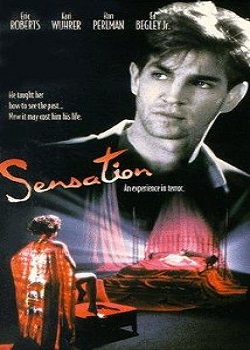
Doctor Ian Burton (Eric Roberts) is a college professor who believes that objects retain impressions of the past.  To prove his theory (and hopefully, not lose tenure), Burton recruits one of his students, Lila Reed (Kari Wuhrer), who has shown that she may have psychic abilities.  Lila holds objects and she sees the past.  At first, she is intrigued but then she realizes that she keeps seeing the same woman in her visions.  The woman was a former student of Burton’s.  She was murdered and the good Doctor Burton is the number one suspect.  Can Lila use her power to solve the crime and clear Burton’s name?  Or is Burton guilty and using her for something more sinister than just testing a thesis?
Sensation is one of the many softcore neo-noirs that used to regularly appear, “after hours,” on HBO and Cinemax in the 1990s.  Sensation has a tagline (“An experience in terror”) that it never lives up to but it is still watchable because of the combination of the sexiness of Kari Wuhrer and the strangeness of Eric Roberts.  The tawdry mystery will not fool anyone and Wuhrer’s visions were all done better in The Dead Zone but Sensation deserves some credit for at least trying to be a little more creative than the average 1990s straight-to-video release.

Keep an eye out for Ron Pearlman, as the lead detective on the case.  He does not get to do much but he’s still Ron Pearlman!


A Movie A Day #171: The Program (1993, directed by David S. Ward)


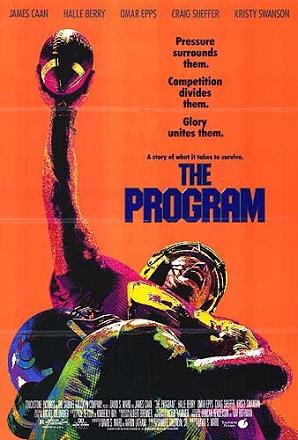
There’s not a single sports cliché that goes untouched in The Program.
A veteran college football coach who, after two disappointing seasons, is now being told that he must get wins at any cost?  Check!

A cocky senior quarterback who is trying to live up to his father’s expectations?  Check!

A cocky freshman who matures during the season?  Check!

A cocky NFL prospect who suffers a career ending injury?  Check!

Corrupt rich backers?  Check!

Beer?  Check!

Steroids?  Check!

Hazing?  Check!

Football groupies?  Check!

Halle Berry wasted in a one-note role?  Check!

Kristy Swanson as the one girl on campus who is not impressed by football?  Check!  Check!  Check!

The Program has its good points.  James Caan does a good job as the coach and Andrew Bryniarski, playing a player who is always on the verge of flying into roid rage, dominates every scene in which he appears.  Kristy Swanson looks good in a tennis outfit, so it’s not all bad.  But Craig Sheffer is neither credible nor likable as the star quarterback and there is not a single scene that won’t be seen coming.

When The Program came out in 1993, it included a scene where the team bonded by laying down in the middle of a busy street, while cars zoomed by on either side of them.  Things turned out alright for the people in the movie but, for the idiots who tried to imitate the stunt in real life, it was a different story.  It turns out that, in real life, drivers don’t always stay in their lane and, if you lay down in the middle of the street, there is a good chance that you are going to get run over.  After several deaths, the scene was taken out of the film.  If you’re going to die for a movie, do it for a movie better than The Program.

A Movie A Day #170: Chato’s Land (1972, directed by Michael Winner)


Don’t mess with Charles Bronson.

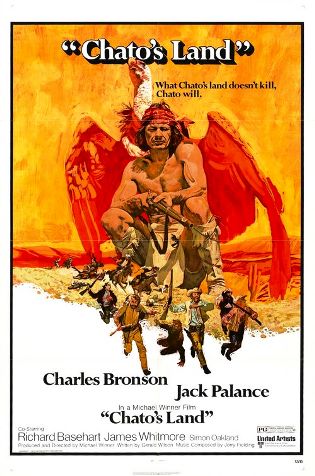
That’s the main lesson that can be taken away from Chato’s Land.  In this western, Bronson plays Chato, an Apache who enters the wrong saloon and is forced to shoot a racist sheriff in self-defense.  Former Confederate Captain Quincey Whitemore (Jack Palance) forms a posse to track Chato down but soon discovers that his posse is not made up of the best and brightest.  Instead, most of them are sadistic racists who just want to kill Apaches.  Despite Whitemore’s efforts to stop them, the posse rapes Chato’s wife and kills his best friend.  Chato trades his white man’s clothes for a loin cloth and sets out for revenge.

Chato’s Land is historically significant because it was the first of many films that Charles Bronson made with Michael Winner.  The most famous Bronson/Winner collaboration was Death Wish, which also featured Charles Bronson as a man who seeks revenge after his wife is raped.  What is surprising about Chato’s Land is how little screen time Bronson actually has.  Most the film is spent with the posse, which is full of familiar faces (Richard Jordan, Simon Oakland, Victor French, Ralph Waite, and James Whitmore all report for duty).  It actually works to the film’s advantage, making Bronson even more intimidating than usual.  There’s never any doubt that Chato is going to kill every member of the posse but since almost every member of the posse is loathsome, that’s not a problem.

It’s possible that Chato’s Land was meant to be an allegory for the Vietnam War, which is probably giving Michael Winner too much credit.  (In an interview, the author of Death Wish, Brian Garfield, once shared an anecdote about Winner inserting a shot of three nuns into Death Wish and bragging about how the shot was meaningless but that it would fool the critics into thinking he was making a grand statement about something.)  Like most of Winner’s films, Chato’s Land is good but not great.  There are parts of the movie that drag and Jack Palance and Charles Bronson don’t get to share any big scenes together, which seems like a missed opportunity.  Bronson, who was always underrated as an actor, gives one of his better performances as Chato.  Chato does not say much but Bronson could do more with one glare than most actors could do with a monologue.  In Europe, Bronson was known as Il Brutto and Chato’s Land features him at his most brutal.

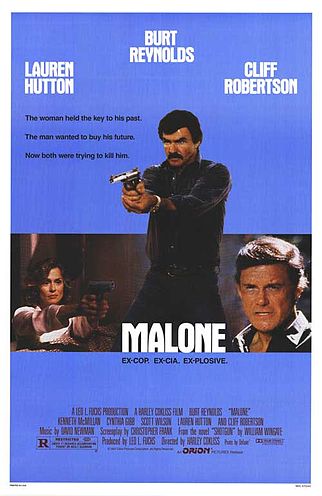
A Movie A Day #169: Malone (1987, directed by Harley Cokeliss)


It’s Burt Reynolds vs. Cliff Robertson.  Cliff has got the money but Burt’s got the mustache and the toupee.

Robertson plays Charles Delaney, a wealthy businessman who, with the help of a mercenary army, has bought nearly all the land in a small Oregon town.  Only the owner of a local gas station, Paul Barlow (Scott Wilson), has refused to sell.  Delaney and his men think that they can intimidate Paul into selling but what they do not realize is that Paul has a houseguest.  Richard Malone (Burt Reynolds) was driving through town when his car broke down.  While waiting for it to get fixed, he has been staying with Paul and his teenage daughter, Jo (Cynthia Gibb).  What no one knows is that Malone used to be an assassin for the CIA.

If ever there was a film that demanded the talents of Charles Bronson, it is Malone.  The tough and ruthless title character would have been a perfect Bronson role, especially if Malone had been made twenty years earlier.  Instead, the role went to Burt Reynolds, who was on the downside of his career as an action hero.  Sometimes, Burt tries to play the role as serious and emotionally guarded.  Then, in other scenes, Burt will suddenly smile and wink at the camera as he briefly turns back into the Bandit.  This is not one of Burt’s better performances.  He gets good support from the entire cast, including Lauren Hutton as his CIA handler, but, in most of his scenes, Burt comes across as being tired and his toupee makes him look like The Brady Bunch‘s Robert Reed.  Burt was 51 when he made Malone and he looked like he was at least ten years older, making the scenes where Jo comes onto him even more improbable.

Where Malone succeeds is in the action scenes.  Along with Burt’s final assault on Delaney’s compound, there is also a classic showdown in a barbershop.  Malone had a budget of ten million dollars.  How many blood squibs did that buy?  Pay close attention to the scene where two hitmen attempt to surprise Malone in his room and find out.

Malone is may not feature Burt at his best but it is still a damn sight better than some of the other films that awaited Burt once his starpower started to diminish.  Mad Dog Time, anyone?