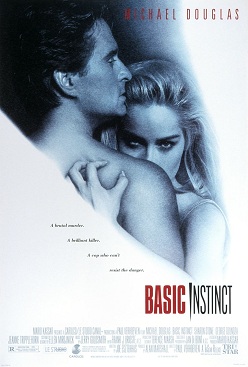
Basic Instinct (1992, directed by Paul Verhoeven)


Nick Curran (Michael Douglas) is a San Francisco police detective who, along with his jolly partner Gus (George Dzundza), finds himself investigating the ice pick-stabbing of a rock star.  The main suspect is glamorous writer Catherine Trammel (Sharon Stone), who is obviously guilty but manages to outsmart all of the men investigating her by not wearing panties during her interrogation.  Nick finds himself drawn to Catherine, despite his own relationship with with psychologist Elizabeth Garner (Jeanne Tripplehorn).  The more Nick digs into Catherine’s past, the more he becomes obsessed with her but also the more he suspects that she may be a serial killer.  This is mostly because Catherine obviously is a serial killer and anyone should have been able to figure that out.  Instead, Nick, an experienced homicide detective, just gets turned on.

It’s strange to remember how seriously people took Basic Instinct when it was released in 1992.  People debated whether it was a throwback to Hitchcock or just a dirty movie.  Feminists debated whether it was empowering or exploitive.  For several years afterwards, every show from The Simpsons to Seinfeld parodied the interrogation scene.  (In Seinfeld’s case, it helped that Wayne Knight appeared in the film as the district attorney who kept shifting in his seat to get a better view.)  Sharon Stone was described as being the new Grace Kelly and, for a period of years, was the subject of fawning profiles in which she was asked about the future of sex in movies.  For a while, she was inescapable.

Sharon Stone, to be fair, did make the role of Catherine her own.  It’s impossible to imagine some of the other actresses considered — Michelle Pfeiffer, Geena Davis, Mariel Hemingway, or Meg Ryan — in the role.  After a decade of not getting anywhere with her film career, Stone was hungry to be a star and was also willing to do things on camera that other name actresses would have refused.  Sharon Stone was not the next Grace Kelly and Catherine Trammel was ultimately more of a sexual fantasy than an actual character but Stone still deserves a lot of credit for her uninhibited performance in the role.  Though Stone later said that she didn’t realize what was actually being filmed during the interrogation scene, it’s her confidence and her unapologetic sensuality that makes the scene compelling.  Her performance has the energy that the sleepwalking Michael Douglas lacks.

Today, Basic Instinct is best-viewed as a satire.  Director Paul Verhoeven sends up both the cop film and the erotic thriller with a movie that turned everything to eleven.  The film’s sensibility is established by the fact that Michael Douglas’s “hero” is nicknamed Shooter because he killed two innocent people while high on cocaine.  The film’s main joke is an obvious one.  Everyone is too busy staring at Sharon Stone to notice that she’s about to stab them in the back with an icepick.  Joe Eszterhas’s script was vulgar to the point of parody and, fortunately, director Paul Verhoeven understood that even more than Eszterhas did.

Basic Instinct has been imitated countless times but it’s never been equaled.  To that, the credit is owed to Sharon Stone and Paul Verhoeven.


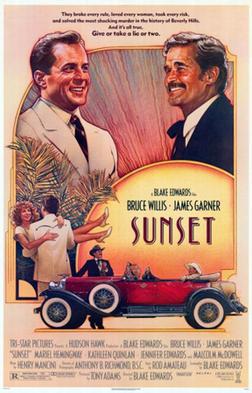
Sunset (1988, directed by Blake Edwards)


In 1920s Hollywood, famed comedian Alfie Alperin (Malcolm McDowell) has made the transition from screen stardom to working behind the scenes as a producer and studio head.  With the coming of the talkies and the death of silent cinema, Alfie plans to make his mark with an epic western starring Tom Mix (Bruce Willis) as Wyatt Earp.  The real Wyatt (James Garner) is hired to act as an on-set consultant.  Wyatt’s former girlfriend, Christina (Patricia Hodge), is now married to Alfie.

What Mix and Earp discover is that, despite his beloved public image, Alfie is actually a monster who is involved with organized crime and sex trafficking and who has the police on his payroll.  While searching for Christina’s missing son (Dermot Mulroney), Mix and Earp get caught up in a murder involving Alife’s sister (Jennifer Edwards) and a gangster named Dutch (Joe Dallesandro).  At the first Academy Awards are handed out in Beverly Hills, Tom Mix and Wyatt Earp prepare for the final showdown with their producer.

The idea behind Sunset was promising.  Wyatt Earp, a real cowboy who survived the end of the West, teams up with Tom Mix, a movie cowboy who is trying to survive the end of the silent era.  (Earp and Mix were friend in real life, as well.)  Bruce Willis comes across as being too contemporary in the role of Tom Mix but James Garner plays Wyatt Earp with a weary dignity and Malcolm McDowell does a convincing Charlie Chaplin impersonation.  Unfortunately, Blake Edwards’s direction allows the story to meander and the mystery itself is so full of red herrings that it’s impossible to follow.  Edwards didn’t seem to know if he wanted this movie to be a buddy comedy, an elegiac tribute to the end of the silent era, or a satire of Hollywood.  He tried to include elements of all three but the movie itself just doesn’t come together.  Only Garner and McDowell emerge from the film relatively unscathed.

Fortunately, for Bruce Willis, Die Hard was released just two months after Sunset.

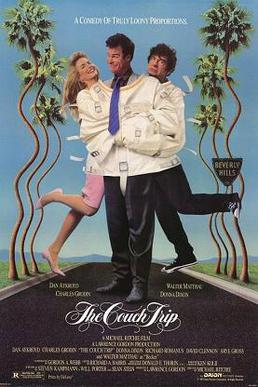
The Couch Trip (1988, directed by Michael Ritchie)


When renowned radio psychiatrist George Matlin (Charles Grodin) has a nervous breakdown, he takes a trip to Europe with his wife (Mary Gross) to both recover and also work on his marriage.  (Matlin’s breakdown was the result of an extramarital affair.)  Needing someone to host Dr. Matlin’s radio show, his producers call Dr. Lawrence Baird (David Clennon), who oversees a mental facility in Chicago.  They assume that Dr. Baird is just dumb enough that they won’t have to worry about him overshadowing Dr. Matlin while he’s guest-hosting.  However, when they call, Dr. Baird is out of his office and the phone is answered by John Burns (Dan Aykroyd), a con artist who has been pretending to be insane so that he can avoid serving time in prison.  Pretending to be Baird, Burns accepts their offer and then escapes from the asylum and heads to Beverly Hills.  The real Dr. Baird, not knowing about the offer, goes on vacation in Europe.  Though Burns had originally only been planning on doing the radio job long enough to get paid enough money to head to Mexico, he soon becomes a celebrity with his non-nonsense, blunt advice.

There’s a lot of talented people in The Couch Trip, including Walter Matthau as a former priest-turned-kleptomaniac and Aykryod’s wife, Donna Dixon, as Matlin’s colleague and Burns’s eventual love interest.  Director Michael Ritchie was responsible for some of the best films of the 70s and radio psychiatry is certainly a ripe subject for satire.  Why, then does, The Couch Trip fall flat?  Some of it is because the movie never seems to know if it wants to be wacky farce or a dramedy about a criminal who finds a new life helping people.  The other big problem is that the talented Dan Aykroyd is miscast as the type of unapologetic smartass that Bill Murray could play in his sleep.  (In a version where Murray played John Burns, Aykroyd would have been perfect casting as George Matlin.)

Aykroyd was one of the most talented members of the original Not Ready For Prime Time Players.  (His impersonations of Nixon and Jimmy Carter were second-to-none.)  Sadly, Hollywood has never figured out what to do with his off-center talent.  The Couch Trip is a prime example of that.


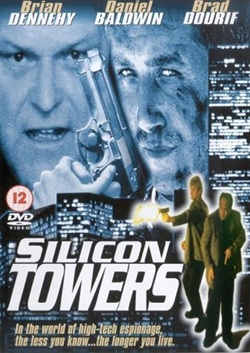
Silicon Towers (1999, directed by Serge Rodnunsky)


Charlie (Jonathan Quint) gets a promotion to an executive job at Silicon Towers.  After his promotion, he is sent an encrypted email that reveals that the company is manufacturing computer chips that it can use to drain money from the banks and to control the world.  Charlie goes on the run, jumping from roof to roof as he tries to avoid the company’s security team and reveal the truth.  Brian Dennehy plays the evil CEO.  Daniel Baldwin plays another executive.  Brad Dourif plays a paranoid tech expert and steals the movie.  Robert Guillaume is the police detective who is investigating the strange things that are happening around the company.  Be sure to hum the Benson theme song while watching.

There was a lot of movies like Silicon Towers in the late 90s.  The internet was still exotic and people were still convinced that technology was going to destroy us all on Y2K.  Silicon Towers was not the only paranoid tech thriller to come out in 1999 but it might have been the most inept.  Serge Rodnunsky made a lot of movies back in the day and never let a lack of a budget stand in his way but he also never seemed to understand the importance of being able to hear dialogue or smooth editing.  There are some good actors in Silicon Towers.  Good luck understanding what any of them are saying.

This film is mostly memorable for the scenes of Charlie “hacking.” Charlie writes his hacking code in HTML.  That’s  pretty much all you need to know.

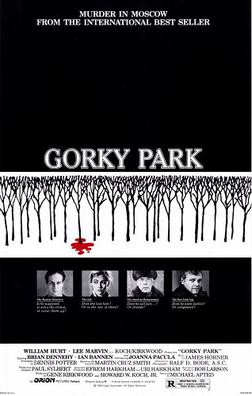
Gorky Park (1983, directed by Michael Apted)


Earlier today, I saw that the writer Martin Cruz Smith has died.  He was 82 years old and was best known for a series of detective novels about Arkady Renko, a Russian police detective.  Starting with 1981’s Gorky Park, Smith’s novels not only dealt with Renko’s adventures but also provided a look at contemporary Russia, as it went from being controlled by the communists to being controlled by Putin.  Renko was a cynical observer whose cases often exposed the corruption of the Russian elite, regardless of who was in charge.

The first of Smith’s Renko novels was turned into a movie in 1983.  Gorky Park stars William Hurt as Renko.  Renko investigates the discovery of three dead bodies at a ice skating rink in Moscow.  One of the victims in an American whose brother (Brian Dennehy) is a tough New York cop who has come to Russia to investigate his disappearance.  Renko’s investigation leads him to an American businessman (Lee Marvin) who is smuggling sables out of Russia and who is also a KGB asset.  Joanna Pacula plays a woman whose hope to escape from Russia leads to her getting caught up in the murders and the subsequent investigation.

Gorky Park‘s mystery is easily solved.  Just by casting Lee Marvin in the role, it is automatically clear who is responsible for the murders and it doesn’t take long for Renko to figure it out either.  Instead, the movie is about how Renko’s investigation exposes the corruption of the Russian state, with the KGB first protecting Lee Marvin’s businessman when he’s considered to be an asset and then expecting Renko to assassinate him once it becomes obvious that his activities are becoming a liability.  The subdued William Hurt and the brash Brian Dennehy make for an compelling investigative team while the underappreciated Joanna Pacula gives an outstanding performance as a woman who is so desperate to escape the oppression of the Soviet Union that she’ll risk everything.  (Even though the murderer is an American businessman, the Soviet Union still banned Gorky Park as both a book and a film.)  Gorky Park’s snowy cinematography and Michael Apted’s measured direction captures the chilly paranoia of Smith’s story and the bleak depiction of a society where national pride mixes with healthy a dose of fear.

Upon release, Gorky Park was a box office disappointment, which meant that there would be no further adventures of William Hurt’s Renko on the big screen.  Martin Cruz Smith continued to write, ultimately publishing ten novels about his unconventional hero.

Presumed Innocent (1990, directed by Alan J. Pakula)


Harrison Ford stars as Rusty Sabich, a smart and ambitious prosecutor who is accused of murdering his former mistress, Carolyn Polhemus (Greta Scacchi).

A lot of people were taken by surprise when Presumed Innocent first came out in 1990.  After a career of always being the hero and the type of person who took his fate into his own hands, Presumed Innocent featured a passive Harrison Ford whose fate was in the hands of his lawyer, Sandy Stern (Raul Julia) and in the prosecutors who are trying to send him to prison.  For most of the movie, the audience doesn’t know if Rusty is innocent and a lot of what Rusty does makes him seem to be guilty.  Just the fact that Harrison Ford was playing someone who would cheat on his wife (played by Bonnie Bedelia, who everyone had last seen sticking up for Bruce Willis in Die Hard) was considered to be shocking at the time.  It says a lot about Ford’s appeal as an actor that he remains sympathetic even though he’s playing a character who does a lot of bad things.  He remains compelling, even though Rusty is forced to spend a good deal of the movie as a passive spectator.  To anyone who underrates Harrison Ford an actor, this is the film to show them.

Presumed Innocent is a murder mystery but it’s also a sad-eyed look at a corrupt judicial system.  Rusty is accused of murder largely due to the whims of fate.  If Raymond Horgan (Brian Dennehy), Rusty’s former patron, had been reelected as district attorney, Rusty would never have been charged.  When the trial moves to the courtroom, the Judge (Paul Winfield) himself is revealed to have been compromised by his own relationship with Carolyn, something that Sandy is willing to use to the defense’s advantage.  John Spencer plays a detective who is willing to hide evidence to protect Rusty.  Joe Grifasi plays a former detective who is motivated less by the evidence in the case and more by a personal grudge against Rusty.  The idea of getting justice for Carolyn is pushed to the side by everyone’s personal drama.  The ending challenges all of our preconceived notions about Rusty and the meaning of guilt and innocence.

Intelligently directed by Alan J. Pakula and featuring an excellent cast, Presumed Innocent is a top-notch legal thriller and also one of Harrison Ford’s best films.


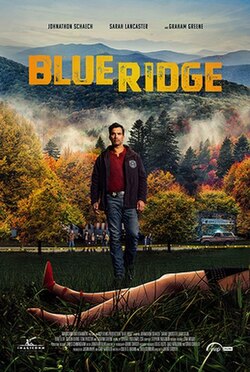
Blue Ridge (2020, directed by Brent Christy)


Former Green Beret Justin Wise (Johnathon Schaech) is the new sheriff of the small mountain town of Blue Ridge.  Sheriff Wise is so good at his job that he can just step inside of a gas station and figure out that it’s been robbed just by observing that the millennial behind the counter isn’t look at his phone.  The sheriff has a phone-obsessed millennial daughter (Taegen Burns) and a supportive ex-wife (Sarah Lancaster), who works as a waitress.

He also has a big mystery on his hands when the daughter of Cliff McGrath (Graham Greene) is found murdered.  The McGraths thinks that the Wade family is responsible.  The Wades have a long-standing grievance against the McGraths.  Sheriff Wise and Deputies Dobson (Lara Silva) and Thompson (Ben Esler) have to solve the mystery before a full-out war breaks out in town.

I was not surprised to discover that this was a pilot for television series.  The movie has the homey feel of the type of mystery show that your parents or grandparents would watch every Friday night.  Sherriff Wise may not be as old as my parents but he definitely shares their feelings about phones and trying to understand what’s wrong with the kids today.

It’s an old-fashioned movie but it’s mildly diverting and it does hold your attention.   Johnathon Schaech gives a strong performance as the sheriff who can beat up three people at once but who still gets nervous before asking a woman out on a date.  Graham Greene and Tom Proctor both give good performances as the rival family patriarchs and the mystery takes some interesting turns.  Blue Ridge did a good job of brining its small town setting to life.  Blue Ridge is good enough to be a pleasant afternoon diversion.

Avenging Angelo (2002, directed by Martyn Burke)


When mob boss Angelo (Anthony Quinn) is assassinated on the orders of the son of a former rival, bodyguard Frankie Delano (Sylvester Stallone) takes it upon himself to protect Angelo’s daughter, Jennifer (Madeleine Stowe).  The problem is that Jennifer, who was adopted by a normal couple, doesn’t know that she is the daughter of a mobster.  Her life and her marriage are already falling apart even before Frankie reveals the truth to her.  All she wants to do is disappear into the pages of a romance novel written by her favorite writer, Marcello (Raoul Bova) but Marello is not quite what he seems.

Sylvester Stallone has had a long career, full of high points (Rocky, First Blood, The Expendables, Creed) and low points (too many to list).  Avenging Angelo, made at a time when it was assumed that the aging Stallone would never again play Rocky Balboa or John Rambo, is a moderate low point.  It’s no Rocky but it’s still better than Stop!  Or My Mom Will Shoot!  Overall, it’s not very good and a lot of the humor falls flat but Stallone and Madeleine Stowe are both likable and they have a few moments that display what seems like genuine chemistry.  It’s still a slow movie that awkwardly mixes comedy and action but it was not the disaster that I was expecting it to be when I first found it on Tubi.  It’s more forgettable than bad.  If there is anything to really regret when it comes to Avenging Angelo, it’s that Anthony Quinn did not get a more memorable swan song.

Avenging Angelo was Stallone’s second movie to go straight to video.  It’s easy to forget not but the conventional wisdom in 2002 really was that Stallone was washed up.  There were jokes about whether or not he would follow Schwarzenegger’s lead and go into politics.  Stallone, however, proved all the naysayers wrong, proving that he could still throw punches as Rocky Balboa and John Rambo while The Expendables revealed a Stallone who could finally laugh at himself.  Avenging Angelo turned out to be not the end of Stallone’s career but instead just a detour.  Say what you will about the man and his movies, Sylvester Stallone is an American institution.

Nothing In Common (1986, directed by Garry Marshall)


Tom Hanks plays David Basner (Tom Hanks), an advertising executive whose immature lifestyle gives him insight into what sells but has also left him totally unprepared to deal with the fallout when his mother (Eva Marie Saint) leaves his father, Max (Jackie Gleason).  David, who is struggling to come up with the perfect commercial for a demanding client (Hector Elizondo), has to come to terms with both his father’s bad health and his history of infidelity.

This isn’t my favorite Tom Hanks movie.  It comes from that awkward period when Hanks was trying to make the transition from comedy to drama and its attempt to mix the two genres is not always successful.  The scenes of Hanks at the ad agency are often so cartoonish that they don’t seem like they belong in a movie where Jackie Gleason loses a foot to diabetes and realizes that he spent his entire marriage emotionally abusing his wife.  The movie, though, is worth watching for the teaming of Hanks and Gleason, two comedic actors who eventually proved themselves to equally as skilled at playing it serious.  Gleason, especially, gives a strong performance.  This was his final film and Garry Marshall convinced him to take it by asking, “Do you really want to go out on Smokey and the Bandit 3?”  Gleason would die a little over a year after the release of Nothing In Common and this film, even if it wasn’t perfect, gave the world a chance to see what a good actor he really was.

This film is often cited as the the movie that started Hanks on the way to becoming a dramatic actor.  Like Punchline, Nothing In Common played a role in Hanks becoming more than just a comedian but  I think Big was ultimately the better showcase for Hanks’s ability to mix pathos with laughs.  Nothing In Common was directed by Garry Marshall and, as was usually the case with Marshall, he often doesn’t trust the audience to figure things out for themselves.  He goes overboard trying to force an emotional response instead of just trusting the material.  Tom Hanks still does a good enough job in Nothing In Common.  Hanks is as likable as always and you can see the dramatic actor emerging in Hanks’s performance even if Hanks still wasn’t totally comfortable with it.

Nothing In Common is flawed but it was definitely a better swan song for Jackie Gleason than Smokey and the Bandit 3.

That Thing You Do! (1996, directed by Tom Hanks)


That Thing You Do! is the story of a one-hit wonder.

In 1964, an aspiring Jazz drummer named Guy (Tom Everett Scott) is a last minute addition to the a local band called the Oneders.  (It’s meant to sound like Wonders but almost everyone mispronounces it as O-Needers.)  The band’s egotistical leader, James (Jonathon Schaech) has written a slow ballad called That Thing You Do! but when Guy’s drumming causes the band to perform the song at a faster tempo, they end up with a local hit on their hands.  That local hit becomes a national hit when The Oneders are signed by Play-Tone Records.  First, Mr. White (Tom Hanks), their new manager, officially changes the name to The Wonders.  Secondly, he makes sure that every teen in America is dancing to That Thing You Do!  Third, he tells Guy to always wear sunglasses.  Fourth, he tells James that he will record and perform what Play-Tone tells him to.  Guitarist Lenny (Steven Zahn) and the unnamed Bass Player (Ethan Embry) are happy to be along for the ride but James chafes at his lack of artistic freedom.  Guy, meanwhile, falls for James’s girlfriend (Liv Tyler, at her loveliest) and dreams of meeting his idol, jazzman Del Paxton (Bill Cobbs).

That Thing You Do! was Tom Hanks’s directorial debut and, with its careful recreation of a bygone era and its collection of authentic sounding early 60s rock on the soundtrack, it was obviously a labor of love.  Considering the number of times that the song is played in the movie, it helps that it is a very good song.  That Thing You Do! is a catchy tune, one that you can’t help but tap your feet to.  At the same time, it also sounds like a one hit wonder.  It’s good but not so great as to make you expect much else from The Wonders.

Not surprisingly, Tom Hanks gets great performances from the entire ensemble cast.  Johnathon Schaech and Tom Everett Scott have never been better.  Liv Tyler is lovely and vulnerable as James’s unappreciated girlfriend.  Familiar faces like Peter Scolari, Kevin Pollak, Chris Isaak, and Clint Howard make welcome appearances.  Hanks himself is surprisingly intimidating as Mr. White.  When he says that the band will cover something the Play-Tone catalogue, it’s obvious that he’s not making a request.

The film is a tribute to being young and to loving music bit it’s also a study in the disillusionment of discovering that everything is ultimately a business.  James is frequently an arrogant jerk and he treats his girlfriend terribly but it’s hard not to sympathize with him when he says that he wants to do more than just cover songs from the Play-Tone catalogue.  To James and Guy, the Wonders are about self-expression and their love of music.  To Mr. White, the Wonders are just another band that came up with one catchy tune and who probably aren’t ever going to be heard from again.   That Thing You Do! pays tribute to all of the one-hit wonders out there, the bands who you forget about until you just happen to hear that one song on the radio or in a movie and suddenly, all the memories come flooding back.