Doctor Who — The Brain Of Morbius (1976, directed by Christopher Barry)


The Time Lords once again decide that they need the Doctor to do their dirty work for them.  The TARDIS, with the Doctor (Tom Baker) and Sarah Jane Smith (Elisabeth Sladen) on board, is sent to the rocky planet Karn.

On Karn, the crazed Dr. Solon (Phillip Madoc) lives in a castle and is kidnapping shipwrecked travelers and using their limbs to build a body for Morbius (Stuart Fell with the voice of Michael Spice).  Morbius was once a Time Lord but, after being found guilty of war crimes, his body was destroyed but his disembodied brain survived.  It now sits atop a makeshift body that has been constructed out of several different alien races.  Solon takes one look at the Doctor’s head and decides that it would be the perfect house for the brain of Morbius.

There’s a subplot about the Sisterhood of Karn and the Elixer of Life but make no mistake.  This is Doctor Who‘s take on Frankenstein, with the Baron reimagined as a mad scientist on a distant planet and the Monster reimagined as being not at all sympathetic.  When I was a kid and first watching these episodes of PBS, The Brain of Morbius was one of my favorites because of the Frankenstein connection and also the look of Morbius.  The original Doctor Who was known for its often-shoddy monsters but Morbius was a definite triumph.  The brain sitting in a transparent bowl atop a stitched together body was one of the defining images of classic Doctor Who.

The Brain of Morbius is also known for a controversial moment during the final episode, where the Doctor and Morbius engage in a battle of the minds.  On a view-screen, the faces of the three former Doctors appear, followed by several faces that had never been shown before.  It was actually an in-joke on the part of production.  The faces were all members of the Doctor Who crew.  For decades, though, this in-joke led to a fierce debate whether or not William Hartnell was actually the first Doctor.  This, of course, was back when it was still believed that a Time Lord could only regenerate 12 times.  The Doctor Who revival tossed out that idea, along with a lot of other good ideas.

All these years later, The Brain of Morbius still remains one of my favorites of the Fourth Doctor’s adventures.  This serial was the Tom Baker/Elisabeth Sladen era at its best.

Hercules (1958, directed by Pietro Francisci)


In ancient Greece, Hercules (Steve Reeves) saves the life of the princess Iole (Sylva Koscina) when she nearly loses control of her chariot.  Iole tells Hercules about how her father, Pelias (Ivo Garrani), become the ruler of the kingdom after the murder of the previous king and the exile of the rightful heir to the throne, Jason (Fabrizio Mioni).

Hercules accompanies Iole back to the kingdom, where he proves himself by doing typical Hercules things like defeating both a lion and a bull.  When Hercules’s discovers that his best friend, Chiron (Alfo Poli) is the number one suspect in the murder of the previous king, he goes on a quest with Jason to recover the Golden Fleece, which will reveal the truth.

All sorts of Greek myths are crammed together as Hercules and Jason search for the Golden Fleece, fight a dragon, and are briefly held prisoner by Amazon Queen Antea (Gianna Maria Canale).  (The dragon’s roar was lifted from a Godzilla film.)  Hercules was the first of several Italian film to be made about Hercules.  American bodybuilder Steve Reeves had the right physique for Hercules but the wrong voice and, even in the English language dub, it’s obvious that we are not actually hearing Reeves when he speaks.

Hercules has a deserved reputation for being campy but it’s not as bad as you might think if you’ve only seen the washed-out and heavily edited version that was used for Mystery Science Theater 3000.  (I say that as someone who loves MST 3K and who dreamed of being one of their writers when I was growing up.)  If you can actually see a restored print of the film, ancient Greece actually looks pretty good and the the deep colors go a long way towards establishing the grandeur of a mythological age.  It’s easy to laugh at Steve Reeves and his expressionless acting but he had the right look for Hercules.  The only thing really required of Hercules in this movie is that he be strong and Reeves was definitely that.

Distributed in America by Joseph E. Levine, Hercules was a worldwide success and there would be 18 sequels, with Reg Park eventually taking over the role.  Steve Reeves, having been seriously injured while filming The Last Days of Pompeii in 1959, eventually retired from acting and spent the rest of his life running a ranch in Valley Center, California and promoting drug-free bodybuilding.  Arnold Schwarzenegger frequently cited him as an inspiration for his own acting career.  Steve Reeves passed away at the age of 74 in 2000.

Music Video of the Day: Devil Woman by Cliff Richard (1976, directed by ????)


Cliff Richard sings about how he became cursed after seeing a black cat with yellow eyes.  Cliff went to a fortune teller, asking her to lift the curse but it turned out that the fortune teller was the one who cursed him in the first place!

The message?  If it can happen to Cliff Richard, it can happen to anyone.

Enjoy!

Doctor Who — Pyramids of Mars (1975, directed by Paddy Russell)


Did you ever wonder who built the pyramids of Egypt?

It was the aliens, of course!

In 1911, Dr. Marcus Scarman (Bernhard Archard) excavates a pyramid.  When he enters a room that has the Eye of Horus over the doorway, he is hit by a beam of light.

Months later, The Doctor (Tom Baker) and Sarah Jane (Elisabeth Slader) materialize at the Scarman Estate in England.  They run into Dr. Scarman’s friend, Dr. Warlock  (Peter Copley).  (Dr. Warlock?  Really?)  Warlock explains that Scarman has been missing every since he went to Egypt and that his estate is now occupied by a mysterious man named Namin (Peter Maycock).

Namin is eagerly waiting the arrival of Sutekh (Gabriel Woolf), who Namin thinks is an ancient Egyptian god but who is actually the last-surviving member of the Osirian alien race.  The Osirians imprisoned Sutekh on a temple on Mars but Sutekh has taken over the body of Scarman and is using him to construct a missile that will free Sutekh from his Martian prison.  The possessed Scarman returns his estate, kills Namin, and gets to work.

Pyramids of Mars takes the usual Doctor Who themes of aliens and time travel and mixed them with mummies and ancient Egyptian curses.  This serial doesn’t skimp on the horror.  Sutekh tries to strangle almost everyone he meets and, once the Doctor and Sarah reach Mars, there’s plenty of scenes of mummies come to life and stalking pyramind to appeal to the most discerning of viewers.  Pyramids of Mars is one of the Doctor Who episodes that is perfect for October!

Wizards of the Lost Kingdom (1985, directed by Hector Olivera)


The kingdom has been conquered by an evil sorcerer named Shurka (Thom Christopher).  Young Simon (Vidal Peterson), the son of the king’s wizard, barely escapes with his best friend and pet, the white fur-covered Gufax (Eugenio Martin).  In the wilderness, they meet warrior Kor (Bo Svenson), who teams up with them to free the kingdom.

This is another Roger Corman-produced sword and sorcery film from Argentina.  Corman did a lot of these in the 80s.  Wizards of the Lost Kingdom stands out by being considerably more kid-friendly than the rest of them.  There’s no nudity.  The violence is not excessive and is largely directed at fake looking giant insects.  There’s no nudity and no scenes of the bad guys forcing themselves on women.  The hero even has a toy-friendly companion!

Wizards of the Lost Kingdom also has a lot of stock footage.  The entire pre-title sequence is stock footage lifted from movies like Death Stalker to explain how “King Tyler” came to control the kingdom.  (King Tyler sounds like someone who would be the kegger king of the local college.)  Wizards of the Lost Kingdom is a short movie with a barely 72-minute run-time.  Fourteen of those minutes is footage from other movies.

Wizards of the Lost Kingdom takes a lighter approach to the sword-and-sorcery genre and it pays off with a simple and easy-to-watch movie featuring swords, magic, and monstrous insects.  It’s not a film that demands much of the audience and Bo Svenson looks convincing grunting and carrying a sword.  It wasn’t a box office hit but found a second life on video.  Of course, it got a sequel.  None of the original cast returned.

Doctor Who — The Ark In Space, The Sontaran Experiment, Genesis of the Daleks, Revenge of the Cybermen, Terror of the Zygons


The 12th season of Doctor Who got off to a shaky start with Robot, a serial that was ultimately distinguished only by the introduction of Tom Baker as the Fourth Doctor.  The best thing about Robot is that it ended with The Fourth Doctor peeking out of the TARDIS and inviting Sarah Jane Smith (Elisabeth Sladen) and Harry Sullivan (Ian Marter) to join him on his further adventures.  By inviting them, he was inviting the audience as well.

The remaining episodes of the 12th season not only established Tom Baker as the Doctor but it also reestablished Doctor Who as being a show about an alien who could travel through time and space.  After several seasons of The Third Doctor largely staying on Earth and in the present, the 12th Season reminded everyone that the Doctor could turn up anywhere.

The Ark In Space (1975, directed by Rodney Bennett)

The first place that the Doctor takes Sarah and Harry is to Nerva, a space station that floating above the Earth.  The time is 10,000 years into the future.  Forced to flee the Earth due to solar flares, the crew of the space station has spent a millennia in suspended animation.  During that time, the space station has been invaded by the Wirm, a space insect that has laid its eggs in some of the crewmen.  When everyone is revived, the infected crewmen are transformed into creatures that are half-human and half-insect.

The Ark in Space is a classic space opera.  When I was a kid and our PBS station first started to broadcast Doctor Who, they started with a four-hour bloc, which included Robot, The Ark In Space, and The Sontaran Experiment.  After Robot, with its basic plot and bad special effects, it was a relief to then see The Ark In Space, a serial that lived up to all of the Doctor Who hype.  Not only did Tom Baker fully step into the role of the eccentric Fourth Doctor but this serial also featured Elisabeth Sladen and Ian Marter in active roles as well.  This serial said that the days of the passive companion were (temporarily) over.

The plot of The Ark in Space does have some similarities to Alien, which came out for years later.  I think that’s probably just a coincidence.

The Sontaran Experiment (1975, directed by Rodney Bennett)

Having defeated the Wirm and saved the remaining colonists on the Ark, The Doctor, Harry, and Sarah transport down to Earth to repair a receiver terminal.  They discover that the Earth is not as deserted as they assumed.  A group of human astronauts returned to the planet earlier but they were captured by Styre (Kevin Lindsay), a Sontaran who has been sent to Earth to prepare it for an invasion so that the Sontarans can use the planet as an outpost in their never ending war with the Rutans.

This serial was only two episodes long but The Sontarans were always good villains.  They’re relentless, destructive, and very, very stupid.  This story featured one of Tom Baker’s best moments, when he convinced Styre to throw away his weapon because it made him look weak.  Styre fell for it because Sontarans will fall for anything.

Genesis of the Daleks (1975, directed by David Maloney)

This is it.  This is the first true classic of the Tom Baker era and also the best of the classic Dalek stories.  Terry Nation was invited back to Doctor Who to write about his most famous creations and he created one of the show’s most enduring villains in the process.

A Time Lord appears to the Doctor and his companions and tells them that they need The Doctor to change history.  (This goes against all Time Lord law, which is why they gave the job to a known renegade like The Doctor.)  The Daleks have been determined to be too much of a threat.  The Doctor is to go back to the time of their creation and “interfere.”

The Doctor, Harry, and Sarah Jane find themselves on Skaro, where the war between the Thals and the Kaleds have left the planet ravaged and inhospitable.  The Thals and the Kaleds each live in a domed city and spend their days shooting missiles at each other.  Terry Nation often said that the Daleks were meant to be a stand-in for the Nazis and he makes that clear in this episode with the Kaleds wearing SS-style uniforms and spouting theories about racial superiority.

In this episode, Nation introduces Davros (Michael Wisher), the horribly scarred and crippled scientist who will ultimately be responsible for transforming the Kaleds into the Daleks.  (The Kaleds who don’t want to be Daleks are wiped out by those who do.)  Davros would appear in every subsequent Dalek episode of classic era Doctor Who and his effectiveness would be diluted by repetition.  In his first appearance, though, he immediately establishes himself as a frightening and truly evil Doctor Who villain.  If their first appearance suggested that the Daleks retreated into the shells for survival in their nuclear-ravaged world, this episode shows that it more about Davros wanting to play God.

A six-episode serial, Genesis of the Daleks more than justifies its epic length.  The heart of the serial is a moment when the Doctor, on the verge of wiping out the Daleks forever, stops to wonder if he has the right to do so.  This was a key moment in the development of The Fourth Doctor.  The Fourth Doctor may have been an eccentric but he was an eccentric with a conscience who realized that even the worst creatures deserved a chance at redemption.  In the end, The Doctor does not destroy the Daleks, though he does set back their evolution by an undetermined number of years.  As the Doctor explains it, good will always rise up to counter the evil of the Daleks.

This episode features the apparent destruction of Davros but you can never keep a good villain down.  Both Davros and his creations would return.

Revenge of the Cybermen (1975, directed by Michael Briant)

After a classic Dalek story, I guess it was inevitable that Doctor Who would feature a Cyberman episode.

Following the events of Genesis of the Daleks, the Time Lords return The Doctor, Sarah Jane, and Harry to the Nerva space station.  They arrive several centuries before the events in The Ark In Space.  Without the TARDIS (it’s traveling back through time to meet them), The Doctor and his companions discover that the majority of Nerva’s crew is dead and that the remaining members are using the station as a space beacon to warn people about a drifting planetoid.  The planetoid is made of gold and the Cybermen show up at Nerva because, being uniquely vulnerable to gold dust, they want to destroy it.

If Genesis of the Daleks re-imagined the Daleks, Attack of the Cybermen proves to be just a typical Cybermen story and a disappointing one.  The best thing about this episode is that it gave Tom Baker a chance to once again prove his Doctor bonafides by defeating a classic Doctor Who villain.

Terror of the Zygons (1975, directed by Douglas Camfield)

Terror of the Zygons was the first seral of the thirteenth season but, since it’s also Harry Sullivan’s final appearance as a regular member of the TARDIS crew (though he would return in a later episode for a one-off appearance), it still feels like a twelfth season episode.

Having been reunited with the TARDIS, the Doctor, Sarah Jane, and Harry return to present-day Earth.  The Brigadier (Nicholas Courtney) and UNIT are investigating attacks on oil rigs by a giant sea creature.  Sea Devils, again?  No, this time it’s the Zygons, who are far less sympathetic.

This was a typical UNIT story, the type of thing that Jon Pertwee did regularly.  Tom Baker’s more mischievous version of the Doctor feels slightly out-of-place with UNIT but it is still a pleasure to see Nicholas Courtney and John Levene again and this episode finally explains what everyone has been seeing in Loch Ness over the years.  This episode ends with Harry returning to UNIT while Sarah Jane and the Doctor returned the TARDIS.  Harry Sullivan was a strong character and producer Philip Hinchcliffe later said it was a mistake to write him out of the series.

Ian Marter, who played Harry Sullivan, continued to be associated with Doctor Who as one of the better writers of the Doctor Who novelizations.  He also wrote two stand-alone novels featuring Harry’s adventures without the Doctor.  Ian Marter died of a heart attack when he was just 42 but Harry Sullivan lived on, frequently being mentioned in both the classic series and the revival.

That’s it for the 12th season, the season that truly made Tom Baker the Doctor and which was one of the best of the classic series.  As these were the first episodes of Doctor Who that I ever saw, I have a lot of nostalgia for them.  The Ark In Space, The Sonatarn Experiment, Genesis of the Daleks, and even Terror of the Zygons still hold up well to this day.


The Human Duplicators (1965, directed by Hugo Grimaldi)


Who’s an android and who’s not!?

It’s hard to keep track in The Human Duplicators.  Dr. Kolos (Richard Kiel) is an alien who is sent down to Earth.  He thinks that he’s not an android but how can he be sure?  He goes to the laboratory of Dr. Vaughan Dornheimer (George Macready) and tells Donheimer that they will be working together to create androids that are perfect duplicates for humans and that Kolos will be the “master.”  But then an android is built of Dornheimer himself and android Dornhiemer declares that he is the master.  Kolos is distracted because he’s fallen in love with Dornhiemer’s daughter, a blind pianist named Lisa (Dolores Faith).

Glenn Martin (George Nader) of the National Intelligence Agency is assigned to figure out what is happening at the Dornhiemer mansion and, wouldn’t you know it, there’s already an android version of Glenn.  Glenn’s girlfriend is played the brassy Barbara Nichols, a comedic actress who was briefly groomed to be the next Marilyn Monroe and who comes on like the star of a burlesque show.  Glenn’s boss is Austin Wells and he’s played by Hugh Beaumont, which makes this film feel like a weird episode of Leave It To Beaver where Wally has to save the world.  I don’t think the bad guys ever duplicate Hugh Beaumont and that’s good because real trouble could be created by an evil version of Ward Cleaver.

The presence of Richard Kiel and Hugh Beaumont is really the only thing that The Human Duplicators have going for it.  There are plenty of fights between Glenn and the androids but it turns out that the androids are easy to beat into oblivion so there’s not much suspense or excitement to be found.  At times, it feels as if it’s trying to be an episode of The Avengers just without the wit of Patrick Macnee or the charm of Diana Rigg.  The Human Duplicators seems to take itself very seriously and I’m not sure why.

After The Human Duplicators, Richard Kiel later went on to play Jaws in The Spy Who Loved Me and Moonraker.  Hugh Beaumont retired from the movies.

Great Moments In Television History #39: The Wolverines


50 years ago tonight, the first episode of Saturday Night Live opened with Michael O’Donoghue giving a language lesson to John Belushi.

Previous Moments In Television History:

  1. Planet of the Apes The TV Series
  2. Lonely Water
  3. Ghostwatch Traumatizes The UK
  4. Frasier Meets The Candidate
  5. The Autons Terrify The UK
  6. Freedom’s Last Stand
  7. Bing Crosby and David Bowie Share A Duet
  8. Apaches Traumatizes the UK
  9. Doctor Who Begins Its 100th Serial
  10. First Night 2013 With Jamie Kennedy
  11. Elvis Sings With Sinatra
  12. NBC Airs Their First Football Game
  13. The A-Team Premieres
  14. The Birth of Dr. Johnny Fever
  15. The Second NFL Pro Bowl Is Broadcast
  16. Maude Flanders Gets Hit By A T-Shirt Cannon
  17. Charles Rocket Nearly Ends SNL
  18. Frank Sinatra Wins An Oscar
  19. CHiPs Skates With The Stars
  20. Eisenhower In Color
  21. The Origin of Spider-Man
  22. Steve Martin’s Saturday Night Live Holiday Wish List
  23. Barnabas Collins Is Freed From His Coffin
  24. Siskel and Ebert Recommend Horror Films
  25. Vincent Price Meets The Muppets
  26. Siskel and Ebert Discuss Horror
  27. The Final Scene of Dark Shadows
  28. The WKRP Turkey Drop
  29. Barney Pops On National TV
  30. The Greatest American Hero Premieres
  31. Rodney Dangerfield On The Tonight Show
  32. The Doors Are Open
  33. The Thighmaster Commercial Premieres
  34. The Hosts of Real People Say “Get High On Yourself”
  35. The 33rd NFL Championship Game Is Broadcast In Color
  36. The Sopranos Premieres on HBO
  37. Eisenhower Hosts The First Televised Press Conference
  38. The Twilight Zone Premieres On CBS

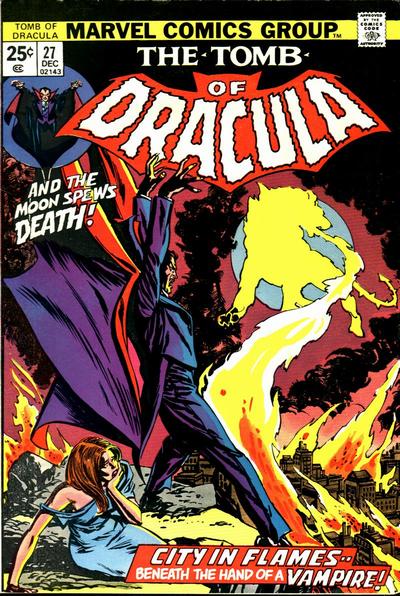
Great Moments In Comic Book History #41: Tomb of Dracula #41


For my money, the original Tomb of Dracula is still the best horror comic to ever show up at a newsstand.  From 1975, The cover of Tomb of Dracula #41 is a classic.  Credit for this goes to Gene Colan, Tom Palmer, and Gaspar Saladino.

Previous Great Moments In Comic Book History:

  1. Winchester Before Winchester: Swamp Thing Vol. 2 #45 “Ghost Dance” 
  2. The Avengers Appear on David Letterman
  3. Crisis on Campus
  4. “Even in Death”
  5. The Debut of Man-Wolf in Amazing Spider-Man
  6. Spider-Man Meets The Monster Maker
  7. Conan The Barbarian Visits Times Square
  8. Dracula Joins The Marvel Universe
  9. The Death of Dr. Druid
  10. To All A Good Night
  11. Zombie!
  12. The First Appearance of Ghost Rider
  13. The First Appearance of Werewolf By Night
  14. Captain America Punches Hitler
  15. Spider-Man No More!
  16. Alex Ross Captures Galactus
  17. Spider-Man And The Dallas Cowboys Battle The Circus of Crime
  18. Goliath Towers Over New York
  19. NFL SuperPro is Here!
  20. Kickers Inc. Comes To The World Outside Your Window
  21. Captain America For President
  22. Alex Ross Captures Spider-Man
  23. J. Jonah Jameson Is Elected Mayor of New York City
  24. Captain America Quits
  25. Spider-Man Meets The Fantastic Four
  26. Spider-Man Teams Up With Batman For The Last Time
  27. The Skrulls Are Here
  28. Iron Man Meets Thanos and Drax The Destroyer
  29. A Vampire Stalks The Night
  30. Swamp Thing Makes His First Cover Appearance
  31. Tomb of Dracula #43
  32. The Hulk Makes His Debut
  33. Iron Man #182
  34. Tawky Tawny Makes His First Appearance
  35. Tomb of Dracula #49
  36. Marvel Publishes Star Wars #1
  37. MAD Magazine Plays Both Sides
  38. The Cover of Green Lantern/Green Arrow #85
  39. LBJ Stands Up For The Hulk
  40. Chamber of Chills #2

Music Video of the Day: Are You Ready For Freddy? by the Fat Boys (1988, directed by Harvey Keith)


I always assumed that this song was specifically written for one of the Nightmare on Elm Street movies but actually, the Fat Boys were just fans of the movies and they decided to put a song about them on one of their albums.  The song was included in The Freddy Krueger Special, which aired on CBS in 1988.

This video, which features several of Freddy’s victims and Robert Englund himself, was written by Wes Craven and directed by Harvey Keith.  Keith directed a few films, including 1988’s Mondo New York and 1990’s Jezebel’s Kiss.

Enjoy!