Horror Film Review: The Shining (dir by Stanley Kubrick)


The Shining is one of the few horror movies that still scares me.

I say this despite the fact that I’ve lost track of the number of times that I’ve watched Stanley Kubrick’s 1980 adaptation of Stephen King’s third novel.  It’s a film that I watch nearly every October and it’s a film that I’ve pretty much memorized.  Whenever I watch the film, I do so with the knowledge that Jack Torrance (Jack Nicholson), the caretaker of the Overlook Hotel, is eventually going to start talking to ghosts and he’s going to try to kill his wife Wendy (Shelley Duvall) and his son, Danny (Danny Lloyd).  Whenever I watch this film, I know what Jack is going to find Room 237.  I know about the blood pouring out the elevator like the Tampax commercial from Hell.  I know what Danny means when he says, “Redrum….”  I know about the twins and their request of “Come play with us, Danny.”  And, of course, I know about the film’s famous ending.

Whenever I start watching this film, I know everything that is going to happen.  And yet, as soon as I hear the booming beat of of Wendy Carlos’s theme music and I see the overhead shot of the mountain roads leading to the Overlook Hotel, I start to feel uneasy.  Whenever Barry Nelson (played the hotel’s general manager) starts to blandly explain that a previous caretaker got cabin fever and chopped up his twin daughters, I smile because Nelson delivers the lines so casually.  But I also get nervous because I know Charles (or is it Delbert) Grady is going to show up later.

(Incidentally, Barry Nelson never gets enough credit for his brilliant cameo as the friendly but guarded hotel manager.  In Stephen King’s original novel, the character was a stereotypically unsympathetic middle manager, a martinet who existed largely to be told off.  In Kubrick’s film, the manager is one of the most fascinating of the supporting characters.)

I still get nervous when I see Wendy and Danny, sitting in their disturbingly sterile Colorado home while Jack interviews for the caretaker job.  Wendy smokes and Danny talks about how his imaginary friend, Tony, doesn’t want to go to the hotel.  With her unwashed her and her tentative voice, Shelley Duvall is a far cry from the book’s version of Wendy.  However, Duvall’s Wendy is also a far more compelling character, an abused woman who finds her strength when her son is put in danger.  Duvall is the perfect choice for Wendy because she seems like someone who you might see in the parking lot of your local grocery store, trying to load the bags in her car and keep an eye on her young child at the same time.  She seems real and her reactions remind us of how we would probably react if we found ourselves in the same situation.  Wendy makes the mistakes that we would all probably make but she refuses to surrender to her fear.

Why does The Shining remain so powerful and so frightening, even after repeated viewings?  Most of the credit has to go to Stanley Kubrick.  Stephen King has been very vocal about his dislike of the film, claiming that The Shining was more Kubrick’s version than his.  King has a point.  Film is a director’s medium and few directors were as brilliant as Stanley Kubrick.  (Along with The Shining, Kubrick also directed Paths of Glory, 2001, Barry Lyndon, Dr, Strangelove, Spartacus, Lolita, The Killing, A Clockwork Orange, Eyes Wife Shut, and Full Metal Jacket.  Stephen King directed Maximum Overdrive.)  From the minute we see the tracking shots that wind their way through the desolate mountains and the empty hallways of the Overlook, we know that we’re watching a Kubrick film.  Those tracking shots also put us in the same role as the spirits in the Overlook.  We’re watching and following the characters, observing and reacting to their actions without being able to interact with them.  King has complained that Kubrick’s version of The Shining offers up no hope.  But, honestly, what kind of hope can one have after discovering that ghosts are real and they want to kill you?  Once Jack Torrance finally accepts that drink from Joe Turkel’s Lloyd and meets Phillip Stone’s Grady, there is no more room for hope.  King’s book ends with the Overlook destroyed and Jack Torrance perhaps redeeming himself in his last moments.  Kubrick’s film suggests that Jack Torrance never cared enough about his family to be worthy of redemption and that the evil that infected the Overlook is never going to be destroyed.  In the end, not even the kindly presence of Scatman Crothers in the role of Dick Halloran can bring any real hope to the Overlook.

The Shining is unsettling because, more than being a ghost story, it’s a film about being tapped.  Physically, the Torrances are trapped by the blizzard.  Mentally, Jack is trapped by his addictions and his resentments.  One gets the feeling that he’s deeply jealous of Danny, viewing him as someone who came along and took away all of Wendy’s attention.  Wendy is trapped in a bad and abusive marriage and there’s something very poignant about the way Duvall both captures Wendy’s yearning for outside contact (like when she uses the radio to communicate with the local rangers station) and her hope that, if she’s just supportive enough, Jack will get his life together.  Danny’s trapped by his psychic visions and his knowledge of what’s to come.  The victims of the Overlook appear to be trapped as well.  Grady’s daughters are fated to always roam the hallways, looking for someone to play with them.  The Woman in 237 will always wait in her bathtub.  Were these spirits evil before they died or were the twisted by the Overlook?  It’s an unanswered question that sticks with you.

As I mentioned earlier, Stephen King has been very vocal about his dislike of both The Shining and its director.  (King once boasted about outliving Kubrick, a comment that showed a definite lack of class on the part of America’s most commercially successful writer.)  Why does King hate the Kubrick film with such a passion?

I have a theory.  Both King’s second novel, Salem’s Lot, and The Shining feature a writer as the man character.  In both cases, King obviously related to the main character.  Ben Mears in Salem’s Lot is charming, confident, articulate, and successful.  He’s a writer that everyone respects and he’s even well-known enough to have a file with the FBI.  Jack Torrance, on the other hand, is a struggling writer who has a drinking problem, resents authority figures (like the hotel manager), and has issues with his father.  Torrance is a much more interesting character than Ben Mears, precisely because Torrance is so flawed.  (King, and I give him full credit for this, has been open about his own struggles with substance abuse and how he brought his own experiences to the character of Jack Torrance.)  I’ve always suspected that, at the time that King wrote Salem’s Lot and The Shining, Ben Mears was King’s idealized version of himself while Jack Torrance, with all of his struggles and flaws, reflected how King actually felt about himself.  (That the Wendy Torrance of the novel is a beautiful blonde who sticks with her husband despite his drinking problem feels like a bit of wish fulfillment on the part of King.)  When Stanley Kubrick made his version of The Shining and presented Jack Torrance as essentially being a self-centered jerk who, even before arriving at the hotel, had a history of abusing his wife and son, it’s possible King took it a bit personally.  Since King had poured so much of himself into Jack Torrance, it was probably difficult to see Kubrick present the character an abusive narcissist whose great novel turned out to be literally a joke.  And so, Stephen King has spent the last 45 years talking about how much he hates Kubrick’s film.

King’s opinion aside, Kubrick’s The Shining is probably the most effective Stephen King adaptation ever made, precisely because Kubrick knew which parts of the book would work cinematically and which parts were best excised from the plot.  As opposed to later directors who often seem intimidated by King’s fame, Kubrick was able to bring his own signature style to the story.  Stanley Kubrick’s The Shining is a masterpiece and one that I look forward to revisiting this October.

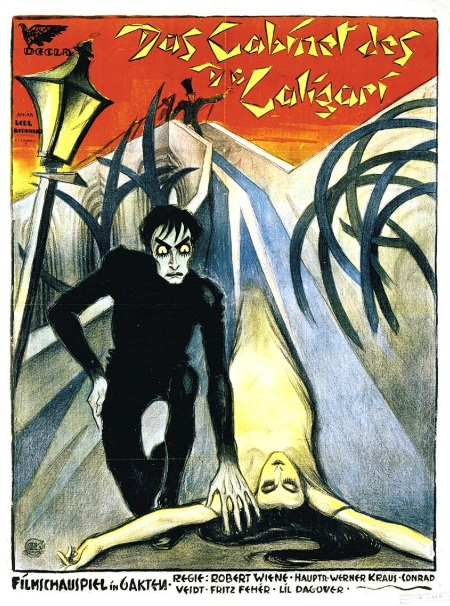
Silent Horror Review: The Cabinet of Dr. Caligari (dir by Robert Wiene)


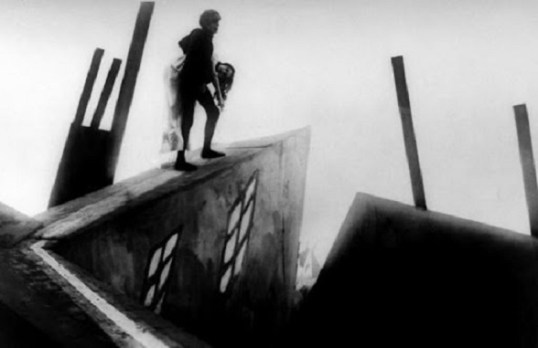
The Cabinet of Dr. Caligari (1920, dir by Robert Wiene, DP: Willy Hameister)

Sitting on a bench, a man named Franzis (Friedrich Feher) tells a story of how he and his fiancée Jane (Lil Dagover) suffered at the hands of Dr. Caligari (Werner Krauss), the owner of a traveling carnival who used an apparent sleepwalker named Cesare (Conrad Veidt) to commit murders for him.  Franzis’s story takes place in an odd village, one that is full of crooked streets, ominous buildings, and dark shadows.  It’s a bizarre story that gets even stranger as we start to suspect that Franzis himself is not quite who he claims to be.

Released in 1920, the silent German film The Cabinet of Dr. Caligari is one of those films that we’ve all heard about but far too few of us have actually seen.  Like most silent films, it requires some patience and a willingness to adapt to the narrative convictions of an earlier time.  However, for those of us who love horror cinema, The Cabinet of Dr. Caligari remains required viewing.  Not only did it introduce the concept of the twist ending but it also helped to introduce German expressionism to the cinematic world.  The film’s images of twisted roads and ominous structures that seem to be reaching out to capture the people walking past them would go on to influence a countless number of directors and other artists.  The film captures not only the logic and intensity of a nightmare but the look of one as well.

It also captures something very true about human nature.  Running through the story is a theme of authoritarianism.  Before Caligari can bring his carnival to the show, he has to deal with a rude town clerk who seems to take a certain delight in making even the simplest of request difficult.  Caligari keeps Cesare in a coffin-like box and only brings him out when he’s needed to do something.  The sleepwalking Cesare does whatever he is ordered to do, without protest.  Even the film’s twist ending leaves you wondering how much you can trust the people in charge.  When the film was released, Germany was still struggling to recover from World War I, a war that was fought by people who had been trained not to question the orders of those who were sending them to die.  Caligari, like a general, sends Cesare into danger and Cesare, being asleep, never questions a thing.

(Of course, thirteen years after The Cabinet of Dr. Caligari was released, Germany would once again embrace authoritarianism.  Director Robert Wiene left Germany after the rise of Hitler and died in France in 1938.  Co-writer Carl Mayer and star Conrad Veidt also fled Germany, with Veidt landing in Hollywood and playing the villainous Nazi in Casablanca.  Meanwhile, Werner Krauss was reportedly a virulent anti-Semite who supported the Nazi Party and who became one of Joseph Goebbels’s favorite actors.  Lil Dagover also remained in Germany and continued to make films.  She was known to be Hitler’s favorite actress though Dagover always claimed that she didn’t share Hitler’s views.)

Needless to say, it takes some adjustment to watch a silent film.  That’s certainly true in the case of a The Cabinet of Dr. Caligari, though the twisted sets and the bizarre story actually help the mind to make the adjustment.  Dr. Caligari takes place in a world so strange that it actually seems appropriate that the dialogue is not heard but only read on title cards.  (If I could imagine a soundtrack to The Cabinet of Dr. Caligari, it would probably involve a lot of industrial noise in the background, in the manner of David Lynch’s Eraserhead.  Lynch, incidentally, is a filmmaker who was clearly influenced by Caligari.)  For modern audiences, watching The Cabinet of Dr. Caligari also means accepting that there was a time when CGI was not a thing and films had to make due with practical effects.  But Conard Veidt’s performance is all the more impressive when you realize that it was one that he performed without any of the filmmaking tricks that we now take for granted.

Ever since I first watched it on a dark and rainy night, The Cabinet of Dr. Caligari has stayed with me.  The night after I watched it, I even had a nightmare in which Dr. Caligari was trying to break into my apartment.  Yes, Dr. Caligari looked a little bit silly staring through my bedroom window but it still caused me to wake up with my heart about to explode out of my chest.

In short, The Cabinet of Dr. Caligari passes the most important test that a horror film can pass and one that most modern film fail.  It sticks with you even after it’s over.

Horror Film Review: The Vampire’s Ghost (dir by Lesley Selander)


1945’s The Vampire’s Ghost takes place in the African port of Bakunda.  It’s the colonial period and the port is full of not just adventurers and local plantation owners but also all sorts of disreputable people who are looking to disappear from civilization for a while.  A series of murders have recently rocked the port.  Victims, almost all of them women, have been discovered drained of blood.  The natives claim that it is the work of vampire but the colonialists dismiss that as superstition.  Plantation owner Thomas Vance (Emmett Vogan) says that there is no such things are vampires.  Thomas’s daughter, Julie (Peggy Stewart), says that there is no such things as vampires.  Julie’s boyfriend, Roy (Charles Gordon), says that there is no such thing as vampires.  Mysterious casino owner Webb Fallon (John Abbott) says that …. well, actually, Webb’s thoughts on the subject are a bit less certain.

Webb Fallon is known to be an expert on the occult and voodoo.  The natives consider him to be a vampire and it turns out that they’re right!  After he is wounded in an assassination attempt, Fallon is forced to reveal the truth of his existence to Roy.  He also puts Roy under his psychic command, forcing him to serve as Fallon’s servant while Fallon proceeds to kill several people.  Can Father Gilchrest (Grant Withers) save Roy from Fallon’s control and also prevent Fallon from turning Julie into his eternal vampire bride?  And why exactly did Thomas think it was a good idea to buy a plantation next to the infamous Temple of Death in the first place?

It may not sound like it from the plot description but The Vampire’s Ghost is actually a fairly interesting take on the traditional vampire story.  The film was made by Republic Studios and, as was so often the case with Republic, the budget was noticeably low and the film’s African locations were obviously just sets on a Hollywood soundstage.  The film was apparently shot in ten days, which was considered to be a long shoot by Republic standards.  And yet, despite the low budget, director Lesley Selander does a good job of creating a properly eerie atmosphere, opening with a POV shot of the vampire stalking a native woman and filling the soundtrack with the sound of beating drums in the distance.  The beautiful Adela Mara appears as a dancer in Abbott’s casino and her dance scene is definitely one of the film’s highlights, a sudden burst of energy that fills the screen with life.  With his somewhat wan appearance, John Abbott may not immediately strike most viewers as the most intimidating of vampires but, as the film progresses, Abbott’s performance win us over.  He plays Webb Fallon as being a calculating villain who suffers from just a touch of ennui.  He’s grown weary of his existence but he’s still driven by his vampiric urges.

This film was an early credit for screenwriter Leigh Brackett.  Apparently, Howard Hawks hired her to adapt The Big Sleep after seeing this film.  Brackett would go on to work on the scripts for Rio Lobo, El Dorado, The Long Goodbye, and The Empire Strikes Back.  And it all started with a vampire named Webb.

Get Ready For The Horror Season With The Help Of Some Old Friends


It’s October and with my Rangers not in the MLB playoffs this year, I’ll have even more time than usual to help out with  this site’s annual Horrorthon!

Are you having trouble getting into the October spirit?  Don’t worry!  The pulps and the comics are here to help!  Here are a few covers that should get anyone into the Halloween mood!

By Earle Bergey

by Harold W. McCauley

Artist Unknown

by Norman Saunders

by Modest Stein

by J.C. Lyendecker

Artist Unknown

Artist Unknown

Artist Unknown

Artist Unknown

Happy horror season!

Horror On The Lens: Mazes and Monsters (dir by Steven Hilliard Stern)


Hi there and welcome to October!  This is our favorite time of the year here at the Shattered Lens because October is our annual horrorthon!  For the past several years (seriously, we’ve been doing this for a while), we have celebrated every October by reviewing and showing some of our favorite horror movies, shows, books, and music.  That’s a tradition that I’m looking forward to helping to continue this year!

Let’s get things started with 1982’s Mazes and Monsters!

Based on a best-seller by Rona Jaffe, Mazes and Monsters tell the story of some college students who enjoy playing a game called Mazes and Monsters.  Now, I realize that Mazes and Monsters may sound a lot like Dungeons and Dragons but they are actually two separate games.  One game takes place in a dungeon.  The other takes place in maze, got it?

When the players decide to play the game in some nearby caves, it causes the newest member of the group (Tom Hanks — yes, Tom Hanks) to snap and become his character.  Convinced that he’s living in a world full of monsters and wizard, Hanks runs away to New York.  How does that go?  During a moment of clarity, Hanks calls his friends and wails, “There’s blood on my knife!”

It’s all fairly silly.  There was a moral panic going on about role playing games when this film was made and this film definitely leans into the panic.  But, in its own over-the-top way, it works.  If you’ve ever wanted to see Tom Hanks battle a big green lizard, this is the film for you.  And I defy anyone not to tear up a little during the final scene!

From 1982, here is Mazes and Monsters!  Happy Horrorthon!

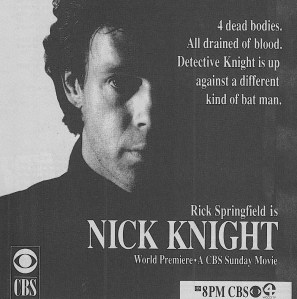
Nick Knight (dir. by Farhad Mann)


Directed in 1989 by Farhad Mann, Nick Knight (a.k.a. Midnight Cop) was a made for tv movie meant as a pilot for a series filmed in Los Angeles. It would take another 3 years to for the show to be picked up as Forever Knight, and even then, it was difficult show to catch given you could really find it sometime after Midnight on Saturdays and/or Sundays. As Vampires in media go, Nick Knight is tucked away in a very small place between the success of Kathryn Bigelow’s Near Dark in 1987 and Francis Ford Coppola’s Bram Stoker’s Dracula in 1992. It’s nowhere near as good as either of those films, but plays on most of the vampire tropes. Allergic to Garlic? Check. Aversion to sunlight? Sure. As I’m writing this the way I would cover a TV episode, this review will have spoilers and will be a bit long in the tooth. My apologies in advance. For the TSL Horrorthon this year, I’m hoping my contribution will be (at least) the first season of Forever Knight. For the film, If you search for it, you can find on YouTube.

Detective Nick Knight (Rick Springfield, Hard to Hold) loves to work the night shift, but not before getting in a quick visit at a local suntan spa. It’s a bit uncomfortable, enough for him to hit the panic button and bring in a few staff to check in on him. He blames it on claustrophobia, “It’s like a coffin in there.”, he says and moves on. When an ancient jade goblet is stolen from a museum, leaving a guard murdered, Knight is brought on to the scene where Don Schanke (John Kapelos, The Shadow, The Breakfast Club) is already helping the cops take photos of the crime scene, and putting himself in the way of things. Nick interviews Dr. Alyce Hunter (Laura Johnson, TV’s Falcon Crest) about the homicide. Alyce reports the goblet was used in ritual blood drinking sacrifices (something that Knight sounds like he’s aware of since he can understand some of the ancient writing in the museum).

Cleaning up the scene, the media approaches Knight and asks if it’s “another Vampire murder”. Word has gotten out that there’s no blood in the course. Knight’s rescued by Captain Brunetti (Richard Fancy, The Girl Next Door) who asks to have him stop by his office after he gets the autopsy work. At the morgue, Nick is given a mug of tea that he just can’t stomach. Thankfully, Dr. Jack (Robert Harper, Twins)knows about Nick’s true nature, and is working helping him find a cure (which includes the tea). “How is your tanning coming along?”, Jack asks. “I’m up to ten minutes.” is Nick’s response, with a smile. When Nick returns to the Precinct, the Captain assigns Knight a new partner to help him with the vampire crimes. Nick’s been able to work alone for the most part, but now he finds himself paired with Schanke. This poses a few problems with hiding his nature.

Schanke and Knight get to know each other on their first night shift, with some talk about Schanke’s married life vs. Nick being forever single. The conversation is interrupted by a dispatch call about an Uzi toting gunman terrorising a local gym. They arrive on the scene, and much like Riggs & Murtaugh, Nick is gung ho about the situation, which causes a third cop on the scene to get killed. With a hostage in stow, the gunman threatens Nick. The girl gets herself out of trouble with a swift knee to the gunman’s gut, causing him to unload a full magazine into Knight. This brings out the vampire in Nick, who throws the gunman into an electrical fence, killing him.

With the case wrapped up, Nick visits Alyce, who spent her evening going through a book on the dig that discovered the cup. Before his arrival, she found a picture of the archeological team that includes someone who looks just like Nick. She makes a copy of the picture, but never mentions it to Nick during his visit. They have a moment, leading to a kiss. Of course, this also causes Nick’s fangs to sprout. He makes a hasty exit.

Having not seen Nick during the evening, Dr. Jack visit’s Nick’s haven, a closed down movie theatre with It’s a Wonderful Life still on the marquee. He finds Nick chugging on a wine bottle full of blood. They have a small argument over Nick’s humanity, leading Nick to admit his desire for love and companionship despite the vampiric side effect of watching people die around them. They make up and move on, there’s crime on the streets and the city needs it’s Midnight Cop. Nick explains that the stolen goblet is part of a pair (one of which he owns) that may be able to cure one of vampirism. The other goblet was coveted by Nick’s maker, LaCroix (Michael Nader, TV’s All My Children), who wants Nick to embrace his vampirism instead of trying to fix it. Could he be the thief?

When a homeless couple goes missing, Nick visits a local vampire nightclub. There he finds Janette (Cec Verrell (Silk). She informs him that while, yes, LaCroix is in town and yes, he may have something to do with the goblet, the missing couple has nothing to do with him. On his way out of the nightclub, Nick bumps into Alyce, who followed him. When some other vampire locals approach the couple, she notices a scar on Nick’s chest (matching one in the photo she had), and confronts him. He doesn’t outright admit to being a vampire, but she gets the feeling she’s on the right track. She even dares him a little, baring her neck. Nick doesn’t take the bait.

On the radio, we hear “The Nightcrawler” who is really LaCroix. The Nightcrawler hosts “Metal for the Ages”, lamenting that he hasn’t seen his old friend Jean Pierre (Nick) in some time. LaCroix dedicates his next song to him, which just happens to be Bobby Brown’s “My Prerogative”. I don’t remember Bobby Brown’s music ever being Metal, but we’ll roll with it.

Eventually, Nick has to deal with both LaCroix and the real villain in this tale. The story ends on a bit of a dark note, resolving the whole mystery, but still leaves open the promise of Nick’s search for Mortality. The city is safe for now, and that’s what counts.

Though the film isn’t terribly strong on the plot, it does shine with the music choices. With classic 80s hits like Steve Winwood’s “Don’t You Know What the Night Can Do” and “Human” by The Human League, Nick Knight definitely has a bit of style, though it’s a bit over the top and campy on the action sequences. It was one of those films that I had a better memory of than what it truly was.

6 Trailers For The First Day Of Horrorthon


Today is the first day of our annual October Horrorthon!  In honor of our favorite time of the year, here is a special edition of Lisa Marie’s Favorite Grindhouse and Exploitation Film Trailers.

The six trailers below all have one thing in common!  Can you spot it?

Enjoy and happy Horrorthon!

  1. Lisa (1989)

2. Lisa Lisa (1977)

3. A Black Veil For Lisa (1968)

4. The Haunting of Lisa (1996)

5. I Am Lisa (2020)

6. Lisa Frankenstein (2024)

Welcome to October On The Shattered Lens


by Erin Nicole

Welcome to October on the Shattered Lens!

Here’s hoping this month finds you with joy, family, friends, fiends, ghouls, and ghosts!

Today is also the start of the Shattered Lens’s annual horrorthon!  Sit back, enjoy the reviews, the art, and the music videos, and have a great month of ghoulish fun!

by Erin Nicole

6 Things That I Am Looking Forward To In October


Welcome to October!  October is a big month here at the Shattered Lens.  It’s the month when we devote the majority of our time to the horror genre.  It’s time for our annual Horrorthon!  Last year, we had a record number of Horrorthon posts.  I’d love to break that record this year but mostly. I just want this year’s Horrothon to be fun for both our writers and our readers!

Here’s what I’m looking forward to in October!

  1. Guillermo Del Toro’s Frankenstein — I think I was one of the few people who unreservedly loved Del Toro’s version of Nightmare Alley and I’m very much looking forward to seeing what he does with Mary Shelley’s classic tale.  Oscar Isaac as Victor Frankenstein just feels like perfect casting.
  2. The Horror Movies On TCM — TCM never lets me down in October.  I can’t wait to binge all of the classic horror that will be aired this month.
  3. Nouvelle Vague — Richard Linklater’s tribute to the French New Wave is scheduled to be released in theaters on October 31st and then on Netflix two weeks later.  While I was a bit disappointed with last year’s Hit Man, I still look forward to every new Linklater film.  Speaking of which….
  4. Blue Moon — Linklater’s other 2025 film is scheduled for an October 17th release.  Ethan Hawke is said to be brilliant in this film.
  5. After The Hunt — I’m not really a huge fan of director Luca Guadagnino and I’ll probably never forgive him not only his Suspiria remake but also his uncharitable words about the original.  That said, After The Hunt has gotten such mixed reviews that I’m intrigued.  Julia Roberts is said to give one of her best performances in the film but the film’s storyline has been criticized.  Whenever critics give a negative review to a politically-charged film, I feel almost duty-bound to watch the film and decide for myself.
  6. Halloween — It’s my favorite holiday!  I can’t wait to see all the decorations, all the parties, and all the costumes!

October’s going to be a great month and those of us at TSL can’t wait to celebrate it with you!  What are you looking forward to in October?