Jaden Miller (Kent Moran, who also directed) is a former honor student who threw away his scholarship to a private school when he got into a fight while defending another student. Having dropped out of high school, Jaden now works as an auto mechanic in the Bronx. When he and his mother (S. Epatha Merkerson) are evicted from their crummy townhouse, Jaden tries to make extra money by becoming a professional boxer. As the “Bronx Boy,” he becomes a local hero and eventually, he wins the chance to challenge the light heavyweight champion of the world (Justin Hartley).
A by-the-numbers boxing movie, The Challenger was the final film of Michael Clarke Duncan and he’s the best thing about the movie. Duncan plays Duane Taylor, the former boxing trainer who dropped out of the spotlight after one of his boxer threw a fight. Duane agrees to train Jaden because he has a secret connection to both Jaden and his adoptive mother. Clarke, with his powerful voice and his infectious laugh, is close-to-perfect in the role and he keeps things interesting, even when the movie sinks into an ocean of cliches. The Challenger was released thee years after Duncan’s tragic death and the end credits feature behind-the-scenes footage of a friendly Duncan smiling and laughing with the film’s crew. The movie may be imperfect but it serves as a tribute to a talented actor who passed away too young.
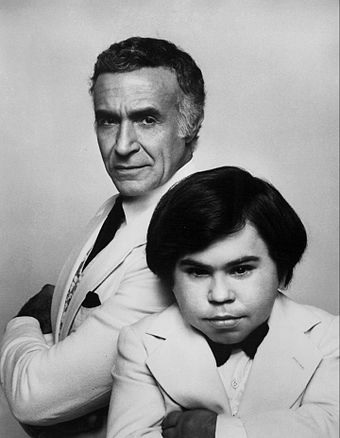
Welcome to Retro Television Reviews, a feature where we review some of our favorite and least favorite shows of the past! On Tuesdays, I will be reviewing the original Fantasy Island, which ran on ABC from 1977 to 1984. Unfortunately, the show has been removed from most streaming sites. Fortunately, I’ve got nearly every episode on my DVR.
This week, season 5 comes to an end.
Episode 5.22 “The Ghost’s Story/The Spoilers”
(Dir by Don Chaffey, originally aired on May 8th, 1982)
The latest batch of guests are arriving and Julie is nowhere to be seen! Perhaps that’s because, as Mr. Roarke explains to Tattoo, Julie is helping out a guest who has an invisibility fantasy. Tattoo and Roarke watch as the guest walks by. His body may be invisible but his pants are not.
This is the final episode of the fifth season and it’s also the final episode in which Wendy Schaal will be credited as a part of the cast. I wasn’t a huge fan of the Julie character but it still seems like a bit of a shame that she didn’t get to do anything in the finale. Then again, this episode doesn’t really feel like a finale. I don’t know what was going on behind the scenes during the fifth season but it’s hard not to feel, with the way that Julie and Tattoo have randomly shown up in different stories, that the season’s episodes were not shown in the order in which they were filmed. Maybe all the Julie episodes were filmed at one time, while Herve Villechazie was off doing something else. Who knows? It’s just been a strange season.
That’s all wonderful and interesting, Lisa …. But what about this week’s fantasies!? you may be asking.
They both feel a bit familiar. That’s not always a bad thing, of course. Fantasy Island is a comfort show and a part of the comfort is knowing that things are always going to play out in a certain way. But, with this episode, both fantasies felt as if they had been done better in the past.
Harry (Bo Hopkins) is a bounty hunter who comes to the Island to track down fugitive Nick Tanner (Robert Fuller). Nick has been accused of robbing a bank and is hiding out on a nearby island. Harry goes to the island but he soon discovers that Nick is innocent and that the real bank robbers have also come to the island in search of Nick. Luckily, there’s a widow named Juliet (Jo Ann Pflug) who is also living on the island. Harry and Nick hide out at her place before they all team up to defeat the real bank robbers. Nick and Juliet fall in love and Mr. Roarke performs one of his trademark wedding ceremonies. Nick and Juliet then board the plane back to America and …. wait a minute, what about Harry? It was his fantasy! We don’t ever see Harry leave Fantasy Island. Maybe he’s still living there.
(Personally, I think he married Julie and that’s why she was no longer working there once season six began. I like that. Consider it to be canon.)
The other fantasy is a haunted house story. Amanda Parsons (Tanya Roberts) comes all the way from Baltimore to spend 24 hours in one of Fantasy Island’s many haunted houses. Two other paranormal investigators attempt to do it before Amanda but they end up fleeing after two minutes. I’m not sure why. The manor looks creepy but it turns out that the ghost is a rather wimpy and not at all frightening guy named Timothy Black (Dack Rambo). Cursed by his own father after Timothy refused to fight a duel with Captain Fitzhugh Ross (John McCook), Timothy has spent two hundred years haunting the old manor. Amanda takes sympathy on him. It turns out that Ross’s descendant is also on the Island. Timothy challenges him to a duel, causing the latest Ross to run in fear. Timothy and his ghost dad (John Myhers) realize it’s okay to be scared of getting shot. Ghost Dad asks Roarke to bring Timothy back to life so that he can pursue his romance with Amanda. Roarke does just that, despite the fact that, in many previous episodes, Roarke has specifically said that he cannot bring the dead back to life.
Usually, I enjoy Fantasy Island‘s haunted house fantasies but this one didn’t do much for me. I think it’s because the ghost was just too wimpy. There’s nothing more annoying than a whiny a dead guy,
And so ends this very odd season. Next week, we being season 6!
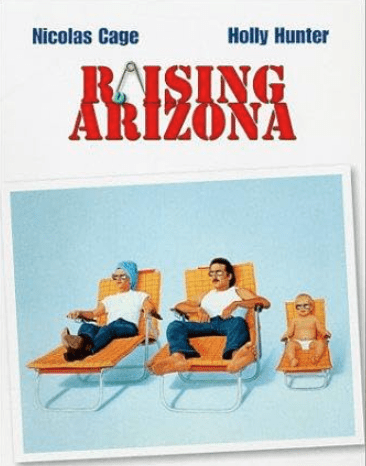
Happy Birthday, Nicolas Cage. If you’re an older Millennial or Young Gen X, you saw “Raising Arizona” about 100 times on Showtime and HBO because I believe that it was very inexpensive to license. The film was a hard left turn for the Coen Brothers who had major success with “Blood Simple” – a brutal thriller- that turned all women off to Fat Southern Murderers forever. The Coen thrillers tended to have comedic edge after Raising Arizona, but never just a comedy again- until The Big Lebowski. This film is also responsible for John Goodman. Prior to this film he was in mostly small parts, then after this picture- he became a household name in Roseanne.
Nicolas Cage is a made up name. He is Francis Coppola’s nephew and I can’t fault him for mayonnaising his name because my Italian ancestors did as well. However, I believe that he was trying to hide the Coppola name more than his heritage. Speaking of Italian heritage, try “Groking” “Italian American Jersey Girl” in grok. The lady who appears is beautiful, but doesn’t look like any of my Aunts. I feel that I should advocate for my people- We trend good looking and gave you Pizza Friday! Come on, show some love!
The film’s premise is that H.I. McDonnough (Nicolas Cage) is an ex con who is addicted to robbing the same convenience store again and again and again. This may seem strange, but in another life, I did criminal defense and I had a client who would steal the same jacket from the same store every year. Edwina “Ed” (Holly Hunter) is a cop who processes H.I. again and again. Each time, he flirts with her. His last time as a convict in front of her- her fiancé left her. H.I. realizes that he must go straight to get her love.
After his jail time, he returns as a free man to get his love- “Ed”. It works! They have a great life, but they want a child and yet she can’t conceive. The solution: they will kidnap a baby from the owner of Gallery Furniture! If you were from Texas, you would’ve laughed! They get the kid and are pursued by all sorts of people who want to claim the reward for the kidnapped baby.
This very intricate plot is just the first 30 minutes of the film. It is truly funny. I always felt for these character because good people should have LOTS OF KIDS- as many as possible! They shouldn’t have to pay taxes or anything. This film is special to me for another reason: it is when the Boomers were still young and filled with hope. Now, we are losing them and it hurts. This film is a glimpse of what they were like before the grey and how much they yearned for a good family on their own terms.
As much as I enjoy writing about movies and talking about movies, I make a living by helping people with their annual income tax filings. That means from around January 15th through April 15th each year, almost every waking hour is spent focused on tax return preparation. While I’m working on these tax returns, I will often play movies or TV shows on one of my computer screens. These aren’t just any movies, though. These are movies or TV shows that make me feel good and help me relax while I’m working so many hours. Over the years, I’ve used movies like THE OTHER GUYS, THE HANGOVER, and ZOMBIELAND. A few years ago, THE ANDY GRIFFITH SHOW was on Prime, and I watched the entire 8 seasons through 3 times during tax season. One genre I hit hard this time of year is romantic films, both comedies and dramas. The main thing I’m looking for is happy endings. My favorite romantic films include NOTTING HILL, RETURN TO ME, HITCH, YOU’VE GOT MAIL, PERSUASION & SENSE AND SENSIBILITY. As a big fan of Nicolas Cage, IT COULD HAPPEN TO YOU, Cage’s 1994 romantic comedy with Bridget Fonda has joined that list over the years as well. Since today, January 7th, 2025, is Nicolas Cage’s 61st birthday, and tax season is coming, I thought I’d write about this charming film!
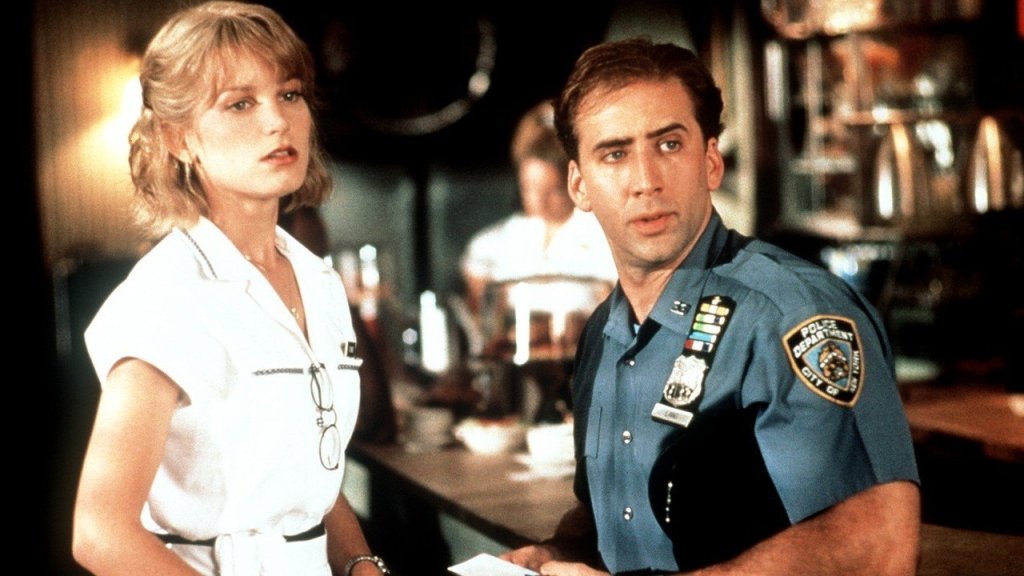
IT COULD HAPPEN TO YOU revolves around Charlie Lang (Nicolas Cage), a New York City cop who seems like an all-around good guy. One day he’s having coffee at a local diner with his partner Bo (Wendell Pierce), when they get a police call. Charlie finds himself without the money to give a proper tip to his waitress, Yvonne (Bridget Fonda), so he improvises on the spot and tells her he has a lottery ticket to be drawn on that very same night. Further, he goes on to tell her if he wins, he’ll split the winnings with her as a tip. The two cops head on out, Charlie happy that he gave her something, and Yvonne, who’s not having a good day anyway, just shakes it off knowing that it’s just another small tip she missed out on. But wouldn’t you know it, on this night the stars all align and Charlie’s number is drawn as a winner. Charlie and his wife Muriel (Rosie Perez) are ecstatic with their win, which amounts to around $4 million. In the middle of their celebration, Charlie remembers his promise to Yvonne and tells Muriel. To say she’s upset is an understatement, and she begs him to stiff the waitress. Charlie is just too honest for that, so he is able to convince Muriel that $2 Million is enough for them to live comfortably on. She begrudgingly agrees, but the fuse has been lit between Charlie and Muriel. The next day, Charlie goes back to the diner and tells Yvonne that they won. At first not believing it’s true, Charlie is able to convince Yvonne that he’s honoring his tip by giving her half of the winnings. We have found out that Yvonne is having severe financial problems, and this “tip” comes as a completely unexpected answer to her prayers. Alls well that ends well, right? As we all know, money can bring out the very best or the very worst in people and we see that play out throughout the rest of the movie. I’ll just put it this way, as Charlie and Muriel grow apart with their newfound money, Charlie and Yvonne grow closer together, bound by this amazing experience.
It’s all a pretty crazy setup, but IT COULD HAPPEN TO YOU is a movie that I relate to idealistically. I really like Cage and Fonda in their roles. I’d love to be as honest and likable as Nicolas Cage’s character Charlie Lang. He is just a good guy, way down deep. I want to be that kind of guy. And Bridget Fonda’s character Yvonne is also very appealing. She’s presented as a lady going through a lot of personal issues, but who somehow seems to always show a kind and compassionate spirit to everyone around her, especially to others who are struggling. The scene where Charlie convinces her that he really is giving her half the money is quite an uplifting scene. Both of these characters have an honesty and attitude about life that resonates with me. Some people might argue that their characters should have more depth to make them more realistic and less one-dimensional, and they might be right, but I personally enjoy seeing them as just really honest and kind people.
It should also be pointed out that you have to be able suspend your disbelief to enjoy IT COULD HAPPEN TO YOU. If your movies “have” to be realistic, this is not the movie for you. The entire premise is a fairytale, and the movie should be seen as such. For the movie to work, the good guys have to be really good guys, and the bad guys have to be really bad guys. I’ve mentioned earlier how kind both Charlie and Yvonne are throughout the film, with the money not changing their attitudes about life in any way. If anything, the money allows them to be even more kind and generous to others. Well, money has had the exact opposite effect on Muriel, and we soon learn that $2 Million isn’t enough for her and that the full $4 Million would not have been enough either. At this point, I’m not sure $100 Million would have been enough. In our fairytale story, she can’t be presented as a lady realistically struggling with her husband’s overly generous tip, she has to be presented as extremely selfish and cruel. I mean, how else is the story going to get Charlie and Yvonne together?!
All in all, IT COULD HAPPEN TO YOU works for me. I’ve said many times I’m a sucker for a good romance, and this film fits the bill for me. The main characters warm my heart as they are decent, kind and honest. I like a good fairytale. It’s one of the main reasons I enjoy the movies, and it doesn’t seem like we get enough good fairytales these days.
Check out the trailer for IT COULD HAPPEN TO YOU below!
And if you’re looking for more awesome information about Nicolas Cage, check out John Rieber’s latest post where he celebrates Cage’s birthday with a movie marathon!
2013’s Bonnie and Clyde: Justified opens with a long-haired Eric Roberts introducing himself as legendary Texas Ranger Frank Hamer. Speaking straight to the camera, Roberts-as-Hamer warns us against idolizing the notorious Depression-era outlaws Bonnie and Clyde. They were murderers!, Hamer tells us with all the fervor of a tent revival preacher.
We then flashback to Bonnie (Ashley Hayes) and Clyde (Jim Poole) driving down a country road. Clyde is behind the wheel. Bonnie, a redhead like me!, reads aloud her latest poem about what it’s like to be a notorious outlaw. Suddenly, Hamer and his men appear on the roadside and open fire.
We then start yet another flashback. 15 year-old Bonnie marries good-for-nothing Roy (Julian Brand) while Clyde and his brother Buck (Hagen Mills) steal a truck full of turkeys. Jump forward to 1929 and Bonnie is unhappily married and working in a diner that we’re told is in Dallas, Texas. Oddly enough, there’s a lot of mountains in the background. I live in North Texas and I can assure you that, as much as things have changed here over the past few years, one thing has always remained the same. There are no mountains in Dallas County.
Eventually, Bonnie meets Clyde, they fall in love, and they rob banks. At least, that’s what we’re told. The majority of the film is told through sepia-toned still shots and newspaper headlines. Clyde attempts to escape from prison but we don’t actually see him do it. Instead, we just see a headline. Bonnie and Clyde rob banks but, again, we don’t really see it as much as we hear about it. Even when people die during the robberies, we don’t really learn the exact circumstances that led to Clyde opening fire. Ashley Hayes actually gives a good performance as Bonnie and her scrappy interpretation of the character is probably closer to the truth than Faye Dunaway’s. As for Jim Poole, he’s much better-looking than the real Clyde Barrow and that’s a good thing. Who wants to watch an ugly bank robber? There’s a reason why my distant-relation Pretty Boy Floyd remains a legend. As for the title, you may be wondering what exactly was justified about Bonnie and Clyde. You can argue that they were justified in doing what they had to do in order to survive during the Great Depression. Or you can argue that Frank Hamer was justified in ambushing them. Or you can assume the film was trying to appeal to (or perhaps just tricks) fans of the Justified television series. Or you can just not worry about it.
This is the story of Bonnie and Clyde on a budget. It came out in 2013, presumably to coincide with a 4-hour Bonnie and Clyde miniseries that was airing on A&E at the time. To be honest, you have to respect the nerve of a film about Bonnie and Clyde that doesn’t actually feature much of them doing what they were famous for. Cheers to director David DeCoteau for sticking with it and giving Eric Roberts top-billing for a cameo appearance. And cheers to Eric Roberts for just being Eric Roberts.
Previous Eric Roberts Films That We Have Reviewed:
Today, the Shattered Lens wishes a happy 61st birthday to the great Nicolas Cage. Over the years, Cage has become an icon of everything that we love about the movies. He’s appeared in great films. He’s appeared in bad films. He’s done films that barely had a budget and he’s appeared in blockbusters. He can do drama. He can do comedy. He can do horror. He can do action. His performances are often so wonderfully bizarre that will sit through the worst films ever made just to catch a Nicolas Cage cameo. And yet, for every strange Cage performance, there’s a Cage performance that is undeniably brilliant, like his performance in Pig.
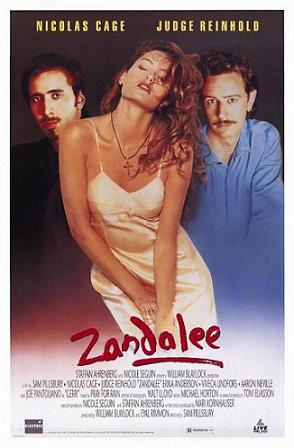
Today’s scene that I love comes from 1990’s Zandalee. In this scene, Nicolas Cage and Judge Reinhold share a dance on a Louisiana pier.
4 Shots From 4 Films is just what it says it is, 4 shots from 4 of our favorite films. As opposed to the reviews and recaps that we usually post, 4 Shots From 4 Films lets the visuals do the talking.
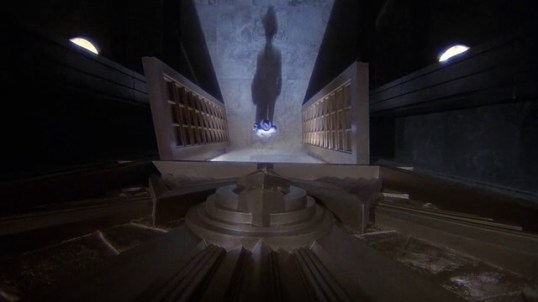
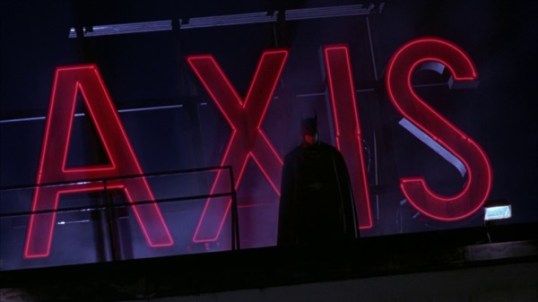
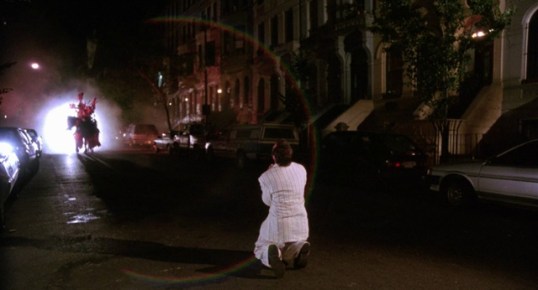
Yesterday, it was announced that the veteran cinematographer Roger Pratt passed away in December. Known for his work with Terry Gilliam and Tim Burton, Pratt left behind a legacy of visually stunning films. It’s time for…
4 Shots From 4 Roger Pratt Films
Brazil (1985, dir by Terry Gilliam, DP: Roger Pratt)
Batman (1989, dir by Tim Burton, DP: Roger Pratt)
The Fisher King (1991, dir by Terry Gilliam, DP: Roger Pratt)
12 Monkeys (1995, dir by Terry Gilliam, DP: Roger Pratt)
First released in 1977, The Great Smokey Roadblock tells the story of Elegant John Howard (Henry Fonda).
Elegant is not really his first name. It’s a nickname, one to let us know that, in the world of independent truckers, John Howard was one of the good guys. He never crashed his rig. He never overcharged for a job. He always arrived on time and in good shape. John Howard was a good man but then he turned 60 and he got sick. He spent months in the hospital, unable to work. His truck was repossessed. The movie starts with John sneaking out of his hospital room, stealing back his truck, and hitting the road in search of one final job. Though John says he just wants to make enough money to get his truck back, the truth is that John is terminally ill. If he’s going to die, he wants to die doing what he loves. Of course, dying while driving could lead to some trouble for anyone else who happens to be on the road at the time but still, you have to respect John’s determination. He’s a true American, independent to his core.
(My Dad occasionally made a living driving a truck so perhaps that’s why I’m partial to films like this one.)
John picks up a hitchhiker, a religious young man named Beebo Crozier (Robert Englund). John picks Beebo up because Beebo was walking through the desert in a suit. Beebo claims that he’s walking to Florida but John tells him that he can’t do that. John will drive Beebo to Florida. Of course, John also expects Beebo to pay for the gas that his truck uses because it’s not like John has any money. At first, Beebo accuses John of cheating him. (Henry Fonda cheating someone!? Perish the thought!) Soon, however, John has become Beebo’s mentor.
Everyone respects John but no one wants to hire him. The only offer that John gets is from sleazy Charlie Le Pere (Gary Sandy), who has an agenda of his own. Finally, John visits his old friend, Penelope (Eileen Brennan). Penelope is a madam whose brothel has just been closed down. John agrees to transport Penelope and her girls (including Susan Sarandon) to a new location on the East Coast. Penelope offers to help John pay the bills. Elegant John’s a pimp now! (I was about to say that this seemed like an odd turn-of-events for Henry Fonda but then I remembered that he starred in The Cheyenne Social Club with Jimmy Stewart.)
There’s not really much of a plot to The Great Smokey Roadblock. John, Beebo, Penelope, and the girls travel from one location to another. They get thrown in jail by a notoriously corrupt deputy named Harley Davidson (Dub Taylor). After they escape, they become minor celebrities. Two counterculture journalists (played by Austin Pendleton and John Byner) show up and help them broadcast their story and the film comes to a halt while Pendleton and Byner exchange what sounds like improvised dialogue. The police attempt to set up a roadblock to stop Elegant John and his Six Mystery Women. I guess that’s the Great Smokey Roadblock of the title.
It’s a weird movie, in that the humor is extremely broad and often crude but Henry Fonda is playing a man who is not only terminally ill but who actually looks like he’s terminally ill. (Henry Fonda himself was reportedly very ill during the filming of The Great Smokey Roadblock.) As such, it’s a rather melancholy comedy, one in which every joke seems like it might be the last one that Elegant John will ever hear. In the 70s, not even a trucker comedy could have a happy ending and, as such, The Great Smokey Roadblock feels like a drive-in film for the existential set. The film’s plot doesn’t really add up to much and is full of plot holes that serve as evidence of a troubled production. That said, there’s something rather charming about seeing a pre-Nightmare On Elm Street Robert Englund playing a gentle guy who ends up as Henry Fonda’s protegee. Fonda and Englund play off each other well and their scenes together are the best thing about The Great Smokey Roadblock.
 Jaden Miller (Kent Moran, who also directed) is a former honor student who threw away his scholarship to a private school when he got into a fight while defending another student. Having dropped out of high school, Jaden now works as an auto mechanic in the Bronx. When he and his mother (S. Epatha Merkerson) are evicted from their crummy townhouse, Jaden tries to make extra money by becoming a professional boxer. As the “Bronx Boy,” he becomes a local hero and eventually, he wins the chance to challenge the light heavyweight champion of the world (Justin Hartley).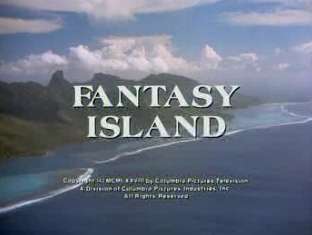


 Through the Shattered Lens