Late Night Retro Television Review: Baywatch Nights 2.14 “Ascension”


Welcome to Late Night Retro Television Reviews, a feature where we review some of our favorite and least favorite shows of the past!  On Tuesdays, I will be reviewing Baywatch Nights, a detective show that ran in Syndication from 1995 to 1997.  The entire show is currently streaming on YouTube!
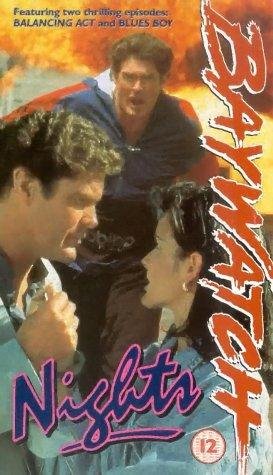
This week …. it’s Templar time!

Episode 2.14 “Ascension”

(Dir by Jon Cassar, originally aired on February 23rd, 1997)

Mitch and Ryan have been kidnapped!  They find themselves trapped in an underground prison, where their guards all wear suits and a disembodied voice demands answers without first supplying a question.  A beautiful and nameless woman (Alexandra Bokyun Chun) gives a bound Mitch a shot of sodium pentanol, the better to make him tell the truth.  But instead of answering questions, Mitch hallucinates snakes and bears.

What’s going on?  Well, not surprisingly, it’s all Teague’s fault.  In this episode, it is revealed that Teague is a part of an organization that is in conflict with the corrupted, modern version of the Knights Templar.  (*sigh*  Haven’t the Knights Templar suffered enough without being a part of every dumbass conspiracy theory out there?)  Mitch and Ryan have been kidnapped in an effort to bring Teague into the open …. or something.  To be honest, it’s never quite clear what the whole point of the kidnapping is.

The woman with the drugs apparently has a change of heart and helps Mitch and Ryan escape from their cells.  Of course, it turns out that this is all a part of the scheme to reveal Teague’s location.  (Why do conspiracies always have to be so complicated?)  Mitch figures out what’s going on and he and Ryan escape from the woman and try to break out of the prison.  If you’ve ever wanted to spend twenty minutes watching David Hasselhoff and Angie Harmon crawl around inside a heating duct, I guess this is the episode for you.

This episode feels rather pointless.  It’s never quite clear what the Templars want and Teague hasn’t really been developed enough as a character for his great friendship with Mitch and Ryan to feel authentic.  One gets the feeling that this episode was written at the last minute and a lot of the action comes across as being filler that was included to disguise the fact that this episode really didn’t have a plot.  Obviously, the show was hoping to turn the Templars into a regular set of villains, much as how The X-Files had those aliens and all the black goo.  But, if the Templars can’t even track down Teague without having to kidnap Mitch and Ryan, how intimidating can they really be?

Watching this episode, I found myself wondering how Mitch can get kidnapped and drugged by a secret organization and then go to work as a lifeguard the next day.  I mean, after everything that Mitch has seen this season, he should be one of those raving lunatics who you see on street corners holding “The End Is Near” signs.  He should be crazier than someone who has looked straight at Cthulhu.  Instead, he’s still the same mellow beach bum that he’s always been.

More power to him, I guess.  That’s the Hoff for you.
Horror on TV: One Step Beyond 2.17 “Earthquake” (dir by John Newland)


Tonight’s episode of One Step Beyond deals with a bellboy named Gerald Perkins (David Opatoshu).  Gerald keeps telling everyone that there’s going to be an earthquake but no one’s willing to listen to him.  Everyone knows that Gerald is a recovering alcoholic so they assume that he’s just drinking again.  Needless to say, it’s far easier to fire someone than to listen to his insane ramblings, right?

Well, considering that this story takes place in San Francisco in 1906, perhaps they should have listened.

According to host John Newland, this is a true story.  It originally aired on January 12th, 1960!

Enjoy!

Horror Film Review: Godzilla (dir by Roland Emmerich)


There’s a giant lizard rampaging through New York, the result of a mutation that happened as a result of being exposed to radiation.  The military tries to stop the lizard but it turns out that stopping a giant lizard is not that easy.  Scientists try to understand the lizard and how it came to be a destructive giant.  The media breathlessly reports from the scene as two wisecracking cameramen do their best to record every second of the mayhem.  The reporters call this lizard …. GODZILLA!

But is it Godzilla?

No, it’s not.  Oh, it may be called Godzilla.  And the movie itself may be called Godzilla.  But the creature at the center of the 1998 American film Godzilla is definitely not Godzilla.

Godzilla was released with a great deal of fanfare in 1998, with commercials and toys and a lot of hype.  Diddy, back when he was still calling himself Puff Daddy, recorded a song for the soundtrack and upset thousands of Led Zeppelin fans like my Dad who found themselves having to deal with kids who thought Kashmir was called Follow Me.  (Diddy singing, “Follow me?”  AGCK!  How cringey is that!?)  But, like many of the film of Roland Emmerich, it’s been almost totally forgotten in the years since.

And why not?  It’s a forgettable film.  It’s the epitome of an assembly-line action blockbuster, the type of thing that Roland Emmerich is known for.  There’s comic relief, in the form of Hank Azaria.  There’s a nerdy scientist hero in the form of Matthew Broderick.  Broderick’s scientist has an ex-wife and yes, Godzilla’s invasion of New York gives them a chance to get back together.  There’s a mysterious Frenchman who is played, somewhat inevitably, by Jean Reno.  The Mayor of New York is a fat guy named Ebert (Michael Lerner) and he has an assistant named Gene (Lorry Goldman) and they get a lot of screentime because Emmerich wanted to make fun of two films critics who didn’t care much for his work.  In fact, the Mayor and his assistant get so much screentime that it distracts from the rest of the film.  Emmerich was directing a multi-million dollar reboot of a beloved franchise and he was more concerned with a petty feud.

He certainly wasn’t concerned with Godzilla.  Personally, I like the giant lizard and one of the only effective moments in the film is when the lizard discovers that its children have been killed by the military.  But that lizard is not Godzilla and the fact that Emmerich made a Godzilla film without Godzilla indicates that he didn’t really care about the monster or its fans.  This film has no love for its source material and that’s a shame.  The Godzilla films are fun!  And the fact that the majority of the ones made up until the release of this film looked kind of cheap and featured a Godzilla who was obviously a man in a rubber suit only added to the fun.  There’s not much fun to be found in this version of Godzilla.  The movie looks great without ever making much of an impression.

And you know what?  Having gotten this review out of the way, I’m ready to get back to reviewing the true Godzilla films.  They may not have cost as much as Emmerich’s film but they’ve got heart.

Previous Godzilla Reviews:

  1. Godzilla, King of the Monsters (1958)
  2. Godzilla Raids Again (1958)
  3. King Kong vs Godzilla (1962)
  4. Mothra vs. Godzilla (1964)
  5. Ghidorah: The Three-Headed Monster (1964)
  6. Invasion of the Astro-Monster (1965)
  7. Godzilla vs. The Sea Monster (1966)
  8. Son of Godzilla (1967)
  9. Destroy All Monsters (1968)
  10. All Monsters Attack (1969)
  11. Godzilla vs Hedorah (1971)
  12. Godzilla vs Gigan (1972)
  13. Godzilla vs Megalon (1973)
  14. Godzilla vs Mechagodzilla (1974)
  15. The Terror of Mechagodzilla (1975)
  16. Cozilla (1977)
  17. Godzilla 1985 (1985)
  18. Godzilla vs. Biollante (1989)
  19. Godzilla vs King Ghidorah (1992)
  20. Godzilla vs. Mothra (1992)
  21. Godzilla vs Mechagodzilla 2 (1994)
  22. Godzilla vs SpaceGodzilla (1994)
  23. Godzilla vs. Destoroyah (1995)
  24. Godzilla, Mothra, and King Ghidorah: Giant Monsters All-Out Attack (2001)
  25. Godzilla (2014)
  26. Godzilla: Planet of the Monsters (2017)
  27. Godzilla, King of the Monsters (2019)
  28. Godzilla vs Kong (2021)
  29. Godzilla Minus One (2023)

Murder In The Dark (2023, directed by Jacob Osborn)


A group of friends gather and spend a night hanging out.  Old resentments simmer to the surface.  A murder is committed.  A killer with a bag over his head emerges from the night.  The friends try to figure out who amongst them could be a killer or if there’s something else going on.  I know some people will automatically suspect the guy wearing the Slipknot t-shirt because the members of the band all wear masks and the killer wears a mask but that’s the same logic that led to the Satanic Panic of the 1980s.  If he was wearing a Nickelback t-shirt, I would be with you.

This is a short horror film that feels like a bunch of real-life friends got together to play the fictional friends.  The opening half is too talky and slow but the second half picks up and features a few clever touches.  There aren’t many kills and they’re largely bloodless but I think director Jacob Osborn was going for something more than just another slasher.  The movie is more about how the friends relate to each other than anything else.  This is a low-budget, regional film that starts out way too slowly but I’m going to cut it some slack because the second half of the movie makes up for the weak first half.  At a time when the term indie film gets applied to even big-budget productions with major stars, Murder In The Dark is a true independent film.

Retro Television Review: Fantasy Island 5.13 “King Arthur in Mr. Roarke’s Court/Shadow Games”


Welcome to Retro Television Reviews, a feature where we review some of our favorite and least favorite shows of the past!  On Tuesdays, I will be reviewing the original Fantasy Island, which ran on ABC from 1977 to 1984.  Unfortunately, the show has been removed from most streaming sites.  Fortunately, I’ve got nearly every episode on my DVR.

This week, King Arthur comes to Fantasy Island!

Episode 5.13 “King Arthur in Mr. Roarke’s Court/Shadow Games”

(Dir by Philip Leacock, originally aired on January 23rd, 1982)

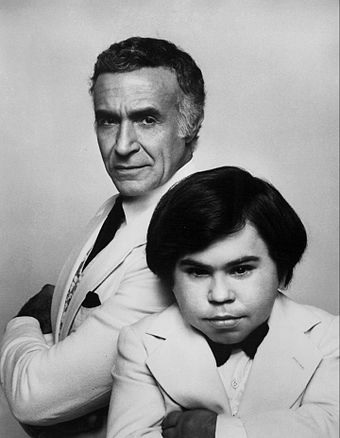
Yay!  Tattoo is present in this episode!

Listen, there’s nothing wrong with Wendy Schaal and it’s not her fault that the character of Julie was seriously underdeveloped by the show’s writers.  But I have to admit that I always cheer a little whenever an episode opens with Julie being sent to take care of something elsewhere on the Island.  In this case, Julie is sent to find a home for five adorable kittens while Tattoo and Mr. Roarke deal with this episode’s guests.

Sara Jean Rawlins (Linda Blair) is a country music singer who comes to Fantasy Island with her manager, Sam (the always sinister Peter Mark Richman).  Sara Jean wants to record her song Shadow Games and she wants her former collaborator and boyfriend, Billy, to play guitar on the track.  The only problem is that Billy is believed to have died in a fiery car crash.  Mr. Roarke says that Sara Jean’s fantasy can come true but only if she has total and complete faith.  Plus, she needs to let guitarist Todd Porter (Don Most) play with her.  “It is very important to the success of your fantasy,” Roarke tells her.  Hmmm….I wonder why.

Hey, do you think that maybe Billy isn’t dead and instead, he’s disguised himself as Todd Porter?  That would certainly explain why Todd’s guitar playing sounds just like Billy’s.  And do you think it’s possible that Sam, who is played by an actor who was always cast as a villain no matter what, might turn out to be the story’s true villain?

This fantasy was predictable and Linda Blair overacted the whole “country” aspect of her character but I did like the Shadow Games song.  And Mr. Roarke played the piano at one point!  It’s always fun when Mr. Roarke shows off a new skill.  (Apparently, Montalban himself was a very talented pianist.)

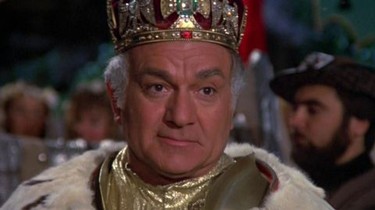
As for the other fantasy, Ralph Rodgers (Tom Smothers) wants to go to the past so he can meet King Arthur.  He specifically says his fantasy is to “meet King Arthur.”  Ralph is briefly sent back to Camelot but, just as abruptly, he returns to the present and he brings Arthur (played by Robert Mandan) with him!  Roarke admits that something must have gone wrong with the time traveling spell but he also points out that Ralph wanted to “meet King Arthur” and now he’s met him.

Now, what do you picture when you think of King Arthur?  Young?  Handsome?  Battle-weary?  Romantic?  British?

Here’s what Fantasy Island gives us.

Now, if you’ve ever seen any old sitcoms from the 70s and the 80s, you’ll probably recognize Robert Mandan.  He was one of those actors who always seemed to play stuffy authority figures.  He was always the overprotective father or the greedy businessman or the principal who wasn’t going to stand for any foolishness in his school.  Robert Mandan was not a bad actor but he was also definitely not British.  But you know what?  Robert Mandan is so miscast as King Arthur that it actually becomes kind of charming.

King Arthur and Ralph wander around the Island while Roarke works on finding a way to send Arthur back to Camelot.  Arthur gets harassed by a group of roughnecks who don’t seem like they really belong on the Island.  (Maybe they work at that fishing village that showed up in one episode and was then never mentioned again.)  Arthur also reveals that his wife, Gwynevere, had vanished.  Ralph eventually goes off on his own and runs into a British woman who says her name is Gwen (Carol Lynley).  She explains she came to the Island because her politician husband was too consumed with work.  Hmmmmm….

The important thing is that

  1. Arthur and Gwen are reunited
  2. Arthur knights Ralph before he and Gwen return to Camelot and,
  3. There’s a masquerade ball and Tattoo dressed up like a knight!

This was a silly but cute episode.  Between Robert Mandan as King Arthur and Linda Blair singing country music, this episode was so weird that it was impossible not to enjoy it.  I just hope Julie found a home for all those kittens.

Horror Scenes I Love: The Job Interview From The Shining


Since today’s song of the day came from The Shining, it only seems appropriate that today’s scene should come from the same film.

I’ve always felt that Barry Nelson’s performance as Ullman is one of the best parts of the early part of the film.  Whereas Ullman was presented as being a stereotypical jerk in King’s novel, the film presents him as a blandly friendly bureaucrat who can talk about what happened with the previous caretaker and make it sound like the most normal thing in the world.  The scene were he interviews Jack Torrance for the caretaker job is wonderfully ominous, even if it’s hard to describe why.  I know that Stephen King disliked this scene because it made Jack look unbalanced from the start but, personally, I think it does a wonderful job of setting the mood.

Finally, Ullman’s office reminds me of Ben Horne’s office in Twin Peaks, right down to the somewhat campy name plate on his desk.


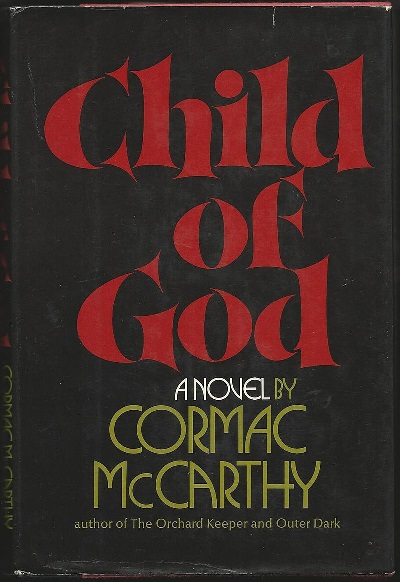
Book Review: Child of God by Cormac McCarthy


In 1960s, Lester Bullard lives alone in the mountains of Tennessee.  Abused as a child and scorned as an adult, Bullard is the type of person that most people try to ignore.  He’s angry, bitter, and not all that knowledgeable about the world outside of his own fevered imagination.  Having been evicted from his home, he moves into an abandoned shack where he spends his time voyeuristically watching the teenagers who sneak off to the isolated mountains so that they can fool around in their cars without being harassed by the grown-ups.  When Bullard stumbles across two dead bodies in a car, it doesn’t so much send him on a downward spiral as much as it just accelerates the only fate that can be waiting for someone like Lester Bullard.  Bullard does some truly disturbing things but, as the narrator reminds us, he’s “a child of God, much like yourself perhaps.”

(No, definitely not like me!  Though I do get the narrator’s point.)

First published in 1973, Child of God was Cormac McCarthy’s third novel.  It tells a disturbing story and one that will leave readers unsettled.  Inspired by the type of macabre tales that used to be told around campfires, it’s a novel of cold, gothic horror.  McCarthy’s prose creates such an atmosphere of darkness that it’s difficult to read the novel in one sitting.  You almost have to put the book down so you can step outside and take a deep breath after some of the more grotesque moments.  Child of God is also a character study of a man living on the fringes of what most people would already consider to be the fringe of society.  Just as the people living on the East and West Coasts have rejected the citizens of Appalachia, Appalachia has rejected Luster Bullard.  The book links Bullard to the violent history of Appalachia, with the Bullard family having been involved in many of the feuds that helped to define the region.  McCarthy’s matter-of-fact prose serves to make Bullard’s crimes all the more disturbing, with McCarthy refusing to give the reader the easy out of a traditional, guns-blazing ending.  Bullard’s ultimate fate feels almost as random as his crimes, challenging the idea of any sort of karmic justice.  In the end, Bullard is destined to become another barely-remembered regional legend, like Ed Gein or the Bloody Benders.  By telling his story without a hint of melodramatic excess, McCarthy leaves the reader with no choice but to consider that the world is full of real Lester Bullards.


4 Shots From 4 Films: Special William Castle Edition


4 Or More Shots From 4 Or More Films is just what it says it is, 4 shots from 4 of our favorite films. As opposed to the reviews and recaps that we usually post, 4 Shots From 4 Films lets the visuals do the talking!

Today’s director is the one and only William Castle, who was as well-known for the gimmicks he used to promote his films as for the films themselves.  It’s time for….

4 Shots From 4 William Castle Films

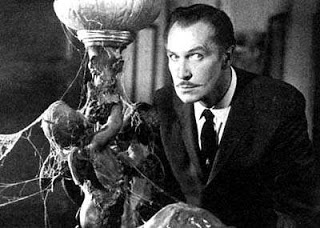
House on Haunted Hill (1959, dir by William Castle, DP: Carl E. Guthrie)

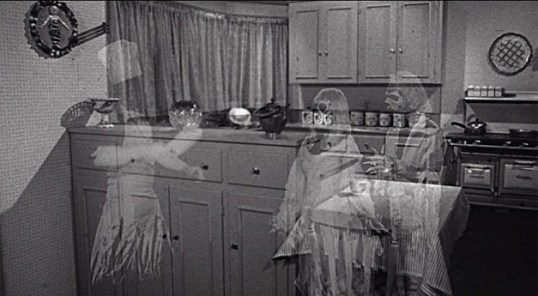
13 Ghosts (1960, dir by William Castle, DP: Joseph F. Biroc)

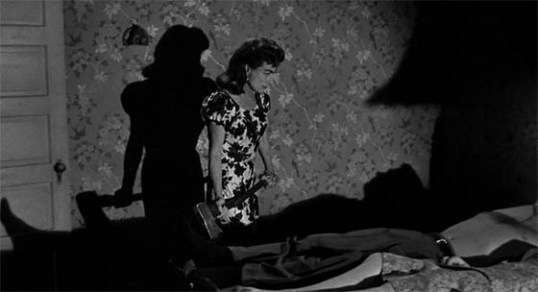
Strait-Jacket (1964, dir by William Castle, DP: Arthur E. Arling)

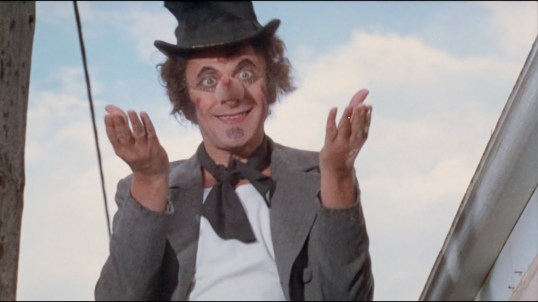
Shanks (1974, dir by William Castle, DP: Joseph H. Biroc)

Horror On The Lens: House On Haunted Hill (dir by William Castle)


The original The House on Haunted Hill is a classic and one that we make it a point to share every Halloween.  And since October is now halfway over, now seems like the perfect time to do so!

Be sure to check out Gary’s review by clicking here!

Enjoy Vincent Price at his best!

Horror Song of the Day: Main Title Theme From The Shining, composed by Wendy Carlos and Rachel Elkind


For today’s horror song of the day, we have the main title track for 1980’s The Shining.  Composed by Wendy Carlos and Rachel Elkind, this music perfectly capture the ominous grandeur of the Overlook Hotel and the snowy mountains that surround it.

It’s also a great song to play at the start of any road trip.  Scare the Hell out of your friends.  It’s fun!