October True Crime: Gacy: Serial Killer Next Door (dir by Michael Feifer)


Released this year, Gacy: Serial Killer Next Door tells the story of two neighbors in the 70s.

Bobby (Mason McNulty) is a typical 7os teenager, with long hair and a laid back attitude.  He’s what my grandparents used to call a “good kid.”  He helps out his neighbors and he only charges 50 cents an hour.  When he sees someone new moving in, he immediately offers to help the man unload all of his furniture.  He gets along with his parents.  He’s popular with his friends.  Bobby seems destined to grow up to become the type of guy who you would want living next door to you.

His new neighbor is named John (Mike Korich).  John is a small businessman with local political ambitions.  He entertains at parties under the name Pogo the Clown.  He has a loud and, if we’re going to be honest, somewhat grating laugh.  He’s a dorky guy but he seems to be super-friendly.  In fact, he’s a bit too friendly.  He’s very quick to invite young men like Bobby to come home with him.  Bobby can’t help but notice that John’s new friends enter the house but they don’t ever seem to leave.

“I’ve never met anyone named John Wayne before,” Bobby says, when he first meets John.

“My mother named me after a cowboy,” John Wayne Gacy replies.

Soon, Bobby’s curiosity gets the better of him and he starts investigating Gacy on his own.  He comes to believe that Gacy is murdering the men that he brings home and then keeping their bodies in the house.  Unfortunately, no one wants to believe Bobby.  John, a murderer?  Friendly, clownish, buffoonish John?  “He works for the Democrats!” Bobby’s mother says at one point, a line that genuinely made me laugh.

There’s a lot of laughter to be found in Gacy: Serial Killer Next Door.  John Wayne Gacy loves to put on his clown makeup, kill people, and laugh.  The laughing gets old pretty quickly, to be honest.  The real-life John Wayne Gacy was executed after less than 20 years on Death Row.  If his real-life laugh was anything like his laugh in the movie, I’m surprised that they weren’t any quicker about doing away with him.

The real-life John Wayne Gacy was one of the worst serial killers in American history.  He killed dozens, so much so that he’s still considered to be a suspect in several unsolved murders.  He tortured his victims in the worst ways imaginable.  And he never even bothered to fake any sort of remorse for his crimes.  Instead, after he was jailed, he sold Gacy merchandise to morbid collectors.  His last words, before being put to death, were reportedly, “Kiss my ass.”  John Wayne Gacy is the type of murderer who makes people like me, who are against the death penalty in general, seriously reconsider their feelings.

Considering how terrible Gacy and his crimes were, it’s a bit odd that Gacy: Serial Killer Next Door almost plays out like a comedy at time.  The film portrays Gacy as being so openly evil that it’s hard  not to smile whenever an adult refuses to believe Bobby’s claim that there might be something wrong with the man who enjoys wearing clown makeup and carrying around a set of handcuffs.  A scene where Gacy comes over to Bobby’s house and asks if he can use the phone is pure cringe comedy.  The problem is that I don’t think that the scene was meant to be comedic.

Gacy: Serial Killer Next Door is a bit of a misfire as a true crime film, as it gets the majority of the facts wrong.  (That said, it was correct about John Wayne Gacy being a Democrat.)  It works as a comedy but one could argue that a film about John Wayne Gacy should not be a comedy, even if it is largely unintentional on the part of the filmmakers.  Mason McNulty gave a good and sympathetic performance as Bobby and Mike Korich was properly creepy as Gacy.

In the end, we should probably just be happy that John Wayne Gacy is dead.
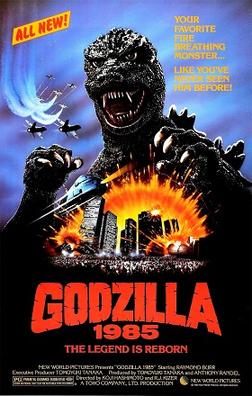
Horror Film Review: Godzilla 1985 (dir by R.J. Kizer and Koji Hashimoto)


Nine years after The Terror of Mechagodzilla, Godzilla finally returned to Japanese movie screens in The Return of Godzilla!

One year later, Raymond Burr joined him when The Return of Godzilla was released in the United States as Godzilla 1985.

The film’s plot is a simple one, though it does have an interesting subtext.  Godzilla is once again roaming the planet and, after spending the last few years as humanity’s champion, he is once again destroying everything in his path.  (This is a rare later Godzilla film that features only Godzilla.  Mothra, Rodan, Ghidorah, and that weird armadillo that always used to follow Godzilla around, none of them are present.  The son of Godzilla is not mentioned, to the regret of no one.)  Looking to prevent a mass panic, the Prime Minister of Japan tries to cover up the news of Godzilla’s return.  But when a Russian submarine is destroyed by Godzilla and the Russians blame the Americans and bring the world to the verge of atomic war, the Prime Minister is forced to reveal the truth.  The Super X, an experimental new airplane, is deployed to take Godzilla out but it turns out that Godzilla is not that easy to get rid of.

Now, as I said, there is an interesting subtext here.  If the first Godzilla films were all about the trauma of Hiroshima and Nagasaki, this version of Godzilla is all about being trapped between the whims of two super powers.  For the most part, Godzilla only attacks Japan.  At the time this movie came out, he had been attacking Japan for nearly 30 years and the rest of the world was content to allow Japan to deal with the consequences alone.  However, when Godzilla sinks that Russian sub, both the Russians and the Americans blame each other and bring the world to the brink of annihilation.  Japan, like the rest of the world, finds itself caught in the middle.  In the end, it’s up to Japan to not only defeat Godzilla but to keep the Americans and Russians from blowing up the rest of the world.  Godzilla may be bad, this movie tells us, but he’s nowhere near as bad as the idiots with all of the atomic missiles.

Of course, when The Return of Godzilla came to America, extra scenes were shot to make it clear that America had Japan’s back.  For that reason, Raymond Burr returns as journalist Steve Martin.  Martin is called in to share his first-hand knowledge of what Godzilla is capable of.  One has to wonder who thought that was a good idea as Martin basically comes across as being a grouchy crank who just wants to tell everyone to get off his lawn.  As opposed to the first Americanized Godzilla film, which was edited to make it appear as if Burr was actually talking to characters from Gojira, Godzilla 1985 just features a lot of scenes of Burr staring at a screen in the Pentagon and making ominous comments about what Godzilla is capable of doing.  It’s a wasted cameo but I guess the film’s American distributors didn’t have faith that Godzilla could pull in the audiences on his own.

Fortunately, Raymond Burr’s time-consuming cameo can’t keep this film from being a lot of fun.  It’s a Godzilla film, after all.  Godzilla stomps on a lot of buildings and breathes a lot of fire and wisely, the film doesn’t wait too long before allowing him to go on his rampage.  After spending several films as an almost comic character, this film reminds audiences that Godzilla was always meant to be frightening.  Of course, lest anyone take this film too seriously, the size of the Super X changes from scene to scene, depending on which miniature was being used.  Godzilla loses his temper and falls into a volcano but there’s never any doubt that he’ll be back.  You can’t stop Godzilla!

Previous Godzilla Reviews:

  1. Godzilla, King of the Monsters (1958)
  2. Godzilla Raids Again (1958)
  3. King Kong vs Godzilla (1962)
  4. Mothra vs. Godzilla (1964)
  5. Ghidorah: The Three-Headed Monster (1964)
  6. Invasion of the Astro-Monster (1965)
  7. Godzilla vs. The Sea Monster (1966)
  8. Son of Godzilla (1967)
  9. Destroy All Monsters (1968)
  10. All Monsters Attack (1969)
  11. Godzilla vs Hedorah (1971)
  12. Godzilla vs Gigan (1972)
  13. Godzilla vs Megalon (1973)
  14. Godzilla vs Mechagodzilla (1974)
  15. The Terror of Mechagodzilla (1975)
  16. Cozilla (1977)
  17. Godzilla vs. Mothra (1992)
  18. Godzilla vs. Destoroyah (1995)
  19. Godzilla, Mothra, and King Ghidorah: Giant Monsters All-Out Attack (2001)
  20. Godzilla (2014)
  21. Godzilla: Planet of the Monsters (2017)
  22. Godzilla, King of the Monsters (2019)
  23. Godzilla vs Kong (2021)
  24. Godzilla Minus One (2023)

4 Shots From 4 Ken Russell Films


4 (or more) Shots From 4 (or more) Films is just what it says it is, 4 (or more) shots from 4 (or more) of our favorite films. As opposed to the reviews and recaps that we usually post, 4 (or more) Shots From 4 (or more) Films lets the visuals do the talking.

Today, we pay tribute to the iconoclastic British director Ken Russell with….

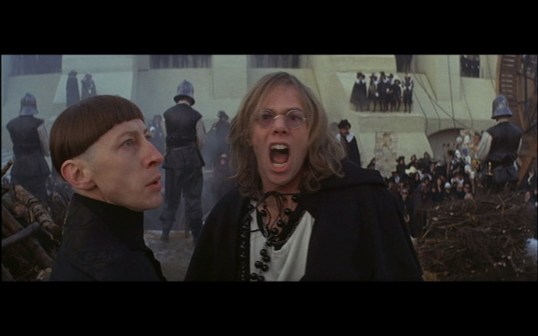
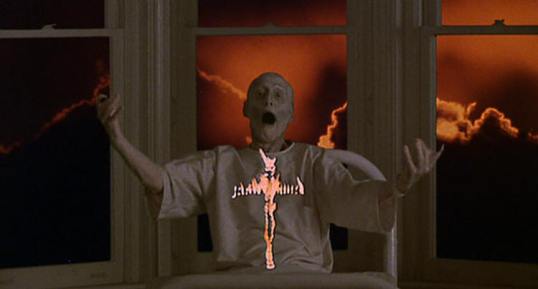
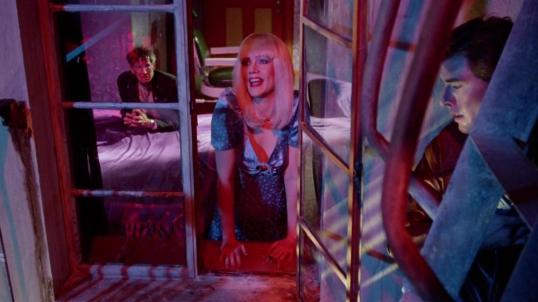
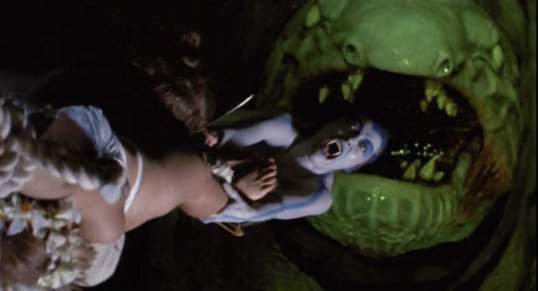
4 Shots From 4 Ken Russell Films

The Devils (1971, directed by Ken Russell, DP: David Watkin)

Altered States (1980, dir by Ken Russell, DP: Jordan S. Croneweth)

Crimes of Passion (1984, dir by Ken Russell, DP: Dick Bush)

The Lair of the White Worm (1988, dir by Ken Russell, DP: Dick Bush)

Horror Film Review: Crimes of Passion (dir by Ken Russell)


The 1984 film, Crimes of Passion, tells the story of three people and their adventures on the fringes of society.  One is just visiting the fringes.  One chooses to work there while living elsewhere.  And the other is a viscous demon of repressed sexuality.

Bobby Grady (John Laughlin) has what would appear to be an ideal life.  He has a nice house in the suburbs.  He appears to have a good job.  He has a lovely wife (Annie Potts) and he has friends who all remember what a wild guy Bobby used to be when he was younger.  Bobby’s grown up and it appears that he’s matured into a life of comfort.  In reality, though, Bobby is frustrated.  He worries that he’s become a boring old suburbanite.  He and his wife rarely have sex.  The commercials on television, all inviting him to dive into the life of middle class ennui, seem to taunt him.  In order to help pay the bills, he has a second job as a surveillance expert.

He’s hired to follow Joanna Crane (Kathleen Turner), an employee at a fashion house who is suspected of stealing her employer’s designs and selling them.  Joanna is describe to Bobby as being cool, ambitious, and always professional.  At work, she always keep her emotions to herself and no one seems to know anything about what she does outside of the office.  There’s no real evidence that Joanna is stealing designs.  Her employer just suspects her because Joanna always seem to be keeping a secret.

Bobby follows Joanna and he discovers that she’s not stealing designs.  Instead, she’s leading a secret life as Chyna Blue, a high-priced prostitute who wears a platinum wig and who tends to talk to like a cynical femme fatale in a film noir.  Bobby becomes obsessed with Chyna, following her as she deals with different johns, the majority of whom are middle class and respected members of society.  Chyna has the ability to know exactly what the men who come to her are secretly looking for.  A cop wants to be humiliated.  A dying man needs someone to care about him.  And one persistent and sweaty customer is obsessed with saving her.

The Reverend Peter Shayne (Anthony Perkins, in twitchy Psycho mode) hangs out on Sunset Strip and tries to save souls.  Those who he can’t save, he kills.  He carries the tools of his trade with him, a bible, a sex doll, and a sharpened dildo.  After Chyna tells him that she doesn’t want anything to do with him or his money or his religion, Shayne grows increasingly more and more obsessed and unbalanced.

The plot is actually pretty simple and not that much different from what one might find in a straight-to-video neo-noir.  What sets Crimes of Passion apart from other films of the genre is the fearless performance of Kathleen Turner and the over-the-top direction of Ken Russell.  Never one to shy away from confusing and potentially offending his audience, Russell fills the film with shocking and frequently surreal imagery.   Grady’s wife would rather watch insanely crass commercials than have sex with him.  (“We just got the cable,” she explains.)  When Shayne first approaches Chyna, the scene plays out in black-and-white and at a pace that would seem more appropriate for a screwball comedy than a graphic horror film.  When Shayne commits one of his first murders, his victim is temporarily transformed into a blow-up doll.  The sex-obsessed dialogue alternates between lines of surprising honesty and moments that are so crudely explicit that it’s clear they were meant to parody what Russell viewed as being America’s puritanical culture.

It’s not a film for everyone, which won’t shock anyone who has ever seen a Ken Russell film.  The film works best when it focuses of Kathleen Turner and her performances as Chyna and Joanna.  John Laughlin is a bit bland as the film’s male lead but that blandness actually provides some grounding for Russell’s more over-the-top impulses.  As for Anthony Perkins, he was reportedly struggling with his own addictions when he appeared in this film and he plays Peter Shayne as being a junkie looking for his next fix.  There’s nothing subtle about Perkins’s performance but then again, there’s nothing subtle about Ken Russell’s vision.

Crimes of Passion has some major pacing issues and, for all of Russell’s flamboyance, his visuals here are not as consistently interesting as they were in films like Altered States and The Devils.  Still, Crimes of Passion is worth seeing for Kathleen Turner’s performance and as a portrait of life on the fringes.  Even a minor Ken Russell film is worth watching at least once.

Live Tweet Alert: Join #FridayNightFlix For Jack’s Back


As some of our regular readers undoubtedly know, I am involved in a few weekly live tweets on Twitter and Mastodon.  I host #FridayNightFlix every Friday, I co-host #ScarySocial on Saturday, and I am one of the five hosts of #MondayActionMovie!  Every week, we get together.  We watch a movie.  We tweet our way through it.

Tonight, at 10 pm et, #FridayNightFlix presents 1988’s Jack’s Back, starring James Spader!

If you want to join us this Friday, just hop onto twitter, start the movie at 10 pm et, and use the #FridayNightFlix hashtag!  It’s a friendly group and welcoming of newcomers so don’t be shy.

Jack’s Back is available on Prime and Tubi!  See you there!

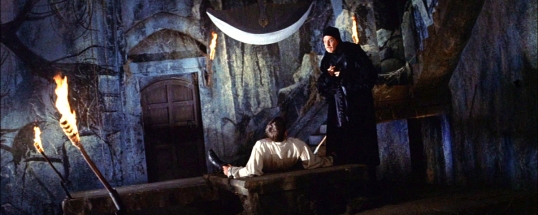
Horror Film Review: The Pit and the Pendulum (dir by Roger Corman)


The second of Roger Corman’s Edgar Allan Poe adaptations, 1961’s The Pit and The Pendulum opens in much the same way as The Fall of the House of Usher.  A young Englishman (played by John Kerr) rides a horse across a colorful but desolate landscape.  A castle sits in the distance.

Of course, as opposed to  the 19th Century British setting of The Fall of the House of Usher, The Pit and the Pendulum takes place in 16th Century Spain, at a time when the country was still scarred by the horrors of the Inquisition.  And Francis Barnard is not traveling to the castle to see his fiancée but instead, he’s searching for information about the disappearance of his sister, Elizabeth (played by the one and only, Barbara Steele).  At the castle, Francis meets Elizabeth’s husband, Nicholas (Vincent Price) and Nicholas’s sister, Catherine (Luana Anders).  Nicholas explains that Elizabeth died under mysterious circumstances, while suffering from a rare blood disorder that seemed to quickly sap away her will to live.  Nicholas’s best friend, Dr. Leon (Anthony Carbone), explains that Elizabeth died of fright after she locked herself in one of the iron maidens in the castle’s torture chamber….

Oh yes, the castle has a torture chamber.  Nicholas’s father was a leader of the Inquisition and he used the castle as a place to conduct his business.  Nicholas’s father was a madman who suspected that his wife was cheating on him.  One day, while young Nicholas was exploring the torture chamber, he witnessed his father murder both his wife and his brother.  Nicholas watched as his mother was entombed alive and ever since, he’s been terrified of the idea of premature burial.  In fact, his fear that he may have buried alive Elizabeth while she was still alive is driving him mad.  The sudden arrival of the suspicious Francis doesn’t help matters….

The Pit and the Pendulum opens with splashes of color spreading across the screen, a sign that Corman was once again in a pop art state of mind when he directed this film.  The Pit and The Pendulum takes everything that worked (and didn’t work) about The Fall of the House of Usher and it turns it all up by a notch or two.  The castle is even more gothic.  Vincent Price’s Nicholas is even more mentally fragile than his Roderick Usher, though Nicholas is also a quite a bit more sympathetic.  If Roderick was a control freak who used his family’s curse as an excuse to embrace his own authoritarian tendencies, Nicholas is just a frail man suffering from PTSD.  He’s definitely more of a victim than a victimizer … or, at least, he is at first.  Much like Mark Damon is The Fall of the House of the Usher, John Kerr is a bit of a stiff in the role of Francis but it doesn’t matter.  Vincent Price is the main attraction here and Corman’s direction shows that he understood that.

And then there’s the Pendulum.  It takes a while for the Pendulum and its swinging blade to make an appearance but when it does, it lives up to the hype.  The Pendulum swings and Corman goes all out, zooming into Price’s crazed eyes while the Pendulum comes closer and closer to its latest victim.  The images are tinted red and green and the Pendulum itself seems to swing in a slow motion, the cinematic equivalent of a nightmare come to life.

The Pit and the Pendulum is a wonderful work of gothic pop art.  Featuring Vincent Price at his most wonderfully unhinged, this is a film we should all watch this Halloween.

Pit and the Pendulum (1961, dir by Roger Corman, DP: Floyd Crosby)


Horror On the Lens: Creation of the Humanoids (dir by Wesley E. Barry)


The Creation of the Humanoids (1962, dir by Wesley Barry)

What makes us human?  What does it mean to have free will?  What is love?  What is freedom?  The questions and more are asked in the low-budget (and rather odd) science fiction epic The Creation of the Humanoids, which you can view below!

Now, I should warn that Creation of the Humanoids is an extremely talky film.  And the plot is occasionally difficult to follow. There’s a lot of ennui to be found in this particular film, both from the humans and those who have been built to serve them  However, I find it impossible not to love this one because it’s just such a strange movie.  I love it for the colorful set design, the contrast between the resentful robots and the paranoid humans, and the fact that the film — despite being made for next to nothing — actually has more ambition than anything ever made by several of the more successful directors working today. And, while it may not really be a horror film in the way that some of our other October films are, it still feels appropriate for the Halloween season. It just has the perfect holiday atmosphere.

First released in 1962, Creation of the Humanoids was reportedly one of Andy Warhol’s favorite films.  Keep an eye out for Plan 9 From Outer Space‘s Dudley Manlove.

Music Video of the Day: The Show Must Go On by Three Dog Night (1975, directed by ????)


Three Dog Night was a band that was prominent in the days before music videos but fortunately, they left us with a wealth of live performances that were captured for television.  I don’t know what show this was filmed for, just that it’s from 1975.  For our purposes, the MVP of this video is the keyboardist who goes out of his way to bring some Halloween flavor to the proceedings.

Originally written and performed by Leo Sayer, this cover of The Show Must Go On was Three Dog Night’s final Top 10 hit in the United States.  The best part of the song, the intro, was severely shortened for the song’s radio edit but it still became a hit.

Enjoy!