Before I came across this video on YouTube, I had never heard this song before. I don’t know much about Modern Talking, either. I’ve noticed that, on YouTube, their videos appear to be popular with Russian viewers. Almost all of the comments are written in Cyrillic.
Even though I don’t know much about the band or the song, I still decided to go with this video because it really does epitomize an era. From the pixelated beginning to the keytar and the pink bowtie, this is a video that could only come from the 80s. Even though this song is not on the GTA: Vice City soundtrack, it feels like it should be.
Earlier today, the red band trailer for The Suicide Squad was released!
It’s always kind of funny to me how excited some people get over red band trailers, when essentially red band trailers are just the same as regular trailers. The main difference is that you get to hear people curse but is that really that exotic? Red band trailers always remind me of a little kid trying to impress everyone by dropping the f-bomb. I mean, we all already knew that The Suicide Squad was R-rated, right? Maybe it’s just that I’ve seen so many Italian horror trailers that everything now seems tame by comparison. I mean, once you’ve seen the trailer forZombie Holocaust, it’s hard to be shocked.
Anyway, people with far more knowledge of The Suicide Squad than me are excited about this trailer so I will refrain from being too critical. I mean, the trailer gets the job done. If you were excited to see The Suicide Squad, I imagine that you’re still excited. I think the only recent trailers that actively turned people from seeing a films that they might otherwise see were the trailers for Ghostsbusters and Cats.
Myself, I’m just looking forward to seeing what James Gunn does with the material.
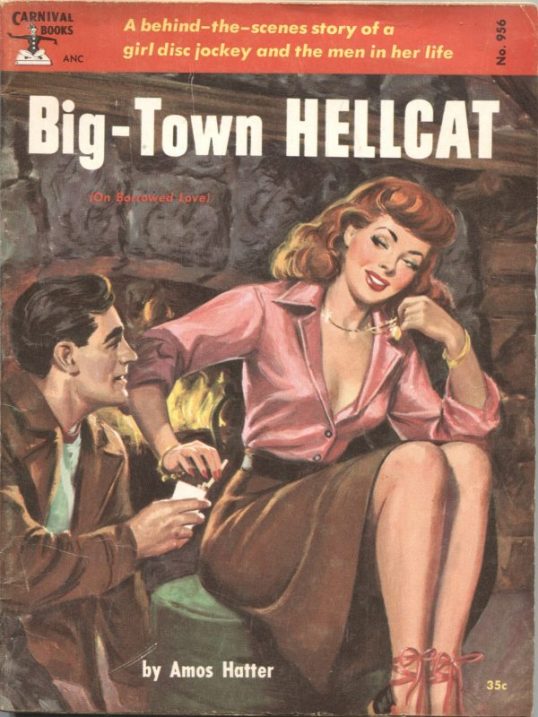
This was published in 1957. One thing that always amuses me about covers like this one is how surprised we’re supposed to be that a woman can have a job. It’s not enough that this is a book about the love life of a disc jockey. The cover makes sure that we know it’s about a “girl disc jockey.”
She’s also a “Big-Town Hellcat,” which I guess is better than being a “small town hellcat’ but not up to the level of being a “city hellcat.” I can’t help but notice the man on the cover is offering her a cigarette but not a light. Maybe that’s why they’ve got that fire roaring in the fireplace.
Unfortunately, the identity of the artist of this cover is unknown.
Every 80s hair band had to have at least one song that showed that, underneath all the debauchery and the partying, they were actually sensitive poets. Motley Crue had Home Sweet Home. Def Leppard had Two Steps Behind. And Poison had Every Rose Has Its Thorn.
This song was inspired by Bret Michaels’s relationship with his then girlfriend, Tracy Lewis. After playing a show in Dallas, Michaels called Lewis in Los Angeles and, in a scene reminiscent of Pink Floyd’s The Wall, he was shocked when another man answered the phone. Michaels wrote the song the next day while sitting in a laundromat.
(Presumably, the death of the landline phone has all but eliminated the risk of getting caught cheating as a result of the wrong person answering phone.)
The concert scenes in this video were filmed at a show in Green Bay, Wisconsin while the scenes of Bret Michaels and his girlfriend (his Rose?) were filmed in a warehouse. The video’s director, Marty Callner, was one of the top music video directors of the 80s and 90s. He worked with just about everyone.
Incidentally, Poison is a band that I always used to make fun of but then I saw them interviewed in Penelope Spheeris’s The Decline of Western Civilization Part II and they came across as being surprisingly well-adjusted, especially when compared to W.A.S.P’s Chris Holmes, who was famously interviewed while floating in a pool and pouring a bottle of vodka over himself.
Though the Academy of Motion Picture Arts and Sciences claim that the Oscars honor the best of the year, we all know that there are always worthy films and performances that end up getting overlooked. Sometimes, it’s because the competition too fierce. Sometimes, it’s because the film itself was too controversial. Often, it’s just a case of a film’s quality not being fully recognized until years after its initial released. This series of reviews takes a look at the films and performances that should have been nominated but were,for whatever reason, overlooked. These are the Unnominated.
The 2002 film Auto Focus start out as almost breezy satire of the perfect all-American life and it ends with an act of shocking violence. It’s based on a real-life mystery, a murder that revealed a secret life.
When we first see Bob Crane (Greg Kinnear), he’s a disc jockey and a drummer living in the suburbs of Los Angeles in the mid-60s. He’s got what would appear to be the ideal life. He’s got a nice house. He and his wife (Rita Wilson) seem to be devoted to each other. His children are adorable. He goes to church. He tells corny Dad jokes. He’s got a quick smile and a friendly manner and it’s impossible not to like him. When he gets offered the lead in a sitcom, his happiness and enthusiasm feels so generous that it’s impossible not to be happy for him.
Of course, the show is a comedy that takes place in World War II POW camp, which doesn’t really sound like a surefire hit or really anything that should be put on the air. (“Funny Nazis?” Crane says in disbelief when he’s first told about the project.) Still, with Crane in the lead role, Hogan’s Heroes becomes a hit and, for a while, Bob Crane becomes a star and it seems like it couldn’t have happened to a more deserving guy.
The problem, of course, is that Crane seems like he’s too good to be true and we all know what they say about things like that. From the start, there are hints that Crane may be hiding another side of his personality. His wife, for instance, is not happy when she discovers his stash of pornographic magazines in their garage. (“They’re photography magazines!” Crane protests with a smile that’s a bit too quick.) Crane obviously enjoys the recognition that comes from being the star of a top-rated show. He starts hanging out at strip clubs, occasionally playing drums with the club’s band and watching the dancers with a leer that’s really not all that different from the smile that he flashes whenever he asks anyone if they want an autograph.
Crane also meets John Carpenter (Willem DaFoe), an electronics expert who introduces him to the then-expensive and exclusive world of home video. As opposed to the clean-cut and smoothly-spoken Crane, Carpenter is so awkward that it’s sometimes painful to watch him move or listen to him speak. He’s the epitome of the Hollywood hanger-on, the type who has deluded himself into thinking that his celebrity clients genuinely like him and enjoy his company. He and Crane become fast friends, though it’s always obvious that Crane considers himself to be better than Carpenter. However, Carpenter is the only person with whom Crane can share the details of his secret life.
The film covers several years, from the late 60s to the mid-70s. Crane goes from being so clean-cut that he neither drinks nor curses to being so addicted to sex that he can stop himself even when it starts to destroy his career and leads to him losing everything that he loves. Carpenter and Crane’s friendship becomes progressively more and more self-destructive until the film ends in violence and tragedy.
Auto Focus begins on a light and breezy note but, as Crane’s addiction grows, the film grows darker. By the time the movie enters the 70s, the camerawork becomes more jittery and the once soft-spoken Crane seems to be drowning in his own anxiety. He becomes the type who causally goes from talking to Carpenter about how he wants to direct the world’s greatest sex film to cheerfully announcing that Disney has decided to cast him in a film called SuperDad. Auto Focus‘s key scene comes towards the end, when Crane is a guest on a silly cooking show and shocks the audience by harassing a woman sitting in the front row. When the audience boos, Crane flashes his familiar smile and it becomes obvious just how much of Crane’s life has been spent hiding behind that smile. By the end of the film, not even Crane himself can keep track of whether or not he’s a wholesome comedy star or a self-destructive sex addict.
Both Greg Kinnear and Willem DaFoe gave Oscar-worthy performance in Auto Focus, performances that hold your interest even after their characters sink to some truly low depths. The film makes good use of Kinnear’s amiable screen presence and Kinnear convincingly creates a man who wishes that he could be the person that he’s fooled everyone into thinking that he is. By the time he’s reduced to begging his agent (well-played by Ron Leibman) to find him a game show so that he can finally stop doing dinner theater, it’s hard not to have a little sympathy for him, even if the majority of his problems are self-created. As Carpenter, DaFoe is convincingly creepy but, at times, he’s also so pathetic that, again, you can’t help but feel a little sorry for him. At his worst, Carpenter is the 70s equivalent of the twitter user who stans a celebrity by sending them adoring tweets and then picking fights with anyone who disagrees.
Unfortunately, the Academy nominated neither Kinnear for Best Actor nor DaFoe for Best Supporting Actor. The competition for Best Actor was fierce that year, with Nicolas Cage, Michael Caine, Daniel Day-Lewis, and Jack Nicholson all losing to Adrien Brody in The Pianist. While Kinnear deserved a nomination, it’s hard to say who I would drop from that line-up to make room for him. As for DaFoe, I would argue that he was more deserving of a supporting actor nomination than The Hours‘s Ed Harris or The Road To Perdition’s Paul Newman. Perhaps DaFoe was just too convincing as the type of clingy groupie that most members of the Academy probably dread having to deal with.
Nominated or not, Auto Focus is a disturbing and ultimately sad look at the darkness that often hides behind a perfect facade.
The Producers Guild announced its picks for the best of 2020-2021 last night and, not surprisingly, the winner for Best Film was Nomadland. Nomadland now pretty much how a clear road to winning the Academy Award for Best Picture at the end of April. I have to admit that I have yet to see it, even though I’ve got Hulu. I don’t know …. I just can’t work up any enthusiasm for the prospect of sitting through it.
Anyway, here are the PGA’s winners:
The Award for Outstanding Producer of a Feature Theatrical Motion Picture
Borat Subsequent Moviefilm
Judas and the Black Messiah
Ma Rainey’s Black Bottom
Mank
Minari Nomadland
One Night in Miami
Promising Young Woman
Sound of Metal
The Trial of the Chicago 7
The Award for Outstanding Producer of Animated Theatrical Motion Pictures
The Croods: A New Age
Onward
Over the Moon Soul
Wolfwalkers The Award for Outstanding Producer of Documentary Motion Pictures
David Attenborough: A Life on Our Planet
Dick Johnson Is Dead My Octopus Teacher
Softie
A Thousand Cuts
Time
The Truffle Hunters
“I flew in a flying saucer and all I got was a new pair of boots!”
They are pretty nice boots, though. They go with the cape, the gun, and Santa’s elves. If I was looking through a store’s magazine racks in 1951 and I saw this cover, I’d probably buy this edition of Other Worlds. I’d want to know who the woman is and who her servants were. I’d really want to know about Captain A.V.G. and his flying saucer trip.
This cover was done by Harold W. McCauley, who did a lot of pulp covers. I’ve always felt that McCauley and his work deserves more attention from collectors than it seems to get.
It’s not really about much. It’s just one of those cheap pop lyrics.
— Roland Orzabal
Today’s song of the day is especially appropriate for me because my WordPress account has been updated and, after five years of using classic editor, I’m just now figuring out how to use block editor. I can tell already that it’s going to take me a while to get the hang of this but I think I’m going to like it eventually. Change can be difficult but it can still be a good thing.
Change was Tears For Fears’s fourth released single and it was their second big hit, after Mad World. It was also their first song to chart in the United States. This video was directed by Clive Richardson, who was also responsible for several early Depeche Mode videos.
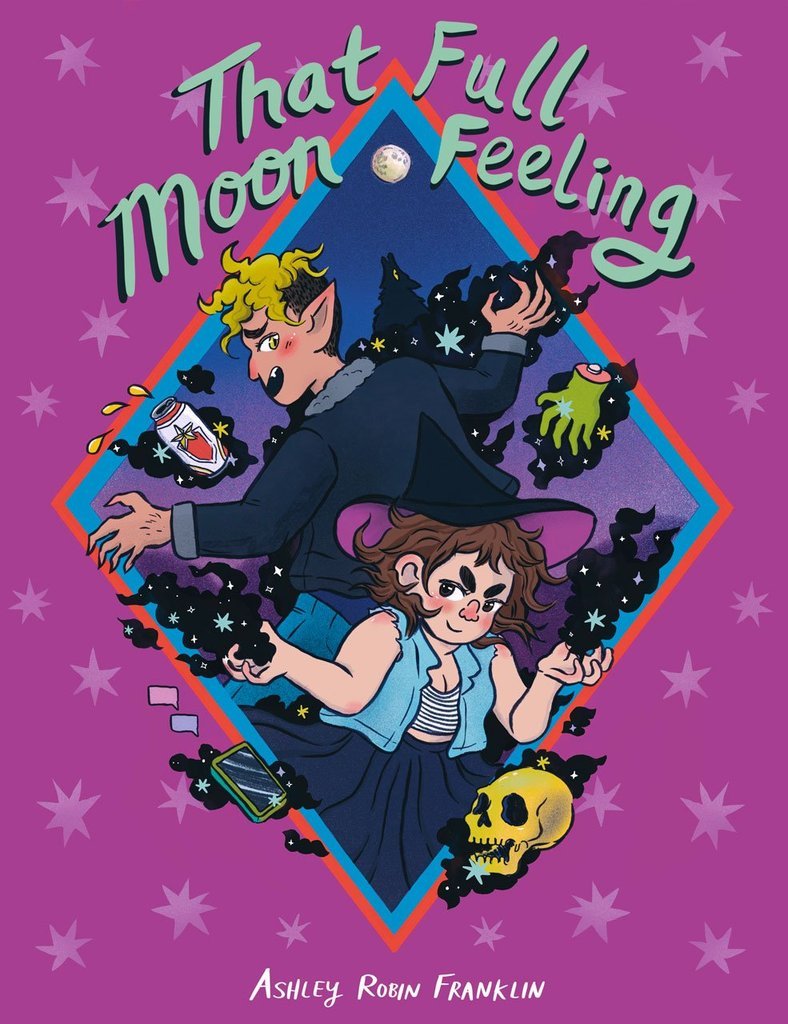
I once opined — and I’m hardly the first to have done so, trust me — that it’s good practice for cartoonists, and really artists of all stripes, to step outside their comfort zones and try something different, but I’ll let you in on a little secret : the same is absolutely true for critics.
As prima facie evidence of this assertion, I offer up Austin-based cartoonist Ashley Robin Franklin’s new little book from Silver Sprocket, That Full Moon Feeling, which lithely threads the needle between two genres that are by and large of little interest to me, specifically romantic comedy and the supernatural, yet nevertheless managed to warm my cynical middle-aged cis white male heart and plant an entirely unforced smile on my face for the duration of its 64 pages. Which, admittedly, is me giving away the final verdict of this review early on, but I do…
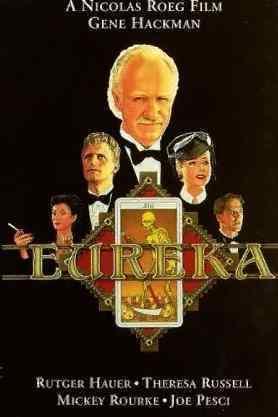
In this 1983 film, Gene Hackman plays Jack McCann, a prospector who is determined to either get rich or freeze to death as he wanders around Alaska in the 1920s. When he’s not having sex and philosophical discussions with the local witch, Freida (Helena Kallianiotes), Jack desperately searches for gold. Jack is convinced that gold is all that he needs to be happy, though Freida counsels him that it’s also important to pursue more Earthly delights. Everywhere Jack looks, he sees people dying in the snow. In fact, Jack nearly dies himself until he stumbles across a mountain full of gold. As gold dust pours down on him, he celebrates while having flashbacks to Freida writhing in ecstasy. It’s just that type of film. When Jack tells Freida about his claim, he asks what’s going to happen next. Freida tells him that it’s both the end and the beginning. Once again, it’s just that type of film.
At this point, Eureka jumps ahead 20 years. The year is 1945. World War II is coming to an end. Jack is no longer freezing and starving to death in Alaska. Now, he is one of the world’s richest men. He even owns his own island in the Caribbean. Jack has a huge house, a beautiful view of the ocean, and all the money in the world. One could even say that his life has become an exclusive beach vacation, an eternal Spring Break, if you will. And yet, even with all of his money, Jack has fallen victim to ennui. He was happier when he was poor and starving and seeking warmth from Freida. Now, he’s got an alcoholic wife (Jane LaPotaire) and his daughter, Tracy (Theresa Russell), is in love with a dissolute aristocrat named Claude (Rutger Hauer), to whom Jack takes an instant dislike. Claude claims that Jack has stolen his wealth from the Earth. Claude is the type who eats gold and then promises to return it to Jack as soon as he can. That’s something that actually happens. It’s kind of silly but Rutger Hauer is such a charmer that he nearly pulls it off.
Claude and Tracy aren’t the only thing that Jack has to worry about. An American gangster named Mayakofsky (Joe Pesci) wants to take over Jack’s island so that he can build a casino on it. However, despite the best efforts of Mayakofsky’s attorney (Mickey Rourke), Jack is still not willing to sell. When hitman Joe Spinell shows up outside the estate, are Jack’s days of ennui numbered?
Of course, they are! That’s not really a spoiler. Eureka is (loosely) based on the real-life murder of Sir Harry Oakes, an American-born prospector who was thought to be one of the world’s richest men when he was brutally murdered in the 40s. Jack is, of course, a stand-in for Oakes while Mayakofsky is based on Meyer Lansky, the mobster who many people suspect ordered Oakes’s murder. Lansky was never charged with the crime. Instead, Oakes’s son-in-law, Count Alfred de Marigny, was arrested and charged with the crime. After a trial that made international news and was described as being “the trial of the century,” de Marigny was acquitted and the murder of Harry Oakes remains officially unsolved.
It’s an interesting story and it seems like one that should perfectly translate to film. Surprisingly though, Eureka doesn’t really do it justice. The film was directed by one of the masters of cinematic surrealism, Nicolas Roeg. Roeg, of course, is probably best remembered for films like Performance, Don’t Look Now, Walkabout, and The Man Who Fell To Earth. As one might expect from a Roeg film, Eureka is visually stunning but, as a director, Roeg can’t seem to decide whether he’s more interested in Jack’s ennui or in all the soapy melodrama surrounding Jack’s murder. As such, neither element of the film gets explored with any particular depth and the resulting film, while always watchable, still feels rather shallow and disjointed. (After taking forever to reach the end of Jack’s story, Eureka then turns into a rather conventional courtroom drama. Theresa Russell does get to utter the immortal line, “Did you cut off my father’s head?” but otherwise, it’s kind of dry.) The film is at its strongest when Jack is just a prospector in Alaska. The harsh landscape and the crazed dialogue is perfect for Roeg’s dream-like style. Once the film moves to the Caribbean, it suffers the same fate that befell Jack when he become rich. It loses its spark.
That said, Eureka has its moments. Any film that features Gene Hackman, Mickey Rourke, Joe Pesci, Rutger Hauer, and Joe Spinell all acting opposite of each other is going to have at least a few scenes worth watching. I particularly liked Pesci’s surprisingly subdued performance as Mayakofsky. With everyone else in the film chewing every piece of scenery on the island, Pesci wisely underplays and is all the more menacing for it. While Eureka ultimately doesn’t add up too much, it’s worth watching at least once for the cast.
Finally, my personal theory is that Harry Oakes’s murder had more to do with the Duke and Duchess of Windsor (formerly King Edward VIII and Wallis Simpson) than it did with Meyer Lansky. (The Duke was the governor of the Bahamas at the time of Oakes’s murder.) But that’s just my opinion.


 Through the Shattered Lens