The first issue of Science Wonder Stories appeared in 1929. It was published by Luxembourg-born businessman, Hugo Gernsback. Along with publishing magazines, Gernsback also owned a radio station and was an amateur inventor. He was also a tireless supporter of science fiction, arguing that his pulp magazines should be read by students in school because science fiction was educational as well as being entertaining.
Science Wonder Stories was one of the many magazines that Gernsbeck founded. The first issue was published in 1929 and featured stories and artwork from several pioneers of the science fiction genre. In 1930, Gernsbeck merged Science Wonder Stories with another magazine, Air Wonder Stories. The new magazine was called Wonder Stories and ran until 1964.
Below are some of the covers of Science Wonder Stories. All of these covers were done by Frank R. Paul.
I was going to do one of the videos that Paul Thomas Anderson directed for Haim today but I changed my mind at the last minute. That’s nothing against Haim or the video. Haim’s great and their videos — particularly the ones directed by Anderson — are frequently brilliant. It’s just, for whatever reason, I knew that today was not the day to write about their video for The Steps. That day will come soon.
Instead, I wrote about the video for Michael Penn’s Try.
Try was the very first music video to be directed by Paul Thomas Anderson. He directed it while he was editing Boogie Nights. Michael Penn, of course, did the score for both Boogie Nights and Anderson’s earlier Hard Eight. He can also be spotted in Boogie Nights, playing Nick in the recording studio and incredulously reacting to the efforts of Dirk Diggler and Reed Rothschild to record their own album.
When watching this video, pay attention to the blonde gentleman wearing the Planet of the Apes t-shirt. He shows up twice and, at one point, holds the microphone into which Penn is singing. If he looks familiar, that’s because he’s actor Philip Seymour Hoffman! When I first saw the video, I honestly didn’t recognize him. I just thought he was some random crew person who got the job because he could run fast enough to keep up with Penn. Of course, once I learned that Hoffman was in the video and I rewatched it, I immediately spotted him. I think it says something about what a good actor Hoffman was that, even in something like this, he could be so convincing that, despite being one of the most recognizable actors in the world, he still became somewhat anonymous. He disappeared into the role.
Thomas Jane and Melora Waters (who played Todd and Jessie St. Vincent in Boogie Nights) are also in this video, standing at the end of a a long line of exhausted dancers. (This was meant to be a reference to the film, They Shoot Horses, Don’t They?) There’s one other Boogie Nights reference, which is kind of interesting considering the fact that he and Anderson supposedly didn’t get along during filming. Keep an eye out for door with a purple 9 on it. That’s a reference to Burt Reynolds, who wore the number 9 when he played college football.
Aram Fingal (Raul Julia) is a computer technician in the future who is caught watching Casablanca at work. The CEO of Novicorp (Donald Moore) is the only person allowed to watch old movies so he decrees that Aram be “droppled,” which is supposed to give Aram a new outlook on life. Aram’s mind is taken out his body and transferred into the body of a baboon. At first, Fingal enjoys being a baboon but then he nearly gets killed by an elephant and he decides that it’s time to return to his body. Unfortunately, his body has been misplaced.
Instead of just leaving Aram’s mind inside of the baboon, Novicorp decides to save his mind in a computer mainframe where Aram discovers how to create his own world, which he patterns after Casablanca. (Raul Julia even takes on a second role, playing the virtual world’s version of Humphrey Bogart.) Watching all of this is a computer technician named Apollonia (Linda Griffiths), who has been assigned to keep an eye on Aram until his body is found. Apollonia falls in a love with Aram but unfortunately, his mind will cease to exist unless it is quickly reunited with his corporeal form.
Originally produced for PBS, Overdrawn At The Memory Bank is best-known for being featured on an episode of Mystery Science Theater 3000. You can watch it in its original form on YouTube but I don’t recommend it. When I first saw it MST 3K, I assumed that the film seemed incoherent because Mike and the Bots were talking over most of the action. When I watched the movie without their commentary, I discovered that it was even more confusing without them talking over the action. The movie seems to take place in the future and it’s insinuated that Novicorp is in charge of the government but then Novicorp’s share prices start to crash when it’s revealed that Aram’s body has been lost and that seems like that’s something that an all-powerful corporation could have avoided. Aram is punished by being put in the body of a baboon but I’m not sure why spending a few hours as a baboon would make Aram no longer want to watch Casablanca. At the same time that Novicorp is trying to find Aram’s body, their agents are invading Aram’s virtual world and trying to destroy his mind which seems counterproductive. Along with featuring a plot that’s impossible to follow, the other problem with Overdrawn at the Memory Bank is that it’s just so damn disillusioning. Raul Julia was a great actor but, judging from this film, he just wasn’t very skilled when it came to imitating Humphrey Bogart. Overdrawn At The Memory Bank is a mix of 1984, The Matrix, and Casablanca and that sounds like it should be cool but somehow, it’s just not.
Continuing our little tribute to Ennio Morricone, today’s song of the day comes the 1976’s Italian thriller, Hitch-Hike. This is not one of Morricone’s better-known scores but it’s still one of my favorites. The film’s pretty good, too. Franco Nero vs. David Hess with a score by Ennio Morricone? How couldn’t that be a classic?
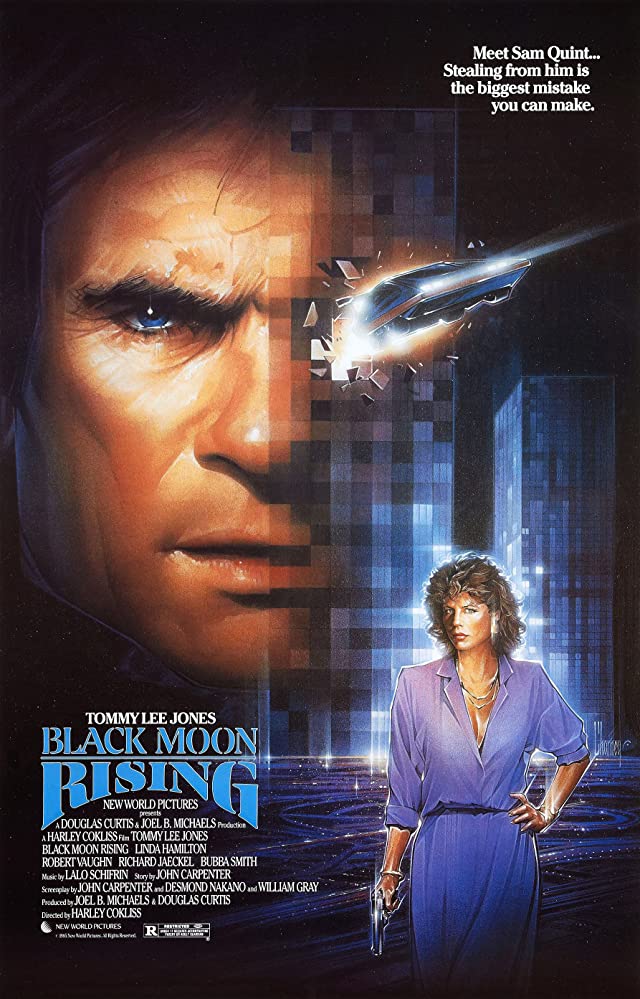
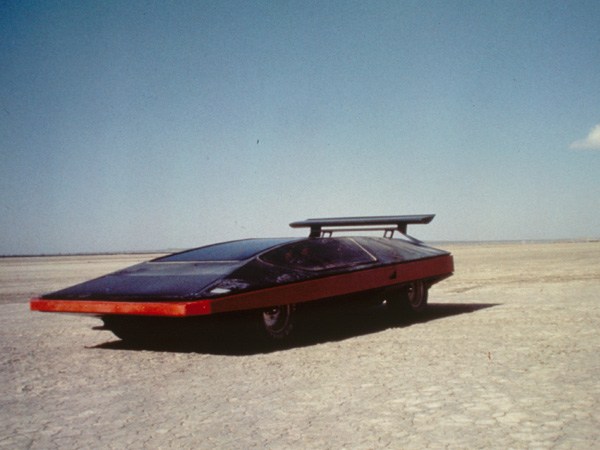
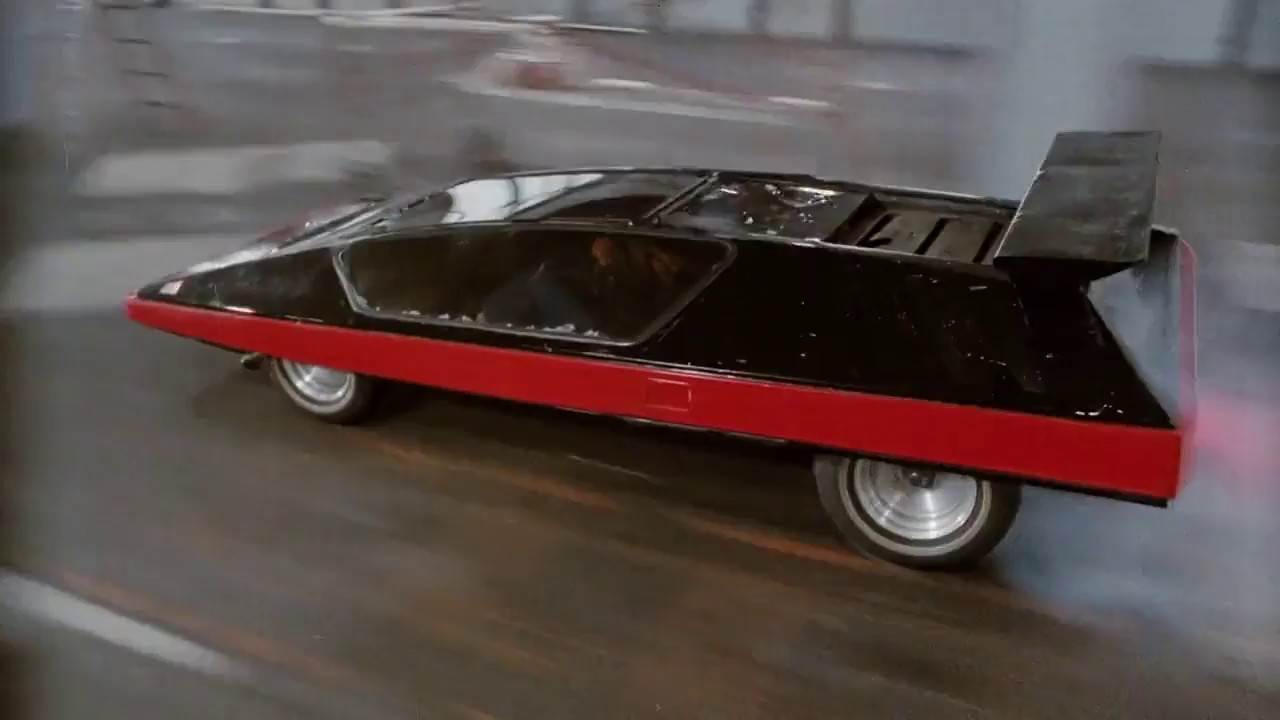
The FBI needs someone to steal a computer disk that can bring down a corrupt Las Vegas corporation so they hire reformed thief Sam Quint (Tommy Lee Jones). Quint manages to steal the disk but he finds himself being pursued by Ringer (Lee Ving), an old acquaintance who now works for the corporation. In order to keep the disk from falling into Ringer’s hands, Quint hides it in the back bumper of an experimental racing car called the Black Moon. The Black Moon, which runs on water and can fly when it reaches its top speed, is being taken to Los Angeles by Earl Windom (Richard Jaeckel) so Quint assumes that he’ll just follow Window to L.A. and then retrieve the disk when no one is watching.
However, as soon as the Black Moon arrives in Los Angeles, it’s stolen by Nina (Linda Hamilton). Nina works for Ed Ryland (Robert Vaughn), an outwardly respectable businessman who secretly runs a syndicate of car thieves. Now, Quint and Nina (who conventiently falls in love with Quint) have to steal the car back from Ryland while staying one step ahead of both Ringer and the FBI.
Black Moon Rising is not a movie that you watch for the plot or for the non-existent romantic chemistry between Tommy Lee Jones and Linda Hamilton. You don’t even watch it for the white collar villainy of Robert Vaughn, who basically just recycles his performance from Superman III. This is a movie that you watch for the car! The Black Moon is definitely an impressive vehicle. Who wouldn’t want to steal one of these?
In a car chase movie like Black Moon Rising, the most important thing is that the car must be cool. The Black Moon looks like something Mad Max would drive and it can actually fly so, by definition, it’s pretty cool. Unfortunately, Black Moon Rising doesn’t spend as much time with the car as it should. The movie gets bogged down with the scenes of Quint and Nina falling in love and Quint having to deal with his FBI handler (played by Bubba Smith). This is a film that would have benefited from being directed by someone like Hal Needham, who understood that people don’t come to car chase movies for the plot. They come to car chase movies because they want to see people driving fast and cars crashing in spectacular ways. Still, even though the car isn’t onscreen as much as it should be, the car is still cool enough to make Black Moon Rising watchable.
One final note: the screenplay is credited to John Carpenter. Though the imdb claims that this was the first script that Carpenter ever sold and that the film spent ten years in development, Carpenter says that he wrote the script around the same time that he made Escape from New York. He also says that he’s never actually seen the completed film.
Today, I arrived home to the sad news that Ennio Morricone, the world’s greatest composer, had passed away at the age of 91. Morricone was responsible for so many classic film scores that it’s hard to know where to begin. I imagine I’ll be sharing a lot of his music over the next couple of days. Some of it will be familiar and hopefully, some of it will inspire our readers to seek out some of his lesser known scores.
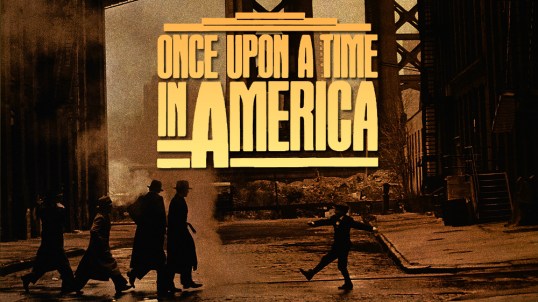
For now, I’d like to share one of my favorite Morricone compositions. This is Deborah’s Theme from Sergio Leone’s 1984 gangster epic, Once Upon A Time In America.




 Through the Shattered Lens