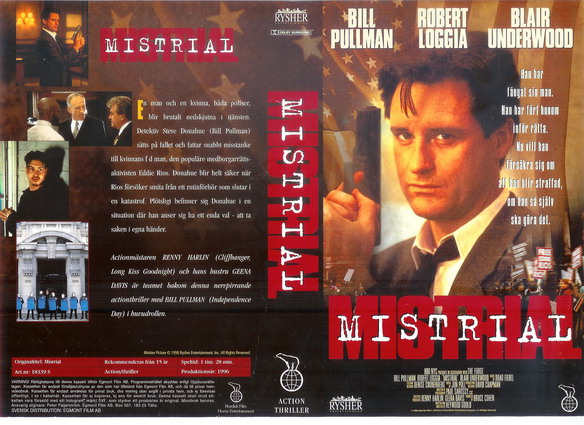
Mistrial (1996, directed by Heywood Gould)


When a NYPD cop and her partner are murdered, overworked and stressed-out Detective Steve Donohue (Bill Pullman) follows a trail of circumstantial evidence that leads him to the door of the cop’s ex-husband, a community activist named Eddie Rios (Jon Seda).  Donohue’s attempt to arrest Rios goes terribly wrong and results in a shootout that leaves Rios’s second wife and bother dead before the handcuffs are eventually slapped on his wrists.

Rios may be the one on trial but Donohue is now the one facing judgment.  With protesters lined up outside the courthouse and the city’s mayor (James Rebhorn) more interested in his own reelection than in the pursuit of justice, Donohue knows that the only way he’ll be vindicated is if Eddie Rios is convicted.  Unfortunately, that’s not what happens.  Rios’s sleazy attorney (played by Josef Sommer) gets most of the evidence tossed out of court on a technicality and it appears that Rios is going to walk free.  That’s when Donohue decides to take the court itself hostage, pulls out a gun, and demands that Rios immediately be put on trial for a second time, with the jury hearing all of the evidence that was originally thrown out of court.

Mistrial is an example of the good-cop-pushed-over-the-edge genre.  Up until a few years ago, this was a very popular genre.  Today, of course, it feels tone deaf and it’s a lot more difficult to sympathize with a cop, even a fictional one, complaining about being restricted by the constitution.  The main problem with Mistrial is that it’s established early on that Eddie Ramos is guilty so there’s no real tension as to whether Donohue is doing the right thing by demanding a second trial.  If there had been some ambiguity about whether or not Ramos was the murderer that Donohue claims he is, it would have made the film much more interesting and less predictable.  The other problem is that Bill Pullman is just too naturally earnest and clean-cut to be convincing as an overworked cop who has been pushed into doing something crazy.  Remembering back to the 90s, I think someone like Gary Sinise or William L. Petersen could have pulled off the role but Pullman’s just not right for it.

Robert Loggia has a few good moments as Pullman’s sympathetic captain.  This was the 2nd time that Pullman and Loggia co-starred together.  The first time was in Independence Day.  The 3rd time would be in Lost Highway, a film that’s as different from Mistrial as day is from night.


Song of the Day: The Strength of the Righteous by Ennio Morricone


Since I reviewed The Untouchables yesterday, it only seems fit that it’s main title theme should be today’s song of the day.  From Ennio Morricone, it’s The Strength of the Righteous!

Previous Entries In Our Tribute To Morricone:

  1. Deborah’s Theme (Once Upon A Time In America)
  2. Violaznioe Violenza (Hitch-Hike)
  3. Come Un Madrigale (Four Flies on Grey Velvet)
  4. Il Grande Silenzio (The Great Silence)

Film Review: Frances Ferguson (dir by Bob Byington)


Frances Ferguson takes place in a town in Nebraska.  As the film’s narrator (Nick Offerman) explains it, it’s a town where everyone knows everyone else.  It’s a town where your mechanic knows your bartender and no one can really keep anything a secret for too long.  For instance, it’s the type of town where there’s no way that a substitute teacher in her mid-20s is going to be able to get away with having an affair with a 16 year-old student.

The teacher in question is named Frances Ferguson (Kaley Wheeless).  Frances wanders through her days in an apathetic haze.  When she steps outside of her house, she sees her useless husband (Keith Poulson) masturbating in the car.  When she spends time with her mother (Jennifer Prediger), she is criticized for every little thing.  On the rare days when she gets called to teach, the students look down on her and Frances thinks about how little she knows about any of the subjects on which she’s giving instruction.  Frances goes through her day holding back her emotions.  She only screams on the inside and, when she does, only she and the viewing audience can hear.

Things start to look up when Frances teaches a biology class and notices a handsome but vacuous student named Jake (Jake French).  When she finds out that Jake has been given detention, Frances volunteers to supervise him.  When Frances flirts with him and the scene cuts way, the narrator asks us, “Was this a crime?”

(Yes, it was.)

Frances and Jake have a short-lived affair, though it doesn’t seem to be particularly passionate.  If anything, Jake seems to be even more blase about it than Frances.  Wearing her old cheerleader uniform, Frances meets Jake in a laundromat.  “I’d never date a cheerleader,” Jake tells her.  We, the viewers, notice that there are other people in the laundromat.  Does Frances want to get caught?

Get caught, she does.  “This is the last time we see Jake,” the narrators tells us as Jake fades away.  Frances, meanwhile, sits in court.  Her mother comes to the trial and tells her that her clothes make her look fat.  Frances is convicted and sent to prison.  Her mom brings her a chocolate cupcake for her birthday.  Frances announces that she’s allergic to chocolate before taking a big bite and then pretending to die.  “Get off that dirty floor!” her mother orders her.

You may getting the impression that Frances Ferguson is a strange film and I supposed it is.  It’s a comedy but it’s an extremely deadpan comedy, with most of the humor coming from Frances’s seeming apathy to ever single thing that happens to her.  It’s not that Frances doesn’t have feelings or emotions.  We hear her inner scream enough times to know that she’s not as apathetic as she seems.  It’s just that Frances is so consumed with small town ennui that she realizes it’s pointless to react one way or the other.  Life is what it is and it continues regardless of how annoying it may all be.  Whether she screams on the inside or on the outside, she’ll still have to wake up every morning in the same situation.  One day, Frances Ferguson was a teacher.  The next day, she was a prisoner.  And the day after that, she was on parole and a minor celebrity.  (“You’re that teacher!” is a phrase that she continually hears.)  What happens, happens.

Here’s the thing …. though it may not sound like it from my description of the plot, Frances Ferguson is an incredibly funny film.  A lot of that is due to Nick Offerman’s performance as the snarky narrator.  (The narrator has a tendency to wander off topic.)  A lot of that has to do with the performance of Kaley Wheeless, who perfectly communicates Frances’s suppressed irritation.  Over the course of the film, Frances has to deal with a lot of people who, if not for her one mistake, she would have otherwise never had to deal with.  Some of them get on her nerves and some of them — well, two of them — provide her with some comfort.  I loved David Krumholtz’s performance as a beleagured but optimistic group leader.  Martin Starr also gets a nice bit at the end, though it would be too much of spoiler to say anything else about his role.  I also enjoyed the performances of Jack Marshall and Yoko Lawing, as the two detectives who investigate the charges against Frances and who explain that, because of TV cop shows, they can no longer get away with playing good cop/bad cop.

Frances Ferguson is good film.  It’s also a short one, clocking in at just 74 minutes.  To be honest, it’s the perfect running time for the story that this film tells.  We follow Frances’s story for just as long as we need to.  Frances Ferguson is on Prime so check it out.

Film Review: Burning Kentucky (dir by Bethany Brooke Anderson)


Burning Kentucky, which I just finished watching on Prime, is a film that has its own unique vibe.  You’re either going to connect with this frequently surreal film or you’re not.  If you do connect with it, you’re going to be aware that, while the film has its narrative flaws, it also has moments of visual brilliance.  If you don’t connect with it, you’ll probably dismiss it as just being another pretentious revenge thriller.  Burning Kentucky currently has a rating of 4.1 over that imdb, not because it’s a bad film but because it’s just not a film for everyone.  It’s not a crowd pleaser but it we’ve learned anything recently it’s that crowds suck.

Burning Kentucky takes place in the hills of Harlan County, Kentucky.  We find ourselves observing two families.  One family lives in a shack and brews moonshine.  They eat whatever animals they catch in the wilderness and about the only thing that’s vaguely modern about them is the camera that their daughter, Aria (played, in her film debut, by Emilie Dhir), carries with her.  (And even that camera appears to be from the mid-20th century.)  Aria also narrates the film, musing about life and death.  In the country, she explains, people understand that death is a part of life.  Regardless of any sentimental feelings, everything dies.

The other family is headed by an man named Jaxson (John Pyper-Ferguson).  Jaxson is the country sheriff, so he’s a man of some importance.  However, it’s also obvious that he’s a man who has long been on a downward spiral.  He drinks too much and he spends most of his time cursing God and complaining about the local preacher, Abe (Andy Umberger).  Jaxson has two sons.  Wyatt (Nick McCallum) appears to be relatively stable.  Rule (Nathan Sutton), on the other hand, is a junkie who lives in a shack that he shares with Jolene (Augie Duke).  Jolene wants to be a singer.  She wants to get off drugs.  Rule, on the other hand, appears to be content to just slowly kill himself.

Whenever Wyatt can get away from his drunk father and his wasted brother, he spends his time with Aria.  They’ve been in love for several years, ever since the night that Aria discovered Wyatt trapped in one of the traps that her family had set around their land.  When we first see Aria and Wyatt together, they talk about how they met on the same night that they each lost their mother.

It takes a while to figure out just what exactly is going on in Burning Kentucky.  The deliberately paced first half of the film freely hops from the past to the present and then back again.  The camera glides over the misty mountains of Kentucky, stopping to linger on deserted houses and crumbling buildings.  Everything seems to be suspended in a state of permanent decay.  The wilderness appears to be both beautiful and threatening at the same time and the imagery, when combined with Aria’s narration, is often surreal.  The first half of the film plays out as if we’re watching a filmed dream.

Unfortunately, the second half of the film is a bit more conventional.  Once we finally discover who everyone is relative to everyone else and after we learn what happened in the past, the film settles down to become a standard revenge thriller, albeit one that’s very much concerned with the concepts of guilt, redemption, and human nature.  Still, the Kentucky hills remains atmospheric and dream-like and the well-selected performers — particularly Augie Duke and John Pyper-Ferguson — continue to bring their haunted characters to life.

As I said, this isn’t necessarily a film for everyone.  The film’s ending will leave a lot of people feeling perplexed but that’s okay.  A story like this doesn’t need a neat ending.  In fact, Burning Kentucky is a film that demands to end on a hint of messiness and ambiguity.  I liked Burning Kentucky.  You might like it too.

Film Review: Emerson Heights (dir by Jennifer Hook)


Earlier tonight, on Prime, I watched a new film called Emerson Heights.  (Well, newish.  It came out in January.)

Emerson Heights tells the story of two people.

Cody McClain (played by Austin James, who also wrote the script and produced) is an aspiring actor who has recently moved out to Los Angeles with his mother and his little sister.  He’s handsome and he’s charming but he’s also dorky enough that he can’t put together a last minute pool party.  He’s only played a few small roles and is perhaps best known for appearing in a series of pretzel commercials.  At least he’s not having to work at Starbucks.

Briley (Gatlin Green) is an aspiring singer.  She does a killer version of Somewhere Over The Rainbow and she aspires to someday perform on Broadway.

Together …. THEY SOLVE CRIMES!

No, actually, they don’t.  Instead, they just meet one day and fall in love.  Unfortunately, Cody lives in Los Angeles while Briley lives in New York City but they’re determined to make it work.  They promise to write to each other often and, whenever Briley can make it out to California, she and Cody spend every moment together.  Briley fears that a long distance relationship won’t be able to survive but Cody promises her that it well.

However, can their relationship survive Cody suddenly becoming famous?  When Cody starts getting bigger roles and more fans, it all starts to go to his head.  While he’s shooting a spy film and hanging out with his seductive co-star, Haley Ryan (Amanda Grace Benitez), Briley is starring in a Broadway production of The Wizard of Oz and trying to figure out how to hold onto her job despite the fact that she’s just found out that she’s pregnant….

Emerson Heights is a pretty simple film.  From the minute that we meet Haley and Cody’s smarmy agent (Matt Singletary), we know that they’re both going to try to lead Cody astray.  We know that Cody’s going to struggle with temptation, just as surely as we know that Briley is going to be pressured to terminate her pregnancy.  It may occasionally be predictable but predictability is actually a strength when it comes to a film like this.  Emerson Heights is an unabashedly sentimental love story, a story about two people who belong together but who have to overcome 90-minutes worth of obstacles to reach each other.  When you’re having to deal with news of riots, pandemics, and threats of war on a daily basis, the predictable but likable romance featured in a movie like Emerson Heights is actually rather comforting.

And make no mistake about it, this is a very likable film.  Austin James and Gatlin Green are two appealing performers and they have a wonderful chemistry together.  (It didn’t surprise me to discover that they’re married in real life.)  They make for a sweet couple and they just seem as if they belong together.  I also liked the enjoyably snarky performance of Amanda Grace Benitez as Briley’s potential rival for Cody’s affection.  As played by Benitez, Haley seems to be having such a ball being bad that it’s fun to watch.  If you’re going to be a villain in a film like this, you might as well enjoy yourself!

Anyway, Emerson Heights is on Prime.  I enjoyed it.

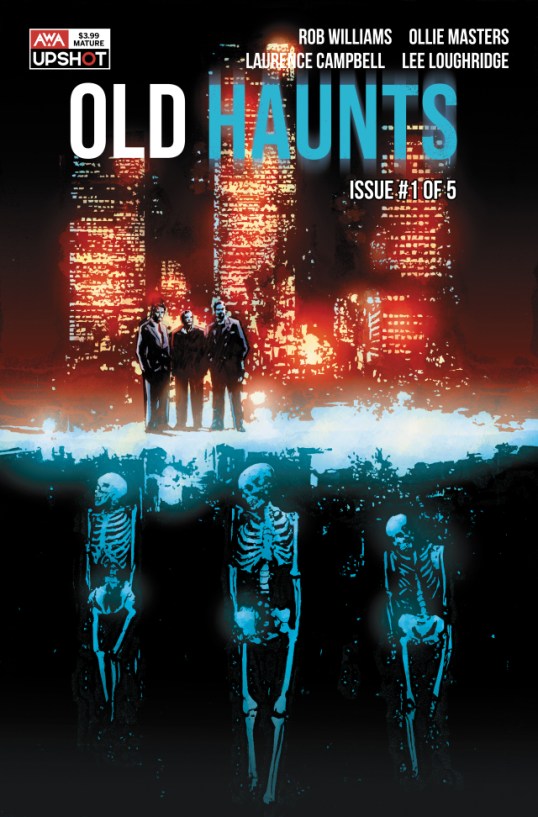
Mainstream Comics Worth Paying Attention To : “Old Haunts”


Ryan C. (fourcolorapocalypse)'s avatarRyan C.'s Four Color Apocalypse

Making their publishing debut the last week Diamond was open for business before the COVID-19 shutdown hit was a rough break for AWA (short for Artists, Writers and Artisans) and their Upshot line, but they adjusted on the fly quickly, offering the first issues of their various and sundry titles online for free (albeit in this really annoying, one-panel-at-a-time format) and bumping their release dates down the schedule accordingly — and now that shops are back up and running, so is this new brainchild of former Marvel head honchos Bill Jemas and Axel Alonso. Their slate of offerings has been a mixed bag in terms of quality, no doubt about it, but their professionalism and ability to adjust on the fly — not to mention their comparably deep financial pockets — has shown them to be a resilient new presence in a still-crowded market, and by and large I’m interested…

View original post 617 more words

The Life and Death of Peter Sellers (2004, directed by Stephen Hopkins)


Peter Sellers was a brilliant actor and comedian while also being a childish and selfish human being who, because he was always performing, never really developed a personality of his own.

That’s the argument made by The Life and Death of Peter Sellers, which stars Geoffrey Rush as Sellers.  The film follows Sellers from his success with The Goon Show to his subsequent collaborations with Stanley Kubrick (Stanley Tucci) and Blake Edwards (John Lithgow).  Sellers becomes an international star but remains a deeply unhappy person, cheating on his wives, emotionally abusing his son, and being difficult on set.  The film makes the argument that that the only person that Sellers truly loved was his doting mother (played by Miriam Margoyles) and that, having been born into a show business family, performing was the only thing that he was capable of doing.  Even the few times when he’s shown to be a decent father, husband, or friend, it’s suggested that he’s just acting the role.  Rush plays Sellers as being someone who is incapable of understanding how other people think so, whenever he has to interact with them, he simply imitates what he’s seen others do.  Just look at the scene where he attempts to flirt with Sofia Loren by grinning up at her like a character in a romantic comedy.

The problem with a film like this is that, because he’s portrayed as being so selfish and immature, it’s hard to make Peter Sellers into a character that you would want to spend any time with.  The narrative goes from one Sellers tantrum to another.  Stephen Hopkins livens things up by including fantasy sequences where Sellers is taunted by some of his best-known characters, driving home the point that there wasn’t much to Sellers beyond the characters that he played and reminding us of both Sellers’s talent and Geoffrey Rush’s as well.  There are also frequent monologues from Rush, dressed up like the other characters in the movie and discussing their relationship with Peter Sellers.  Sometimes it works and sometimes it doesn’t.  Rush does a good job playing Stanley Tucci playing Stanly Kubrick but when he’s made up to look like Miriam Margoyles, the conceit gets too ridiculous to work.

The main reason to see the film is for the performances, especially Emily Watson as Sellers’s first wife and Stephen Fry as Sellers’s “spiritual advisor.”  Stanley Tucci is an inscrutably brilliant Stanley Kubrick while John Lithgow is a hyperactive and crass Blake Edwards.  Finally, Geoffrey Rush is a marvel as Peter Sellers.  Rush has a difficult job, making an extremely unlikable character compelling but he succeeds despite not always being helped by the film’s script or direction.

Like the man it portrayed, The Life and Death of Peter Sellers is flawed but filled with enough talent to watchable.


Mainstream Comics Worth Paying Attention To : “Tartarus”


Ryan C. (fourcolorapocalypse)'s avatarRyan C.'s Four Color Apocalypse

Granted, it’s early days yet, but at three issues in I’m already prepared to say that writer Johnnie Christmas and artist Jack T. Cole’s ambitious sci-fi/comedy epic Tartarus is my favorite thing coming out from Image Comics at the moment, and perhaps my favorite thing coming out of the mainstream in general. And why wouldn’t it be? It’s got everything you want : compelling characters, breakneck action, smart scripting, a solid premise — and, oh yeah, absolutely gorgeous art.

Cole first came across my radar screen via Boom! Studios’ The Unsound, where his stunning visuals elevated a rather derivative horror script from Cullen Bunn and turned the insane asylum of the book’s setting into a Dante-esque phantasmagoria of despair and delight, revenge and revelation, but to say he’s kicked it into another gear here is to sell his visionary work short — his design work and figure drawings belie…

View original post 688 more words