Enjoy!
Enjoy!
 Today would have been Steve McQueen’s 90th birthday.
Sadly, McQueen died in 1980 at the absurdly young age of 50. In life, McQueen never got as much respect as he deserved as an actor but in death, he’s been rediscovered as not just an icon of cool but also as an underrated actor who, much like Clint Eastwood, could say a lot without uttering a word. (Be sure to read Marshall Terrill’s biography of McQueen.) When Steve McQueen (as played by Damian Lewis) showed up in Once Upon A Time In Hollywood, it seemed appropriate. McQueen and Tarantino both seem made for each other, even if McQueen died long before Tarantino even wrote his first screenplay.
McQueen made two films shortly before he died, The Hunter and Tom Horn. Unfortunately, neither one of them was a hit with audiences or critics. The Hunter, which was McQueen’s last film, is a forgettable movie that features McQueen as a bounty hunter who can’t drive. Tom Horn, however, was an underrated western that features one of McQueen’s best performances.
In Tom Horn, McQueen plays the title character, a legendary frontier scout who is known for the role he played in the capture of Geronimo. When the film opens, Tom Horn has seen better days. With the frontier changing and the old west being replaced by the modern age, Horn has been reduced to being almost a vagrant, wandering from town to town in search of work. When the film begins, Horn has found employment as a “stock detective.” He’s employed by the local cattlemen to keep rustlers from stealing their stock. Horn uses the same violent methods that he’s always used, gunning down rustlers and often doing so in public. What Horn doesn’t realize is that times have changed and the methods that previously made him a legend are now making him a pariah. When the cattlemen realize that the townspeople are turning against them because of Horn’s activities, they conspire to take out Horn themselves.
Tom Horn is based on a true story. In 1903, Tom Horn was hung for shooting a 15 year-old boy. While it is agreed that Horn killed many men over the course of his life, he was undoubtedly framed for the murder for which he was executed. While sitting in his jail cell, waiting to be executed, Horn wrote the autobiography upon which this movie is based. The movie makes the argument that Horn was executed because he was a reminder of what the West used to be like. In order to prove that they were now ready to be members of civilized society, the cattleman had to sacrifice Horn in the most public way possible.
The film does a good job of capturing the final days of the old west and Steve McQueen does an even better job of playing a man who doesn’t realize that his time has come to a close. Horn often seems to be the only man who doesn’t understand that the time of outlaws and the gunslingers is coming to a close and that leaves him defenseless when he’s put on trial. Even after found guilty, Horn remains confident that he will somehow escape the hangman’s noose. Tragically, it’s not until time is up that Horn truly comes to understand that the world has changed and civilization no longer has place for men like him. The same people who used to depend on men like Tom Horn now just want to forget that he ever existed. McQueen took a long break between making The Towering Inferno and Tom Horn and dropped out of the public eye. The only film he made during that period was a barely released version of Enemy of the People. When McQueen made Tom Horn, he was also a man out of time and he brings a sense of resignation and loss to the role that he might not have been capable of doing earlier in his career.
Sadly, it was while filming Tom Horn that McQueen first started to show symptoms of the cancer that would eventually kill him. Tom Horn was released in 1980 and never got the attention that it deserved. It’s a minor western classic and features Steve McQueen at his best.

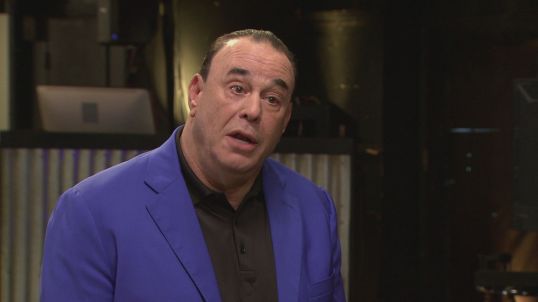
As I write this, I’m watching Bar Rescue on the Paramount Network and I’m trying to figure out why it is that I like this annoying show.
Bar Rescue, of course, is one of those shows where a jackass goes into a failing business — in this case, a bar — and basically screams at everyone for an hour until the bar starts making money. It stars Jon Taffer, who has all of the charm of a low-level gangster who desperately needs to make his quota for the week or else the capo is going to break his thumbs. The main them of each episode is that Taffer takes “bar science” very seriously and apparently cannot fathom a world where anyone tries to do anything different or quirky with their business.
If you search the internet, you’ll find all sorts of stories about the bars that Taffer “saved.” A good deal of them went out of business after Taffer gave them their makeover. Several of them immediately went back to the way they were running things pre-Bar Rescue. Some of those bars have survived and some of them have not. Taffer always makes a big deal about renaming almost every bar that he saves. It’s rare that anyone sticks with Taffer’s new name.
I have to admit that I rarely drink so I’ve never really cared that much about bars. In fact, it’s kind of hard for me to imagine anyone caring about the decor of the place where they’re getting drunk. That may be one reason why I always find it oddly compelling to listen to Taffer rant and rave, as if designing the perfect bar is somehow the same thing as restoring the Sistine Chapel. Whenever Taffer brings in his bar experts, I find myself smirking a little bit because Taffer’s experts are usually just people who are obviously angling for a show of their own. The “experts” tend to be so condescending that I actually look forward to people talking back to them.
Speaking of people talking back, another reason that I watch Bar Rescue is because there’s always a chance that someone might throw a punch at Jon Taffer. Seriously, he’s just obnoxious! It’s interesting to compare him to someone like Gordon Ramsay, who is just as loud and overbearing but who also somehow remains likable through the whole ordeal. Taffer just comes across as being a bully.
(What’s funny is that, while I was researching the bars that the show previous rescued, I came across several comments from people who worked at those bars. Most of them said that Taffer was actually very polite and rather affable off-camera. He plays a bully for the ratings and …. well, Hell, I’m watching so I guess it’s working.)
Watching the show in the age of Coronavirus, Bar Rescue almost feels like an artifact from a different age. Today, I watch it and I notice the huge crowds of people, all pressed up against each other in the bar. I notice all of the hand-shaking. (Taffer almost always shakes the bar owner’s hand at the end of each episode.) Just the fact that the show features a different bar every week makes Bar Rescue feel like something you might find in a time capsule.
Like I said, I don’t usually drink. But, as soon as all this is over, I’m going out and getting so drunk. (Well, buzzed. Actually, I’ll probably just go out and have a glass of water while everyone else gets drunk. But still, I’m going out, dammit!) Until then, I guess I can just watch Bar Rescue….
Previous Guilty Pleasures
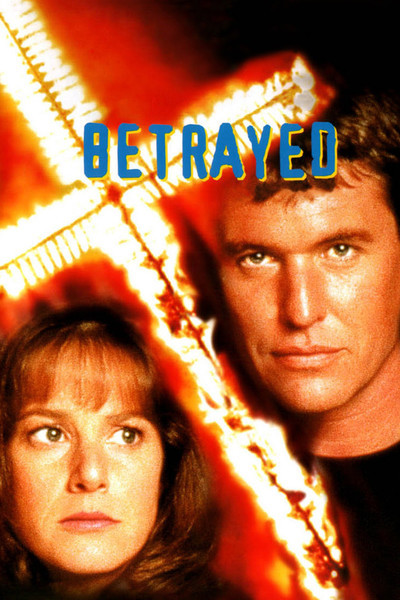
The 1988 film, Betrayed, starts out on a strong note but then quickly becomes annoying as Hell.
It opens with shots of a radio talk show host, an outspoken liberal named Sam Kraus (Richard Libertini). Kraus berates his callers. Kraus ridicules anyone who is to the left of Bernie Sanders. When a man with a rural-accent calls in and attacks Karus for being Jewish, Kraus calls the man an idiot. After he gets off the air, Kraus walks through a parking garage and stops in front of his car. Another car pulls up beside Kraus and suddenly, a masked man with a gun opens fire on Kraus, killing him. The gunman gets out of the car and spray paints, “ZOG” on Kraus’s car before then fleeing the garage.
(ZOG stands for Zionist Occupational Government. It’s a term used by the type of anti-Semitic dipshits who thinks that the Protocols of Elder Zion are real.)
From this shockingly brutal opening, we cut to panoramic shots of beautiful farmland and crops being harvested in the American midwest, the heartland. Gary Simmons (Tom Berenger) owns a farm. He’s a Vietnam vet who nearly received the medal of honor. He lives with his mother and he has two children. (He’s divorced and his ex-wife died as the result of a mysterious hit-and-run in California.) Almost everyone in his small hometown seems to worship Gary. They’re certainly curious about his new girlfriend, Katie Phillips (Debra Winger).
And really, they probably should be. Katie Phillips isn’t Katie Phillips at all. She’s actually an FBI agent named Cathy Weaver and she’s been sent undercover to investigate whether or not Gary was involved in the murder of Kraus. Cathy, who comes from a broken family and who we’re told has always been seeking some sort of deeper meaning in her life, is charmed by both Gary and his family. In fact, she falls in love with Gary. She tells her superior, Mike Carnes (John Heard), that there’s no way Gary is dangerous. Mike doesn’t believe her but, of course, Mike has a personal stake in this because he and Cathy used to be romantically involved.
(That’s right, everyone. Betrayed is so narratively lazy that it resorts to making Mike a scorned lover, even though the film’s plot would have worked just as well if he wasn’t.)
As I said, the first part of the movie works. Debra Wingers gives a strong performance and Tom Berenger is a charming roughneck. For the first half-hour or so, the film does a good job of showing why men like Gary and his friends are susceptible to conspiracy theories and why they feel that the entire world is stacked against them. You can understand why Cathy is so troubled by her assignment because Gary’s friends are hardly master criminals. For the most part, they’re farmers who feel like their entire way of life has been taken away from them.
Unfortunately, almost immediately after Mike refuses to allow her to end her investigation, Cathy returns to the farm and sleeps with Gary. Not only is this a plot development a disservice to everything that has previously been established about Cathy as a character but it also marks the point where the movie entirely falls apart. Immediately after sleeping with Cathy, Gary suddenly goes from being a complex but troubled character to being a cartoonish super villain. And listen — we’ve all been there. You meet a guy. He’s handsome. He says all the right things. He seems like he’s sensitive. He makes you feel safe. You let down your defenses for one night and the next morning, he’s yelling at you for wearing a short skirt in public. It happens. Of course, in Gary’s case, it means that he’s not only criticizing the way that Cathy dresses but he’s also taking her on a hunt where the prey is terrified person of color who Gary and his friends have kidnapped. It also means that Gary drags Cathy along on a bank robbery and then expects her to join him when he wants to assassinate a presidential candidate. Even after all that, Cathy remains conflicted about what to do with Gary. The problem is that it’s not like Gary’s a guy who needs sensitivity training or who spends too much time watching ESPN. Gary is a guy who is carting around weapons and talking about how he wants to kill “mud people.” That Cathy still has mixed emotions after all of that goes against everything that the film previously asked us to believe about her. Gary becomes too cartoonish to be plausible and, as a result, he drags down Cathy’s character as well.
Unfortunately, as the film’s narrative falls apart, so do the majority of the performances. While Debra Winger struggles to make her character’s motivations plausible, Tom Berenger is reduced to doing a lot of glaring. (Poor John Heard spends most of the movie shouting and bugging his eyes.) About the only actor who comes out Betrayed unscathed is John Mahoney, who plays Shorty. Shorty is one of Gary’s friends. He’s a friendly and personable guy who seems to sincerely care about everyone and who has a charmingly gentle smile. He’s also a total racist and the contrast between Shorty’s amiable nature and his hateful thoughts provide the latter half of Betrayed with its only powerful moments. Mahoney gets one big scene, where he talks to Cathy about how much he hates violence but, at the same time, he feels that the world has left him no other choice. Mahoney does a great job with his small role. It’s unfortunate that the rest of Betrayed couldn’t live up to his performance.
Other Entries In The 18 Days Of Paranoia:
Sadly, we have to start today with some sad news. On the 22nd, the world of music lost both Mike Longo and Eric Weissberg.
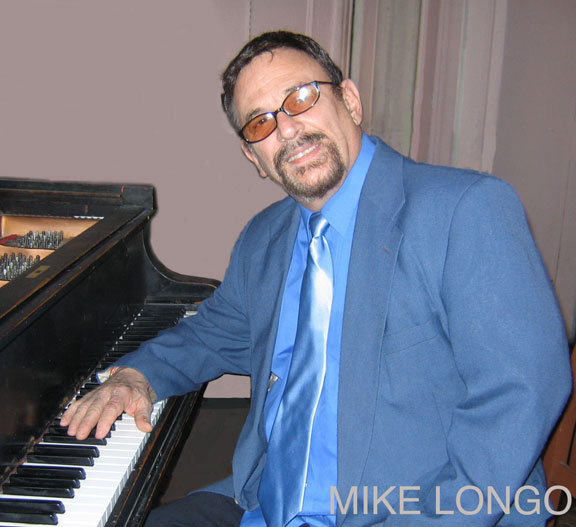
Mike Longo was 83 years old and passed away at Mount Sinai Hospital in New York City. Longo, who was admitted to the hospital last Tuesday, died of COVID-19. Tragically, he was the first American jazz casualty of the cornonavirus. Long had a long and distinguished career as both a pianist and a composer. Along with his own solo work, he was known for serving as Dizzy Gillepsie’s musical director. Below is a performance of Gillespie’s band, taken from a 1968 concert in Copenhagen. The song that their playing is a Longo composition called Ding A Ling:
Longo also had an extensive solo career and he also worked as an educator, passing on his knowledge and love for jazz to the next generation.

Eric Weissberg
Eric Weissberg was 80 and passed away in a Detroit nursing home. He had been suffering from Alzheimer’s for several years. A folk musician who later became an in-demand sessions player, Weissberg was best-known as a banjo player. With Steve Mandell, Weissberg arranged and performed the version of Dueling Banjos that is heard in the film Deliverance.
Rest in peace to both of these gentleman. Thanks for the music.
Today’s music video of the day comes to use from Italy.
Don’t ask me to explain what all is happening in the video. I’ll just say that it I appreciate the ominous atmopshere and the feeling of doom the permeates nearly every minute of this video. This is a video to haunt your dreams.
Enjoy!
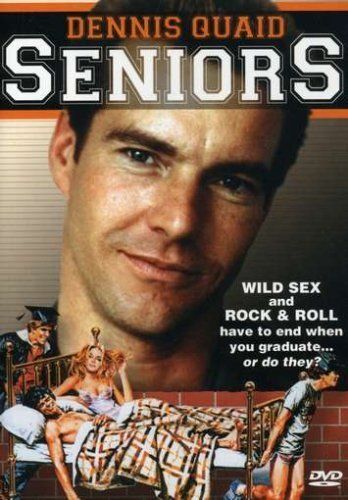 Four college seniors (including one played by Dennis Quaid) are upset at the prospect of graduating, having to get real job, and losing Sylvia (Priscilla Barnes), the mute nymphomaniac who lives in their house with them and does all the cleaning and cooking. They decide that the best way to avoid getting a real job is by setting up a fake company called Phantom Research. They apply for and get a grant to study female sexuality, which essentially means that they pay the girls on campus to have sex with them. Before you can say Risky Business (which was actually released years after this film), they expand their operations, get involved with some crooked businessmen, and nearly lose their lives. It’s a comedy.
The Seniors is one of those films that used to come on television frequently when I was a kid. I remember watching it when I was 12 and enjoying it, mostly because I was a stupid kid and I was at that age where any film about sex seemed clever and hilarious. I recently rewatched it and discovered that there was only one funny bit and that was about a nerdy research assistant named Arnold (Rocky Flintermann) who helps out the seniors in return for them setting him up with Sylvia. Throughout the film, the formerly virginal Arnold gets laid so often that he loses the ability to walk and then he dies. Ha ha. The rest of the film is just dumb. The problem is that the film wants to be a raunchy, Animal House-style comedy but it was written by Stanley Shapiro (who previously wrote Doris Day comedies) and directed by Rod Amateau, who had previously directed several episodes of Gilligan’s Island. Their style is all wrong for the material.
The film’s opening credits announce that it stars, among others, Ryan O’Neal, Clint Eastwood, and Charles Bronson. A cartoon professor then walks out and announces that, “All of these big stars! None of them are in this film!” That’s too bad. I would have liked to have seen some of those stars in this movie. I think Eastwood would have told the seniors to get jobs and stop exploiting Sylvia. Bronson would have blown away the entire operation but Ryan O’Neal probably would have been cool with it all.
O’Neal, Eastwood, and Bronson are not in the film. Dennis Quaid is, though he probably doesn’t brag about. Edward Andrews and Ian Wolfe both have minor roles as corrupt businessmen who help fund Phantom Research. Alan Reed, the voice of Fred Flinstone, plays a professor. This was his last performance before his death.
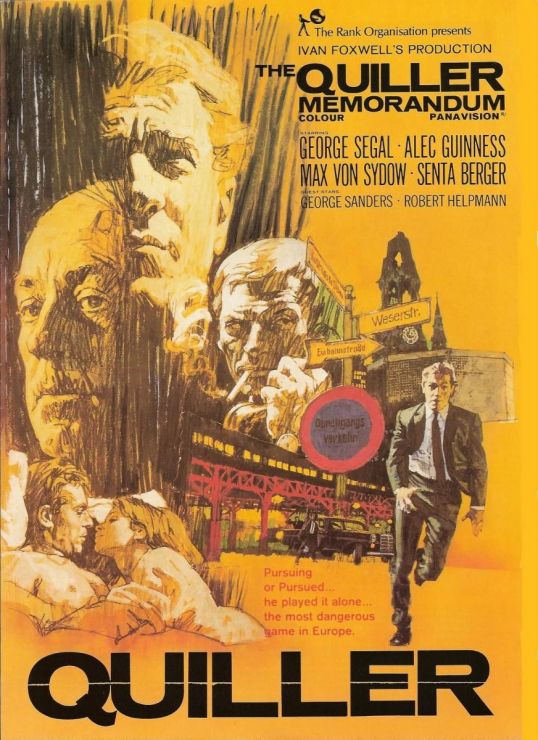
The 1966 film, The Quiller Memorandum, is a diabolically clever little spy thriller.
The film opens with a British secret agent getting gunned down while trying to make a call from a phone booth in Berlin. While we never learn the exact name of the agency that the man was working for, we do discover that they don’t take kindly to their agents getting gunned down in phone booths. They send in another agent, an American named Quiller (George Segal), to take his place.
In Berlin, Quiller’s boss is a man named Pol (Alec Guinness). Pol explains that the man in the phone booth was actually the second of his agents to be assassinated in Berlin. All of the agents were looking for information about a Neo-Nazi group called Phoenix. Pol tells Quiller that it is vitally important they discover just where, in Berlin, Phoenix is headquartered. Quiller is given a few items that were found on the dead man in the phone booth: a bowling alley ticket, a swimming pool ticket, and a newspaper article about a school where it was discovered that one of the teachers had Nazi sympathies.
Though The Quiller Memorandum was undoubtedly produced with the hopes of capitalizing on the popularity of the Bond films, Quiller is no James Bond. We know that as soon as we see him. It’s not just that Quiller’s an American while Bond was British. It’s also that James Bond was played by the cool and calculating Sean Connery while Quiller is played by George Segal. Whereas Connery’s Bond never loses his confidence, Segal’s Quiller comes across as being, at first, a bit cocky and, as a result, we worry about him. Whereas Connery’s Bond rarely gave his actions a second thought, Segal brings a slightly neurotic edge to Quiller. You take one look at Connery’s Bond and you know that he’s going to survive no matter what. Quiller, however, you never get that feeling. When he’s in danger, you worry about him because it’s easy to imagine him turning up like the man in the phone booth.
And, indeed, it doesn’t take long for Quiller to get captured by the members of Phoenix. A man bumps him with a suitcase, injecting a drug into his system that makes Quiller become drowsy. When Quiller awakens, he’s being interrogated by an erudite man named Oktober (Max von Sydow). Oktober’s an aristocrat. He speaks in a very calm tone, rarely showing any hint of anger. The only thing that betrays his evil nature are his eyes, which are cold and soulless.
Even though Quiller survives the interrogation, it’s tempting to give up on him. After all, Quiller got captured so easily and Oktober seems so clever that you kind of find yourself wondering if maybe the agency made a mistake when they gave this mission to Quiller. That’s where The Quiller Memorandum surprises you, though. Quiller turns out to be a lot more clever and resourceful than anyone gave him credit for being and, for that matter, the film itself turn out to have a few more twists and turns in store for the viewer.
It’s a clever and enjoyable spy film, featuring wonderful performances from Segal, Guinness, von Sydow, and Senta Berger as the teacher who may be in love with Quiller or who may have an agenda of her own. The film may be a spy thriller but Michael Anderson directs it as if its a film noir, full of shadowy streets and morally ambiguous characters. The script, by Harold Pinter, encourages us to trust no one and Anderson’s direction reminds us that we made the right decision. On the dark streets of Cold War Berlin, no one is who they seem.
The Quiller Memorandum is a must-see for fans of 60 spy films. Watch it with someone who you think you can trust.
Other Entries In The 18 Days Of Paranoia:
4 Shots From 4 Films is just what it says it is, 4 shots from 4 of our favorite films. As opposed to the reviews and recaps that we usually post, 4 Shots From 4 Films lets the visuals do the talking!
110 years ago today, Akira Kurosawa was born. Today, we honor the life of one of the most influential directors in film history and that means that it’s time for:
4 Shots From 4 Films
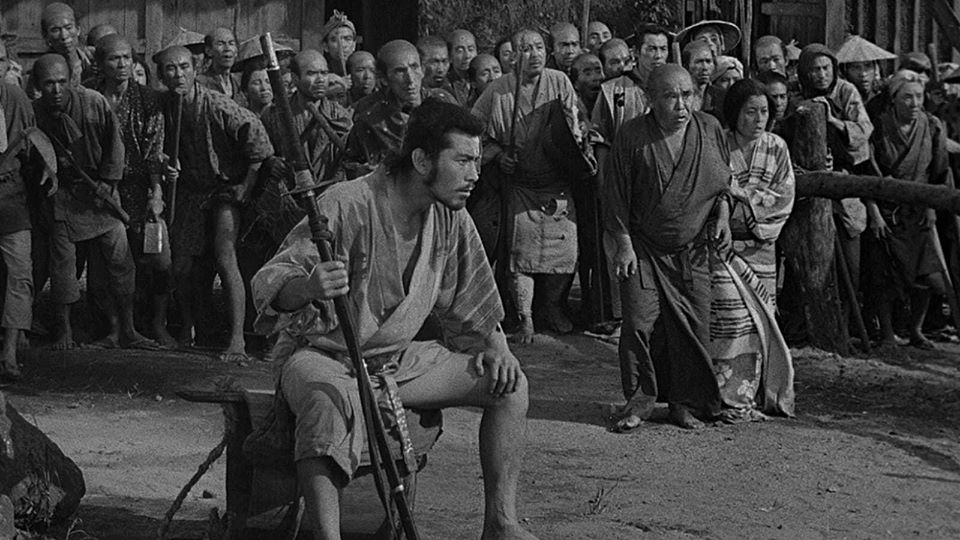
Seven Samurai (1954, directed by Akira Kurosawa)
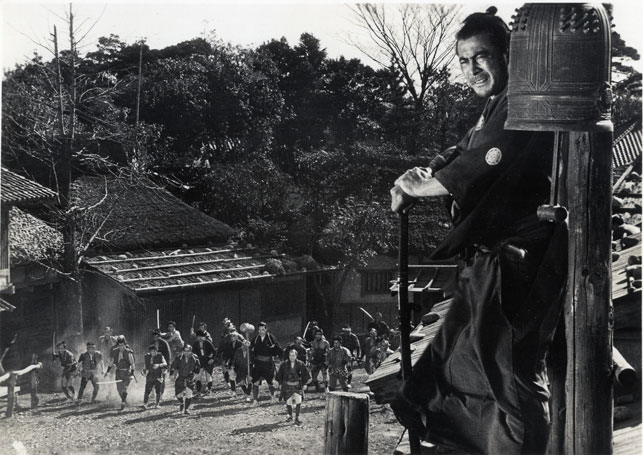
Yojimbo (1961, directed by Akira Kurosawa)
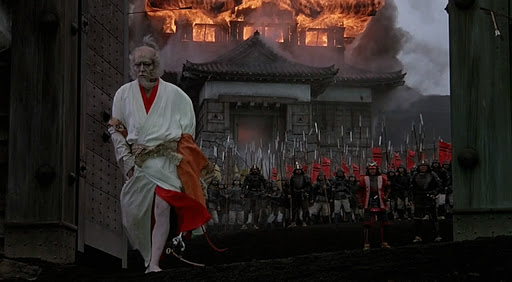
Ran (1987, directed by Akira Kurosawa)

Dreams (1990, directed by Akira Kurosawa)
If you’re on lockdown right now and you’re not at already a familiar with Japan’s greatest director, this is a great time to discover the works of Akira Kurosawa!
 Through the Shattered Lens