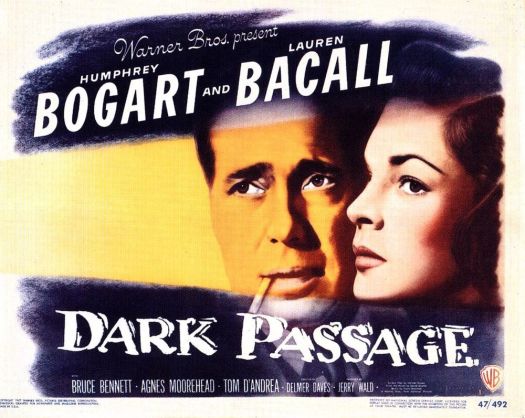
“Tuesdays in Noirvember” concludes with the genre’s biggest icon, Humphrey Bogart (and he’s bringing Lauren Bacall along for the ride!):
The year 1947 belonged to filmnoir, as some of the dark genre’s true classics saw the light of day: Robert Mitchum donned that iconic trenchcoat in OUT OF THE PAST , Richard Widmark snarled his way through KISS OF DEATH, Burt Lancaster battled sadistic Hume Cronyn with BRUTE FORCE , Tyrone Power got trapped in NIGHTMARE ALLEY , Rita Hayworth bedeviled Orson Welles as THE LADY FROM SHANGHAI , Ronald Colman won an Oscar as a cracked actor leading A DOUBLE LIFE, and Lawrence Tierney terrorized the hell out of everyone in his path in BORN TO KILL . Humphrey Bogart and Lauren Bacall, noir’s power couple thanks to the previous year’s THE BIG SLEEP , teamed again for DARK PASSAGE, an slam-bang crime drama that may not…
Today, the National Board of Review announced their picks for the best of 2018!
Every year, the announcement of the NBR’s picks is considered to be the “official” start of Awards Season. (This despite the fact that the Spirit Nominations were announced a few weeks ago and the Gotham Awards were handed out just last night.) Getting honored by the NBR is considered to be a big boost, when it comes to getting Academy recognition. Of course, nothing’s guaranteed but, since 2010, every NBR best picture winner (with the exception of A Most Violent Year in 2014) has received a corresponding Oscar nomination.
(Interestingly enough, the last time that the NBR winner actually went on to also win the Oscar for Best Picture was way back in 2008. That’s when Slumdog Millionaire won.)
This year, the NBR named, as best picture of the year, Green Book. That’s certainly a boost that Green Book, which has been struggling at the box office, needed. The NBR also gave a big boost to A Star Is Born (Bradley Cooper for Best Director, Lady Gaga for Best Actress, Sam Elliott for Best Supporting Actor), If Beale Street Could Talk (Best Adapted Screenplay, Best Supporting Actress), First Reformed (Best Original Screenplay and Top Ten of the Year) and maybe Black Panther and A Quiet Place (both of which were named as one of the ten best films of 2018).
Not getting a boost from the NBR: Spike Lee’s BlackKklansman and Damien Chazelle’s FirstMan, neither of which received any mention.
Here are the National Board of Review’s picks for the best of 2018:
Best Film: GREEN BOOK
Best Director: Bradley Cooper, A STAR IS BORN
Best Actor: Viggo Mortensen, GREEN BOOK
Best Actress: Lady Gaga, A STAR IS BORN
Best Supporting Actor: Sam Elliott, A STAR IS BORN
Best Supporting Actress: Regina King, IF BEALE STREET COULD TALK
Best Original Screenplay: Paul Schrader, FIRST REFORMED
Best Adapted Screenplay: Barry Jenkins, IF BEALE STREET COULD TALK
Best Animated Feature: INCREDIBLES 2
Breakthrough Performance: Thomasin McKenzie, LEAVE NO TRACE
A hushed silence has descended in the TSL Bunker, for today is a very special day. Today is the day that we all wish a happy birthday to the man who makes this site possible, TSL co-founder and editor-in-chief, Arleigh Sandoc!
Happy birthday, Arleigh! 9 years ago, Arleigh started the process of bringing together the blogging team who, since 2009, have been reviewing movies, books, video games, pulp art, music, comic books, Lifetime movies, amusing twitter memes, and the occasional Super Bowl! Happy birthday Arleigh!
What better way to celebrate Arleigh’s birthday than with some Death Metal cats?
Since it was first released, In the Meantime is one of those song that has come to epitomize an era, in this case the mid-90s. (It’s no surprise that the song was prominently featured in both the premiere and the finale of Everything Sucks!, the Netflix dramedy about growing up in the 90s.) Even if you don’t know necessarily remember the title or the name of the band that performs the song, you’ll immediately recognize those opening notes.
I hate the term “one-hit wonder” because often it’s just a fancy way that some people have of saying that a band found greater success in Europe than in America. However, it is true that, as of this writing, In The Meantime remains Spacehog’s biggest mainstream hit. While the song peaked at number 29 on the UK charts, In the Meantime reached the number one spot on the U.S. Billboard Mainstream Rock Charts.
Some of the song’s success was undoubtedly due to this video, which was directed by Jake Scott and, though it may be hard to believe now, seemed to be very edgy and futuristic in 1995. (Today, of course, nose piercings and androgyny are no longer considered to be as unconventional as they were back in the 90s.) For a while, it was impossible to turn on MTV without seeing this video. It’s open to interpretation as to what the song is actually about, though lead singer Royston Langdon explained it to Songfacts as follows: “It’s using some kind of metaphor of a worldly or inner-worldly search for the end of isolation, and the acceptance of one’s self is in there. At the end of the day it’s saying whatever you gotta do, it’s OK, it’s alright. And I think that’s also me talking to myself, getting through my wan anxieties and fear of death. That’s what it all comes down to.”
The 1946 film, Behind Green Lights, takes over the course of one night at one police station.
When tough-but-fair Police Lt. Sam Carson (William Gargan) shows up for work, he discovers that a car has been haphazardly parked in front of the station. Inside the car is bullet-ridden body of Walter Bard, a somewhat notorious private investigator. If the brazenness of the crime wasn’t already enough to indicate that there’s more going on here than just a detective following the wrong lead, it is soon discovered that Bard was acquainted with Janet Bradley (Carole Landis), the daughter of a reform-minded mayoral candidate. As Janet explains it to Lt. Carson, Bard was blackmailing a friend of hers. Janet admits that she had a gun with her the last time that she saw Bard but she swears that she didn’t murder him.
Corrupt newspaper publisher Max Calvert (Roy Roberts) views Janet’s father as being a potential rival and he immediately starts to pressure Lt. Carson to make an arrest in the case. Not convinced of Janet’s guilt, Carson refuses. Meanwhile, the crooked coroner (Don Beddoe) comes across evidence that could change the entire case but, as a favor to Calvert, tries to cover it up….
But that’s not all. It’s a very busy night at the precinct. Not only does Carson have to deal with the murder and all of the political fallout, he also has to deal with an escapes prisoner and a collection of snarky crime reports who spend all of their hanging out at the station house and waiting for a big story to drop.
Largely set in one location and featuring a cast made up of fast-talking, quick-witted cynics, Behind Green Lights sometimes feel more like a play than a film. (One could easily imagine it taking place in the same cinematic universe as The Front Page. Call it the MacArthur/Hecht Cinematic Universe, or MHCU for short.) Though the film only has a running time of 64 minutes, it manages to pack a lot of twists and turns into that hour. For the most part, it all works. The mystery is intriguing, the cast is made up of properly tough character actors, and the tragic Carole Landis is well-cast as a character who could be an innocent victim or a dangerous femme fatale. The film and her performance will keep you guessing. (It has been written that Landis, a talented actress who never quite got the roles that roles that she deserved, was heart-broken when Rex Harrison refused to divorce his wife and marry her. Two years after the release of Behind Green Lights, she was found dead at the age of 29. The official ruling was suicide, though members of Landis’s family dispute that.)
Behind Green Lights may be a minor noir but it’s still an entertaining one. And it can be viewed for free on YouTube! Just remember, when doing an online search, that the film is called Behind Green Lights and not Behind the Green Door. Don’t make the same mistake that I did!
If not, don’t worry. This Los Angeles rap group was only active from 1997 to 1999. During that time, they released an album called Freelance Bubblehead, which featured their two best-known songs, Kitty Kat Max and (Not The) Greatest Rapper. As evidence by their name and the video above, 1000 Clowns took a light-hearted approach to their work. In a review for CMJ New Music Monthly, Neal Goldstone said that rapper MC Kevi’s style would be “darn endearing if he was your little brother’s best friend.” I think that best sums up both the appeal of this song and also why 1000 Clowns only released one album.
This video was directed by the very busy Mark Kohr, who started directing music videos in the early 1990s and who has since worked with several well-known artists, including Green Day, No Doubt, Alanis Morrisette, Everclear, and Cake.
Well, one holiday down and one more month to go until we say goodbye to 2018 and hello to 2019! Thanksgiving was last week and now it’s time to celebrate whatever it is you choose to observe in December!
November has been a month of birthdays here at the Shattered Lens! My birthday was on the 9th. My sister Erin (a.k.a., our wonderful Arts Editor, the Dazzling Erin) celebrated her birthday on Saturday! Arleigh has a birthday coming up on the 27th! And finally, the site itself will be turning 9 years old in December!
The 1959 film, Gangster Story, holds the distinction of being the only film ever directed by the Oscar-winning actor, Walter Matthau.
That’s right, this low-budget film about a bank robber and the people who want to kill him was directed by TCM’s favorite curmudgeon. The man who would later be nominated for multiple Oscars and who would star in numerous Neil Simon adaptations only directed one film and that movie was a low-budget, 68-minute, black-and-white movie about cops and robbers.
(And no, Jack Lemmon is nowhere to be found.)
Walter Matthau not only directed this film but he starred in it as well. He plays Jack Martin, a career criminal who pulls off a daring bank robbery. How does he do it? Well, first, he rents an office in the same building as the bank. He gets to know everyone at the bank. He wins their trust. No one can resist the charms of Jack Martin, which I guess is the advantage of getting to direct yourself.
On the day of the robbery, Jack approaches the cops who are hanging around outside the bank. He tells them that he’s from Hollywood and he’s going to be shooting a scene in which he pretends to rob the bank. He assures them that it will look realistic. They might even see a rather flustered bank manager leading him into the vault. But it’s just a movie and therefore, it’s very important that the cops not rush into the bank with their guns drawn or anything silly like that.
Of course, the cops fall for it. While Jack is busy robbing the bank, the cops are just hanging around and shooting the breeze outside. When Jack walks out of the bank, he thanks the cops for not ruining the scene and then promptly leaves. Needless to say, the cops are humiliated when they realize how they’ve been tricked. For them, tracking down Jack isn’t just about upholding the law. It’s about vengeance.
Meanwhile, the local mob boss is upset because not only did Jack rob the bank without permission but he also failed to shared any of the stolen money. Not only does Jack have the cops after him but he also has all the local gangsters!
What a mess!
However, Jack isn’t worried. He’s happy because he’s met and fallen in with a local librarian, Carol (played by Carol Grace). Will Jack find love or will his criminal past find him?
It’s always a bit strange to watch a film that’s been directed by an actor with a firmly entrenched persona. Matthau was famous for playing urban misanthropes and, when watching GangsterStory, your natural instinct is to look for signs of that curmudgeonly worldview. There are hints of it in the scene where Jack tricks the cops outside the bank but, for the most part, there’s really not much personality to be found in any of the film’s scenes. Matthau’s direction is workmanlike but never particularly memorable. For reasons that will soon become clear, as a director, Matthau seems far more interested in the unlikely love story between Jack and Carol than in the film’s criminal-on-the-run storyline. After making this film together, Walter Matthau and Carol Grace married. It was her third marriage and Matthau’s second and it lasted for 41 years, ending only with Walter Matthau’s death in 2000.
Not surprisingly, the scenes between Jack and Carol are the best in the film. As for the rest of it, it’s pretty much a standard crime film. As a director, Matthau struggles to keep the story moving at a steady pace and the film’s low-budget certainly doesn’t help. Watching the film, you can tell why Walter Matthau devoted the rest of his career to acting as opposed to directing. It’s hard not to feel that he made the right choice.







 Through the Shattered Lens