
By Robert Stanley
By Robert Stanley
 In the 1980s, Mark “Gator” Rogowski was a superstar. A professional skateboarder, Gator was one of the most popular vert skaters, competing and partying alongside Tony Hawk, Christian Hosoi, Steve Caballero, and Lance Mountain. Yet today, unlike his contemporaries, Gator is almost totally forgotten. In 1991, after having changed his name to Mark Anthony and declared himself to be a born again Christian, Gator raped and killed Jessica Bergstrom, a friend of his ex-girlfriend. Convicted of first degree murder, Gator was sentenced to life imprisonment. He is currently an inmate of the California State Prison System.
Through archival footage and interviews with both his fellow skaters and his ex-girlfriend, Stoked tells the story of Rogowski’s rise and fall. Even if you know nothing about the history of skating, the interviews are interesting and frequently insightful about the fickle nature of fame. Anyone who was not already a fan of Jason Jessee’s will be after seeing him interviewed in Stoked. Because California state law prohibits inmates from giving video interviews, Rogowski is interviewed over the phone and his disembodied voice provides a ghostly accompaniment for much of the film.
Stoked not only tells the story of how Gator ended up in jail but also of how vert skating became big business in the 1980s. At the height of his popularity, Gator was making $20,000 a month, just through board sales and the sponsorship of Vision Street Wear. When street skating became popular in the 90s and a new generation of skaters rejected Vision’s commercial approach, Gator found himself washed up before he even turned 25. By using Gator’s story as a way to examine an entire era, Stoked is to skateboarding what O.J.: Made in America is to football.
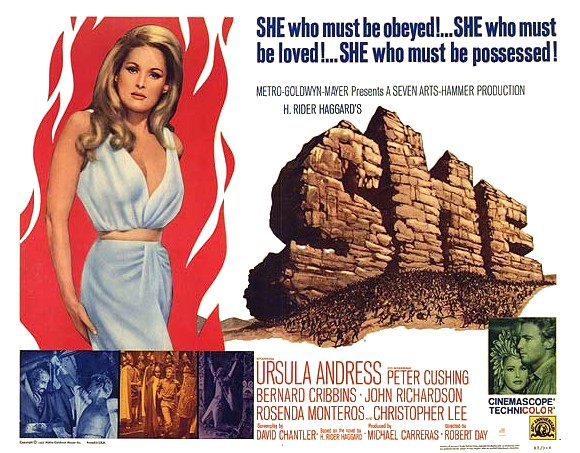
…didn’t manage to keep me awake, that is! That’s right, I actually dozed off in the middle of SHE for a good fifteen minutes! This so-called adventure film, a remake of the rousing 1935 Merian C. Cooper production starring Helen Gahagan and Randolph Scott, is based on a novel by H. Rider Haggard, a pretty big-deal adventure novelist back in the day, who also wrote the novels KING SOLOMAN’S MINES and ALLAN QUARTERMAIN. The ’35 version was filled with sumptuous Art Deco sets and a dynamic score by Max Steiner, and proved popular with moviegoers of the day.
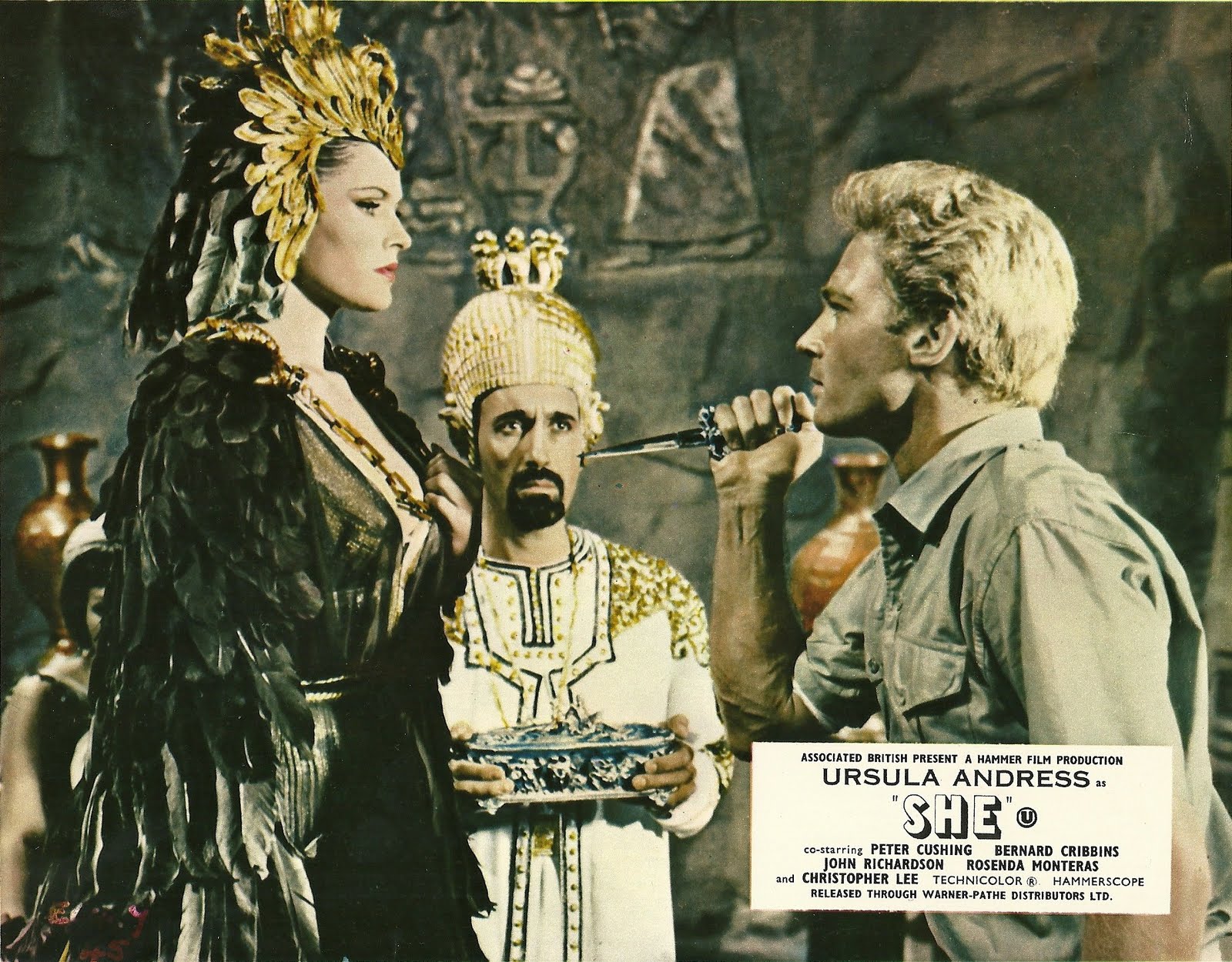
But the times, they do a-change, and so do tastes. Hammer Films decided to do this remake thirty years later, with Ursula Andress in the title role. ONE MILLION YEARS B.C. caveman John Richardson plays Leo Vincey, who’s the spitting image of Queen Ayesha’s long-lost love Kallilkrates. Hammer’s top tag-team Peter Cushing and Christopher Lee are in the cast…
View original post 209 more words
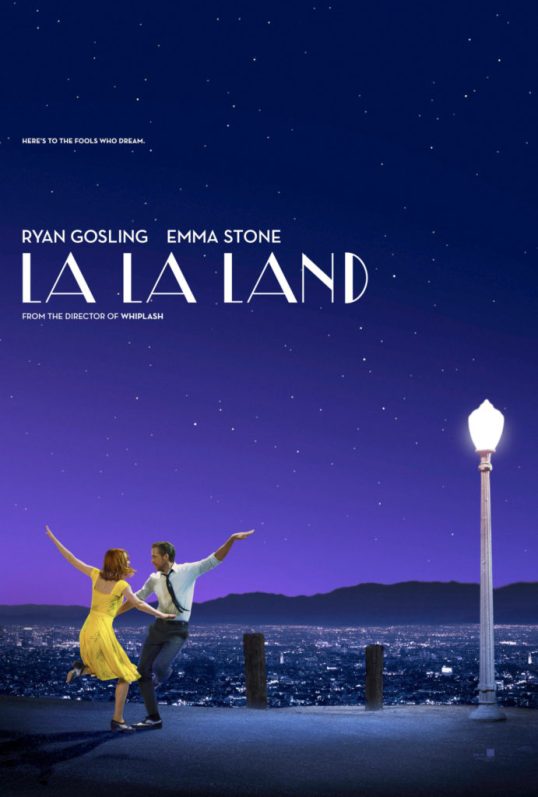
The Director’s Guild announced their feature film nominations earlier today.
A DGA nomination is one of the biggest prizes of the precursor season. In general, if the DGA nominates a film then it’s likely that film will also get nominated for best picture. There have been exceptions, of course. (David Fincher was nominated for his bastardized rehash of Girl With The Dragon Tattoo.) But, for the most part, the DGA is the most reliable precursor available.
Five directors were nominated. The usual suspects were there — Lonergan, Jenkins, and Chazelle. Fortunately, Denis Villeneuve picked up a nomination, which is good news for Arrival. The fifth nominee was a bit of a surprise. Garth Davis was nominated for Lion, which I guess means I’ll have to go see that movie now, even though I have little real desire to do so.
Martin Scorsese was not nominated for Silence, which probably means that the film will be dead-in-the-water as far as Oscar nominations are concerned.
Also not nominated — Tim Miller for Deadpool, a film that’s been doing surprisingly well with the precursors. If Tim Miller had been nominated, heads would have exploded. It would have been fun to watch the twitter reaction.
Instead, we just got this —
Just to make it official, here are the five DGA nominees:
Denis Villeneuve — Arrival
Damien Chazelle — La La Land
Garth Davis — Lion
Kenneth Lonergan — Manchester By The Sea
Barry Jenkins — Moonlight

My look back at the previous year continues with 10 of my favorite non-fiction books of 2016! Now, it should be noted that, because this is an entertainment-related website, I’m only listing my favorite entertainment-related books. There was a lot of good nonfiction published last year but the majority of it had nothing to do with either the movies or television so who cares?
Anyway, all of these are wonderful and well-worth the money!
Finally, I have to give an honorable mention to two books that were published in 2015 but which I didn’t read until 2016. These two books were definitely my favorite non-fiction reads in 2016 and there’s no way that I couldn’t mention them. Troy Howarth’s So Deadly, So Perverse and So Deadly, So Perverse Volume 2 contain everything you could possibly want to know about the giallo genre!

Tomorrow, my look back at 2016 continues with my favorite novels of the year!
Previous Entries In The Best of 2016:
Of course there are! This is turning into the ABBA hole.
Since I do plan on including Frida’s and Agnetha’s post-ABBA music videos leading up to, and following 2004’s The Last Video (ABBA), it means I need to do any pre-ABBA music videos as well. Go figure that a band that would become well-known for their videos would have members that made music videos prior to its creation.
In the 1960s, Benny was in a band called The Hep Stars. That’s him on keyboards. You can read about them on Wikipedia.
The only thing that has me a little worried is that many of the videos after this for the members of ABBA, before ABBA, were part of TV specials as opposed to standing on their own. However, they seem to just be music videos that were shot and aired in a row for varying reasons. They aren’t A Hard Days Night (1964). Besides, there’s no way I’m not including the one where Björn does the tango.
Enjoy!
ABBA retrospective:

Unknown Artist
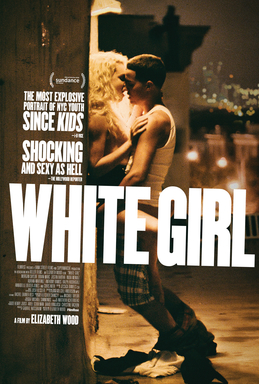
Ever since it premiered at the Sundance Film Festival, I’ve read the White Girl was the most “shocking” film of 2016. You can take a look at the poster above and see that, according to The Hollywood Reporter, White Girl is “SHOCKING … AND SEXY AS HELL!”
Well, I finally got a chance to watch White Girl on Netflix and the only thing shocking about it is that so many (male) critics were apparently convinced that it was the most shocking movie ever made. I certainly wouldn’t call it shocking. (And considering that White Girl features two graphic rapes, I’d love to know why the critic thought “sexy as Hell” would be an appropriate description.) A better description of White Girl would be “honest.” Then again, considering the way that the movies usually present the experience of being young, female, and in the city, perhaps the fact that White Girl is an honest film is the most shocking thing of all.
Morgan Saylor plays Leah, a college student who, along with her friend, Katie (India Meneuz), moves into a New York apartment. The apartment is located in a largely Spanish neighborhood, one that has yet to surrender to gentrification. While Katie and Leah’s hipster friends are immediately suspicious of everyone else in the neighborhood, the Oklahoma-born Leah is far more adventurous (or perhaps reckless). She approaches Blue (Brian Marc) on a street corner and asks him if he has any weed.
Blue has weed and a lot more. He’s the neighborhood drug dealer and soon, he’s also Leah’s boyfriend. When Leah isn’t getting high and having sex with Blue, she’s working as an intern at a magazine where, early on in the film, she’s sexually assaulted by her boss, Kelly (Justin Bartha, playing a predator who, for many, will seem disturbingly familiar). Leah invites Blue to a party given by the magazine and Blue is able to make a lot of money selling cocaine to Leah’s wealthy co-workers.
For Blue, drugs are a business and he refuses to do hard drugs himself. To Leah, it’s an adventure, one that she believes doesn’t have any real consequences. Or, at least, that’s the way she sees it until Blue is arrested. With Blue, a repeat offender, facing a life sentence, Leah manages to find a lawyer (Chris Noth, who will make you skin crawl) but she needs to raise the money to pay him. Fortunately, Leah has a stash of cocaine that Blue was supposed to sell. Blue tells Leah that she needs to return the cocaine to his dealer but instead, Leah decides to sell the cocaine herself. Or, at the very least, she’s going to sell whatever cocaine she doesn’t end up snorting herself…
White Girl has been called shocking because of its open and nonjudgmental portrayal of both drugs and sex but, honestly, there’s nothing shocking about it. It may be a generational thing but, to me, Leah’s story was a familiar one. I’ve known a lot of Leahs and, personally, there were moments in White Girl that left me cringing just because I could relate to one of Leah’s naive notions or I could remember what it was like to feel like, no matter what I did, there would never be any consequences. Leah may not always be a likable character but it’s not because she has sex or experiments with drugs. Instead, it’s because she spends most of the film blissfully unaware of her own privilege. Leah thinks that she understands the realities of Blue’s world but, as she learns by the end of the film, she’s really just a tourist. And, unlike Blue and the rest of her neighbors, Leah can always leave whenever she wants.
So, White Girl was not a shocking film to me. Instead, it was a very honest film. It can currently be viewed on Netflix.
Earlier this week, I named Pride and Prejudice and Zombies as the worst Jane Austen adaptation of 2016. Of course, I understand that Pride and Prejudice and Zombies isn’t really a Jane Austen adaptation. Instead, it’s an adaptation of a jokey novel that took Austen’s characters and combined them with zombies. But you know what? Nobody would have given a damn if the name of that book and that movie didn’t include three words: Pride. And. Prejudice. That’s the power of Jane Austen.
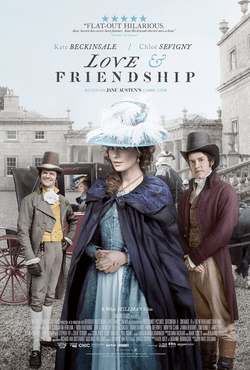
But anyway, my point is that Pride and Prejudice and Zombies was pretty much a low point as far as Jane Austen films are concerned. Fortunately, 2016 also saw the release of a very enjoyable and entertaining Jane Austen film named Love & Friendship and, even better, Love & Friendship was based on something that Austen actually wrote.
Of course, though Austen may have written the novella Lady Susan, it wasn’t published until long after her death and there’s speculation that it was an unfinished (or abandoned) first draft. In fact, it’s debatable whether or not Lady Susan was something that Austen would have ever wanted to see published. While it shares themes in common with Austen’s best known work, it also features a lead character who is far different from the stereotypical Austen heroine. Lady Susan Vernon is vain, selfish, manipulative, and unapologetic about her numerous affairs. She’s also one of the wittiest of Austen’s characters, a woman who is capable of identifying and seeing through the hypocrisies of 18th century society.
In Love & Friendship, Susan is played by Kate Beckinsale, who does a great job in the role. One of the best things about Love & Friendship is that it serves to remind us that Kate Beckinsale is a very good actress, even when she isn’t dealing with vampires and Lycans and all that other Underworld stuff. Lady Susan is a recent widow and has been staying, with her daughter, Frederica (Morfydd Clark), at the estate of Lord and Lady Manwaring (Jenn Murray and Lochlann O’Mearáin) . That’s a good thing because, as a result of the death of her husband, Lady Susan is now virtually penniless and homeless. But, once it becomes obvious that Susan is having an affair with Lord Manwaring, she and Frederica are kicked out of the estate.
They eventually find themselves living with Susan’s brother-in-law, Charles (Justin Edwards) and Charles’s wife, Catherine (Emma Greenwell). Susan, realizing that she needs to find not only a rich husband for Frederica but also one for herself, immediately starts to scheme to win the hand of Catherine’s brother, Reginald DeCourcy (Xavier Samuel). Meanwhile, Susan also tries to arrange for Frederica to marry the hilariously slow-witted Sir James Martin (Tom Bennett). Needless to say, things do not go quite as plan and it’s all rather chaotic and hilarious in its wonderfully refined way.
Director Whit Stillman, who has spent his career making refined and witty movies about morality and manners, is the ideal director for Austen’s material and he’s helped by an extremely witty (and, with the exception of Chloe Sevigny, very British) cast. In the role of Susan, Kate Beckinsale is a force of nature and Tom Bennett is hilariously dense as Sir James, the type of well-meaning dunce who is literally stumped when someone asks him, “How do you do?” Never before has dullness been so hilariously performed and Bennett’s performance really is a minor miracle.
Love & Friendship was a wonderful excursion into Austenland. It didn’t even require zombies to be enjoyable.
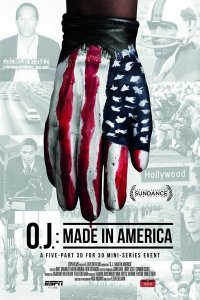
O.J.: Made in America, the best film of 2016, opens with a parole hearing in Nevada. The inmate is surprisingly friendly and affable. He talks about how he has tried to make the best use of his time in prison. He chuckles as he talks about his prison duties. For a prisoner, he seems like a really nice guy.
Then the parole commissioner asks him about the first time he was ever arrested and the prisoner’s entire demeanor changes.
“We’re going to talk about that?” he asks.
 The prisoner, of course, is former football great and actor Orenthal James Simpson and the first time that he was arrested, he was charged with murdering both his ex-wife, Nicole Brown Simpson, and Ronald Goldman. In 1995, after a long and controversial trial that both forced people to reconsider how they viewed race relations in America and also marked the beginning of what would become reality television, O.J. Simpson was acquitted. 13 years to the day of his acquittal, he was sentenced to 33 years in prison for armed robbery in Nevada.
O.J.: Made in America leaves little doubt that O.J. got away with murder, though it should be pointed out that O.J. Simpson did not respond to requests for an interview and that Johnnie Cochran, who headed the legal team that won Simpson’s acquittal, died in 2005. But with a sprawling running time of 7 and a half hours and featuring interviews with hundreds of people who either knew or were affected by O.J., O.J.: Made in America is about much more than just the trial of the century.
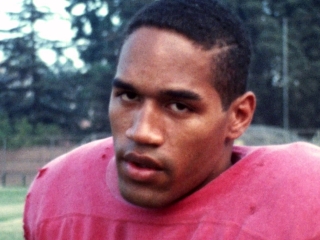
The first three hours of O.J.: Made in America deal with who O.J. was before he was charged with murder. Things open in the 1960s, with the nation torn apart by racial unrest, and O.J. Simpson winning the Heisman Trophy and setting rushing records with both the USC Trojans and the Buffalo Bills. While other black athletes, like Mohammad Ali, were putting their careers on the line and speaking out about civil rights, O.J. was deliberately apolitical. When O.J. was pressured to speak out on civil rights, he would reply, “I’m not black. I’m O.J.”
In turbulent times, O.J. emerged as a black celebrity that whites could safely embrace. O.J. made history as the first black man to be used as a spokesman in an advertising campaign, running through airports for Hertz Rent-A-Car while onlookers shouted, “Go, O.J., go!” A Hertz executive explains that, whenever they filmed a commercial, they were careful to make sure that it was only white people who were seen cheering O.J. on. Retiring from football, O.J. moved to Brentwood, an all-white enclave in Los Angeles. Surrounded by sycophants, O.J. pursued an acting career and remained silent while Los Angeles dealt with a series of racial incidents, culminating in the riots that followed after four LAPD officers was acquitted in the beating of Rodney King.
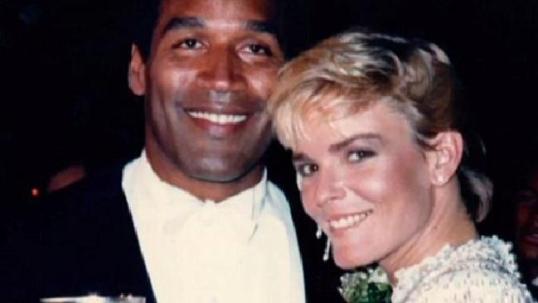
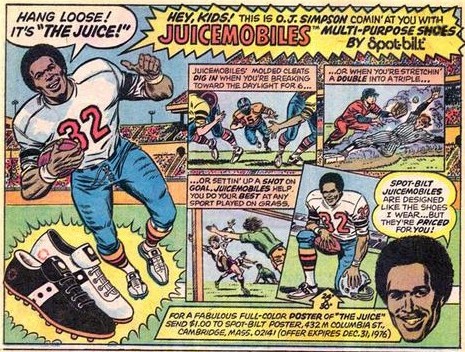
During all of this, O.J. divorced his first wife and married Nicole Brown. One of the commendable things about O.J.: Made in America is that it gives a face and a personality to Nicole, who is often the forgotten victim when people discuss the O.J. Simpson case. At the same time, O.J.: Made in America also documents how O.J. never faced any serious consequences for abusing Nicole. Even after he was charged with domestic battery, all O.J. had to do for his community service was set up a charity golf tournament. He later did an interview with Roy Firestone where the two of them joked away the charges and Firestone worried that they may have led some people to think that the Juice was a bad guy.
The next three hours deal with not only the murders of Nicole and Ronald Goldman but also with the national ramifications of the so-called “trial of the century.” The first three hours were dominated by interviews with childhood friends, business associates, and neighbors. It’s during the 2nd three hours that the familiar faces start to pop up. Gil Garcetti, Bill Hodgman, and Marcia Clark talk about prosecuting O.J. (Unfortunately, Chris Darden declined to be interviewed.) From the defense team, F. Lee Bailey, Barry Scheck, and Carl E. Douglas share their memories of how this murder trial became a national Rorschach test on how Americans viewed race, celebrity, and justice. The irony is not lost on anyone that O.J., who never made any public commitment to civil rights and who surrounded himself with rich, white people, was largely acquitted because of race.
Until I saw O.J.: Made in America, I could never understand how O.J, manages to win acquittal. His guilt has always seemed so obvious to me. But, as O.J.: Made in America made clear, reasonable doubt can mean different things to different people. A black jury in downtown Los Angeles had reason to both distrust and dislike the LAPD. When Mark Furhman is heard using racial slurs, Carl Douglas says that it confirmed everything that he had always suspected by the LAPD. Beyond that Cochran and his team put on a better show than the prosecution, who often seemed unsure how to respond and who repeatedly shot themselves in the foot with unforced errors, like asking O.J. to try on the bloody glove. (Mike Gilbert, O.J.’s agent, reveals that O.J. had stopped taking his arthritis medication during the trial, causing his fingers to swell up.) Even though the late Cochran could not be interviewed, he still easily dominates the documentary.
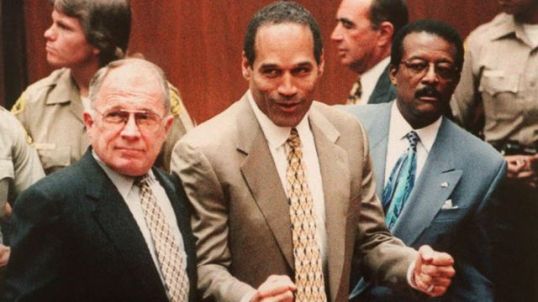
O.J.: Made in America features interviews with two of the jurors, Carrie Bess and Yolanda Crawford. When Crawford is asked if the acquittal was payback for the Rodney King verdict, she weakly protests that it was not. When ask the same question, Carrie Bess unapologetically nods in the affirmative.
With the trial over, the best part of the documentary is yet to come. The final 90 minutes deals with the decade between O.J.’s acquittal and his Nevada conviction. Freshly acquitted from murdering his wife, O.J. Simpson swore that he was going to track down the real killers, returned to his Brentwood mansion, and discovered that none of his old friends wanted to hang out with him anymore. The once popular O.J. Simpson was now a pariah. Simpson was taken to civil court by the Goldmans and the Browns and a new jury found him liable for the deaths of both Nicole and Ron. Ordered to pay $33,000,0000, a bankrupt and friendless O.J. spent ten years in the wilderness.
If things could not get any more surreal, O.J. was hired to star in a Punk’d-style TV show that would have been called Juiced. The Juiced footage would have been the strangest part of O.J.: Made in America if not for what happened in Las Vegas. Convinced that a memorabilia collector had stolen his stuff, O.J. and his entourage confronted the man in his hotel room. In a comedy of errors, O.J. grabbed everything that he felt had been stolen from him and ended up taking a lot of other things as well, with the entire encounter being audio recorded. Because a member of Simpson’s entourage had a gun on him, O.J. was charged with armed robbery.
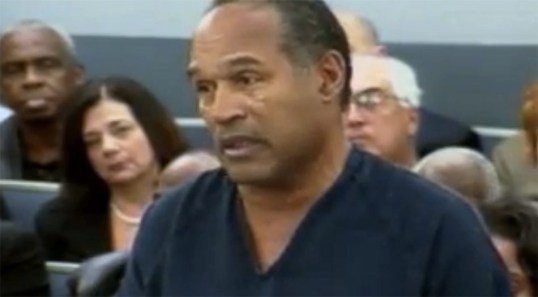
Tom Riccio, a member O.J.’s Las Vegas entourage, talks about how, in the minutes before leaving to confront the memorabilia collector, O.J. was watching the Tyra Banks Show in his hotel room. Tyra’s guest? O.J.’s goddaughter, Kim Kardashian. Kim announced that she and her family were going to be starring in a new show for E! O.J. laughed and said, “That show will never last.” Ironically, just as no one would have known (or cared) who Kim Kardashian was if not for her father’s role on O.J.’s defense team, O.J.’s murder trial also set the stage for the emergence of the reality television genre that would make stars of everyone from the Kardashian daughters to Donald Trump.
One final note about what happened in Las Vegas: O.J.’s Nevada trial was covered, for Entertainment Tonight, by Marcia Clark.
Convicted of armed robbery, O.J. was sentenced to prison. As Carl Douglas puts it, it was not a coincidence that the judge waited until a year to the day after Simpson’s previous acquittal to sentence him. And it was not a coincidence that Simpson, found liable for $33,000,000 in the civil lawsuit, was sentenced to 33 years. Douglas calls it the “fifth quarter,” the fight that happens after the fourth quarter to determine who really won the game. O.J.’s childhood friend, Joe Bell, calls it “white justice in America.”
Most people saw O.J.: Made in America when it was broadcast over five nights by ESPN. But the best way to see this documentary is the way it was originally viewed at Sundance: as a seven and a half hour movie, watched with little break or interruption. Full of candid and thought-provoking interviews and previously unseen footage, O.J.: Made in America is a powerful look at race, fame, and crime.
For tomorrow’s movie a day, it’s another documentary about a sports hero who ended up in prison, Stoked: The Rise and Fall of Gator.

 Through the Shattered Lens