By Paul Rader

By Paul Rader
It took me since September 5th of 2015 to finally reach the very last film in this retrospective of the Trancers series, but I’m finally here. This is the lost sequel that was made…why am I explaining this? There is a title card right at the beginning that does it for me.
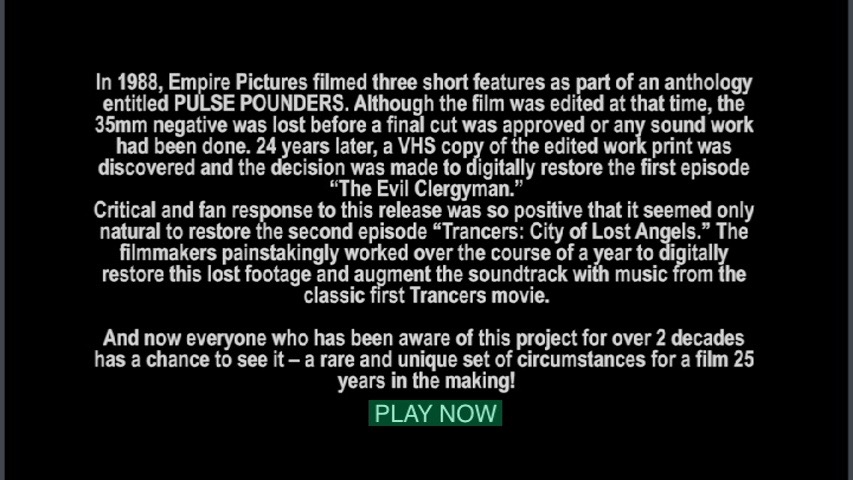
Yes, I do have The Evil Clergyman. I will get to it eventually. Pulse Pounders also has a sequel to The Dungeonmaster (1984) in it, but that doesn’t appear to have been released yet.
The movie begins with good old McNulty (Art LaFleur).
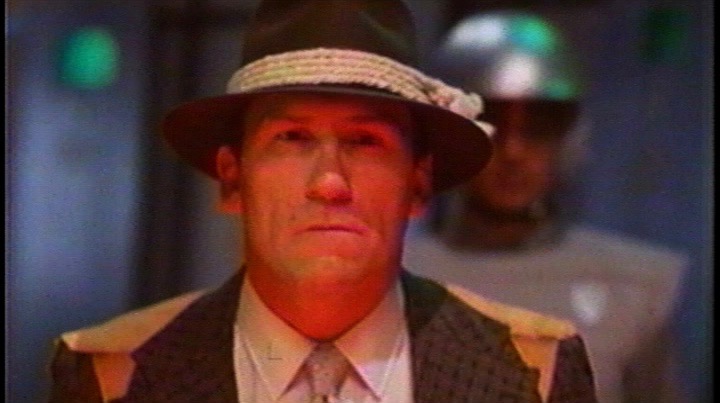
He is on his way to be briefed about a prisoner in jail who apparently does not like Jack Deth (Tim Thomerson) who is still in the past. He is being briefed by The Warden of the jail…
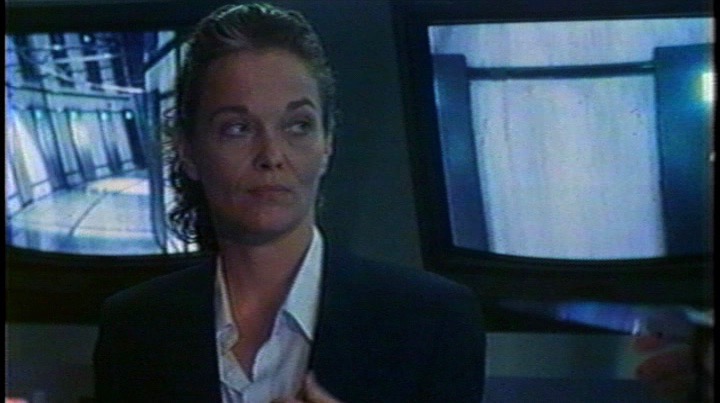
played by actress Grace Zabriskie. Ah, the good old days when I could still play dumb. You of course know Grace from Norma Rae (1979), Galaxy of Terror (1981), An Officer and a Gentleman (1982), Leonard Part 6 (1987), Wild at Heart (1990), My Own Private Idaho (1991), Fried Green Tomatoes (1991), Seinfeld, Big Love, and that little short-lived show called Twin Peaks. Oh how I wish I could have claimed I thought that was some late night cable series from the 90s like the TV Show Red Oaks having a character think The 400 Blows (1959) was porn. I still have the right to make a couple American Sniper rubber baby jokes in future posts. You can’t take that away from me! If you are thinking I’m padding out this review because the movie is really short, then you’d be right.
She takes him to every futuristic hallway from the 80’s to meet the vicious murderer named Edlin Shock (Velvet Rhodes). She only says two words in her time there: Jack Deth. He is the one who brought her in.
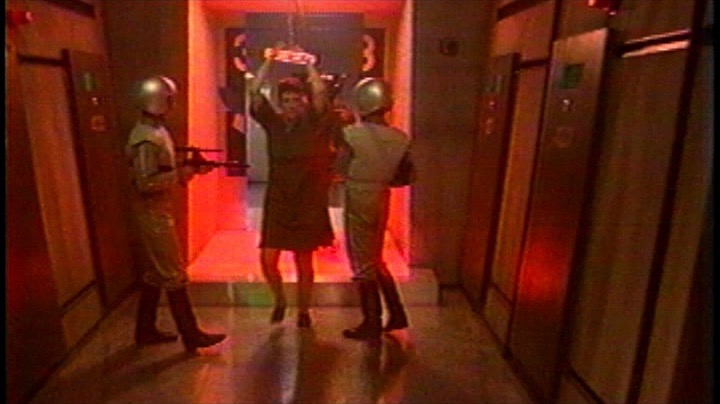
You can sort of see through the lousy VHS rip this DVD provides that she is being transferred because the movie has to have an excuse for the criminal to escape and they went with this one.
McNulty walks through a door that can conveniently close on him when needed, and she breaks free.
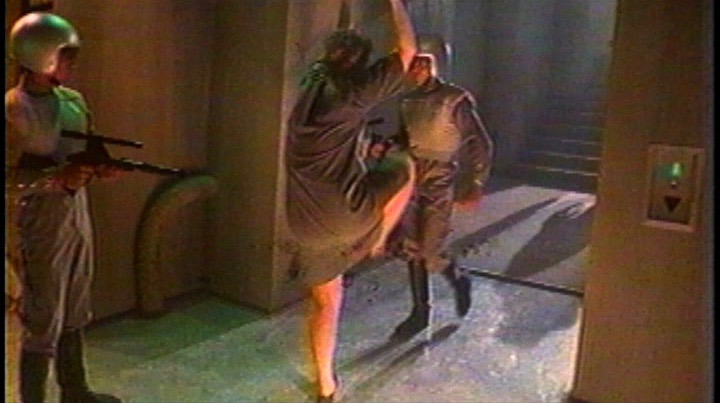
She has the cuffs off now that were holding her hands straight up for some reason. Just thought I’d tell you that, cause the movie never explains how that happened. Nor does it explain this.
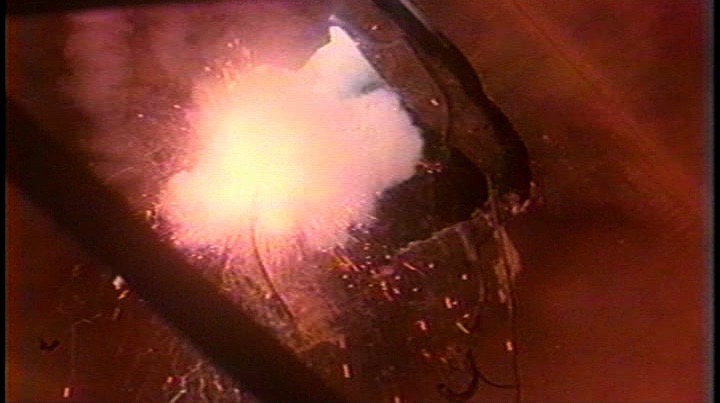
That’s right! She somehow punctured and got through the ceiling. Even Zar in Rock’s Winning Workout Without Weights couldn’t do that!
The best he could do was bonk his head on the ceiling.

Rock’s Winning Workout Without Weights (1990)
If you’re thinking they might show her taking someone’s gun that could be used to make that hole, then…um…nope! The best we get is that as she kicked one of the soldiers, he appears to have shot upward once. Blink, and you’ll miss it.
Anyways, The Warden instantly knows she has reached the room where she can go back in time. So of course they go there and find Raines (Thelma Hopkins).
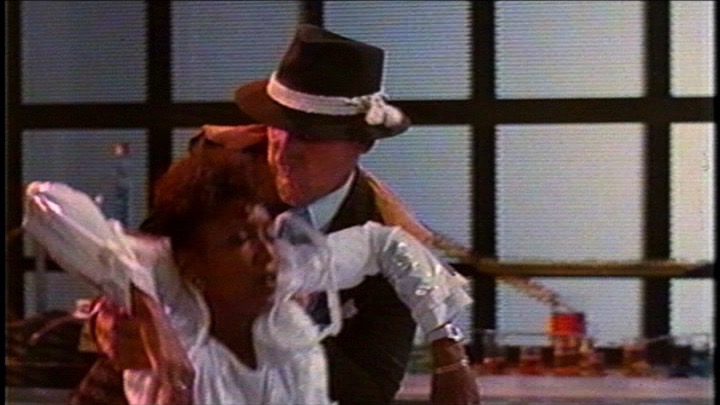
She tells him that Edlin forced her to send her down the line. McNulty orders Jack’s body brought out of the vault, and gets Raines to send him down the line. By that I mean Alyson Croft is back to play McNulty as a girl. She’s as good as ever in this. In fact, the majority of the film is made up of Tim Thomerson and Alyson Croft reminding us that they really did give the best performances in any of the Trancers movies.
We now cut to the past of 1986 Los Angeles so that Helen Hunt can make what is basically a cameo appearance as Lena Deth. We first see her throwing dishes.
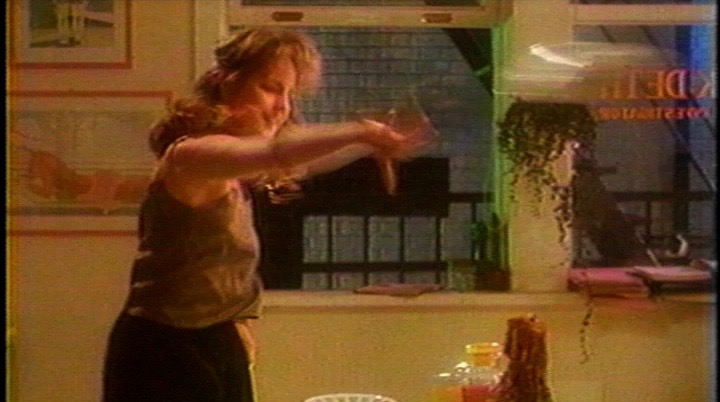
She’s not too happy with the last three years of their time together. Jack tells her they have a great detective agency. However, they have zero clients despite a great newspaper ad that says, “Put your trust in Deth.” Sounds fine to me! A plumbing agency ran that kind of an ad in my city’s local newspaper back in the 50s.
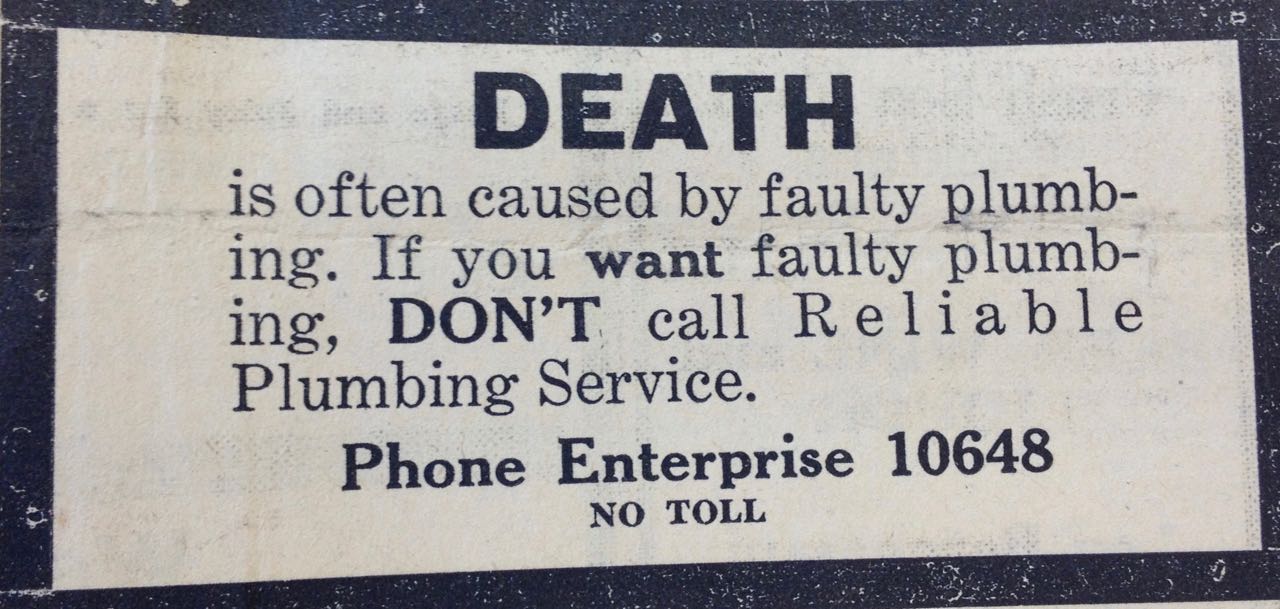
Then again, this is the same paper that ran a story talking about dogs pissing on the paper while it sat on newsstands. They also wrote an apology for making a typo in a classified ad by making another typo in the apology. Maybe she’s right. By the way, I’m not kidding about the pissing thing. It’s a four paragraph story about how “canines criticize” the paper.
Meanwhile, back in the movie, she chews him out, he uses the long second to give a speech, but after kissing her, she storms off anyways. Now Jack sits down to watch…
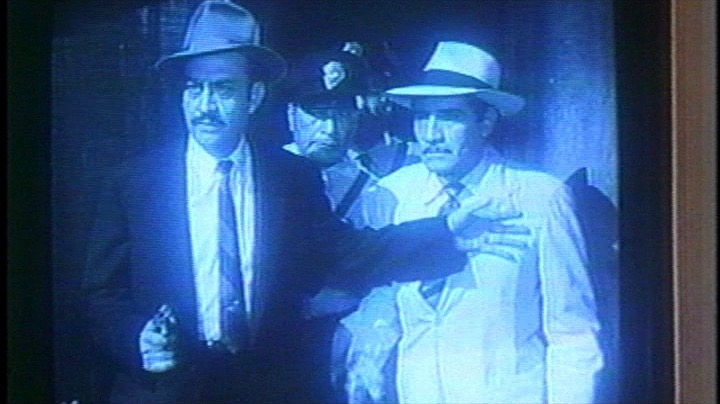
what I assume is Peter Gunn? They did make a joke about that show in the first Trancers movie. I’m not knowledgable enough about 50s television. That’s when Alyson Croft, as McNulty’s ancestor, shows up to deliver the message that the crazy killer from the beginning is after him.

Along with that, she brings up the fact that it’s a lot easier to protect Jack if he comes back to the future. This is probably the best part of the movie cause they actually bother to bring this next part up. Jack says that if he left now, then Phillip Deth, his ancestor whose body he is in, could be picked off and thus erase his own existence. McNulty says that the bad lady likes to look the person she is going to kill in the eye. That means she’ll follow him back to the future if necessary. However, since they already built this nice apartment set, Jack stays and stops McNulty from shooting him with the back to the future dart. McNulty likes to do that suddenly to Jack. He did it in the first film thus interrupting Jack just before he was going to have sex.
Now a guy fixing the roof shows up because we are only working without about 24 minutes of footage here.

Of course Jack lets him go. Now a red herring shows up. Okay, I kid. She’s not a bird, but she is dressed in red!
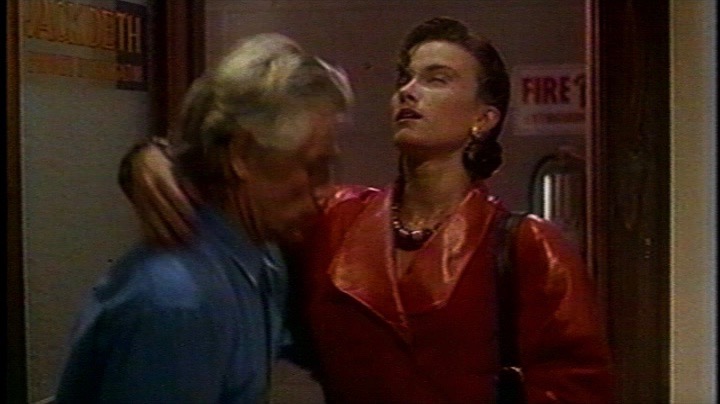
If this is actress Velvet Rhodes, then they sure don’t tell you anywhere in the non-existent credits or on IMDb. If she was, then you’d think he would recognize her, but he doesn’t, and neither does McNulty. I don’t think it is. Although, he certainly is skeptical. It really doesn’t matter what happens here. You are watching this just to see Tim Thomerson and Alyson Croft do their thing. They really are good together.
Oh, and the way you know for sure it’s either red jacket lady or roof guy is that they make sure to tell you that McNulty is lucky he has a genetically aligned ancestor to go back into before sending him down the line. That way you know for sure it’s not the killer posing as McNulty.
After a little bit of drinking, a little bit of interrogating, and red herring changing her clothes, this happens.
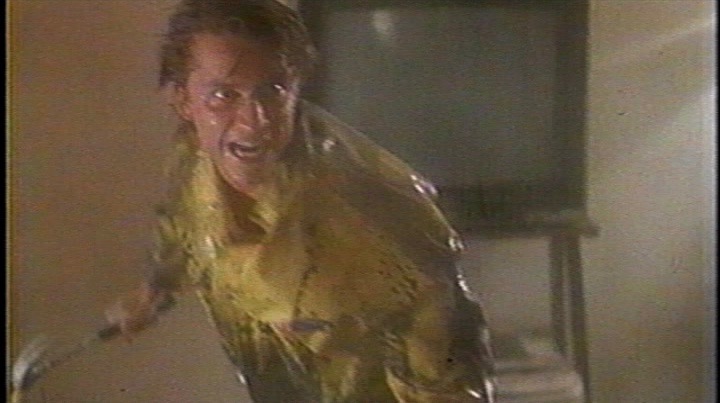
Yep, roof guy was the one she took over.
A scuffle now ensues, and between Jack and McNulty,…
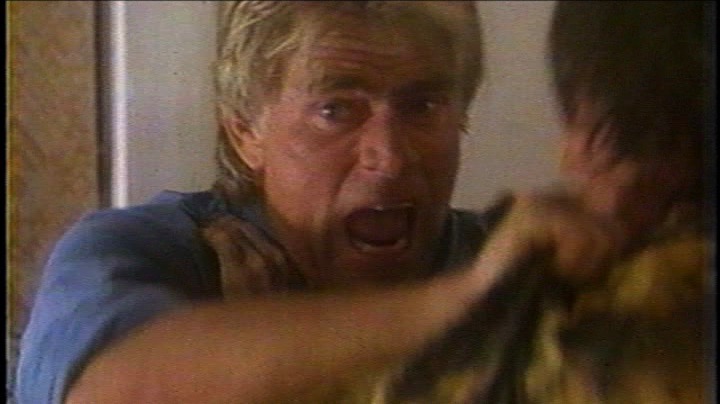
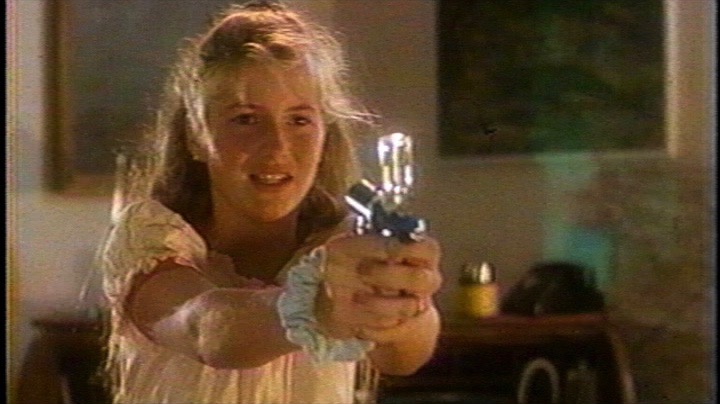
she and Jack are sent back to the future.
Now the fight continues in the future.
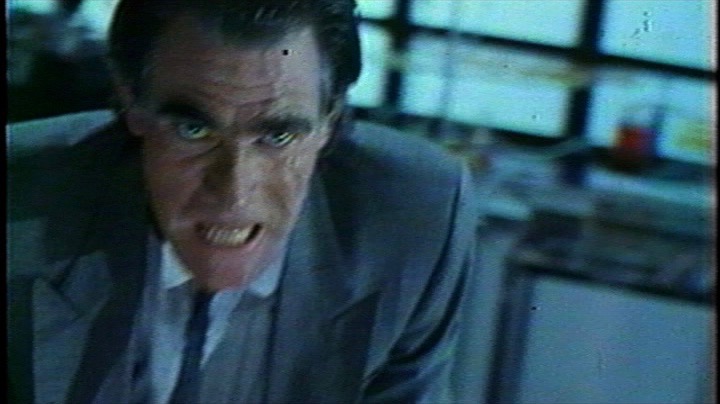
The fight goes to the roof, and she gets knocked off bringing the reason for this plot to exist to an end.
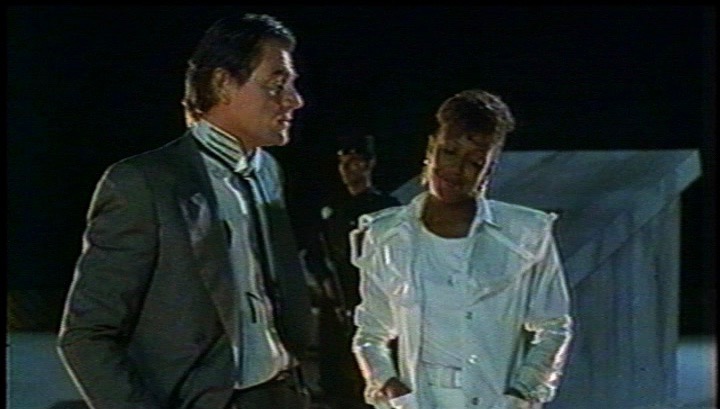
Jack and Raines talk a bit. Jack decides to go back to the past, but with one condition. Could she send him back three hours earlier? You know, that way this movie never actually happened. Of course she can so…
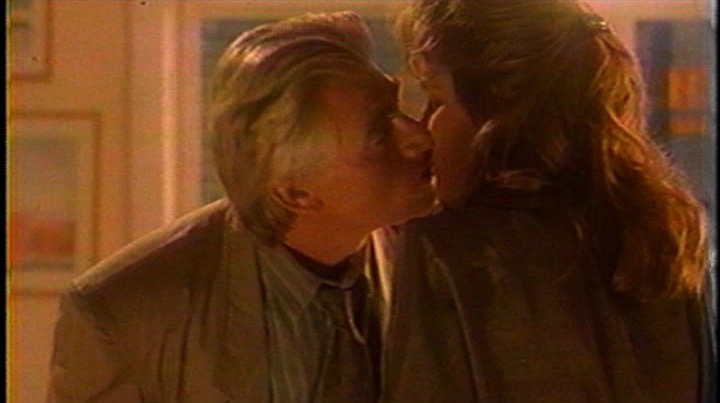
they can attempt to kiss,…
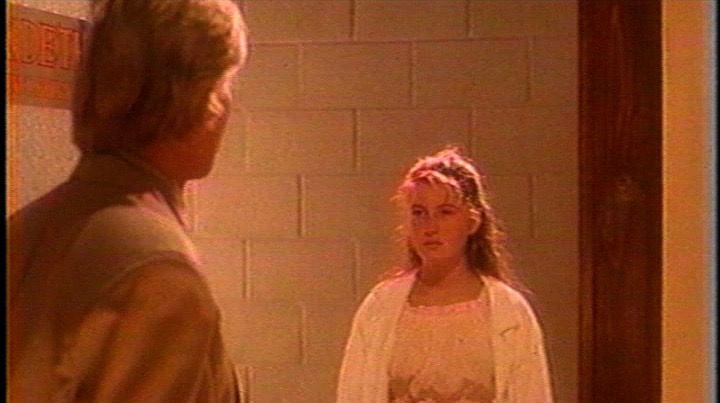
tell McNulty to piss off,…
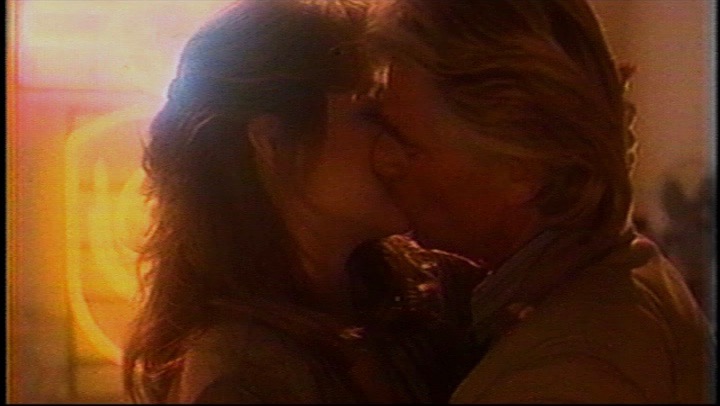
and actually kiss.
Then this happens.
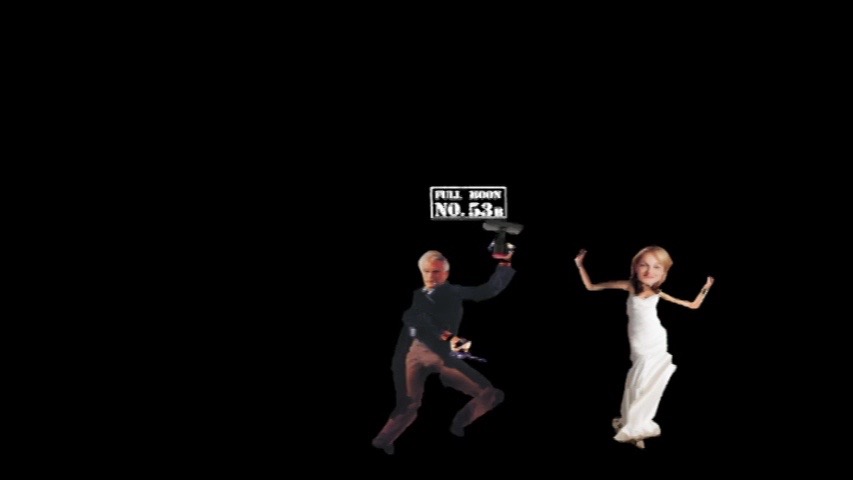
Thomerson runs across the screen holding some stuff while Helen Hunt dances. Classy, Full Moon Features.
Now you may be asking yourself a question right now. Where were the Trancers in this Trancers movie? You didn’t miss anything. They aren’t here. This is the one and only Trancers movie without any Trancers in it. No mind controlled zombie Trancers from the first one. No drug-induced/mind controlled ones from the second film. No super solider ones from the third one. No vampire ones from four and five. No meteor rock tied into a ray gun that zaps you in the eyes from Trancers 6 either. No Trancers whatsoever. Honestly, I’m glad. I needed a change.
What’s nice about this film is that it really doesn’t break the continuity with the actual Trancers II. If anything, it gives us an early glimpse into how Jack was trying to settle into living in the past. Also, how his and Lena’s relationship was already on the rocks. In the end though, I would only recommend this for real fans of the series.
At the end of this entire look back at the series, the only ones worth seeing are the first one, this one, and the actual second movie. Definitely skip the rest.
When I was searching for information on illustrator Darrel Millsap, I came across the following obituary from the Santa Cruz Sentinel:
“Darrel passed away on April 11, 2012, due to complications of stroke, diabetes and Parkinson’s disease. He was born in Ontario, CA, on May 9, 1931, to Poley and Isabelle Millsap. He was known as “Bunky” to all and in the years prior to his stroke, he was quite the character, with a loving heart and a smile on his face.
Darrel served in the U.S. Navy and was honorably discharged in 1953, where he immediately attended Art Center College of Design in Pasadena, California. He graduated in 1956 with a degree in Commercial Illustration. He later became a mentor to many graduates of Art Center and was an inspiration to many aspiring artists in the years to come.
He began his illustration career in Los Angeles, working for Fred Kopp Studios under Hector Huerta. Within a few years, he moved to San Diego and began working for Frye and Smith, then ventured out on his own with his partner Robert Kinyon, creating Millsap/Kinyon Illustration. They thrived for years until Robert lost his battle with cancer. Darrel continued his artistic legacy by going solo under Darrel Millsap Illustration, and worked with his many friends and acquaintances in the art business until he retired in 1999. Darrel was truly on of San Diego’s best known “unknown” artists.”
Here’s a few examples of his work:


The 12th film contained in Mill Creek’s Fabulous Forties box set is the classic film noir D.O.A. Before I get into reviewing this film, there’s an oddity that I feel the need to point out. According to the back of the Fabulous Forties box, D.O.A. was released in 1949. However, according to Wikipedia, imdb, and almost every other source out there, D.O.A. was released in 1950. In short, it’s debatable whether or not D.O.A. actually belongs in the Fabulous Forties box set but it really doesn’t matter. D.O.A. is a classic and, along with Night of the Living Dead, it is undoubtedly one of the best B-movies to ever slip into the public domain.
D.O.A. opens with a lengthy tracking shot, following a man named Frank Bigelow (Edmond O’Brien) as he walks through the hallways of a San Francisco police station. Frank walks with a slow, halting movement and it’s obvious that he is not a healthy man. When he finally steps into a detective’s office, Frank announces that he’s come to the station to report a murder — his own.
Frank is a small-town accountant who came to San Francisco for a vacation. After a long night of drinking, Frank woke up feeling ill. When he went to a doctor, he was informed of two things. Number one, he was in overall good health. Number two, he only had a few days to live. Sometime during the previous night, Frank was poisoned with a “luminous toxin.” There was no antidote.
The rest of the film follows Frank as he attempts to figure out who poisoned him and why. It’s an intriguing mystery and I’m not going to ruin it by going into too many details. Over the course of his investigation, the increasingly desperate Frank comes across a gangster named Majak (Luther Adler). This leads to a lengthy scene in which Majak’s psychotic henchman, Chester (Neville Brand), repeatedly punches Frank in the stomach. It’s a scene that, even in our far more desensitized times, made me cringe. I can only imagine how audiences in 1950 reacted.
(There’s also a shoot-out at a drug store that can stand alongside almost any modern-day action sequence. Regardless of whether the film was made in 1949 or 1950, it still feels like a movie that could have just as easily been made in 2016.)
But really, the mystery is secondary. Instead, D.O.A. is truly about Frank and how he deals with the knowledge that he is going to die. Before being poisoned, Frank is the epitome of complacent, middle-class suburbia. He’s engaged to Paula (Pamela Britton) but he’s in no hurry to marry her. He’s got all the time in the world. When Frank goes to San Francisco, he epitomizes the bourgeoisie on vacation. He goes to the 1940s equivalent of a hipster nightclub, not because he’s actually interested in what the scene is all about but because he’s a tourist looking for a story to tell the folks back home. When he checks into his hotel, he leers at every passing woman with a casual sexism that would not be out-of-place on an old episode of Mad Men. Frank is floating through life, confident in his own complacency.
It’s only after he’s poisoned that Frank actually starts to live. He goes from being passive to being aggressive. Knowing that he’s going to die, he no longer has anything to lose. Only with death approaching does Frank actually start to live. Frank’s realization that he waited to long to live makes his final line all the more poignant.
D.O.A. is a classic! Watch it below, you won’t be sorry!
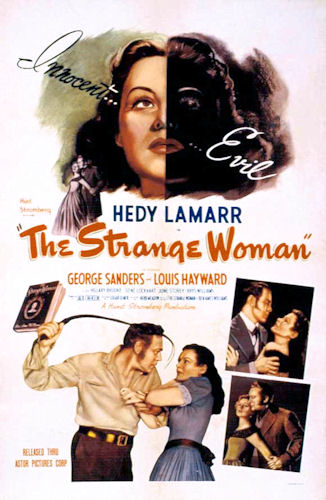
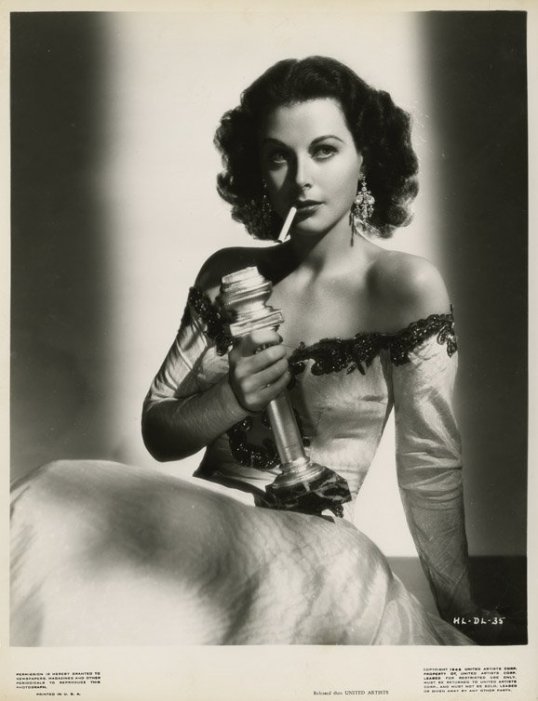
The eleventh film in Mill Creek’s Fabulous Forties box set was 1946’s The Strange Woman. The Strange Woman is one of those film noir/small town melodrama hybrids that seem to have been something of a cinematic mainstay in the mid to late 40s.
The Strange Woman of the title is Jenny Hager (Hedy Lamarr) and she’s not just strange because she’s got an Eastern European accent despite having grown up in Bangor, Maine. The film opens in 1824 and we watch as tween Jenny pushes one her classmates into a river, despite the fact that he can’t swim. At first, she seems content to let him drown. However, once she realizes that an adult is watching, Jenny jumps into the river and saves his life.
Ten years later, Jenny has grown up to be the most beautiful woman in Maine. However, her father is abusive and regularly whips her as punishment for being too flirtatious. Jenny has plans, though. She wants to marry the richest man in town, a store owner and civic leader named Isaiah Poster (Gene Lockahrt). Isaiah also happens to be the father of Ephraim (Louis Hayward), the young man who Jenny tried to drown at the beginning of the film.
And eventually, Jenny’s dream does come true. She marries Isaiah, even though she doesn’t love him. She just wants his money and is frustrated when the sickly Isaiah keeps recovering from his frequent illnesses. She starts to flirt with the weak-willed Ephraim, trying to manipulate him into killing his father.
Of course, even as she’s manipulating Ephraim, she’s also flirting with John Everd (George Sanders), despite the fact that John is already engaged to the daughter of the local judge. Though Everd is a good and decent guy, he still finds himself tempted by Jenny.
What makes all of this interesting is that Jenny isn’t just a heartless femme fatale. Throughout the film, there are several instances when she wants to do good but can’t overcome her essentially heartless nature. She gives money to charity and, whenever she listens to one of the local fire-and-brimstone preachers, she finds herself tempted to give up her manipulative ways.
The Strange Woman was directed by Edgar G. Ulmer, who is probably best known for directing the ultimate indie film noir, Detour. He was a childhood friend of Hedy Lamarr’s and she specifically asked that he direct her in The Strange Woman. As a result, this film represents one of the few times that Ulmer was given a budget that was equal to his talents. What makes The Strange Woman stand out from other 40s melodramas — like Guest In The House, for example — is that, even with the larger budget, Ulmer’s direction retains the same deep cynicism and dream-like intensity that distinguished his work in Detour. The film remains sympathetic to Jenny, even as she often suffers the punishments that were demanded by the production code.
In the role of Jenny , Hedy Lamarr is a force of a nature. She is so intense and determined that watching her as Jenny is a bit like seeing what Gone With The Wind would have been like if Scarlet O’Hara had been a total sociopath. Even the fact that Lamarr’s accent is definitely not a Maine accent seems appropriate. It sets Jenny apart from the boring people around her.
It reminds us that, even if she is “strange,” there is no one else like Jenny Hager.
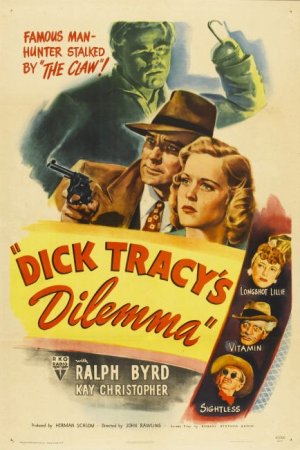
The 10th film in Mill Creek’s Fabulous Forties box set was 1947’s Dick Tracy’s Dilemma. According to Wikipedia, this was the third Dick Tracy film to be produced by RKO Pictures. In case you couldn’t guess from the title, Dick Tracy has a dilemma in this film. I assume that, in the first two films, he had a problem and a quandary.
Clocking in at just an hour, Dick Tracy’s Dilemma takes place over the course of one long and very dark night. Three men rob the Flawless Furs Warehouse and kill the night watchman. The leader of the gang (played by Jack Lambert) is known as the Claw because, instead of a right hand, he has a prosthetic hook, which he can use to either beat or claw people to death. (It all depends on his mood.) The Claw also loves cats so he can’t be all bad.
Investigating the murder is Detective Dick Tracy (Ralph Byrd). This was the first Dick Tracy film that I’ve ever actually watched so I can’t claim to be an expert on the character. But judging from this film, Dick Tracy’s dilemma is that everyone around him is either extremely stupid or extremely evil. For example, Dick’s partner, Patton (Lyle Latell), is useless. When Dick’s number one informant, a fake blind beggar named Sightless (Jimmy Conlin), attempts to get some important information to Dick, he has the misfortune of running into Dick’s idiot friend, a Shakespearean actor named Vitamin (Ian Keith). Vitamin mishears the information and he delivers his lines with so much over-the-top flourish that, by the time he tells Dick that Sightless wants to speak to him, the poor beggar has already been murdered by The Claw.
Seriously, people have been talking about how dark Batman v. Superman is but just check out Dick Tracy’s Dilemma. The Claw is a sadistic killing machine and, in the end, it seems like it’s more dumb luck than good police work that leads to Dick Tracy tracking him down. The film ends with smiles all around, despite the fact that it’s only been a few hours since poor Sightless was clawed to death. If Vitamin wasn’t a drunk old actor, Sightless wouldn’t be dead. For that matter, Dick Tracy is the one who pressured Sightless to act as an informant in the first place.
Seen today, Dick Tracy’s Dilemma seems more like an episode of an old cop show than an actual movie. It’s easy to be dismissive of it but I don’t know. If I had been alive in 1947 and saw this movie when it was originally released, I probably would have enjoyed it. Ralph Byrd makes a convincing hero and there is a sense of genuine menace to Jack Lambert’s performance as The Claw. That said, don’t even get me started on Vitamin.
What type of name is Vitamin anyway?
You can watch Dick Tracy’s Dilemma below!
Unknown Artist


Let’s get this out of the way and just say that Warner Bros. executives and major shareholders are none too pleased by the reception from both critics and the general audience when it comes to Batman v. Superman: Dawn of Justice. Not a very good start to their planned DC Extended Universe. While fanboys from both DC and Marvel have been going at it for weeks now, there’s at least some bright spot ahead for DC in their summer tentpole release Suicide Squad.
Even with rumors of extended reshoots to add more levity and fun to balance out public’s perception that the DC films are too dour and dark (grimdark even), Suicide Squad still remains one of the more anticipated films of the summer.
During this year’s MTV Movie Awards, DC and Warner Brothers released the newest trailer for what they’re hoping will sell the DCEU to the audience what Batman v. Superman could not and that’s a fun comic book film that understands dark and serious doesn’t have to mean not fun.
Suicide Squad is set for an August 5, 2016 release date.
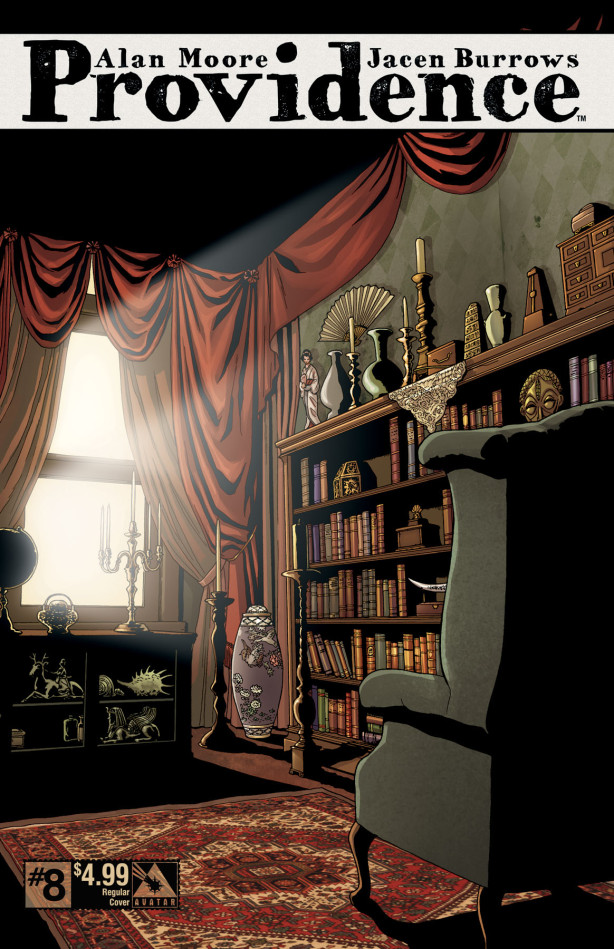
Some years back, Dave Sim conducted (via correspondence, if memory serves me correctly) a lengthy and fascinating interview with Alan Moore that he ran over the space of several issues as a backup feature in Cerebus. Moore was, at the time, in the midst of writing From Hell, and one idea that he kept coming back to as he expounded upon his creative process was something that he called “high-altitude mapping,” which is sort of a convenient shorthand term for “when you stand back far enough from the situation, there is no distinct separation between dreams and reality.”
It’s a powerful notion, when you really stop to think about it — after all, isn’t the whole point of living to “chase our dreams”? And don’t the limits imposed on those dreams by daily life’s practicalities whittle down and otherwise confine the scope of them over time? When you’re…
View original post 1,267 more words

I’m really glad my cable box told me what movie I was watching cause that title card sure doesn’t do a good job of it. It would be perfectly natural for someone to look at that and think it says Aee Yours before they realized it said All Yours.
Have you ever wanted to see the TV Show Melissa & Joey condensed down to about 90 minutes without a good reason for the smart guy to become a nanny, not much humor, and not much chemistry between Mom and the nanny? Neither did I. To be fair, I’ve been a big fan of Melissa & Joey for years. When I saw that Hallmark had a movie called The Manny in production, I wasn’t too jazzed. They appeared to have changed the title at the last minute though. I mean you can still see in the credits that the movie was made by Manny Productions Inc.

I think what happened was that at the last minute they got the rights to use I’m Yours by Jason Mraz. They probably figured the title All Yours not only fit with the song, but that it sounded more like the generic greeting card titles that Hallmark likes to use.
I mentioned that I’m a big fan of Melissa & Joey so I was constantly comparing it to that show while watching it. That’s only partly fair because that had many many many hours to develop all of the stuff I mentioned before, while this only had an hour and a half. I will try to be reasonable with the film.

The movie begins and we are introduced to Cass McKay (Nicollette Sheridan). She’s a lawyer. The case she’s arguing doesn’t matter. All the case part does for her character is establish that she is a good and busy lawyer. What this film does here is interrupt her argument over and over to cut to her kids at home.

The son’s sister runs up into his treehouse. You gotta put that No Girls Allowed sign where she can see it. She could argue that it wasn’t displayed properly at his establishment so she had every right to go up there. Believe it or not, these scenes are not just to establish that Cass needs a nanny. They are not just to establish that they need a nanny who can put up with the kids’ hijinks either. One of the excuses the daughter gives for getting up in the treehouse is because the son doesn’t use it anyways since he is afraid of heights. This getting over his fear of heights part of the story will be the equivalent to the bridge from Love, Again for example. Or, to use Melissa & Joey as an example, it’s the equivalent of when Joey finds and talks Lennox off the roof in the first episode of the show, thus proving his worth as a nanny. There will be a similar thing with the daughter playing the violin.
Now we get what I always show in these reviews.

I think they did a good job here. They hid the Canadian cellphone provider by having her connected to the courthouse WiFi. It also looks like they modified the screen too. It’s probably a screenshot she is looking at rather than the real interface. Regardless, good work.
Now we cut to the house to chew out the kids and introduce us to Grandma played by Jayne Eastwood.

I always like looking up these actors who I don’t immediately recognize such as Eastwood here. Wow! She seems to have been in everything under the sun. She’s been in what appears to be a sexploitation flick called My Pleasure Is My Business in the 70s, SCTV; Videodrome; and Care Bears in the 80s, the TV Show Goosebumps in the 90s, My Big Fat Greek Wedding; the remake of Dawn of the Dead; Degrassi: TNG; Chicago; and the musical remake of Hairspray in the 2000s, and in a variety of TV Shows and movies along with My Big Fat Greek Wedding 2 in the 2010s. At the time of writing this, she has 215 acting credits on IMDb since her first one in 1970. Amazing!
Now we get something pretty awesome. Yes, we get a brief shot of the future nanny named Matthew Walker played by Dan Payne, but who cares when we have this shot.

Care to take a guess at where this shot was taken? It’s on the sign and attached to the flag pole. Times up! It’s Denmark. No joke. That restaurant is at Nordre Beddingsvej 17, 3390 Hundested, Denmark. I have no idea why they use this shot a couple of times, but they do. I’ve seen Hallmark movies shot in the Los Angeles area, all over Canada, and even a pseudo-Hallmark movie shot in Scotland. Denmark is a new one on me. The rest of the movie is shot in the Hallmark favorite of Langely, British Columbia. If anyone involved in the production of this movie knows why this shot ended up in the movie, then please leave a comment.
Now we go inside and meet Matthew’s father Charles played by Michael Kopsa.

Michael Kopsa is another one of these actors that has had a long and eclectic career. He’s been in some major films such Watchmen (2009) and Rise of the Planet of the Apes (2011), but he goes back to the late 70s and early 80s where he got his start doing English dub work for the TV Show Mobile Suit Gundam as well as two of the movies. One of which he appears to have done the English voice of the main character: Mobile Suit Gundam: Char’s Counterattack (1988). Always worth taking advantage of IMDb while you watch movies.
He is here to talk to Grandma about his son. His son is the typical well educated guy who really found what he learned in college isn’t his thing so he’s been drifting around. A real world example of a guy like this is Huey Lewis of Huey Lewis and the News. Lewis is a bit of a math genius and attended Cornell. However, he found out it wasn’t his thing and drifted around playing music before settling down and starting his music career. His father was a doctor. That’s kind of how Charles describes his son. Charles is a developer who wants to tear down and redevelop the marina. His son isn’t a fan of that idea. I’m not either considering the marina never really looks like it’s in need of that kind of work during the film. What happens here is that Charles, Grandma, and Matthew strike a deal. Matthew will take a job as a nanny to Cass’ kids, and his father will reconsidering the redeveloping the marina. They keep that a secret from Cass. There’s your setup.

Oh, and they knew each other as kids so that they already come pre-packaged with some basis for their romance. Despite recognizing him, Grandma trying to make the hard sell, the kids obviously already liking him, and them already knowing each other, when Nicolette Sheridan gives you this look,…

then you know she means business.
Next we get introduced to Henry played by Lochlyn Munro who is kind of the wrong guy, but won’t play that role to the degree that we usually see in other Hallmark movies. On the good wrong guy to the weirdo in Christmas Land wrong guy, I’d say he sits somewhere in the middle leaning towards the decent wrong guy.

During the entire film I kept thinking that I had seen this guy before. After the film I checked the credits and realized it’s you cut to me before I had my wig on Burger King from In The Name of the King: Two Worlds (2011).

In the Name of the King: Two Worlds (2011, dir. Uwe Boll)

In the Name of the King: Two Worlds (2011, dir. Uwe Boll)
We meet him as Cass is introduced to a new court case. It is between two tech billionaires that have brought a case against each other so that their reconciliation as old friends can parallel the story between Cass and Matthew. It also adds a bit of a procedural element to the film that lets Matthew edge his way further into her life rather than having a separation of work and home since he went to law school too.
After suddenly needing to be called back to help the kids, Cass gives in and hires Matthew. That’s when she introduces him to the big calendar that will show us at what point Cass is in her character arc based on how much she breaks it and gets involved in the events listed on it. Then Matthew does something that pisses me off. He points out that Monday and Tuesday are reversed on the calendar.

Dammit, Dan Payne! You’re taking away work from cynical Hallmark critics like myself who like to point out flaws in these movies.
Anyways, she then gives him a phone to remind future viewers that this movie was released near Easter.
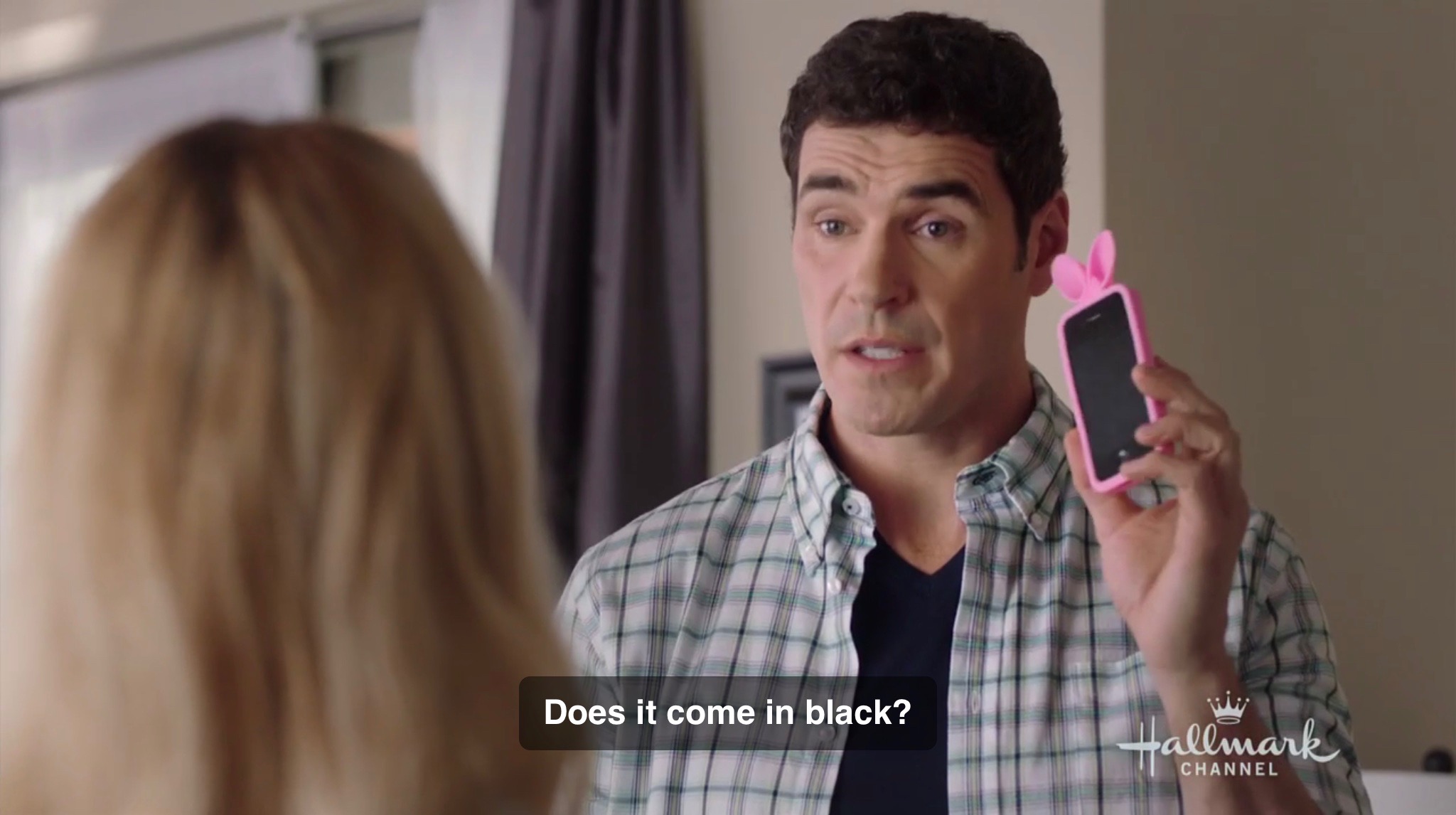
Also, it definitely doesn’t come in black. It’s not that kind of bunny, Matthew!
The next big thing is when he takes them to school. They actually don’t hide the name of the school at all in this movie. They say it’s Yorkson Elementary School, and it is. Well, sort of. It’s actually Yorkson Middle School, but close enough. It’s at 20686 84 Ave, Langley, BC V2Y 2B5, Canada. It’s new too because you can see it was in construction a few years ago on Google Maps.

They also bring up again that the girl’s equivalent to her brother’s height issue is playing the violin during this scene.
He takes them rock climbing. This is where we really find out that the boy has issues with heights. So of course, Matthew does what anybody would do.

He builds mini rock climbing walls in the backyard. Pretty cool actually.
This is the point in my reviews when I say you’ve got it now. The rest of the movie is kind of on autopilot. The stuff between Matthew and the kids is really the highlight of the movie. It’s not like Melissa & Joey where there’s more a balance in the quality of interaction between the nanny and Mom as well as the kids. He does have his moments with Cass, but the main focus is on his time with the kids. Cass kind of comes for free with Matthew helping the kids. That’s the way it felt to me while watching it.
The son gets over his fear.

The daughter plays the electric violin in the talent show at the end of the film.

There is of course a last minute speed bump. I think having that is in the Hallmark writing bible that they give anyone who is going to make films for them. However, it really does make sense here given how they set things up and all. Does she overreact? Yes, she does, but she comes around and they kiss at the end of the talent show.

Do I recommend it? Maybe marginally. I liked October Kiss better as a Hallmark nanny love story. If you want the the nanny to be a guy, then I really do recommend Melissa & Joey. The best part of the movie I would say is with the kids played by Genea Charpentier and Kiefer O’Reilly.
Here are the songs:


 Through the Shattered Lens