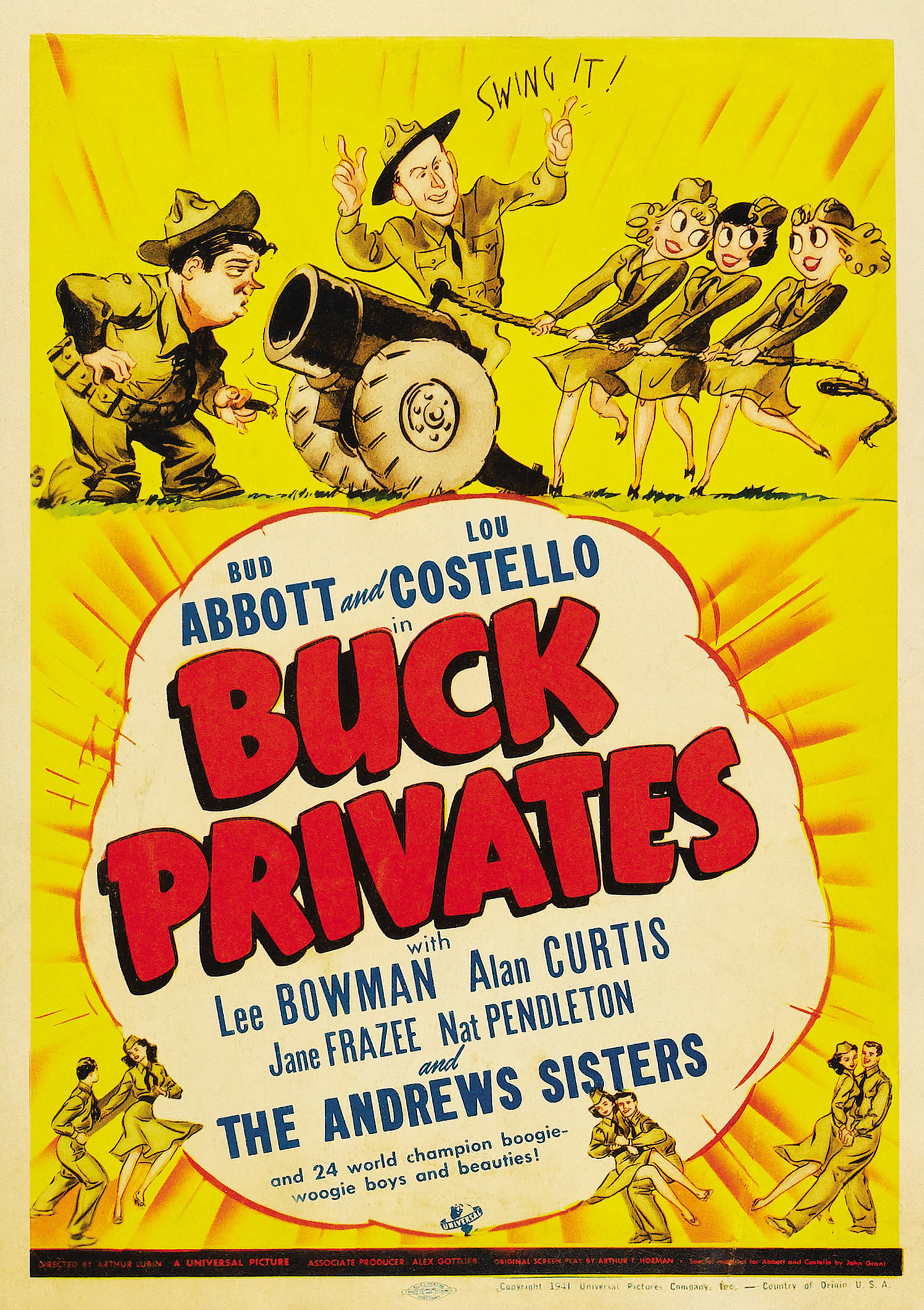
The comedy team of Bud Abbott and Lou Costello don’t get much love these days. They belong to another era, but there was a time that Abbott & Costello were the most popular comedy duo in the nation, consistently landing in the top ten box office rankings. They honed their snappy patter and slapstick routines in burlesque, got national attention on Kate Smith’s radio show, and made their film debut in ONE NIGHT IN THE TROPICS. Universal Studios sat up and took notice, signing the boys to a contract and starring them in BUCK PRIVATES, creating a simple formula that would serve the team well for the better part of the decade: put Bud and Lou into a situation that allows them to perform their tried-and-true routines, add a romantic subplot, surround them with solid support, toss in some popular music acts, and let ’em run wild.
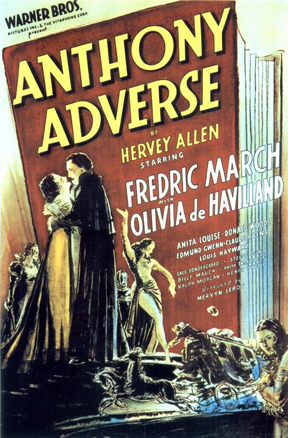
Late last night, I continued to clean out my DVR by watching the 1936 film, Anthony Adverse.
I recorded Anthony Adverse off of TCM, where it was being shown as a part of that channel’s 31 Days of Oscars. Anthony Adverse was aired because it was nominated for Best Picture of 1936. That’s significant because, if not for that nomination, I doubt that anyone would ever have a reason to watch Anthony Adverse. It’s certainly one of the more obscure best picture nominees. Despite a prestigious cast and being directed by the respectable Mervyn LeRoy, Anthony Adverse only has a handful of reviews over at the imdb. And most of those reviews were written by Oscar fanatics like me.
Anthony Adverse is an epic historical film, one that tells the story of Anthony Adverse (Frederic March). Anthony is the illegitimate son of Denis Moore (Louis Hayward) and Maria (Anita Louise), the wife of evil Spanish nobleman, Don Luis (Claude Rains, convincing as a nobleman but not as someone from Spain). Luis murdered Denis and Maria died giving birth so Luis abandons the baby at an Italian convent. Anthony is raised by nuns and priests and then, 10 years later, is apprenticed to an English merchant named John Bonnyfeather (Edmund Gwenn). Bonnyfeather just happens to be Anthony’s grandfather! Though Luis told him that Anthony died as soon as he was born, Bonnyfeather quickly figures out that Anthony is his grandson. However, Bonnyfeather doesn’t share that information with Anthony and instead, he gives Anthony the surname “Adverse.”
Bonnyfeather raises Anthony as his own son. Anthony grows up to be Frederic March and ends up falling in love with and marrying the beautiful Angela (Olivia De Havilland). However, Anthony is suddenly called away on business to Havana, Cuba. He doesn’t even have a chance to tell Angela that he’s leaving. He does leave her a note but it blows away. Assuming that she’s been abandoned, Angela goes to France, becomes an opera singer, and is soon the mistress of Napoleon.
Meanwhile, in Cuba, Anthony becomes convinced that Angela has intentionally abandoned him. Consumed by grief, he ends up running a slave trading post in Africa. He takes one of the slaves, Neleta (Steffi Duna), as his mistress and becomes known for his cruelty. However, he eventually meets Brother Francois (Pedro de Cordoba) and starts to reconsider his ways.
(The film’s treatment of the slave trade is …. well, it’s awkward to watch. The film is undoubtedly critical of slavery but, at the same time, it’s hard not to notice that the only slave with a prominent part in the film is played by a Hungarian actress. Anthony may eventually reject cruelty but it’s left ambiguous as to whether or not he rejects the slave trade as a business. If Anthony Adverse were made today, one imagines that this section of the film would be handled much differently.)
Meanwhile, back in Europe, Bonnyfeather is dying and his housekeeper, Faith (Gale Sondergaard, who won the first ever Oscar awarded for Best Supporting Actress for her performance here), plots to claim his fortune.
After I watched the movie but before I started this review, I did some research and I discovered that Anthony Adverse was based on a 1,222-page best seller that came out in 1933. I’m going to guess that the film’s long and ponderous story may have worked better on the page than it does on the screen. As a film, Anthony Adverse clocks in at 141 minute and it feels even longer. Despite the impressive cast, the film just never clicks. It’s never that interesting.
At the same time, I can understand why it was nominated for best picture. It’s a big movie, full of characters and extravagant sets and ornate costumes. You can tell it was an expensive movie to make and there’s enough philosophical dialogue that you can pretend there’s something going on underneath the surface. In the 1936, Anthony Adverse may have been quite impressive but seen today, it’s forgettable.
Anthony Adverse lost best picture to another overproduced extravaganza, The Great Ziegfield. Personally, I would have given the award to the unnominated My Man Godfrey.
4 Shots From 4 Films is just what it says it is, 4 shots from 4 of our favorite films. As opposed to the reviews and recaps that we usually post, 4 Shots From 4 Films is all about letting the visuals do the talking.
Welcome to a special TV edition of 4 Shots From 4 Films!
4 Shots From 4 Shows
Degrassi: The Next Generation: Time Stands Still Part One (2004, dir by Stefan Scaini)
Lost: The End (2010, dir by Jack Bender)
Community: Modern Warfare (2010, dir by Justin Lin)
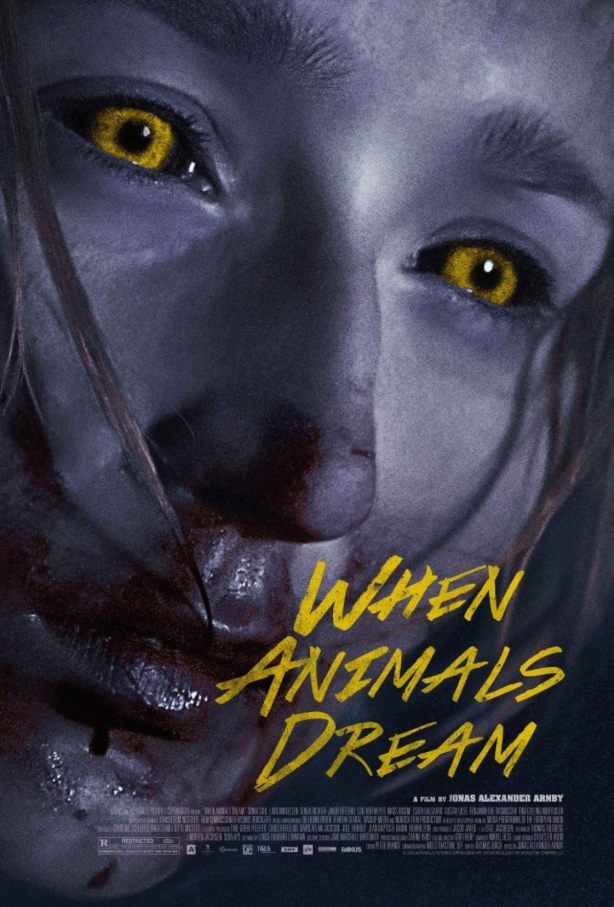
They tell me that the new season of some popular purported “quality drama” is now available on Netflix and that everyone is staying in this weekend to “binge watch” it, but if you’re no more a fan of sleazy soap operas with delusions of grandeur than I am (and really, what is House Of Cards other than Dynasty, with a better cast, transposed from a mansion in Denver to the White House?), you may be looking for something else on there to watch — if so, allow me to humbly recommend the recently-added 2014 Danish supernatural horror/thriller When Animals Dream, an artfully-crafted, beautifully-shot, often harrowing look at a teenage girl going through some serious changes.
I’ve seen some folks comparing this austere film to another Scandinavian genre entry from a few years back, Let The Right One In, and while on paper that makes sense, please don’t…
Ever since the start of this month, I have been cleaning out my DVR and I am happy to say that I’ve managed to go from only having 9 hours of space available to now having 17 hours. Progress is a wonderful thing!
Last night, I decided, after watching Picnic, to take a two-hour break from watching movies that I had recorded off of TCM. Instead, I watched a film that I recorded off of Lifetime way back in January, The Wrong Car.
If you’ve watched enough Lifetime movies, you know that there are three things that all Lifetime movies distrust: men, teenagers, and technology. The Wrong Car doesn’t feature any teenagers but it does feature some really bad men who use technology to do some really bad things. In the past, Lifetime has exposed the dangers of Facebook, Match.com, twitter, and YouTube. With this movie, they take on Uber.
Except, of course, they don’t actually call it Uber. Instead, they call it “NetCar.” But it’s totally Uber.
Trudy (Danielle Savre) is a law student who doesn’t have much of a social life because she is always either too busy studying or arguing that criminals can be reformed. Her best friend, Gretchen (Francia Raisa), is constantly begging her to go out and have a good time but Trudy refuses. (Isn’t that always the role of a best friend in a Lifetime movie?) Finally, Gretchen is somehow able to convince Trudy to go to a club with her. However, Trudy get bored and decides to leave. Standing outside the club, she calls for a NetCar.
Usually, whenever Trudy uses NetCar, her driver is another law student named Charles (Kevin G. Cox). However, this time, she doesn’t know the driver. However, she still gets in the car and accepts his offer of bottled water. The next thing that Trudy knows, she’s waking up naked in a totally sleazy motel.
With the police unable to help, Trudy takes matters into her own hands. In this case, that means that she decides to become a NetCar driver herself. She now spends her time driving around the city, looking for the man who raped her. Along the way, she lectures two women about proper car safety, deals with an angry but later helpful criminal, and meets a cute investment manager (Jackson Davis).
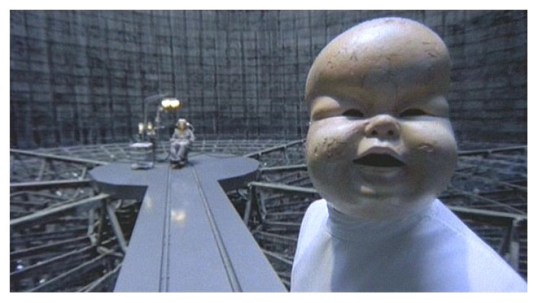
She also has flashbacks to her rape and these are pure nightmare fuel. The man who assaulted her is frequently seeing wearing a giant baby mask, much like the one pictured below:
Technically, the scene above is from Terry Gilliam’s 1985 dystopian satire Brazil. But it’s the same baby mask! AGCK!
To be honest, though, the entire film is nightmare fuel. The Wrong Car is one of the few genuinely disturbing Lifetime films that I’ve ever seen because it does get at some very important truths. We all give out way too much information about ourselves to total strangers. And, much like Trudy, I probably would have gotten into that NetCar and drank that bottled water. Nobody wants to spend their life paranoid but The Wrong Car suggests that perhaps a little paranoia might be justified.
Director John Stimpson fills the screen with shadowy and menacing images while Danielle Savre does an excellent job in the sometimes difficult role of Trudy. The entire film is well-cast, with Rhett Kidd turning in a memorable performance in the small role of the world’s sleaziest desk clerk. And that baby mask … at the risk of repeating myself, AGCK!
The Wrong Car is definitely a Lifetime film to keep an eye out for.
What’s an Insomnia File? You know how some times you just can’t get any sleep and, at about three in the morning, you’ll find yourself watching whatever you can find on cable? This feature is all about those insomnia-inspired discoveries!
Last night, if you were awake at one in the morning, you could have turned on FLIX and watched the 1993 film Beyond The Law.
Now, you may look at the title and think to yourself, “That movie sounds way too generic for anyone to watch.” And, to a certain extent, you’re right. Based, so the narrated epilogue insists, on a true story, Beyond The Law is about a troubled cop who goes undercover and joins a biker gang. After gaining the trust and friendship of the gang’s ruthless leader, the cop struggles to maintain a between order and chaos. Sometimes, he succeeds. Sometimes, he doesn’t. Largely, his success is dependent on whatever the narrative requires at the moment.
It’s totally predictable but, at the same time, it’s hard not to watch. When a film starts with an Indian shaman telling Charlie Sheen that his dark side is going to destroy him, how can you not keep watching?
That’s right … the undercover cop is played by Charlie Sheen. Fortunately, since Beyond the Law was made in 1993, we’re talking about the sexy and dangerous Charlie Sheen who showed up at the end of Ferris Bueller’s Day Off and not the sad and bloated Charlie Sheen who co-starred on Two And A Half Men.
Charlie’s a deputy in Arizona who, as a result of his traumatic childhood, has a violent temper. After he gets into a fist fight with another deputy (played by Rip Torn), he is told that he can either quit the force or he can go undercover. He chooses to go undercover. Fortunately, he knows an informant (Leon Rippy) who can teach him how to pass for a biker. The informant’s nickname is Dildo (no, really) but later, we find out that his given name is Virgil. And he’s Charlie’s guide through the Hell of the Arizona underworld, just as another Virgil led Dante through another Hell…
Yes, it’s totally heavy-handed but somehow, it’s appropriate. The title may be generic but, within the first 30 minutes of the film, Beyond the Law gives us Indian wisdom, strange flashbacks, references to Dante, a guy named Dildo, and Charlie Sheen. But that’s not all! Beyond the Law also has Michael Madsen!
Michael Madsen plays Blood, the leader of the biker gang that Charlie has to infiltrate. And he gives a classic Michael Madsen performance, full of random squints, arched eyebrows, menacing pauses in the middle of dialogue, and that famous Michael Madsen half-smirk. Predictable as its plot may be, Beyond The Law is your only chance to see Charlie Sheen and Michael Madsen compete to see who can chew the most scenery. Charlie does his crazy eyes. Madsen does his half-smirk. In the end, I would say that Madsen wins.
Charlie also ends up having a relationship with an photojournalist (Linda Fiorentino). Before going undercover, he gave her a speeding ticket and, when they later meet at a biker gathering, she immediately recognizes him but keeps his secret. She doesn’t really get to do much in the film but I still liked the character because she was tough and she was the only person in the film who could outsmirk Michael Madsen.
Beyond The Law is nothing special but it’s worth watching just for the chance to see Michael Madsen and Charlie Sheen acting opposite each other.
Tonight, I continued to clean out the DVR by watching the 1955 film Picnic.
Now, Picnic is kind of a strange film. It’s one of those films from 50s that takes place in a small town where everyone is obsessed with sex but, since it’s the 1950s, nobody can just come out and say that they’re talking about sex. So, instead, all of the dialogue is very discreet. For instance, when Madge Owen (Kim Novak) talks to her mother, Flo (Betty Owens), about her date with her boyfriend, Alan (Cliff Robertson), Madge confesses that they spent the night kissing. Flo asks if Madge if they have done anything more than kiss but, of course, she never comes straight out and says what “more” would be. The audience knows what she’s talking about but it’s as if the world would actually end if anyone actually uttered the word. “Oh mom!” an embarrassed Madge says before confirming that she and Alan haven’t done anything more than kiss.
Flo desperately wants Madge to marry Alan because Alan is rich and his father owns the town’s grain elevator. Marrying Alan would allow Flo to move up in the town’s strict social hierarchy. However, Madge isn’t sure that she loves Alan. Certainly, Alan seems to be a good man with a good future but he’s not a romantic. Instead, he is someone who has his entire life already mapped out for him.
On Labor Day, a stranger comes to town. His name is Hal Carter and he shows up riding on a freight train. He’s come into town to see his old friend, Alan. It turns out that Hal and Alan went to college together and were members of the same fraternity. Hal was a star football player but he eventually flunked out of school and has spent the last few years drifting around the country. However, Hal is now ready to settle down and he wonders if his old roommate Alan can get him a job at the grain elevator.
Now, here’s the strange part. Hal is played by William Holden. When he made Picnic, William Holden was 38 years old and looked closer to being 45. (By contrast, Cliff Robertson, in the role of his former college roommate, was 32 and looked like he was 25.) Hal spends a lot of time talking about his traumatic childhood and how he is finally ready to settle down and start acting like an adult. In short, Hal talks like a 30 year-old but he looks like he’s nearly 50. It’s odd to watch. But even beyond the age issue, William Holden was an actor who always came across as being both confident and cynical. Hal is a secret romantic with a deep streak of insecurity. As great an actor as he may have been, William Holden is so thoroughly miscast here that it actually becomes fascinating to watch. It brings a whole new subtext to the film as you find yourself wondering why no one is town finds it strange that a middle-aged man is still struggling to deal with his childhood. When all the town’s young women ogle that shirtless Hal, it’s as if he’s wandered into a town populated only by teenagers with daddy issues.
(Paul Newman played the role of Hal in a Broadway production of Picnic. And really, that’s who the ideal Hal would have been, a young Paul Newman.)
The majority of the film takes place at the town’s Labor Day picnic, where almost every woman in town is driven to distraction by the sight of Hal dancing. Even the spinster teacher, Rosemary (Rosalind Russell), is so turned on by Hal’s masculinity that she makes a pass at him and accidentally rips his shirt. Of course, some of Rosemary’s behavior is due to the fact that she’s drunk. Her date, the befuddled Howard Bevans (Arthur O’Connell), made the mistake of being whiskey to the picnic.
Hal also dances with Madge’s 13 year-old sister, Millie (Susan Strasberg). I have to admit that, even though I related strongly to Madge, Millie was my favorite character in the film. Millie wears glasses and can recite Shakespeare from memory. She knows that everyone around her is full of it and she’s willing to call them on it. Of course, Millie herself ends up with a crush on Hal and it’s a dream for her when she finally gets to dance with him.
(Strasberg was 17 years old but is believable as a 13 year-old. At the same time, since Hal appears to be nearly 50, his sudden closeness to Millie carries an icky, if unintentional, subtext.)
But then Madge suddenly appears, wearing a pink dress and literally emerging from the black night. She starts to sway to the music. As she slowly approaches Hal, he forgets about Millie and soon is dancing with Madge. It’s actually a rather striking scene, one that so full of dream-like sensuality that it almost seems more like it was directed by surrealist David Lynch as opposed to the usually workmanlike Joshua Logan.
(In the video below, the scene freezes about 12 seconds in, before starting up again at the 16 second mark. This is a glitch with the upload and is not present in the actual film.)
Needless to say, a drifter can’t just come into town and steal his ex-roommate’s girlfriend without drama following. Picnic starts out as a slightly overheated examination of small town morality and then, after about an hour, it goes the full melodrama route, complete with police chases, stolen cars, a fist fight in an ornate mansion, and a lot of big speeches about the importance of love. Needless to say, it’s all a lot of fun.
Picnic was nominated for best picture of the year. However, it lost to the far more low-key Marty.
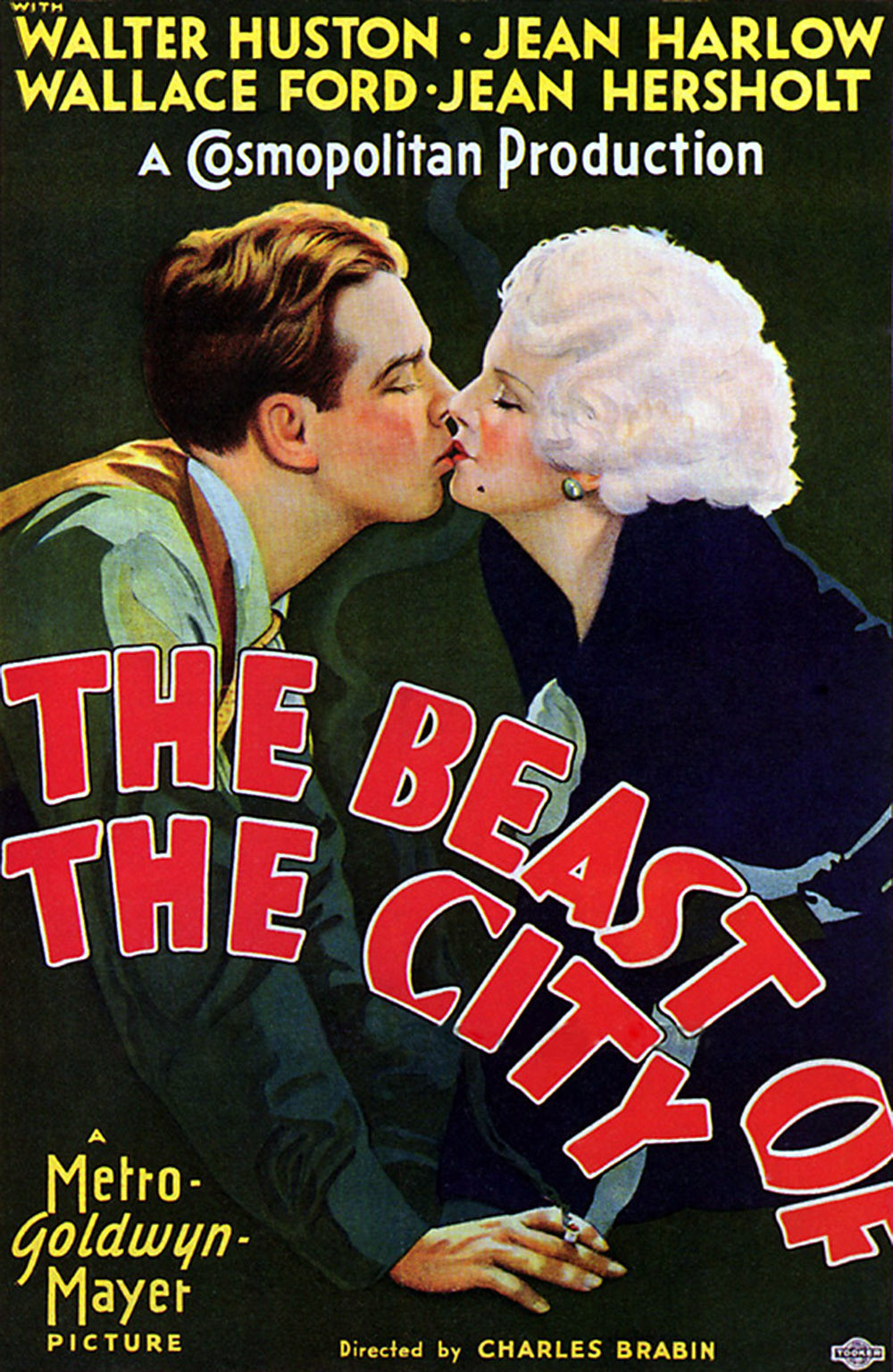
In honor of Jean Harlow’s birthday (born March 3, 1911), TCM ran a Harlow marathon today. Since I was at work, I recorded a few of them. I couldn’t wait to get home and view THE BEAST OF THE CITY for three reasons: 1) Harlow, of course, 2) it’s a Pre-Code film I’ve never seen, and 3) it was directed by Charles Brabin, who gave us the devilishly decadent THE MASK OF FU MANCHU. I’d heard a lot about this movie and its violent ending, and though not nearly as gruesome as today’s films, it’s vigilante justice packs a punch that must’ve been pretty shocking in 1932.
The movie starts off with a forward from President Hoover (that’s Herbert, kids, not J. Edgar) decrying the glorification of gangsters in films, and saying we should be glorifying the police instead. We then get into the story, as we find Captain Jim Fitzgerald (aka “Fighting…







 Through the Shattered Lens