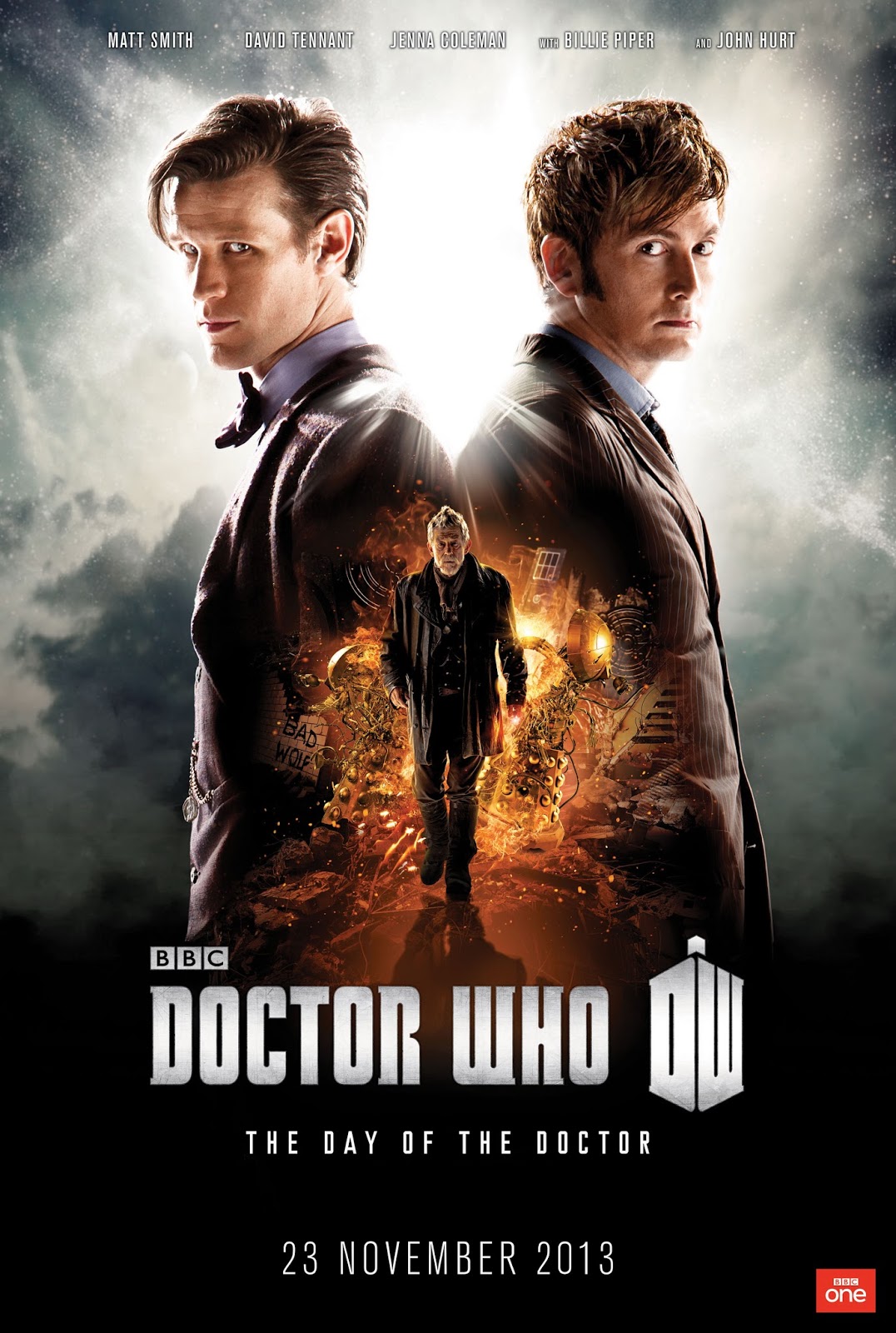
Trash TV Guru : “The Day Of The Doctor” — The “Doctor Who” 50th Anniversary Special


4753398-high-doctor-who


First off, a couple of disclaimers : this is one of those reviews that’s going to pre-suppose a fair amount of knowledge about the BBC’s Doctor Who  from the outset, so if you’re not at the very least a casual viewer of the show, you’re going to feel pretty lost right from the word go. So, ya know — newbies beware. Secondly, it’s well-nigh impossible, at this point, to discuss The Day Of The Doctor without indulging in some pretty serious “spoiler talk,” so if you’re part of the legion of “spoiler police” that apparently have nothing better to do than troll around the internet looking to play seagull (fly in, make a lot of noise, shit all over everything, and fly back out) with any review that gives away any plot points whatsoever, now would be a good time fuck directly off. Major “spoilers” do, in fact,  abound here, so — you’ve been warned.

Now, with all that out of the way —

For those of us who have been “Whovians” for a long time, the 50th anniversary really has been something of a “pinch me, I gotta be dreaming” type of year, hasn’t it? Especially for us sad souls who stuck with fandom during the so-called “wilderness years” between 1989 and 2005, when the 30th anniversary gave us the debacle that was Dimensions In Time, the 35th anniversary gave us — well, nothing, I guess — and the 40th anniversary essentially went unnoticed, even by us, because we were all too busy speculating about what the  just-announced-at-the-time new series would end up looking, feeling, and being like.

Our only frames of reference, then, for how the BBC would celebrate a major anniversary with the show as a going concern were the 10th, 20th, and 25th anniversaries. For the tenth, there wasn’t much by way of hoopla and tie-in merchandising and the like, but we did get The Three Doctors (why I’m saying “we” here I have no idea, as I was barely two years old at the time and had never, to my knowledge at least, seen the show — but whatever), which was not only the first big “reunion story,”  but a pretty cracking good adventure, as well, that introduced the now-legendary figure of Omega into the Who mythos.

For the 20th, it has to be said that the Beeb pulled out all the stops. For one splendid year there they seemed to be willing to acknowledge that this creaky little cheap show that they tried their best to keep out of the public eye really was a genuine global phenomenon despite their best efforts to make it anything but, and we got a slew of anniversary-themed books, toys, magazines, posters — you name it.

And there was Longleat. Ah, yes, Longleat. Fandom’s own Woodstock. The biggest single Doctor Who-related event ever, tales of it still abound — and, like fish stories, grow with each re-telling — to this day. I wasn’t there. I was a 12-year-old kid in the US. But  we heard about it,  even without the benefit of instantaneous online communication. It sounded great then. It sounds even better now. Memories, real or imagined, of Longleat frankly eclipse anything else as far as the 20th anniversary is concerned, especially since the special 90-minute “reunion story” we all got to see, The Five Doctors, was a rather tepid affair at best.

I’ll tell you what, though — warts and all, The Five Doctors was a key moment for American fans for one simple reason : we got to see it first. That’s’ right, us poor yanks, who had yet to see William Hartnell, Patrick Troughton, or, in most cases, even Jon Pertwee reruns — we sad former colonists who had been subsisting on a diet of the same Tom Baker and Peter Davison stories over and over again ad infinitum — we got the anniversary special a matter of hours before it was shown on its own native soil. There was a quiet message being sent here — try as the suits at the BBC might to present an image on the home front as a broadcasting organization that specialized in period costume dramas and in-depth news (remember when there was such a thing?), internationally, they knew which side their bread was buttered on. Doctor Who was their number one worldwide property, and the booming American fan market was where the action was. Let’s just not tell the folks back in the UK, shall we?

Following on from that, though, something curious happened — more or less immediately after admitting that an international breakthrough was taking place, with a Doctor Who  convention going on, quite literally, every weekend in one major American city or other, Auntie Beeb suddenly remembered that the show was an embarrassment. At the very same moment that an ever-hungrier North American fan base was clamoring for more Who, the powers that be decided to give us less. In these days before mass-released DVD or even VHS, a famished fan can only subsist on the same set of re-runs over and over again for so long, and the BBC effectively killed its own golden goose by putting the show “on hiatus” for 18 months — then giving us drastically shortened seasons when it did, in fact, quietly return.

As a result, the 25th anniversary was a complete disaster, both at home and abroad. Very little recognition was given to the occasion from official quarters, and the “special story” broadcast to commemorate what should have been a proud milestone instead was a limp little Cybermen three-parter called Silver Nemesis that essentially followed the exact same plotline as the recently-concluded (and far superior) Remembrance Of The Daleks, only with different villains.

All in all, it was an anniversary well worth forgetting.

Fast forward a quarter century and things couldn’t be more different. Doctor Who is the shit, as far as the BBC is concerned. This is is a new iteration of Who, of course, broadcast by a new BBC that, for good or ill,  has its eye more on its balance sheets than its purported reputation.  Fans around the world are lapping it up, Who-themed merchandise is ubiquitous, and the money machine is rolling. Of course the 50th anniversary is going to be the biggest multi-media juggernaut the BBC has ever undertaken, what do you think they are — stupid?

Full disclosure — I’m something of a curmudgeon when it comes to Doctor Who. I miss the days when the cracks showed and the creaks could be heard. I loved the inventiveness that the Philip Hinchcliffes and Robert Holmeses and Barry Lettses and Malcolm Hulkes (among too many others to mention) were forced to either find or fall back on to make silk purses out of sow’s ears. I loved the first season of the new series, to be sure, but it’s been leaving me feeling increasingly unimpressed ever since. Under Russell T. Davies’ stewardship, I felt it became bland and formulaic. Under Steven Moffat’s.  it’s become bland, formulaic, and overly impressed with itself.

But never once did I consider throwing in the towel and walking away. No sir (or madam). You always keep hope alive for the home team.

And so here we all are — November 23rd, 2013, exactly 50 years to the day from the broadcast of An Unearthly Child, and all of us, everywhere around the world, get to see The Day Of The Doctor, the culmination of an entire year of set-to-overdrive mass-marketing, at exactly the same time.

But was it any good?  And, furthermore, are we all still a bit too giddy to even care?

Well, having watched it twice now, I feel the time has come to give it at least something  of a fair-minded analysis, even if the glow of the occasion hasn’t faded entirely just yet.
day-of-the-doctor-batch-b-6


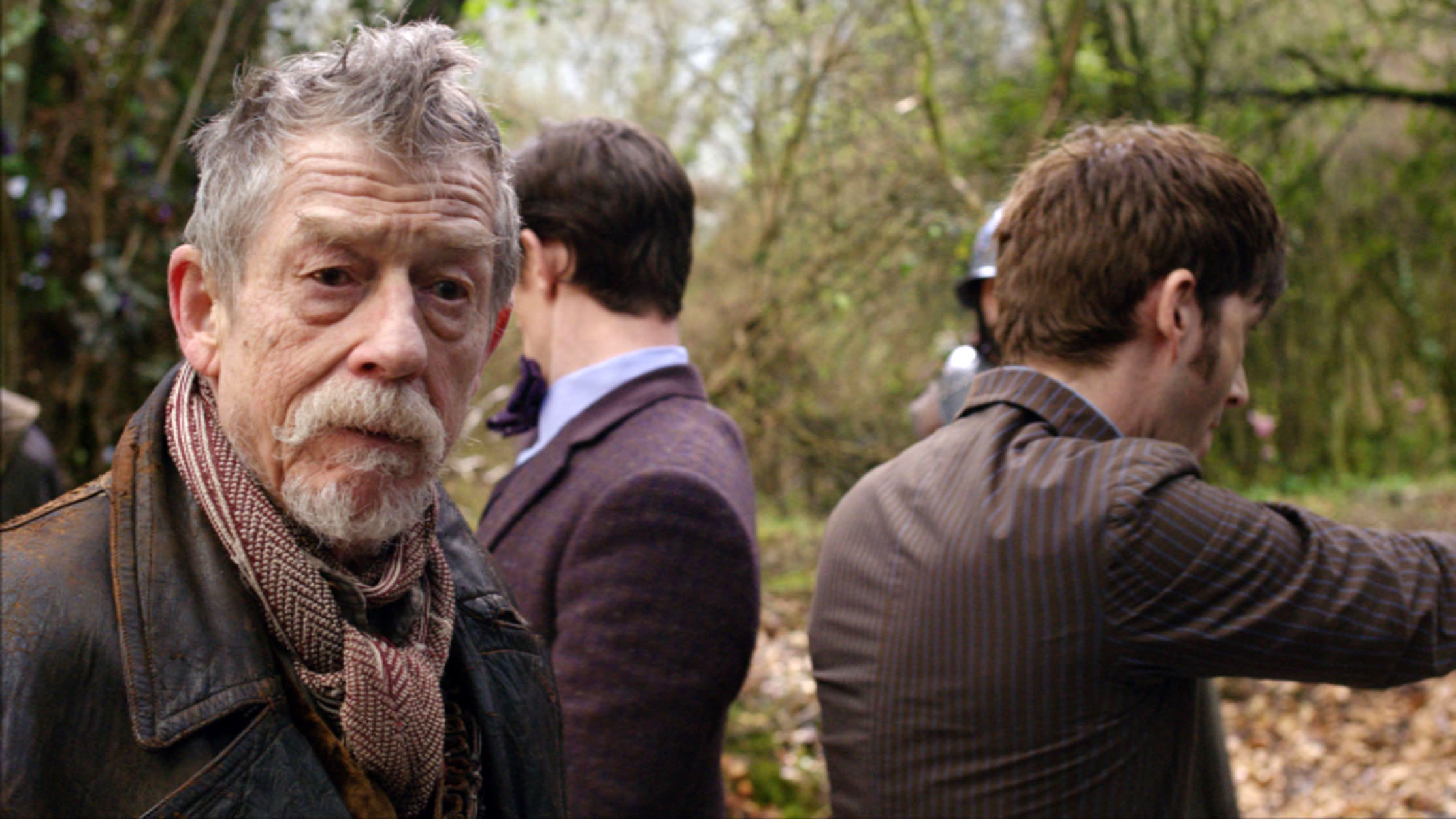
Indications were that we would probably very well be in for a monumental-type story that would shake the foundations of everything we knew and shake up the Etch-A-Sketch all over again. After intense months of speculation, the Night Of The Doctor mini-“webisode” (and thank you thank you for bringing  back Paul McGann !) confirmed that John Hurt was, indeed, a “missing Doctor” that none of us had known about before — furthermore, he was no ordinary Doctor, he was “The War Doctor,” whatever that means. We figured there would be Daleks. We knew David Tennant and Billie Piper were returning. We assumed we’d be plunged back into the Time War — and, once it was announced that Eleventh Doctor Matt Smith would be departing come the Christmas special, we guessed that we might finally get some inkling as to what his (far too heavy-handedly) forthcoming demise at a place called Trenzalore was all about.

We got some of that. And something else that we probably weren’t expecting, as well — an accessible, “stand-alone” story featuring the return of fan- favorite monsters the Zygons. For a time, at any rate.

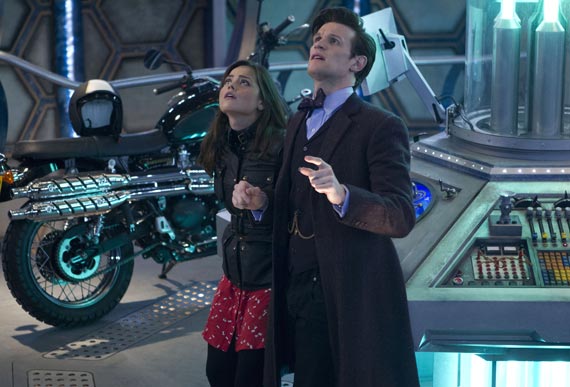
There’s some rather bland set-up material (that once again bastardizes the memory of U.N.I.T., this time doubling the insult by throwing The Brigadier’s daughter into the mix) with Smith and current companion Clara (played by Jenna Coleman) at the outset, then we do, in fact, go back into the Time War with John Hurt’s War Doctor, then we get re-introduced to Billie Piper (not, mind you, as Rose Tyler — in fact, she seems to still think she’s working on The Secret Diary Of A Call Girl here), and then, after cribbing much of the basic multi-Doctor story set-up idea from both The Thee Doctors and The Five Doctors, writer/head honcho Steven Moffat takes a turn and gives us a somewhat nifty standard-issue Zygon -invasion story that pretty much works, even if he did rip the core idea straight from Grant Morrison’s old Doom Patrol story “The Painting That Ate Paris.” No real harm in that, mind you — Doctor Who has often been at its best when liberally “borrowing” from other works.

Then, though, things do go a bit pear-shaped (again). After lots of fairly successful three-Doctor banter, some good, old-fashioned breaking out of jail cells (that were never locked, but that’s another story), some running around in corridors (yes!), and some nifty little doppleganging that should adequately thrill n’ chill the kiddies in the audience (and ,okay, some of us grown-ups, as well), Moffat does something — I dunno. Curious, I guess, if you’re being generous, and stupid and/or lazy if you’re not.

After spending over 40 minutes bringing the human/Zygon confrontation to a head, getting them all in a room, and employing a very nifty conceit to flat-out force them to negotiate, he drops the whole story. We never find out how it ends. And we’re back in Time War territory again. Only this time with a bigger Deus Ex Machina at the center of it than even anything RTD ever gave us — a big Hellraiser-box-on-steroids with a gleaming red button that the Doctor can push to just end everything.

And he does. Or did. But he doesn’t anymore.
Doctor Who – 50th Anniversary Special - The Day of the Doctor


Look, we all know that this show has strayed pretty far from its roots. “You can’t change history, Barbara! Not one line!” has given way to a new “philosophy” of “time can be re-written.” But this, well — let’s just say that the very events that gave birth to the Ninth (or I guess that should now be Tenth) Doctor, Christopher Eccelston, and in turn his successors in the role — well, they’re just no more. The past seven seasons of the show? Well, I guess they still happened — but now, apparently, not the way we saw them. At least not anymore. And the Doctor is most certainly no longer the “Last Of The Time Lords.”

So — what does it all mean? Shit, I dunno. Gallifrey still exists. In a painting.  It never stopped existing (except, ya know, when it did). And whereas the entire history of Doctor Who is based on the concept of a Time Lord running away from home (even though that mythology was developed nearly a decade after the show first aired) — a point that was re-emphasized in The Five Doctors with Fifth Doctor Peter Davison”s famous “Why not? That’s how it all started!” line — now we’re told that the Doctor is going “where I’ve always been going — back home.”

So, ya know, all that Trenzalore stuff we’ve been building up to? Forget all that. It’s Gallifrey or bust now, folks!

I guess all this should be exciting — and maybe, on paper, it is. I like being thrust into unknown waters as far as Doctor Who goes. Even though I’m a bit of a self-admitted sad old traditionalist, as stated earlier. In the days when all we had going were the Eighth Doctor BBC novels, Lawrence Miles’ much-maligned Interference, which basically set all of Who continuity on its ear (for a time, at any rate) excited me. And all this could well do the same — if I had more confidence in the current show-running regime to get things right. Which I don’t. Buuuuuuttttt —

They did get some things here right, unquestionably. The “old school” opening shots in  black and white, complete with vintage theme music, were marvelous. The direction by Nick Hurran was energetic, pacy, and cinematic (in a good way) throughout. The Three Doctors redux portion of the story, with John Hurt functioning as a William Hartnell stand-in, was a joy to watch. Clara seems to be coming along nicely as a companion and was essential to the proceedings here without overshadowing them — as Davies had a tendency to do with Rose, in particular.  And as for that ending —
doctor-who-day-of-the-doctor-nov-17-13


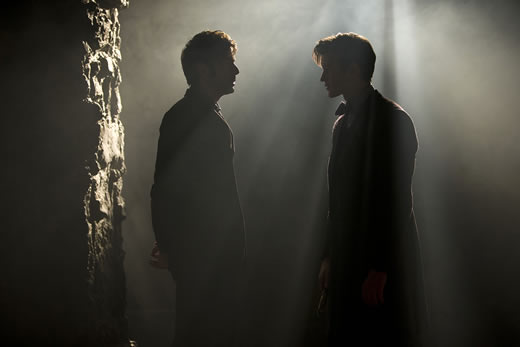
Okay, it was about as subtle as a neo-Nazi march through downtown Tel Aviv in broad daylight, I’ll grant you — Clara : The curator wants to see you. The Doctor (sitting, as Clara exits) : Okay. A curator. I’d like to be a curator. I’d be a good curator. Curators are cool. I should retire one day. Maybe I’ll be a curator when I retire. Yes, that’s it, I’ll retire and be a curator. In fact, I bet in some “timey-wimey” way I’ve already done that. And this curator guy who’s about to talk to me, shit, who are we kidding? It’s me. Or another of me, at any rate. It’s Tom Baker. He’s here. In the building.  That’s Tom Baker standing right behind me — but still : it was. Tom Baker. Standing right behind him. And yes,  the dialogue was trying too hard to be mysterious and momentous and came off instead as clumsy, but cone on, people. There he was. The Doctor. My Doctor. And I deserve to smile for the rest of the day for that reason alone. And so do you.

So who knows? Maybe a partial changing of the guard is all that’s in order here. Maybe Moffat just needs to scrap all the baggage that’s hanging on Matt Smith — baggage that, okay, “The Moff” himself put there, but let’s not nitpick here — and start fresh with Thirteenth (did I get that right?) Doctor Peter Capaldi, who actually makes his brief debut in this story in another very cool (if, yeah, very gimmicky) moment. Maybe a re-write of the last seven-plus seasons is just what — sorry! — the Doctor ordered. Maybe it’ll be good for him to go home again. If — and only if — once that’s all over,  he follows the best advice his Ninth (excuse me, I guess that’s Tenth) persona ever gave : “run for your life!”

I’ve been waiting a good few years now for Doctor Who to relieve itself of the burden of its own excesses and get back to the strength — and dare I say beauty — of its core premise, as so splendidly told in Mark Gatiss’ awe-inspring TV movie (and the real highlight of the 50th anniversary so far) An Adventure In Time And Space — a mysterious traveler making his way through the the past, the present, and the future of the whole,  entire universe in a rickety old blue police box that’s bigger on the inside than it is on the outside. That, right there, is all we’ve ever needed.

The Day Of The Doctor did enough , glaring flaws notwithstanding, to make most any fan — including this one — feel more than just a little bit giddy throughout, and I’m reasonably thankful for that,  but it came up short in terms of re-setting the table in the kind of fundamental fashion I’m still hoping to see. It rattled the cupboards, and that’s a good first step, but we’ll have to see where and how the pieces fall after the Christmas special, which has rather stolen its thunder as the big “event” piece of Doctor Who for the year. We seem to be heading straight into the heart of Who mythology and continuity for one last (I hope, at any rate) big blow-out. So, yeah — let him go home again. If that’s what he needs to do to run away.

After all, that’s how it all started.


44 Days of Paranoia #6: JFK (dir by Oliver Stone)


JFK-John-F-Kennedy-DVD-Yon-OLIVER-STONE__76044126_0When I first decided to do this series of reviews of conspiracy-themed films, I knew that I would eventually have to review the 1991 Oliver Stone film JFK.

JFK is one of those films that continues to divide audiences.  Those who think that John F. Kennedy was killed by a conspiracy tend to love this film and are given to describing JFK as being “one of the most important films ever made.”  Those who believe that Lee Harvey Oswald was the lone assassin dismiss Stone’s film as being left-wing propaganda.  Just check out  the message board at the imdb if you need evidence of just how worked up people get over this film and its subject matter.

It seems that very few of the people who criticize or praise JFK ever review it as a work of cinema.  Instead, they focus on the film’s politics.  If I criticize the film for wasting the talents of Sissy Spacek or featuring one of Kevin Costner’s least interesting performances then I’m running the risk of having to deal with angry conspiracy theorists telling me that I need to open my eyes to the reality of American history.  On the other hand, if I praise Tommy Lee Jones’s wonderfully decadent turn as one of the film’s conspirators, chances are that someone is going to accuse me of being a naive leftist.

Then again, perhaps that reaction is to be expected.  Oliver Stone is one of our most political and least subtle filmmakers.  His movies are specifically designed to challenge the status quo.  For that reason, it’s not surprising to discover that Stone considers JFK to be the best of all of his films.

JFK is based (rather loosely, some claim) on the true story of New Orleans District Attorney Jim Garrison (played by Kevin Costner) and how, in 1967, he charged businessman Clay Shaw (played by Tommy Lee Jones) with being a part of a conspiracy to kill John F. Kennedy.  Shaw was eventually acquitted and both Jim Garrison and his investigation remain controversial to this day.

JFK courts controversy immediately with its portrayal of Jim Garrison.  I’ve read several accounts of the Garrison investigation and the one thing that they all seem to agree on is that Jim Garrison was a flamboyant, bigger-than-life figure who enjoyed publicity.  Even among those who believe that Garrison uncovered some valuable evidence as a result of his investigation, there is a good deal of ambiguity about Garrison’s motives.  However, in Stone’s film, Jim Garrison is played by Kevin Costner and is portrayed as being an incorruptible, all-American idealist.  It’s not that Costner gives a bad performance.  Instead, it’s just a rather uninteresting one, especially when one compares Costner’s Garrison to some of the stories about the real-life Garrison.

However, as the film unfolds, it becomes obvious that Stone is using Costner’s blandness to the film’s advantage.  Over the course of three hours, JFK slowly peels back layers of secrecy and cover-ups and reveals the shadow world that, according to Stone, lurks underneath everyday reality.  Costner’s Garrison might not be interesting but he is a stable presence.  He anchors the film, giving us someone to relate to while the film itself grows more and more bizarre.

While Costner’s might give the least interesting performance of his career in this film, the same cannot be said of the rest of the cast.  JFK is full of familiar faces, many of whom are only on-screen for a few minutes but all of which play an important role in creating Stone’s shadow universe.  Kevin Bacon, Gary Oldman, Joe Pesci, Michael Rooker, Donald Sutherland, and Tommy Lee Jones; they all have small roles but every single one of them makes an undeniable impression.  Whether you agree with the film’s conclusions are not, it’s impossible not to enjoy JFK for the chance to spot a bunch of familiar faces giving memorably bizarre performances.

But ultimately, its impossible to review JFK without considering the film’s conclusions.  JFK makes the case that John F. Kennedy was killed as the result of a massive right-wing conspiracy that involved the military, business interests, the CIA, the FBI, anti-Castro Cubans, and the mafia.  By the end of the film, the question becomes less who killed JFK and more who didn’t kill JFK.

Myself, I’m not going to claim to be enough of an expert on the Kennedy assassination to argue whether JFK is accurate or if it’s just propaganda.  However, as a film reviewer, I can say that it’s a very well-made and powerful film but it’s also one of those films that works better the first time you see it than the second time.

The first time you see it, the film overwhelms you.  It leaves you convinced that yes, there was a conspiracy and yes, everyone was involved and yes, Jim Garrison was right!  It convinces you so thoroughly that you end up using exclamation points, just to make sure everyone knows how convinced you are.

However, with each subsequent time that you view JFK, you became a bit more aware of just how manipulative and one-sided it truly is.  You become a bit more aware of the technique underneath the outrage and, if you’re a smart film watcher, you remember that JFK is a recreation as opposed to being a historical document.  You become more and more aware that Stone approached the material with a destination in mind and, like any good director, he has specifically shaped the material to make sure that you reach that destination at the end of the journey.

That was certainly my experience with JFK.  I first saw it in high school and it convinced me that JFK was the victim of a conspiracy.  Then, when I was in college, I watched it for a second time and, though I still believed the film’s conclusions, I also found myself much more aware of how the film’s length and Stone’s direction were designed to beat the audience into submission.  When I saw the film a third time, I found myself resenting the film’s manipulative nature and, as a result, I found it a lot more difficult to accept Stone’s conclusions.

However, when I rewatched the film last night for this review, I was surprised to discover that JFK actually holds up pretty well.  It’s still way too long (and, unlike a lot of other reviewers, I am not impressed by the droning speech that Costner delivers at the end of film) and Stone’s lack of subtlety does backfire on a few occasions.  However, perhaps because I was finally watching the film as entertainment as opposed to judging the film on its political or historical merits, I discovered that JFK is a watchable and entertaining film, one that does a pretty good job of making Stone’s case.  If nothing else, it’s worth watching just for the chance to see the wonderfully snarky performances of Tommy Lee Jones, Kevin Bacon, and Gary Oldman.

Perhaps the best thing that I can say about JFK is that its the type of film that will inspire smart people to do their own research and come to their own conclusions, which may or may not be the same conclusions that Oliver Stone reaches.

And, honestly, isn’t that the most that we can ask of any film?

JFK

Scenes I Love: Drive Angry


DriveAngry3D

“Gentlemen, aim for their tires.”

Drive Angry came out in early 2011 and it was one of those films which everyone thought was going to flop and flop hard. It did flop like a dying carp on a desert dune, but it was also one of the most fun flicks of the year. People just didn’t get what the film was about and trying to do. I, for one, was of the minority that got “it”.

This film starring Nicolas Cage going the subdued crazy route had so many funny and WTF sequences that it was difficult just to pick one, but pick one I shall.

I think the sequence where William Fichtner’s supernatural bounty hunter, The Accountant, chasing and assisting the undead John Milton on his vengeance ride against a Satanic cult leader, and to the tune of the KC and The Sunshine Band’s “That The Way (I Like It)” classic song was a major favorite. It emphasized just how over-the-top Drive Angry turned out to be, but in a fun and hilarious way. William Fichtner just chews the scenery in this scene. I also like how Tom Atkins, himself a veteran of grindhouse flicks, matches Fichtner chew for chew.

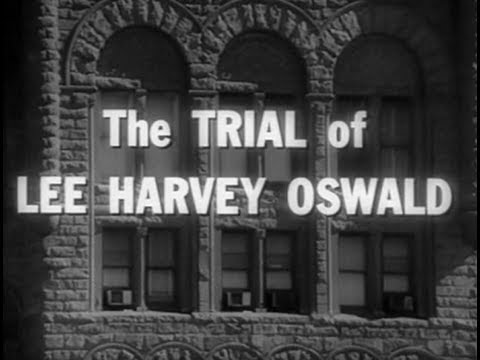
44 Days of Paranoia #5: The Trial Of Lee Harvey Oswald (dir by Larry Buchanan)


The Trial of Lee Harvey Oswald

Today has been a strange day to live and work in Dallas, Texas.  It is, of course, the 50th anniversary of the day that President John F. Kennedy was assassinated in my hometown.

As I mentioned in my review of Executive Action, those of us who live in Dallas are still expected to live in the shadow of something that happened before a lot of us were even born.  Today, the city of Dallas did everything that it could to embrace that shadow.  Despite the fact that it was cold and rainy today, a lot of people attended the memorial ceremony at Dealey Plaza.  (Despite the weather, nobody was allowed to open an umbrella during the ceremony.  Having been raised Catholic, I appreciate a little self-punishment as much as the next girl but considering how bad the weather  was, it all seems a bit much to me.)  One of the local talk radio stations spent today rebroadcasting all of its programming from November 22nd, 1963.  I guess the idea was to give people a chance to experience a terrible day in real time.  That seems a bit creepy to me but it does illustrate just how much the Kennedy assassination continues to overshadow life here in Dallas.

Considering just how much my city is identified with it, it’s perhaps appropriate that the very first film ever made about the Kennedy assassination was made by a Dallas filmmaker, the infamous Larry Buchanan.  As a filmmaker, Buchanan specialized in exploitation films that claimed to either be ripped-from-the-headlines or were presented as being lurid dramatizations of real-life events.  Hence, it’s not surprising that, in 1964, Buchanan gathered together a group of local (and obscure) Dallas actors and filmed The Trial of Lee Harvey Oswald.

Lee Harvey Oswald

The eyes of a killer?

The Trial of Lee Harvey Oswald takes place in an alternative reality in which Lee Harvey Oswald was not murdered by Jack Ruby and, instead, actually stood trial for the assassination of John F. Kennedy.  The prosecution pretty much presents the case that was made by the infamous Warren Commission.  The defense argues that the evidence against Oswald is circumstantial and that, even if Oswald did fire the fatal shots, he should still be found “not guilty for reason of existing insanity.”  The film’s audience is meant to serve as the trial’s jury.

As I watched this film, two things stood out for me.  One is the fact that Buchanan never allows us to get a good view of the defendant.  Instead, we simply see his eyes.  While this was probably due to the fact that actor Charles Mazyrack didn’t bear a strong resemblance to the real-life Oswald, it’s still an occasionally striking effect that allows the character to remain a troubling enigma.

Secondly, and this surprised me as a contemporary viewer, next to no accusations of conspiracy are made during the trial.  There’s no talk of the grassy knoll or the military-industrial complex or any of the other things that one naturally expects when it comes to a film about the Kennedy assassination.  Instead, The Trial of Lee Harvey Oswald is based solely on the information that was available to the general public in 1964.  As such, it remains an interesting historical document, a chance to get a genuine look at what people actually knew and thought in the days immediately following the Kennedy assassination.

(Interestingly enough, Buchanan’s later films would often feature shadowy government conspiracies.)

When Larry Buchanan died in 2004, The New York Times summarized his career as follows: “One quality united Mr. Buchanan’s diverse output: It was not so much that his films were bad; they were deeply, dazzlingly, unrepentantly bad.”  For the majority of Buchanan’s films, that’s true but it’s not exactly true for The Trial of Lee Harvey Oswald.  Considering that  Buchanan is best remembered for directing a film called Mars Needs Women, The Trial of Lee Harvey Oswald feels almost respectable.

In fact, the film is a bit too respectable.  The dialogue and direction are often rather dry and the mostly amateur cast alternates between overacting and not acting at all.  If there was ever a film that could have benefited from some ludicrous melodrama, it’s this one.

That said, I enjoyed The Trial of Lee Harvey Oswald because I’m a history nerd and, if nothing else, this film remains an interesting historical curio.   As well, it was filmed on location in Dallas and I can’t complain about any film that features a close-up of my favorite downtown building, the old red courthouse.

Enjoy The Trial of Lee Harvey Oswald!

AMV of the Day: Animegraphy 2013


Animegraphy

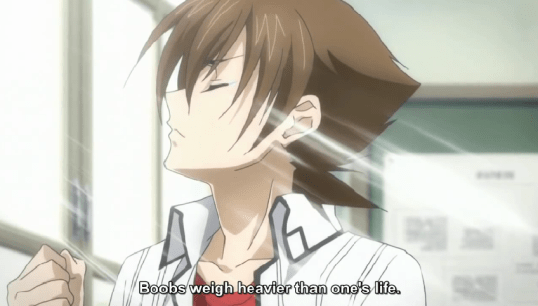
Yes, I agree with the philosophy of one Issei Hyodo of the anime series High School DxD. This is just one of over 200+ anime titles which were picked to comprise the 5-minute running time of the latest “AMV of the Day”.

“Animegraphy 2013” by qyll pretty much takes every anime title that is currently showing in the year 2013 and puts selected scenes into the video. This is quite a feat considering that some anime titles appear more than just once and for more than a second. I like how the video shows an early form of anime with 1963’s Astro Boy as a sharp contrast to how anime looks like now 50 years later.

Anime sure has grown since these last 50 years.

Anime: A Certain Scientific Railgun S, Accel World EX, Ace Of Diamond, Ai Mai Mi Aiura, AKB0048: Next Stage, Aku No Hana Amnesia, Ano Hi Mita Hana No Namae Wo Bokutachi Wa Mada Shiranai. Movie, Arata Kangatari, Arpeggio Of Blue Steel, Arve Rezzle: Kikaijikake No Yosetachi, Astro Boy, Shingeki no Kyojin, Aura: Maryuuinkouga Saigo No Tatakai (Movie), Bakumatsu Gijinden Roman, Berserk The Golden Age Ac Lll – Descent BlazBlue: Alter Memory, Blood Lad Blue Exorcist (Movie), Boku Wa Tomodachi Ga Sukunai Next, Brother’s Conflict Buki Yo Saraba (Movie), Cardfight!! Vanguard: Link Joker-Hen, Chihayafuru 2, Chitose Get You!!, Chokotan! Code:Breaker, Coppelion, Corpse Party: Tortured Souls – Bougyakusareta Tamashii No Jukyou, Cuticle Tantei Inaba, D.C.III ~ Da Capo III ~, Dakara Boku Wa H Ga Dekinai, Danganronpa The Animation, Dansai Burni No Crime Edge, Dareka No Manazashi Date A Live, DD Hokuto No Ken (2013), Death Billiards, Devil Survivor 2 The Animation, Diabolik Lovers, Dokidoki! Precure, Dragonball Z Battle Of The Gods Ebiten: Kouritsu Ebisugawa Koukou Tenmonbu, Encouragement Of Climb, Fairy Tail, Fantasista Doll, Fate/Kaleid Liner Prisma☆Illya Free! Freezing Vibration, Futari Wa Milky Holmes, Galilei Donna, Gambo (Movie), Kotonoha no Niwa, Gargantia On The Verdurous Planet, Gatchaman Crowds Genei Wo Kakeru Taiyou Genshiken Nidaime, Ghost In The Shell: Arise (Movie), Gifuu Doudou!!: Kanetsugu To Keiji, Gingitsune, Gintama Girls Und Panzer Specials Gj-Bu Golden Time, Gundam Build Fighters, Haitai Nanafa 2nd Season, Haiyore! Nyaruko-San W, Hajime No Ippo: The Fighting! – Rising, Hakkenden: Touhou Hakken Ibun, Hal (Movie) Hanasaku Iroha: Home Sweet Home (Movie), Hanayaka Nari, Waga Ichizoku: Kinetograph, Hayate No Gotoku! Cuties, Henneko: Hentai Prince And The Stony Cat, Hidamari Sketch: Sae Hiro Sotsugyou-Hen, High School DxD New, Higurashi No Naku Koro Ni Kaku: Outbreak, Houseki No Kuni, Hunter X Hunter (2011), Hyakka Ryouran: Samurai Bride, Hyperdimension Neptunia Inazuma Eleven Go Vs Danball Senki W (Movie), Inazuma Eleven Go: Chrono Stone, Infinite Stratos 2, Inu To Hasami Wa Tsukaiyou Ishida To Asakura, Jewelpet Happiness, Kakumeiki Valvrave Kamisama Kiss, Kamisama No Inai NIchiyoubi Kara No Kyoukai – The Garden Of Sinners (Movie), Karneval Kick Heart, Kill La Kill Kimi No Iru Machi, Kindaichi Shounen No Jikenbo: Kuromajutsu Satsujin Jiken-Hen, Kingdom 2nd Season, Kiniro Mosaic Kira Kira 5th Anniversary Live Anime: Kick Start Generation, Kiss×Sis, Kitakubu Katsudou Kiroku, Koitabi: True Tours Nanto, Kono Naka Ni Hitori Imouto Ga Iru!: Ani Imouto Koibito, Kotoura-San, Kuroko’s Basketball 2, Kyoukai No Kanata Kyousougiga (2013), Little Busters! Refrain, Little Witch Academia, Log Horizon Love Lab Love Live! School Idol Project Love, Chunibyo & Other Delusions (Movie), Love, Chunibyo & Other Delusions: Depth Of Field – Ai To Nikushimi Gekijou Love, Chunibyo & Other Delusions: Kirameki No… Slapstick Noel Magi: The Kingdom Of Magic, Majestic Prince Maji De Otaku Na English! Ribbon-Chan: Eigo De Tatakau Mahou Shoujo, Makai Ouji: Devils And Realist, Mangirl!, Maoyuu Maou Yuusha, Meganebu!, Minami-Ke Tadaima, Mirai Nikki Redial, Miss Monochrome The Animation, Miyakawa-Ke No Kuufuku, Mobile Suit Gundam AGE: Memory Of Eden (Movie) Mobile Suit Gundam Unicorn, Mondaiji-Tachi Ga Isekai Kara Kuru Sou Desu Yo?, Monogatari Series: Second Season Mushibugyo My Little Monster, My Little Sister Can’t Be This Cute, My Mental Choices Are Completely Interfering With My School Romantic Comedy, My Teen Romantic Comedy SNAFU, Nagi No Asu Kara, Namiuchigiwa No Muromi-San Naruto Shippūden, Nekomonogatari (Black), Non Non Biyori, One Piece OreShura, Otona Joshi No Anime Time, Outbreak Company, Patema Inverted (Movie), Persona 3 The Movie, Phi-Brain: Puzzle Of God (2013), Photo Kano Pokemon: Origins Pretty Rhythm: Rainbow Live, Puchimas!: Petit IDOLM@STER, Puella Magi Madoka Magica The Movie Part III: Rebellion, Recorder To Randoseru Mi☆, Red Data Girl Ro-Kyu-Bu! SS, Rozen Maiden (2013), Ryo, Saint Young Men, Saki: Achiga-Hen – Episode Of Side-A Specials, Samurai Flamenco, Sasami-San@Ganbaranai, Say “I Love You”, Seitokai Yakuindomo, Senhime Zesshou Symphogear G, Senran Kagura, Senyuu, Servant X Service Silver Spoon Sket Dance (OVA) Space Brothers, Sparrow’s Hotel, Star Driver The Movie, Steins;Gate: Fuka Ryouiki No Déjà Vu , Stella Jogakuin Koutou-Ka C³-Bu Strike The Blood, Super Seishun Brothers, Tamako Market Tamayura: More Aggressive, Tanken Driland: 1000-Nen No Mahou, Tantei Opera Milky Holmes: Alternative (OVA), Teekyuu 2, Tesagure! Bukatsu-Mono, The Devil Is A Part-Timer Toaru Majutsu No Index: Endymion No Kiseki Tokyo Ravens, Uchouten Kazoku Unbreakable Machine-Doll, Uta No☆Prince-Sama Maji Love 2000%, Vanquished Queens (OVA), Vassalord (OVA), Vividred Operation, Walkure Romanze, Wanna Be The Strongest In The World, WATAMOTE ~ No Matter How I Look At It, It’s You Guys’ Fault I’m Not Popular!, White Album 2, Wind Rises, World God Only Knows III, Yami Shibai, Yondemasu Yo Azazel-San. Z, Yonhyakunijuu Renpai Girl (OVA), Yowamushi Pedal, Yozakura Quartet: Hana No Uta, Yuusha Ni Narenakatta Ore Wa Shibushibu Shuushoku Wo Ketsui Shimashita Yuyushiki, Zettai Bouei Leviathan, Zettai Karen Children

Song: “Love Lost” by the Temper Trap and “If You Wanna” by The Vaccines”

Creator: qyll

Past AMVs of the Day

44 Days of Paranoia #4: Interview With The Assassin (dir by Neil Burger)


InterviewDAS062810

Continuing with the 44 Days of Paranoia, we today take a look at one of the best films to have been inspired by the assassination of John F. Kennedy, 2002’s Interview With The Assassin.

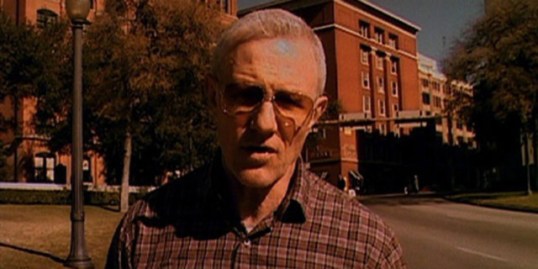
Interview With The Assassin tells the story of Ron (Dylan Haggerty), a cameraman who, at the beginning of the film, has recently lost his job.  His gruff neighbor, an ex-Marine named Walter (a brilliantly menacing Raymond K. Barry), approaches Ron and tells him that he’s dying of cancer and he wants Ron to film him confessing to a crime.  After Ron sets his camera up, Walter proceeds to state that he was the second gunman and that he — and not Lee Harvey Oswald — was the sniper who killed President Kennedy.  When Ron asks Walter who hired him to kill Kennedy, Walter says that he was approached by a man named John Seymour but that he’s not sure who Seymour was working for.

Ron, not surprisingly, is initially skeptical of Walter’s claims.  However, Walter gives Ron a spent shell casing that he claims he grabbed off the ground after he shot Kennedy.  Walter explains that the only reason he’s been allowed to live is because he has that shell casing and, therefore, can prove that there was a second gunman.  Ron gets the shell casing analyzed and is informed that it was probably fired in 1963.

Still skeptical but now intrigued, Ron agrees to make a documentary about Walter and his claims.  Walter and Ron drive across the country to find John Seymour and confront him.  Along the way, they stop in Dallas and Walter shares more of his memories of killing Kennedy.

As Ron becomes more and more convinced that Walter is telling the truth, he also finds himself becoming more and more immersed in Walter’s secretive and fatalistic worldview.  However, as their paranoid road trip continues, Ron also starts to find reasons to doubt whether or not Walter is telling the truth about anything.  It all leads to a genuinely surprising finale that forces us to reconsider everything that we had previously assumed about both Ron and Walter.

I usually hate found footage films but Interview With The Assassin is a wonderful exception.  In his directorial debut, Neil Burger (who would later direct the brilliant Limitless) makes good use of the faux documentary format.  As opposed to many other found footage films, Interview With The Assassin actually provides a believable reason for why the characters are filming everything and, even more importantly, it’s willing to both explore and question the motives of the man holding the camera.  As a result, even though he spends much of the film off-screen, Ron becomes as interesting a character as Walter.

The genius of Interview With The Assassin is to be found in the film’s ambiguity.  While the film creates a believable atmosphere of conspiracy and paranoia, it also forces the viewer to interpret what she’s seen and heard for herself.  Is Walter crazy or is he telling the truth?  Is Ron a hero trying to uncover the truth or is he a frustrated journalist who is exploiting a dying and mentally disturbed man?  Convincing arguments can be made for any of those interpretations as well as a dozen more.  I’ve seen the film a handful of times and I’m still conflicted on just how I feel about both Walter’s claims and the initial assumption that Ron is meant to be the film’s hero.

Interview With The Assassin is a film that invites its audience to think.  As a result, it’s a film that deserves to be seen.

Raymond Barry in Interview With The Assassin

Raymond Barry in Interview With The Assassin

44 Days of Paranoia #3: Winter Kills (dir by William Richert)


MPW-39279Yesterday, I took a look at Executive Action, a 1973 docudrama about the assassination of John F. Kennedy.  Today, I want to take a look at another film inspired by the Kennedys, the 1979 satire Winter Kills.

As the film opens, it’s been 16 years since a popular and dynamic President named Tim Kegan was assassinated in Philadelphia.  Despite constant rumors of conspiracy, the official story is that Kegan was killed by a lone gunman and that gunman was subsequently killed by another lone assassin.  The President’s half-brother, Nick (played by Jeff Bridges, who looks so impossibly young and handsome in this film), has disappointed his father (John Huston) by declining to follow his brother into politics.  Instead, he spends most of his time sailing on corporate oil tankers and dating fashion editor Yvette (Belinda Bauer).  This all changes when a dying man named Fletcher (and played, underneath a lot of bandages, by Joe Spinell) asks for a chance to speak to Nick.  Fletcher reveals that he was the 2nd gunman and that he was hired by to kill President Kegan.  Before dying, Fletcher tells Nick where he can find the rifle that was used to kill the President.

Following Fletcher’s directions, Nick finds both the rifle and proof that his brother’s death was the result of a conspiracy.  Determined to find out who was truly behind the conspiracy, Nick goes to see his father, the flamboyant tycoon Pa Kegan (John Huston) who, we discover, is only alive because he frequently gets blood transfusions from young women.  With Pa’s encouragement, Nick is sent on an increasingly bizarre odyssey into the darkest shadows of America, a world that is populated by militaristic businessmen, sinister gangsters, and an unemotional man named John Cerutti (Anthony Perkins) who very well may be the most powerful man in the world.

The martyred President might be named Tim Kegan, his accused assassin might be named Willie Abbott, and the man who shot Abbott might be named Joe Diamond (and might be played by Eli Wallach) but make no mistake about it — Winter Kills is a thinly disguised look at both the Kennedy assassination and the Kennedy family.  Based on a novel by Richard Condon (who also wrote the conspiracy classic, The Manchurian Candidate), Winter Kills takes all of the various Kennedy conspiracy theories and intentionally pushes them to their most ludicrous extremes.  The end result is a film that tries (and occasionally manages) to be both absurd and sincere, a portrait of a world where paranoia is the only logical reaction.

As I discovered from listening to director William Richert’s commentary on the Anchor Bay DVD, Winter Kills had a long and complicated production history.  The film was produced by two marijuana dealers, one of whom was murdered by the Mafia shortly after the film premiered while the other would later be sentenced to 40 years in prison on federal drug charges.  The production actually went bankrupt more than a few times, which led to Richert, Bridges, and Bauer making and releasing another film specifically so they could raise the money to finish Winter Kills.

When Winter Kills was finally released, it got a good deal of attention because of its spectacular cast.  Along with Bridges, Huston, Perkins, and Wallach, the film also features cameo appearances by Tomas Milian, Elizabeth Taylor, Ralph Meeker, Richard Boone, Sterling Hayden, Dorothy Malone, Toshiro Mifune, and a host of other actors who will be familiar to those of us who enjoy watching old movies on TCM.  And yet, according to Richert, the film itself was barely released in to theaters, the implication being that Winter Kills was a film about conspiracies that fell victim to a conspiracy itself.

Given the film’s history and the subject matter, I was really hoping that Winter Kills would turn out to be a great movie.  Unfortunately, it really doesn’t work.  The film struggles to maintain a balance between suspense and satire and, as a result, the suspense is never convincing and the satire is ultimately so obvious that it ends up being more annoying than thought-provoking.  The cast may be impressive but they’re used in such a way that film ultimately feels like it’s just a collection of showy celebrity cameos as opposed to being an actual story.

That said, Winter Kills remains an interesting misfire.  Jeff Bridges is a likable and compelling lead (and he gives the film much-needed focus) and, playing a role that has a lot in common with his better known work in Chinatown, John Huston is a always watchable if not necessaily likable.  Best of all is Anthony Perkins, who plays a role that, in light of what we now know about the NSA, seems oddly prophetic.

Finally, best of all, Winter Kills remains an interesting time capsule.  If nothing else, it reminds us that mistrust and paranoia are not unique to this century.

3260389_l1

Song of the Day: I’ve Gotta Be Me (by Sammy Davis, Jr.)


SammyDavisJr

Today is the date that will forever become a date of remembrance for me and my family.

My father, Fernando Sandoc, passed away after losing his battle with cancer. He’s been a huge influence in my taste in music. I remember listening to him when I was younger singing songs by Frank Sinatra, Dean Martin to The Beatles, Tom Jones, The Temptations right up to The Eagles and Elvis Presley. His was an eclectic taste in music, but one that I didn’t appreciate at a young age.

Yet, as I grew older I began to listening to the very same bands and singers and really become fans of them as well. It was one of many ways he and I bonded throughout the years. This was especially true as I grew into adulthood.

One song which always stood out for me was of the Sammy Davis, Jr. song “Ive Gotta Be Me”.

I remember him singing this song with as much enthusiasm and vigor as Sammy himself. It became a sort of anthem (in addition to Frank Sinatra’s “My Way” which was another favorite of his and mine) as if he tried to live his life just how the lyrics spelled them out. I can’t say whether he succeeded or not, but he definitely lived his life “his way” and remained to being true to himself.

He and those he called his closest friends were lived to be their very own Rat Pack.

So, I shall be forever grateful for having such a loving, understanding father and a great friend and mentor who will remain eternal as I take up the mantle he has finally set down to rest.

I’ve Gotta Be Me

Whether I’m right or whether I’m wrong
Whether I find a place in this world or never belong
I gotta be me, I’ve gotta be me
What else can I be but what I am

I want to live, not merely survive
And I won’t give up this dream

Of life that keeps me alive
I gotta be me, I gotta be me
The dream that I see makes me what I am

That far-away prize, a world of success
Is waiting for me if I heed the call
I won’t settle down, won’t settle for less
As long as there’s a chance that I can have it all

I’ll go it alone, that’s how it must be
I can’t be right for somebody else
If I’m not right for me
I gotta be free, I’ve gotta be free
Daring to try, to do it or die
I’ve gotta be me

I’ll go it alone, that’s how it must be
I can’t be right for somebody else
If I’m not right for me
I gotta be free, I just gotta be free
Daring to try, to do it or die
I gotta be me

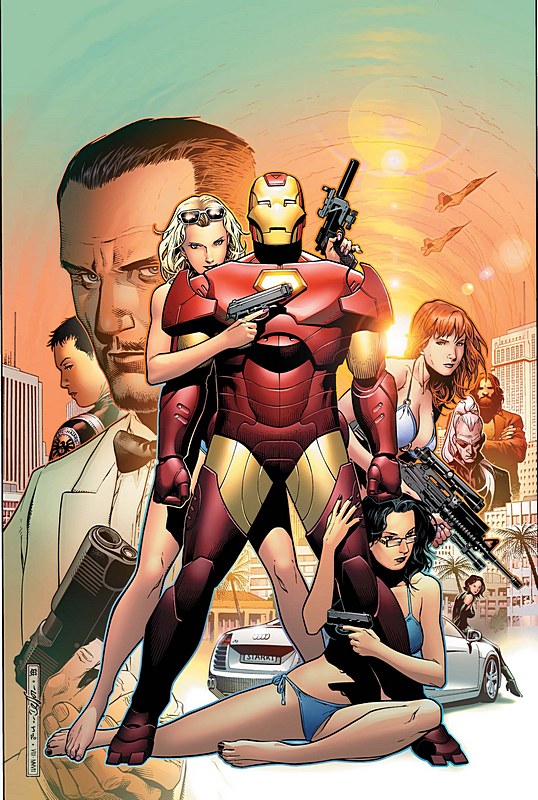
Marvel’s Agents of S.H.I.E.L.D. – The Well Review


Iron_Man_Annual_1

It still seems tame, almost like the creative team is holding back. Skye and Coulson continue to be the saving grace of the show. The nerds are growing on me slowly.

What I liked:

  • A closer look at Agent Ward’s troubled past and why he became the man we see before us.
  • A hint of what Agent May faced and what ghosts still haunt her.
  • The possible Faith-Xander like hook-up that occurred in tonights.
  • The potential traumatic/sinister nature of Coulson’s stay at Tahiti.


What I was expecting:

  • The focus character of the week to be Vali Halfling instead of some generic Asgardian or at least a reformed Skurge the Executioner, an Asgardian known for his blood rages and cursed weaponry.
  • The MacGuffin  was the Blood Axe instead of a random spear.
  • Some of Steranko’s trippy spy fiction.
  • Some sense of threat or true danger… it’s missing the “ZOMG What just happened” endings that Buffy/Angel happened.
  • High tech weaponry and gadgets… either Steranko inspired or something taken from Millar’s or Ellis’ ventures in the Ultimate Universe.


Review (Spoiler Free):

The villains were weak this week. They came off as a background annoyance rather than a real threat. They were even brushed off as some rowdy punks. It was the common “Find the MacGuffin before the baddies get it” plot. Fortunately it did give us some detail about May’s and Ward’s past in addition to giving us another spin on Coulson’s stay in Tahiti

AMV of the Day: See Who I Am


GuiltyCrown

Just going to be brief with the description of the latest “AMV of the Day”. The latest pick was the winner of Anime Weekend Atlanta (AWA) 2012.

“See Who I Am” is the title of the video and also the title of the song used by the video’s creator (Speedy180). This particular song is a favorite of mine from symphonic metal band Within Temptation and also used in one of the very first AMV’s I watched (Alchanum) and one which got me into the scene to begin with. The video itself is an anime mix of so many anime titles that I could only recognize some of the one’s that I’ve actually seen. I’m sure there are many more I missed.

It’s a well-done video that uses Sheryl Nome of Macross Frontier singing to sub in for Within Temptation’s Sharon den Adel. It’s a very dramatic song and the anime visuals picked and they’re put together more than matches the emotional content of the song.

Anime: Guilty Crown, Macross Frontier, Fairy Tail, Fate/Stay Night, Fafner in the Azure, Tengen Toppa Gurren Lagann, Bleach and many others…

Song: “See Who I Am” by Within Temptation

Creator: Speedy180

Past AMVs of the Day