First released in 2006, Richard Linklater’s A Scanner Darkly is one of the unacknowledged great films of the past ten years. The scene below, featuring Rory Cochrane as the hapless Charles Freck, is all the stronger for being adapted almost word-for-word from Philip K. Dick’s source novel.
This scene (which, be warned, is a huge spoiler) is from the original Django (1966) and features the one and only Franco Nero. If you liked Django Unchained, you’ll love Django.
I stayed up way too late last night but it was totally worth it because I was watching a film from 1966, The Oscar.
Among those of us who love bad and campy movies from the 50s and 60s, The Oscar is a legendary film. It has a reputation for being one of best so bad-its-good-films ever made. The Oscar is a film that I’ve read about in several books but, until last night, I had never gotten a chance to actually see it. When I saw that the film was going to be on last night, I said “Sleep be damned!” and I stayed up and watched. What other choice did I have?
The Oscar takes place in a world where women are “dames” and men are “fellas” and everyone acts as if they’re a character in a Rat Pack-themed fanfic. One look at Frankie Fane (played by Stephen Boyd) and you know he’s the type of guy who snaps his fingers when he walks and probably uses pig Latin when he flirts. He’s one cool cat and as the film begins, he’s been nominated for an Academy Award for Best Actor.
The film begins at the Oscars. Frankie sits out in the audience, surrounded by Hollywood royalty and nervously waiting for the envelope to be opened. The camera pans over to Frankie’s personal manager, Hymie Kelley. Hymie stares bitterly at his former friend and suddenly, we hear his thoughts and do they ever let us know what type of movie we’re about to see.
As Hymie himself puts it:
“You finally made it, Frankie! Oscar night! And here you sit, on top of a glass mountain called “success.” You’re one of the chosen five, and the whole town’s holding its breath to see who won it. It’s been quite a climb, hasn’t it, Frankie? Down at the bottom, scuffling for dimes in those smokers, all the way to the top. Magic Hollywood! Ever think about it? I do, friend Frankie, I do…”
Hymie, incidentally, is played by the singer Tony Bennett. This was Bennett’s first dramatic film role and it was also his last. Whatever talent or magnetism Bennett may have had as a singer, it didn’t translate into screen presence. Bennett goes through the entire film looking embarrassed but who can blame him when the script calls for him to constantly tell Frankie that, “You lie down with pigs, you stand up smelling like garbage…”
As we discover through the use of flashback, Frankie has had to lay down with a lot of pigs to get his chance at winning an Oscar. After starting out his career working at sleazy clubs, Frankie, Hymie, and Frankie’s stripper girlfriend (Jill St. John) find themselves in New York. Frankie dumps his girlfriend (unaware that she’s pregnant with his child) after he meets artist Elke Sommer at a “swinging party.”
“Are you a tourist or a native?” Frankie asks her.
“Take one from column A and one from column B. You get an egg roll either way,” Sommer replies.
No wonder Frankie tells her, “You make my head hurt with all that poetry.”
Eventually, Frankie is discovered by a talent agent who takes him to see studio mogul Joseph Cotten (who went from Citizen Kane, The Magnificent Ambersons, and Third Man to this). Cotten is so impressed with Frankie that he says, “Once in a while, you bring me meat like this. It all has different names: prime rib of Gloria, shoulder cut of Johnny. MEAT!”
With the help of savvy talent agent Milton Berle, Frankie becomes a film star but he’s still a total heel who cheats on Sommer and takes advantage of Hymie’s loyalty. When Frankie gets nominated for an Oscar, he hires a sleazy private investigator (Ernest Borgnine, of course) to leak a story about Frankie’s criminal past. Frankie assumes that one of his fellow nominees will be blamed for the leak and that he’ll be able to ride a wave of sympathy to victory.
And who are Frankie’s fellow nominees? We only learn the identity of three of them – Frank Sinatra, Richard Burton, and Burt Lancaster. We never find out what movie Sinatra was nominated for but we’re told that Burton was nominated for The Grapes of Winter (which, I’m going to assume, was a film version of a Shakespeare play about Tom Joad) while Lancaster was nominated for his amazing performance in The Spanish Armada. Doesn’t that sound like an amazing film?
Oh, how to describe the delirious experience of watching The Oscar? In many ways, it is a truly terrible movie but it’s fun in the way that only a “racy” film from the mid-60s can be. Nobody plays his or her role with anything resembling subtleness. Instead, everyone spends the entire film yelling, screaming, and gritting their teeth while flaring their nostrils. Everyone, that is, except for Tony Bennett who gives a performance that has a definite community theater feel to it. Even better is the dialogue. People in this film don’t just say their lines – they exclaim them. If you’ve ever wanted to spend two hours in a world where every sentence ends with an exclamation point, watch The Oscar.
For a film that was apparently meant to be something of a love letter to the Academy, The Oscar was only nominated for two Oscars. It received nominations for Best Art Design and Best Costume Design. While I had a hard time seeing what was so impressive about the film’s art design (in the world of The Oscar, Hollywood has a definite Ikea feel to it), the costumes were fairly impressive in a tacky, 1966 type of way.
Finally, I think it’s time that somebody remake The Oscar. David Fincher can direct it, Aaron Sorkin can write the script, Jessie Eisenberg can play Frankie Fane, and Justin Timberlake would make for an adorable Hymie Kelley. For the supporting roles, I think Billy Crystal would be a natural for Milton Berle’s role and perhaps Philip Baker Hall could step into the shoes of Joseph Cotten. Perhaps veteran film blogger and self-described very important person Sasha Stone could make her film debut in Ernest Borgnine’s role.
Ah, the folly of youth. When we’re young, we’re so determined to prove we can “make it on our own” that we’ll turn our backs on opportunities that might serve us better in the long run just because they would mean answering to “The Man” in the short term. A hot-shot young chef (a nauseating demographic which our nation is currently, and quite literally, under absolute fucking assault from) will bypass the chance to apprentice under a master of his craft in a popular and established kitchen in order to go start up his own restaurant that will be lucky to last out the year. A promising young journalist will eschew the opportunity to work as a “beat” reporter on a local paper in order to start up a “cutting edge” news website with “attitude” that folds when they can’t get any advertisers. A way-too-full-of-himself young lawyer will say “no thanks” to a “lesser” offer from a major, established firm in order to start his own personal injury practice before realizing that there are already 10,000 other guys in town doing the exact same thing. There’s no doubt about it, my friends — we don’t know jack shit when we’re young, but we know we know better than anybody else.
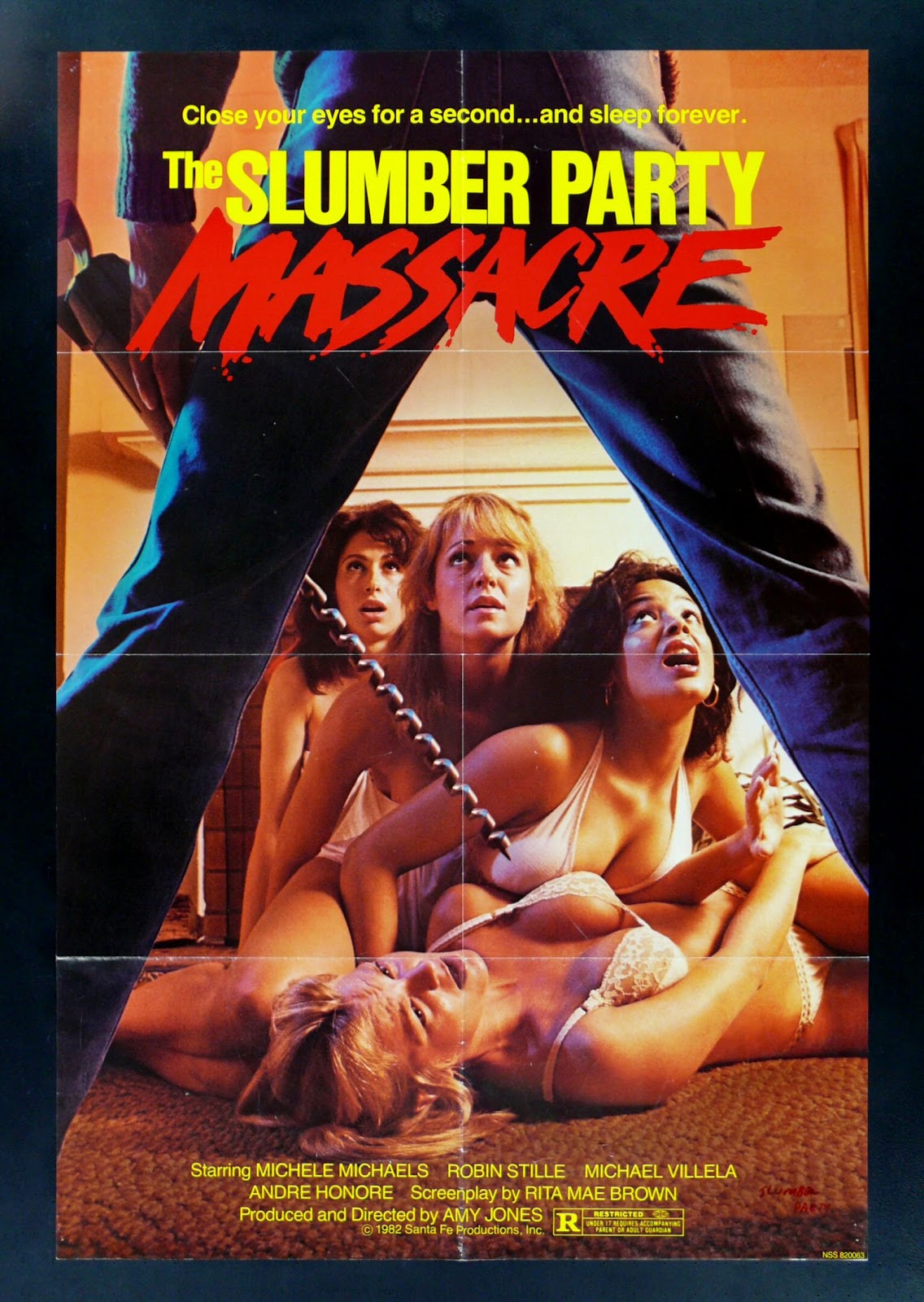
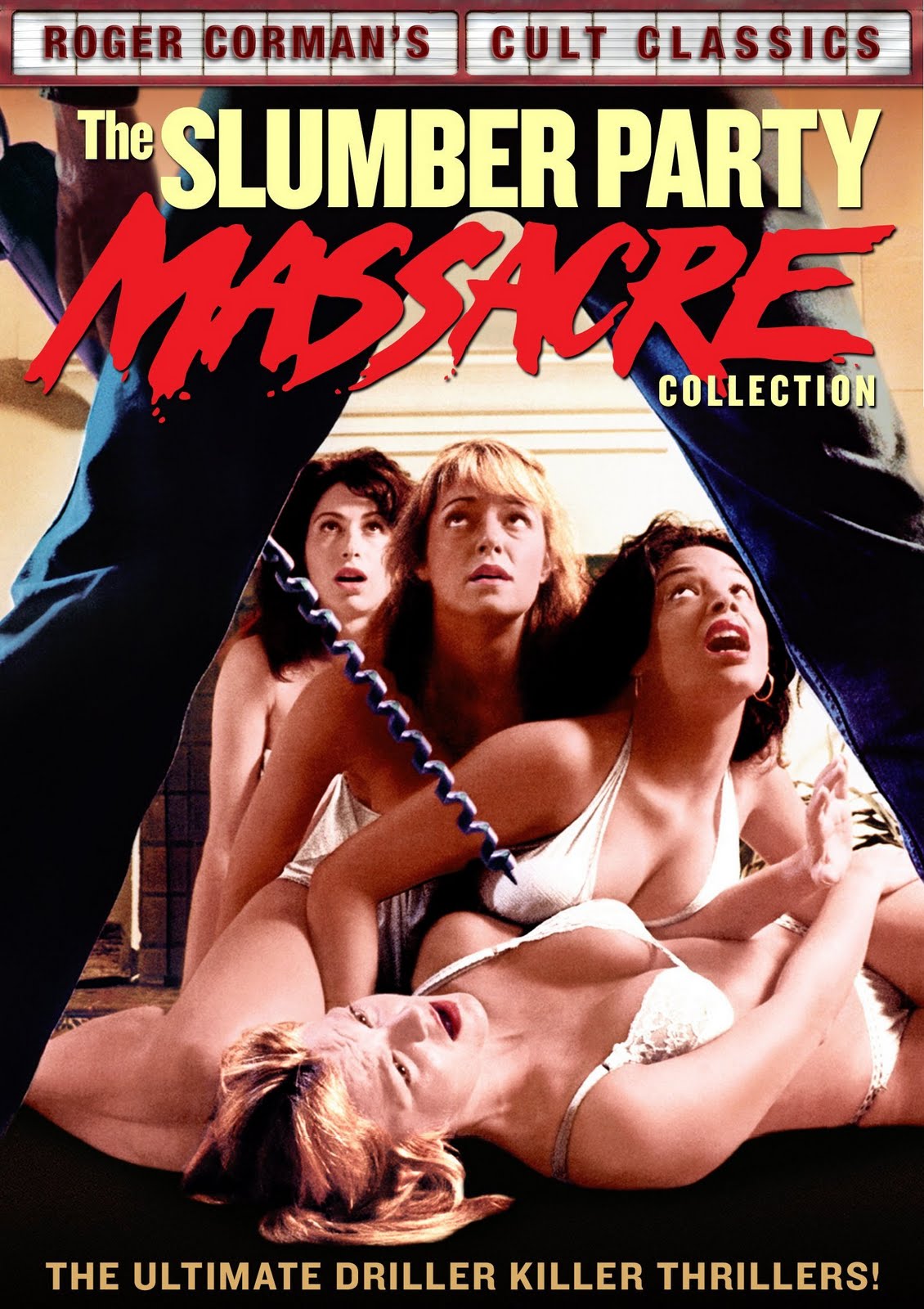
All of which is to say, I guess, a couple of things : one, that I’m older and wiser now and will gladly give up the “freedom” and “total control” I have over my own website in less than a goddamn heartbeat in order to go work for somebody who actually pays me to write this shit; and two, that back in 1982 a semi-recent USC film school grad named Amy Holden Jones, who was considered something of an up-and-comer behind the camera in Hollywood at the time, turned down the chance to be Steven Spielberg’s cinematographer on a little something called E.T. in order to direct a much littler something for Roger Corman called The Slumber Party Massacre.
I’m sure she’s not kicking herself too badly over that decision today.
Corman, of course, as he always seemed to, had an angle figured with this one, as well — in order to deflect, or at least try to deflect, some of the rampant feminist criticism that was just starting to be directed at the “slasher” genre back then, he’d take the largely (okay, entirely) symbolic step of hiring women to both direct (Jones) and script (Rita Mae Brown) his latest girls-take-off-their-shirts-and-get-butchered-for-being -“slutty” opus, therefore “proving” that he, himself, had no problem with the fairer sex —only his movies did.
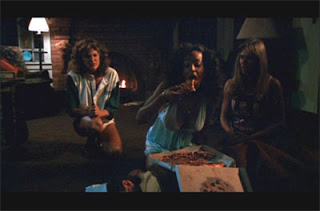
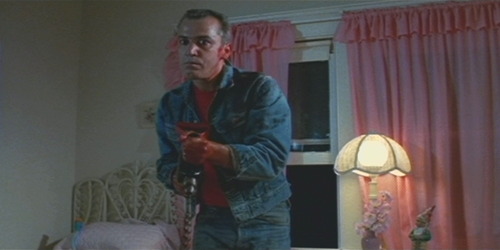
To their credit, both Jones and Brown obviously knew full well what they were getting into here (hell, how could you not?) and decided to play the whole thing up for all it was worth by indulging in blatant self-parody at more or less every turn. Their escaped-from-the-loony-bin killer, one Russ Thorne (Michael Villella) is given essentially no motivation whatsoever and goes after his victims with the most overtly phallic power drill ever conceived of; he’s thrust into the middle of a high school all-girls’ basketball team slumber party (hence, ya know, the title) by the most contrived set of circumstances possible; and every one of the nubile young targets of his kill-spree is a paper-thin, less-than-two-dimensional cipher rather than being anything like an actual, proper character.
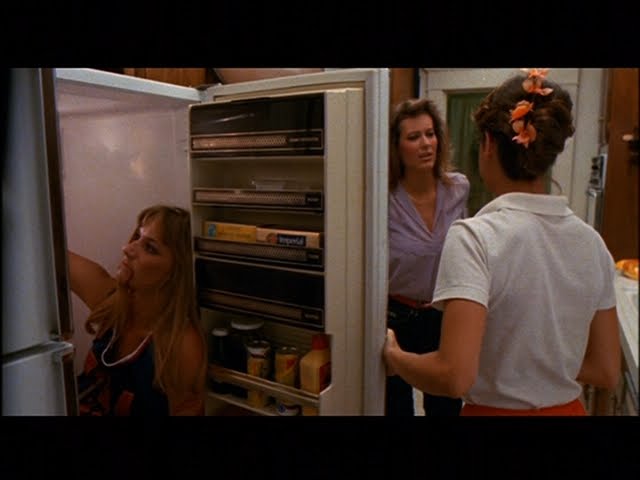
As far as any kind of plot synopsis goes, that’s probably all you really need here, if not more — after all, you know the drill (sorry!), right? The party’s hostess, Trish (Michelle Michaels), despite being listed first in the credits, isn’t gonna be the last girl standing (or limping, or writhing, or crawling), that honor goes to picked-on-for-being-aloof-quiet-and-too-much-better-at-basketball-than-the-others (she’s even a new girl at school, to boot! How many different ways can you say “virgin” without just blurting it out?) Valerie (Robin Stille). All the proceedings here follow the typical cut-and-dried formula more or less to a “T,” with a heavy dose of self-awareness being basically the only wrinkle added into the mix, apart from “keep your eyes open for an early turn by future ‘scream queen’ semi-star Brinke Stevens.”
None of which is to say that I didn’t enjoy The Slumber Party Massacre — the fact of the matter is, this one of those flicks that I always kinda turn to when I want to turn my brain off. It’s solid, if unspectacular, tongue-in-cheek fun, leaves a pleasant-enough grin on your face, and keeps you reasonably involved for its brief-but-just-right-all-things-considered 77-minute run time. If ol’ Russ was as smart and efficient at his job as Holden was at hers, he might still be running around sticking his power drill in high school girls today. And yeah, I realize that last sentence sounded every bit as unsubtle as this movie is, that was kinda the — errrmmm — point (damn! Just can’t help myself).
Being that this movie and its two sequels (part two being even more OTT farcical than this one, part three being something of a “back-to-basics” straight-to-video affair) have a semi-sizable cult following, Shout! Factory made the wise decision to release ’em all together in one collection on (two-disc) DVD and (single-disc) Blu-Ray. Since I’ll be going to the “effort” of reviewing ’em all here in the next few days, I’ll just take it one at a time with the technical specs and extras. The Slumber Party Massacre is presented in a 1.78:1 widescreen remastered transfer that looks pretty damn stunning, and the remastered mono sound is perfectly serviceable, as well. There’s a really good little “making-of” featurette included , a photo still and poster artwork gallery, and director Jones is on hand for a full-length commentary track. The original theatrical trailer, a smattering of trailers for other titles in the “Roger Corman’s Cult Classics” series, and a solid set of liner notes by Jason Paul Collum round out the package.
If you don’t have the time, money, or inclination to break new ground — and let’s face it, Roger Corman never had any of the above — you could do a lot worse than to tread the same ol’ familiar territory with a little bit of style, self-deprecating wit, and a quick little wink to the audience. The Slumber Party Massacre certainly delivers on each of those counts, and while I’ll never be fully on board with those who view this thing as some sort of “classic,” it’s definitely a good — if thoroughly predictable — time.
I’m older and wiser now, remember? I’m perfectly happy to take what I can get.
Today is the last day for the members of the Academy to vote for the 86th Annual Academy Awards. With that in mind, here are my predictions as to what’s going to win next Sunday. Please note: this is not necessarily who I think should win.
Best Picture — Argo
Best Director — Ang Lee for Life of Pi
Best Actor — Daniel Day-Lewis in Lincoln
Best Actress — Jennifer Lawrence in Silver Linings Playbook
Best Supporting Actor — Alan Arkin in Argo
Best Supporting Actress — Anne Hathaway in Les Miserables
Best Adapted Screenplay — Argo
Best Original Screenplay — Amour
Best Foreign Language Film — Amour
Best Animated Feature — Frankenweenie
Best Documentary Feature — Searching For Sugar Man
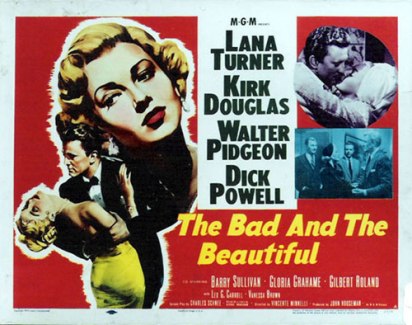
Released in 1952 and directed by Vincente Minnelli, The Bad and the Beautiful is arguably one of the greatest films ever made. It’s certainly one of my favorite films.
Perhaps appropriately, The Bad and the Beautiful is a film about the movies.
Jonathan Shields (played in a truly amazing performance by Kirk Douglas) is a legendary film producer. He’s won Oscars, he’s got a reputation for being a genius, and, as the film begins, he is one of the most hated men in Hollywood. It’s been years since Shields made a succesful film but he thinks that he’s finally come up with a movie that can put him back on top. His assistant, Harry Pebbel (played with a weary dignity by Walter Pidgeon), invites Hollywood’s best director, actress, and screenwriter to a meeting and he proceeds to spend the rest of the film trying to convince them to help Jonathan make his comeback.
The only problem is that all three of them hate Jonathan Shields and have sworn that they’ll never work with him again. Through the use of flashbacks, we see how each of them first met Jonathan and how each eventually came to despise him.
Director Fred Amiel (Barry Sullivan) first met Jonathan when Jonathan hired him to pretend to be a mourner at his father’s funeral. With Jonathan’s help, Fred moves up from directing B-movies to finally getting a chance to make his dream movie, an adaptation of a believably pretentious novel called The Far Off Mountain. With Jonathan’s help, Fred even gets womanizing film star Gaucho Ribera (a hilariously vain Gilbert Roland) to agree to star in Fred’s movie. Jonathan also introduces Fred to Georgia (Lana Turner), the alcoholic daughter of Jonathan’s mentor.
Jonathan eventually makes Georgia into a film star and Georgia falls in love with him. Of all the major actresses of the 1950s, Lana Turner seems to get the least amount of respect from film historians. She’s more remembered today as the epitome of glamour and scandal but, in The Bad and the Beautiful, Turner gives one of the best performances of her career. In her best scene, Georgia has a nervous breakdown while driving in the rain and, for those few minutes, you forget that you’re watching an iconic film star. Instead, you’re just amazed by the performance.
Finally, the screenwriter is James Lee Bartlow (Dick Powell), an intellectual novelist who is brought to Hollywood by Jonathan. While the reluctant Bartlow finds himself being seduced by J0nathan, his flighty wife (Gloria Grahame) is seduced by Gaucho.
The Bad and the Beautiful is perhaps one of the few perfect movies ever made, a film that qualifies as both art and entertainment. There are so many reasons why I love this film that its hard for me to describe them all. The film snob in me loves the fact that Minnelli directed The Bad and the Beautiful as if it were a classic black-and-white film noir. The entire film is lit and shot to emphasize shadows and moral ambiguity. As played by Kirk Douglas, Jonathan Shields is as seductive and dangerous a figure as Barbara Stanwyck in Double Indemnity. My inner film historian loves the fact that the film is full of barely disguised portraits of real life Hollywood figures like David O. Selznick, Val Lewton, Alfred Hitchcock, and Diane Barrymore. Finally, and perhaps most importantly, my girly girl side loves that this film is basically a big melodramatic soap opera. Lana Turner’s outfits are to die for and Jonathan Shields is the ultimate bad boy that we can’t help but love.
The Bad and the Beautiful received 6 Oscar nominations but it wasn’t nominated for best picture. (This snub is all the more surprising when you consider what the Academy did name as the best picture of 1952 — Cecil B. DeMille’s The Greatest Show on Earth.) Out of those six nominations, the Bad and the Beautiful won five Oscars. (Of all the film’s nominees, only Kirk Douglas failed to win.) As of this writing, The Bad and the Beautiful still holds the record for most Oscars won by a film that failed to be nominated for best picture.
Previously, I reviewed the 1935 Best Picture winner Mutiny on the Bounty, a film that still stands as one of the best adventure films ever made. However, this was not the only film made about the Bounty to be honored with several Oscar nominations. In 1962, another version of Mutiny on The Bounty was released and, like its predecessor, received a nomination for Best Picture of the year. However, while the 1935 Mutiny on the Bounty remains one of the most entertaining films ever made, the 1962 Mutiny on the Bounty is a mess.
As in the 1935 version of the story, we once again follow the HMS Bounty as it sails from England to Tahiti. Again, the ship’s captain is the tyrannical Capt. Bligh (Trevor Howard) and again, the eventual mutiny is led by Fletcher Christian (Marlon Brando). While the 1935 version presented Christian as the unquestioned leader of the mutiny, this version features an indecisive Christian who is goaded into leading the mutiny by a seaman named John Mills (Richard Harris). Whereas the 1935 Fletcher Christian never regretted his decision, the 1962 version seems to regret the mutiny from the moment it occurs and literally spends the rest of the film trying to get the mutineers to agree to return to England with him.
Perhaps the biggest difference between the two versions of Mutiny on the Bounty is that the 1935 version was a 2-hour film that felt shorter while the 1962 remake lasts 3 hours and 15 minutes (including intermission) and feels even longer. The 1962 version was made at a time when Hollywood was attempting to counteract the influences of European art films and American television by making films that were a thousand times bigger then they needed to be. Whereas the 1935 Mutiny on The Bounty was all about telling the story as efficiently as possible, the 1962 Mutiny on the Bounty was about telling audiences, at every possible moment, that they couldn’t see anything like this on television or in some French art film. Audiences in 1962 may very well have been amazed by the endless shots of Tahitians dancing and the Bounty rocking on the ocean but, for modern audiences, the entire film just feels incredibly slow and padded.
Another major difference between the two versions of Mutiny on the Bounty is that Marlon Brando, to be charitable, was no Clark Gable. Much as Clark Gable could never have been a credible Stanley Kowalski or Vito Corleone, Brando could never have been a convincing Fletcher Christian. Whereas Gable played Christian as the epitome of masculinity, Brando’s internalized, method approach serves to turn the character into something of a wimp. It doesn’t help that Brando’s twangy attempt at an English accent sounds like every bad Monty Python impersonation that’s ever been heard in a college dorm room.
The 1962 Mutiny on the Bounty was a notoriously troubled production. Marlon Brando was reportedly bored with the role of Fletcher Christian (which might explain why he gave such an eccentric performance) and he reportedly used his star status to demand and make constant changes in the script. The film’s original director, Carol Reed, reportedly quit over frustration with Brando and was replaced by Lewis Milestone. Milestone, a veteran director who had started his career during the silent era, proved just as ineffectual when it came to controlling Brando. By the end of the film, Richard Harris was literally refusing to film any scenes opposite Brando. The end result was that the film went wildly over schedule and over budget.
Despite being reviled by even contemporary critics, Mutiny on the Bounty received seven Oscar nominations, including Best Picture. The nomination was a triumph for the studio system as MGM reportedly directed all of its employees to vote for the film. That may have been enough to win Mutiny a nomination for best picture but the actual Oscar went to Lawrence of Arabia.
The series returned from it’s two month hiatus with even bigger numbers that still continues to surprise many tv pundits. The Walking Dead seems to be the show that no behind-the-scenes problems or storytelling and characterization problems can kill like other shows that has similar problems. The show is not on the same level as HBO’s Boardwalk Empire and Game of Thrones, FX’s Justified and Sons of Anarchy or even AMC stablemates Breaking Bad and Mad Men, but it’s a show that looks to have become must-see tv because of the very things tv pundits and critics have been complaining about.
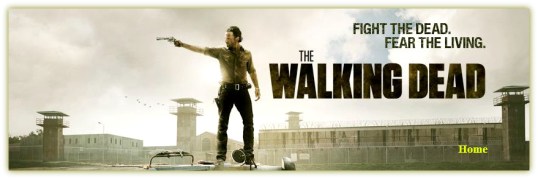
Tonight’s episode, “Home”, was a microcosm of why the show has been such a frustration to hardcore fans of the comic book and the zombie genre, but also why the show still continues to bring in huge viewing numbers. Numbers that has begun to rival shows on the major networks and not just shows on cable. It was an episode that made me wonder if the season’s trip to redemption from season 2’s wildly uneven tone was suddenly being wasted. Then the second half of the episode arrived like a bullet to the head and we’re reminded why the show has gained such a huge following.
“Home” opens up with Rick still in the grips of the psychotic break we saw and experienced to end the previous episode. This part of tonight’s narrative is beginning to look like one of this season’s weaker ones. While I thought it was good to show the source of Rick’s growing mental instability the way the writers have gone about it makes Rick such a wildly uneven character when the “crazies” hit him. We understand that the burden of leadership has cost the poor man since he rejoined his family but whenever he begins to hallucinate it’s quite a glaring change. The same could be said about Glenn’s sudden rage-fueled need to avenge himself on the Governor for what he thinks was done to Maggie. We’ve seen leadership qualities in Glenn throughout the series’ run, but this need for vengeance for something that didn’t happen to him looks so out of character for Glenn. He’s almost channeling his inner-Shane and, despite what fans of TV Shane’s character might think, that’s never a good thing.
Tonight’s episode was all about the concept of the word “home” what it means to people surviving in a world where no place is safe. The prison and Woodbury are homes for two different survivors. On the one hand, we have Rick and his band of survivors who have survived some of the worst this zombie apocalypse has thrown their way and learned the hard way to survive. On the other side we have Woodbury where most of it’s population never learned to survive but relied on those in power to keep them safe. People in power who really do not have their well-being in mind, but just a resource to dominate and use when it suits them. One home has been invaded and it’s illusion of safety shattered by Rick and his people. Tonight we see the Governor repay that action in his own way.
Home is now a concept that doesn’t seem like a logical thing in this new world order and tonight’s episode went too talky about whether it was safe to remain in the prison or whether it was their best chance of survival. It didn’t help that Rick was on his crazytown jaunt through the woods outside the prison, Glenn was going all Shane on everyone and Hershel was starting to sound very Dale-like. Not very good combinations considering the writers on this show could never handle the quieter and philosophical moments on the show.
Where the episode was saved was when the bolts, bullets and blood flew in abundance in the second half. This first begun with Daryl doing something that Merle would never see himself doing on his own and that’s helping a band of strangers cornered by a large group of zombies. We see how much Daryl’s time with Rick away from the influence of his more volatile big brother Merle has made Daryl a better man without taking away his inherent badassness (yes that is a made up word that should be used more often).
The Governor’s payback against Rick and his people becomes a bookend to the midseason finale where Rick attacked Woodbury. The prison’s illusion of safety has been destroyed and with it one of their own who seemed to be finding his role. Axel was beginning to become a character of note then the Governor and his bullet happened and we’re once more left with the the core group which entered the prison.
If there’s one thing this show has done well since it first began two years ago it’s action and gore. I think it’s what this show does well that keeps people from tuning in for new episodes. There’s a chaotic feel to the action that makes them such a fun thing to watch. These people are not action heroes and not trained professionals in killing but it doesn’t keep them from trying to be both which goes to one of the core tenets of the zombie apocalypse genre. These people should be working together but the inherent mistrusts people have when put into extreme situations keeps that from happening. It’s why things got out of hand and things fell apart for everyone. It looks like it’s happening again but in a much more smaller scale with this war between Rick and the Governor.
With the season now putting the showdown between the two groups front and center it should keep things basic and that’s a good for this show. Basic and simple narratives keep the show moving at a fast-pace. It’s when everyone has some downtime to reflect on the nature of things that the show falters. Here’s to hoping that the first half of this episode was something that had to be done to set things up for the rest of the second half of this season. If it’s not then maybe there was reason why Glen Mazzara will not be returning as showrunner for season 4.
Notes
Tonight’s episode of was directed by series newcomer Seith Mann and written by series regular Nichole Beattie.
We have ourselves another cameo of a series regular killed off with Sarah Wayne Callies appearing as a figment of Rick’s fractured mind during the episode’s cold opening.
Interesting how this sequence is musically scored by the same music theme from way back in the series’ pilot. At first, I thought the return to this motif in the cold opening was announcing the announced return of Lennie James’ Morgan Jones character from the pilot.
Glenn trying to make up for Rick’s latest bout of craziness as leader of the group is both refreshing and, at the same time, funny as he’s clearly trying to overcompensate for what happened to him and Maggie during their time in Woodbury.
We may be starting to see one of the reasons why Glen Mazzara was replaced as showrunner for the upcoming season. Only two episodes into the second half of season 3 and we’re starting to see the bad habit of the show spinning it’s wheels as it rehashes some philosophical questions about survival and leadership.
Andrea being put in charge of Woodbury while the Governor “pulls himself together” would be a much more interesting turn of events if Andrea wasn’t such a broken character played by a performer who can’t seem to find that fine line between cocky and annoying that her character seems to be written as.
The best performance of this second half of the season seems to consistently be from Lauran Cohan as Maggie Greene. She has another fine performance tonight as Maggie as she pretty much puts Glenn in his place.
Good to see the writers resisted the temptation to revert Carol back to being an emotional mess once she found out about Daryl choosing to leave the group.
Speaking of the Dixon Brothers: it looks like Daryl really regrets choosing blood over his new family as Merle continues to be Merle. His attitude towards the Latino family besieged by walkers on the creek bridge is so hilariously racist yet something that continues to stay in character. It definitely helps in making the question of whether Daryl stays with Merle or goes back to the group not become a protracted affair as we see at the end of the sequence.
The first half of the episode was quite a bore that highlighted the very flaws this show has had throughout it’s current broadcast life, but the second half saved it by showing just why people continue to return to watch each new episode every Sunday.
Axel, we hardly knew you but at least you lasted longer than Oscar. I must say that his death mirrored very well the way he died in the comics.
It would seem that it’s easier to headshot zombies when they’re stumbling towards Rick and his people than to actually hit the Governor and his shooters when they’re standing still.
Zombie Kill Count of tonight’s episode: 35 (at least 15 more off-screen).
Before I came on board here at The Shattered Lens, I joined in on Live Tweeting, where you watch a movie with a group of people, while tweeting about it at the same time. Imagine being one of those audience members in Mystery Science Theatre 3000, and you’ve a rough idea of how fun it can get. Our own Lisa Marie Bowman does this every Saturday with her group, the Snarkalecs, as they cover the SyFy Movie of that week.
On Saturday Nights around 11pm Eastern(or just about every Saturday), Kevin Carr (over at Fat Guys at the Movies) hosts his Late Night Live Tweet, which I’ve participated in from time to time over the last 3 years. Tonight, they’re talking on 1981’s Dragonslayer on Netflix Instant.
Dragonslayer is one of those films that flopped at the box office, but remains iconic for its representation of dragons and for having been Industrial Light and Magic’s first Visual Effects production outside of any of the Lucasfilm movies (Raiders of the Lost Ark and the first two Star Wars films). Even though ILM was popular for what it did for those films, they were considered somewhat exclusive (or rather it’s my belief that they were). Dragonslayer became ILM’s test of whether they were a go to effects studio for the rest of Hollywood. It didn’t quite work out for the film, but at least ILM did well. At one point, the amount of lens flares in this movie would make J.J. Abrams proud.
Walt Disney Pictures, wanting to get into something a little more adult, came up with Dragonslayer just before Tron, but because of then graphic nature of the film (at least by their standards) supposedly had Paramount Pictures handle the distribution of the film and keep their hands clean. The movie contains blood, immolation and a hint of nudity, which seemed unbecoming of the Disney label. Over the years, Disney would come up with Touchstone Pictures, Buena Vista Pictures, and Hollywood Pictures for their more adult fare. I think Disney even had Miramax at one point.
The story behind Dragonslayer is pretty straight forward. In a faraway land in the Dark Ages, a group a people seek out an old wizard named Ulrich (Sir Ralph Richardson – Watership Down and one of my favorites, Time Bandits) to have him slay the dragon known as Vermithrax Pejorative. Why would anyone want to kill a dragon? Well this particular dragon spends it’s time burning nearby villages and to keep it from doing so, the land has a lottery where the winner – a young maiden – is offered as a sacrifice. On looking at the evidence provided – some scales and a claw (to which Urlich exclaims “That’s not a claw, by the gods….that’s a tooth!”), the wizard refuses and asks the team to look for another Dragonslayer. They inform him that he is indeed the last of his kind. His apprentice, Galen Bradwarden (Ally McBeal’s Peter MacNicol) feels that maybe they could do the job, but before Ulrich can get on his way, he is challenged by the head of the King’s Guard, which leads to the wizard’s demise.
Galen, on cleaning up the wizard’s castle, stumbles upon a glowing amulet that enhances his magic ability. then takes it upon himself to get rid of the Dragon after discovering one of Ulrich’s glowing amulets and the ability to perform magic. As a kid, I thought that amulet was the coolest thing. There are of course some complications, mainly the fact that the Monarchy believes having the sacrifices and the Dragon are a good thing, but like all Disney movies, it all works out.
From an acting standpoint, Dragonslayer is okay. None of the performances are really award winning, and actor Peter MacNicol has gone on to say that he was embarrassed to have done the film, and doesn’t even mention it when referencing anything he’s done. Actor Ian MacDiarmid, who played Emperor Palpatine in the Star Wars films, plays a priest in Dragonslayer, which was nice to see.
ILM’s biggest contribution to Dragonslayer was the use of a then new effect called “Go-Motion”. The idea was that most effects at the time were stop motion, similar to what you’d see in a Harryhausen film like Clash of the Titans, As a result, it was often very easy to tell when stop motion was being used due to the jerky but accepted movements of characters. Go Motion used puppets on computers to track their movements, inducing a motion blur and give the appearance that puppets were moving more naturally. I guess it was a lot like rotoscoping for the Lightsaber effects. ILM tried this out with some success in The Empire Strikes Back, and a combination of either Stop Motion or Go Motion was used in many films right up until CGI came along. The look of the Dragon itself was very aggressive and its look can be seen in similar films like Reign of Fire. Most of the effects haven’t held up very well at all under HD, and you can clearly see some of the areas where effects start and end.
It should be noted that Stop Motion is still in use today and is very popular with animated fares like The Nightmare Before Christmas, Coraline, and the Academy Award Nominated Film, Frankenweenie.
It’s been a strange Oscar season and it could get even stranger. Several critics and industry insiders are speculating that, on February 24th, Argo might win the Oscar for best picture without winning in any other category. As strange as that may sound, Argo would not be alone in achieving this distinction. In the past, 3 films have won best picture without winning anything else.
Mutiny on the Bounty, the best picture of 1935, is one of those films.
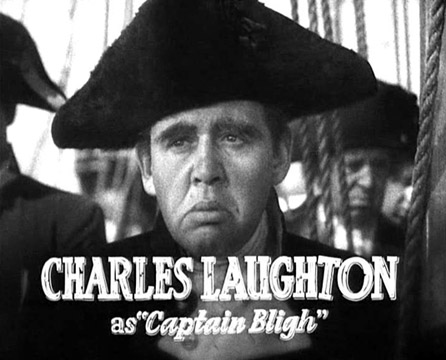
Based (rather loosely, according to many historians) on a true story, Mutiny on the Bounty tells the story of one of the most controversial events in maritime history. The HMS Bounty leaves England in 1787 on a two-year voyage to Tahiti. The Bounty is manned by a disgruntled crew (many of whom have been forced into Naval service) and is captained by a tyrant named William Bligh (Charles Laughton). Bligh has little use for the majority of his crew and thinks nothing of having a man whipped until he is dead for even the pettiest of infractions.
Blight’s lieutenant is Fletcher Christian (Clark Gable), a compassionate man who disapproves of Bligh’s methods. As the voyage continues, Christian grows more and more vocal with his disgust towards Bligh. When the ship finally reaches Tahiti, Christian falls in love with a local Tahitian girl and defies Bligh’s direct orders so that he can spend time with her.
It’s only after the ship leaves Tahiti and Bligh’s tyranny leads to the death of an alcoholic crew member that Christian finally leads the mutiny of the film’s title. The rest of the film is divided between Bligh’s surprisingly heroic efforts to survive after being set adrift in a lifeboat and Christian’s attempts to avoid being captured by British authorities. Caught up in the middle of all of this is Christian’s friend (and audience surrogate), Roger Byam (Franchot Tone).
Mutiny on the Bounty was one of the biggest box office hits of 1935 and it received 8 Academy Award nominations, including Best Picture, Best Director, and a record-setting 3 nods for Best Actor with Clark Gable, Charles Laughton, and Franchot Tone all receiving nominations. However, out of those 8 nominations, Mutiny only won the award for Best Picture while John Ford’s The Informer took home the Oscars for Best Director and Actor. Mutiny on the Bounty was the third (and, as of this writing, the last) best picture winner to fail to win any other categories.
For a film that lost dramatically more awards than it won, Mutiny on the Bounty still holds up pretty well. Director Frank Lloyd keeps the film moving at a quick pace and perfectly captures not only the misery of the Bounty but the joyful paradise of Tahiti as well. Lloyd is at his best during the short sequence of scenes that depict Bligh’s efforts to reach safety after being forced off of the Bounty. During this sequence, the audience is forced to reconsider both Captain Bligh and everything that we’ve seen before. It introduces an intriguing hint of ambiguity that is not often associated with films released in either the 1930s or today.
Of the three nominated actors, Clark Gable and Charles Laughton both give performances that remain impressive today. In the role of Fletcher Christian, Gable is the literal personification of masculinity and virility. Meanwhile, in the role of Bligh, Laughton is hardly subtle but he is perfectly cast. If Gable’s performance is epitomized by his charming smile than Laughton’s is epitomized by his constant glower. Wisely, neither the film nor Laughton ever make Bligh out to be an incompetent captain. As is shown after the mutiny, the film’s Bligh truly is as capable a navigator and leader as everyone initially believes him to be. Unlike many cinematic tyrants, Blight’s tyranny is not the result of insecurity. Instead, Bligh is simply a tyrant because he can be. Laughton and Gable are both so charismatic and memorable that Franchot Tone suffers by comparison. However, even Tone’s bland performance works to the film’s advantage. By being so normal and boring, Roger Byam is established as truly being the sensible middle between Gable’s revolutionary and Laughton’s tyrant.
Mutiny on the Bounty remains an exciting adventure film and it certainly holds up better than some of the other films that were named best picture during the Academy’s early years. If Argo only wins one Academy Award next Sunday, it’ll be in good company.




 Through the Shattered Lens