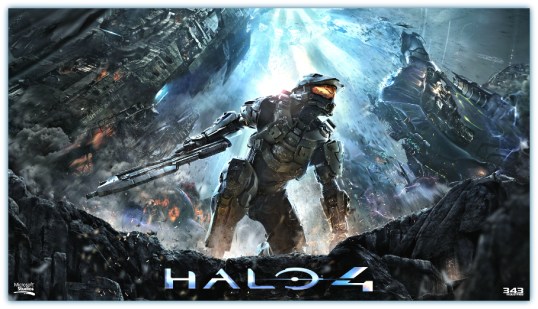
It’s now been three or more weeks since I began playing halo 4 and to say that it has surpassed my very high expectations for this title would be an understatement. Even the soundtrack has been such a wonderful surprise that I’ve been listening to it almost nonstop. I already profiled one of my favorite tracks from Neil Davidge’s work on the score with the song Green and Blue and now I pick another track from the soundtrack for the next “Song of the Day”.
This one wasn’t composed by Neil Davidge but from another composer brought in to create the final end credits song. The game could easily have settled for using music that played during the game to score the lengthy end credits, but everyone involved went for broke and decided really remind gamers that what they’ve just gone through was epic both in gaming terms but also in cinematic. It’s hard not to listen to Kazuma Jinnouchi’s contribution to this title’s score, simply titled “117”, and not imagine some sci-fi blockbuster film rolling up it’s credits with this type of song being played alongside.
From just listening to “117” one could hear some early James Horner influences in Jinnouchi’s composition in the track’s beginning and middle before it transitions in it’s last third to something that resembles one of Basil Poledouris’ epic martial scores. For fans of Martin O’Donnell’s own work in the previous Halo titles this song reaches a crescendo around 6:05 mark with a very familar musical cue. For those who complained that the Halo 4 soundtrack abandoned the iconic sound of the Bungie Studio produced Halo soundtracks should listen to this song around that mark much more closely.
While Neil Davidge deserves all the praise he has been getting for his work on the soundtrack for Halo some of it should also be heaped Jinnouchi-san’s way for the very epic (yes it bears repeating that word) musical composition he created to end the Halo 4 title and leave fans wanting the sequels to arrive now rather than later.
Last week, I shared The Snob, an educational film from 1958. Today’s short film — 1955’s The Gossip — is from the same people who gave us The Snob and it has also become something of a personal obsession of mine. While it’s not as intense as the Snob, the Gossip is still a pretty accurate look at the type of people that every girl has had to deal with at some point in her life. If nothing else, The Gossip was the Mean Girls of its day.
(That said, it’s interesting to note that, in the 50s, all the gossip centered on who was cheating on tests as opposed to who was cheating on who.)
Like The Snob, The Gossip was directed by Herk Harvey and stars Vera Stough.
Today is the day that I (and perhaps a few others) look over the past year and ask myself, “What am I thankful for?” I am happy to say that I have a lot to be thankful for right now. I’m thankful for my family, for my friends, for my readers, and for my love.
Believe it or not, I’m even thankful that I’m now 27 years old! When my family gathered together earlier today, I actually got to hang out with the grown ups! Seriously, being an adult was a lot more fun than I was expecting.
Traditionally, Thanksgiving is also the day when I do a post entitled “10 Things That I Am Thankful For.” So, here we go. As I stated previously, I’m thankful for a lot of things in 2012. Here, in no specific order, is twelve of them:
1) I’m thankful that The Cabin In The Woods and Sinister reminded me of why I love horror films in the first place.
2) I’m thankful for the Snarkalecs on twitter, the best group of people that a girl could hope to watch a SyFy movie with.
3) I’m thankful that this current season of Survivor is one of the best yet.
4) I’m thankful that someday, when I do have a daughter, I’ll be able to watch films like Brave and The Hunger Games with her.
5) I’m thankful that Richard Linklater directed Bernie and let the true citizens of Texas speak for themselves.
6) I’m thankful that Sarah Polley wrote and directed Take This Waltz.
7) I’m thankful for the TCMParty on twitter, the best group of people that a girl could hope to watch a classic film on TCM with.
8) I’m thankful that the final season of The Office is turning out to be a good one.
9) I’m thankful that Skyfall reminded us of why we all love James Bond in the first place.
10) I’m thankful that Branded eventually ended. Seriously, I was worried that film was never going to come to a close.
11) I’m thankful that The Avengers turned out to be a lot more fun than even I was expecting.
12) I’m thankful that even a generally disappointing film year can still see the release of films like Life of Pi and The Master.
What do you think, Trailer Kitties?
Don’t worry, kitties! Lisa Marie’s Favorite Grindhouse and Exploitation Film Trailers will return next week!
What better way to kick off the holiday season than to put up the greatest film ever made. It’s a film about love, compassion, helping one’s people and standing up for those who cannot defend themselves. Produced and directed by filmmaker Jason Eisener this film has become a sort of tradition here at Through the Shattered Lens whenever the holiday season rolls around and it would be a shame to break the cycle now.
So, sit back and enjoy. Eat, drink and be merry for tomorrow we die.
VGM Entry 67: EarthBound
(Thanks to Tish at FFShrine for the banner)
Hirokazu Tanaka and Keiichi Suzuki composed Mother in 1989, and it would remain perhaps the most eclectic soundtrack in all of video gamedom until 1994, when they teamed up again for Mother 2.
Better known to western gamers as EarthBound, Mother 2 (Nintendo, 1994) was… well… on the new game ‘name your characters’ screen you are asked the crucial question “What is your favorite homemade food?”, and that’s about as normal as it ever got. Since Mother was never released here, EarthBound was our first experience with Shigesato Itoi’s madness, and the already ridiculous events and dialogue were made all the more bizarre by a sometimes incredibly awkward (though fairly grammatically sound) translation. (Consider that the most powerful spell in the game is called “PSI Rockin Omega”.) Perhaps this was not originally by intent, but I like to pretend NOA fell in love with it and let a few oddities through intentionally.
The EarthBound soundtrack was huge, or so it seemed to me. With no comprehensive ost on the market it can be a bit hard to tell, but at least one fan rip I came across contained 78 tracks. Every town had a theme. Every combat zone had a theme. There were easily a dozen or more different battle themes. The new music just never stopped coming from start screen to the ending credits. According to Wikipedia, Keiichi Suzuki claimed in a Famitsu interview only available in Japanese that he wrote over 100 songs for the game. Many of these obviously were not used, but Suzuki also only accounts for half of the music.
EarthBound‘s finest musical moments took place in combat. This video presents a compilation of eight battle tunes (by no means all-inclusive) which should give you a good idea of what the game had to offer. The music was a mix of smooth grooves like the first track played here and corny absurdities like the second, with the former typically representing aliens and tougher bosses and the latter such detestable foes as “New Age Retro Hippie”, “Scalding Coffee Cup”, and “Big Pile of Puke”.
The corny tracks are more representative of the larger gaming environment, but the groove numbers are where Tanaka and Suzuki really excelled, culminating with “Kraken of the Sea” (6:27).
I’m not actually sure who was responsible for the combat music throughout this game, or whether the individual tracks were collaborative efforts. (Many songs in the game in fact were.) It would certainly make sense, considering how they all fall into two neat categories, to reason that one composer made the groove tracks and another did the comedy ones, but I certainly can’t confirm this. The track “Another 2” on the highly mutilated official Mother 2 ost contains quite a few samples from the former and none from the latter, and it’s credited to Tanaka specifically, but that might simply mean he was responsible for the remix. “Another 2” contains the bicycle theme as a hidden track after a half minute of silence, and that was definitely written by Suzuki, so there’s really no clear evidence here pointing to one musician or the other.
The two best songs in the game are the last two you’ll hear before the ending. Both are combat tunes, and they couldn’t be more different. “Pokey Means Business” was my favorite song in any video game as a kid, and I don’t think I need to tell you why.
Or are you not there yet? Wait for it…
Ok so, maybe it’s not decisively the best song on the SNES, but it’s definitely the heaviest. Funny that for all the dozens of games out there marketing their edginess as their selling point, none came anywhere near goofy little EarthBound. Once again I am not sure if this is a product of Suzuki, Tanaka, or both. I just know that Pokey meant business alright…
And then there was Giygas. Credits suggest this was all a product of Tanaka’s twisted mind, and it may well go down in history as he most disturbing boss music ever written. Everything about Giygas was completely abstract, from his form to his combat moves. (The game would just say “You cannot grasp the true form of Giygas’ attack!” and deal out damage.)
There are a lot of hairbrain theories out there as to what Giygas represents, especially in connection with how his final form outlines the shape of a fetus. Frankly I think if you’re playing EarthBound for the plot you’re probably reading too much into it.
This song does have a little bit of relevance to what’s going on though. The transition starting around 1:40 and the music box charm it leads into at 2:32 reflect a break in the gameplay action where Paula uses her psychic powers to ask various friends for help. So while its inclusion certainly adds to the creepiness of the overall piece, it’s also intended to be a bit heartwarming. And anyway the song as it appears here, 4:03 in length, is a little arbitrary. The song isn’t a single continuous piece, and the transitions take place as a result of progression in the boss fight.
The song and its visual counterpart have earned quite a bit of internet popularity for its unorthodox behavior. You’ll have to forgive me for sharing this last one with you:
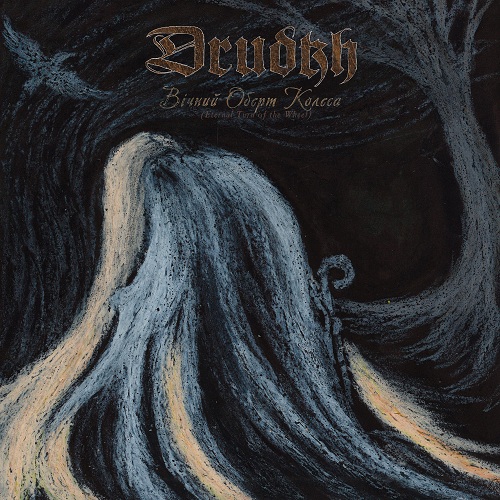
Another year, another Drudkh album. It’s something we’ve come to expect from a band that’s pumped out 9 full length albums in the past decade. Their last release, Handful of Stars, was pretty universally denounced as their weakest album to date, and perhaps there is something to be said for the fact that they skipped over 2011 without a new one. Eternal Turn of the Wheel makes a clear shift away from the direction they had been heading in, returning to a style more in keeping with their earlier releases.
Breath of Cold Black Soil
The question is what they gained from that transition. The sound is certainly in touch atmospherically with the old vibe fans have been clamoring for a return to. If you’ve been following Drudkh from the get-go, there is definitely something refreshing about this one. I am instinctively inclined to engage it, whereas Handful of Stars kind of lost me and I never gave it the proper listening time a Drudkh album deserves.
But that’s not to say they’ve gotten better, nor that they were getting progressively worse before. Drudkh have always had their ups and downs. When you come close to releasing an album every year for a decade, it’s bound to happen. It’s difficult as a fan to even keep up with them. If the music doesn’t strike me pretty readily I put it off for a bit, and by the time I do get around to it the next release is already in the mail.
Eternal Turn of the Wheel will gain some attention because it presents at the surface what people have been looking for for a while now. I think if Drudkh had, alternatively, stuck to the same general sound all along, this one would be pretty readily forgotten.
Night Woven of Snow, Winds and Grey-Haired Stars
Beneath the surface, it’s just a little lacking in creative song writing. It’s quite nice by the standard of average atmospheric black metal, but from Drudkh I tend to expect a little bit more. On Swan Road and Blood in Our Wells especially they managed to merge this sound with absolutely superb song writing, and the latter was the selling point that really projected them from just another Ukrainian black metal band to legends of the genre.
I think the Microcosmos haters heard a stylistic watershed and immediately cashed in their opinions. The shift didn’t phase me at the time, because I think the song writing that really propels them was present in full form. The further changes on Handful of Stars were a bit more of an immediate turn-off, but I’ll venture to make the potentially bogus claim that the song-writing, not the style, ultimately accounts for my having never given it a good and thorough listen.
I’d argue that the song-writing on Eternal Turn of the Wheel is really not appreciably better, but in returning to an old school Drudkh sound they at least compelled me to leave it on repeat for a day. Don’t expect any of the tracks to overwhelm you the way Eternity or Solitude do, or Ars Poetica for that matter. It’s pretty cut-and-dry, generic Drudkh, and it’s crucially lacking any sort of subtle Ukrainian folk undertone. I would be lying if I pretended to not appreciate their return to black metal, but all in all this album is nothing special… at least by Drudkh standards. It will still rightfully go down as one of the better releases of 2012.
Do you know how many albums I’ve reviewed in 2012 so far? One. Comparing that to 2011, when I had pumped out well over 40 by this point in the year, you might say I am a bit behind. It was somewhat inevitable this year, with my video game music project taking up the grand bulk of my free time, but it’s not too late to catch up where I can.
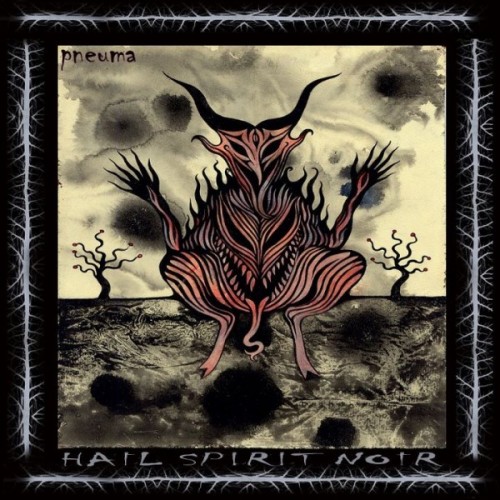
And why not start with the obscure? Hail Spirit Noir is a band from Thessalonika, Greece. The person who introduced me to this album described it as “progressive psychedelic black metal”, which I don’t necessarily agree with but should certainly uh… pique your curiosity.
Mountain of Horror
My apologies for this video. I wanted to include the opening track, and the only copy of it on youtube commits the double idiocy of presenting a fake music video and cutting off the last 30 seconds of the song. While it actually syncs up with the music quite nicely, I have no reason to believe it is anything but a fan project, and it should be duly ignored.
I think there is a general bias among metal fans to label anything black which possesses the slightest traces of the sub-genre. To call Pneuma black metal is a bit of a stretch. The elements of black metal it incorporates are all on the fringe of the genre, and at the end of the day it is far too broad to place any single label on. What you get in “Mountain of Horror” is a combination of that “black and roll” vibe that Peste Noire perfected on Ballade cuntre lo Anemi francor, a heavy dose of 70s prog keyboards, and a progressive black break that falls firmly within the sort of sound Ephel Duath pioneered–more avantgarde than “progressive black” in the sense that recent Enslaved and Ihsahn might call to mind.
Against the Curse, We Dream
And what do you know, another fake music video. Oh well. What you might start to notice as this album progresses is a semblance of stylistic consistency underlining the disorganized madness. Black and roll meets traditional black metal meets psychedelic/70s prog meets avantgarde doodling, mouthful though it may be, is definitely the order of the day.
The Peste Noire vibe is definitely the selling point for me, and in Against the Curse, We Dream it syncs up particularly nicely with the prog synth. The Ephel Duath-esque avantgarde bits leave a lot to be desired, but really, when does avantgarde music ever not leave a lot to be desired? Its presence is at least relatively minimal in the broad range of Pneuma’s sounds. The disorganized nature of the songs is also not particularly problematic, in so far as a standard rock beat sustains to hold the vast majority of it together.
The only thing that kills it a bit for me is the lack of dynamics. From the most break-neck blast beats to the calmest, coolest prog grooves, the album maintains pretty much the exact same level of intensity. It is very much even keel from start to finish. That is more a vice of prog music, which Hail Spirit Noir ultimately choose to place above the metal side of their sound. Much like practically all prog that I have encountered prior to the past ten years, it never opts to overwhelm, feeling relatively dispassionate at the moments where intensity is in highest demand. Consider the staccato break at 5:34 in this video, and how much it could benefit from the level of tension System of a Down applied to similar passages in their early albums. The aggression which follows is somewhat lost to the vibe-killer that the previous passage did not necessarily need to invoke. The avantgarde outro is a disappointing end to a relatively creative song that, enjoyable though it may be, fails to move me to the extent that I feel like it ought to have. This is, of course, to place some unfair stipulations on the band; that the overall atmosphere isn’t what I would have chosen doesn’t mean it fails to capture the vibe Hail Spirit Noir were aiming for.
Haire Pneuma Skoteino
The closing song, Haire Pneuma Skoteino, is by far the most accessible song on the album, and I was pretty surprised by how well I remembered it, having only heard the song one time before, when I first picked up the album half a year ago. I suppose a poppy, catchy outro track is well in keeping with Hail Spirit Noir’s consistent inconsistencies.
At the end of the day, I have mixed feelings about Pneuma. It falls victim to being the first new release I’ve listened to in the better part of a year, and I’m no doubt being a lot more critical than I would have been this time last year, but I just feel like the execution leaves a lot to be desired. On the other hand, it is definitely an impressive and well-informed debut from a band on an obscure label from a country not exactly famous for its metal scene, and the shortcomings I hear suggest I am instinctively holding them to a much higher standard than I would other bands with similar backgrounds. Pneuma isn’t an album I’m likely to revisit, but it has convinced me that this band is a world of potential. I’ll be keeping an eye out for their future releases.
The newest “AMV of the Day” entry is one that will give site contributor and anime/manga editor pantsukudasai a smile. It’s a video for one of this year’s newest anime series in Japan and one that’s growing in popularity with each passing day.
“Our Miracle” is a video dedicated to the anime series Sword Art Online and it uses the song “Miracle” from the hard rock group Shinedown. This series has been quite a surprise in that it’s an anime about a fictitious MMORPG of the same. It’s one that I’ve only started watching but I can understand why so many people have been raving about it. It has action, romance and comedy in equal amounts and it actually has quite a story about loyalty and perseverance. Not to mention that it’s pretty dark for a series that’s a visual feast to the eyes with its animation that goes for bold and bright colors and brightly lit settings.
The video itself tries to focus on the romance between it’s two main leads in Kirito and Asuna but at the same giving equal focus on the action that should attract the shonen crowd. If I had to pick a type of AMV this one goes under it would be as an action video and it definitely makes a strong case for action fans to check out. The romance and comedy are great side bonuses for those willing to take them on.
I have to give it up to the video’s creator, FedeBankai, for making a very clean video that doesn’t go for too much excessive video effects. I do like the paneling effect that makes some of the scenes transition from motion to static images on paper. He’s made the best Sword Art Online AMV I’ve seen yet and has raised the bar for those wanting to use the same series to create their AMV around.
VGM Entry 66: Super Metroid and Donkey Kong Country
(Thanks to Tish at FFShrine for the banner)
The release of Star Fox in 1993 was a sign of quite a few great games beyond the RPG/adventure genre to come. The following year would see another visually revolutionary blockbuster, this one completely blowing Star Fox off the map. Rare, a famous name on the Nintendo, held back developing much for the SNES until they were good and ready to take the system by storm.
Donkey Kong Country (Nintendo, 1994) essentially marked the peak of graphics on the Super Nintendo. It never got appreciably better than this, though plenty of other developers would rise to equal it by the end. Considering just how bad the graphics of say, Final Fantasy VII or Super Mario 64 look today, its amazing how well the best of the SNES have stood the test of time. Musically the game did not have quite as big of an impact, but it definitely maintained the cutting edge standard.
Composed by Dave Wise (Wizards & Warriors), Eveline Fischer, and Robin Beanland, the game’s sometimes hoaky jungle themes might be misleading; somewhat silly tunes out of context, they were ideally suited for the gameplay, and they completely defied the limitations of the SNES. I mean, plenty of great musicians were able to craft soundtracks that didn’t sound contrived. They weren’t obligated, as in the 8-bit days, to treat their audio chip as an instrument for any hope of success. But when Nobuo Uematsu added a pseudo-vocal track to Aria Di Mezzo Carattere he wasn’t fooling anybody; the extent to which SNES music could sound performed rather than programmed came in degrees and was not directly relevant to quality. (Final Fantasy VI, Uematsu’s opera included, was one of the best scores of all time despite sounding nowhere near as authentically orchestrated as Yuzo Koshiro’s ActRaiser 2.) But I feel like Donkey Kong Country was remarkably successful in its ability to distance itself from any sense of these limitations.
I mean, it’s electronic music in spirit (or more appropriately ‘new age’, though that is a dangerous term to throw about in so far as the musicians who have defined it share little in common with the finest musicians to have been branded with it) and it should not be compared to attempts at orchestration, but the subtle panning and fading, the outstanding percussion, the appropriate and convincing use of ambient jungle noises in the background… it all adds up to a sound that goes beyond the system, as if they had the nearly limitless possibilities of composers from the Playstation era and beyond.
While Donkey Kong was enjoying his first incarnation as a well-defined, major franchise character, Samus was returning for her third venture, and her first on the SNES. Super Metroid (Nintendo, 1994) was one of the best games on the SNES, presenting a massive, open world for exploration that surpassed its series predecessors and remained unmatched until Castlevania: Symphony of the Night (Konami, 1997). And much like Castlevania, the Metroid series was synonymous with good music. Super Metroid was composed by Kenji Yamamoto and Minako Hamano (Link’s Awakening), and as best I can tell this was very much a joint effort. The ost on vgmdb credits both artists with 11 out of the 24 tracks. (Hirokazu Tanaka is credited for the last two.)
The two had their work cut out for them. While Tanaka’s original was, I think, far more novel in concept than as an actual finished product, his vision of the Metroid sound as carried on by Ryoji Yoshitomi in Metroid II: Return of Samus was nothing short of perfection.
Super Metroid took a slightly different approach from the get-go. The first two games featured eerie yet beautiful intro songs which really captured the conflicting nature of the metroids as morally innocent yet dangerous predators (one of Metroid’s unique features in early gaming is that some of the monsters aren’t evil or lifeless ‘bad guys’, but rather a natural species taken advantage of by, well, evil bad guys). Super Metroid, on the other hand, starts off on a human space station, and the opening conflict is between Samus and the Zebesian Ridley, not a metroid, so a different sort of musical theme was in order. Yamamoto and Hamano effectively captured that with dark and suspenseful music that offered none of the warmth of the first two games.
Furthermore, the majority of the game takes place on Zebes, the home world of the space pirates who are manipulating the metroid species for conquest. The original Metroid took place here as well, but a lot had changed plot-wise since then. The metroid species had been all but exterminated, and Samus at any rate had had a much more intimate encounter with them in Metroid II than would be possible on Zebes. Their presence here was no longer such a significant factor (in setting the mood, though they remained central to the plot), and the Zebesians presented a less mysterious and more sinister threat.
Yamamoto and Hamano wrote some pretty creepy music for Super Metroid, and it served its purpose well, but the bulk of the tunes were earthy in ambiance and more action-oriented, precisely in keeping with the mood of the game.
The SNES had some less famous gems in 1994 too. Demon’s Crest was the third installment in Capcom’s largely forgotten Gargoyle’s Quest series, which was in turn derived from the Ghosts’n Goblins series. It couldn’t have been much of a commercial success in North America; at the height of my teenage game obsession I managed to never even hear of it. It had a unique classical soundtrack which rarely stands out in any single instance but deserves a great deal of praise for its consistency. The composer never gives in to temptation by picking up the pace, keeping an even keel that succeeds in maintaining a sort of Halloween spook to the whole game from beginning to end.
Who composed it? I was about to say Yuki Iwai, because she’s almost universally credited for it, but this is yet another one of those gross misconceptions derived from failure of in-game attribution. Apparently Demon’s Crest has no credits (I never played it), and some time long ago someone decided Yuki Iwai must have composed it because she composed the previous series installment, Gargoyle’s Quest II (Capcom, 1992). Thankfully someone on Wikipedia caught on to this and did some research; a compilation cd of music from the series explicitly credits the score to Toshihiko Horiyama.
And then there’s Live a Live (Square, 1994), composed by the rising star Yoko Shimomura (Gargoyle’s Quest, Street Fighter II, some minor involvement in Breath of Fire). Shimomura left Capcom in 1993 and joined Square, with whom she would maintain a long and productive partnership up through the present day. Chances are you never heard of and almost certainly never played the RPG Live a Live. Even in the present day of classic game redistribution it has never received an official English language port. It’s a shame, because with a lively mix of adventurous western themes and oriental melodies, Live a Live presented one of the most spirited soundtracks on the SNES.
It was also one of Yoko Shimomura’s first independent scores. Though she receives solo credit for a few earlier games–F-1 Dream (Capcom, 1989) for the PC Engine and The King of Dragons (Capcom, 1991) for the arcade for instance–the bulk of her earlier games list joint credits, and these can be pretty misleading. (She only contributed one song to Breath of Fire from what I gather.) Live a Live then might be seen as one of her first really extensive works, and it was definitely a sign of good things to come. With a legendary repertoire to include Super Mario RPG and Kingdom Hearts, Shimomura would be making herself heard in video games for a long time to come.
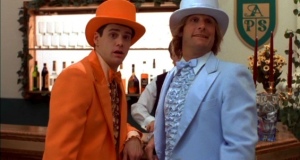
Last night, I turned on Comedy Central and I watched the 1994 comedy Dumb and Dumber.
Why Was I Watching It?
Last night was my first time to ever sit down and watch Dumb and Dumber from beginning to end. I had seen several clips on YouTube and I had been assured by many people that Dumb and Dumber was one of the funniest movies ever made. Last night, since SyFy was not showing an original movie, I decided to find out for myself.
What Was It About?
Harry (played by Jeff Daniels) is dumb and Lloyd (Jim Carrey) is dumber. Harry has messy hair and Lloyd has a chipped tooth. They end up getting kicked out of their depressing apartment and this somehow leads to them going on a road trip from Rhode Island to Colorado. They’re looking for Lloyd’s dream girl, Mary (Lauren Holly). Along the way, they’re pursued by a gangsters and engage in a lot of disgusting adventures. It’s a dumb movie about dumb people doing dumb things.
What Worked?
I laughed once while watching the film. It was a weary laugh that was largely the result of being slowly worn down by the film’s insistence that what I was watching was actually funny. It wasn’t a sincere laugh. It was a laugh of surrender but it was a laugh nonetheless.
Jeff Daniels is currently best known for playing Will McAvoy, the smug and condescending center of HBO’s The Newsroom. That show’s pilot famously started off with McAvoy declaring that the millenials are the “WORST. GENERATION. EVER.” As a member of the WORST. GENERATION. EVER, I have to say that there was something oddly satisfying about seeing Jeff Daniels getting continually humiliated (and, at one point, set on fire) in Dumb and Dumber.
What Did Not Work?
Just to judge by the reaction on twitter while Dumb and Dumber was playing, a lot of people are going to disagree with me on this but Dumb and Dumber sucks. Seriously. The film’s constant gross-out humor felt more lazy than clever and watching it quickly became as tedious as watching a commercial featuring a celebrity talking to their iPhone. As I watched Dumb and Dumber, I found myself constantly checking the time and wondering, “Is the film ever going to actually get funny?”
One of the keys to succesful film comedy is that you have to believe that the characters have an actual stake in the film’s plot, regardless of how ludicrous or over-the-top the plot may get. That stake is the difference between silly and funny. With Jeff Daniels looking extremely uncomfortable and Jim Carrey apparently acting in a separate movie from everyone else, Dumb and Dumber is silly without ever really being funny.
Maybe it was easier to make people laugh in 1994.
“Oh my God! Just like me!” Moments
For once, I’m glad to say that a movie featured absolutely no “Oh my God! Just like me!” moments.
Actually, I take that back. Both me and Lauren Holly have the same hair color. So, that was just like me.
But that is it!
Lessons Learned
Comedy, like beauty, is in the eye of the beholder.


 Through the Shattered Lens