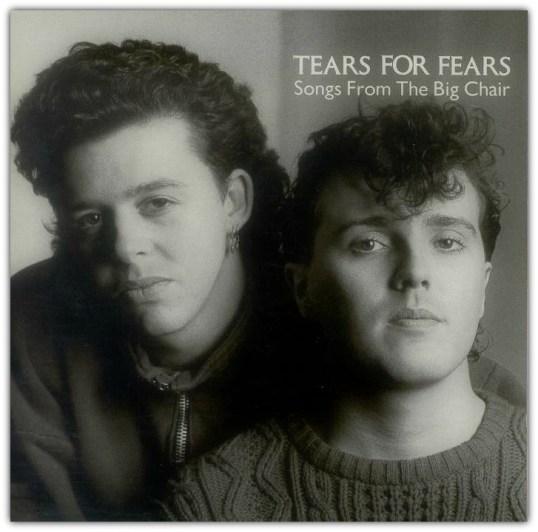
I will readily admit that I am a child of the 80’s. I grew up listening to 80’s music whether it was metal (though I didn’t truly listen to them until the 90’s), rap all the way to synthpop and new wave which became quite popular during the decade with groups such as Depeche Mode, INXS, Duran Duran and The Cure. One band which I listened to quite a bit during the mid-80’s was the British new wave band Tears For Fears. It’s from this band that the latest “Song of the Day” comes from: “Everybody Wants To Rule The World”.
The song is actually an 80’s classic that has stood the test of time and musical taste. While many scoff and ridicule most of the pop songs which blew up during the 80’s this particular song from Tears For Fears was never one of them. While the song does have a foundation in the synthpop sound of the time the song itself doesn’t really sound like most of the 80’s pop music. The lyrics are socially aware without being too preachy. In fact, if one was to listen to the song now it’s original message of limitless optimism in the future for everyone actually sounds a bit selfish in today’s social climate.
The song has been covered quite a bit by many singers and bands of different stripes from such groups as The Dresden Dolls, Clare & The Reasons and Dru Hill right up to the pop punk band Care Bares on Fire whose cover was used during the end credits for Season 5, Episode 9 of True Blood which used the song’s title as the episode title. I’m not a huge fan of that particular cover which made me decide to choose the original version as the latest “Song of the Day” to point out that the original may be old, but it will always be the best.
Everybody Wants To Rule The World
Welcome to your life There’s no turning back Even while we sleep We will find you acting on your best behavior Turn your back on Mother Nature Everybody wants to rule the world
It’s my own design It’s my own remorse Help me to decide Help me make the most Of freedom and of pleasure Nothing ever lasts forever Everybody wants to rule the world
There’s a room where the light won’t find you Holding hands while the walls come tumbling down When they do I’ll be right behind you So glad we’ve almost made it So sad they had to fade it Everybody wants to rule the world
I can’t stand this indecision Married with a lack of vision Everybody wants to rule the world Say that you’ll never never never never need it One headline why believe it? Everybody wants to rule the world
All for freedom and for pleasure Nothing ever lasts forever Everybody wants to rule the world
Tonight’s episode of True Blood saw the apparent conclusion of two storylines.
First off, do you remember how, two weeks ago, I predicted that the Dragon would turn out to be Bud Dearborn (William Sanderson)?
Well, I was kinda right. The Dragon wasn’t Bud Dearborn. Instead, the Dragon was Sweetie, the plump woman who Bud had taken up with since leaving his wife. We really didn’t find out too much about the Dragon, beyond the fact that she’s a bit on the heavy-side and she enjoys square dancing and, quite frankly, I felt a little bit let down by the revelation that, after all the build up and mystery, the Dragon was just a broadly drawn stereotype. It is true that, in the past, True Blood has effectively used stereotypical characters to make a bigger point but tonight, the revelation that Sweetie was the Dragon just fell flat.
I have mixed feelings about how the whole “Obamas” plotline was wrapped up during tonight’s episode. At its best, the storyline managed to show how prejudice is often the product of people feeling as if they have no power over their lives, no hope for the future, and that they need a scapegoat to hold responsible for their own failures. As well, I also appreciated that the show actually had them wearing Obama masks because, quite frankly, it’s the closest any show has come to poking fun at the President since the South Park election episode way back in 2008. It has nothing to do with the Obama’s politics or my own beliefs. I just happen to believe that all leaders, regardless of who they are or what they represent, should be frequently ridiculed.
(Aaron Sorkin’s Newsroom may get more critical acclaim but trust me — Aaron Sorkin will never have the guts to write an episode featuring a murderer in a Barack Obama mask.)
After a nice build up, however, it was hard not to be disappointed with how conventional and predictable the conclusion to the whole Obamas subplot eventually turned out to be. Sookie, with the aid of helpful spirits that happened to be hanging out in her bedroom, figured out that Bud Dearborn might know who killed her parents. She went to see him about it and ended up getting knocked out by a frying pan-weilding Sweetie.
When she came to, Sookie discovered that she was tied up and trapped in a pig pin with Hoyt (and I have to say that I cringed a little at this because I grew up near enough farms that I have first hand experience with just how disgusting pigs really are). Luckily, it turned out that Dearborn and Sweetie were the type of villains who can’t ever just kill anyone without delivering a lengthy monologue beforehand. This, fortunately, gave Sam, Luna, Andy, and Jason time to show up at the barn and save the day. It also gave Andy a chance to prove his worth as a lawman by gunning down Bud Dearborn.
Meanwhile, in this episode’s other major plotline, True Blood factories across the world are being bombed and both vampires and humans are in a panic. Tara, at first, suggests to Pam that they should stock up on their supply of True Blood but Pam informs Tara that they will keep selling True Blood and, once they run out, they will discreetly feed on humans. Meanwhile, the Rev. Newlin is condemning the bombings, despite the fact that the Authority is secretly responsible.
That’s right. The new Salome-led Authority has figured out that the easiest way to provoke a war between humans and vampires is to cause a True Blood shortage. When Eric asks Bill if he truly thinks this is a good idea, Bill replies that he’s not sure but that he does know that he saw Lillith earlier. When Eric and Molly, the cool techie vampire who is my favorite new character this season because she just seems so annoyed with everything in general, attempt to escape from Authority Headquarters, they are apparently betrayed by Bill. So, is Bill now a true believer or does he have a plan of his own? I’m betting on the latter.
Speaking of manipulative vampires, Russell and the Rev. Newlin paid a visit on the wolf pack where, after putting J.D. in his place, Russell proceeded to take Emma (in wolf puppy form) out of Martha’s hands and gave her to the Rev. Newlin. While I’m always happy to see wolf puppy, this development made me go, “Agck!” Seriously, Rev. Newlin’s perpetual smile is so creepy!
Along with the Obamas, another subplot concluded with tonight’s episode but it was a subplot that nobody ever really cared that much about so I’ll just say that Terry finally killed Patrick and the fire demon appeared to be satisfied. So, good for Terry and Arlene.
Random Thoughts and Observations:
I have to admit that tonight’s episode was not one of my favorites. Part of the show’s appeal has always been its willingness to go to extremes but tonight’s episode felt over the top even for True Blood.
I also felt a bit cheated that the scene that popped up in all the previews for this episode — Bill apparently biting Sookie — turned out to just be an elaborate hallucination on Bill’s part. It’s hard not to feel that the show didn’t play fair as far as that was concerned.
Tonight’s unofficial scene count: 45.
Performance-wise, this episode really belonged to Chris Bauer. Andy may not be the smartest character on the show but Bauer brought some much needed depth to the role on tonight’s show.
Though she only had about a minute of screen time, Dale Dickey continues to make a strong impression in the role of Martha.
I would have to go back and rewatch the previous seasons to know for sure but some people online are complaining that Bud Dearborn’s villainy seemed to come out of nowhere. Simply going by my own faulty memory (and please remember, I do not claim to be a True Blood expert, merely a fan of the show), I can see their point. The episode seemed to suggest that Sweetie was the one who brought out his evil side but still…
William Sanderson, incidentally, is one of my favorite character actors. He has a special talent for creating Southern eccentrics (which may be because he apparently is a Southern eccentric himself) and I have to admit that I was a little sad to see his character so casually killed off tonight.
Last night, I watched a little film called Shark Week on the SyFy channel.
Frankie Cullen in Shark Week
Why Was I Watching It?
I was watching for a few reasons. Number one, it was on the SyFy Network and that’s always a good sign. Number two, it’s the latest film to be produced by the folks at the Asylum and that’s usually another good sign that the film, if nothing else, is going to be an interesting viewing experience. Finally, some of the wittiest people on twitter were live tweeting this film and they were tolerant enough not to block me when I decided not to join in.
What’s It About?
It’s Saw Meets Jaws!
So, there’s this evil millionaire guy named Tiberon (played by Patrick Bergin) and he apparently owns a private island just south of the Florida keys and he’s a little bit upset because his son is dead and there’s 8 people that he holds responsible for the death. Those 8 people all have individual names but, to be honest, they’re all pretty interchangeable and I found it easier just to refer to them all by nicknames like Blue Shirt, Tattoo Girl, Skinny Vin Diesel, Ugly Katy Perry, and my personal favorite character in the entire film, Psuedo Arquette (who was played by Frankie Cullen).
Tiberon and his assistant Elena (played by Yancy Butler) kidnap our 8 victims and dump them on an island where they’re forced to fight for their right to live while having to deal with several shark-related booby traps. Why? I assume because the evil guy is named Tiberon (and yes, that’s how he spells it, according to the imdb). Just imagine if the guy was named Kittens. It would have been a totally different movie.
What Worked?
Speaking of the imdb, one reviewer over on that site has already declared that Shark Week is the worst film ever made. To him, I say, “Calm down, your judgmental toadsucker.” Shark Week is a low-budget film with a bunch of hammy acting and obviously cheap special effects. It’s also a lot of fun. Shark Week, like the best SyFy offerings, is a film that’s been specifically designed to inspire you to talk back to your TV. Shark Week is not a film that you watch alone while jotting down critical observations in your Hello Kitty notebook. Shark Week is a movie that you watch with a bunch of friends and you have a good time while doing so. Shark Week doesn’t take itself seriously and neither should you.
Plus, I absolutely adored Frankie Cullen, who played a character named Frankie. I, however, referred to him as Pseudo Arquette throughout the entire film because he really does look like a less goofy, more manly version of David Arquette. I mentioned on twitter that I thought Pseudo Arquette was the cutest guy on the island. “Sweetie, he’s a porn star,” someone tweeted back, referring to the fact that, outside of Shark Week, Cullen’s filmography is made up of movies like Celebrity Sex Tape, The Breastford Wives, The Devil Wears Nada, and Busty Coeds Vs. Lusty Cheerleaders. Well, no matter. I still loved my Psuedo Arquette.
Speaking of which, if I ever take up a second career as a super-powered crime fighter, I hope that the newspapers call me, “Busty CoEd.” As in, “Thank you, Busty CoEd, you saved our town! YAY!”
What Didn’t Work?
The title was a bit of a problem because the film appeared to take place over the course of just two or three days. Certainly, they weren’t on that island for an entire week. Add to that, we were using the #SharkWeek hashtag on twitter to talk about the film while we were watching it and, as a result, we had to deal with other people making random comments like, “I can’t wait for #SharkWeek to start on the Discovery Channel!” Seriously, it got a little annoying after a while.
“Oh my God! Just Like Me!” Moments
Much like Tattoo Girl and Ugly Katy Perry, I’m scared of sharks, too. That’s one of the many reasons why I always stay in the shallow end of the pool.
Lessons Learned
Two lessons learned: First off, you can literally do anything as long as you’re in international waters. Secondly, baby sharks are seriously cute.
It’s been over a year since I’ve chosen a new “Hottie of the Day”. Fellow site writer Leonard made the last choice with Lynn Collins just in time for the release of John Carter. I thought it was a good follow-up that my newest choice also be just in time for a new film release. Making a second return to the site is the ridiculously beautiful British actress and all-around badass Kate Beckinsale.
Ms. Beckinsale made her first appearance on this feature just a little under two years ago. She now returns just in time for the release of the Len Wiseman directed (aka Mr. Beckinsale) remake of the 1990’s Paul Verhoeven/Schwarzenneger collaboration Total Recall. To say that she shined in every scene she was in during this remake would be an understatement. The film was fun, but Kate and her scenes just made it better if just for those moments.
So, without further adieu time to gaze on the lovely Kate Beckinsale.
VGM Entry 07: Other chip options
(Thanks to Tish at FFShrine for the banner)
I am at the unfortunate disadvantage of having no clue what key terms such as “FM Synthesis” and “Programmable Sound Generator” really mean, and no amount of reading technical explanations or listening to arbitrary examples of audio employing one or the other is really going to fill me in. I feel like it is the very sort of thing this series of articles is intended to explain, but it’s not currently within my grasp.
One thing I’d like to know is what makes arcade games like Tube Panic (Nichibutsu/Fujitek, 1984) sound so much better than their arcade predecessors of only a year or two prior. (Unfortunately this composer’s name has eluded me, perhaps lost in translation.) This game uses a General Instrument AY-3-8910 chip, or so I am told, which is a PSG. So did Jungle Hunt, and the two are worlds apart. Jungle Hunt‘s three very basic tones could barely hold themselves together, constantly breaking out of rhythm and sounding quite primitive even when they all synced up. Of course the glitchiness was part of the charm, but Tube Panic is an entirely different animal. There is definitely no sense that the system is struggling to contain the music, and the tones are much fuller. What changed? And if it’s the case that later arcade games stacked multiple audio chips where early ones did not, how exactly does this effect the end product?
There is one thing I’ve noticed, and it’s probably both an amateur observation for those who know what they’re talking about and a pointless one for those who don’t. But it seems to me like audio employing FM-synthesis is much cleaner.
Thexder (Game Arts, 1985) for instance was composed by Hibiki Godai and released for the NEC PC-8801 the same year that this system began to incorporate a Yamaha YM2203 sound chip, which, as best I understand it, used FM synthesis. Whatever that actually entails, what I seem to be hearing here is a lack of distortion never attained with the AY-3-8910, or with the Commodore 64 SID for that matter (another PSG). That’s not necessarily a good or bad thing–distortion was the perfecting touch to the early Ultima soundtracks (the Mockingboard also employed multiple AY-3-8910 chips) and it would be the focal point for some of the best ZX Spectrum titles. But there is a noticeable difference in clarity, and if I had to guess I’d say it’s the dominant difference between FM synthesis chips and PSGs.
The most impressive early consequence of this cleaner sound is Marble Madness (Atari, 1984), which used the YM2151, an FM synthesis chip similar to the YM2203. The music Brad Fuller and Hal Cannon manage to create here is gorgeous and completely unbecoming of an otherwise conceptually mundane video game. The music of Marble Madness can essentially function as a stand alone semi-ambient synth album. With a few exceptions and a little longer content it could have been commercially released independent of any game to reasonable acclaim, and it is not all that particularly different from the sort of works you might expect on the Yamaha keyboards employed by 1980s synth musicians. Tasking Brad Fuller and Hal Cannon with the job and providing them with the sound chip to get it done might have been one of the only things Atari did right in the 1980s.
The last thing to note here is that Earl Vickers is credited as the Marble Madness sound programmer. This is one of the earliest games for which I’ve noticed different names associated with ‘composition’ and ‘sound programming’, and it’s a confusing distinction which will impact plenty of future discussions.
VGM Entry 06: Hubbard’s covers
(Thanks to Tish at FFShrine for the banner)
Monty on the Run is arguably Rob Hubbard’s most famous work today, and perhaps because of that I am inclined to believe it was one of his most distributed songs at the time, but it remains one game among many. A broad and stylistically diverse collection of games released in 1985 all featured Hubbard’s novel techniques as well as his high standard of quality, and it was through this larger catalog that Hubbard really made his mark on the future of game sound. What may come as a surprise is that a lot of these songs were not actually original. Hubbard had a knack for finding obscure preexisting songs that could translate well into the SID sound.
In fact, Monty on the Run was essentially a cover song. It was a rock arrangement of “Devil’s Galop”, a classical piece by Charles Williams which served as the theme to the radio show Dick Barton – Special Agent. Dick Barton, moreover, aired from 1946 until 1951, and Hubbard was born in 1955, so I doubt the choice was merely nostalgic. But whatever inspired him to choose the song, rock and roll was no obvious style through which to reinterpret it. It took a pretty unique ear to hear this and envision a C64 chiptune epic.
It helped that Hubbard was an experienced musician. His career began as a studio musician, not a programmer, and his first effort as a programmer was to design musical education software for the Commodore 64. When he submitted the project to Gremlin Graphics, it was his demo songs rather than the associated software that peaked their interest, and his new career was born.
Elsewhere, Hubbard took more recent and relevant inspiration. Master of Magic (Richard Darling, published by Mastertronic, 1985) was an arrangement of “Shibolet”, written by Larry Fast for his Synergy project and released on Audion in 1981. Trying to obtain more than a 10 second clip of the original has become more trouble than it’s worth for me, but I have to imagine that, as with all else, Hubbard made it uniquely his own.
The fact that he was even listening to contemporary synth composers–far more relevant to chiptunes than say, classical music–says a bit about how he viewed his work. Certainly Monty on the Run had a ‘guitar’ solo, but I doubt he intended the song to sound like an actual rock band in the same sort of way that some early NES composers tried to emulate real orchestras. In covering a synth artist, he was turning to a style of music designed for precisely the type of instrument the Commodore 64 was. He employed the sounds available to him for what they were, not for what they distantly resembled. This concept of viewing the SID as an instrument, not as a means to approximate instruments, is not an obvious step, and it’s much to his credit that C64 sound came to evolve as an instrument in the first place. I think it’s telling that when the likes of Tim Follin and Neil Baldwin began composing for the NES their music had a distinct Commodore 64 sound; Hubbard’s SID manipulations manifested as a unique and classifiable style of music.
His most exciting early work to consider is Rasputin (Firebird, 1985). It is derived from traditional and early Soviet-era Russian folk tunes, but wait a minute here. Yes, Tetris was created in 1984, but Alexey Pajitnov’s original was silent, and in any case it was initially isolated to the U.S.S.R. Hirokazu Tanaka, another video game music legend, composed its famous tunes based on Russian folk songs, but that wasn’t until 1989. Whether Rob Hubbard influenced him or not, the reverse is certainly not the case.
szigand on youtube actually took the trouble to dissect the components of this song and the order they appear in. It’s an amalgamation of Katyusha by Soviet composer Matvey Blanter, Czardas by Italian composer Vittorio Monti, and the traditional Hungarian folk song Kaljinka. Where Hubbard might have found them, let alone what inspired him to combine them into a chiptune classic, is anyone’s guess, but the result is brilliant.
Earlier today, Jeff and I went down to the AMC Valley View and saw the new sci-fi comedy The Watch. The Watch has been getting universally negative reviews and it’s proving to be a bit of a bust at the box office (including Jeff and me, there were about 10 people at the showing we saw) but it was still a film that I was looking forward to seeing. This is largely because the film stars three actors — Ben Stiller, Jonah Hill, and Vince Vaughn — who are rarely popular with film critics but who almost always seem to find a way to make me laugh.
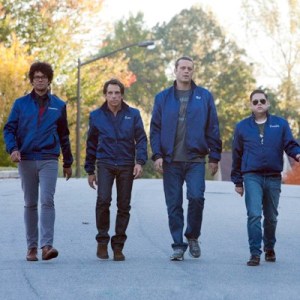
In The Watch, Ben Stiller plays a suburbanite who deals with his frustrating existence by forming clubs and obsessing over his job as the manager of the local Costco. (Costco, by the way, is actually a major plot point in the overall film and I would say that close to 60% of the actual film either takes place in Costco or involves characters talking about how much they love Costco. Unlike a lot of critics, I’m not morally offended by blatant product placement but, even for me, The Watch went a little bit overboard with all the Costco hype.) Wen the security guard at the Costco is brutally murdered, Stiller decides to form a neighborhood watch so that he can track down the killer. After giving an impassioned speech at a high school football team, Stiller is able to recruit three more members of the neighborhood watch. Vince Vaughn is a goofy guy who is overprotective of his daughter. Jonah Hill is a psycho with a knife and a frustrated desire to be a policeman. And Richard Ayoade is … well, he’s kinda strange but that’s explained away by the fact that he’s apparently English.
And together, they solve crimes!
The solution in this case is that the suburbs have been invaded by aliens. Those aliens have a diabolical plan of their own and it’s up the Neighborhood Watch to stop them. And did I mention that all of this somehow involves Costco?
Because it totally does.
I think The Watch can best be summed up in one word: Forgettable. It’s not a great film but it has a few funny moments. Director Akiva Schaffer got his start directing comedic short films for Saturday Night Live and that’s pretty much the same approach that he brings to The Watch. Every scene feels like a self-contained short film and the end result is a wildly uneven movie that never finds a consistent tone or really seems to be sure just what type of story it’s trying to tell. The mix of raunchy comedy, sci-fi drama, and sentimental bromance never quite gels and, as a result, watching the film almost feels like being forced to try to concentrate on three different movies at once, never being allowed to truly focus on a single one of them.
However, taking all of that into account, I still have to say that I laughed out loud several times during The Watch. I may not have laughed quite as much as the 300 lbs. gentleman, sitting two rows behind us, who sounded as if he might choke to death every time Vince Vaughn delivered the line, “It feels like cum,” but I still laughed. The Watch is a funny movie. Quite frankly, with a cast like this, there’s no way that the movie couldn’t have been funny. The main thing that I love about watching Vince Vaughn and Jonah Hill is the way that both of them bring an almost earnest sincerity to even the most ludicrous of roles. As a result, Hill and Vaughn are actors who can get laughs out of even the weakest of jokes and they certainly get a oppurtunity to prove it in The Watch. Meanwhile, Ayoade gives a wonderfully bizarre performance, scoring a lot of laughs just from being so consistently odd. Ben Stiller does his usual uptight suburbanite routine and makes a good straight man for his 3 co-stars. The Watch is at its best when it just lets its four stars hang out and play off of each other.
For such a forgettable film, The Watch has been the subject of some controversy. The film was originally titled Neighborhood Watch until, earlier this year, Trayvon Martin was shot and killed by a member of a real life neighborhood watch. The title was changed to avoid being “insensitive.” Regardless of the film’s title, I have to admit that I did cringe a little at a rather lengthy joke that involved the film’s heroes — all wearing their “neighborhood watch” jackets — firing several bullets into the body of an apparently dead alien. That said, The Watch is ultimately neither pro nor anti-neighborhood watch. In the end, the only thing that the film seems to truly believe in is the universal importance of Costco.
VGM Entry 05: SID comes to life
(Thanks to Tish at FFShrine for the banner)
1985 was the year that changed video game music forever, and this transpired primarily through the mediums of the Commodore 64 and the Nintendo Entertainment System. At a glance it can seem a lot easier to discuss the latter, what with Koji Kondo’s classics being performed around the world in symphonies today. The former still lacks a formalized history. Where people will readily make the bold and overpresumptuous claim that Super Mario Bros. revolutionized NES music, or even all game music, you don’t really hear the same claim being made about Monty on the Run. This is good, because neither are entirely true. The main difference I suppose is that Super Mario Bros. was undeniably the most popular game of its day, while you may well have never even heard of Monty on the Run. I don’t know if its priority over other Commodore 64 works stems from greater marketing success in 1985 or from a later acknowledgement that it was probably the best among a whole lot of excellent songs.
Let’s focus on the Commodore 64 first. The C64 sound revolution required a lot of programming innovations. The sort of sounds Rob Hubbard, Martin Galway, and the like were able to produce weren’t preset to the click of a button, and they weren’t at all obvious. Hubbard was most certainly the first prolific composer for the system, and a lot of SID programming innovations were his in origin, but to what extent C64 musicians influenced each other at this point in time is hard to say.
Monty on the Run (Gremlin Graphics, 1985) is probably Rob Hubbard’s most famous work, granted it was one of many he composed in 1985, and the improvement here over C64 examples from previous years is certainly staggering. I mean, games like 3D Skramble in 1983 may serve as fine examples of the SID’s naturally appealing tones, but they certainly don’t predict a chip and roll epic. With Rob Hubbard in 1985, and with Monty on the Run as the hallmark, we can really mark the end of serious technological limitations for home gaming sound. Programming sound for the Commodore 64 was a painstaking process no doubt, but its sound capacity was not so limiting as to physically deny quality in anything but the obscure/avantgarde. It took sound programmers a while to catch on, and perhaps, in light of the fact that they were not previously expected to compose great music for home game systems, it took a while for developers and real musicians to partner up. But three years after the release of the Commodore 64 and its legendary SID chip, home gaming music really came into its own.
Despite both making their first major waves in 1985, western and Japanese sound programming probably developed independently at first. Early game composers tended to stay within their regional spheres of influence. The European movement was not exclusive to the SID, but rather to local systems. Rob Hubbard for instance composed for the ZX Spectrum as well as the Commodore 64 early on, scoring such games as Spellbound (Mastertronic, 1985), but he never really branched out to Japanese gaming mediums. The Commodore 64, ZX Spectrum, and Amstrad CPC formed a fairly isolated pocket of platforms. Similarly, Koji Kondo composed exclusively for Nintendo, and Nobuo Uematsu’s non-NES works were all on computers of Japanese origin, such as the PC-8801 and MSX. A few British musicians, notably Tim Follin and Neil Baldwin, would later turn to the Nintendo, but the language barrier proved daunting. Some of Neil Baldwin’s best works were never commercially released due to communication difficulties between British developers and Japanese producers.
The most interesting indicator of what was going on with the Commodore 64 might be “Synth Sample” by Georg Feil. Composed in 1984 or 1985, it was a widely distributed file in the early days of the internet and had no affiliation with any sort of commercial enterprise. No one needed to ‘invent’ game music. It wasn’t discovered; it didn’t come to the first sound programmer as a sort of epiphany. It was the natural result of improvements in sound chips. Once the potential for good music was out there, it would happen with or without support from major game developers. The SID sounded great, it still sounds great, and it was an inspirational instrument in its own right. Hubbard and others might have been lucky enough to be paid a pittance for their works, but I like to think of them as musicians more so than ‘composers’ in the commercial sense.
VGM Entry 04: The dark ages
(Thanks to Tish at FFShrine for the banner
One of the final systems to be categorized as “second generation” was Coleco’s ColecoVision, released in 1982. It also happens to be the only second generation system for which I have found an example of good music.
I don’t believe that any music actually appears in the original arcade version of SubRoc-3D (Sega, 1982), but the following year’s ColecoVision port features a wild avant-garde pause screen tune that I really think captures the best second gen technology had to offer. Certainly the ColecoVision had better audio than the Atari 2600 to begin with, but it’s a little easier to imagine a piece like this on other platforms. Who needs a coherent melody anyway? On more advanced systems like the Nintendo, game audio is plagued by attempts to capture musical styles beyond the system’s means. Nobuo Uematsu for instance may be found guilty on such charges, and the scores for the first three Final Fantasy titles really aren’t all they’re cracked up to be. What you get with SubRoc-3D is a pretty early example of a sound programmer adapting musical style to the needs of the machine.
But the third generation and its partners in crime did not rise up from the dust and ashes in 1985. The mediums through which the first really great video game music would take shape often originated years before developers, and specifically sound programmers, took notice of them. Just as the Atari 2600, a pop culture icon of the early 80s, was actually released in 1977, gaming as it came to be redefined around 1985 often took place on early 1980s systems. The gap between system release and major game development would not really disappear until the fourth generation. If you look for music in the earliest years of the Commodore 64 for instance, the best you’re going to find–or at least the best I could find–are tunes like that of 3D Skramble (Anirog, 1983). Given what Commodore 64 music would soon become without any improvements in technology, it’s reasonable to wonder whether a few solid early 80s works have been forgotten over time.
A lot of the early to mid-80s systems which would resuscitate the video game industry are a bit obscure. Different systems thrived in different markets, and the North American gamer is not likely to have ever heard of say, the PC-8801 or the MSX, despite their significance in Japan. Let’s take a moment to look at some of the names that will be reoccurring throughout this series of articles. I’m not going to pretend I know much about them, but at least some name recognition will help clarify future events.
The one overwhelming exception to the rule of ho-hum early 80s home gaming music is Ultima III: Exodus, composed by Kenneth W. Arnold and released across a large variety of systems (and thus a large variety of audio formats). I will be returning to it later, but I thought it might provide a nice background piece for the moment.
1977 – Apple II
The Apple II was a home computer designed by Steve Wozniak and released in 1977. (Steve Jobs was little more than a shady businessman exploiting his success as far as I’m concerned, though I don’t know whether Wozniak would agree). As with any system of that era, its sound capacity was very limited, but upgrades were developed over the following years. Sweet Microsystems released their first Apple II soundcard, Sound I, in 1981, and at some point in time between then and 1983 this was upgraded into the Mockingboard A, which used the General Instrument AY-3-8910 Programmable Sound Generator (PSG). Game audio as it actually sounded through the Mockingboard is a little hard to come by these days, but the most important music to utilize the Mockingboard, that of the Ultima series, has been faithfully reconstructed.
1981 – PC-8801
NEC Corporation’s PC-8801 was a computer only released in Japan, and judging by the shear quantity of material created for it I have to imagine it became Japan’s most dominant gaming system. As a musical entity the PC-8801 came to life in 1985, when new models began to incorporate the Yamaha YM2203 FM synthesis chip.
1982 – ZX Spectrum
Britian’s Sinclair Research Ltd. released the ZX Spectrum home computer in April 1982. Musically, the ZX Spectrum would always take second stage to the Commodore 64, but it was sufficiently capable for some significant names in sound programming to work their magic on it. Later ZX Spectrum models would employ the General Instrument AY-3-8910 PSG.
1982 – Commodore 64
Commodore International was founded in Toronto and headquartered in Pennsylvania, but their Commodore 64 found the bulk of its success in Europe. Released in August 1982, it would become the quintessential medium for chiptunes. Its SID chip (Sound Interface Device) continues to define the genre today, and the most famous European sound programmers of the 1980s all had a go at it. Through the SID such figures as Rob Hubbard, Tim Follin, Martin Galway, Chris Hülsbeck, Jeroen Tel, and Neil Baldwin would revolutionize game music.
1982 – FM-7
The FM-7, or Fujitsu Micro 7, was a Japanese home computer equipped with the AY-3-8910 for which little original game material has been brought to my attention. Occasional game port projects for the FM-7 may make for some interesting comparisons.
1983 – MSX
The AY-3-8910 was a prolifically distributed chip, and it found its way into the MSX as well. The MSX was an industry standardization project headed by Kazuhiko Nishi, vice-president of Microsoft’s Japanese branch and director of ASCII. The MSX model found a lot of success outside of the United States, and many early computer games were designed for it. This was followed by the MSX2 in 1985, which switched the audio chip to a Yamaha YM2149 PSG. I am not sure that this should be considered an upgrade though. As I understand it the YM2149 was a replica of the AY-3-8910, produced by Yamaha under license from General Instrument. At any rate, games like Vampire Killer (Konami, 1986) and Final Fantasy (Square, 1987, ported in 1989) would feature it.
1983 – Famicom/Nintendo Entertainment System (NES)
The NES requires little introduction, but it is certainly worth reiterating the fact that it was released in 1983. Super Mario Bros. was not actually a launch title (though it would be in the United States), and it would take two years, and arguably the brilliance of Koji Kondo, to really get the Nintendo game music revolution under way. NES hardware included its own audio design.
1984 – Amstrad CPC
Amstrad was yet another British company to employ the AY-3-8910. Amstrad would go on to purchase the rights to the ZX Spectrum in 1986 and develop new models of that system, so the CPC and later versions of the Spectrum would have a lot of technological overlap.
1985 – Sega Master System (SMS)
Sega showed up late on the scene with their Master System, in part because it was a recovery from the relative failure of the SG-1000, released in 1983. The Master System faired only slightly better. It used the Texas Instruments SN76489A–the same PSG chip appearing in the ColecoVision sampled above.
1985 – Amiga
The Amiga was Commodore’s next generation of home computers, with the original Amiga 1000 designed to be a major upgrade over the Commodore 64 (which dated back to 1982). But much like the Atari 2600, the Commodore 64 came into its prime a few years after its release, and consumers weren’t quite ready to upgrade in 1985. It would be the Amiga 500 version, released in 1987, that became the C64’s rightful heir. Like the C64, the Amiga had its own unique sound chip, called Paula.




 Through the Shattered Lens