For today’s public domain horror film, I present to you 1959’s Attack of the Giant Leeches. This 60-minute film is a classic Drive-in film. While it has its slow spots, it also features an iconic performance from Yvette Vickers, who is like one of my favorites of the strong, confident, unapologetically sexy women who dominated the old B-movies. (Plus, she was only 5’3 and it’s not easy being brave when you’re having to look up at everyone. Trust me, I know.) Sadly, she passed away under truly sad circumstances last year but instead of going into that, I’d rather just remember the classic performance that she gives in this film.
I have to admit that I’m kinda freaked out by the scenes of people floating underwater in this film. And leeches … agck! Don’t even get me started on leeches. Especially giant leeches…
My father was working in a precinct in Manhattan, and on occasion, my family would have to drive into the city to either get his check or help him file / retrieve something there. Whenever we went to Manhattan, we always saw something grand, like the “Ghost Building” which was shimmered in white light (this was actually Rockefeller Center, but my little sister, brother and I never knew). We once even saw the ’89 Batmobile tear through the city on it’s way to deliver the video release of Tim Burton’s Batman to the Tower Records uptown.
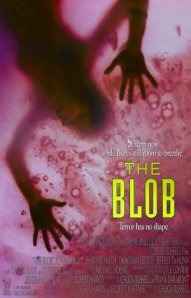
At a stop light, right by the Flatiron Building, I happened to glance around at some of the construction scaffolds. They always put movie posters on there, and I’d squint to see what was coming out soon. That’s when it caught my eye, a pink poster that looked like someone was swimming underwater. We got a little closer as my dad had to make a turn and I was then able to make it out.
“Oh no.”, I muttered, scrunching down in my seat. “They redid it.” All my childhood fears came flooding up in a wave of memories.
I once saw Larry Hagman’s Beware! The Blob (alternately known as Son of Blob) when I was really little. The idea that a gooey mass could squeeze under doors and through window cracks and anywhere there was a space freaked me out. This wasn’t Michael Meyers looking for his sister, or Jason Vorhees guarding Crystal Lake. There was no reasoning my little mind could use to feel better about it. Add to the fact it was only bothered by the cold, it made every summer a secret “look over the shoulder” one. When I attended my first bowling match for fun in college, I’ll admit I hesitated to step out into the bowling alley, if only for a second.
I never saw the movie in the theatre. I got so caught up in Who Framed Roger Rabbit, and everyone talked about Die Hard so much that The Blob became something of a blip to the school kids (from what I remember), but it remembered. I read the poster, and kept tabs on the writer’s names – Frank Darabont and Chuck Russell, who both went on to interesting projects over the years.
Okay, enough about my history with The Blob, let’s dig into the film, which is quite possibly one of the best remakes I’ve ever seen. It hits all of the notes of the original while setting down the groundwork for new directions when some fresh ideas. It’s not perfect, but it’s damn good.
The Blob is a re-telling of the classic 1958 film with Steve McQueen, only this time, Chuck Russell (The Mask) and Frank Darabont (The Shawshank Redemption, The Green Mile, The Mist) brought Kevin Dillon and Shawnee Smith aboard. It’s the story of a small town that receives a strange visitor from outer space in the form of a gelatenous mass inside of a meteor. When an old man gets a little too curious with a yard stick, it jumps out on and onto his hand. Needless to say, if you ever see anything fall from the sky, please, don’t go running to check it out. It never really ends well. At least, I’ve never heard of it doing so.
Anyway, like the original, the old man is found by the Gallant Hero (Donovan Leitch) and Heroine (Smith), who put him in their car and head to the local hospital. This results in the death of the old man, but also a twist in that the Gallant Hero is also killed / absorbed by the Blob. Shawnee’s character tries to save him, but to no avail. She’s should consider herself lucky that she made it through okay. While I didn’t see this in the theatre, I always wondered what effect that might have had on the audience. I mean, here you had the would be hero of the story and he’s taken out of the picture in the first act. That had to be amazing, I think.
As with the original, the Blob makes its way to the main part of town by way of the sewer, heading into the local movie theatre. Before getting there, there’s a interesting scene where Meg and Flagg (Dillon) – the bad boy turned reluctant hero – run into the Blob in a diner and hide in a nearby refrigerator. Rather than go with the classic “solidify it all in one piece”, Darabont and Russell decided to make the Blob’s freezing effect more like pieces of quartz. I thought this made things all the more scary – how could one really tell that all of it was ever collected while it was frozen?
One has to feel just a little sorry for Candy Clarke’s character. You run into a phone booth to make a phone call, only to have slime run down the sides. To top it off, you try to make a phone call for the local sheriff (played by Darabont favorite Jeffrey DeMunn from all of his films and The Walking Dead), and as if it answered for her, the Blob puts his decaying face right on the phone booth window. Another twist thrown in the remake is the death of a child. Usually in horror movies, kids are usually spared. Usually. Not so here, and it just adds to the horror of things. No one’s safe unless you’re walking around with some liquid nitrogen, and it’s not like that’s in great supply.
Eventually, we come to find – thanks to a lot of men in white suits and Crossroads Joe Seneca – that the Blob was actually man made, and it’s the scientists fault it came back the way it did. What I found interesting about that was the idea that they felt they had to burn it. Didn’t anyone think of bringing something cold? I mean, they’re scientists. Someone in the group had to have that idea at some point. Anyway, this all ends with a huge battle in the middle of a busy street and the townsfolk hiding in the municipal hall. Meg and Flagg do find a way to get everything fixed, but (as with many horror movies), we’re left with the promise of another sequel.
Overall, I loved The Blob. There’s very little I can find wrong with it, given that the source material was never really Oscar worthy to begin with. This was just a sit down for the adult in me, grab your popcorn and enjoy the film.
The kid in me prefers to watch this in a very cold room, just in case.
Hi! Good morning and Happy October the 26th! For today’s plunge into the world of public domain horror films, I’d like to present you with a true classic. From 1960, it’s the original Little Shop of Horrors!
When I was 19 years old, I was in a community theater production of the musical Little Shop of Horrors. Though I think I would have made the perfect Audrey, everybody always snickered whenever I sang so I ended up as a part of “the ensemble.” Being in the ensemble basically meant that I spent a lot of time dancing and showing off lots of cleavage. And you know what? The girl who did play Audrey was screechy, off-key, and annoying and after every show, all the old people in the audience always came back stage and ignored her and went straight over to me. So there.
Anyway, during rehearsals, our director thought it would be so funny if we all watched the original film. Now, I’m sorry to say, much like just about everyone else in the cast, this was my first exposure to the original and I even had to be told that the masochistic dentist patient was being played by Jack Nicholson. However, I’m also very proud to say that — out of that entire cast — I’m the only one who understood that the zero-budget film I was watching was actually better than the big spectacle we were attempting to perform on stage. Certainly, I understood the film better than that screechy little thing that was playing Audrey.
The first Little Shop of Horrors certainly isn’t scary and there’s nobody singing about somewhere that’s green (I always tear up when I hear that song, by the way). However, it is a very, very funny film with the just the right amount of a dark streak to make it perfect Halloween viewing.
So, if you have 72 minutes to kill, check out the original and the best Little Shop of Horrors…
Lisa Marie recently wrote up her very unique review of the James Bond film Live and Let Die and I’ve decided to use that review as the springboard for the latest “Song of the Day” entry. It’s easy enough to figure out that the latest choice is the similarly titled song from the film by Paul McCartney: “Live and Let Die”.
This song remains one of the most recognizable songs made specifically for a film. Most songs that become part of a film’s appeal tend to be pre-existing licensed songs and music. Live and Let Die would be the first James Bond film that would introduce Roger Moore as the British superspy and 007 agent. The song itself, written by Paul McCartney and his wife Linda, would become even more popular than the film through the years.
While the song has been covered by many bands and groups through the years it would be the cover by Guns N’ Roses in 1991 as part of their Use Your Illusion I album that many consider the best cover. I consider both favorite songs of mine, but I must pick McCartney’s original over the GnR cover by the smallest of margins.
Live and Let Die
When you were young and your heart was an open book You used to say live and let live you know you did you know you did you know you did But if this ever changin’ world in which we live in Makes you give in and cry Say live and let die Live and let die
What does it matter to ya When ya got a job to do Ya got to do it well You got to give the other fella hell
You used to say live and let live you know you did you know you did you know you did But if this ever changin’ world in which we live in Makes you give in and cry Say live and let die Live and let die
Hi there and Happy October 25th! For today’s treat from the ranks of horror films that have fallen into the public domain, I present to you one of the most important films in horror history. Though it wasn’t appreciated when it was first released back in 1964, The Last Man On Earth was not only the 1st Italian horror film but George Romero has also acknowledged it as an influence on his own Night of the Living Dead.
It’s easy to be a little bit dismissive of The Last Man On Earth. After all, the low-budget is obvious in every scene, the dubbing is off even by the standards of Italian horror, and just the name “Vincent Price” in the credits leads one to suspect that this will be another campy, B-movie. Perhaps that’s why I’m always surprised to rediscover that, taking all things into consideration, this is actually a pretty effective film. Price does have a few over-the-top moments but, for the most part, he gives one of his better performances here and the black-and-white images have an isolated, desolate starkness to them that go a long way towards making this film’s apocalypse a convincing one. The mass cremation scene always leaves me feeling rather uneasy.
The film is based on Richard Matheson’s I Am Legend and no, it’s nowhere as good as the book. However, it’s a lot better than the Will Smith version.
If you have 87 minutes to kill, please enjoy The Last Man On The Earth.
I know what you’re going to say before you say it.
“Okay, Lisa,” you sigh, “I hate to tell you this butLive and Let Dieis not a horror film. Live and Let Die is a James Bond film. In fact, it’s the first one to feature Roger Moore in the role of Bond. It’s the one where Yaphet Kotto is the guy who’s both a Harlem drug dealer and a world leader and he’s planning on importing all this heroin from Haiti or somewhere and Bond runs off with his Tarot card reader who is played by Jane Seymour, who has mismatched eyes, just like you!”
“Thank you,” I say in my shy little way as my cheeks flush red and my mismatched eyes glance downward.
“However,” you continue, “it’s hardly a horror film. Live and Let Die is just the James Bond film where they go to Louisiana and end up chasing each other in boats and then Clifton James shows up as this redneck sheriff and its just kinda embarrassing.”
“May I speak now?” I ask as I narrow my multi-colored eyes at you, “Now, to be honest, I’ve only recently started to really watch all of the old school James Bond films from the 60s and the 70s but Live and Let Die is actually one of my favorites, even with Clifton James as Sheriff J.W. Pepper. I mean, the film’s actually a lot of fun, Yaphet Kotto made a great villain, and even if Roger Moore wasn’t quite as sexy and dangerous as Sean Connery was, at least he wasn’t all stiff and humorless like Daniel Craig. In fact, I think it could be argued that Live and Let Die was the first — and maybe only — truly Grindhouse James Bond film. I just find it interesting how the whole film is basically a hybrid of all of the big exploitation genres of 1973. The scenes in Harlem and really the film’s entire plot is pretty much ripped off from blaxploitation while the voodoo scenes all have this kind of campy, Hammer feel to them. Even the scenes in Louisiana are an homage to the southern car chase movies that were apparently big at the drive-ins back then.”
“That’s all good and well, Lisa, but how does that make Live and Let Die a horror film? And don’t say it’s because Felix Leiter is played by David Hedison, the star of the original Fly because–”
“Hold on,” I say, “this is the point where we show the trailer.”
“Okay, Lisa Marie,” you say, “now that you’ve indulged in your bizarre trailer fetish, explain just how exactly this is a horror film and don’t try doing that thing you always do where you link it to some weird-ass thing that happened to you like ten years ago.”
My nostrils flare as I begin, “Ten years ago, me and my family were taking a vacation in voodoo country…”
“Lisa Marie, did you not read the previous paragraph?”
“Oh, sorry.” I pause in order to get my thoughts straight in my head. “Well, first off, let’s start with the opening credits. Now, I’ll be honest here and admit that I’ve always kinda wanted to be one of those girls that are always dancing around naked during the opening credits of all the old school James Bond films–”
“That’s a shock.”
“–so I always end up paying attention to those opening credits. I mean, that’s my time to fantasize about being in a James Bond film. And I have to say, the opening credits of Live and Let Die — Agck! Seriously, everyone always spends so much time talking about how great the theme song is that they kinda miss just how freaky and nightmarish those opening credits are. I mean, seriously, when you’re at home alone and you’re watching this in a dark room, these opening credits are genuinely unsettling. Here, check them out.”
“Okay,” you say, “I can see how the credits might freak you out but that’s just like 2 minutes of a two hour film–”
“Oh my God, I’m so not even done yet!” I snap, “This film isn’t about James Bond fighting drug dealers. All of that stuff with Yaphet Kotto and the heroin and all that — it’s all just an excuse to get to what the film is truly about: James Bond vs. Baron Samedi, the man who can not die! As played by Geoffrey Holder, Baron Samedi’s only in a few scenes but he dominates the entire film. I mean, it’s actually kinda funny because every time Baron Samedi shows up, someone dies but the film comes to life.”
“In fact,” I continue, now pretty much talking to myself, “when Baron Samedi first appears in the film, he’s killing this poor, terrified man by holding a poisonous snake up to the man’s face and oh my God, that scene freaked me out when I first saw it! In fact, it’s the only scene from a James Bond film that’s ever given me a nightmare. Even Eva Green drowning in Casino Royale didn’t freak me out as much as that snake scene did and you know I’m a lot more scared of drowning than I am of snakes. Which is odd since I live in Texas and there’s a lot more snakes around here than large bodies of water…”
“Slow down and breathe, Lisa Marie,” you say, “you’re getting off topic.”
“Right, sorry. Anyway, it’s a scary scene precisely because Baron Samedi seems to be enjoying killing the man so much. Then again, it could also be the fact that Baron Samedi had the most evil laugh ever. Seriously, listen to it in the scene below.”
As you watch the scene, I continue to speak, my words tumbling one after another out of my mouth, “But the scariest Baron Samedi scene isn’t even on YouTube. Seriously, YouTube sucks. I hate YouTube. I mean, you can find a thousand videos of silly people doing that Wii workout game in their underwear but you can’t find the freakiest Baron Samedi scene ever. Seriously, forget about Occupying Wall Street. Let’s occupy freaking YouTube and demand–”
“Focus, Lisa.”
“Sorry. Anyway, the freakiest scene in Live and Let Die and I would dare say the freakiest scene of the entire James Bond series, comes towards the end of the film. Baron Samedi pops up out of this grave and James Bond like shoots him and blows off half his forehead, right? And Baron Samedi just stand there perfectly still and emotionless. Then, his eyes slowly roll upward and stare up at where his forehead used to be. So, Bond shoots him like three more times and Baron Samedi just collapses like a rag doll. And then, suddenly, Baron Samedi — forehead intact — pops out of another grave and does that evil laugh of his! Oh. My. God! It is so freaky! I was watching it and I was just like…AGCK!
“And that,” I conclude, “is why Live and Let Die is a horror film.”
However, now that I’m finished, you don’t reply. I look up and I see that you’re gone.
Below is the trailer for the new zombie comedy Deadheads, which played to sell-out crowds at the Austin Film Festival. I’m usually a little bit hesitant whenever I see horror and comedy being mixed together because for those two genres to mix, a perfect balance must be struck. Otherwise, you end up with a horror film that’s too funny or a comedy that’s too scary. Still, I’ve heard good things about Deadheads from my friends in Austin and the trailer would seem to suggest that, at the very least, the film has a good heart and I hope it picks up a national distributor in the near future.
(Special thanks to frequent Shattered Lens commenter Jake Moore for alerting me to this trailer!)
When I first read Arleigh’s idea that we devote October to reviewing horror films, I knew immediately that there was no way I could let the month pass without saying a few words about one of the true classics of the horror genre, the 1973 best picture nominee The Exorcist.
Based on an equally scary novel by William Peter Blatty and directed by William Friedkin, The Exorcist is one of those films that has become so iconic that even people who have never seen it know what the movie is about. Chris McNeil (Ellen Burstyn) is an agnostic actress who is shooting a film about student protestors on a college campus. Her 12 year-old daughter, Regan (played by the future Grindhouse queen Linda Blair), spends her time playing with a Ouija Board and talking to her friend “Capt. Howdy.” Unfortunately, Capt. Howdy is actually a Sumerian demon who proceeds to posses Regan. Soon, Regan is levitating, cursing, and masturbating with a crucifix. After trying (and failing with) all the conventional methods of treatment, Chris desperately turns to the God she doesn’t believe in and tries to convince a troubled priest (Jason Miller) to perform an exorcism on Regan. Unfortunately, this priest has begun to question his faith and he fears that he might not be strong enough to “cure” Regan. An elderly priest (Max Von Sydow) is called in to help with the exorcism and, faster than you can say, “The power of Christ compels you,” the two priests are locked in mortal combat for Regan’s soul.
The ultimate test of any horror films is whether or not it’s still unsettling even after you already know what’s going to happen and when all the evil is going to come jumping out of the shadows. In short, the test is whether or not the film holds up to repeat viewings. This is a test that The Exorcist easily passes. I’ve seen this film enough times that I now know exactly when Linda Blair’s head is going to do that 360 degree turn and I now know exactly when to divert my eyes so I don’t have to see possessed Regan puking on the priests. (For all the terrible physical manifestations of Regan’s possessions, it’s always the vomiting that gets to me.) Most of the film’s “shock” sequences aren’t that scary any more because we’ve all seen far worse. However, watching this film remains, for me, a truly unsettling experience. This is due largely to director William Friedkin. Today’s aspiring filmmakers could learn a lot from Friedkin because, for all the attention the film’s grotesque effects received, Friedkin actually devotes more time to setting up the situation and establishing a palpable atmosphere of doom. This is a film full of grainy, almost gray images, the perfect visual suggestion of a world that has perhaps been abandoned by its God. It takes more than an hour before Ellen Burstyn meets Jason Miller and Max Von Sydow doesn’t show up until the final 30 minutes of the film. At first, it seems as if the movie itself is moving slowly but, by the end of it, you realize that what Friedkin has done is that he’s sucked us into the reality of his film. For all the special effects and metaphysical concerns, The Exorcist almost feels like a documentary. He’s also helped by a talented cast that makes the situation feel real, regardless of how extreme things may get. I’ve read that a lot of people decided they needed to be exorcised after seeing this film and I can understand why.
The Exorcist is a film that benefits from debate and it’s also one that is open to multiple interpretations. Quite a few critics have argued that the Exorcist is actually a very reactionary film in that Regan’s possession can be seen as a metaphor for adolescent rebellion and her exorcism is actually more about the establishment regaining control than any attempt to save her eternal soul. I actually think this interpretation is pretty much spot on correct though I also don’t think the filmmakers were intentionally trying to deliver that message. Instead, I think that the Exorcist — like all great films — is simply filled with the subtext of its time. While the filmmakers may have unintentionally created a document of then-contemporary fears, I think the film is even more interesting as an argument about the origin of sin and evil.
Ultimately, for a horror film to be truly timeless, it has to do more than just scare you. The supernatural and/or otherworldly forces have to serve as more than just a cinematic threat; they have to stand-in for our own universal fears and concerns. The Exorcist attempts to answer one of the most basic questions: why is there evil in the world and why do people sometimes behave in such terrible ways? For all of the film’s notoriety, the answers it provides are surprisingly simple. Evil is because of the devil and people behave the way they do because they’re not individually strong enough to resist the lure of sin. The only way to defeat the world’s demons is through sacrifice, suffering, and martyrdom. You don’t have to come from a Catholic background to “get” the Exorcist but it helps. (To be honest, it probably helps even more to be a “fallen” Catholic like me because wow, this movie really knows how to exploit all that lingering guilt.) Thanks to this film, it sometimes seems the only time that priests (and Catholicism in general) are portrayed positively in the movies is when they’re exorcising someone (which, contrary to popular belief, doesn’t really happen all that much). Fortunately, you don’t have to agree with the answers provided by the Exorcist in order to find both the questions and the film itself to be intriguing.
The good thing about AMC’s The Walking Dead is that it puts zombies on the forefront of the public’s cultural consciousness. They’ve become the monster that still remains scary. The show has also allowed for new fans of the genre to seek out other classic zombie films and stories that they wouldn’t have bothered to check out if it hadn’t been for this show. One such classic zombie film would be another of Lucio Fulci’s gorefests from the early 80’s. It is a film which also has my latest “Scenes I Love” and one that continues this month’s horror theme.
Lucio Fulci’s The Beyond (aka Seven Doors of Death) has one of my favorite scenes in horror. It wouldn’t be too much of a stretch to say that I love pretty much everything Fulci has done and each of those films always have several memorable scenes that would imprint themselves on fans. My favorite scene from The Beyond has to be when the film’s two protagonists (played by regular Fulci actors in Catriona McColl and David Warbeck) find themselves under siege by zombies in a hospital. Warbeck’s character tries to fend them off with his trusty six-shooter, but seems to have forgotten to read the memo about shooting them in the head.
Every miss lessens their chance and when the creepy little red-haired girl suddenly makes her appearance as she attacks McColl’s Liza then the payoff in the scene finally happens. It looks like Warbeck’s character suddenly remembered what will kill them undead and decides to test it out on the little red-haired girl. To say that this scene was shocking when seen by a 9 year-old boy would be an understatement. I think even now that soon to turn 38 years of age young boy would still react with utter shock at this scene.
Hi! Do you know what today is? That’s right, it’s October 24th! That means only one more week to go until Halloween. And what better way to observe this important date than with an old, low-budget B-movie that’s fallen into the public domain?
I first discovered The Brain That Wouldn’t Die through the Drive-In Mob on twitter. It first came out in 1962 and it’s 82 minutes of medical malpractice, bitchy disembodied heads, and a scary monster hiding in a closet. Well, not really that scary. However, the monster does rip-off of one guy’s arm. Luckily, the guy has another arm obviously tucked away underneath his lab coat.
As a sidenote, this is a low-budget film and you can tell just by looking at it. However, I kinda think that the harsh lighting and the stark sets add a little something to the film, the key word being little.
Anyway, if you’ve got 82 minutes to kill and a strong tolerance for bossy heads, check out The Brain That Wouldn’t Die…

 Through the Shattered Lens