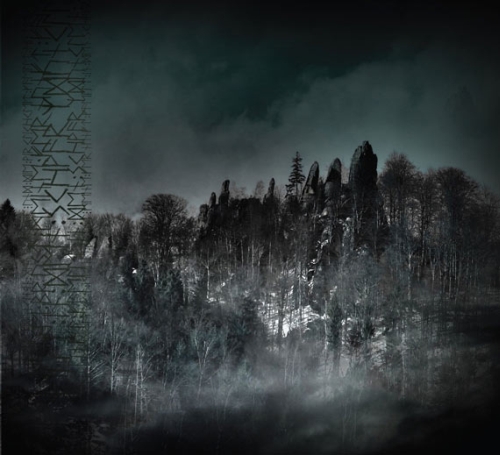
Review: Kroda – Schwarzpfad


I’ve been listening to this album for months now and I’m still not sure what exactly I want to say about it. The songs are very well written in a format you might come to expect from Ukrainian metal; In some ways I feel like they’re better written than most others in their scene, including Kroda’s past works. But there is a lack of intensity in the execution that leaves me unable to be really moved by it. I don’t know if it’s a matter of performance or production, but something just isn’t there.

First Snow

The result is rather uncharacteristic. I mean, what do most Slavic metal bands have in common if not a degree of savage intensity that puts all other metal scenes to shame? Schwarzpfad goes for a much more mellow approach. It’s got this weird dual effect of highly dynamic song writing and almost monotonal atmospherics. The acoustic breaks, the woodwind solos, the occasional peak into a triumphal chorus, they all just kind of blend together for me. Like on this song, nothing really stands out to mark the switch into the guitar and vocal peak that starts about two minutes in. I sometimes barely notice anything has changed.

Now, I’m not calling this a fault. I don’t know what Eisenslav intended, so I’m in no position to say he missed the mark. But it certainly makes for a difficult listening experience. You just have to force yourself to pay attention, because it can be very inaccessible at times.

Forefather of Hangmen

Any complaints I might have about the sound quality of this album (and these youtube rips actually sound a lot better than the 192 cbr copy I found) shouldn’t overshadow its many positive traits, but what makes Schwarzpfad good I’ve had equal difficulty describing. The songs are just really well written, and I might have to leave it at something as vague as that. Honestly, the juxtaposition of really great songs and what I feel is a really bad recording make both pretty difficult to describe. I can’t hear the good attentively without thinking of the bad, and vice versa. I’ve invested a tremendous amount of time into this album and all I’ve taken out of it is a conviction that there’s something really great here and I’m not hearing it, so I think it’s time I called it quits. If they actually decide to tour the United States for once I’ll be the first in line to find out just how good Schwarzpfad really is, but until then I think I’ll give this one a rest and wait for their next album.

Lisa Marie Is Confused By The Demons of Ludlow (dir. by Bill Rebane)


Last night, after I finished with The Alpha Incident, I decided to watch yet another Bill Rebane film from the Mill Creek 50 Chilling Classics box set, 1983’s The Demons of Ludlow.

The Demons of Ludlow

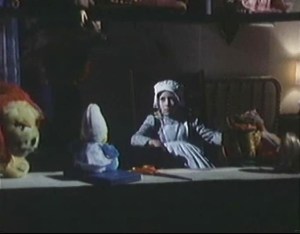
Ludlow is a tiny New England town that is celebrating its 200th birthday.  Now, when I say tiny, I mean that there appears to be about 17 people living in the town.  Anyway, a mysterious piano is sent to the town as a birthday present and, uh-oh — guess what’s possessed with the angry spirit of a warlock who happened to be murdered by the citizens of Ludlow 200 years ago?  Anyway, this warlock has a whole lot of other angry ghosts with him and soon, they’re exacting revenge on the citizens of Ludlow. 

Okay, I think I can hear Arleigh going, “Uhmmm…Lisa Marie, remember a little film called The Fog!?” and yes, I guess the plot is a bit similar to John Carpenter’s film.  It’s also reminiscent of another 1983 horror film called The Devonsville Terror.  While The Devonsville Terror was directed by the infamous Ulli Lommel, Bill Rebane is listed as being one of the “associate producers.”  I’m sure there’s probably a story there.

But anyway, back to The Demons of Ludlow.  This is very much a horror film of the 80s, which means that it has a real nasty streak.  As opposed to The Alpha Incident, where Rebane actually did appear to have a higher purpose in mind, the Demons of Ludlow is pretty much all about killing people.  Yet, this lack of higher purpose actually makes Demons of Ludlow a far more entertaining film to watch.  It helps that none of the 17 citizens of Ludlow are actually likable enough for you to get too upset once they die. 

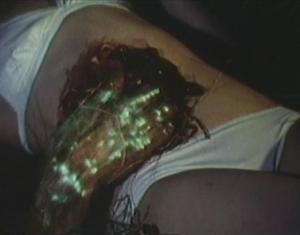
A shocking scene of demonic vengeance...or something.

The demons of Ludlow themselves are far more interesting, if just because they challenge logic by their very existence.  As the reviewer known as Scarina pointed out in her own excellent review, the film’s own internal logic states that the ghosts that are helping out the warlock in the piano are the exact same ghosts who ran him out of Ludlow in the first place.  So, therefore, why are they helping him? Now, if pressed, I can accept that perhaps he used his warlock powers to take control of their ghosts.  I mean, he’s had to kill 200 years doing something, right?

But what’s odd is that we’re told that Ludlow is 200 years old.  Seeing as the film came out in 1983, let’s give the movie the benefit of the doubt and say that Ludlow was founded in 1782.  Okay, that would mean that Ludlow was established during the final year of the American Revolution.  Therefore, why are half the ghosts of Ludlow dressed like pilgrims from a community theater Thanksgiving pageant?   I say half because the other half are dressed like decadent nobles from pre-Revolutionary France.  Seriously, they’ve got the powdered wigs and the fake moles and everything!  And then, to top it off, five pirate ghosts show up at the end of the movie.  I mean, my God, I would have loved to have been back in Ludlow in 1782.  Apparently, it was like the New Orleans of colonial New England.

Pilgrims of LudlowPirates of Ludlow

Marquis De Sade of Ludlow

 Still, I have to admit I enjoyed the Demons of Ludlow.  It doesn’t drag as much as The Alpha Incident and this is a film that definitely has more than enough “What the Fuck” appeal to be watchable.  There’s even one sequence — in which one unfortunate citizen ends up getting shot by a musket-holding Pilgrim who suddenly shows up in a mirror — that is actually rather effective.  This is one of those films that people like me tend to defend by citing its “dream-like” qualities.  That may be going a bit too far in this film’s case but it’s still a definite success d’estime.

Trailer: The Sitter (Red Band)


To say that I’m not a big Jonah Hill fan would be an understatement. The characters he has played on film have ranged from annoyingly nebbish to downright obnoxious. An almost irrational rage builds up in me whenever I see a trailer with him in it either as a supporting cast member or one of the leads. To my surprise when I saw the red band trailer of his upcoming R-rated comedy, The Sitter, the rage I was feeling petered out the more I watched the trailer.

The Sitter stars Jonah Hill and is directed by one David Gordon Green who also made the hilarious Pineapple Express and also one of the creators of the HBO comedy series, Eastbound & Down. Unfortunately, Green also directed the very unfunny comedy earlier in 2011 called Your Highness. Here’s to hoping that The Sitter is more of the very hilarious kind and not the unfunny that was his latest comedy film this year.

From what I could tell in the trailer this film looks almost like a remake of the 80’s comedy, Adventures in Babysitting starring Elisabeth Shue. That was a funny film and if Jonah Hill and Green can deliver the raunchiness and laughs then I have a feeling The Sitter may just be worth a look-see.

The Sitter is set for a December 9, 2011 release.

Lisa Marie Considers The Alpha Incident (dir by Bill Rebane)


It seems that every film lover owns at least one of those box sets of public domain films that Oak Creek Entertainment puts out.  You know which ones I mean — the box sets usually have about 50 to 100 movies crammed onto 12 discs and always have titles like “Astounding Adventure Classics.”  Most of the time, you’ll recognize one or two of the movies included (usually Night of the Living Dead) and you’ll end up buying it because they only cost like 6 bucks and that’s pretty good for 50 movies, even if you already know most of those movies are going to suck.  I own several of these box sets, including 50 Chilling Classics. 

I’ve recently decided to write a review for every single film that I have in my collection and I figured, what better place to start than with the often-forgotten and ignored public domain films that can be found in 50 Chilling Classics?  So, let’s get things started by reviewing a little public domain film from Wisconsin called The Alpha Incident.

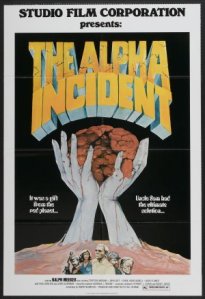
Made in 1977, The Alpha Incident tells us what happens when a train, carrying a deadly virus brought back from Mars, makes a stop over at a small country train station.  It seems that Hank (played by George “Buck” Flower, who giggles a lot) had taken it upon himself to inspect that deadly cargo and has accidentally released it into the atmosphere.  The train station, and the five people trapped inside, are quarantined by the U.S. government.  Trapped in the station are the increasingly crazed Hank, the cold Dr. Sorenson (Stafford Morgan), gruff bully Jack (John F. Goff), neurotic secretary Jenny (Carol Irene Newell), and the shy station agent, Charlie (Ralph Meeker, who was the best-known actor in the cast).  The five are told to wait while American scientists try to find a cure for the virus.  Under no circumstances can they 1) leave the station and 2) fall asleep because, the minute they do, the virus will cause their brain to literally explode out of the back of their head.  For the rest of the film (which, honestly, would probably have worked better as a play), the five fight among themselves, wonder if they’re infected, and above all else, struggle to stay awake.

The Alpha Incident was directed by Bill Rebane, an independent filmmaker who is based up in Wisconsin.  Apparently, Rebane’s unique cinematic vision has won him a cult following among fans of low-budget horror and sci-fi films.  One term that I’ve often seen used to describe him is “the Ed Wood of Wisconsin.”  On the basis of the Alpha Incident, I don’t know if that’s a fair comparison.  Yes, the film does drag at time and the editing pretty much defines the term “ragged” but the movie still held my interest and not in a solely “what the fuck am I watching?” sort of way.  Yes, the performances are uneven, ranging from histrionic (George “Buck” Flower and John F. Goff) to boring (Stafford Morgan) to adequate (Ralph Meeker) to surprisingly good (Carol Irene Newell) but the characters themselves aren’t the usual stereotypes and, while the dialogue is often a bit clunky, the film’s story is an interesting one and the ending is just so wonderfully cynical and downbeat.  With it’s portrayal of common people trying to survive the mistakes of a faceless government, The Alpha Incident is so wonderfully 70s that I it made me want to go to a club, tell my companions, “I’m going to powder my nose,” and then snort someone else’s cocaine. 

Like many of the best B-movies, The Alpha Incident was made with more ambition than skill but it’s still a film that, if you truly appreciate the low-budget exploitation movies of the 70s, is more than worth seeing.

6 Trailers In Celebration


Okay, I am like supper giddy excited and dancing-around-my-house-in-my-underwear excited right now and that’s because a story I wrote has been accepted for publication  so let me just repeat what I said when I learned the news: “Oh. My. God.  YAY!”  And then I pushed off my jeans and tossed my camisole and I started dancing around the house in my underwear and that’s where you came in and…

Well, anyway — Hi!  How ya doing?  Having a good weekend?  Ready for another edition of Lisa Marie’s Favorite Grindhouse and Exploitation Trailers?  Let’s get started:

1) Explosion (1969)

This is appears to be yet another one of those “So You Say You Want A Revolution” films from the late 60s.  The 60s were a good time for freeze frames apparently.

2) The Green Slime (1968)

This is a classic example of a “Look How Excited The Narrator Is!” style of grindhouse trailer.

3) The Student Nurses (1970)

I love any trailer that claims that the movie being advertised is about “what’s happening now…”  It’s a line that just screams 1970s.  Anyway, this is The Student Nurses which was directed by Stephanie Rothman, one of the first of the true Grindhouse feminists.

4) The Student Teachers (1973)

Student Nurses was a huge success so the next few years so a whole lot of different “Student” films.  Hence, the Student Teachers.  That clown at the end of this trailer freaks me out.  By the way, Chuck Norris is apparently in this trailer.

5) The Two Faces Of Love (1972)

Of course, even as the grindhouse celebrated the strong women who became student nurses and student teachers, it was also celebrating the woman who found themselves trapped in rip-offs of Repulsion, like The Two Faces of Love.

6) Stacey (1973)

Finally, let’s close things out with Stacey.  Why?  Because she’s super, sexy, and sensational!

A Quickie Review: Dylan Dog: Dead of Night (dir. by Kevin Munroe)


Yesterday, I called into work because my asthma was acting up and, in order to pass the time, I watched Dylan Dog: Dead of NightTo be honest, I probably should have just risked having another asthma attack and spent 108 minutes at work, answering the phone.  It would have been a more productive use of my day.

Dylan Dog is based (quite loosely) on the same Italian comic book that inspired one of the best Italian horror films of all time, Dellamorte Dellamore.  Brandon Routh gives a charisma-free performance as Dylan Dog, a New Orleans-based private investigator who is hired by a mysterious woman (Anita Briem) to investigate the circumstances of her father’s death.  It turns out her father was killed by a werewolf and fortunately, Dylan is apparently an expert on New Orleans’ supernatural underground, including the decadent vampires that are led by Taye Diggs (who, seriously, deserves better than this movie.)

Dylan Dog: Dead of Night plays less like a movie and more like a greatest hits collection of other, better movies (and tv shows).  We get werewolves and vampires going to war, we get an athletic blonde woman doing karate moves on a bunch of vampires, and we get a lot of casual decadence being committed by vampires who speak with Southern accents that just drip molasses.  Now, I love True Blood, Buffy the Vampire Slayer is one of the shows that gave me the strength to survive a lot of hard times, and I’ve even got a girlcrush on Kate Beckinsale as a result of Underworld.  But I’ve also got all of those wonderful shows on DVD.  I can see them whenever I want.  I didn’t spend $5.00 to rent Dylan Dog OnDemand just so I could see Dylan become the millionth film hero to walk in slow motion while firing two guns at the same time.

By all accounts, the film’s version of Dylan Dog has very little in common with the comic book version of Dylan Dog.  It’s hard for me to say for sure because, while I’ve read and heard a lot about the Dylan Dog comic, I’ve never actually read it.  Even if I could get my hands on a copy, it wouldn’t be much help since I’m not exactly fluent in Italian.  This is what I assume to be true, strictly based on my own research:

1) The comic book Dylan Dog is a melancholy character who, despite dealing with the supernatural on a regular basis, also suffers from several irrational phobias of his own.  The movie’s Dylan Dog is a blank-faced mannequin who utters useless quips and appears, in the tradition of American movie heroes, to have no fear. 

2) The comic book Dylan Dog has an assistant who is a Groucho Marx imitator.  The American Dylan Dog has an assistant who is a zombie.  That assistant is well-played by Sam Huntington and he actually does have a few good moments but it’s still impossible to watch him and not wish he was a Groucho Marx imitator.  (In the film’s defence, it appears that the Marx estate took legal action to prevent Groucho’s likeness from being used in the film.) 

3) The comic book Dylan Dog lives in London.  The movie Dylan Dog lives in New Orleans for absolutely no reason other than these movies always seem to be based in New Orleans.  Seriously, New Orleans is one of the most overrated cities in America.

4) Finally, the comic book Dylan Dog is one of the most popular cult heroes in Europe.  The movie Dylan Dog is the subject of one of the biggest cinematic flops of 2011.

It’s really hard to know what to say about a film like Dylan Dog other than the fact that it’s really, really bad.  In fact, I’m tempted to call it the worst of 2011 so far but, after giving it a lot of thought, I decided that title still belongs to The Conspirator.  Unlike The Conspirator, Dylan Dog isn’t a pompous film, it’s just a very, very lazy one. 

I think the best thin to say in regards to Dylan Dog: Dead of Night is that it might inspire viewers to seek out and watch Dellamorte Dellamore.  Now, that’s a film.

Quickie Review: Un Chien Andalou (dir. by Luis Buñuel)


 The first 20-30 years of the 20th century was an ever-changing time for the burgeoning film industry not just in North America but in Europe. Many filmmakers in Europe began to take the motion picture camera and began to use them in ways which went beyond just capturing motion and sound then selling them to the masses as a new form of entertainment.

In Germany, we had the rise of German Expressionist movement with such luminaries as F.W. Murnau, Robert Weine, Fritz Lang and Paul Wegener. Over in France the 20’s saw the rise of a new movement in cinema that would quickly become the Surrealist movement which would include such filmmakers as Jean Cocteau, Germaine Dulac and René Clair. There is one filmmaker who made a major impact on French Surrealist cinema during the 20’s and he was actually a Spaniard whose first film became a major sensation then and continues to be one to this day: Luis Buñuel.

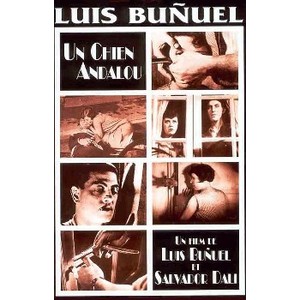
Buñuel’s first film was actually a short film he had made with the help of Spanish surrealist painter Salvador Dalí. Un Chien Andalou (An Andalusian Dog) is a 16-minute film well-known for Buñuel’s use of disjointed chronology to give the film that very surreal quality we tend to attribute to our dreams. The film has Dalí’s influence in almost every scene and one of which would go down in film history as one of the more shocking visual sequences ever put on film. I would describe it but it’s better to just see it for yourself below.

Un Chien Andalou doesn’t really make much sense when one tries to watch it in a purely structured narrative. The film’s inherent genius comes from the fact that it’s chaotic in how it unfolds with scenes chronologically moving back and forth with no impact on the characters within them. Some have called this film a perfect example of dream logic in that while the scenes in themselves do not make any sense when looked at individually they do seem to share particular traits when seen as a whole.

It’s difficult to say whether this film was entertaining. For someone looking to learn more about the craft of filmmaking, especially the part on storytelling, then Un Chien Andalou is quite an eye-opener. But In the end, Luis Buñuel’s first film has less to do with trying to entertaining and more of one filmmaker’s attempt to put into film the very intangible quality and nature of one’s dreams.

Un Chien Andalou is what I’d call the anti-Inception. Where Nolan’s film about dreams still retained a surreal quality to them they were still very much structured with order in mind. Buñuel’s short film is all about the chaos nature of dreams and no one has done it better since the day he released this classic in 1929.

Review: Powerwolf – Blood of the Saints


Over the top gimmicks have been helping otherwise average bands make names for themselves since times unknown. Rarely do they backfire, but with Powerwolf I just don’t know. The music on this album is incredibly good. Having never heard them before, I thought maybe they just drew a lyrical blank, sort of burning out on their gimmick while still steamrolling as musicians. But apparently, from what I’ve read at least, all four of their albums are pretty much identical thematically.

Sanctified with Dynamite

That is pretty strange considering Blood of the Saints is itself so thematically narrow that I get the feeling half of the songs use the exact same lyrics. I mean, I criticized Alestorm this year for pushing the line “get drunk or die” a bit farther than necessary at the expense of more clever lyrics, but compared to this album Back Through Time is pure poetry.

Each track pretty much consists of five lines: the name of the song, something about dying, something about wolves, something about blood, and the word “hallelujah”. That makes the opening track, Sanctified with Dynamite, the most lyrically diverse song on the album, because it is the only track that does not mention blood, wolves, or dying in the title.

They wrote a song called “We Drink Your Blood” and a song called “All We Need is Blood” and put them on the same album. Really? You would think the conceptual powers of an angry eight year old would translate to the music itself.

We Drink Your Blood

But in fact, this album is undeniably great. Their sound is powerful and enormous. The operatic vocals, the sinister organ, the production as a whole, everything just surrounds you and kicks your ass. The heavy metal choruses are always catchy in spite of the far too discernible lyrics. Every track is memorable. Musically, there’s just no getting around the quality of this album.

Why couldn’t they be singing in German or Romanian, their two native languages? Why couldn’t I enjoy this in blissful ignorance and not have to endure some of the lamest lyrics ever written? Oh dear…

Night of the Werewolves

If We Drink Your Blood sounds like a heavy metal version of Lordi, Night of the Werewolves has an almost Iron Maiden feel to it. The album is consistently comparable to my favorites among power-infused heavy metal bands, and they add a unique operatic element to the mix. It’s just that their comedy routine is something more on par with a Meet the Spartans. Blood of the Saints is definitely good enough for me to get over that and still enjoy it. Their lyrics aren’t annoying really, because the vocals are so good. It’s just disappointing that they couldn’t cultivate their gimmick into something actually entertaining. Blood of the Saints could have been a lot better than it actually is with relatively little additional effort on the band’s part. But so what, I guess, because I’m not going to stop listening to this one for a long time.

Scenes I Love: Salem’s Lot (Part 1)


Stephen King’s novels and short stories were mined relentlessly during the late 70’s and through the 80’s and the early 90’s. For the most part the film and tv adaptations of his work were adequate and passable. Some were downright awful and made one wonder if King was just trying to cash as many of his work for licensing paychecks or if he really thought the studios who purchased the rights would actually do a good job adapting them. One such studio which seemed to have done a very good job adapting one of King’s greatest works, Salem’s Lot, was Warner Brothers who adapted the classic vampire novel to become a mini-series for CBS.

I never saw the mini-series when it first aired in 1979, but I did see it a few years later when it re-aired on TV and then many more times on VHS and then on DVD. Tobe Hooper directed the hell out of this mini-series and turned what was a very complex modern retelling of Bram Stoker’s Dracula into a 3-hour mini-series that was both gothic and downright terrifying despite the restraints of TV.

While the mini-series does seem dated now it still retains that creepiness, foreboding atmosphere and scares which made Hooper’s Salem’s Lot one of the better King adaptations. The scene which will always stick with me and still gives me the chills whenever I watch it is when Danny Glick’s younger brother visits him in the hospital. This scene is just downright scary whether watching it as a 9 year-old or one in their 30’s.

Trailer: The Darkest Hour (Official)


Timur Bekmambetov is not the director of this upcoming alien invasion film The Darkest Hour. The director is actually one Chris Gorak, but the trailer is definitely pushing Bekmambetov’s name as if he is the director. Then again I think the film does seem to have Bekmambetov’s stylistic flourishes written all over it.

The Darkest Hour looks to be set in Russia from beginning to end as we follow a group of young Americans on vacation and hitting up all the party night spots in Moscow. This makes for an interesting premise in that we see an alien invasion from a wholly different perspective. It’s an alien invasion seen through the Russian perspective even if half the cast are American tourists.

I hadn’t heard much about this film until now, but after seeing the trailer I’m definitely going to run out and see it when it comes out.

The Darkest Hour is set for a December 23, 2011 release date.