This week has been quite the busy couple days over here in San Francisco. The Games Developers Conference (GDC for short) for 2011 is in town and being held over at the Moscone Convention Center. This conference is one of the biggest for industry insiders and games developers. While most of the stuff talked about in the conference are stuff that really only developers and publishers would understand and find interesting, the conference has also become a sort of launching point for announcing future titles for the different gaming platforms.
One such game which just had it’s first gameplay trailer introduced to much acclaim is the first-person shooter title from EA and DICE: Battlefield 3. This series has been one of the more popular games on the PC and has made major in-roads into console gaming. 2010’s Battlefield: Bad Company 2 received universal acclaim and some had even seen it as a title that could possibly dethrone Activision’s juggernaut franchise: Call of Duty. While said dethroning didn’t happen gamers and pundits still saw the Battlefield franchise as the one to finally take on that Activision jugger and actually win. It just may take the next title, Battlefield 3, to do it.
This trailer is all gameplay and has no prerendered scenes. What people see in the trailer is exactly how the game will look (at least for the PC. Whether the 360 or the PS3 will look just as good only this summer’s E3 can answer). The game will be using DICE’s latest graphics engine, the Frostbite 2.0 which will allow for a more realistic and fluid motion for all the people in the game. This title will also be the first one to utilize Frostbite 2.0.
As much as I enjoy playing the Call of Duty titles I do see how some have started to see how stale it’s starting to get. Activision hasn’t been challenged in so long that they really haven’t improved much on how the franchise plays. Maybe EA and DICE releasing Battlefield 3 and delivering on all they’ve promised will give Activision the kick in the ass it needs to keep the Call of Duty from becoming the Guitar Hero of military first-person shooters.
Just a little under a month ago Marvel Studios released the first official picture of Steve Rogers as Captain America. Ths was just days before the first teaser trailer for Captain America: The First Avenger made its debut during the Super Bowl telecast. With talk of the first official full trailer for this film just around the bend Marvel Studios has continued to tease fans by releasing through Entertainment Weekly the first official picture of Captain’s nemesis: Johann Schmidt as the Red Skull (played by the always very good Hugo Weaving).
To say that Joe Johnstone and his crew of skilled artisans got Red Skull down correctly would be an understatement. The first time I saw the image late this morning any doubt I had about this film was just blown away. They got the look and attitude of the Red Skull down exactly as I had pictured him in my head. The make-up effects to make Hugo Weaving look like the Red Skull doesn’t look fake from that picture and seeing it in motion would only enhance it.
The film is still set for a July 22, 2011 release and the wait until then will be difficult as Marvel and Paramount continues to release more and more tidbits to whet the appetites of fans.
Also, I want that coat he’s wearing. That’s a badass attire.
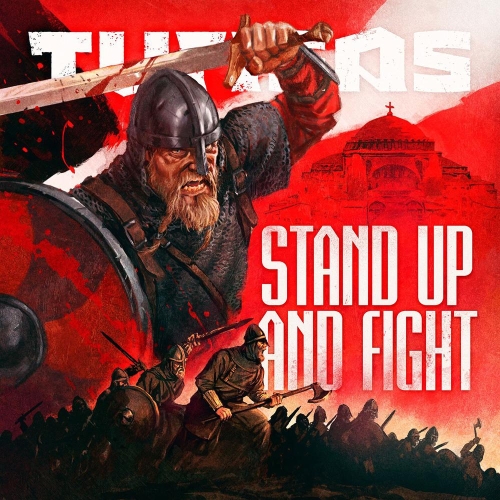
Turisas’s last release, The Varangian Way, got my vote for album of the year in 2007. It was a concept album, as so many monumental releases have been, telling the story of a band of viking soldiers of fortune traveling through Kievan Rus, intent on joining Byzantium’s Varangian Guard. Through sweeping symphonics, gritty folk, and a small but significant dose of progressive rock, the travelers encounter new lands, pass through Veliky Novgorod, party hard in king Yaroslav’s court, long for home while daring Dnieper rapids, and eventually arrive at the most majestic city in the world. (The back cover of the album is a map of Russia with each track title placed in its relevant location.) The lyrics might be shallow at times, and the English of questionable quality, but Turisas harness the power of names in a way I’ve never encountered before. When the central character raises “a toast to our generous host . . . ruler of Rus from coast to coast”, it’s the chanting of the Norse rendering of his name–Jarisleif! Jarisleif!–that really drills home the ruler’s greatness. The final, triumphal ending never mentions “Constantinople”. Nygård shouts “Tsargrad!” The chorus responds with “Konstantinopolis!” “The Golden Horn lives up to its name.” And the final resounding proclamation: “Great walls! Great halls! Greatest of all, Miklagard!”
I think it is the historic allusions, and the intensity with which they are employed, that really tip the scales from mere greatness to a masterpiece. If you have any fascination with history, you can’t help but be sucked in.
Stand Up and Fight is not nearly so consistant. At face value it certainly appears to be a continuation of the concept album. Hagia Sophia graces the cover. The opening track is called “The March of the Varangian Guard”, and the final track “The Bosphorus Freezes Over”. After a few listens, I caught on that, these three references aside, the album really has nothing to do with The Varangian Way. If you dig into the lyrics though, there are a few other Easter eggs.
The track most musically reminiscent of The Varangian Way is Venetoi! Prasinoi!
(Due to some bs copywrite issue you’ll have to click the link to hear this one.)
It’s a song about a chariot race, something I tend to associate with earlier Roman culture. If you plug “Venetoi” into wikipedia though, it redirects you specifically to the “Byzantine era” subsection of chariot racing. The use of lesser known names though isn’t at all emphasized like it is in The Varangian Way. The allusions are more subtle, meant I think to give a feeling of continuity without forcing the band to focus exclusively on one general topic. Track title aside, this song could take place in Rome proper.
Of course, The Varangian Way’s lyrics were dubious at times–(What the hell does the Nile river have to do with traveling through Rus to Constantinople?)–and their English was, if usually grammatically sound, not always quite on the mark. In the absence of allusions and grand proclamations, this is much more apparent on Stand Up and Fight. Consider Fear the Fear.
It opens with the lines “Bravery, as we’ve seen on TV: Explosions and swords, hot girls in reward.” How awkward is that? The song continues on with more words than most, and I’m pretty sure they’re attempting to convey some sort of message, but I don’t have a clue what it is. Yet the awkwardness isn’t always a bad thing. Skip to the last minute, and you’ll hear Nygård screaming “Die! Die you sucker! Let me go! Let me free motherfucker!” The way he does it, it’s just as cool as it is corny. It reminds me of Devin Townsend and Mikael Akerfeldt’s epic duet at the end of Ayreon’s “Loser”. … Well, that’s really a stretch, but that song is fucking awesome in ways I can barely comprehend, and I’ll take any excuse to link it:
.
Corny lyrics also play a hand in my favorite song on the album, Hunting Pirates.
(Due to some bs copywrite issue you’ll have to click the link to hear this one.)
Ok, first of all, it’s called Hunting Pirates. What the hell? The stuff Nygård babbles is ridiculous. “Kill them all! Let them die! Scum they are! Foe of mankind!” The music though, and his vocal style, are so fun that the cheese is almost a good thing. Besides, when he shouts “It is you who are the bad guys!” he’s not necessarily out to save the world. Plenty of folk metal bands are equally ridiculous, Turisas just take the less popular side. If if was a song about being a pirate, I’d laugh at the lines and not think twice about them.
My verdict on Stand Up and Fight: It’s catchy. It’s corny. It’s not The Varangian Way, but it’s miles beyond Battle Metal. Bare with the lyrics; they definitely overextend themselves in contemplation a few times, but for the most part it might only be their cultivation of a “good guy” persona that makes them appear any worse for wear than Alestorm’s demands for “more wenches and mead.” I mean, when I saw them live Nygård was chugging a bottle of vodka throughout the set.
Oh, while I was looking around youtube for functional links (without much success) I did find this:
As part of my mission to view every film — good or bad — ever nominated for best picture, I spent last night watching 1953’s The Robe (which was nominated for best picture but lost to From Here To Eternity.) The Robe is an old school biblical epic, the type of film that used to regularly get nominated for best picture but which you don’t see much of anymore. If you’re wondering why that genre hasn’t stood the test of time, I’d suggest watching The Robe.
Richard Burton stars as Marcellus, a womanizing Roman centurion who falls in love with young, pure noblewoman Diana (Jean Simmons). Unfortunately, Diana is set to marry the decadent Caligula (Jay Robinson). (Yes, that Caligula…) Burton’s rivalry with Caligula leads to him being reassigned to Jerusalem where he not only witnesses the crucifixion but also wins Jesus’ robe in a dice game. However, Marcellus soon finds himself being haunted by nightmares of the crucifixion and he discovers that he can’t even wear the robe without having a seizure. His slave, Demetrius (played by musclebound Victor Mature) has secretly become a Christian and steals The Robe before disappearing into the Holy Land. As Marcellus, who believes that only by destroying the robe can he free himself from his guilt, searches for Demetrius, he is reunited with Diana and, since this is an old school biblical epic, he also ends up converting as well. Unfortunately, he does all this around the same time that Caligula becomes Emperor and (in this film if not in actual history) begins to persecute the early Christians.
The Robe was the first film to made in “Cinemascope” and, while that may have been an amazing development back in 1953, when watched today, it’s obvious how much of the film is really just made up of filler designed to show off the new process. Again, it may have been amazing at the time but today, it just seems like a slow movie. Even more importantly, The Robe itself is so reverent and respectful of its subject that it’s just not that interesting. Speaking as a nonbeliever, I’ve still sometimes feel that a lot of contemporary films make it a point to ridicule Christians because they’re an easy target. Unlike a certain other world-wide religion, most Christians aren’t going to blow you up just because you featured an image of Jesus in your movie. However, movies like The Robe were not only extremely reverent and respectful but they went out their way to let you know how reverent and respectful they were being. The result is a film that lack any hint of nuance or anything that might actually challenge the audience. It’s like Avatar with Jesus.
Since he’s best known for being an alcoholic and marrying Elizabeth Taylor, Richard Burton might seem like an odd choice to play an idealistic Christian martyr. And, quite frankly, he is. Throughout the film, he’s visibly uncomfortable and, quite frankly, he didn’t have the legs necessary to pull off the ancient Roman look either. Jean Simmons is also stuck playing a stock character — the virtuous maiden. As with a lot of the old school biblical epics, the lead characters are so boring that you can’t help but feel they had more fun as pagans. Meanwhile, poor Victor Mature wanders through the film struggling to show anything resembling emotion. I mean, he tries so hard that its impossible not to like him. At the very least, The Robe proves that any film featuring Victor Mature will have some sort of camp value.
(As I watched The Robe, I kept thinking about a comment that Groucho Marx supposedly made. Apparently, he said he wouldn’t watch any movie starring Victor Mature because “I won’t watch any movie where the guy’s tits are bigger than the girl’s.”)
The Robe does feature some interesting supporting performances from several wonderful B-movie character actors. Jay Robinson is obviously having the time of his life playing the Emperor Caligula. Robinson’s version isn’t quite as effective as Malcolm McDowell’s but Robinson is a lot more fun to watch. Richard Boone is effectively slovenly in the role of Pilate and there’s a nice little throw-away scene where Pilate absent-mindedly washes his hands twice. Meanwhile Ernest Thesiger (who played Dr. Pretorious in the Bride of Frankenstein) is an oddly benevolent Emperor Tiberius while Michael Rennie, the alien from the original The Day the Earth Stood Still, plays none other than St. Peter. Even Jeff Morrow (from This Island Earth) has a small role.
Like most of the old school Hollywood biblical epics, The Robe seems pretty hokey when viewed today and I get the feeling it probably seemed hokey when it was first released back in 1953. Still, I remember that my Grandma Meehan used to love to watch these movies whenever they would show up on television. She would have deep theological debates with the images that flickered across the screen. I can still remember spending multiple Easters listening to her argue with The Ten Commandments. I don’t know if Grandma ever saw The Robe but I do know that she believed that the Holy Tunic was presently located in France and not at the Cathedral of Trier in Germany. Seriously, you did not want to question her on this point.
To be honest, watching this type of film is always an odd experience for me. Up until recently, I described myself as a “fallen Catholic” and I always felt so proud of myself afterward. I could spend hours telling you why I no longer believed in the faith of my childhood and I could get quite smug about it. I guess I still can but, as of late, I’ve discovered that humility goes well with a lack of faith. I’ve also been forced to admit that when you’re raised Catholic, you’re a Catholic for life regardless of whether you believe in the Holy Trinity or not. If pressed, I guess I’d call myself “an agnostic Catholic.” I’m the type of nonbeliever who still feels the need to go to confession after a long weekend. It’s not so much that I doubt my doubt as much as I wish that I could still go back to a time in my life when I actually could have faith without feeling like I was in denial. So, even as I openly scoff at these films, there’s always that small part of my heart that wants to embrace the film in all of its simplistic and hokey glory.
That said, it’s also true that The Robe is a lot easier to resist than a film like Pasolini’s The Gospel According to Saint Matthew or, for that matter, The Exorcist.
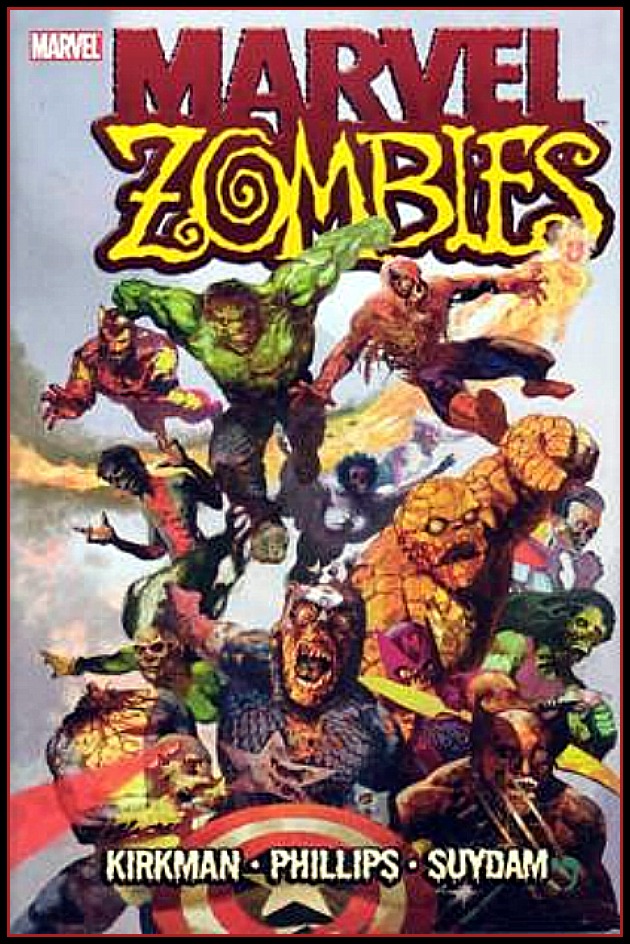
When Marvel Zombies was first announced I had been away from reading the superhero titles from DC and Marvel. I’d gone fully into non-superhero titles. One such title is Robert Kirkman’s The Walking Dead. Kirkman finally created a story which really tapped into what Romero was talking about in his Living Dead films. Kirkman’s zombie series continued where the film end credits began. To suddenly find out that Kirkman was to pen a “What If…?” style miniseries for Marvel telling the tale of what would happen if the Marvel Universe (well on of its alternates at least) and all its heroes and supervillains had suddenly all turned into flesh-eating zombies was great news indeed.
Marvel Zombies continues where the Ultimates Fantastic Four “Crossover” story-arc left off (story-arc where we’re introduced to the Marvel Zombies alternate universe). The Ultimates Fantastic Four has made it back safely to their Ultimates reality through the assistance of an unzombified Magneto. In the very first pages of Marvel Zombies we find Magneto on the run from those superheroes and villains turned zombies gunning for him. With these super-powered zombies having devoured the planet’s population within days they’re now set to hunting down, and at times, fighting with each other for the last few remaining people left on Earth for them to feed their hunger.
This being titled Marvel Zombies and not Magneto should give a hint as to the fate of the Master of Magnetism. No, this book deals with how the Marvel Zombies solve through their problem of not having anymore people to eat. It’s a good thing that in this reality Galactus and his herald, the Silver Surfer, have decided it was time to add Earth to the Devourer of Worlds’ menu. Unbeknownst to the Silver Surfer and Galactus, a planet they once thought to be teeming with life and energy to be consumned has become a death world where only the zombified Marvel heroes and villains remain.
The scenes once the Surfer and Galactus arrive were both action-packed and also full of some very dark humor. It was very difficult trying to root for anyone since in the end everyone left in the story were the “bad guys” but where the Surfer and Galactus were the serious villains in the story the Marvel Zombies themselves were funny enough in their need to take down Galactus and his Herald to feast on. The aftermath of the battle between the remaining Marvel zombies and Galactus makes for a great twist and also makes sense in a darkly humorous and wicked way.
Kirkman doesn’t dwell too much on the nature of the zombie plague’s effect on people’s humanity and feelings. He goes all-out to tell a fun, rip-roaring story. It shows in that there’s a little less depth in the book’s story than in Kirkman’s Walking Dead series, but what the story lacks in dramatic depth was made up for in some very funny and witty dialogue between the zombies themselves. The artwork by Sean Phillips (been a fan of his style since his work on Ed Brubaker’s Sleeper) complimented well with Kirkman’s zombie writing. I also like the fact that this graphic novel collected all the Marvel Zombies issue covers (both first and later reprintings) by renowned artist Arthur Suydam. His zombified alternate covers of classic Marvel issue covers was something of a great treat for comic book fans everywhere.
So, while Marvel Zombies doesn’t rise to the dramatic depths of The Walking Dead what it does do is tell a fun story of zombies versus Cosmic beings with plenty of flesheating and bloody good action. I’m glad that as great as Marvel Zombies was I’m even gladder that Marvel decided to re-visit this oft-kilter universe with some follow-up miniseries like Marvel Zombies vs The Army of Darkness and Marvel Zombies Volumes 2 thru 5.


 Through the Shattered Lens