The one game which I am willing to kill for to get my hands on the moment it comes out in time for the 2011 holidays is from video game developer BioWare. BioWare created a scifi-rpg franchise four years ago which has consumed my life everytime a new one in the series comes out. First there was Mass Effect then just this past January was it’s bigger follow-up Mass Effect 2. It looks like Mass Effect 3 will once again consume my time and life in the end of 2011.
From the look of the trailer the foreboding scenes in the end of the last game will culminate in the extra-galactic terror machines called “The Reapers” heading for Earth to once and for all stop the race who spawned the one man who dared challenge it’s millenia-long cyclical harvesting of all organic life from the galaxy. The fact that I am that human who stops them has no bearing on just how awesome this game franchise has been.
It will be the final game in this series as announced by BioWare, but I won’t be surprised if the universe created by this franchise continues on using a different name with a new set of heroes and villains. In the end, this game and any that follow it up will have one thing in common. A galaxy to save, a game as close to cinematic as we’ve ever seen and me as it’s savior.
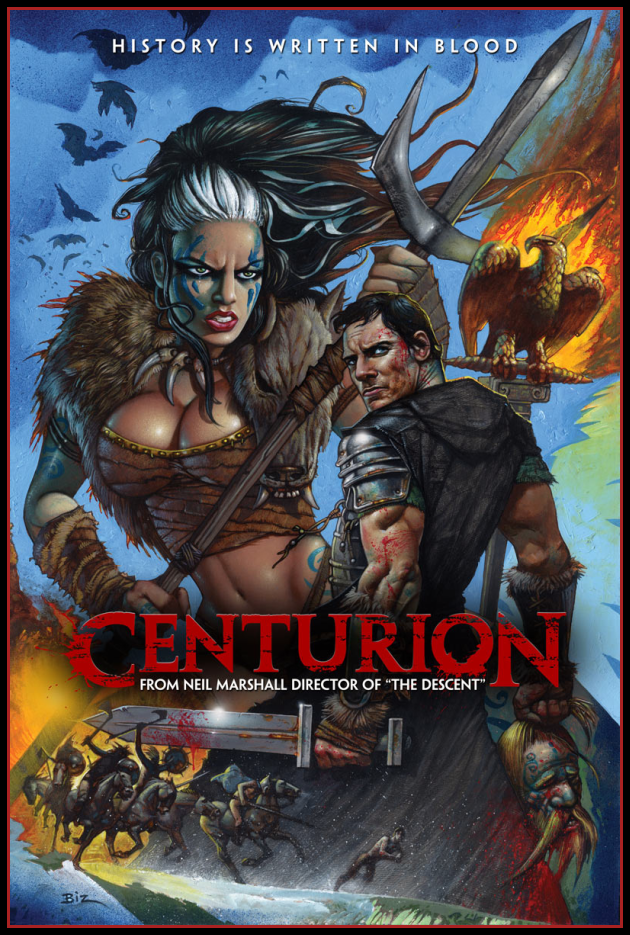
I’ll outright say and admit that one of my favorite filmmakers has to be British-filmmaker Neil Marshall who burst into the scene almost a decade ago with his genre mash-up werewolf film, Dog Soldiers. Since then he has come out with a film every couple years which follows what’s becoming a trademark style of his.He would take a well-worn and used genre and mash it together with a few others to create a film that’s wholly his own. He did this with his follow-up films in The Descent and Doomsday. Now it’s 2010 and we have his latest film and it follows his usual style. Centurion is an adventure, chase and men on a mission film that doesn’t reinvent the genres it’s smashing together but instead embraces their traditions and creates a rip-roaring yarn which moves at a frenetic pace with characters who grow and expose their motivations as the film progresses to it’s bittersweet finale.
Neil Marshall will always be known to fanboys and the action crowd even if the elites of the film industry continues to dismiss the man as nothing more than competent filmmaker. In Centurion he shows that he could work within a traditional sword and sandal story and still show his signature style. We have it’s main character of Roman centurion Quintus Dias (played with a subdued and introspective seriousness by Michael Fassbender) who gets captured by the Picts of Britain during Rome’s occupation of the island. Unlike most Romans captured by the guerilla-warfare conducting Picts, Quintus has learned to speak Pict thus has become a valuable capture. But his loyalty to his Empire and its people dashes the hopes of the Picts ever learning anything from Quintus and decides to play some sport with him as the hunted prey.
It’s during the hunt for Quintus by a band of Pict warriors that he stumbles upon the Roman Ninth Legion led by General Titus Flavius Virilus (Dominic West). Once freed from his captors and hunters, Quintus is more than happy to rejoin his fellow Roman centurions in their hunt to once and for all destroy Pict leader Gorlacon (Urlich Thomsen) and his Pict army. To aid them in their search for this enemy army is the mute Brigantes scout, Etain (played with silent fury by Olga Kurylenko), who knows the lands where the Picts hide and do their hit-and-run raids.
It’s once the whole Ninth Legion has been led into the thick forests by Etain that the trap was sprung with Etain herself the catalyst for what amounts to as the massacre of the Legion. It’s this event which Marshall in his own way tries to explain one of history’s mysteries: The mysterious fate of the Roman Ninth Legion. Historians have never agreed as to why the Legion disappeared from Roman and historical records and Marshall’s film is one theory.
The rest of the film has the handful of the Legion who has survived trying, at first, to free their general from Pict captivity and when that mission fails with deadly results the remaining men who has chosen to follow Quintus try to make a run back to Roman lines. On their heels like a she-wolf leading a pack of wolves is Etain whose thirst for vengeance for what the Romans did to her (raped her as a young child and cut out her tongue in addition to wiping out her family and tribe) pushes her to get these Romans with near-supernatural drive. It’s rare to find a film where the main villain is a woman, but one whose abilities surpasses that of the men she’s hunting and whose motivations make her more than a tad sympathetic to her cause.
Centurion does action well with sequences involving a jump off of a steep cliff and into the river below to last stand inside an abandoned Roman fort. Marshall knows how to stage and shoot these scenes so we never lose sight of where the participants are. Most filmmakers nowadays try to hide their inability to choreography action sequences by using quick cut editing, hand-held camera jittery viewpoints and, at times, just shooting it from a distance. Neil Marshall doesn’t do anyone of these gimmicks and tricks which just shows that while his hybrid style in terms of storytelling might be new and refreshing he still embraces the traditional ways if it serves his films properly.
The acting in this film was quite good from not just its leads in Fassbender and Kurylenko but from everyone. This film’s ensemble cast includes veteran British actors just as Liam Cunningham, Paul Freeman and David Morrissey. Other supporting players such as Imogen Poots, Urlich Thomsen and Dominic West do a great job in the limited roles they’re given. The fact that Kurylenko utters not one word in her scenes yet commands each and everyone she’s in shows just how well Marshall can direct not just action pieces but how to direct his actors in doing their jobs.
This film doesn’t do anything to reinvent the action genre that is it’s foundation, but what it does is show that action films sometimes could be just as good when it’s filmmaker leans on practices from traditions past. Outside of the CGI-blood used to show the brutality of the fights and deaths this film is quite lacking in the CG department. Shot on location in the highlands of Scotland and studios near and around London, Centurion is quite a throwback to the sword and sandal films which dominated the film industry during the late 50’s and most of the 60’s. Marshall’s latest will not win any mainstream awards, but the genre crowd will definitely embrace it as something that will entertain and thus welcome it with cult status.
I went to see Harry Potter and the Deathly Hallows, Part One earlier today and, before the film started, I saw the trailer for the upcoming Red Riding Hood. The trailer itself gives off a definite Twilight vibe, which isn’t surprising since both films were directed by Catherine Hardwicke and, regardless of what we may think of them, the Twilight films have made a lot of money. So, it makes sense that the trailer would be designed to bring in as many Twilight fans as possible…
Still, I’m looking forward (though admittedly, with a certain amount of caution) to Red Riding Hood. Why? Well, first off, Gary Oldman’s in it and Gary Oldman would have made Twilight a lot better as well. Plus, both of the leads are pretty to look at. (And, it should be noted, if Amanda Seyfried could give a good performance in a terrible film like Chloe than she can probably give a good performance in anything.) And finally — Catherine Hardwicke made her debut with Thirteen back in 2003 and I love that film so much that I can even forgive her for a hundred Twilights.
The Visual Branch Executive Committee of the Academy of Motion Pictures Arts and Scienes (yes, you can say it five times fast but can you say it five times fast while eating a pop tart — I think not!) has released a list of the 15 semifinalists for the 2010 Oscar for Best Visual Effects.
And here they are:
Alice in Wonderland
The Chronicles of Narnia: The Voyage of the Dawn Treader
Clash of the Titans
Harry Potter and the Deathly Hallows Part 1
Hereafter
Inception
Iron Man 2
The Last Airbender
Percy Jackson and the Olympians: The Lightning Thief
Prince of Persia: The Sands of Time
Scott Pilgrim vs the World
Shutter Island
The Sorcerer’s Apprentice
TRON: Legacy
Unstoppable
This list will be narrowed down again to 7 semifinalists and then in February, the actual nominees will be announced.
Looking over this list, there’s a few bright spots. I don’t think anyone’s surprised that Inception made the cut but it’s still good to see it there. I’m also happy to see that there’s at least a chance that Scott Pilgrim Vs. The World might get some love. Same thing with Shutter Island.
As for the rest of the list — well, it’s pretty much what you would expect to see, isn’t it? Clash of the Titans? Really? I have to admit that I don’t remember the film all that well but didn’t the special effects kinda look like …. well, crap? I can only assume that the voters were overwhelmed by the raw charisma of Sam Worthington. Prince of Persia was a little better but still, for the most part, the effects were routine, dull, and predictable. Hereafter featured an impressive tsunami but otherwise, the visual effects were pretty much limited to making the afterlife resemble a poorly lit office of the DMV.
As usual, I guess what’s really interesting about this list isn’t what’s listed as much as what’s not. I would happily replace both Clash of the Titans and Price of Persia with Splice and Skyline, two mediocre films that were distinguished by impressive f/x work.
For that matter, even the Social Network featured Armie Hammer acting opposite himself.
I’m also disappointed to see that Black Swan was left off the list. In typical Darren Aronofsky fashion, they did indeed come close to going over the top. The fact that they didn’t is exactly why they deserve to be honored.
(I found this list of semifinalists on AwardsDaily.com but I’m not including a link because the site is run by an elitist dumbfug who apparently thinks that she’s the end-all/be-all of Oscar commentators. Yes, she’s a commentator and not just some grubby little blogger like the rest of us. Or, as she once put it — “I know the game. Hell, I am the game…” When I call someone a toadsucker, that’s the type of person I’m talking about.)
First we get the first official Thor poster and now just a day later we finally have the first official trailer (just a teaser, but still a trailer) for this film which looks to be one of the most-awaited films for 2011’s summer blockbuster season.
The teaser looks to be a shorter version of the sizzle reel shown at this past summer’s San Diego Comic-Con. We get to see Thor in his Asgard and human form and boy did Hemsworth look like he worked out to fit the role. Dude looks yoked. There’s some scenes of the Destroyer doing its destroying things deal that wasn’t in the Con footage and we get a bit more Loki scenes even if they’re just a tad fleeting.
The trailer has just increased my need to see this film and it looks like Thor will explore the more epic and outrageous side of the Marvel Universe with the Asgard’s advanced tech seeming to act and look like magic to those on Midgard (Earth). Here’s to hoping Kenneth Branagh was up to task in adding some gravitas and his penchant for working well with Shakespearean themes into what is just a comic book film.
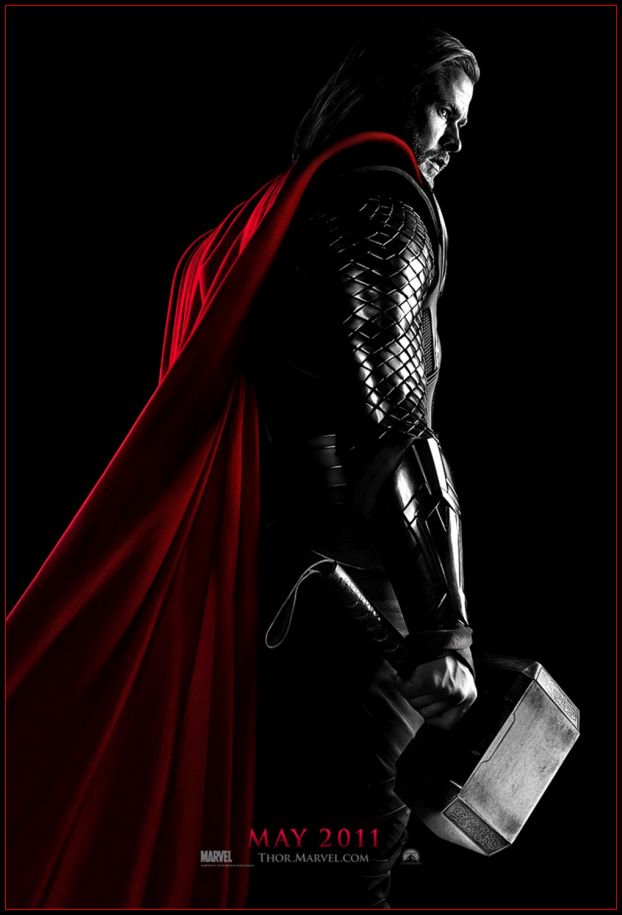
Finally! We now have the first official poster from Marvel Studios in regards to one of their tentpole 2011 summer films.
Thor looks to continue building the Marvel Universe live-action world which began with the first Iron Man then followed up by both The Incredible Hulk and Iron Man 2. This film will finally put the Asgardian Thunder God on the big-screen with Chris Hemsworth (played Captain Kirk’s father in J.J. Abrams’ Star Trek reboot) in the title role with British filmmaker Kenneth Branagh in the director’s chair.
The film sports quite a cast with Natalie Portman, Anthony Hopkins, Idris Elba, Tadanobu Asano, Tom Hiddleston and Stellan Skarsgard brought in to support Hemsworth. This film will be one of the films to usher in the 2011 summer blockbuster season as it gets a May 2011 release. A sizzle reel of some finished footage was shown in this past summer’s San Diego Comic-Con and reaction was mostly positive though there was a vocal minority who moaned that the look of the film looked to be too corny or just plain awful.
One must take such reactions, both in the positive end and the negative end with a grain of salt as the crowd in the audience are the hardcore of the hardcore fans. It’s not surprising that the reactions would be extreme on both ends.
Thor is either doing some final reshoots of scenes or has already completed them with post-production work now in gear to get the film ready for it’s May 2011 release date. Hopefully, part of said post-production is to fine-tune the 3-D process for the film so as to avoid any Clash of the Titans and The Last Airbender 3-D debacles which has given 3-D a bad name after a great showing with James Cameron’s Avatar.
I, for one, cannot wait to finally sit in that darkened theater to see Thor with his mighty hammer, Mjolnir, smiting foes both Asgardian and technological. It is with guarded optimism that this film continues what has been and still is an ambitious project by Marvel Studios to tie-in all their films together to create an epic and ever-growing universe on film.
Do critics (specifically, professional film critics) matter? In a word, no.
This is something I’ve been thinking about for a while now, ever since I came across an article by “professional” critic Sasha Stone in which she asked the exact same question and came to the exact opposite conclusion. Her argument boiled down to one quote: “You see things differently when you’re 20 than when you’re 30.”
And she’s right. I see things differently at 25 than I did when I was 13. And I imagine that when 30 comes around, I’ll have a whole new set of opinions. For that matter, I’m sure that as a Texan I probably see some things differently than how a native of California would see them. As I mentioned in my previous review of Black Swan, a lot of my reaction to that film was due to my own history and experiences. Would someone who has never had those same experiences have the same reaction? Probably not.
So, yes, Sasha is right. People see things differently.
And I’m even more right when I say that a 30 year-old critic matters about as much as a 20 year-old critic.
At the heart of professional film criticism is this elitist notion that somehow, Roger Ebert’s opinion is more worthy of consideration than some guy who actually had to spend money to get a ticket so he could watch the movie in theater surrounded by strangers while he eats rancid move theater nachos.
Ultimately, criticism is just an opinion and the only opinion that matters is yours. Just because I hated Avatar doesn’t mean that Avatar is a terrible movie. It just means that from my point of view, it sucks. And, as much fun as I have explaining why I felt it sucked, that’s ultimately just my opinion. Whether or not Avatar is a good film or if Black Swan is a great film , the only person that can answer that question is you.
When it comes to film (and really, all art) I think we would do best to remember the words of Aleister Crowley: “Nothing is true. All is permitted.”
This has been on my mind a lot recently as we went Oscar season and so many critics are now taking it upon themselves to announce which films are the best and we’re all expected to follow along with their opinions like lemmings going over a cliff. Around this time, the old school film critics start to get paranoid about all of us bloggers who have the nerve to offer up our opinions on film as if our opinion matters. That’s because most of these critics are a part of that generation that was raised to believe that only certain people were allowed to speak and that they only had the right as long as what they said was safe and predictable. Independent bloggers scare them because it proves what we all know: that anyone can provide an opinion.
Perhaps that’s why they’ve been so enthusiastic about embracing The Social Network, a film that suggests that blogging was the invention of sociopaths.
But ultimately, a critic is just another person providing their opinion. And maybe you respect that opinion enough that you’ll allow it to influence what you chose to see or not to see. And there’s nothing wrong with that. To me, the best thing that a critic can do — and what I hope I can do on occasion — is make the viewer aware of a film that he or she might otherwise not be aware of. If you see a film because I recommended it, I thank you and I hope you enjoyed the film as much (or as little) as I did. And if you didn’t, that’s cool too. I’m just a viewer with an opinion.
But when it comes to the movie itself, critics do not matter. The only thing that matters is the individual viewer. Art is the eye of the beholder.
At this time of year, we’re reminded that so much of so-called “professional” film criticism is simply about building a bandwagon and hopping on. Here’s hoping that in the future, we set that bandwagon on fire and let it burn.
The final 15 minutes or so of Black Swan are so intense and exhilarating that, after I watched them, I ended up having an asthma attack. The movie literally left me breathless.
I saw this movie last Saturday at the Plano Angelika and I’ve been trying to figure out just how exactly to put into words my feelings about this movie. Why is it so much easier to talk about movies we hate than the movies we love? Perhaps it’s because we all know what a bad movie looks like but a great movie is something unique and beautiful. I fear that any review I write it going to cheapen this experience.
However, I’m going to try. And if my words can’t convince you then just see the movie yourself. You’ll either love it or you’ll hate it. As with all great works of art, there is no middle ground. Unfortunately, I don’t see any way for me to talk about this film without talking about a few key plot points that could be considered spoilers. So, if you haven’t seen the movie yet, read on with caution.
This year, there’s been two types of filmgoers. There’s been those who have spent 2010 waiting for The Social Network and then there are people like me who have been waiting for Black Swan. There’s a lot of reasons why I had been so looking forward to seeing this movie. First off, it’s directed by Darren Aronofsky, one of my favorite directors. Requiem for a Dream is a personal favorite of mine and I thought The Wrestler was one of the best films of 2008. Secondly, the movie stars Natalie Portman, a great actress who rarely ever seems to get parts worthy of her talent.
However, the main reason was a personal one. Black Swan takes place in the world of ballet and, for several years, ballet was literally my life. My family used to move around a lot but whether we were living in Ardmore, Oklahoma or Carlsbad, New Mexico or Dallas, Texas, ballet always remained my constant. Every town we ended up in, my mom tracked down the closest dance studio and enrolled me. I’ve loved all types of dance (and still do) but ballet is what truly captured my heart. It provided structure for my otherwise chaotic life. Ballet was something that I knew not everyone could do and when I danced, I felt special. I felt like I was something more than just an asthmatic girl with a big nose and a country accent. I felt beautiful and strong and special. When I danced, I felt alive.
As much as I dreamed of being a prima ballerina, I always knew that I wasn’t really that good at it. I’ve always danced with more enthusiasm than technique and, if forced to choose between perfect execution and just having fun, I almost always chose to have fun. My body also conspired me against me as I’ve been a D-cup since I was 14 and while boobs don’t necessarily make ballet impossible, they don’t exactly help. Of course, my main problem was that I was (and still am) a klutz. When I was 17 years old, I tripped, fell down a flight of stairs, and broke my ankle in two places. And so ended my ballet career.
To a certain extent, falling down those stairs is the best thing that ever happened to me because it forced me to explore a life outside of the idealized fantasy of ballet. It forced me to consider ambitions that don’t necessarily have to end the minute one turns 30. It allowed me to realize how much I love to write and how much I love to watch movies. Still, I do miss ballet. While I still love to dance, it’s just doesn’t feel the same. I still have fun but it no longer makes me feel special.
I guess I was hoping that Black Swan would remind me of that feeling that I had lost. And it did.
But enough about me. Let’s talk about Black Swan.
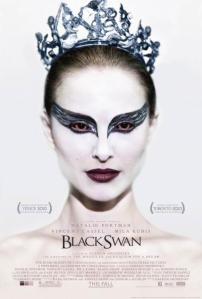
Natalie Portman plays Nina, a veteran ballerina who, despite being young enough to still live with her mother (and, it’s hinted, to still be a virgin), is also approaching the age when she’ll be considered too old to ever be a prima ballerina. She is a member of a struggling New York dance company that is run by Thomas (Vincent Cassel, turning up the sleaze level to 11). Thomas has decided that the company’s next show will be Tchaikovsky’s Swan Lake and that it’s time to replace the company’s prima ballerina, Beth (played by Winona Ryder), with a younger dancer. Nina begs for the chance to be Beth’s replacement but Thomas rejects her, claiming that her dancing is technically perfect but has no passion. He then attempts to kiss her which leads to Beth biting his lip and, apparently, convincing him that she has passion after all. Thomas soon announces that Nina will dance the lead in Swan Lake.
Unfortunately, even before winning the role, Nina is obviously unstable. Whether she’s obsessively stretching in her hideously pink bedroom, forcing herself to vomit up the contents of her stomach, or seeing shadows down every corridor, Nina’s every action and thought seems to be obsessed with finding the idealized perfection that ballet demands and life seldom affords. No matter how much she and her controlling mother (Barbara Hershey) cut her nails, she still wakes up with mysterious scratch marks across her back. Even worse, as she gets deeper and deeper into the role, she finds herself strangely drawn to and fearful of Lilly (Mila Kunis), a younger, free-spirited dancer who may, or may not, have her eye on taking Nina’s place.
Along with being an homage to such classic films as Repulsion, Suspiria, and All About Eve, Black Swan is also a modern-day reinterpretation of Swan Lake. Swan Lake tells the story of Odette, a princess who has been cursed by an evil sorcerer. As a result of the curse, Odette is only allowed her human form at night. During the day, she exists only in the form of a white swan. A prince named Siegfried meets Odette in her human form and falls in love with her so Rothbart tricks the prince by transforming his own daughter, Odile, into the Black Swan, a seductress who looks just like Odette except she wears black. One reason why the lead role in Swan Lake is so coveted is because the same ballerina plays both the innocent and fragile White Swan and the seductive and uninhibited Black Swan. As such, the two roles are presented as opposite sides of the same coin. (I’ve always thought of the White Swan as representing what men idolize and the black swan representing what men actually desire.) The challenge is to be convincing in both roles while still perfectly executing the idealized movements of ballet.
Over the course of Black Swan, Nina is continually told (by Thomas) that she is perfect for the role of the innocent and sheltered White Swan but that she doesn’t have what it takes to be the sexy and uninhibited Black Swan. At one point, Thomas gives her a homework assignment for the role, ordering her to go home and touch herself. (Nina eventually does so just to suddenly realize, right when she’s on the verge of bringing herself to climax, that her mother is sleeping in the exact same room. This sudden shot of Barbara Hershey sleeping in that chair both made me jump and laugh at the same time.)
Thomas also suggests that Nina study that way that Lilly dances. In many ways, Lilly appears to be the exact opposite of Nina. (Though wisely, Aronofsky emphasizes how much Portman and Kunis — not to mention Ryder and Hershey — all resemble each other physically, therefore creating the feeling that we’re seeing four different versions of the same basic human being.) Whereas Nina’s every dance move appears to be the product of rigorous training, Lilly dancing follows her emotions. While Nina’s expression while dancing is always one of a grimly obsessive dedication, Lilly smiles and enjoys the moment. Whereas Nina is scared of sex and can barely bring herself to look a man in the eye, Lilly is openly flirtatious with both men and women. In short, Lilly is Nina’s Black Swan.
Even as Nina studies Lilly, Lilly starts to pursue Nina, even showing up at her apartment and inviting Nina out for a night on the town. Desperate to escape her controlling mother (whose goal seems to be to keep Nina as the innocent White Swan for the rest of her life), Nina goes out with Lilly. They hit the clubs, Lilly convinces Nina to drink a spiked drink, and soon Nina is making out with random men in corners and eventually with Lilly in a taxi cab.
Now, I know this is something that a lot of people are wondering about so I’ll just confirm it. Yes, Mila Kunis does go down on Natalie Portman in this film. And yes, it’s hot. But even more importantly, it works as something more than just a juvenile male fantasy of what we girls do when you guys aren’t around. When Nina touches Lilly, she is reaching out for and accepting the side of her personality that she’s previously tried to deny. She’s accepting what she knows could destroy her.
(SPOILERS BELOW READ CAREFULLY)
And sure enough, after her encounter with Lilly (which Lilly subsequently claims never happened), Nina’s world grows more and more distorted. She looks at the paintings that line her mother’s room and she sees a hundred faces laughing at her. On the subway, men leer at her. And suddenly, Thomas seems to be paying more attention to Lilly (who is named as her alternate) than to her. Lilly visits Beth in the hospital where Beth is recovering from a car accident. Beth responds to Lilly’s presence by mutilating herself with a fingernail file. And so things go until the film reaches its climax in a dizzying mix of dance and blood.
Much like ballet itself, Black Swan presents a very stylized view of existence and, in order for the film to work, the performances have to be perfect. I’m happy to say that everything you’ve heard about Natalie Portman in this film is correct. She gives a brilliant performance. The film doesn’t provide a definite explanation as to what lies at the root of Nina’s mental instability but the clues are all there in Portman’s subtle but effective performance. Perhaps even more importantly, Portman is convincing in the ballet sequences. She captures perfectly the rigorous and often times painful dedication that ballet demands. In the movie’s finale, as she dances on stage while her fragile world collapse around her, she was suddenly creating my own fantasy of what it would be like to be a true prima ballerina. Watching her, I felt her every move as if I was on the stage dancing the role. It left me exhausted and breathless and I have to admit that after the movie, I foundd myself crying for a solid hour as I realized that would truly be as close as I would ever get to living my old teenage fantasy.
Portman pretty much dominates the entire film but still leaves room for Hershey, Cassell, and especially Mila Kunis to give impressive performances. Alternatively loving and spiteful, Hershey is the stage mother from Hell. Cassell’s character is almost too sleazy for his own good but Cassell still has fun with the role and even adds a few notes of ambiguity. However, Mila Kunis is the true standout among the supporting players. Playing a role that requires her to be both likable and vaguely threatening, Kunis holds her own with Portman and proves here that she actually can act. Her character also provides the film with a few much-needed moments of humor. Lilly gets all the best one-liners and Kunis delivers them flawlessly.
So, I’m sure many people might be saying at this point, “That’s great that you loved it, Lisa Marie. But you’re like all convinced that this film is actually about you. What about us normal people who don’t really care about ballet? Is there anything here for us?”
That’s not an easy question for me to answer precisely because I do love ballet and I did relate a lot of this film to experiences — both good and bad — from my own life. It’s also an issue that Aronofsky acknowledges in a rather clever scene where Nina and Lilly flirt with two frat boy types who react to Nina’s talk of ballet with boredom. However, I do think that this film can be seen and appreciated by those who aren’t into ballet for the exact same reason why I loved The Wrestler despite being interested in professional wrestling like not at all.
I’ve always felt that ballet — and by that, I mean the whole experience of both the dancing and all the stuff that goes on before and after the actual dance — was in many ways the perfect metaphor for life.
For instance, in my experience, there were always two separate cliques in any dance school or company.
There was the group of dancers who had spent their entire lives preparing for the one moment they would become a prima ballerina. These were the girls who spent hours obsessing over their technique and who minutely examined every performance for the least little flaw. These were the girls who risked their health to maintain perfect dancer bodies. They obsessed over everything they ate, which struck me as strange since they usually just threw it all back up a few minutes later anyway. They had parents who not only spent the money to make them the best but who, unlike the rest of us, actually had the money to spend in the first place. These were the girls who knew every move they were supposed to make but they never knew why.
And then, there was the group that I was always a part of. We were the girls who never worried about perfect technique. We would laugh when we missed a step and we joked about our mistakes. When we danced, we followed our emotions and if that meant breaking a rule, so be it. The perfect girls hated us because, for the most part, we were more popular than they were because we allowed ourselves to be real as opposed to perfect. And we hated the perfect girls because we knew that they would eventually have the life that we fantasized about.
I used to think that was unique to ballet and certainly, in Black Swan, it’s clear that Portman would be one of the perfect girls and Kunis would be one of us. However, once my life was no longer solely about ballet, I realized that everyone was either a part of the perfect group or a part of the real group. It wasn’t just ballet. It was life, the conflict between those who try to create an idealized fantasy and those who simply take advantage of the randomness of everyday life. And, when I watched Black Swan, it was obvious that Aronofsky recognizes this as well.
Ballet is all about creating perfection, of telling a story through exactly choreographed movements. As the film progresses, it become obvious that the root of Nina’s psychosis is that the reality has not lived up to her idealized worldview. Nina hides from the real world because the real world, unlike ballet, is not messy. Movement in ballet is controlled but movement in reality is random and often frightening. However, by submerging her identity into ballet, Nina has fallen into another trap because, as a prima ballerina, her every movement has to be perfect. There’s no room for error. There’s no room for her to break free of Thomas’s choreography. Her every move has been dictated for her and not a single mistake can be tolerated.
And I guess that’s truly why this film got to me because who hasn’t felt like that? Who hasn’t felt as if the world is watching and waiting to pounce on you for failing to live up to their ideal? While I’m not suggesting that men don’t face unique pressures of their own, this theme especially hit home for me as a woman. Everyday, I wake up knowing that I’m being expected to live up to some sort of societal concept of perfection that was set up long before I was born by people I’ll never actually meet. Every day, I wake up knowing that I’m always look my best without flaunting it in a way that would suggest that I know I look my best, to find a husband and devote my life to the agonizing pain of childbirth, to suffer my period in respectful silence, to always be weak when I want to be strong, and certainly to never, ever view sex as anything other than a duty. It’s the type of expectation that leads every woman to consider embracing her own black swan. Some of us are brave enough to do it. And others, scared of being rejected as imperfect, simply try to pretend that they never saw it in the first place.
For me, that’s what Black Swan is truly about. It’s not about ballet and it’s not about Mila Kunis bringing Natalie Portman to orgasm. It’s about finding the courage to live life regardless of how scary it might be. Much as Aronofsky used pro wrestling to tell the story of everyone who ever refused to be anonymous and forgotten, Black Swan is the story of every one who ever struggled to reconcile the demands of society with the realities of existence.
Since this is an Aronofsky film, viewers will either love it or hate it. As exhilarating as I found that film’s finale to be, I can already hear other viewers saying, “What!?” As a director, Aronofsky has always been willing to walk that thin line between art and excess and you’re reaction to him will probably depend a lot on where you personally draw that line. Throughout the film, Aronofsky comes close to going over the top. However, he also directs the film in such a way as to make it clear that we’re not meant to be watching an exact recreation of reality. Instead, we view most of the film’s events through the prism of Nina’s own unstable mind and both the film’s grainy cinematography and the deliberately odd camera angles perfectly capture the feel of a mind losing its grip on reality.
Again, I should admit that I’m bipolar and, as such, I reacted very sympathetically to Nina’s struggle to distinguish the real world from the world created by her own paranoid fears because I recognized much of it from my last major manic episode. Now, would I have had a different reaction if not for my own personal experiences? The honest answer is that I don’t know. All I know is that Darren Aronofsky gets it right.
The film’s ending will surely be the root of not a little controversy. (Again: MAJOR SPOILER WARNING) Much like the end of the The Wrestler we’re left to wonder whether our main character has truly triumphed or if she’s been defeated. Is Aronofsky celebrating self-destruction or is he celebrating the individualistic impulse that leads people to pursue their passions no matter what the end result? Has Nina found true perfection and freedom or has she been destroyed by her own demons?
Aronofsky leaves it up to the viewer to decide and a lot of people won’t like that.
However, for me, Black Swan is the best film of 2010.
Well, what is there to say about the Transformers franchise other than it is what it is. A special-effects heavy flick about a Hasbro toyline from the 80’s that has become a sensation (a good first film with a sub-par follow-up) that’s made millions worldwide. The fact that Michael Bay (who I tend to believe as only a step above Uwe Boll in his talent as a filmmaker) is the filmmaker in charge of the franchise almost guarantees that each film will be a hit no matter what critics say.
Now we have the third film in the series with the very Pink Floyd-ish title which I am sure Pink Floyd fans are none to happy about. The film is deep into its film schedule and the fact that there’s now a teaser trailer with still 7 months to go before its July 1, 2011 release tells me that pre-production on this project began either as soon as the second film premiered or while it was finishing post.
Gone in this third and, as Michael Bay announced earlier, final film in the series is Megan Fox thus Shia LeBouf’s character Sam Witwicky will have a new love interest in English model Rosie Huntington-Whiteley. Most of the cast from both previous films will return and so do most of the primary Transformers on both sides. With the Fallen having fallen in the second film this third entry will bring in one of the more popular Decepticons in Shockwave to act as the main villain. How they’ll work this part of the script into having Shockwave being the main heavy despite Megatron still appearing in the film will be interesting to see.
In the end, the film will have great special-effects courtesy of ILM with chaos and destruction as seen through the mad-eyes of Bay. The wild card is whether Bay has learned how to work the 3-D cameras used to film the project from beginning to end. Because no matter what people may think of James Cameron he seems to be the only one who has figured out how to properly create an immersive 3-D film and not lose out on the action end.
Will Bay’s hyper-kinetic and MTV-style editing be able to work well with 3-D or will this third film just end up making its entire audience nauseous and I don’t mean from the film’s plot. We’ll soon find out this coming July.
While most first-person shooter games tend to bore me there are a few which have caught my gaming fancy and continue to play to this day. Usually it’s either the latest game from Microsoft’s Halo franchise or Activision’s Call of Duty series. I tend to have less excitement over upcoming new FPS games and will wait until people who do love them actually give me a thumbs up or thumbs down on a particular title before I try it.
There’s one game which has caught my eye and part of it is due to the interesting story the game will be built around. A speculative fiction the game will revolve around and it’s the occupation of the US by a Greater Korean Republic in the year 2027.
Yes, you read that correctly. The US in this game will be invaded by a unified Korea (with the North in control) after many years of economic downturn has finally collapsed the US economy in addition to the world itself experiencing the first stages of post peak-oil. This setting has a major Red Dawn feel to it and it’s not surprising since the person who came up with the story for Homefront is none other than John Milius himself who wrote and directed the film.
While details on the gameplay looks to keep to the usual FPS gameplay standard the plot and some of the single-player campaign tweaks has made me decide that this game will be something I need to play. This time the player will play an American playing as a guerilla fighter in the Korean-occupied US. Civilians as collateral damage is suppose to play an integral part in how the game unfolds in the single-player campaign.
The multiplayer will include the usual point system earned to buy newer and better gear and weapons. Unlike the two franchises previously mentioned the points earned can also go towards bigger ticket items such as helicopters, tanks and other vehicles.
Here’s to hoping that there’s a fancy swag-edition of this game and that publisher THQ and the game’s developer KAOS Studios get creative with said limited swag-edition.






 Through the Shattered Lens