Tonight, as I watched the premiere of The Walking Dead’s 2nd season, I found myself thinking about some of my favorite zombie films. One which came to mind immediately was Ken Wiederhorn’s low-budget but effectively disturbing 1977 film, Shock Waves.
In Shock Waves, a group of tourists find themselves shipwrecked off the Florida coast. As they wander through the isolated, swampy terrain, they happen to come across a decaying mansion that is inhabited by one very mad scientist (Peter Cushing). It turns out that Cushing is a Nazi war criminal who, during World War II, created the Death Corps., an elite unit of zombie super soldiers. As World War II came to an end, Cushing somehow ended up in Florida and, unfortunately for the living, he brought the Death Corps. with him. And now, with the arrival of the castaways, the Death Corps. has reawakened…
Shock Waves is considered by many (like me, for instance) to be the best example of the small genre of film known as the Nazi Zombie film. (Though I have to admit that it’s not my favorite Nazi zombie film. That honor would have to go to Jean Rollin’s delightfully weird Zombie Lake. For another example of the genre, check out Arleigh’s review of Dead Snow.) Admittedly, once you get past the idea of underwater zombies, the film is pretty predictable plot-wise. But a certain predictability goes along with any zombie film. One reason why zombies are so scary is the very fact that they are very simple and predictable. Zombies exist solely to destroy and, beyond running and hiding, there’s not a whole lot of options available for dealing with them. Vampires and werewolves are almost ludicrously vulnerable to all sorts of defensive moves (seriously, people, how difficult is it to wear a crucifix around your neck?) but zombies are pretty much an unstoppable force and for a zombie film to succeed, the zombies must truly seem unstoppable. This is where Shock Waves truly succeeds because seriously, these zombies are brutal. There’s a lengthy montage where the zombies literally tear apart a building, searching for the castaways and it’s probably one of the most chilling sequences of destruction ever caught on film. It helps that these Nazi zombies are truly frightening to look at, with their hair plastered to the sides of emotionless faces and their eyes hidden behind dark goggles. Add to that, they’re Nazis. Seriously, nothing’s scarier than Nazis. Perhaps the most enduring image from this film is of the members of the Death Corp. emerging from the water, one after another. It’s a remarkable sequence and probably one of the most striking “zombie mob” scenes ever.
The Shock Waves DVD also features an audio commentary with director Ken Wiederhorn and a few other crew members. It’s actually probably one of the more interesting DVD commentaries I’ve ever heard, as Wiederhorn is very honest about not being happy with how the final film turned out. And certainly, this is one of those low budget B-films that you can pick to death. As Wiederhorn himself points out, lead actress Brooke Adams often seems to just be going through the motions and, as effective as the Nazi zombies are, the film never explains how 1) they ended up off the coast of Florida or 2) how they haven’t been discovered before this. But so what? Shock Waves is one of those films that manages to be quite a bit more than the sum of its parts. Wiederhorn might not be happy with the film but that doesn’t change the fact that he manages to create a true sense of menace and danger during the film’s first half and the second half features some of the scariest zombies ever. Ultimately, Shock Waves is a genuinely scary and effective zombie film and one that the director has every right to be proud of.
One final note — Shock Waves opens up with one of those “This film might be based on a true story” narrations and it’s all the better for it. I’m including a clip of it below because 1) it’s just so grindhouse that I can’t help but love it and 2) it also features a bit of the film’s brutally effective score.
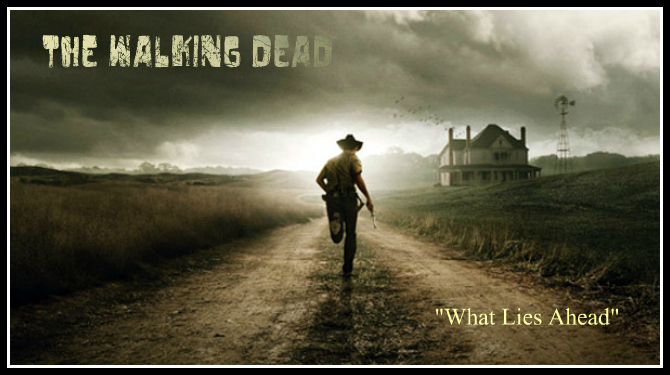
The first season of AMC’s The Walking Dead was a runaway hit for the network. Despite the inaugural season being a a truncated 6-episode long one the series gained a huge following that included long-time fans of the Robert Kirkman long-running zombie comic book series, but also new ones. The Walking Dead would have it’s showrunner and tv series creator Frank Darabont to thank for bringing it to a wider audience which is why this second season premiere brings with it a sense of bittersweet to the proceedings. This past summer saw Darabont fired from the very show he had helped create due to creative and financial differences with the show’s parent network in AMC.
Does this mean the show will suffer as it moves forward without it’s leader at the helm? If the premiere episode of season two is any clue then the show has hit the ground running and doesn’t seem to be in a hurry to stop to mourn the firing of it’s leader.
“What Lies Ahead” begins with the survivors soon after their narrow escape from the destruction of the CDC in Atlanta. The group’s number is now one less and any chances of a cure to what has caused the zombie apocalypse and a hopeful future seems slim at best and a hopeless exercise in futility at it’s worst. Rick (Andrew Lincoln) continues to be the group’s de facto leader which seems to wear on him now that he doesn’t just have his wife and son to think about but others as well. The episode does show that Rick’s acceptance of leadership in the group might be more out of necessity and less about him wanting to lead. No one, from his partner Shane (Jon Bernthal) to the wise, old Dale (Jeffrey DeMunn) seem to want the job and everyone seems willing to blame Rick for every instance of danger the group finds itself in.
Just like the pilot episode of the first season this new season doesn’t skimp on the tension. Frank Darabont wrote this first episode and his handling of the group’s first encounter with a moving “herd” of zombies show’s that he hasn’t lost the ability to create tension and just build it past the point of unbearable. This entire sequence with the group hiding beneath abandoned cars on the interstate with countless zombies walking past just inches away has to be one of the signature scenes of this season and more than a match for Rick’s solitary walk through the empty hospital in the pilot episode.
The bulk of the episode doesn’t come down too much from the tension and dread built up during this “herd” scene. It continues to keep the tension level at a fever pitch as the group must now search for one of their own who has gone missing during the “herd” march. The tension doesn’t just come from the situation Rick and the group find themselves in, but from the cracks and fractures that has begun to appear within the collective group. It’s these fractures which becomes the impetus for some character building that the first season rarely seem to have time for.
We still see repercussions from decisions made in the last season continue to make itself known. Whether it’s Shane wallowing in self-pity for losing what he thought was a ready-made family he had created for himself once Rick reappeared right up to Andrea’s bitterness towards Dale for having saved her from her choice to commit suicide in the last episode of the first season. It’s through the interaction between some of the factions being created through these particular characters that we begin to see the stress of this new world beginning to wear on them. Not to mention how they all seem to blame Rick for the situation they find themselves in. Which made it a suprising turn of events when was left to Lori to defend her husband and put everyone in their place. Her little speech near the end of the episode went a long way in establishing her character as one who sought redemption not in self-pity but in supporting the one person she understand to be the most qualified to see them through alive.
The episode wasn’t all positive. What hampered the first season was still quite evident in this season two premiere. While most of the writing was much improved from the first season there was still some parts in the episode when the dialogue seemed forced and not something which came about organically. It’s a testament to the performances by the whole cast that most people watching the show wouldn’t notice it much. Some stand out performances has to be the husband and wife team of Andrew Lincoln and Sarah Wayne Callies. Then there’s Norman Reedus as Daryl who continues to grow as a character beyond the typical redneck many thought him to be during the first season. With Reedus’s portrayal of Daryl one could see that he might not agree with some of Rick’s moral choices and decisions but he respects the man for actually making a decision instead of being wishy-washy. Daryl knows and understand, just as Lori does, that Rick is their best chance at surviving.
“What Lies Ahead” is a great start to a new season of The Walking Dead. While the firing of Darabont as showrunner from the show (replaced by a more than qualified Glen Mazzara) does hang like a dark cloud over the premiere that still shouldn’t detract from this episode’s quality. It’s an episode that really doesn’t dwell on allowing the rest of the world to catch it’s breath from start to finish while at the same time still allowing for characters to grow. This episode even ends in a cliffhanger that should be quite familiar for fans of the comic book, but should be quite a shock to the system for those who haven’t read a page of Kirkman’s comic.
Rick said in the beginning of the episode, after seeing the destruction of the CDC and getting the news that there’s really no more way to turn back the clock on this apocalypse, that it was all about “slim chances” now and from what this episode showed even slim might be too hopeful a word. These are people living on borrowed time and one can say that they’re already the walking dead. Time to see if Rick’s word’s will be rewarded with safety and salvation or just new levels of hell they must navigate through.
Notes
Chandler Riggs as Carl looks to be getting more and more comfortable in the role. His line delivery don’t seem as flat as they were in the first season.
Steven Yeun didn’t get as much time on the screen, but his gleeful reaction at being handed one of the bladed weapons was priceless. Like a kid in a candy store.
I noticed that while Frank Darabont wrote this episode the name shown during the beginning of the film was the name Ardeth Bay. For genre geek fans that name should sound familiar. It was a nice touch and better than just using the usual Alan Smithee.
We see more clues as to zombie behavior in this episode as Daryl once again proves that the stink of the dead bodies will hide living humans from zombies as he drapes corpses over himself and T-Dog during the “herd” march.
Love the line reading by Norman Reedus as his Daryl looks up at the large crucifix in the abandoned chapel and says “Hey J.C….taking requests”.
Gore content in this episode still continues the series trademark of being quite high for a network tv series. I’m still surprised at how much the show has gotten away with. Tonight’s signature gore scene has to be the impromptu zombie autopsy and trying to find out if their missing group member is in its stomach.
This episode deviated very much from the comic book, but when it mattered most it used one of the early shockers in the comic book series to end the episode on a huge note.
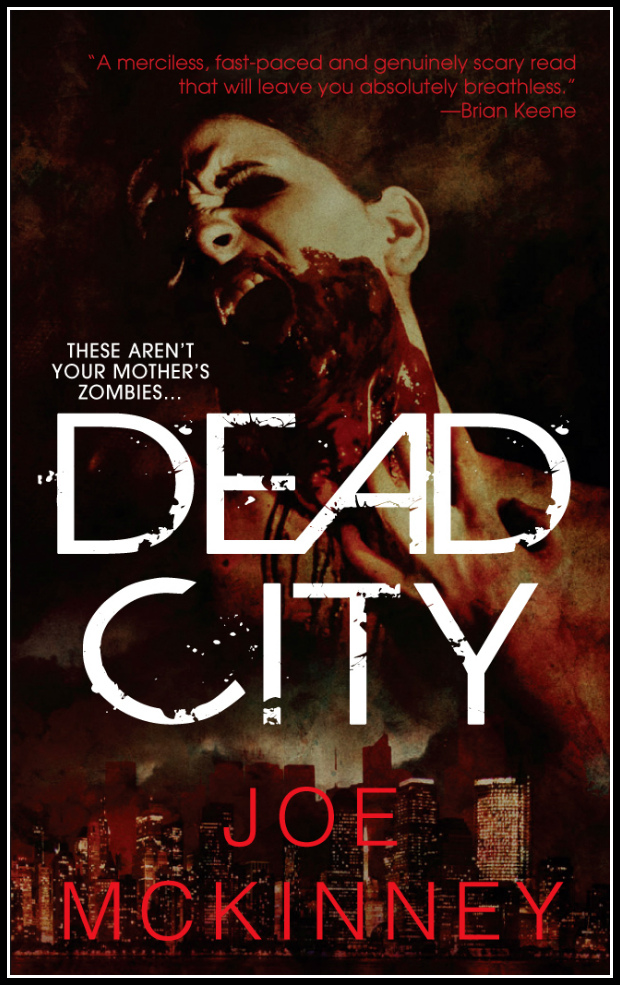
Joe McKinney’s debut novel, Dead City, is quite an impressive piece of writing for a first-timer. It’s doubly impressive for taking the zombie tale and just making it unfold as one long nightmare with little or no prelude or wasted exposition about what led up to it. McKinney’s novel is not overlong or full of filler chapters that does nothing but try to extend the telling of the tale far longer than necessary.
Dead City is not too different from many of the zombie novels and stories that continues to see a renaissance of sorts these past couple years. McKinney takes a more novel approach in his setting by using the hurricane disasters which plagued the Gulf from Katrina and onwards. It is during the aftermath of a series of non-stop super hurricanes hitting the Texas Gulf Coast where we meet the main protagonist of this novel. Eddie Hudson is a police officer in the San Antonio Police Department who we see balancing the problems he’s having with his wife with that of the devastation left by the passing of the major hurricanes over San Antonio. The action and horror begins pretty quickly as Hudson and his partner for the night head off to a disturbance call in one of San Antonio’s neighborhoods. What they encounter at the scene is one they’ve not been trained for. Confusion and lack of relevant knowledge to combat the newly zombified citizens of San Antonio leads to disaster for Hudson and the rest of his police and emergency services brothers.
McKinney does a great job of showing the confusion and disbelief Hudson goes through as a real-life horror film comes to life in front of his very eyes. There’s the disbelief in seeing their attackers continue to move towards him and his partner with a focused determination despite being pepper sprayed at point-blank range, then hit by shotgun beanbags then to lethal gunshots to the body. It is only when shot cleanly through the head and thus destroying the brain do their crazed assailants finally stop for good. This revelation comes way too late from most of Hudson’s fellow police officers and he’s left to his own dwindling supplies of ammunition and a vow to get to his own family before the nightmare he’s seen reaches them. Along the way Hudson meets up with other survivors from undocumented workers, a high school teacher and amateur zombie researcher, to other fellow officers who have managed to survive the first few hours of the zombie outbreak.
Throughout Hudson’s attempts to get to his wife and six month-old son, more of the extent of the zombie outbreak makes itself know to Ernie and those who tags along with him as they travel the streets of a devastated San Antonio. McKinney gets high marks from this fan of the zombie genre for not shying away from describing the sort of damage these zombies can do to a human body. The gore quotient in Dead City is quite high and I think one that would satisfy any fan like myself. In fact, I will very much like to see how this novel will look like adapted into a film. The story is pretty simple and a horror road trip through a devastated city with the simple goal of a man trying to find his family amongst all the horror he has seen and still to see.
Dead City is by no means a perfect novel and at times it shows. Characters sometimes have a certain cookie-cutout feel to them. From the gung-ho and adrenaline junkie cop whose wisecracking attitude is suppose to balance out the near-desperation and panic Hudson seems to be in all the time. Then there’s the angry black man whose mistrust of the police makes him blind to the need for cooperation. Some characters seem to be there looking to become a major role in the making then quickly gone thirty pages later under the assault and tearing hands and teeth of the zombies. I think the size and length of the novel may be one reason why characterization on some of the people on the periphery got a bit shortchanged. It doesn’t bring down the overall quality of the story but it does show that this is indeed a debut novel. But with the amount of quality storytelling McKinney was able to put together I am more than confident that this writing style will improve with each successive book.
In the end, Joe McKinney’s Dead City is one roller-coaster ride of a debut horror novel which doesn’t pull its punches. The story never lets up for a moment to give our main protagonist a moment of respite from the dangers around him. Like Officer Ernie Hudson, the reader becomes bombarded with horrific images after horrific images and only until the end to we find the respite and time to relax. I hope McKinney has more tales of the undead ahead of him and that he shares it with those likeminded people who displa the same kind of interest in the black sheep of the monster genre. I very much recommend Dead City to those who enjoy a very good zombie yarn.
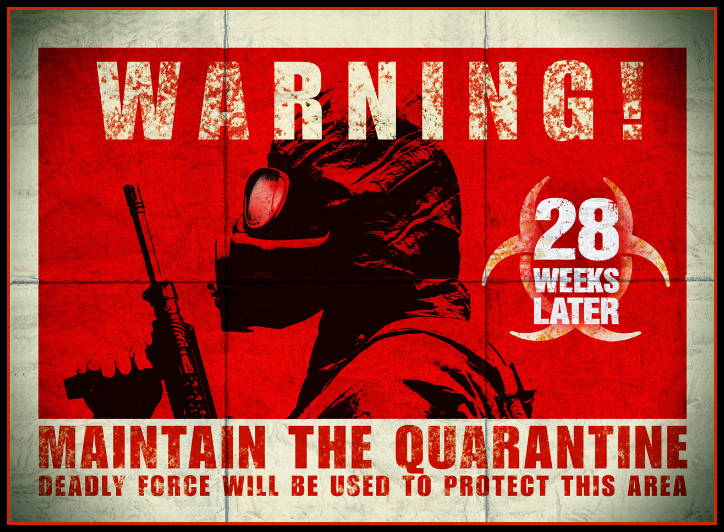
Danny Boyle and Alex Garland’s 28 Days Later was made in such a way that any sequel was almost destined to struggle in its shadow. Their film was not only one of the most influential horror films of the early 2000s, but also an exercise in experimental filmmaking and cinematic reinvention. It fused realism and terror through its digital photography, unconventional pacing, and minimalist score. Any follow-up would have to contend not just with its fresh twist on the zombie mythos (despite the infected not technically being zombies) but also its unique atmosphere, music, and stripped-down aesthetic. Against those odds, 28 Weeks Later manages to stand as an impressive and worthy successor—one that in some respects even surpasses the original.
Spanish director Juan Carlos Fresnadillo approaches the material with a clear reverence for Boyle and Garland’s vision while imprinting his own stylistic and emotional signature on the sequel. From the very first scene, Fresnadillo establishes a tone that blends despair and dread with human frailty. The film opens on a stunningly tense prologue in which Don (a gaunt and haunted Robert Carlyle) and Alice (Catherine McCormack) are living with several others in a rural cottage outside London during the first weeks of the Rage virus outbreak. In this sequence, Fresnadillo distills the central moral dilemma that runs through both films: whether to preserve one’s humanity through compassion or to surrender to pure survival instinct. When Don is forced to choose between rescuing his wife and saving himself, his decision—while horrifying to watch—feels horribly plausible. The following chase through open fields as he flees dozens of Rage-infected attackers captures the raw panic that made Boyle’s original so memorable, yet Fresnadillo shoots it with a sharper sense of chaos and movement. It sets the tone for a story that is both intimate in its human tragedy and apocalyptic in its reach.
Following this intense opening, the film transitions through an introductory credits montage that fills in the aftermath. Don’s escape was not the end of the story but the beginning of a grim reconstruction effort. The British Isles, we are told, were swiftly quarantined when it became clear the infection could not be contained. Twenty-eight weeks later, with the infected population presumed dead from starvation, a U.S.-led NATO force spearheads an ambitious effort to repopulate and rebuild. Led by General Stone (played with austere calm by Idris Elba), the military has converted London’s Isle of Dogs into a heavily fortified safe zone. This enclave represents both restoration and repression—a fragile bubble of civilization built atop the bones of horror.
Within this environment lives Don, now employed as a maintenance manager and struggling to suppress the guilt from his past. The arrival of his two children, Tammy (Imogen Poots) and Andy (Mackintosh Muggleton), who were abroad in Spain during the initial outbreak, reopens emotional wounds he had hoped were sealed. Their reunion, though heartfelt, carries an undercurrent of deception. Don’s explanation of their mother’s fate does not align with what the audience has already witnessed. This dishonesty propels the children into dangerous territory when they decide to sneak out of the Green Zone to retrieve personal belongings from their old cottage. While this act of recklessness fits with youthful impulses and emotional longing, it also feels like the film’s only contrived lapse in logic—an inevitable but frustrating horror trope that sets off the story’s next catastrophe.
What the children discover at the cottage reintroduces the virus in a shocking way. Without realizing it, they bring the Rage infection back into the supposedly secure refuge of London. As soon as containment is broken, the military response escalates with brutal efficiency. General Stone declares a “Code Red,” authorizing the use of extreme measures to eradicate the infected—including indiscriminate firebombing of civilian areas. These scenes echo not only classic apocalyptic tropes but also resonate as a grim reflection of post-9/11 militarism. Many viewers and critics interpreted this act of mass destruction as allegory for the United States’ War on Terror and the ethical corruption of occupation forces. Fresnadillo’s direction, while hinting at this reading, avoids heavy-handed political critique. His portrayal of military overreaction feels less ideological than tragic—a manifestation of fear, confusion, and the blunt-force nature of institutional power. The armed forces are not villains so much as desperate men trapped in an impossible moral quagmire. As in George A. Romero’s The Crazies, which 28 Weeks Later strongly recalls, the destructive consequences stem not from malice but from the futility of trying to maintain order amid chaos.
Where 28 Days Later focused on a small group of survivors and the intimate erosion of morality under crisis, 28 Weeks Later expands the scale dramatically. Fresnadillo transforms Boyle’s compact nightmare into a large-scale urban apocalypse. The sweeping aerial shots of a deserted London—bridges empty, streets silent—hammer home the desolation. When the city is engulfed in flames and gas clouds during the firebombing sequence, the imagery becomes both terrifying and grimly beautiful, a vision of civilization consuming itself. The sequel’s tone is darker and more nihilistic than Boyle’s film, which allowed a trace of optimism in its ending. Here, even innocence becomes a catalyst for doom: it is the children’s actions, driven by love and loss, that inadvertently reignite the infection and condemn the survivors to another wave of horror. This subversion of the “innocent child” trope underscores Fresnadillo’s bleak worldview—where sentiment and humanity, however noble, can still create destruction.
In several ways, 28 Weeks Later aligns more closely with Romero’s Living Dead films than with Boyle’s original. Though Boyle borrowed some of Romero’s thematic DNA, Fresnadillo fully embraces it. The infected may not be reanimated corpses, but the societal collapse, moral ambiguity, and recurring cycles of violence all trace back to Romero’s legacy. One of the sequel’s most striking qualities is its unflinching pessimism: even individuals acting out of love or duty become agents of devastation. The so-called survivors are reduced to primal instincts—running, hiding, killing—in a landscape where institutional power and human decency dissolve together. Fresnadillo makes the action kinetic without glamorizing it. His camera work, switching between chaotic handheld intensity and precise, panoramic destruction, keeps the viewer off balance, mirroring the unpredictability of the apocalypse itself.
The performances elevate the material beyond genre expectations. Robert Carlyle’s portrayal of Don is both gut-wrenching and terrifying. His character’s transformation—from remorseful father to infected embodiment of pure rage—serves as the film’s emotional and thematic anchor. Imogen Poots, in an early standout role, conveys resilience and vulnerability in equal measure, while Jeremy Renner delivers a strong supporting turn as Sergeant Doyle, the soldier torn between obedience and morality. Their performances, though sometimes confined within the film’s relentless pace, enrich its exploration of guilt, loyalty, and the futility of control.
Despite sacrificing some character depth for momentum, the film’s taut editing and grim atmosphere sustain tension throughout. Fresnadillo’s direction never loses sight of his central message: that humanity’s efforts to rebuild are perpetually haunted by its capacity for self-destruction. Even as the few surviving characters reach supposed safety, the final scenes undermine any hope of resolution. The closing image—infected sprinting through the streets of Paris—reminds viewers that, although the city itself appears intact and bustling in daylight, the Rage virus has now breached mainland Europe. This ending shifts the scale of threat from the quarantined British Isles to the broader continent, making containment and redemption feel like dangerous illusions.
As a sequel, 28 Weeks Later earns its place alongside 28 Days Later by honoring the original’s DNA while pushing its boundaries. It retains the visceral dread and societal commentary but broadens the lens to encompass collective failure rather than individual struggle. Fresnadillo’s approach feels colder and more apocalyptic, transforming the story into a study of fear’s infectious nature—social, political, and biological. While his film might not achieve the same creative purity as Boyle’s indie landmark, it succeeds in redefining the tone, expanding the mythology, and pushing the series toward a darker, more cinematic landscape.
In the end, 28 Weeks Later is both a continuation and an escalation—a relentless, despairing study of human fragility under crisis. Its pacing, performances, and imagery combine to create an experience that’s not only horrifying but profoundly unsettling in its realism. If 28 Days Later showed us the collapse of civilization, its sequel reveals the hopeless struggle to rebuild it. Few horror sequels accomplish that much, and fewer still end with such haunting inevitability.
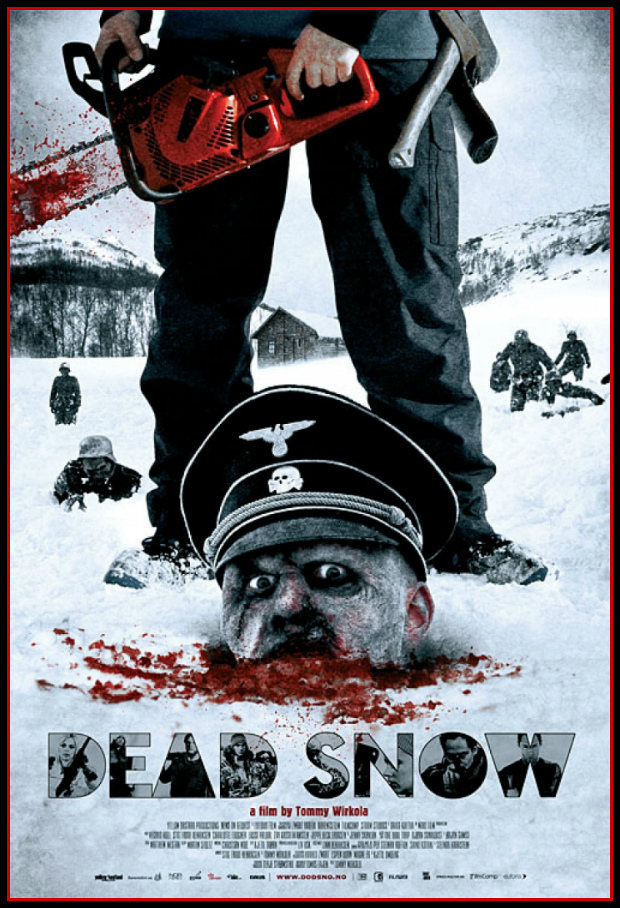
One thing about the zombie monster is that they’re pretty much a blank slate and anyone with an idea on how to use them can add their own spin to this undead staple in horror. Some have made zombies be undead Templar knights who hunted by sound. Some have even been made in combination with Egyptian mummies. There has even been zombies underwater fighting and trying to feed on sharks. In 2009, Norwegian Tommy Wirkola filmmaker took the zombie and combined it with that other icon of evil in entertainment, the Nazi. What he was able to create with this combo is the horror film Dead Snow.
The film begins with a lone woman running frantically through the snows somewhere in the mountain fjords of Norway with unknown figures chasing her. Like most horror films which begins like this her fate looks to be predetermined and how she finally buys it shows the audience that this is not going to be the usual zombie film as undead figures tear her apart and devour her while wearing the typical Nazi regalia. This gory start segues into the unfortunate group who will end up having to experience and deal with the sudden problem of WWII-era Nazis who had occupied Norway during the war and had ended up being buried (and presumed killed by the Norwegians near the end of the war) for decades in the snows of the Norwegian mountainside.
There’s really nothing too special about the seven students who decided to spend their Easter vacationing in the mountain cabin owned by the young woman killed earlier in the film. They’re not one-dimensional characters, but they’re also not the smartest tools in the shed as they make the usual mistakes young people make while staying at an isolated cabin high up in the mountain with a reputation for being haunted and cursed. The film’s director also co-wrote this script with screenwriter Stig Frode Henriksen and one could almost sense they were trying to emulate the group dynamics of the group in Edgar Wright’s instant zombie-comedy classic Shaun of the Dead. While Wirkola and Henriksen never reach the same level of creativity in their characters the actors playing them do a good enough job that we root for them to survive the siege of the suddenly hungry Nazi zombies outside their cabin.
Dead Snow does have something which raises the film from being dull and predictable into something very entertaining and thrilling through it’s many gory set-pieces. These scenes as the survivors try to fight their way and escape the Nazi zombies (or are they zombie Nazis) doesn’t skimp on the blood and gore. Wirkola may have known that the story of his film was very thin on plot with charactersa step or two above cardboard so decided to just let the grue fly. It’s here that Dead Snow suddenly becomes jet-fueled rollercoaster ride as bodies (both living and undead) get mutilated, decapitated, blasted, shot-up and everything in-between. The final stand-off with the final survivors and an increasing number of Nazi zombies makes this film worth watching.
Tommy Wirkola’s Dead Snow doesn’t bring too many new things to the zombie genre (Nazi zombies having been done decades earlier in films such as Shock Waves and Oasis of the Zombies), but he does add some dark humor and a healthy dose of over-the-top zombie mayhem that makes the film quite entertaining despite it’s flaws. Plus, how can one go wrong with picking something to watch that has Nazi zombies gallivanting their bloody way through Norwegian mountainsides with a hankering for Norwegian students.
It’s just 13 days more days til the season 2 premiere of AMC’s The Walking Dead series. The show has been a runaway hit for the network and for all involved. The past summer has seen some major turmoil within the creative team (mostly the firing of show-runner Frank Darabont halfway through the season 2 filming), but the show still remains one of the most awaited ones for 2011 with millions of fans waiting to see what’s in store for Rick Grimes and his small group of survivors.
Leading up to the show’s October 16 premiere the people at AMC and the show decided to create six webisodes showing the life of the first zombie Rick comes across in the first season. Yes, these 2.5 minute webisodes details the life of the “Bicycle Girl” before she joined the ranks of the undead. The webisodes were directed by the show’s lead make-up effects guru in Greg Nicotero.
One would think that AMC would release one webisode every other day until the seasoon 2 premiere but they’ve tortured fans of the show enough with all the drama this past summer and decided to release all 6 webisodes at the same time.
From what I saw these webisodes were well-done and added an extra but of tragic backstory to one of the iconic figures of the first season. Here’s to hoping this becomes a regular practice with each new season for the show.
Part 1: “A New Day”
Part 2: “Family Matters”
Part 3: “Domestic Violence”
Part 4: “Neighborly Advice”
Part 5: “Step-Mother”
Part 6: “Everything Dies”
Comment on what you’ve just watched. Do you think the family’s decisions made things worse or were things just too far gone for them to reach safety? What would you do differently if in their shoes?
For decades, the zombie film genre has been defined by the rules established by the grandfather of the modern zombie story, George A. Romero. His 1968 landmark horror film Night of the Living Dead transformed what had once been a gothic creature rooted in the voodoo folklore of Haiti and the Caribbean into an apocalyptic force symbolizing social collapse and human weakness. The film not only terrified audiences but also laid the foundational blueprint for every zombie movie that followed. Romero’s zombies weren’t merely monsters — they were a reflection of humanity’s fears, prejudices, and inner decay. His influence has remained so pervasive that, even today, filmmakers working in horror are inevitably responding to his legacy, whether they realize it or not.
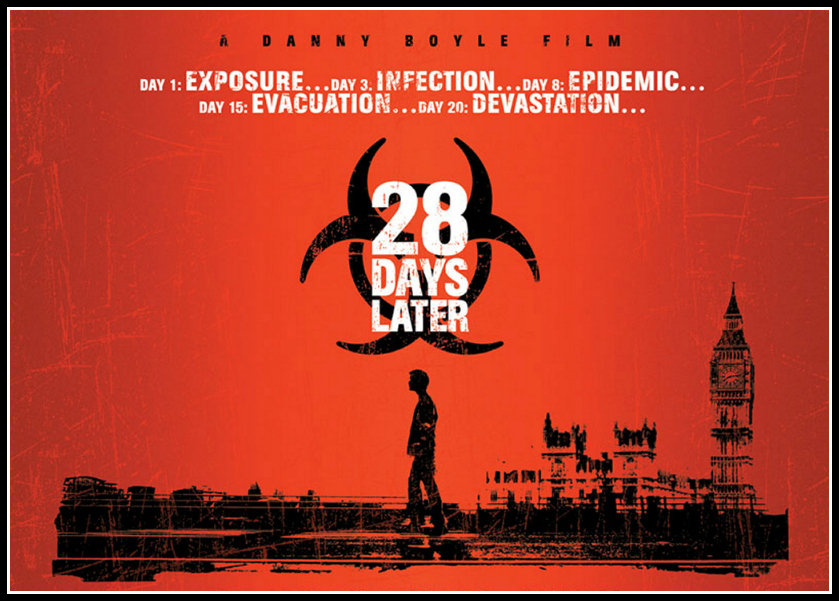
Through the years, there have been numerous attempts to deviate from Romero’s formula. The most prominent early success came in the 1980s with the Return of the Living Dead series — a clever horror-comedy franchise that infused dark humor and punk aesthetics into the genre. Yet even that beloved cult entry eventually lost steam. True reinvention did not arrive until 2002, when British filmmaker Danny Boyle and screenwriter Alex Garland collaborated on 28 Days Later, a project that both revitalized the zombie genre and split its devoted fan base down the middle. Was it truly a “zombie” film, or something else entirely? That very debate remains unresolved more than twenty years later.
Boyle’s film begins not with a supernatural curse or the reanimation of the dead, but with a catastrophic act of human arrogance. A group of naïve animal-rights activists break into a research laboratory to rescue chimpanzees subjected to bureaucratic cruelty. However, they find that these animals have been injected with a rage-inducing virus — the product of bioengineering rather than black magic. One of the activists, horrified by what she witnesses, ignores the pleas of a desperate scientist and frees a chimp, unleashing a pandemic that will decimate Britain within weeks. This opening sequence is both economical and horrifying: the origins of the apocalypse come from compassion twisted into recklessness. Boyle establishes his tone immediately — quick editing, grainy digital video, and an oppressive sense of realism create a world that feels disturbingly possible.
The narrative then leaps forward twenty-eight days. In a now-iconic sequence, the protagonist Jim (played by Cillian Murphy) awakens from a coma in an abandoned London hospital. His disorientation mirrors that of the audience: sterile hallways littered with trash, flickering lights, a haunting silence broken only by the hum of wind through the empty city. When Jim emerges into the sunlight, the camera captures a London entirely devoid of people, its majestic landmarks standing as hollow monuments to civilization’s sudden collapse. This is one of cinema’s most unforgettable depictions of isolation. The haunting score by John Murphy and the use of Godspeed You! Black Emperor’s instrumental “East Hastings” heighten the apocalyptic stillness, transforming London into a ghost metropolis.
Jim’s bewilderment only deepens when he seeks refuge in a church — a setting traditionally associated with salvation — only to find it desecrated by carnage. His presence awakens a horde of infected individuals who charge at him with terrifying speed. Unlike Romero’s slow, lumbering undead, Boyle’s infected are human beings transformed by a virus that amplifies their aggression to animalistic extremes. They move like predators, sprinting at prey with berserk fury. Jim narrowly escapes thanks to two survivors, Selena (Naomie Harris) and Mark (Noah Huntley), who introduce him to the brutal new rules of existence: infection spreads through blood contact, turning victims within seconds, and hesitation means death.
The trio’s uneasy alliance soon crumbles after Mark becomes infected, forcing Selena to kill him without hesitation. This harrowing moment establishes her as one of the film’s strongest and most pragmatic characters — a refreshing departure from the damsel archetype that has long haunted horror cinema. Jim and Selena later encounter Frank (Brendan Gleeson), a good-natured taxi driver, and his teenage daughter Hannah (Megan Burns), who have been surviving in a fortified apartment building. Together they form a fragile surrogate family and travel in search of a military broadcast promising safety and a potential cure.
Boyle deftly blends moments of human warmth amid horror. Scenes like the group’s scavenging trip through an abandoned grocery store — a darkly comic echo of Dawn of the Dead’s consumer satire — offer glimpses of joy and normalcy. The countryside sequences, shot with a painterly eye, contrast the urban decay of London with the serene beauty of a world reclaiming itself from human control. Nature, the film quietly suggests, endures long after people have vanished.
Their journey leads them to a fortified mansion commanded by Major Henry West (Christopher Eccleston), a British officer whose soldiers claim to have “the answer to infection.” The supposed sanctuary quickly reveals a darker truth. West’s band of men have descended into moral depravity, promising their commander that the promise of “women” will restore morale. The film shifts from survival horror to psychological thriller as the real threat emerges — not the infected outside, but the monstrousness within human beings when order collapses. In this descent into militaristic patriarchy and madness, Boyle channels the spirit of Romero’s Day of the Dead, where the military’s illusion of control becomes the true source of terror.
Boyle and Garland’s reinvention of the zombie mythos was revolutionary. Longtime fans of Romero’s shambling undead initially resisted the notion that 28 Days Later even qualified as a zombie movie. After all, its creatures weren’t reanimated corpses but living people overtaken by an uncontrollable virus. Yet their function within the story — relentless, dehumanized embodiments of contagion and rage — served the same thematic role as zombies always had: mirrors for society’s breakdown. The debate over whether the infected “count” as zombies is less important than the fact that Boyle redefined the genre’s emotional and kinetic language. His infected didn’t just pursue victims; they hunted them. Their blistering speed and screams injected pure chaos into what had once been slow, creeping dread.
The technical and artistic choices heightened the film’s intensity. Shot largely on digital video with handheld cameras, 28 Days Later looked raw and immediate, more like found footage than polished fiction. This realism bridged the gap between old-school horror and the new century’s fixation on viral outbreaks and global instability. Coming in the post-9/11 era, its images of deserted cities and military lockdowns felt eerily prescient, foreshadowing later fears of pandemics and authoritarian control.
The performances ground the film emotionally. Cillian Murphy’s portrayal of Jim evolves from bewildered innocence to hardened survivor, serving as the audience’s emotional compass. Naomie Harris delivers one of the genre’s most capable female performances, blending vulnerability with ferocity. Brendan Gleeson, always magnetic, brings compassion and tragedy to Frank — a man whose paternal instincts ultimately lead to heartbreak. Christopher Eccleston’s Major West stands as a chilling embodiment of human corruption in crisis: the soldier who insists he is saving civilization while replicating its worst impulses.
Despite being produced on a modest budget of roughly eight million dollars, Boyle’s film achieved a scale and impact far greater than its resources suggested. The empty London shots — achieved by closing key streets at dawn for only minutes at a time — remain astonishing feats of logistical precision and cinematic audacity. More importantly, the film’s minimalist production enhanced its believability. Everything about 28 Days Later feels lived-in, grimy, and plausible.
Two decades on, 28 Days Later continues to stand as one of the most influential horror films of the 21st century. Its success reinvigorated a genre that had grown stale and inspired a wave of imitators across film, television, and video games, from Zack Snyder’s Dawn of the Dead remake to AMC’s The Walking Dead. Beyond its cultural impact, it remains a haunting meditation on rage — personal, societal, and political. Boyle and Garland transformed horror into a canvas for existential dread, exploring how quickly civility unravels when survival becomes the only law.
Whether one calls it a zombie film or not hardly matters anymore. 28 Days Later breathed new life into the undead myth, shattering old rules and redefining what modern horror could be. The debate it sparked continues, but one truth is undeniable: the genre has never been the same since Jim first walked through that silent, ruined London — a world devoured not by the dead, but by the terrifying rage of the living.
Lisa Marie picked her favorite scene from Lucio Fulci’s classic Zombie (aka Zombi, Zombie Flesh Eaters) and now I counter with my own favorite scene from this film.
This scene has a simple set-up. The wife of the doctor researching zombification on the island of Matool gets herself in a sort of a pickle. Zombies have laid siege to her island home and most of her servants have either fled into the night or have become zombie chow. She’s barricaded herself in a room as zombie begin to batter down doors to get to her. It’s in the sequence where she has thought herself safe as she’s barricaded the door to her room when the hand and arm of a zombie breaks through the door (for some reason quite flimsy and prone to splintering) and grabs her by the hair and begins to pull her out through the splintered hole in the door.
I could continue to describe the scene, but I think it’s better for people to see why this scene is the one I love from Lucio Fulci’s Zombie.
Okay, so I realize that this is a pretty familiar scene. Along with being one of the highpoints of Lucio Fulci’s seminal Zombi 2, it was also used — out of context — in a television commercial a few years ago. I can’t remember what the commercial was for but I do remember being ticked off whenever I was on twitter and I saw people who had probably never even heard of Lucio Fulci going, “Awww! I love the Shark/Zombie makeout commercial!”
(Oh! Wait, I do remember — it was one of those “Windows So-and-So was my idea!” commercials. God, I hated that advertising campaign.)
Anyway, here’s a scene I truly love, shown in its proper context — the Zombie/Shark fight from Lucio Fulci’s 1979 masterpiece Zombi 2. One thing I always wondered was whether or not that the shark came back as a zombie shark.
The day before AMC released new production photos from the set of the second season of The Walking Dead series. Another bonus was their reveal of the Comic-Con exclusive poster for the show painted by comic book illustrator and cover artist extraordinaire Tim Bradstreet. Today was the big panel for the show’s season 2 at San Diego Comic-Con. Robert Kirkman was in attendance as was showrunner Frank Darabont and producer Gale Anne Hurd. The cast was also in attendance. Questions about their initial experience on the truncated first season were asked and answered. But the one thing people wanted to see the panel showed quite early and again as the panel concluded.
The Walking Dead season 2 has been given a definitely premiere date of October 16, 2011 just in time for AMC’s Fear Fest leading up to Halloween. It was the unveiling of the new season’s trailer which got the audience cheering loudly and from reactions to the trailer one thing is set to be sure and that’s this season looks to be even more bleak and with more forward momentum than the first season.
The show is less than 3 months away and it cannot come any sooner.


 Through the Shattered Lens