On the precipice of becoming an international superstar, director Sergio Leone gave Charles Bronson one of the coolest introduction scenes in film history in ONCE UPON A TIME IN THE WEST. Enjoy my friends!
Tag Archives: Woody Strode
Horror On The Lens: Kingdom of the Spider (dir by John “Bud” Cardos)

Agck! I hate spiders and today’s movie has got a lot of them!
Fortunately, it also has William Shatner and some lovely Southwestern scenery.
Still, if you have a thing about spiders, this film will probably scare the Hell out of you, which makes it perfect for October. Fortunately, William Shatner gives a very William Shatenerish performance and therefore provides some relief from all of the tarantula horror.
Here is 1977’s Kingdom of the Spiders!
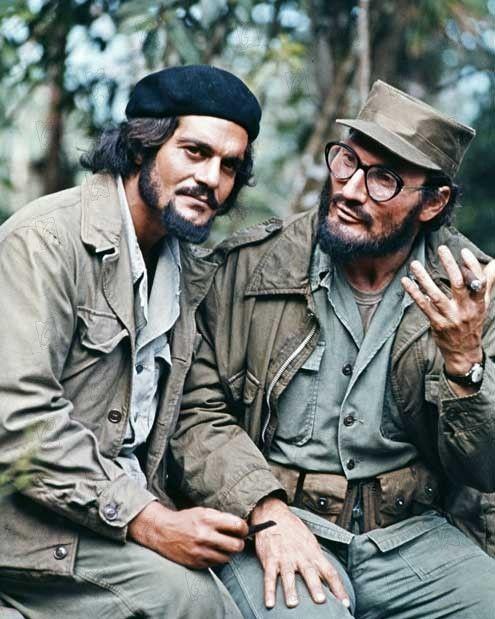
Icarus File No. 17: Che! (dir by Richard Fleischer)
Che Guevara!
By most accounts, Che Guevara epitomized the excesses and the hypocrisies of the extreme Left. He spoke of the class struggle while remaining an elitist himself. He oversaw thousands of executions and advocated for authoritarian rule. In his writings, he frequently revealed himself to be a racist and a misogynist. By arguing that the Russians should be allowed to bring nuclear missiles to Cuba, he brought the world to the brink of destruction. However, he also died relatively young and he looked good on a t-shirt. Decades after he was executed by the Bolivian Army in 1967 (or was it the CIA?), he remains an icon for college students and champagne socialists everywhere.
The film about Che! was released in 1969, two years after his death. Starring the Egyptian actor Omar Sharif as Che Guevara, Che! opens with Guevara already a martyr and then quickly gives way to flashbacks. Various actors pretending to be Cuban appear and speak directly to the audience, debating Che Guevara’s legacy. Some describe him as being a violent thug who killed anyone who displeased him. Others describe him as a visionary doctor who sacrificed his comfortable existence for the people. It’s a rather conventional opening and one that hints that Che! is going to try to have it both ways as far as Che’s legacy is concerned. But it’s still effective enough. A montage of soldiers and rebels creates the proper feeling of a society on the verge of collapse.
And then Jack Palance shows up.
Palance first appears creeping his way through the Cuban jungle with a group of soldiers behind him. Palance is chomping on a cigar and he wears the intense look of a man on a mission. My initial reaction was that Palance was playing one of the CIA agents who sent to Cuba to try to assassinate Fidel Castro or to set up the Bay of Pigs invasion. I kept waiting for him to look at the camera and launch into a monologue about why, for the safety of America, he had been dispatched the topple Cuba’s communist government. Imagine my shock when Omar Sharif called Palance, “Fidel.”
Yes, that’s right. Jack Palance plays Fidel Castro! As miscast as the suave Omar Sharif is as Che Guevara, nothing can prepare one for seeing Jack Palance playing Fidel Castro. Needless to say, there is nothing remotely Cuban or even Spanish about Jack Palance. He delivers his lines in his trademark terse Jack Palance voice, without even bothering to try any sort of accent. (And, needless to say, both he and Sharif speak English through the entire film.) Anyone who has ever seen a picture of a young Fidel Castro knows that, while he shared a family resemblance with Justin Trudeau, he looked nothing like Jack Palance. Eventually, Palance puts on a fake beard that makes him look even less like Castro. When one of our narrators mentions that Castro was a great speaker, the film cuts to a scene of Palance spitting out communist slogans with a noted lack of enthusiasm. When Castro takes control of Cuba, Palance looks slightly amused with himself. When Che accused Castro of selling out the revolution, Palance looks bored. It’s a remarkably bad piece of casting. Seeing Palance as Castro feels like seeing John Wayne as Genghis Khan. Thank goodness Hollywood never tried anything that silly, right? Anyway….
As for the rest of the film, it hits all the expected notes. The film was made in the very political year of 1969, a time when the New Left was ascendant and many considered Che Guevara to be a hero. However, since this was a studio production, Che! tries to appeal to both college radicals and their parents by taking a “both sides” approach to Che Guevara. Here’s Che teaching an illiterate farmer how to read. Here’s Che overseeing a bunch of dissidents being executed. Here’s Che getting angry at Castro for not being properly enthusiastic about housing Russian nuclear missiles. Here’s Che talking about a moral revolution. Here’s Che trying to start an unwanted war in Bolivia. Here’s Che talking to Sid Haig — hey, Sid Haig’s in this film!
Like so many mainstream political films of the 60s and today, Che! tries to be political without actually taking any firm positions. One is tempted to say that is the film’s downfall. Of course, the film’s real downfall is casting Jack Palance as Fidel Castro.
There’s no way to recover from that.
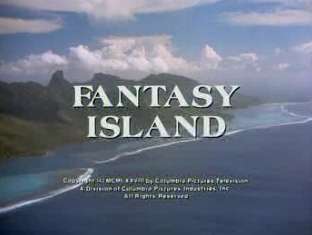
Retro Television Review: Fantasy Island 4.19 “The Proxy Billionaire/The Experiment”
Welcome to Retro Television Reviews, a feature where we review some of our favorite and least favorite shows of the past! On Tuesdays, I will be reviewing the original Fantasy Island, which ran on ABC from 1977 to 1984. Almost the entire show is currently streaming on Daily Motion.
This week, things get weird.
Episode 4.19 “The Proxy Billionaire/The Experiment”
(Dir by Richard Benedict, originally aired on March 21st, 1981)
This week’s episode is a bit of an odd one.
The first fantasy is fairly typical for the series. Playing two roles, Robert Goulet is cast as both a billionaire and as Frank Miller, a Wall Street analyst who wants to be a billionaire. The real billionaire agrees to allow Frank to live his life for the weekend. Frank soon discovers that being a billionaire is …. well, actually, it’s pretty cool. Except, of course, Phyllis Davis and Troy Donahue are plotting to poison him at a luau so that they can steal all of his money. Fortunately, Mr. Roarke shows up at the luau in time to catch the vial of poison as Davis and Donahue attempt to toss it away. Frank learns that being a billionaire is fine as long as no one wants to kill you. Still, he has to return to his normal life at the end of the weekend. Fortunately, the millionaire’s administrative assistant (Britt Ekland) has fallen in love with Frank and she decides to leave the Island with him.
As I said, this story felt pretty typical of Fantasy Island. Probably the highlight was Mr. Roarke walking in on Tattoo badgering Frank for financial advice. Roarke responded by giving Tattoo a strong glare that, if nothing else, reminded the audience that Tattoo and Roarke absolutely despise each other.
The other fantasy was …. well, it was weird. Dr. Lucas Bergmann (James Broderick) and his daughter, Lisa (hey!), come to the Island. Each has a fantasy. Lisa (played by Laurie Walters) says her fantasy is for Lucas to relax and enjoy himself and to stop obsessing over bringing the dead back to life. Lucas’s fantasy is to bring the dead back to life. Roarke sets Lucas and Lisa up in a bungalow that once belonged to another scientist who also wanted to play God. Roarke warns Lucas that the local Islanders are superstitious and they might not appreciate him tampering in God’s domain.
(If the Islanders are that superstitious, how are they handling living on a magical island that is ruled by a mercurial demigod?)
Soon, the Islanders are beating their drums and Lucas’s mute assistant (Woody Strode) is looking concerned. Lucas steps outside and discovers that Lisa has apparently drowned in a nearby lake. Lucas decides that she’ll be the subject of his experiment. Can he bring her back to life? Lucas doesn’t find out because the Islanders storm his bungalow and Lucas runs into the jungle, fleeing until he eventually runs into Roarke, Tattoo, and …. LISA!
It turns out that Lisa was only pretending to be dead in order to teach her father a lesson. And it also turns out that the Islanders were in on it and Woody Strode can speak.
WHAT!?
Seriously, was there not a simpler and perhaps less traumatic way to teach Lucas a lesson? This seems like an awful lot of trouble to go to. Lucas does realize that he doesn’t need to raise the dead to be happy so that’s good. Still, this whole thing just feels weird.
Of course, weird is good when it comes to Fantasy Island. With Roarke and Tattoo barely on speaking terms, it’s even more important for the fantasies to be memorable. And I will never forget about the time Mr. Roarke tricked a scientist into believing his only child was dead. Seriously, I’m stunned Mr. Roarke was never sued.
Next week, we meet Mr. Roarke’s goddaughter!
Horror on the Lens: Bride of the Gorilla (dir by Curt Siodmak)
In the 1951 film, Bride of the Gorilla, Raymond Burr plays a plantation manager who commits a murder. Unfortunately, for him, the murder is observed by a witch who promptly puts a curse of Burr. Now, every time the sun goes down, Burr transforms into a gorilla and goes wild in the jungle.
Basically, it’s kind of like The Wolf Man, just with a less sympathetic protagonist and a gorilla instead of a werewolf. Just in case we missed the similarities, Lon Chaney, Jr. plays the film’s nominal hero, a police commissioner who suspects that something weird might be happening with Burr. Apparently, the plan was originally for Chaney to play the gorilla and for Burr to play the policeman but, because Chaney was dealing with a serious alcohol problem at the time, the roles were reversed.
Also in the cast, playing the role of Dina, is Barbara Payton, the tragic actress who is best known for being at the center of a love triangle involving actors Tom Neal and Franchot Tone. In 195000, Neal attacked Tone and beat him so severely that Tone spent 18 hours in a coma. Tone was notably shaky onscreen for the rest of his film career while Neal spent a few years in prison. After the incident between Tone and Neal, Payton could only get roles in B-movies like this one. Tragically, she would pass away, in 1967, of heart and live failure. She was only 39 years old.
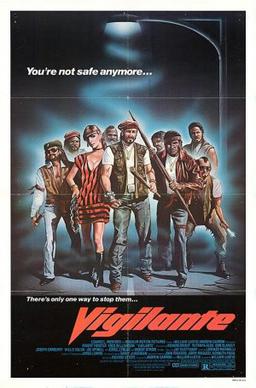
Vigilante (1982, directed by William Lustig)
The year is 1982 and New York City has gone to Hell. While honest, hard-working people try to make a living and take care of their families, the streets are ruled by gangs and drug dealers. The police and the legal system impotent in the face of intimidation and corruption. Maybe it’s time for the citizens to take the streets back, by force if necessary.
That’s what Nick (Fred Williamson) and most of his friends believe. Eddie Marino (Robert Forster) disagrees. He says that people taking the law into their own hands will just lead to more violence and death. The vigilantes will become just a bloodthirsty as the criminals. While Eddie is debating policy with Nick, Eddie’s wife (Rutanya Alda) is threatening to call the police on a Che Guevara look-alike who she spots trying to set a gas station attendant on fire. Eddie’s wife is stabbed. His son is killed. And when the man responsible is allowed to walk by a crooked judge, Eddie’s courtroom outburst leads to him being sent to jail.
Eddie spends 30 days in jail, fighting off predators and befriending a mysterious inmate named Rake (Woody Strode). When Eddie is finally released, his traumatized wife no longer wants to be married to him but Eddie has found a new purpose in life. Working with Nick, Eddie tracks down and murders the men who have destroyed his family.
One of the many films to be inspired by the success and enduring popularity of the original Death Wish, Vigilante is a classic of its kind. Director William Lustig wastes no time in establishing New York City as being a graffiti-decorated war zone where good is fighting a losing war against evil and most of the victims are just innocent bystanders. The New York of Vigilante looks even worse than it did in Lustig’s previous film, Maniac. (Maniac’s Joe Spinell plays one a crooked lawyer in Vigilante.) The action is brutal and bloody. While Forster fights for his life in prison, the people who killed his son are allowed to run free. It’s not subtle but, by the time Forster finally walks out of jail, you’ll be more than on his side and ready to see him get his revenge. With his trademark intensity, Robert Forster is believable as someone who goes from aborhing to violence to being a stone cold killer who doesn’t even flinch when he shoots a defenseless man. As Nick, Fred Williamson is his usual confident self. Williamson may not have much range as an actor but he has such a forceful screen presence that he dominates any scene in which he appears.
Vigilante is a grim film, with Eddie ultimately going further than almost any other screen vigilante before him. It’s also a deeply satisfying film because it appeals to everyone’s desire for revenge. In the real world, vigilantes are often as dangerous as the people they’re trying to keep off the streets. In the movies, though, they’re easy to root for. They present easy and direct solutions to complex problems. Even a film as dark as Vigilante works as a sort of wish fulfillment. With crime on the rise and the constant news reports about innocent victims who just happened to be in the wrong place at the wrong time, it’s easy to root for Nick and Eddie as it once was for Paul Kersey.
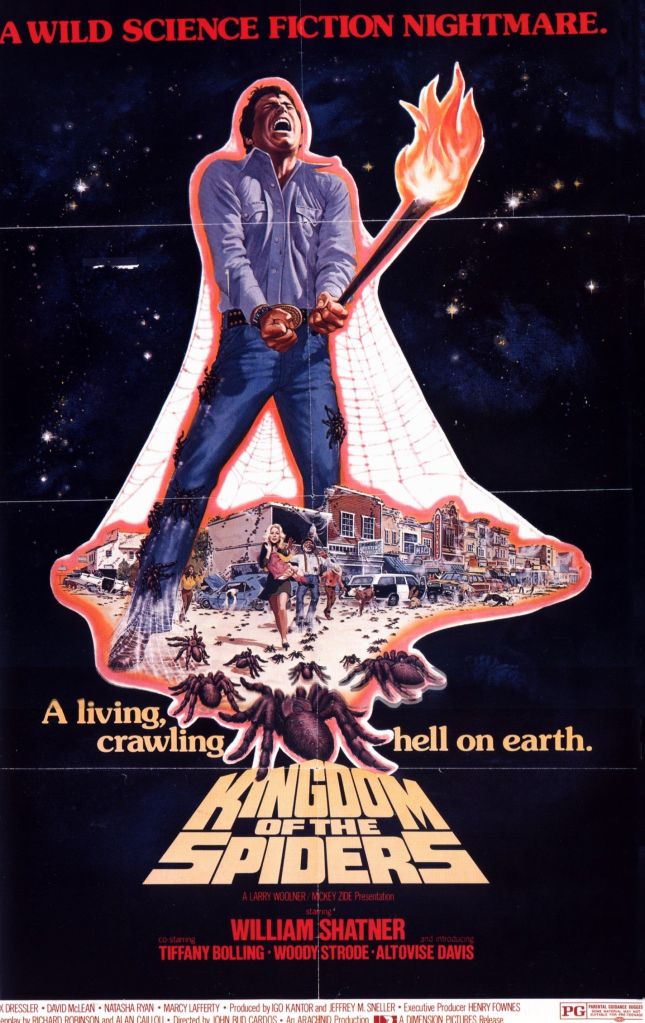
Kingdom of the Spiders (dir by John “Bud” Carlos)

While many celebrated International Cat Day on August 8th, it also happened to be National Tarantula Appreciation Day. As a result, I decided to return to a film that terrified me when I was little (and watched when I was far too young), 1977’s Kingdom of the Spiders.
As a kid growing up near the beginning of cable, movies were regularly during the weekends shown on prime time TV. This consisted of about 5 main channels in New York City: CBS (Channel 2), NBC (Channel 4), ABC (Channel 7), WNYW (Channel 5, which would become Fox in the Mid80s), WWOR (Channel 9), and WPIX (Channel 11). In addition to this, Channel 5, 9, and 11 would have movies playing on weekday afternoons just before the nightly news. I ended up watching Kingdom of the Spiders at my grandmother’s house, from under her bed. I didn’t sleep well for a while after this movie.
I don’t know why she ever owned it, but my Grandmother had this near clear shower curtain with a giant red and black spider on it. The web started from the center and spread out to the edges of the curtain. The image below is the closest approximation I could find to the one she owned. This was the source of my arachnophobia, which caused me to either enter the bathroom with my eyes closed, or use the basement bathroom (which had the rare added chance of seeing actual spiders). She tried to make me see the reality of it once, scooping me up and lifting me in front of the curtain to realize it was just a plastic sheet. My imagination was a little too much, however, and all I saw was something that wanted to cocoon and drink me dry. I screamed and flailed in her arms, and that was the end of that.

The premise for Kingdom of the Spiders is incredibly simple. At first, life is pretty comfortable in Verde Valley, Arizona. You’ve a family of cattle ranchers in the Colby’s (played by Spartacus‘ Woody Strode and Can’t Stop the Music‘s Altovise Davis). However, when a farmer’s cattle begin to fall ill and eventually dies, Dr. Rack Hansen (William Shatner, Miss Congeniality) is brought in to figure out what’s happening. Between heavily flirting with this brother’s widow Terry (Marcy Lafferty, Star Trek: The Motion Picture and Shatner’s wife at the time) and taking care of her daughter, Laura (Natasha Ryan, The Amityville Horror), it’s a surprise Rack has the time to help the Colby’s out.
When he sends in the blood samples to a lab for more research, the diagnosis is spider venom on a highly toxic scale. It’s so toxic that a spider specialist, Diane Ashley (Tiffany Bolling, Open House) is brought in to help. Of course, this springs Rack into action. After they meet, he cuts her off on the road, gives her his best one liner and then picks her up and takes her to his favorite restaurant (in her car, mind you). Rack’em, indeed.
Over lunch, they come to an understanding that DDT might be the cause of their tarantula menace. Having killed off their regular food sources of insects, the spiders have moved on to larger game. A quick visit back to the Colby Ranch confirms their fears. A spider mound is on their farm and the decision is eventually made to burn it down. Burning helps, but little do the humans realize that the spiders had exit strategies of their own. They also had additional mounds that the humans never even noticed.
With time running around out, Rack and Diane eventually decide the answer is more DDT, but the spiders thwart the attempt and decide from that point on, it’s all out war. Can the town survive the assault?
So, the spiders in Kingdom of the Spiders are just tarantulas. While all tarantulas are spiders, not all spiders are tarantulas. We’re not talking about the small house spiders from Frank Marshall’s Arachnophobia. They can be dangerous too, depending on the type. The Brown Recluse in particular has venom that is necrotic and will eat away the flesh around a bite. This movie focuses on the large hairy ones.
From what I’ve read, while most tarantulas have venom, it’s not particularly dangerous to humans. The only real exception to this are the Funnel Web spiders of Australia. They’re super aggressive and their venom can kill. Thankfully, according to a USA Today article, no one on that continent’s been killed by one since 1980. Additionally, some tarantulas only really use their fangs as a last resort. They will usually choose to flick the hairs off their back, which sting the eyes and noses of most predators.
There were about 5000 tarantulas used in the movie, with a mix of real ones for the early close ups and fake models for some of the wider shots. I’ve always wondered if the American Humane Society supervised the film, because it looks looks like a number of them were killed (at least in the last third).
Shatner is pretty much himself here, bringing that style he always does to a role. It’s not the over the top levels of Captain Kirk or Denny Crane, but it’s still fun to watch. Though I haven’t been able to confirm it, I’m told that Tiffany Bolling was one of the few people that wasn’t scared to work with the arachnids and that helped to get her the role. Most of the cast are okay, thought their reactions to spiders might cause one to laugh more than to share in their fear. Granted, I’d probably react the same way as most of them.
There’s one part involving Mrs. Colby with a gun that shares the same musical piece used in David Cronenberg’s Rabid and Scott Sanders’ Black Dynamite. Much like the classic Wilhelm scream, this musical piece seems to pop up in older movies now and then.
Overall, Kingdom of the Spiders is a decent film to unleash upon your Arachnophobic friends to watch them squirm. The spiders may spend more time running away from their prey, but some low to the ground camera shots help to make things more interesting.
The Gatling Gun (1971, directed by Robert Gordon)
In the post-civil war west, two Calvary troopers steal a Gatling Gun, the weapon that was invented to be such a powerful instrument of death that people would stop fighting wars just to avoid finding themselves in front of its barrel. (It didn’t work out that way, of course.) With the help of a pacifist reverend named Harper (John Carradine), they smuggle the gun into Apache territory. Rev. Harper thinks that the gun is going to be destroyed and, thus, another instrument death will be eliminated. from the world Instead, the greedy troopers are planning on selling the gun to Apache Chief Two Knife (Carlos Rivas). Two Knife has promised a fortune’s worth of gold to anyone who can deliver to him the deadliest weapon in the west.
Before the gun can be exchanged, the reverend, his daughter, and the two deserters are intercepted by a group of Calvary troops led by Lt. Wayne Malcolm (Guy Stockwell). One of the deserters is killed while the other, Pvt. Sneed (Robert Fuller) is captured.
However, Chief Two Knife still wants what he calls “the king gun.” Malcolm and his troops find themselves pinned down by the Apaches. Can Malcolm, with the help of a rancher (Phil Harris), a scout (Woody Strode), and a cook (Pat Buttram), keep both the gun and the all important firing pin from falling into the hands of Two Knife?
The Gatling Gun is a low-budget western that would probably be today forgotten except that it has fallen into the public domain and has been included in several DVD box sets. It has the flat, generic look of a Western television show and Guy Stockwell’s stiff performance may be believable for a 19th century Calvary captain but it’s still doesn’t exactly make for compelling viewing. The main problem is that the most exciting and interesting part of the story, the two deserters stealing the gun and tricking the Reverend into helping them, occurs off-screen and the movie instead begins with Malcolm capturing Sneed.
Western fans will mostly want to watch this one to see John Carradine and Woody Strode, two very different actors who were both favorites of John Ford’s and who appeared in several other, better westerns. (Strode and Carradine had both previously appeared in The Man Who Shot Liberty Valance, to name just one example.) Carradine is typically theatrical, delivering his lines like the old Shakespearean that he was. Strode, as usual, is stoic but his imposing screen presence makes him the most memorable of the film’s heroes. Also keep an eye out for Patrick “son of John” Wayne, playing the rancher’s son.
Though The Gatling Gun has the look of a film that was shot on a studio backlot in Hollywood, it was actually filmed, on location, in New Mexico. The state’s then-governor, David Cargo, has a small role as Corporal Benton and is listed in the credits as “Honorable Governor David Cargo.” A look at his imdb page reveals that David Cargo appeared in four films while he was governor. All of them were filmed in New Mexico so I guess casting the governor was a requirement for filming in that state. When Cargo left office in 1971, his movie career ended.
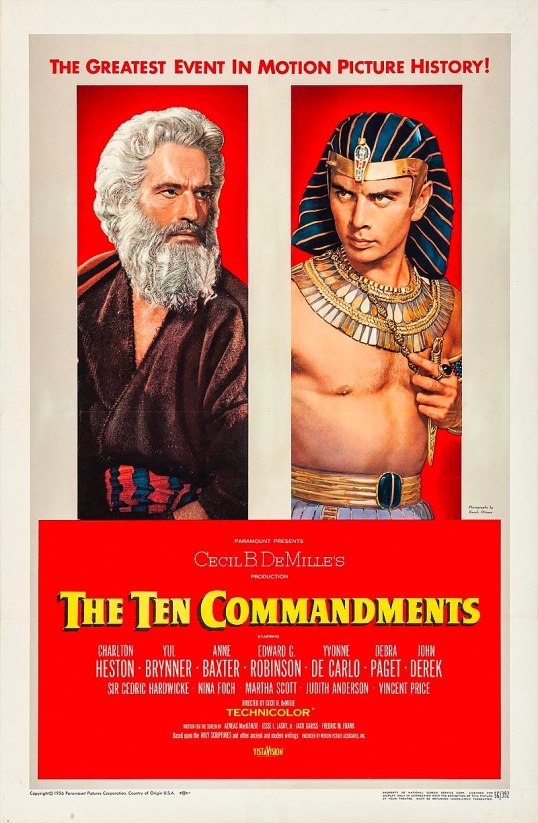
Film Review: The Ten Commandments (dir by Cecil B. DeMille)
Though you may not know it if you’ve only seen the film during one of its annual showings on television, the 1956 religious epic, The Ten Commandments, originally opened with director Cecil B. DeMille standing on a stage. Speaking directly to the audience, DeMille explains that, though the film they’re about to see me take some dramatic license with the story of Moses, it still based on not just the Bible but also the accounts of Philo, Josephus and Eusebius. He also tells us that The Ten Commandments is more than just an adaptation of the Book of Exodus. Instead, it’s a film about every man’s desire to be free.
Demille concludes with: “The story will take 3 hours and 29 minutes to unfold. There will be an intermission. Thank you for your attention.”
To be honest, it’s kind of a sweet moment. Cecil B. DeMille is a name that is so associated with (occasionally overblown) epic filmmaking that it’s easy to forget that DeMille was one of the most important names in the artistic development of American cinema. He was there from the beginning and, unlike a lot of other filmmakers, he was equally successful in both the silent and the sound era. Say what you will about his films, DeMille was a showman and he handles the introduction like a pro. At the same time, there’s a real sincerity to DeMille’s tone. After you listen to him, you’d almost feel guilty if you didn’t sit through all 3 hours and 29 minutes of his film.
That sincerity extends throughout the entire film. Yes, The Ten Commandments is a big, long epic and some members of its all-star cast are more convincing in their roles than others. And yes, the film can seem a bit campy to modern viewers. (In fact, it wouldn’t surprise me if it seemed a bit campy to viewers in 1956 as well.) Yes, The Ten Commandments does feature Anne Baxter saying, “Oh Moses! You sweet adorable fool!” But it doesn’t matter. Even the most ludicrous of dialogue just seem right. The film is just so sincere that it’s difficult not to enjoy it.
In the Book of Exodus, Moses is described as having a speech impediment and even tries to use it as an excuse to get out of going to Egypt. That’s actually one of the reasons why Moses brought Aaron with him to Egypt, so that Aaron could speak for him. In the movie, Moses is played by Charlton Heston, who comes across as if he’s never felt a moment of insecurity over the course of his entire life. But no matter. Heston may not by the Moses of Exodus but he’s the perfect Moses for the DeMille version. When Heston says that Egypt will be visited by plagues until his adopted brother Ramses (Yul Brynner) agrees to allow the Jews to leave Egypt, you believe every word. (Aaron, incidentally, is played by the legendary John Carradine. He doesn’t get too much other than respectfully stand a few feet behind Charlton Heston but still: John Carradine!)
And really, anyone who dismisses The Ten Commandments out-of-hand should go back and, at the very least, watch the scene where the Angel of Death descends upon Egypt. The scene where Moses and his family shelter in place while the screams of distraught mothers echo throughout the city is chilling. Ramses may spend most of the film as a petulant villain but you almost feel sorry for him when you see him mourning over his dead son. When he sets off after Moses, it’s not just because he’s doing what villains do. He’s seeking vengeance for the loss of his first born. For that brief moment, Ramses goes form being a melodramatic bad guy to being someone with whom the viewer can empathize. Brynner, with his burning intensity, gives a great performance as Ramses.
As I said before, this film has what, in 1956, would have been considered an all-star cast. Watching the names as they show up during the opening credits — Cedrick Hardwicke! Yvonne DeCarlo! Woody Strode! Debra Paget! — is like stepping into a TCM fever dream. Some of the performers give better performance than others. And yet, even the worst performer feels as if they just naturally belong in the world that DeMille has created. John Derek may seem rather smarmy as Joshua but his callowness provides a good contrast to the upright sincerity of Heston’s performance as Moses. Edward G. Robinson’s cries of, “Where is your God now!?” may have provided endless fodder for impersonators but just try to imagine the film without him. Even Vincent Price is in this thing! He doesn’t have his famous mustache but, as soon as you hear his voice and see that famous glare, you know that it’s him.
Of course, when you’re growing up and The Ten Commandments is on TV every year, you mostly just want to see the scene where Moses parts the Red Sea. The Ten Commandments was nominated for seven Oscars but it only won one, for its special effects. (The prize for Best Picture went to another epic, Around The World In 80 Days.) Today, the film’s special effects may no longer amaze viewers but there’s still something rather charming about the Red Sea parting and then crashing in on the Egyptian army. The scene where the Earth opens up and swallows those who worshiped the Golden Calf remains impressive, if just because all of the extras really look terrified that they might die. And while the Pillar of Fire may look a bit cartoonish to modern eyes, that’s a huge part of the film’s appeal.
The Ten Commandments is a big, long, sometimes silly, sometimes effective, and always entertaining epic. It’s a grand spectacle and one that I usually watch every year when it shows up on television. I missed this year’s showing but, fortunately, I own it on DVD. It’s a sincere epic and a difficult one not to like.
Horror on the Lens: Bride of the Gorilla (dir by Curt Siodmak)
In the 1951 film, Bride of the Gorilla, Raymond Burr plays a plantation manager who commits a murder. Unfortunately, for him, the murder is observed by a witch who promptly puts a curse of Burr. Now, every time the sun goes down, Burr transforms into a gorilla and goes wild in the jungle.
Basically, it’s kind of like The Wolf Man, just with a less sympathetic protagonist and a gorilla instead of a werewolf. Just in case we missed the similarities, Lon Chaney, Jr. plays the film’s nominal hero, a police commissioner who suspects that something weird might be happening with Burr. Apparently, the plan was originally for Chaney to play the gorilla and for Burr to play the policeman but, because Chaney was dealing with a serious alcohol problem at the time, the roles were reversed.
Also in the cast, playing the role of Dina, is Barbara Payton, the tragic actress who is best known for being at the center of a love triangle involving actors Tom Neal and Franchot Tone. In 195000, Neal attacked Tone and beat him so severely that Tone spent 18 hours in a coma. Tone was notably shaky onscreen for the rest of his film career while Neal spent a few years in prison. After the incident between Tone and Neal, Payton could only get roles in B-movies like this one. Tragically, she would pass away, in 1967, of heart and live failure. She was only 39 years old.