October True Crime: In Cold Blood (dir by Richard Brooks)


In 1959, the Clutter Family was murdered in Holcomb, Kansas.

Herbert Clutter was a farmer and was considered to be prosperous by the standards of small-town Holcomb.  Neither he nor his wife nor his teenage son and daughter were known to have any enemies.  The brutality of their deaths took not just the town but the entire state by surprise.  People like the Clutters were not supposed to be brutally murdered.  They certainly weren’t supposed to be brutally murdered in a tight-knit community like Holcomb or in a state like Kansas.

The Clutters

The author Truman Capote traveled to Holcomb with his friend Harper Lee, looking to write a story about how the heartland was dealing with such a brutal crime.  Six weeks after the murders, while Capote and Lee were still conducting their interviews, two small-time criminals named Dick Hickock and Perry Smith were arrested for the crime.  Capote’s proposed article about Holcomb instead became the basis for his best-known book, In Cold Blood.  Capote followed the case from the initial investigation to the eventual execution of both Hickok and Smith.  He examined the backgrounds of the two criminals, especially Perry Smith’s.  (Indeed, there were some who felt that Capote saw something of himself in the mentally-fragile Smith.)  In Cold Blood was Capote’s most successful book and it also launched the entire “true crime” genre.  It also may have been Capote’s downfall as Capote reportedly spent the rest of his life haunted by the feeling that he would never top the book and that he had potentially exploited Perry Smith while writing it.  In Cold Blood may be critical of the death penalty but, if Smith and Hickok hadn’t gone to the gallows, Capote would never have had an ending for the book.

(The writing of In Cold Blood and Capote’s subsequent struggles are dramatized in the excellent Capote.)

When it was published in 1965, In Cold Blood shot up the best seller lists.  A film version was an inevitability.  Otto Preminger —  who had already made films out of Anatomy of a Murder, Exodus, Advice and Consent, and The Cardinal — was eager to turn the book into a film and one can imagine him churning out some epic version with his usual all-star cast.  (Sal Mineo as Perry Smith?  Peter Lawford as Dick Hickok?  With Preminger, anything was possible.)  However, Capote sold the rights to Richard Brooks, an independent-minded director who was also an old friend.  Brooks decided to duplicate Capote’s “non-fiction novel” approach by actually shooting his film in Holcomb and having several residents of the town play themselves.  He also rejected Columbia’s suggestion that Smith and Hickok should be played by Paul Newman and Steve McQueen.  Instead, he cast former child actor Robert Blake as Perry Smith and an up-and-coming character actor named Scott Wilson as Dick Hickok.  The only “star” who appeared in the film was television actor John Forsythe, who played the Kansas detective who was placed in charge of the investigation.

The story plays out in deliberately harsh black-and-white.  (Legendary cinematographer Conrad Hall made his debut with this film.)  The opening contrasts scenes of Smith and Hickok, both recently released from prison, meeting up in Kansas with scenes of the Clutter family innocently going about their day.  Perry Smith is neurotic and quick to anger, a wannabe tough guy who wears a leather jacket and whose greasy hair makes him look less like a cunning criminal and more like an understudy in a regional production of West Side Story.  Dick Hickok is friendly and slick, a compulsive shoplifter who claims that his smile can get him out of anything.  In jail, Hickok heard a story that suggested that Mr. Clutter kept a lot of money hidden away in a safe on his farm.  Hickok’s plan is to tie up and rob a family of strangers, with the assumption being that, by the time the Clutters get loose and call the police, he and Smith will already be far out of town.  Neither he nor Smith seem like natural-born murderers.  Smith seems to be too sensitive.  Hickok seems like the epitome of someone who brags but doesn’t follow through.  And yet, the morning after the robbery, four of the Clutters are discovered murdered in their own home.

The film delves quite a bit into Perry Smith’s background.  Throughout the film, he has flashbacks to his abusive father and his promiscuous mother.  When Alvin Dewey (played by John Forsythe) investigates Smith’s family, the recurring theme is that Perry never really had much of a chance to become anything more than a criminal.  We learn less about Dick Hickok’s background, beyond the fact that he was a popular high school jock who turned mean after a car accident.  And yet, despite the fact that the film is clearly more interested in Perry Smith than Dick Hickok, it’s Scott Wilson who dominates the film.  It’s not that Robert Blake gives a bad performance.  It’s just that Perry is such a neurotic mess and Blake gives a performance that is so method-y that occasionally, you’re reminded that you’re just watching a movie.  Scott Wilson, on the other hand, gives a very natural performance as Dick Hickok.  There’s nothing particularly showy about his performance and that makes Hickok all the more disturbing as a criminal and a potential murderer.  If you’ve spent any time in the country, you’ve met someone like Dick Hickok.  He’s the friendly guy who always knows that right thing to say but there’s something just a little bit off about him.  He’s likable without being trustworthy.

A few years ago, when I saw that In Cold Blood was going to be airing on TCM, I told my aunt that I was going to watch the film.  She replied that I shouldn’t.  She saw the film when it was originally released and she described it as being incredibly disturbing.  Despite her warning, I watched the film and I have to admit that she was right.  Even though it’s nearly 60 years old and not particularly explicit when compared to the true crime films of today, In Cold Blood is still a disturbing viewing experience.  Towards the end of the film, we finally see the murders in flashback and the image of Smith and Hickok emerging from the darkness of the farmhouse will haunt you.  There’s not a lot of blood.  The camera often cuts away whenever the actual murders occur (we hear more gunshots than we see) but the Clutters themselves are sympathetic and innocent victims and their deaths definitely hurt.  Indeed, considering that the film falls on the more liberal side of the question of root causes, In Cold Blood deserves a lot of credit for not shying away from the brutality of the crimes.  After spending 90 minutes emphasizing Perry Smith’s terrible childhood, it was important to remind the audiences of what he and Dick Hickok actually did.

The murder scene is so nightmarish that it actually makes it a bit difficult to buy into the film’s anti-death penalty argument.  The film may end with Smith remorseful and a reporter (Paul Stewart) talking about how revenge is never the answer but the film’s liberal talking points feel hollow after witnessing the murder of four innocent people.  (Ironically, it turned out there was no safe so those four people died so Smith and Hickok could steal about forty dollars.)  A few years ago, I probably would have been very moved by the film’s anti-death penalty message.  While I’m still opposed to the death penalty because I think there’s too much of a risk of a wrongly convicted person being executed, I’m long past having much personal sympathy for the Perry Smiths of the world.

Overall, In Cold Blood remains a powerful and disturbing movie. It was a film that was nominated for several Oscars, though it missed out on Best Picture due to 20th Century Fox’s huge campaign for Dr. Dolittle.  Neither Blake nor Wilson were nominated, which is evidence that they were perhaps too convincing as Smith and Hickok for the Academy’s taste.  While Robert Blake would go on to have the more storied career, Scott Wilson was a dependable character actor up until his death in 2018.  A whole new generation of fans knew him not as Dick Hickok but instead as The Walking Dead‘s beloved Herschel Greene.

One final note: Both the book and the film present the murders as being an aberration, something that neither Smith nor Hickok originally planned.  In 2013, new evidence was released that revealed the Smith and Hickok were the number one suspects in the murder of Christine and Cliff Walker and their two children, a crime that occurred in Florida shortly after they fled Kansas.  The two of them were questioned at the time and given a polygraph test, which they both passed.  The bodies of Smith and Hickok were exhumed for DNA testing,  The tests came back inconclusive.

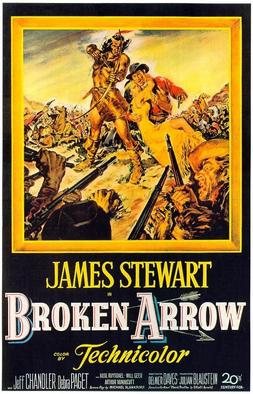
Film Review: Broken Arrow (dir by Delmer Daves)


The 1950 film, Broken Arrow, takes place in the years following the Civil War.

Having survived the war, frontier scout Tom Jeffords (James Stewart) just wants to get away from his fellow countrymen for a while.  During the Civil War, Jeffords saw the worst that humanity had to offer and the experience has left him cynical about the idea of bringing civilization to the American frontier.  Tom just wants to be left alone.  Still, when he comes across a 14 year-old Apache who has been shot in the back, Tom stops to help.  Though wounded, the Apache still tries to attack him.  He’s learned not to trust the white man.  Broken Arrow is a film that suggests that he has good reason not to.  Indeed, Broken Arrow was one of the first major Hollywood productions to attempt to treat the American Indians with sympathy and fairness.

Tom saves the Apache’s life and reunites him with his tribe.  When the Apaches attack and kill a group of nearby gold prospectors, they allow Tom to live but they warn him to stay out of their territory.  However, circumstances make it impossible for Tom to do that.  When Tom arrives in Tucson, the citizens are incredulous that he allowed the Apache child to live.  When Tom learns the Apache language and customs and marries an Apache woman named Sonseeahry (Debra Paget), it causes the other whites to distrust him even more.  However, it is Tom’s eventual friendship with the Apache chief Cochise (Jeff Chandler) that eventually lands Tom in the middle of the conflict between the Apaches who want to preserve their way of life and the white men who want their land.

Broken Arrow is a well-intentioned film, in the way that mildly liberal films from the 50s tended to be.  The U.S. government and its citizens are criticized for breaking their promises and their treaties to the Apache but the film’s ultimate message is one of compromise and understanding.  The bigoted whites may be the villains but then again, so is Geronimo (Jay Silverheels) for refusing to accept Cochise’s desire for peace.  Cochise is the film’s hero specifically because he calls for setting aside differences and living in peace with the white man, despite his own distrust of their leaders.  The majority of the extras were Apache, though Neither Jeff Chandler nor Debra Paget were of Native descent.  Both of them give good performances that largely avoid the stereotypes of the time.  Chandler received his only Oscar nomination, for Best Supporting Actor, for his performance in this film.

That said, the unnominated Jimmy Stewart dominates the film and that’s not really surprising.  (It should be noted that, while Stewart was not nominated for this film, he was nominated for his performance in Harvey, that same year.)  Stewart may have first found fame as the happy and go-lucky face of Middle America but his experiences in World War II left a definite mark on him.  He returned from the war a much more serious figure and every character that he played (even the lovable Elwood in Harvey) had more than a hint of melancholy to him.  Stewart plays Tom as being a troubled soul, someone who is still struggling to come to terms with the destruction and cruelty that he saw during the Civil War.  There’s an authenticity to Stewart’s performance, leaving little doubt that he understood exactly what Tom was going through.  Broken Arrow ends on a note of compromise and racial harmony but it’s a sad film because we know what waits in the future for Cochise and his people.  Tom Jeffords fights to bring peace to the frontier but it’s a peace that won’t last.  And, as played by Stewart, Tom seems to understand that better than anyone.

14 Days of Paranoia #10: The Brotherhood of the Bell (dir by Paul Wendkos)


First aired on television in 1970, The Brotherhood of the Bell tells the story of Andrew Patterson (Glenn Ford).

Andrew Patterson is a widely respected economics professor.  He is an influential academic, one who has a nice house, a beautiful wife (Rosemary Forsyth), and a father-in-law (Maurice Evans) who owns a very successful business.  Patterson is also a member the Brotherhood of the Bell, a secret society made up of successful men who all graduated from the prestigious College of St. George in San Francisco.  Patterson has been a member of the society for 22 years and he’s never really taken it that seriously.  He thinks of it as just being a collection of influential men who enjoy getting together and discussing their vision for the world.

That all changes when the man who brought Andrew to the Society, Chad Harmon (Dean Jagger), gives Andrew an assignment.  The Society wants him to deliver an envelope to his friend, Dr. Konstantin Horvathy (Eduard Franz).  Horvathy is up for a deanship that another member of the Society desires for himself.  Inside the envelope is damaging information that the Society has gathered about the people who helped Horvathy defect to the United States, information that will be made public unless Horvathy withdraws as a candidate.  Reluctantly, Andrew shows Horvathy the envelope.  Horvathy responds by committing suicide.

Stricken with guilt, Andrew decides to expose the existence of the Society but he discovers that won’t be easy.  Almost overnight, Andrew’s perfect life starts to collapse.  He loses his job.  The IRS launches an investigation of his father (Will Geer).  As Chad explains it, the Society is responsible for everything that Andrew has and, therefore, the Society can take everything away.  When Andrew goes public, he’s dismissed as just being paranoid and soon, Andrew truly is paranoid.  With his marriage in ruins, Andrew goes on a talk show and can only watch helplessly as his claims are dismissed by the host (William Conrad) and as the audience argues about whether or not the Society is a white plot, a communist plot, a Jewish plot, a Catholic plot, or a government plot.  Even the people who believe Andrew are too busy fighting amongst themselves to provide any help for him or to stand up to the unified power of the Brotherhood.  The host repeatedly rings a bell during the show, the better to mock everyone’s fears.  The film makes a good point.  Crazed theorists are often a conspiracy’s best friend.

An intelligently written and well-acted film, The Brotherhood of the Bell‘s main strength is the direction of Paul Wendkos.  The lighting gets darker and the camera angles become increasingly more skewed as Andrew’s paranoia grows.  In fact, Wendkos does such a good job of visualizing Andrew’s deteriorating mental state that it’s easy to wonder if maybe everyone is right and all of this really is just happening in Andrew’s head.  Though the film ends on a slightly triumphant note, it’s hard not to feel that it’s a temporary victory at best.  The Brotherhood of the Bell (which I imagine was based on Yales’s Skull and Crossbones) will always be there.

14 Days of Paranoia:

  1. Fast Money (1996)
  2. Deep Throat II (1974)
  3. The Passover Plot (1976)
  4. The Believers (1987)
  5. Payback (1999)
  6. Lockdown 2025 (2021)
  7. No Way Out (1987)
  8. Reality (2023)
  9. Chappaquiddick (2017)

Retro Television Reviews: The Love Boat 1.12 “The Old Man and the Runaway / The Painters / A Fine Romance”


Welcome to Retro Television Reviews, a feature where we review some of our favorite and least favorite shows of the past!  On Wednesdays, I will be reviewing the original Love Boat, which aired on ABC from 1977 to 1986!  The series can be streamed on Paramount Plus!

Welcome aboard!  We’re expecting you.

Episode 1.12 “The Old Man and the Runaway / The Painters / A Fine Romance”

(Directed by Stuart Margolin and James Sheldon, originally aired on December 24th, 1977)

Hey, this episode of The Love Boat aired on Christmas Eve!  Oddly enough, unlike last week’s episode, it was not a holiday-themed episode.  You really do have to wonder if there was some sort of scheduling snafu at ABC and perhaps the episodes were shown out-of-order.  Then again, it could be that ABC realized that everyone would be busy getting ready for Midnight Mass on Christmas Eve so they decided to burn off a lesser episode while no one was watching.

(Doesn’t everyone spend Christmas Eve getting ready for Midnight Mass while their aunt tells them to dress more like the Virgin and less like the Magdalene?  Or was that just my experience?)

Yes, this is a lesser episode of The Love Boat.  It’s not a terrible episode but, at the same time, it’s not all the memorable.  A big problem is that there’s not really much romance on this cruise.  The show was called The Love Boat for a reason and, when there’s no love, it just doesn’t feel right.

For instance, one subplot dealt with two incompetent painters (played by Arte Johnson and Pat Morita) painting the captain’s office during the cruise.  They kept screwing up the job, which led to Captain Stubing getting progressively more and more annoyed.  From the start, I guessed that the punchline would be that the painters were screwing up on purpose so that they could stay on the boat and get a free cruise and …. yep, that’s exactly what it was.  Johnson and Morita were a good comedy team but the story itself felt like filler.

Meanwhile, a grumpy old widower (Will Geer) discovered that he was sharing his cabin with a teenage runaway (Bayn Johnson), who had stowed away on the ship and who was planning on meeting up with her boyfriend in Mexico.  Once he got over complaining about her being young and irresponsible, Geer convinced her to return to her parents.  Again, it wasn’t terrible and Bayn Johnson did a good job of keeping her character from getting annoying but it felt a bit out of place on The Love Boat.  Obviously, the 75 year-old man and the 16 year-old runaway weren’t going to fall in love and leave the ship arm-in-arm while the crew smiled knowingly.  Instead, this was a typical generation gap story.  The most interesting thing about this story is that this was the second time that a runaway managed to stowaway on the Love Boat.  Does that boat not have a security team?  Don’t you actually have to show your tickets to board the boat?  How does these people keep sneaking aboard?

Finally, the third storyline felt a bit more like a Love Boat story.  Cruise director Julie (Lauren Tewes) is super-excited when she sees that Sean McGlynn (Anson Williams) is a passenger on the cruise.  Julie and Sean grew up together and Julie always had a crush on him.  At first, Julie and Sean have fun hanging out but, whenever Julie tries to flirt, Sean panics and runs off.  Julie worries that there’s something wrong with her (oh, Julie!) but …. nope, Sean’s a priest.  Apparently, he was having a crisis of faith when he boarded the boat, which is why he didn’t tell anyone he was a priest.  But, when his roommate (Tom Poston) has a heart attack, Sean delivers the last rites and his faith is restored.  (Don’t worry.  His roommate survives and has a surprisingly quick recovery.  Doc Bricker is a miracle worker!)  Anyway, Sean leaves the boat wearing his collar and Julie stays on the boat, no doubt waiting for someone else from her past to buy a ticket.  It’s a bit of a shame, as Lauren Tewes and Anson Williams did make a cute couple.  Then again, we all know that Julie and Gopher belong together.

Like I said, this was not a terrible episode.  It just wasn’t particularly memorable.  It needed just a bit more romance.  After all, love is life’s sweetest reward.

The Hanged Man (1974, directed by Michael Caffey)


In this made-for-TV western, Steve Forrest stars as James Devlin.  A hired killer and a notorious outlaw, Devlin has finally been captured and is sent to the gallows.  At first, it seems as if the hanging’s been a success and Devlin’s life has been extinguished at the end of the rope.  But then, while his body is at the funeral home and is being prepared for burial, Devlin suddenly opens his eyes and reveals that he’s alive.

No one can figure out how Devlin manage to survive being hung, especially not Devlin.  However, Devlin is now alive and free to leave town.  Has Devlin been sent back to Earth to serve God or did he just get lucky?  Devlin may not be sure himself but he is determined to turn around his old ways.  That starts with protecting a widow (Sharon Acker) and her son (Bobby Eilbacher) from Lew Halleck (Cameron Mitchell), a greedy businessman who wants their land and is prepared to go to any lengths to get it.  Devlin is not only still as good with a gun as he was before his execution but, having survived his hanging, he can now read minds!

The Hanged Man was designed to be a pilot for a weekly TV series and watching it, it’s easy to imagine how the show would have developed.  Devlin would have traveled around the old west, helping out a new guest star every episode and presumably trying to discover why he had been returned to life.  It’s not a bad idea for a show, though the pilot film doesn’t do enough with it.  Despite the fact that Devlin might be undead and that he now has the power to read minds, it really is just a conventional western, featuring the saintly widow and the evil land baron and all of the other familiar tropes of the genre.  It may begin with Devlin coming back to life but it ends with a shoot-out that could have been lifted from any number of old TV shows.

Still, as far as made-for-TV westerns are concerned, this one is entertaining enough.  Steve Forrest is a good hero and, as always, Cameron Mitchell is a good villain.  I wish they had done more with the supernatural aspects of the story but The Hanged Man is good enough for undemanding fans of the genre.

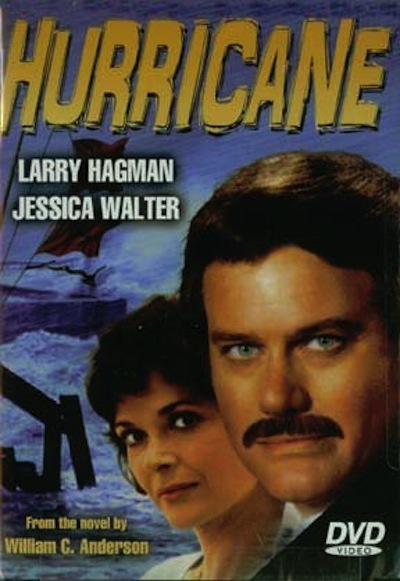
Hurricane (1974, directed by Jerry Jameson)


Hurricane Hilda is crashing down on the Gulf Coast and everyone in its path is about to get all wet.  While Will Geer and Michael Learned try to warn everyone about the approaching hurricane, coast guard pilot Martin Milner observes the storm from the air and tires to rescue everyone in its path.  Some people listen and some people don’t.  Milner’s own father, played by Barry Sullivan, ends up getting stranded in a cabin while Larry Hagman and Jessica Walter play a married couple on a boat who find themselves sailing straight into the storm.  On temporarily dry land, Frank Sutton (a.k.a. Gomer Pyle’s Sgt. Carter) plays a homeowner who refuses to evacuate because he’s convinced that he knows everything there is to know about hurricanes.  He and the neighbors have a drunken party while waiting for the storm.  When Patrick Duffy and his wife announce that they’re heading for safety, Sutton demands that they come in and have a beer with him.  When Hilda finally makes landfall, some survive and some don’t.

Hurricane is a by-the-numbers disaster movie.  It was made after The Poseidon Adventure and during the same year as The Towering Inferno and it hits all the usual disaster movie beats.  Survival is determined by karma, with Hilda going after anyone who was too big of a jerk during the first half of the movie.  It’s predictable stuff but it does feature footage from an actual hurricane so it’s at least not too dragged down by any of the bad special effects that always show up in made-for-TV disaster films.

This is one of those films where the cast was probably described as being all-star, even though most of them were just TV actors who needed a quick paycheck.  Seen today, the film feels like a MeTV reunion special.  Years before they played brothers in Dallas, both Larry Hagman and Patrick Duffy appeared in Hurricane, though neither of them shares any scenes.  Will Geer and Michael Learned were starring on The Waltons when they appeared in this movie and they’re in so few scenes that they probably shot their scenes over a weekend before returning to Walton’s Mountain.  The best performance is from Frank Sutton, who died of a heart attack just a few weeks after this movie aired.  He’s a convincing hothead, even if he doesn’t have Gomer around to yell at.

Hurricane may be bad but it’s still not as terrible as most made-for-TV disaster movies.  People who enjoy watching TV actors pretending to stare at a tidal wave of water about to crash down on them will find this film to be an adequate time waster.

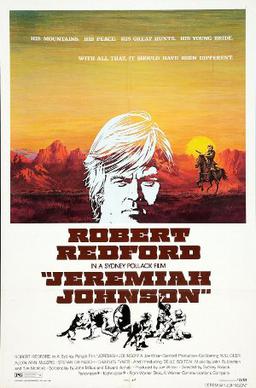
Jeremiah Johnson (1972, directed by Sydney Pollack)


In the 1840s, Jeremiah Johnson (Robert Redford) is a veteran of the Mexican War who wants to get away from civilization.  He sets up an isolated life for himself in the Rocky Mountains and looks to support himself by working as a trapper.  At first, he struggles but eventually he gets some much-needed help from a veteran trapped named Chris Lapp (Will Geer).  Along the way, Johnson discovers that life in the mountains can be harsh and violent.  He adopts a mute boy named Caleb, whose family has been killed by Blackfoot warriors.  Later, the chief of the local Flathead tribe “gives” Jeremiah his daughter.  Despite the language barrier between him and his new wife, Jeremiah is soon the head of a happy family.

One day, when the U.S. Calvary shows up and requests that Jeremiah guide them through the mountains so that they can rescue some starving missionaries, Jeremiah reluctantly leaves behind his family and helps them.  However, Lt. Mulvey (Jack Colvin) insists that Jeremiah lead them through a sacred Crow burial ground.  The Crow retaliate by killing Jeremiah’s family.  Driven mad by grief, Jeremiah sets out to kill every Crow that he can find.

Jeremiah Johnson is really two movies in one.  The story starts out with Jeremiah as a proto-hippie who wants to get away from the hypocrisy and violence of modern society.  Jeremiah takes care of the land, makes friends with other outcasts, and makes a good life for himself.  After Jeremiah’s family is killed, the movie turns into a Death Wish-style revenge thriller, with Jeremiah losing himself in his rage and killing almost everyone that he sees.  Redford is surprisingly convincing as the insane, murderous Jeremiah and the sudden outbursts of violence provide a strong contrast to the relatively peaceful first half of the film.

Jeremiah is a like a lot of the early American settlers.  He wants to get away from the world and start an entirely new life for himself.  He’s seen what the civilization has to offer and he would rather just build a cabin in the mountains and pretend that the rest of the world doesn’t exist.  If Jeremiah had been born earlier, he probably could have pulled it off.  But, by the time Jeremiah tries to go off the grid, it’s already too late.  Society is growing too fast for him to escape from it.  Jeremiah discovers that it’s impossible to truly cut yourself off from humanity. In the end, he’s much like the Crow Indians that he’s declared war upon.  His way of life is ending, whether he’s ready for it or not.  When he and the Crow chief greet each other with a raised open hand (meaning that they come in peace), they are both acknowledging that they are bonded as men whose time is coming to an end.

Jeremiah Johnson was the second of Robert Redford’s many collaborations with director Sydney Pollack and it’s one of their best.  This may be an epic film but it never loses its humanity and, for once, Redford plays someone who isn’t a cut-and-dried hero.  Jeremiah Johnson has recently been rediscovered because of a popular meme of a bearded Redford looking at the camera and nodding but people should know that it’s also a damn fine film on its own.


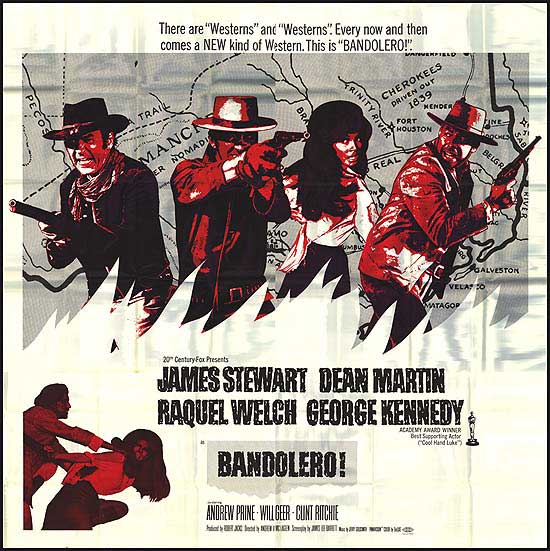
On the Border: BANDOLERO! (20th Century-Fox 1968)


gary loggins's avatarcracked rear viewer

bandolero1

BANDOLERO! was made at an interesting time in the history of Western movies. Sergio Leone’s “Man With No Name” trilogy had begun to exert their influence on American filmmakers (HANG EM HIGH, SHALAKO). Traditional Hollywood Westerns were still being produced (FIRECREEK, 5 CARD STUD), but in a year’s time, Sam Peckinpah’s THE WILD BUNCH would change the Western landscape forever. Andrew V. McLaglen’s BANDOLERO! is more on the traditional side of the fence, though it does exhibit a dash of Spaghetti flavor in its storytelling.

Outlaw Dee Bishop and his gang attempt to rob a bank in Valverde, Texas. The heist is going well until rich Nathan Stone walks in with his beautiful Mexican wife, Maria. Stone tries to break it up, and gets shot for his troubles, thus alerting the attention of Sheriff July Johnson and his deputy, Roscoe. The lawmen successfully catch the gang as they’re leaving the bank. Stone dies, and Dee and…

View original post 782 more words

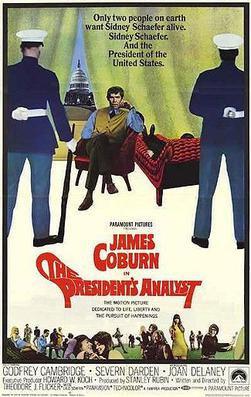
Shattered Politics #25: The President’s Analyst (dir by Theodore J. Flicker)


Presidents_movieposter “If I was a psychiatrist, which I am, I would say that I was turning into some sort of paranoid personality, which I am!” — Dr. Sidney Schaefer (James Coburn) in The President’s Analyst (1967)

Let’s just be absolutely honest about something.  Judging from what they regularly get caught saying and from some of the policies that they support, a good deal of politicians could probably use some sort of professional help.  That’s probably especially true of the men who sit in the Oval Office.  It can’t be easy to have to hide so many secrets, tell so many lies, and be constantly aware of how close the government is to actually collapsing.  We’ve had 44 Presidents and I imagine all of them probably could have used someone to talk to.

But here’s the thing.  We spend so much time worrying about the well-being of the President that we often don’t stop to think about the people who have to listen to them speak on a daily basis.  I imagine that being the President’s therapist must be a thankless job.  Not only do you have to spend hours listening to someone who you may not have voted for but, at the same time, you can’t share any of the information that you’ve learned.

That would certainly seem to be what’s happening with Dr. Sidney Schaefer (James Coburn), the title character of the wonderfully psychedelic 1967 satire, The President’s Analyst.  At the start of the film, Sidney is a supremely confident psychiatrist.  He can calmly and rationally deal with all of his patients problems and, in order to keep from getting overwhelmed, he has his own analyst (Will Geer).

One of his patients is Don Masters (Godfrey Cambridge), an agent for the Central Enquiries Agency (CEA) who is first seen casually murdering a man on the streets of New York.  (When Sidney discovers that Don is an assassin, he’s thrilled and impressed to discover that Don has managed to channel all of his hostility into his job.)  What Sidney doesn’t realize is that Don is testing him to see if he’s up to the job of serving as the President’s analyst.

At first, Sidney is thrilled with his new position but he soon discovers that being the closest confidante of the leader of the free world has its downside.  For one thing, Sidney is viewed by suspicion by Henry Lux (Walter Burke), the head of the Federal Bureau of Regulation (which, in this film, is exclusively staffed by people who are less than 5 feet tall).  Even beyond being targeted by the FBR, Sidney struggles with not being able to see his own therapist and discuss what he’s been told by the President.  Soon, Sidney is becoming paranoid and is even convinced that his girlfriend is a spy.

(And, of course, she is.)

So, Walter does what any sensible and paranoid person would do.  He makes a run for it.  Pursued by the FBR, the CEA, and a Russian assassin (a funny performance from Severn Darden, who also played Kolp, the sadistic torturer in Conquest of the Planet of the Apes), Sidney hides out with everyone from a group of hippies to a family of heavily armed, karate-trained, middle class “militant liberals.”

(The father of the militant liberal family is played by William Daniels, who decades later would play Mr. Feeney in Boy Meets World.)

Of course, there’s an even bigger conspiracy at work than even Sidney realizes.  The real threat is the TPC and I’m not going to tell you what that stands for.  You need to see the movie.

And really, The President’s Analyst is a film that you really should see.  What makes this film truly special — beyond the clever dialogue and the excellent performances and the great direction — is that it’s both a product of when it was made and a timeless portrait of power and paranoia.  It’s a time capsule that still feels incredibly relevant.


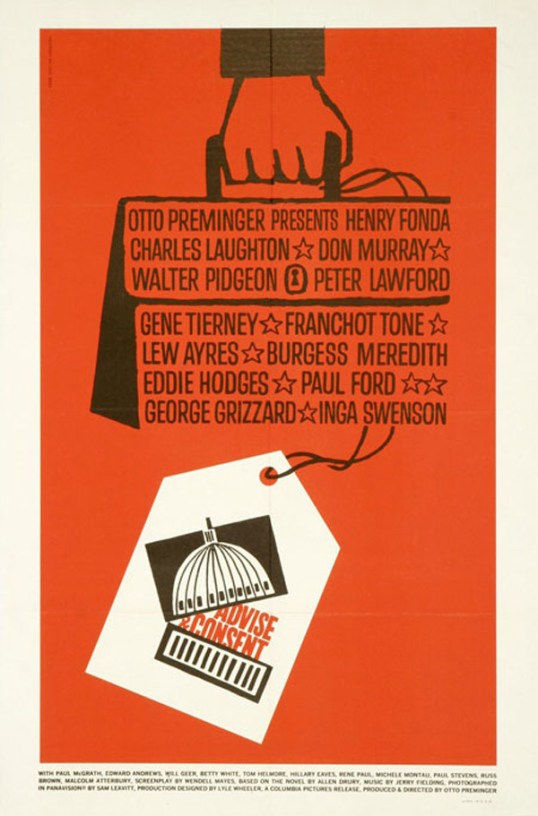
Shattered Politics #17: Advise & Consent (dir by Otto Preminger)


Advise-&-Consent-(1)

In case you hadn’t heard, U.S. Sen. Barbara Boxer has recently announced that she’s retiring in 2016.  For the first time in decades, there’s going to be an open senate seat in California.  There’s been a lot of speculation about who might run for the seat and, for the most part, it’s all been the usual political suspects.  The state’s attorney general is running.  A few congresspeople might run.  Token billionaire Tom Steyer is thinking of getting into the race.

What disappoints me is that, as of right now, it doesn’t look like any celebrities are planning on running.  You know what would have made the Golden Globes perfect?  If George Clooney had announced his candidacy while accepting his Cecil B. DeMille award.  (At the very least, it might have given Amal something to smile about, as opposed to just sitting there with a condescending smirk on her face.  Seriously, what’s up with that?)  But even beyond George Clooney, there’s all sorts of celebrities who could run.  Charlie Sheen lives in California, after all.  Jeff Bridges might not be able to run in Montana but what about California?

I was discussing this with a friend of mine who suggested that Betty White should run because who could vote against Betty White?  Speaking for myself, I could easily vote against Betty White but I do think there would be something appropriate about Betty White serving in the U.S. Senate.  After all, in 1962, she played a senator in Otto Preminger’s political epic, Advice & Consent.

White played Sen. Bessie Adams of Kansas and was only given a few minutes of screen time.  She’s one of many performers to show up in Advise & Consent‘s version of the U.S. Senate.

For instance, Walter Pidgeon plays Sen. Bob Munson, who is the Senate majority leader and, as a result, the closest thing that this sprawling film has to a central character.  His job is to make sure the President’s agenda is pushed through Congress.

And then there’s Peter Lawford, as Sen. Lafe Smith, who always has a different girl leaving his hotel room.  When Advise & Consent was made, Lawford was President Kennedy’s brother-in-law.  Interestingly enough, one of Kennedy’s former girlfriends — actress Gene Tierney — shows up in the film as well, playing Bob Munson’s lover.

George Grizzard plays Sen. Fred Van Ackerman, who is about as evil as you would expect someone named Fred Van Ackerman to be.  Grizzard gives one of the better performances in the film, which just goes to prove that it’s more fun to play an evil character than a good one.

Don Murray is Sen. Brigham Anderson, a senator who is being blackmailed by Van Ackerman’s lackeys.  Despite being happily married to Mabel (Inga Swenson), Anderson is leading a secret life as a gay man.  The scene where Anderson steps into a gay bar may seem incredibly tame today but it was reportedly very controversial back in 1962.

And finally, there’s Sen. Seabright Cooley.  You may be able to guess, just from his overly prosaic name, that Cooley is meant to be a southerner.  That, of course, means that he wears a white suit, is constantly fanning himself, and speaks in lengthy metaphors.  Sen. Cooley is played by Charles Laughton, who overacts to such a degree that I’m surprised that there was any oxygen left over for anyone else.

All of these senators have been tasked with deciding whether or not Robert Leffingwell (Henry Fonda) will be the next secretary of state.  Fonda, not surprisingly, is the epitome of urbane liberalness in the role of Leffingwell.  However, Leffingwell has a secret.  Back in the 1930s, Leffingwell was a communist.  When Sen. Cooley introduces a witness (Burgess Meredith) who can confirm this fact, Leffingwell offers to withdraw as the nominee.  However, the President (Franchot Tone) refuses to allow Leffingwell to do so.  Instead, with the help of Van Ackerman, he tries to pressure Anderson into supporting Leffingwell’s nomination.

This, of course, leads to melodrama and tragedy.

As far as literary adaptations directed by Otto Preminger are concerned, Advise & Consent is better than Hurry Sundown while being nowhere to close to being as good as Anatomy of a Murder.  It’s a film that is occasionally entertaining, often draggy, and, if just because of all the different acting styles to be found in the cast, always interesting to watch.

And, for what it’s worth, Betty White makes for a convincing senator.  So, perhaps the people of California should watch Advise & Consent before voting for Tom Steyer…