Film Review: Executive Decision (dir by Stuart Baird)


In 1996’s Executive Decision, terrorists hijack an airplane.  Their leader, Nagi Hassan (David Suchet) demands that the U.S. government not only give him and his men safe passage but that they also release Hassan’s commander, Jaffa (Andreas Katsulas).

In Washington D.C., it is decide to use a stealth plane to transport Col. Austin Travis (Steven Seagal) and his men into the passenger plane.  Accompanying them will be Dr. David Grant (Kurt Russell), a consultant for U.S. Intelligence.  Dr. Grant is the world’s leading expert on Hassan, even though neither he nor anyone else is even sure what Hassan looks like.  Travis distrusts Grant because he’s a civilian and also because he holds Grant responsible for a botched raid on a Russian safehouse in Italy.  Dr. Grant is going to have to prove himself to Col. Travis because Travis doesn’t have any time for people who can’t get the job done.  And Travis is determined to get on that plane and save all those passengers.

In other words, Travis is a typical Steven Seagal character and, for the first fourth of this movie, Seagal gives a typical Steven Seagal performance.  He delivers his line in his trademark intimidating whisper, he glares at everyone else in the film, and essentially comes across as being a total douchebag who can still handle himself in a fight..  However, when it’s time to board the airplane through a docking tunnel, something goes wrong.  Everyone — even nervous engineer Dennis Cahill (Oliver Platt) is able to slip through the stealth plane’s docking tunnel and get into the hijacked airplane cargo hold without being detected.  But the two planes are hit by severe turbulence.  Suddenly, it becomes apparent the one man is going to have to sacrifice his life and close the hatch before the docking tunnel decompresses.

David, already in the cargo hold, looks down at Austin in the tunnel.  “We’re not going to make it!”

“You are!” Austin replies before slamming the hatch shut and getting sucked out of the tunnel.  (There’s your Oscar Cheers Moment of 1996!)  After all that build-up, Steven Seagal exits the film early and now, it’s up to Kurt Russell and what’s left of Austin Travis’s men to somehow stop the terrorists.  Not only do they have to stop Hassan but they also have to do it before the Air Force — which has no way of knowing whether or not any of their men were able to get on the plane before the tunnel fell apart — shoots down the airliner.

(If the airplane looks familiar, that’s because Lost used the same stock footage whenever it flashed back to the plane crash that started the show.)

It’s actually a rather brilliant twist.  When this film came out, Seagal was still a film star.  He played characters who always got the job done and who were basically infallible.  He wasn’t a very good actor but he did manage to perfect an intimidating stare and that stare carried him through a lot of movies.  No one would have expected Seagal to die within the first 30 minutes of one of his movies and when Col. Travis, who the film has gone out of its way to portray as being the consummate warrior, is suddenly killed, there really is a moment where you find yourself wondering, “What are they going to do now?”  In just a matter of minutes, Executive Decision goes from being a predictable Steven Seagal action film to a genuinely exciting and clever Kurt Russell thriller.  For once, Russell is not playing a man of action.  He’s an analyst, a thinker.  And, to the film’s credit, he uses his mind more than his brawn to battle Hassan’s terrorists.  With excellent support from Halle Berry (as a flight attendant who discreetly helps out David and the soldiers), Oliver Platt, B.D. Wong, Whip Hubley,  David Suchet, Joe Morton, and even John Leguizamo (as Travis’s second-in-command), Executive Decision reveals itself to be an exciting and ultimately rewarding thrill ride.

And to think, all it took was sacrificing Steven Seagal.

Daddy’s Girl (1996, directed by Martin Kitrosser)


Daddy’s Girl is a forgotten film today but I swear that there was a two-month period in 1997 when it showed up every weekend on late night Cinemax and Showtime.  Like many former late night cable mainstays, Daddy’s Girl never developed enough of a cult following to justify getting a DVD release so, if you want to see it, you either have to have a working VCR or the ability to search YouTube.

I’m surprised this film doesn’t have a following because it features two thing that were every popular on cable in the 90s, William Katt and an evil child.  This time, William Katt plays Don, a toy designer who can’t get anyone to buy his creations.  Because he’s struggling, his wife (Michele Greene) is having to support the family.  Despite the fact that they’re not in great financial shape, they still decided to adopt 11 year-old Jodi (Gabrielle Boni).  Jodi loves Don and he spoils her every chance that he gets.  Jodi hates everyone else and tries to kill all of them.

What sets Daddy’s Girl apart from other crazy kid movies is just how far Jodi will go to kill anyone who might get between her and her adopted father.  Don’t even think about recommending that Jodi go to a special school because Jodi will knock you off a ladder and then push over a bookcase so that it lands on top you!  Don’t try to investigate her past because Jodi knows how to use a meat tenderizer as a deadly weapon!  Even if you’re at the hospital as a result of Jodi’s actions, she’ll just go down there and pull the plug herself!  And Jodie won’t just kill you.  She’ll make a joke about it after she does it!  Jodi is full of one liners.  Is this kid a comedian or a killer?  You’ll die laughing!

It’s hard to believe that no one would catch on to what Jodi is doing and I think the movie overestimates the physical strength of a typical 11 year-old girl but Daddy’s Girl isn’t bad.  William Katt was one of the better actors to regularly appear in direct-to-video thrillers like this one and Gabrielle Boni is a trip as the clingy and crazy Jodi.  Direct-to-video mainstays Mimi Craven and Whip Hubley also make welcome appearances.  Daddy’s Girl is an enjoyable take on The Bad Seed.

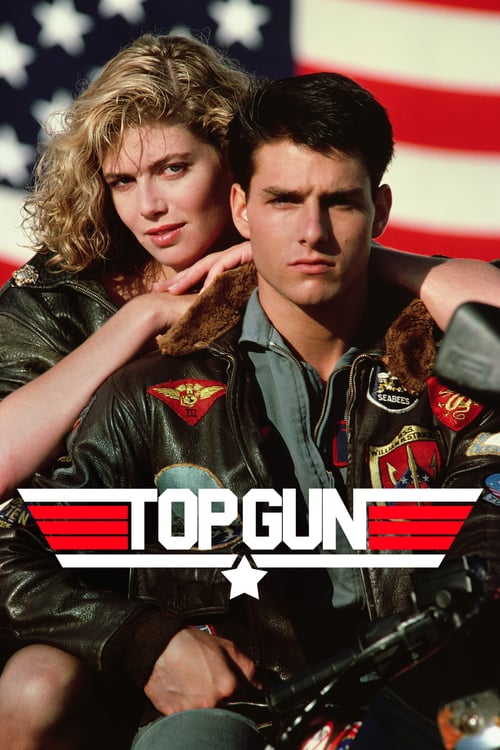
Film Review: Top Gun (dir by Tony Scott)


Oh, where to even begin with Top Gun?

First released in 1986, Top Gun is a film that pretty much epitomizes a certain style of filmmaking.  Before I wrote this review, I did a little research and I actually read some of the reviews that were published when Top Gun first came out.  Though it may be a considered a classic today, critics in 1986 didn’t care much for it.  The most common complaint was that the story was trite and predictable.  The film’s reliance on style over substance led to many critics complaining that the film was basically just a two-hour music video.  Some of the more left-wing critics complained that Top Gun was essentially just an expensive commercial for the military industrial complex.  Director Oliver Stone, who released the antiwar Platoon the same year as Top Gun, said in an interview with People magazine that the message of Top Gun was, “If I start a war, I’ll get a girlfriend.”

Oliver Stone was not necessarily wrong about that.  The film, as we all know, stars Tom Cruise as Pete “Maverick” Mitchell, a cocky young Navy flyer who attends the TOPGUN Academy, where he competes with Iceman (Val Kilmer) for the title of Top Gun and where he also spends a lot of time joking around with everyone’s favorite (and most obviously doomed) character, Goose (Anthony Edwards).  Maverick does get a girlfriend, Charlie (Kelly McGillis), but only after he’s had plenty of chances to show both how reckless and how skilled he can be while flying in a fighter plane.  Though the majority of the film is taken up with scenes of training and volleyball, the end of the film does give Maverick a chance to prove himself in combat when he and Iceman end up fighting a group of ill-defined enemies for ill-defined reasons.  It may not be an official war but it’s close enough.

That said, I think Oliver Stone was wrong about one key thing.  Maverick doesn’t get a girlfriend because he started a war.  He gets a girlfriend because he won a war.  Top Gun is all about winning.  Maverick and Iceman are two of the most absurdly competitive characters in film history and, as I watched the film last weekend, it was really hard not to laugh at just how much Cruise and Kilmer got into playing those two roles.  Iceman and Maverick can’t even greet each other without it becoming a competition over who gave the best “hello.”  By the time the two of them are facing each other in a totally savage beach volleyball match, it’s hard to look at either one of them without laughing.  And yet, regardless of how over-the-top it may be, you can’t help but get caught up in their rivalry.  Cruise and Kilmer are both at their most charismatic in Top Gun and watching the two of them when they were both young and fighting to steal each and every scene, it doesn’t matter that both of them would later become somewhat controversial for their off-screen personalities.  What matters, when you watch Top Gun, is that they’re both obviously stars.

“I’ve got the need for speed,” Tom Cruise and Anthony Edwards say as they walk away from their plane.  The same thing could be said about the entire movie.  Top Gun doesn’t waste any time getting to the good stuff.  We know that Maverick is cocky and has father issues because he’s played by Tom Cruise and Tom Cruise always plays cocky characters who have father issues.  We know that Iceman is arrogant because he’s played by Val Kilmer.  We know that Goose is goofy because his nickname is Goose and he’s married to Meg Ryan.  The film doesn’t waste much time on exploring why its characters are the way they are.  Instead, it just accepts them for being the paper-thin characters that they are.  The film understands that the the most important thing is to get them into their jets and sends them into the sky.  Does it matter that it’s sometimes confusing to keep track of who is chasing who?  Not at all.  The planes are sleek and loud.  The men flying them are sexy and dangerous.  The music never stops and the sun never goes down unless the film needs a soulful shot of Maverick deep in thought.  We’ve all got the need for speed.

In so many ways, Top Gun is a silly film but, to its credit, it also doesn’t make any apologies for being silly.  Instead, Top Gun embraces its hyperkinetic and flashy style.  That’s why critics lambasted it in 1986 and that’s why we all love it in 2020.  And if the pilots of Top Gun do start a war — well, it happens.  I mean, it’s Maverick and Iceman!  How can you hold it against them?  When you watch them fly those planes, you know that even if they start World War III, it’ll be worth it.  If the world’s going to end, Maverick’s the one we want to end it.


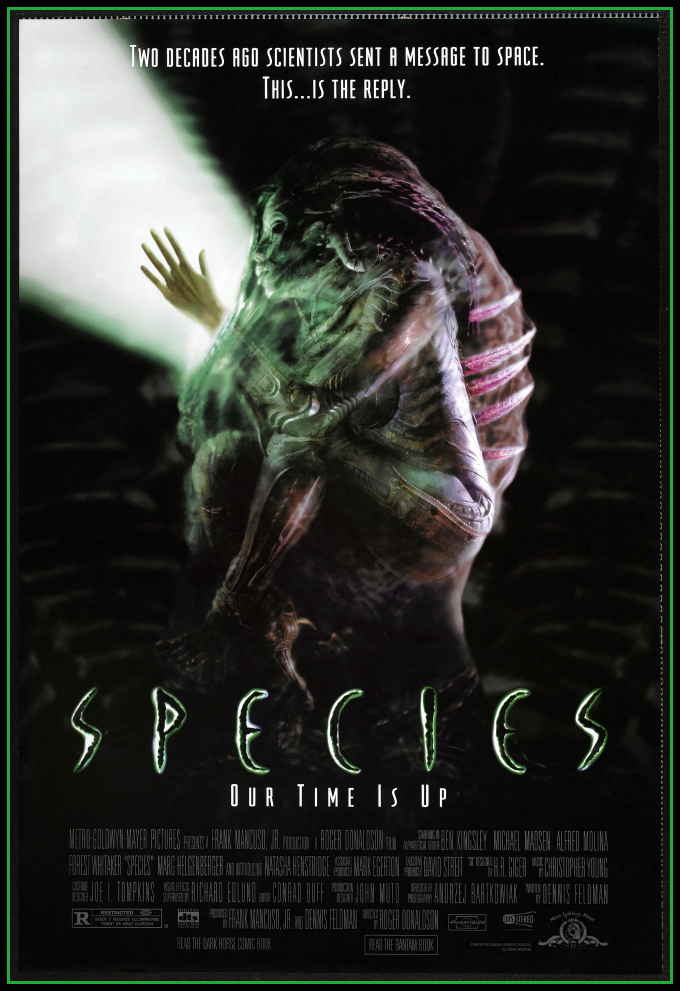
Quickie Horror Review: Species (dir. by Roger Donaldson)


1995’s Species was a studio’s attempt to replicate the start of a new sci-fi/horror franchise like the one begun by Ridley Scott’s Alien. Roger Donaldson was tapped to direct this attempt with a cast that included Sir Ben Kingsley, Michael Madsen, Marge Helgenberger, Forrest Whitaker and Alfred Molina. The lucky gal who gets to play the role of Sil — the half-alien, half-human hybrid — fell on the stunning and gorgeous shoulders of Natasha Henstridge.

Species pulls from so many different sci-fi/horror films and shows from the past that it’s hard to find anything original in the story. There’s stuff from Alien, The Hidden, and even some episodes of The X-Files. The one original twist in this derivate film was the plot of an alien race sending over the genetic markers of its race and instructions on how to recombine it with human DNA to create a form of hybrid. Why the scientists decided to go through with such a seemingly dangerous task is known only to the writer who put pen to paper to create the screenplay. The bulk of the film’s story comes from one the creation of one such human-alien hybrid named Sil (the young version played by Michelle Williams in one of her very first roles) and how her creators and handlers begin to realize that she has an almost desperate need to procreate.

The acting by the select group of experts (Madsen, Helgenberger, Molina, Kingsley and Whitaker) were good enough and no one embarrassed themselves in the end. Henstridge does a fine job of being sexy and hot. It helped that she pretty much was naked through most of the film, or at least put herself in situations to be naked. In fact, Henstridge goes beyond just being the naked eye candy in the film, but does a great job playing the naive adult Sil who escapes her lab-prison as her instincts propel her to find the perfect mate. It’s during this search that much of the film’s gore make their appearance and there’s a bit of it.

The art design of Sil as the evolved alien hybrid came courtesy of the great Swiss surrealist, H.R. Giger who also did the design for the alien creature in Alien. Giger’s biomechanical designs have always been disturbing and beautiful at the same time and he didn’t disappoint with his design of Sil. If there was a quibble on Sil’s final design it was that it still resembled a bit too much of the alien design in Ridley Scott’s Alien. But it was still great to see H.R. Giger still creating such wonderful artwork and designs for people to see. His popularity has always been mostly composed of the elite circles of the artworld and those small, loyal art groups with a penchant for the surreal, weird and disturbing.

In the end, Species was a good sci-fi/horror that didn’t bore too much and for those who enjoy their gore this film had its equal share of the red stuff. Gratuitious nudity and sex from Natasha Henstridge as Sil the alien hybrid and the excellent designs from H.R. Giger gives this film enough good things to look at. It doesn’t bring anything new and pretty much reuses alot of other things from other movies, but Species was good enough albeit derivative of better past films and shows.