I read about the movie COCKFIGHTER many years ago, and I remember the review being very positive. I had never watched the film before, but with today being Warren Oates’ birthday and it being available on Amazon Prime, I decided I’d finally watch it.
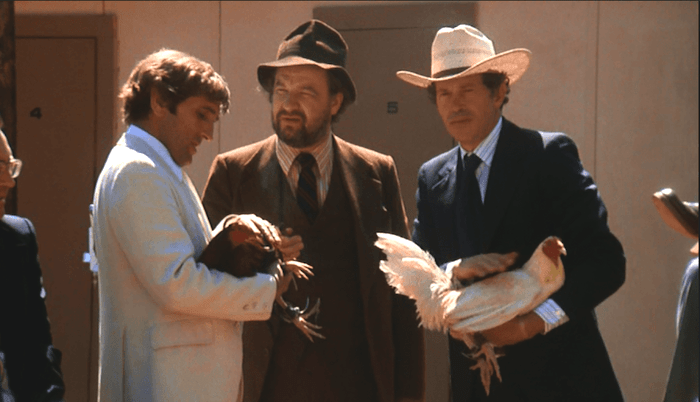
Directed by Monte Hellman and based on Charles Willeford’s 1962 novel, COCKFIGHTER introduces us to Frank Mansfield (Warren Oates), a man completely obsessed with the southern “sport” of cockfighting. As we meet him, he’s in the process of losing a bet and a cockfight with Jack Burke (Harry Dean Stanton). The loss isn’t just a setback, it costs him all of his cash, his truck, his trailer, and his current girlfriend Dody White (Laurie Bird). We also notice in these early scenes that Frank only communicates through sign language and writing notes. It seems that he’s been living under a self-imposed vow of silence. Two years earlier, on the eve of the big, season-ending cockfighting grand finale, Frank’s big-mouthed braggadocio caused him to lose his prized cock, and the prestigious “Cockfighter of the Year” medal in a meaningless hotel bet, also against Jack Burke. Frank vows not to speak again until he wins that medal. Coming up with cash in the only way he can by selling his family’s home, Frank buys a new cock named White Lightning from Ed Middleton, played here by the film’s writer Charles Willeford. Armed with new fowl and a new, capital rich partner named Omar Baradansky (Richard B. Shull), Frank will not let anything stop him, including the love of his life Mary Elizabeth (Patricia Pearcy) or an axe wielding competitor (Ed Begley, Jr.), from being named “Cockfighter of the Year” and finally regaining his voice and the respect he desires!
COCKFIGHTER definitely has some things going for it. First and foremost, Warren Oates is so good in the lead role as the obsessed man who puts success in cockfighting above anything else in his life, including every other person. He literally sells the family home out from under his alcoholic brother Randall (Troy Donahue) in order to fund his next cock purchase after he’s gone bust. This sets up quite the sight gag for such a gritty and realistic film as a large truck and trailer drives away the family home taking up the entire state highway. When his long time fiancé asks him to give up cockfighting, he just gets up, leaves her shirtless and heads back out on the circuit. He writes her a letter from the road and tells her he loves her, but he also makes it clear that life without cockfighting is a life that he’s unwilling to live. Oates’ Frank Mansfield is not the kind of person you’d ever want to depend on in life, but he’s also an uncompromising individual who is determined to live life wholly on his own terms, accepting of the successes and failures that come with it. I watched the film because it features Warren Oates, and after having done so, I can say that his performance is truly special.
COCKFIGHTER is one of those movies that makes us feel like we’re watching real people, and that’s kind of fascinating even if they reside in a world that we don’t really want to live in. The primary credit for that has to go to director Monte Hellman and Oscar winning cinematographer Nestor Almendros (DAYS OF HEAVEN). The restraint that is shown in the storytelling, as well as the sweaty, ramshackle authenticity of the Georgia locations, brings the story to life. The supporting cast also does its part to create the world of COCKFIGHTER. Harry Dean Stanton as Jack Burke, Frank’s primary rival in the cockfighting game, is excellent as you might expect, and he seems a lot like a regular guy. I really like Richard B. Schull, who plays Frank’s outgoing and talkative partner Omar. His friendly and gregarious personality seems a little untrustworthy at first, but he turns out to be the most likable person in the film. And finally, I want to shoutout Charles Willeford. Not only did he write the source novel and screenplay for COCKFIGHTER, he also gives a solid performance as Ed Middleton, an old-timer in the game who treats Frank with honesty and decency when he’s hit rock bottom.
With all the positive things I’ve said above, I have to address the graphic depiction of cockfighting in COCKFIGHTER. This was the 70’s, and the scenes shown here are real and were very difficult for me to watch. It’s not fun to see animals fight and kill each other, and this is coming from a person who loves fried chicken and is not particularly an animal lover. The scenes are presented as matter of fact and in service of the story, but that still doesn’t make them easy to watch. Director Monte Hellman has gone on record to express his personal disgust at even filming these scenes. While a movie made in the 1970’s probably couldn’t have been made without these sequences, I just wanted to make it clear that this film is probably unwatchable for a lot of people.
Overall, COCKFIGHTER is a relic of the 1970’s. It’s a gritty and realistic film, featuring a great central performance from Warren Oates. It’s also an ethically troubling film that features real animal on animal violence. Based on that I don’t necessarily recommend the film. Rather, I just want to share my own thoughts, and you can determine if you want to watch it or not. That’s what I’ve tried to do above.
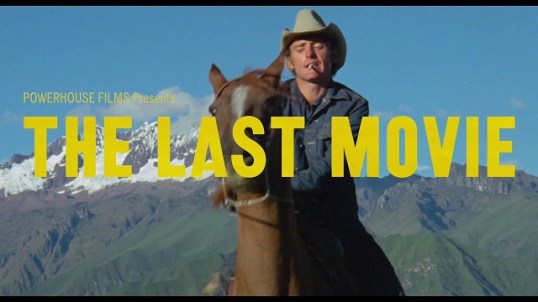
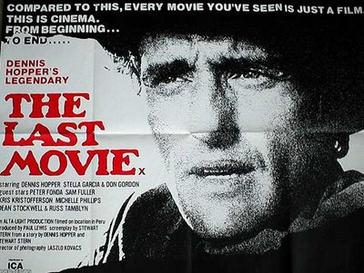
The story behind the making of 1971’s The Last Movie is legendary. It’s also a bit of a cautionary tale.
In 1969, Hollywood was stunned by the box office success of an independent, low-budget counter-culture film called Easy Rider. Easy Rider not only made a star out of Jack Nicholson but it was also the film that finally convinced the studios that the way to be relevant was not to continue to crank out big budget musical extravaganzas like Doctor Doolittle and Hello, Dolly! Instead, it was decided that the smart thing to do would be to hire young (or, at the very least, youngish) directors and basically just let them shoot whatever they wanted. The resulting films might not make much sense to the executives but, presumably, the kids would dig them and as long as the kids were paying money to see them, everyone would continue to get rich. Because Dennis Hopper had directed Easy Rider, he suddenly found himself very much in demand as a director.
Of course, almost everyone in Hollywood knew Dennis Hopper. Long before he became an icon of the counter-culture, Dennis Hopper had been a part of the studio system. John Wayne even referred to Hopper as being his “favorite communist.” Everyone knew that Dennis could be a bit arrogant. Everyone knew that Dennis was very much into drugs and that, as a result, he had a reputation for being a bit unstable. Everyone knew that Dennis Hopper deliberately cultivated an image of being a bit of a wild man and a revolutionary artist. But Dennis Hopper had just directed Easy Rider and Universal was willing to give Hopper some money to go down to Peru and direct his follow-up.
The Last Movie was a film that Hopper had been planning on making for a while. The film’s original script told the story of an aging and broken-down stuntman named Kansas who retires to Mexico and searches for a gold mine with a friend of his. Hopper first tried to get the film going in 1965, with Montgomery Clift in the lead role. After Clift died, Hopper tried to interest John Wayne in the starring role but, though Wayne enjoyed having Hopper in his films so that he could threaten to shoot him whenever Abbie Hoffman said something shocking, he had no interest in being directed by him. When Universal finally agreed to put up the money for the film, Hopper offered the lead role to Jack Nicholson. Nicholson turned it down and told Hopper that it was obvious that Dennis wanted to play the role himself. Dennis decided that he agreed with Nicholson and he cast himself as Kansas. Dennis also made the fateful decision to not only change the story’s setting to Peru but to also film on location.
Dennis and a group of friends flew down to Peru, which, at that time, was the cocaine capitol of the world. Drug use was rampant on the set, with Dennis reportedly being one of the main offenders. The cast and crew filmed during the day and partied at night and no one was particularly sure what the film was supposed to be about. Amazingly, Hopper finished filming on schedule and within budget but, much as he did with Easy Rider, he also overfilmed and ended up with 40 hours of footage. Not wanting to be bothered by the studios, Hopper edited the footage in his compound in Taos, New Mexico. Working slowly and continuing to consume a large amount of drugs and alcohol, Hopper still managed to put together a film that had a straightforward storyline. When Hopper showed his initial cut to filmmaker Alejandro Jodorowsky, the director of El Topo accused Hopper of being too conventional in his approach, which led to Hopper chopping up the film and reassembling it. Finally, after spending over a year working with the footage, Hopper turned in his final edit.
Universal had no idea what to make of the film that Hopper delivered to them. Still, they released it with the hope that the same crowd that loved Easy Rider would embrace The Last Movie. While the film did win an award at the Venice Film Festival, critics hated it and, even worse, audiences stayed away. The film’s reception was so overwhelmingly negative that Hopper found himself largely exiled from Hollywood, with only a few directors (like Francis Ford Coppola) willing to take the chance of working with him. It wasn’t until the 80s, when he finally got clean and sober, that Dennis Hopper was able to reestablish himself as a character actor and, ultimately, a beloved cultural institution.
But what about The Last Movie? Was is it really as bad as the critics claimed? Or was it, as some more recent reviewers have suggested, an unacknowledged masterpiece that was ahead of its time? I recently watched The Last Movie to find out for myself.
Despite its reputation, The Last Movie gets off to a pretty strong start. Samuel Fuller (playing himself) is directing a hilariously over-the-top and violent western in the mountains of Peru. Kansas (Dennis Hopper) is working as a stuntman. He’s fallen in love with a local sex worker named Maria (Stella Garcia). Kansas is meant to be an aging Hollywood veteran, someone who has broken a lot of bones and who carries a lot of aches as a result of his line of work. (One can see why Hopper initially imagined an actor like John Wayne in the role.) He knows that this is going to be his last job and, as we see over the first 25 minutes of the film, he feels alienated from the rest of the cast and crew. Admittedly, Hopper does appear to be a bit too young for the role. The ideal Kansas would have been someone like Ben Johnson, L.Q. Jones, or perhaps Warren Oates. But, still, Hopper does a good job of capturing Kansas’s mixed feelings about the western that’s being filmed around him.
A lot of familiar faces pop up in the film’s fictional western. Dean Stockwell plays an outlaw. Jim Mitchum, Russ Tamblyn and Kris Kristofferson plays his associates. Peter Fonda is the youthful sheriff. Michelle Phillips is the daughter of the town’s banker and apparently, she’s also the girlfriend of one of the outlaws. We watch as the actors pretend to shoot guns and kill each other while the cameras are rolling, just to get up off the ground once “Cut” is yelled. When a local Indian who has been cast as an extra grows upset at the violence, an assistant director explains to him that no one really dies while the cameras are rolling. When shooting wraps, the film company goes home but Kansas stays behind with Maria. One day, the local priest (Tomas Milian) warns Kansas that the local indigenous people have moved into the abandoned film set and are trying to shoot their own movie. Kansas discovers that they have built wooden cameras and wooden boom mics and that their chief is giving orders in the style of Sam Fuller. They’re also firing the guns that the Americans left behind.
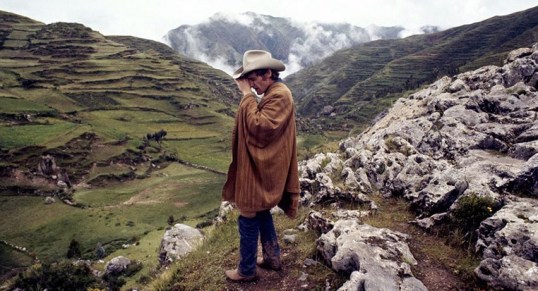
The first part of the film works quite well. Hopper’s camera captures the beautiful and isolated Peruvian landscape. The violent western is a pitch perfect and affectionate parody of a generic studio film. Though Hopper is a bit too young for the role, he still does a good job of capturing Kansas’s alienation from his fellow Americans. Even more importantly, the first part of the film seems to have an identifiable theme. The American film crew invaded an isolated part of Peru and changed the culture of the natives without even realizing it. Now, they’ve left but the natives are still dealing with the after effects of the American “invasion.” It’s easy to see, within that part of the story, a critique of both American culture and American foreign policy.
The second part of the film is where things start to fall apart. Kansas meets an old friend named Neville (Don Gordon). Neville has discovered a gold mine in the Peruvian mountains. With Kansas as his partner, he tries to get a businessman named Harry Anderson (Roy Engel) to invest in it. Kansas and Neville try to impress Harry and his wife (Julie Adams, best-known for being stalked by The Creature From The Black Lagoon). Kansas and Neville take the Andersons to a brothel and, in the process, Kansas offends Maria. Kansas then paws Mrs. Anderson’s fur coat and mentions that human beings are covered in hair. For all of their efforts, Harry will not invest, no matter how desperately Neville begs him to reconsider.
The second part of the film drags, with many of the scenes being obviously improvised between Hopper, Gordon, Garcia, Engel, and Adams. Unfortunately, the improved conversations aren’t particularly interesting and they tend to go on forever. Usually a reliable character actor, Don Gordon ferociously chews the scenery as Neville and it doesn’t take long before one grows tired of listening to him yell. (Gordon was far more impressive in Hopper’s Out of the Blue.) With the use of improvisation and overlapping dialogue, the second half of the film tries to feel naturalistic but instead, it’s a migraine-inducing method exercise gone wrong. It’s also during the second part of the film that a “scene missing” title card flashes on the screen, an indication that the discipline that Hopper showed as a director during the beginning of the film is about to be abandoned.
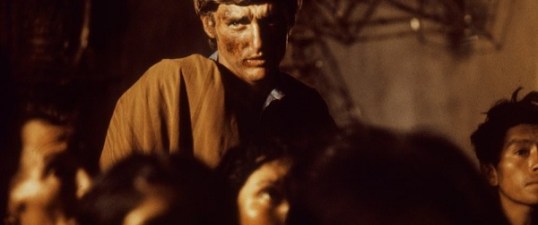
Finally, the third part of the film — well, who knows? The final 25 minutes of the film is collection of random scenes, some of which may be connected and some of which may not. The natives have decided that the only way to properly end their “film” is to kill Kansas. Kansas is shot several times and rides away on his horse. Suddenly, Kansas is back at his home and Maria is taunting him for getting shot. Then, Kansas is riding his horse again. Then suddenly, Dennis Hopper and Tomas Milian are laughing at the camera. A script supervisor tries to get Dennis to look at the shooting schedule while Dennis drinks. This happens:
Milian points out that the blood on Hopper’s shirt is dry. Hopper looks at his shoulder, where Kansas was previously shot, and says that someone needs to add his scar before he can shoot the scene. Ah! So, now we’re acknowledging that it’s all just a movie. Thanks, Dennis! Suddenly, Dennis is Kansas again and he’s collapsing over and over again in the dust. He appears to be dead but no, now he’s Dennis again and he’s standing up and smiling at the camera. And now, he’s singing Hooray for Hollywood. And now, suddenly, Kansas and Neville are talking about The Treasure of the Sierra Madre and then….
Well, let’s just say that it goes on and on before finally ending with a scrawled title card.
It’s a disjointed mess and it’s all the more frustrating because the first 30 minutes of the film is actually pretty good. But then, Dennis apparently remembered that he was supposed to be the voice of the counter-culture and he gave into his most pretentious impulses. Of course, just because a film is a mess, that doesn’t mean that it can’t be entertaining. And again, the first part of the film is entertaining and third part of the film is weird enough that it’ll hold most people’s attention for at least a few minutes. But the middle section of the film is so slow and pointless that it pretty much brings down the entire film.
In the end, what is The Last Movie about? In The American Dreamer(a documentary that was filmed while Hopper was editing The Last Movie in New Mexico), Hopper spends a lot of time talking about revolution and taking over Hollywood but The Last Movie is hardly a revolutionary film. The film is at its most alive when it is focused on the shooting of its fictional western. For all the satirical pokes that The Last Movie takes at the studio system, it’s obvious that Hopper had a lot of affection for Old Hollywood and for directors like Sam Fuller. Kansas may say “Far out,” but he’s hardly a hippie. Even the film’s jumbled finale seems to be saying, “It’s all Hollywood magic!” In the end, the film’s call for a new style of cinema is defeated by its love for the old style of cinema.
Instead, I think The Last Movie works best when viewed as a portrait of paranoia. Hopper himself admitted that he was naturally paranoid and the heavy amount of drugs that he was doing in the 70s didn’t help. One reason why Hopper filmed in Peru and edited in New Mexico was so the studios couldn’t keep track of him and, while directing, he worried about being arrested by the Peruvian secret police. As an actor, Hopper plays Kansas as being someone who views the world with caution and untrusting eyes. He doesn’t trust the other members of the film crew. He loves Maria but he’s still convinced that she’s going to betray him. Even the natives ultimately try to destroy him and the script supervisor tries to get him to stick to the shooting schedule. The film works best as a disjoined portrait of one man’s paranoid and fatalistic world view.
The Last Movie pretty much ended the studio’s attempts to harness the counter-culture by giving money to self-described revolutionaries. The new wave of directors — like Spielberg and Lucas — may have shared Hopper’s then-politics but they weren’t looking to burn down the system. (Hopper himself later became a Republican.) The Last Movie may not have been the literal last movie but it was, for a while at least, the last of its kind.
We all know the famous line from The Godfather. “I’m going to make him an offer he can’t refuse.” Of course, everyone also knows that “It’s not personal. It’s strictly business.” There’s another line that’s almost as famous: “One lawyer with his briefcase can steal more than a hundred men with guns.” That line comes from Mario Puzo’s novel. It’s never actually used in the film though it’s certainly present as a theme.
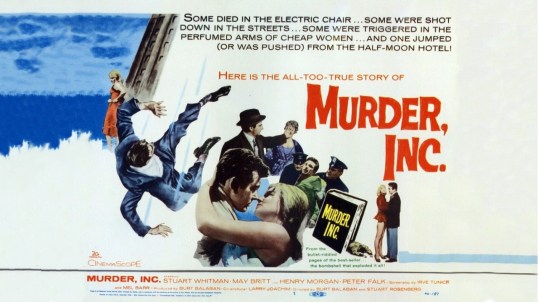
The idea of organized crime essentially being a huge corporation is hardly a new one. In fact, it’s become a bit of a cliche. Nearly every gangster film ever made has featured at least one scene where someone specifically compares their illegal activities to the day-to-day business of politicians and CEOs. However, just because it’s a familiar analogy, that doesn’t make it any less important. It’s hard not to think of organized crime as being big business when you consider that, in the 30s and the 40s, the mafia’s assassination squad was actually known as Murder, Inc.
Murder, Inc. was formed in Brooklyn, in the 30s. It was founded and initially led by a man named Lepke Buchalter. Lepke was a gangster but, because he was Jewish, he couldn’t actually become a made man. However, he used that to his advantage when he created Murder, Inc. The organization was largely made up of non-Italians who couldn’t actually become official members of the Mob. The major mafia families would hire Murder, Inc. to carry out hits because they knew that, since none of the members were made men, they wouldn’t be able to implicate any of the families if they were caught by the police.
It was a good idea and Lepke and his band of killers made a lot of money. Of course, eventually, the police did catch on. A member of the organization by the name Abe Reles was eventually arrested and agreed to be a rat. Lepke went to the electric chair. Reles ended up falling out of a window. Did he jump or was he thrown? It depends on who you ask.
19 years after Reles plunged from that window and 16 years after Lepke was executed, their story was told in the 1960 film, Murder, Inc. Lepke was played by David J. Stewart while Reles was played by Peter Falk. The film is told in a documentary style, complete with a narrator who delivers his lines in a rat-a-tat-tat style. We follow Reles as he goes to work with Lepke and as he harasses a singer (Stuart Whitman) and his wife (May Britt), forcing them help him carry out a murder and then allowing them to live in a luxury apartment on the condition that they also let Lepke hide out there. (It’s probably not a surprise that a professional killer wouldn’t turn out to be the best houseguest.) Eventually, a crusading DA (Henry Morgan) and an honest cop (Simon Oakland) take it upon themselves to take down Murder, Inc.
To be honest, there’s not a whole lot that’s surprising about this film but it’s still an entertaining B-movie. The black-and-white cinematography and the on-location filming give the film an authentically gritty feel. The action moves quickly and there’s enough tough talk and violent deaths to keep most gangster aficionados happy. The best thing about the film is, without a doubt, Peter Falk’s portrayal of Abe Reles. Falk is magnetically evil in the role, playing Reles as a man without a soul. Even when Reles finally cooperates with the police, the film leaves no doubt that he’s only doing it to try to save himself. Falk plays Reles like a tough guy who secretly knows that his days are numbered but who has convinced himself that, as long as he keeps sneering and threatening people, the rest of the world will never figure out that he’s been doomed all the time. The more people he kills, the higher Reles moves up in the corporation and the more he tries to take on the look of a respectable member of society. But, no mater how hard he tries, Reles always remains just another violent thug. Falk was deservedly Oscar-nominated for his performance in this film, though he ultimately lost the award to Spartacus‘s Peter Ustinov.
Murder, Inc. may be a low-budget, B-movie but it’s also a classic of gangster cinema. It’s an offer you can’t refuse.
The 1971 The Panic in Needle Park tells the story of two young lover in New York City.
Helen (Kitty Winn) is an innocent runaway from Indiana who, when we first meet her, has just had a back alley abortion. Her boyfriend, Marco (Raul Julia), doesn’t seem to be too concerned about her or anyone else for that matter. Instead, it’s Marco’s dealer, Bobby (Al Pacino), who checks in on Helen and who visits her when she eventually ends up in the hospital. It’s also Bobby who gives her a place to stay after she gets out of the hospital.
Bobby is a small-time dealer. He’s not book smart but he knows how to survive on the streets and it’s hard not to be charmed by him. He literally never stop talking. As he explains it to Helen, he’s been in jail 8 times but he’s not a bad guy. His brother, Hank (Richard Bright, who also co-starred with Pacino in The Godfather films), is a burglar and he legitimately is a bad guy but he and Bobby seem to have a close relationship. Bobby also swears that he’s not a drug addict. He just occasionally indulges. It doesn’t take long to discover that Bobby isn’t being completely honest with either Helen or himself.
Together, Bobby and Helen ….
Well, they don’t solve crimes. In fact, they really don’t do much of anything. That’s kind of the problem with movies about drug addicts. For the most part, drug addicts are boring people and there’s only so many times that you can watch someone shoot up before you lose interest. Heroin may make the addicts feel alive but, with a few notable exception (Trainspotting comes to mind), it’s always been a bit of a cinematic dead end. The film takes a documentary approach to Bobby and Helen’s descent into addiction and it’s not exactly the most thrilling thing to watch.
Bobby and Helen live in an area of New York that’s known as needle park, largely due to the fact that it’s full of addicts. It’s a place where people sit on street corners and nod off and where everyone’s life is apparently fueled by petty crime. An unlikable narcotics detective (Alan Vint) occasionally walks through the area and tries to talk everyone into betraying everyone else. It turns out that being a drug addict is not like being in the mafia. Everyone expects you to betray everyone else.
As I said, it’s a bit of a drag to watch but you do end up caring about Bobby and Helen. They come across as being two essentially decent people who have gotten caught up in a terrible situation. Even when they piss you off, you still feel badly for them because you know that they’ve surrendered control of their lives to their addictions. It helps that they’re played by two very appealing actors. This was only Al Pacino’s second film and his first starring role but he commands the screen like a junkie James Cagney. Meanwhile, making her film debut, Kitty Winn gives a sympathetic and likable performance as Helen. You watch Winn’s vulnerably sincere performance and you understand why Helen would have looked for safety with undeserving losers like Marco and Bobby and, as a result, you don’t hold it against her that she seems to be addicted not just to heroin but also to falling for the wrong men. Helen does a lot of stupid things but you keep hoping that she’ll somehow manage to survive living in needle park.
Pacino, of course, followed-up The Panic In Needle Park with The Godfather. As for Kitty Win, she won best actress at Cannes but the role didn’t lead to the stardom that it probably should have. Her best-known role remains playing the nanny in The Exorcist.
1961’s The Connection opens with a title card and voice over from someone identifying himself as being J.J. Burden. Burden explains that what we are about to see is the last known work of an aspiring documentarian named Jim Dunn. Burden explains that, after he and Dunn filmed the footage that’s about to be shown, Dunn disappeared. It was left to Burden to put the footage together and he swears that he has gone out of his way to stay true to Dunn’s intentions.
Of course, if you’ve watched enough old movies, you might recognize Burden’s resonate voice as belonging to the distinguished actor, Roscoe Lee Browne. And, once the film starts, you may also notice that you’ve seen Jim Dunn in other movies. That’s because Dunn is played by William Redfield, a character actor who specialized in playing professional types.
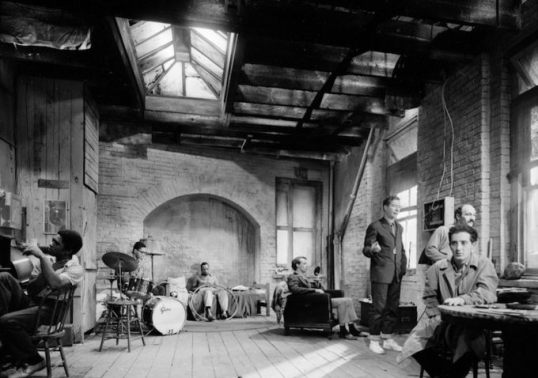
The Connection takes place in a New York loft. A group of jazz musicians are waiting for their drug dealer. Sometimes, they play music. Sometimes, they look straight at the camera and answer questions about what it’s like to be a heroin addict. While Burden always remains behind the camera, Jim Dunn occasionally steps in front of it and scolds the men for not being dramatic enough. Dunn is attempting to stage reality. Leach (Warren Finnerty), the most verbose of the addicts, taunts Dunn over never having done drugs himself. Dunn jokingly says that maybe he could start with some marijuana.
This is no Waiting for Godot. The dealer does eventually arrive. His name is Cowboy and he’s slickly played by Carl Lee. (Carl Lee was the son of Canada Lee, who appeared in Hitchcock’s Lifeboat. Sadly, 25 years after filming his role in The Connection, Lee would die of a heroin overdose.) He’s accompanied by a flamboyant woman named Sister Salvation (Barbara Winchester). As Burden films, the musicians enter a small bathroom one-by-one, so that they can shoot up. Music is played. Overdoses are dealt with. And Dunn, who was originally so detached, becomes more and more drawn into the junkie life style…
Was The Connection the first mockumentary? To be honest, I’m really not sure but it definitely has to be one of the first. The beginning title card (and Burden’s narration) feels like it could easily be used in front of any of the hundreds of found footage horror films that have been released over the last few years. The film itself makes good use of the found footage format, though it’s also trapped by the genre’s limitations. With all of the action taking place in just one room, there’s no way that The Connection can’t feel stagey. (And, indeed, it was based on a play.) Along with detailing the lives of those on the fringes of society, The Connection makes some good points about the staging of reality, though it never goes quite to the lunatic extremes of Ruggero Deodato’s Cannibal Holocaust.
(The Cannibal Holocaust comparison is not as crazy as it may sound. Much as how the arrogant filmmakers in Deodato’s film attempted to exploit the cannibals, Jim Dunn attempts to exploit the addicts. When the addicts and Cowboy start pressuring Dunn to try heroin, it’s not that much different from the cannibals eating the cameraman in Cannibal Holocaust. The exploited are getting their revenge.)
The Connection was the first dramatic film to be directed by documentarian Shirley Clarke and, like many of Clarke’s films, it struggled to find an audience. (Both the film and Clarke would have to wait several decades before getting the recognition that they deserved.) The subject matter was considered to be so sordid (and the language so shocking) that the film was originally banned in New York. The filmmakers actually had to file a lawsuit to get the film released. The New York State Court of Appeals ruled the film was “vulgar but not obscene.”
Seen today, the film seems to be neither vulgar nor obscene. Instead, it seems like a time capsule of the era in which it was made. We tend to think of the early 60s as a time of beach movies, drive-ins, early rock and roll, and Kennedy optimism. The Connection reveals that there was a lot more going on than just that.
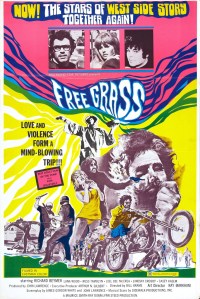
As everyone surely knows, before they appeared as Dr. Lawrence Jacoby and Benjamin Horne on Twin Peaks, Russ Tamblyn and Richard Beymer co-starred in West Side Story. Tamblyn played Riff, the leader of the Jets. Beymer played his best friend, Tony, who fell in love with Natalie Wood. West Side Story is a classic that won several Oscars. What is not as well known is that, in between West Side Story and Twin Peaks, Beymer and Tamblyn co-starred in one other movie, a hunk of psychedelic cheese called Free Grass.
By the late 60s, both Beymer and Tamblyn had tired of their clean-cut images and, like their characters in Free Grass, had become card-carrying members of the Hollywood counter-culture. Beymer plays Dean, a motorcycle-riding drop-out from conventional society. Dean meets and falls in love with buxom, mini-skirted Karen (played by Lana Wood, younger sister of Natalie). When a riot breaks out on the sunset strip, Dean punches a cop. With the Man now looking for him, Dean needs some quick cash so that he and Karen can escape to Dayton, Ohio.
(Dayton, Ohio?)
That’s where Russ Tamblyn comes in. Tamblyn plays Dean’s friend, Link. Link works for a drug kingpin named Phil (played not very convincingly by Casey Kasem, of all people). Phil is willing to pay Dean $10,000 if he smuggles several pounds worth of grass across the Mexican border. Dean agrees but soon finds himself being pursued by two narcotics agents, played by Jody McCrea and Lindsay Crosby (sons of Joel McCrea and Bing Crosby, respectively). Because Dean is not willing to commit murder, Link plots to kill him. But first, Link doses Dean with LSD, which leads to the de rigueur psychedelic 60s light show.
Slow-moving and ineptly directed, Free Grass is for fans of the 1960s counterculture only. Russ Tamblyn provides the movie with what little energy it has but Richard Beymer apppears to be just as uncomfortable here as he was in West Side Story and Casey Kasem shows why he was better known as a DJ than an actor. Lana Wood does look good in a miniskirt, though. Otherwise, Free Grass shows why both Tamblyn and Beymer grew so frustrated with Hollywood that they were both in semi-retirement when David Lynch revitalized their careers by casting them on Twin Peaks.
For the past week and a half, I have been on a major Warren Oates kick. The latest Oates film that I watched was Kid Blue, a quirky western comedy that features Warren in a small but key supporting role.
Bickford Warner (Dennis Hopper) is a long-haired and spaced-out train robber who, after one failed robbery too many, decides to go straight and live a conventional life. He settles in the town of Dime Box, Texas. He starts out sweeping the floor of a barber shop before getting a better job wringing the necks of chickens. Eventually, he ends up working at the Great American Ceramic Novelty Company, where he helps to make ashtrays for tourists.
He also meets Molly and Reese Ford (Lee Purcell and Warren Oates), a married couple who both end up taking an interest in Bickford. Reese, who ignores his beautiful wife, constantly praised Greek culture and insists that Bickford take a bath with him. Meanwhile, Molly and Bickford end up having an affair.
Bickford also meets the local preacher, Bob (Peter Boyle). Bob is enthusiastic about peyote and has built a primitive flying machine that he keeps in a field. The town’s fascist sheriff, Mean John (Ben Johnson), comes across Bob performing a river baptism and angrily admonishes him for using “white man’s water” to baptize an Indian.
Bickford attempts to live a straight life but is constantly hassled by Mean John, who suspects that Bickford might actually be Kid Blue. When Bickford’s former criminal partner (Janice Rule) shows up in town and Molly announces that she’s pregnant, Bickford has to decide whether or not to return to his old ways.
Kid Blue is one of a handful of counterculture westerns that were released in the early 70s. The film’s biggest problem is that, at the time he was playing “Kid” Blue, Dennis Hopper was 37 and looked several years older. It’s hard to buy him as a naïve naif when he looks older than everyone else in the cast. As for Warren Oates, his role was small but he did great work as usual. Gay characters were rarely presented sympathetically in the early 70s and counter-culture films were often the worst offenders. As written, Reese is a one-note (and one-joke) character but Warren played him with a lot of empathy and gave him a wounded dignity that was probably not present in the film’s script.
Kid Blue plays out at its own stoned pace, an uneven mix of quirky comedy and dippy philosophy. Still, the film is worth seeing for the only-in-the-70s cast and the curiosity factor of seeing Dennis Hopper in full counterculture mode, before he detoxed and became Hollywood’s favorite super villain.



 As everyone surely knows, before they appeared as Dr. Lawrence Jacoby and Benjamin Horne on Twin Peaks, Russ Tamblyn and Richard Beymer co-starred in

 Through the Shattered Lens