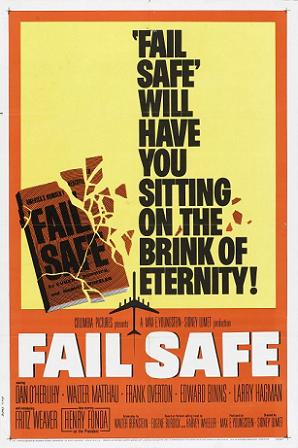
Shattered Politics #23: Fail-Safe (dir by Sidney Lumet)


Fail_safe_moviep

After watching Dr. Strangelove, you may find yourself asking what that film would have been like if it had treated its doomsday scenario seriously.  Well, you can find out by watching yet another film from 1964, Sidney Lumet’s Fail-Safe.

What’s Fail-Safe about?  Well, basically, it tells the exact same story as Dr. Strangelove, except without the humor.  Once again, an American bomber is accidentally ordered to launch a nuclear attack against Russia.  Again, the President (played, somewhat inevitably, by Henry Fonda) has to have an awkward conversation with the leader of Russia.  Again, a sinister defense advisor (this time played by Walter Matthau) argues that the world can survive a nuclear war.

Admittedly, there is no equivalent to George C. Scott’s Buck Turgidson in Fail-Safe.  However, there is a General Black (Dan O’Herilihy) who has a recurring nightmare about watching a bullfight while the sky around him glows with radiation.

Fail-Safe has the same plot as Dr. Strangelove but none of the humor.  In fact, Fail-Safe has absolutely no humor at all.  It’s one of the most somber films that I’ve ever seen.  It has a good opening with General Black’s nightmare and an effective ending that makes excellent use of freeze frames but the middle of the film is basically just a collection of endless debates.

And I’m sure that approach made sense at the time because, after all, Fail-Safe was dealing with a serious theme, it was directed by a serious filmmaker, and it featured a bunch of serious actors.  And maybe if I had never seen Dr. Strangelove, Fail-Safe would not seem like such a slow and boring movie.  But I have seen Dr. Strangelove and, as a result, it’s impossible to watch Fail-Safe without wanting to hear Henry Fonda say, “You can’t fight here!  This is the war room!”

Embracing the Melodrama #14: Bigger Than Life (dir by Nicholas Ray)


Bigger Than Life 2

Today, we continue to embrace the melodrama by taking a look at Nicholas Ray’s 1956 Hell-In-The-Suburbs masterpiece, Bigger Than Life.  Unfortunately for some of you, this review is going to contain minor spoilers because there’s no way you can talk about Bigger Than Life without talking about that ending.

Bigger Than Life is a film about deception.

English teacher Ed Avery (James Mason, who not only gives a brilliant lead performance but produced the film as well) pretends to be happy with his safe and dull life but it only takes a few minutes of looking at his strained smile and listening to him wearily  make perfunctory conversation to realize that Ed is a deeply disappointed man.  He decorates his house with travel posters for locations that he’s never visited and spends too much time thinking about when he played football in high school, the one time in life when he truly stood out from the crowd.

Ed doesn’t want his wife Louise (Barbara Rush) to know that they’re in financial trouble so he gets a job working as a taxi dispatcher without telling her.  While Louise fears that he’s actually having an affair, Ed spends his time coming up with excuses for why he can never come straight home from school.

Ed doesn’t want either Lou or his son Richie (Christopher Olsen) to know that he’s been feeling pain and dizziness.  It’s only after he faints at home that he finally agrees to go to the hospital.

The doctors who inform Ed that he has a life threatening condition don’t want Ed to know how dangerous the medicine that they’ve prescribed for him can truly be.  They tell him that cortisone can save his life but they don’t tell him about the side effects.  It’s up to his friend Wally (Walter Matthau) to research the drug and, by the time he does, it’s already too late.

Ed doesn’t want anyone to know that he’s becoming a drug addict.  However, as he takes more and more of the pills, his personality starts to change.  The once meek Ed is now demanding perfect service at stores and restaurants.  At a PTA meeting, Ed has no problem announcing that most of his students are stupid.  (“You should make that young man principal!” one parent shouts, apparently relieved to hear that a teacher thinks of little of his children as he does.)  At home, Ed pushes his son to become a football great and announces that he no longer loves his wife.

Richie doesn’t want his father to know that he now hates him.  Lou doesn’t want her husband to know how much she is growing to fear him.

Ed doesn’t want Richie to know that, after reading the biblical story of Abraham and Isaac, Ed has decided that he has to murder his son.  When Lou points out that God kept Abraham from killing Isaac, Ed replies, “God was wrong.”

And finally, the film itself deceives you into thinking that it has a happy ending with Lou and Richie hugging a now recovered Ed.  Everyone laughs and the happy music swells but there’s prominent shadow cast on the wall close to the family, a reminder that the darkness that Ed has unleashed on his family will not be so easily contained or forgotten.

bigger than life

Bigger Than Life is famous for being one of those films that flopped when it was originally released, just to eventually be rediscovered and acclaimed decades later when it was released as part of the Criterion Collection.  It’s easy to understand why the film flopped because the power of Bigger Than Life is almost entirely to be found in the film’s subtext.  On the surface, Bigger Than Life is a typical social problem film.  In this case, that problem would appear to be drug abuse.

However, as you watch the film, it becomes obvious that, for director Nicholas Ray, the real problem is the conformist and repressed society that the Avery family finds themselves living in.  When Ed’s personality changes, all he is really doing is achieving an extreme version of the ideal suburban existence.  The suburban ideal is that the man should be the king of his castle.  Ed becomes a king but he’s one of those kings who would behead his subjects on a whim.  In telling this tale of American exceptionalism gone mad, Nicholas Ray uses the techniques of European expressionism, using skewed camera angles and creating a world that is full of shadows.  Even before Ed takes his first pill, his world is a dark and threatening one.

By the end of the film, Ed may be off the drugs and he may be recovering but, as Nicholas Ray makes clear, the real problem remains.

Bigger Than Life

44 Days of Paranoia #29: A Face In The Crowd (dir by Elia Kazan)


For our latest entry in the 44 Days of Paranoia, we take a look at Elia Kazan’s 1957 political satire, A Face In The Crowd.

The film opens with radio producer Marcia Jeffries (Patricia Neal) visiting a local jail in Arkansas.  She’s looking for human interest stories that she can feature on her show and she discovers one when she meets an imprisoned drifter named Larry Rhodes (Andy Griffith).  When Marcia interviews him, Rhodes proves himself to be a natural performer, telling folksy jokes and launching into a song about being a “free man in the morning.”  Rhodes proves to be so popular that, after he’s released from jail, he pursues a career in show business with Marcia as both his manager and, eventually, his lover.

Moving to Memphis, a renamed Lonesome Rhodes eventually lands his own television variety show and he soon starts doing irreverent commercials for local companies.  Along the way, Rhodes also finds a new manager, the glib and manic Joey DePalma (Anthony Franciosa).  With the help of Joey, Rhodes becomes the spokesman for a fake energy supplement, Vitajex.

As Rhodes’ fame grows, so does his ego.  After dumping Jeffries, Rhodes impulsively marries a 17 year-old majorette (Lee Remick).  His show also goes national and Rhodes soon starts to use his influence to try to both promote an incompetent, business-backed Presidential candidate and to destroy anyone who he considers to be an enemy.  As his show’s disillusioned head writer (Walter Matthau) puts it, Rhodes has become a “demagogue in denim.”

A Face In The Crowd is a personal favorite of mine.  Director Kazan deftly mixes satire with melodrama and, with the exception of the weak ending, the film’s vision of media manipulation and demagogic celebrities probably feels more plausible today than when it was first released.  The film is full of great performances, from the avuncular Walter Matthau to vulnerable Patricia Neal to the innocent-and-then-not-so-innocent Lee Remick.  Anthony Franciosa is wonderfully glib and sleazy and it’s a lot of fun to watch his joy at discovering how easy it is to manipulate the world.

Ultimately, however, the film’s success is mostly due to Andy Griffith’s amazing performance as Lonesome Rhodes.  Griffith, displaying all of the folksiness but none of the empathy that would be displayed in his later television show, turns Rhodes into a force of nature, a smiling charlatan and a charismatic sociopath who manipulates for the pure enjoyment of manipulation.

To make the obvious comparison, it’s very easy to imagine Lonesome Rhodes getting his own show on MSNBC, where on a nightly basis he could bark orders at his followers and ridicule anyone who dares to question him.  But even beyond that, the character of Lonesome Rhodes resonates.  I’m from the South.  I grew up down here and I live down here.  I can tell you, from my own personal observations and experiences, that we still have our share of demagogues.  Some of them run in elections and some of them preach on Sunday but all of them have got a bit of Lonesome Rhodes inside of them.

For that reason, A Face In The Crowd is probably more relevent today than it’s ever been.

Other Entries In The 44 Days of Paranoia 

  1. Clonus
  2. Executive Action
  3. Winter Kills
  4. Interview With The Assassin
  5. The Trial of Lee Harvey Oswald
  6. JFK
  7. Beyond The Doors
  8. Three Days of the Condor
  9. They Saved Hitler’s Brain
  10. The Intruder
  11. Police, Adjective
  12. Burn After Reading
  13. Quiz Show
  14. Flying Blind
  15. God Told Me To
  16. Wag the Dog
  17. Cheaters
  18. Scream and Scream Again
  19. Capricorn One
  20. Seven Days In May
  21. Broken City
  22. Suddenly
  23. Pickup on South Street
  24. The Informer
  25. Chinatown
  26. Compliance
  27. The Lives of Others
  28. The Departed

44 Days of Paranoia #6: JFK (dir by Oliver Stone)


JFK-John-F-Kennedy-DVD-Yon-OLIVER-STONE__76044126_0When I first decided to do this series of reviews of conspiracy-themed films, I knew that I would eventually have to review the 1991 Oliver Stone film JFK.

JFK is one of those films that continues to divide audiences.  Those who think that John F. Kennedy was killed by a conspiracy tend to love this film and are given to describing JFK as being “one of the most important films ever made.”  Those who believe that Lee Harvey Oswald was the lone assassin dismiss Stone’s film as being left-wing propaganda.  Just check out  the message board at the imdb if you need evidence of just how worked up people get over this film and its subject matter.

It seems that very few of the people who criticize or praise JFK ever review it as a work of cinema.  Instead, they focus on the film’s politics.  If I criticize the film for wasting the talents of Sissy Spacek or featuring one of Kevin Costner’s least interesting performances then I’m running the risk of having to deal with angry conspiracy theorists telling me that I need to open my eyes to the reality of American history.  On the other hand, if I praise Tommy Lee Jones’s wonderfully decadent turn as one of the film’s conspirators, chances are that someone is going to accuse me of being a naive leftist.

Then again, perhaps that reaction is to be expected.  Oliver Stone is one of our most political and least subtle filmmakers.  His movies are specifically designed to challenge the status quo.  For that reason, it’s not surprising to discover that Stone considers JFK to be the best of all of his films.

JFK is based (rather loosely, some claim) on the true story of New Orleans District Attorney Jim Garrison (played by Kevin Costner) and how, in 1967, he charged businessman Clay Shaw (played by Tommy Lee Jones) with being a part of a conspiracy to kill John F. Kennedy.  Shaw was eventually acquitted and both Jim Garrison and his investigation remain controversial to this day.

JFK courts controversy immediately with its portrayal of Jim Garrison.  I’ve read several accounts of the Garrison investigation and the one thing that they all seem to agree on is that Jim Garrison was a flamboyant, bigger-than-life figure who enjoyed publicity.  Even among those who believe that Garrison uncovered some valuable evidence as a result of his investigation, there is a good deal of ambiguity about Garrison’s motives.  However, in Stone’s film, Jim Garrison is played by Kevin Costner and is portrayed as being an incorruptible, all-American idealist.  It’s not that Costner gives a bad performance.  Instead, it’s just a rather uninteresting one, especially when one compares Costner’s Garrison to some of the stories about the real-life Garrison.

However, as the film unfolds, it becomes obvious that Stone is using Costner’s blandness to the film’s advantage.  Over the course of three hours, JFK slowly peels back layers of secrecy and cover-ups and reveals the shadow world that, according to Stone, lurks underneath everyday reality.  Costner’s Garrison might not be interesting but he is a stable presence.  He anchors the film, giving us someone to relate to while the film itself grows more and more bizarre.

While Costner’s might give the least interesting performance of his career in this film, the same cannot be said of the rest of the cast.  JFK is full of familiar faces, many of whom are only on-screen for a few minutes but all of which play an important role in creating Stone’s shadow universe.  Kevin Bacon, Gary Oldman, Joe Pesci, Michael Rooker, Donald Sutherland, and Tommy Lee Jones; they all have small roles but every single one of them makes an undeniable impression.  Whether you agree with the film’s conclusions are not, it’s impossible not to enjoy JFK for the chance to spot a bunch of familiar faces giving memorably bizarre performances.

But ultimately, its impossible to review JFK without considering the film’s conclusions.  JFK makes the case that John F. Kennedy was killed as the result of a massive right-wing conspiracy that involved the military, business interests, the CIA, the FBI, anti-Castro Cubans, and the mafia.  By the end of the film, the question becomes less who killed JFK and more who didn’t kill JFK.

Myself, I’m not going to claim to be enough of an expert on the Kennedy assassination to argue whether JFK is accurate or if it’s just propaganda.  However, as a film reviewer, I can say that it’s a very well-made and powerful film but it’s also one of those films that works better the first time you see it than the second time.

The first time you see it, the film overwhelms you.  It leaves you convinced that yes, there was a conspiracy and yes, everyone was involved and yes, Jim Garrison was right!  It convinces you so thoroughly that you end up using exclamation points, just to make sure everyone knows how convinced you are.

However, with each subsequent time that you view JFK, you became a bit more aware of just how manipulative and one-sided it truly is.  You become a bit more aware of the technique underneath the outrage and, if you’re a smart film watcher, you remember that JFK is a recreation as opposed to being a historical document.  You become more and more aware that Stone approached the material with a destination in mind and, like any good director, he has specifically shaped the material to make sure that you reach that destination at the end of the journey.

That was certainly my experience with JFK.  I first saw it in high school and it convinced me that JFK was the victim of a conspiracy.  Then, when I was in college, I watched it for a second time and, though I still believed the film’s conclusions, I also found myself much more aware of how the film’s length and Stone’s direction were designed to beat the audience into submission.  When I saw the film a third time, I found myself resenting the film’s manipulative nature and, as a result, I found it a lot more difficult to accept Stone’s conclusions.

However, when I rewatched the film last night for this review, I was surprised to discover that JFK actually holds up pretty well.  It’s still way too long (and, unlike a lot of other reviewers, I am not impressed by the droning speech that Costner delivers at the end of film) and Stone’s lack of subtlety does backfire on a few occasions.  However, perhaps because I was finally watching the film as entertainment as opposed to judging the film on its political or historical merits, I discovered that JFK is a watchable and entertaining film, one that does a pretty good job of making Stone’s case.  If nothing else, it’s worth watching just for the chance to see the wonderfully snarky performances of Tommy Lee Jones, Kevin Bacon, and Gary Oldman.

Perhaps the best thing that I can say about JFK is that its the type of film that will inspire smart people to do their own research and come to their own conclusions, which may or may not be the same conclusions that Oliver Stone reaches.

And, honestly, isn’t that the most that we can ask of any film?

JFK

6 Trailers To Strip Down For


It’s time for another edition of Lisa Marie’s Favorite Grindhouse and Exploitation Trailers.  This week’s edition has no set theme beyond the fact that, in-between typing up the six trailers featured here, I was also trying on different outfits.  Multi-tasking!

1) Performance

From 1970, it’s the debut film of Nicolas Roeg (though technically, he co-directed by Donald Cammell).  Reportedly, acting in this film led to costar James Fox having a nervous breakdown.

2) Twitch of the Death Nerve

This is the trailer for Mario Bava’s infamous, trend-setting giallo.  Bava’s preferred title for this film was Bay of Blood though it was released under several titles, including Carnage and my personal favorite, Twitch of the Death Nerve.

3) The Comeback

This 1978 film is from the criminally underrated director Pete Walker.  The trailer has a similar feel to Lamerto Bava’s A Blade in the Dark.  Who is Jack Jones and was he actually an international singing sensation?  So many questions.

4) The Class Reunion Massacre (a.k.a. The Redeemer)

What an odd little trailer.  It starts out all slasher-like and then suddenly, it decides to go all Omen.

5) The Corpse Grinders

Yup, that’s what it is alright.  From directed Ted V. Mikels.

6) Candy

This trailer is from 1968, which — if you’ve seen the trailer — is kind of one of those “well, duh” facts.  Based on a book by my fellow Texan Terry Southern (hence, the tag line), the film features Walter Matthau, Richard Burton, Ringo Starr, Marlon Brando, and James Coburn all taking advantage of Ewa Aulin (who, much like James Fox in Performance, reportedly had a nervous breakdown as a result of making this film).  The film was directed by Christian Marquand who, years later, would play the main French Plantation Guy in Apocalypse Now Redux.

Scenes I Love: A Face In The Crowd


Located below is the famous Vitajex advertising montage from Elia Kazan’s 1957 film, A Face In The CrowdEverytime I see this, I wonder if maybe American audiences in the 50s were smarter than we give them credit for. 

Then again, A Face in The Crowd was a notorious financial and critical failure when it was first released.  It’s actually one of the best and most influential movies ever made.  Certainly, it’s one of the few Kazan films that still seems artistically relevent today.  It should also be noted that A Face in the Crowd features Anthony Franciosa years before his starring turn in Dario Argento’s Tenebrae, Andy Griffith playing a villain, the film debut of Lee Remick, Walter Matthau as a tv writer, and Patricia Neal having a nervous breakdown.  Supposedly, a very young Rip Torn is somewhere in this film as well but I’ve never been able to spot him.