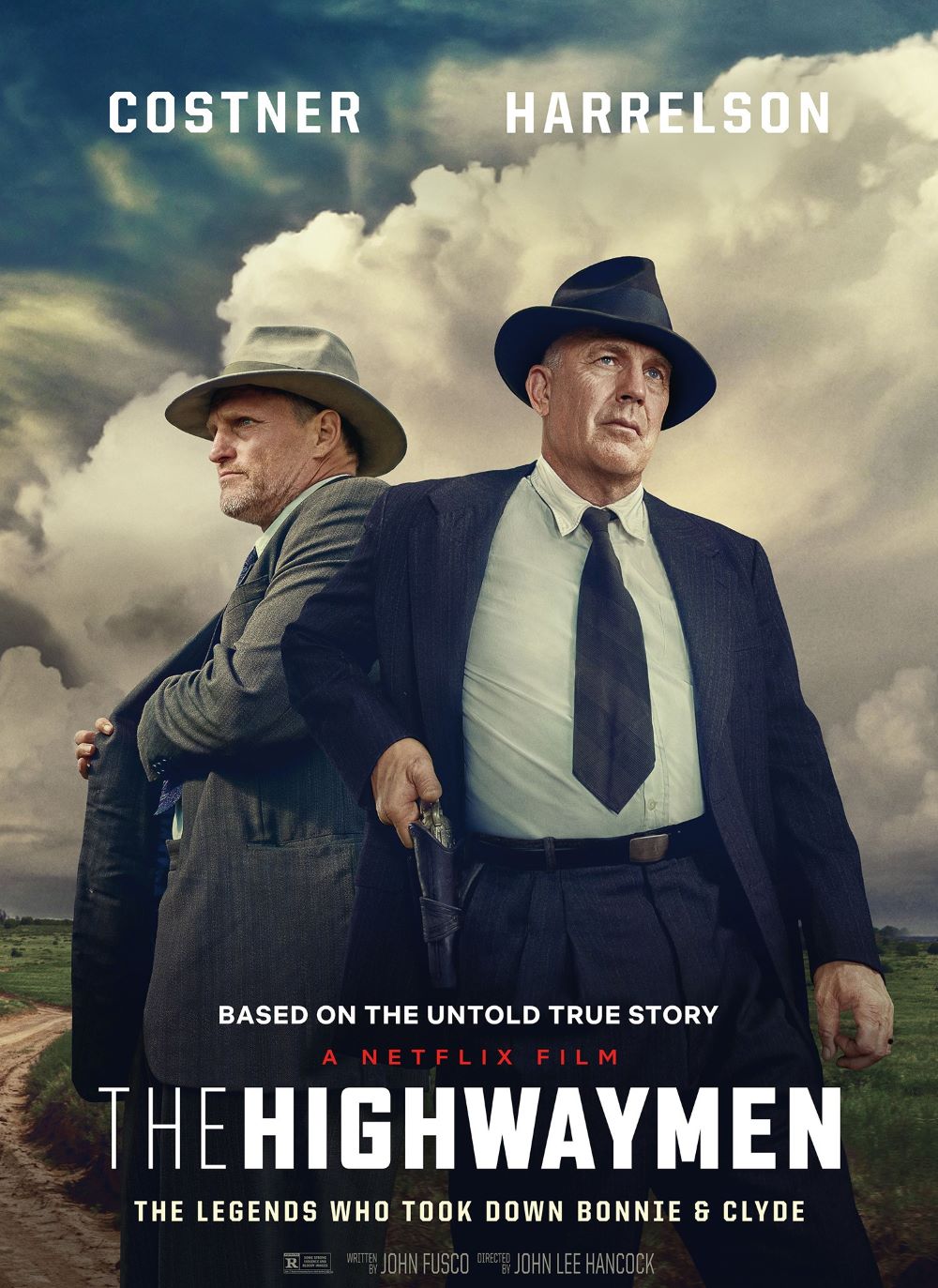
Review: The Highwaymen (dir. by John Lee Hancock)


“People don’t always know who they are… ’til it’s too late.” — Frank Hamer

The Highwaymen, as directed by John Lee Hancock, delivers a character-driven, period crime drama that refreshes a story so often mythologized in American pop culture. Instead of glamorizing Bonnie and Clyde, the film spotlights the two former Texas Rangers tasked with ending their crime spree: Frank Hamer (played by Kevin Costner) and Maney Gault (played by Woody Harrelson). Set against the bleak dustbowl landscape of 1934, the film opens with the criminal duo breaking their associates out of Eastham Prison, setting the state of Texas into a panic. In desperation, Governor “Ma” Ferguson authorizes the return of Hamer, a seasoned lawman whose old-school methods have largely been left behind in modern policing.

From the start, The Highwaymen takes its time, inviting viewers into a slower, more contemplative chase rather than the kinetic action often associated with outlaw stories. Hamer, long retired and resistant to rejoining the fight, is persuaded both by the severity of Bonnie and Clyde’s violence and the humiliation his state faces in failing to catch them. Gault, for his part, is recruited despite his own personal struggles, adding a layer of regret and weariness to their partnership. Their pursuit is marked by straightforward detective work—staking out small towns, following trails, and confronting a public that is strangely captivated by the criminals they hunt. The film repeatedly draws attention to the way crowds and the press elevate Bonnie and Clyde, reflecting on an early version of true crime celebrity culture.

The dynamic between Hamer and Gault forms the emotional core of the movie. Their bond is shaped by years of experience, mistakes, and a real sense of being out of place in a society that now doubts their relevance. There’s plenty of banter and friction, but also reflective moments that dig into the costs of life spent in pursuit of justice. Throughout the investigation, the film uses the Texas and Louisiana landscape as a powerful backdrop—the vast, windswept highways underscore the isolation and existential gravity faced by these lawmen. The cinematography favors wide shots and muted colors, giving the chase a feeling of endlessness and melancholy.

Instead of showcasing Bonnie and Clyde as glamorous anti-heroes, the film keeps them at a distance, rarely granting much screen time or dialogue. Violence is handled abruptly and unsentimentally. When it finally arrives, most notably in the climactic ambush, it is portrayed as brutal and inevitable, reminding the viewer that myths are built on blood and public spectacle. The lawmen’s final confrontation results in the infamous shootout, depicted with documentary-like restraint. The aftermath involves a bullet-riddled car towed through throngs of onlookers—an eerie scene that highlights how tragedy becomes spectacle.

One of the film’s greatest strengths is in its portrayal of moral ambiguity. Both Hamer and Gault operate by principles shaped in a different era. Their methods can be rough and unorthodox; they clash with younger law enforcement and the FBI, whose approaches are more bureaucratic, less personal. The film hints at the toll violence and a lifetime in law enforcement has taken on them, including a poignant story from Gault about a tragic accident in his past. These reflections draw out the muted sadness underlying their pursuit, exploring themes of justice, changing times, and what remains after one’s era passes.

Performance-wise, Costner and Harrelson bring authenticity and gravity to their roles. Their chemistry is quiet and real, developed largely through understated scenes—silent drives, awkward motel breakfasts, and occasional arguments broken up by mutual respect. Supporting roles, like Kathy Bates’s steely governor and John Carroll Lynch’s earnest corrections chief, flesh out the historical setting and institutional pressures.

The film doesn’t always dig as deep as it could into the complexities of Depression-era justice, but its restraint and focus on character make up for that. Rather than indulging in nostalgia or sensationalizing violence, it keeps its lens on the human cost—the consequences for the victims, the weariness of the men trying to restore order, and the strange cultural fascination with outlaws. If you’re looking for a grounded historical drama that trades fast action for thoughtful pacing, and puts working-class grit front and center, The Highwaymen is worth the ride.
The Films of 2024: Shirley (dir by John Ridley)


In 1972, a New York Congressperson named Shirley Chisholm made history when, in January of that year, she announced that she would be a candidate for the Democrat presidential nomination.  Chisholm, who had already made history when she became the first Black woman to be elected to Congress, was also the first Black woman to run for a major party’s presidential nomination.

(For the record, U.S. Senator Margaret Chase Smith of Maine and the Rev. Channing Phillips were, respectively, the first woman and the first Black to run for a major party’s presidential nomination.  Smith lost the Republican nomination to Barry Goldwater in 1964.  In 1968, Phillips was the first Black to have his name officially put into nomination at a major party political convention.)

Of course, Chisholm did not win in 1972.  She was one of many liberal candidates who declared that they were running as an alternative to the presumed front runner, U.S. Sen. Edmund Muskie.  When Muskie’s campaign stalled in New Hampshire, it was George McGovern (and not Shirley Chisolm, John Lindsay, Eugene McCarthy, or Fred Harris) who benefitted.  For the most part, the media viewed Chisholm as being a protest candidate, one who had a small but loyal activist base but which couldn’t compete with candidates like McGovern and Hubert Humphrey.  Still, Chisholm went into the convention with a handful of delegates and, with McGovern not having enough pledged delegates to win outright, it was expected that Shirley Chisholm would at least be able to get some concessions from him in return for her support.

Political conventions being what they are, things didn’t work out that way.  Due to several backroom deals, George McGovern was able to secure the nomination during the first round of voting.  McGovern went on to suffer a landslide defeat and for years, his general election campaign would be held up as an example of how not to run for President.  Chisholm returned to the U.S. Congress, where she served for another ten years.

Featuring Regina King in the title role, Shirley is a dramatization of that primary campaign.  In many ways, it’s a typical Netflix docudrama.  It’s well-made and it’s tasteful and occasionally, it’s a little bit boring.  Political junkies will enjoy it, particularly if they’ve studied the 1972 presidential election.  My inner history nerd was thrilled as largely forgotten historical figures were casually mentioned in the dialogue.  Who would have guessed that a film released in 2024 would have featured characters talking about the presidential campaigns of Sam Yorty, John Lindsay, and Walter Fauntroy?  Sadly, no mention is made of Patsy Mink.  While Shirley Chisholm was making history as the first Black woman to run for president, U.S. Rep. Patsy T. Mink of Hawaii was doing the same as the first Asian-American woman to run.

It’s an uneven film, one that takes it time getting started.  Filmmaker John Ridley is a better writer than director.  Some of the scenes, like the ones of Chisholm mentoring a young Barbara Lee (Christina Jackson), felt a bit too much on the nose.  (That said, Barbara Lee did start her career as a volunteer with the Chisholm campaign and, while in Congress, she regularly cited Chisholm as an inspiration.)  But then there were other scenes that worked wonderfully, like Chisholm visiting segregationist George Wallace (W. Earl Brown) after Wallace had been shot.  The film is at its best when it reaches the Democrat Convention and Chisholm goes from being elated to disappointed as one of her strongest allies goes from supporting her to announcing that it’s time for all the black delegates to line up behind McGovern.  Regina King’s performance, especially towards the end of the film, captures both Shirley Chisholm’s strength and her vulnerability.  It’s not always easy being a trailblazer.

Finally, if you want to learn more about Shirley Chisholm’s 1972 presidential campaign, I suggest the 2005 documentary, Shirley Chisholm ’72: Unbought and Unbossed.

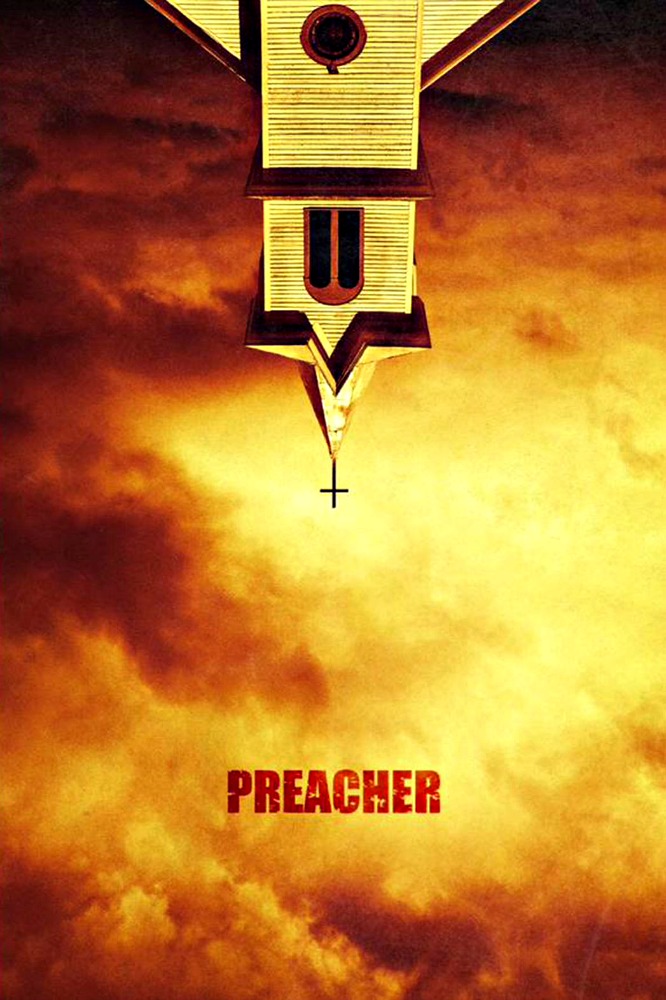
The Preacher Is About To Begin Mass


Preacher

Preacher the comic book that came out in 1995 and became the title that everyone gravitated to to balance out all the superhero titles that were coming out from Marvel, DC, Image and every small publisher in-between. The book was written by Garth Ennis and drawn by Steve Dillon. It was the book that took on the institutions of the Church, government and family in the most irreverent and blasphemous way one could think of at the time.

The book had been talked of within Hollywood since it’s release as one title that producers (seems all of them at one time or another) wanted to adapt for the big-screen. It wasn’t a superhero title so there was no need to worry about trying to adapt tights-wearing heroes and villains. Yet, the book’s subject matter which tended to go into the extreme at times became something that kept the title from being adapted.

After almost two decades of futile attempts to get Preacher up onto the big-screen it took the star-power of one big-screen star (Seth Rogen) to finally get the book adapted, but not on the big-screen, but on the small-screen to become part of AMC’s stable of unique series titles (The Walking Dead, Better Call Saul, Into the Badlands).

So, fans of the books only have until 2016 to wait for their dreams of Preacher finally coming to live-action life and non-readers will finally see what all the hype has been all about.

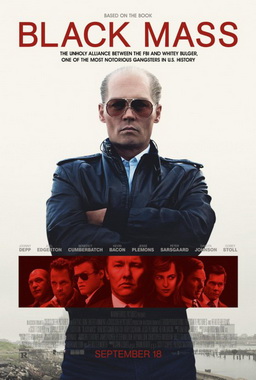
Film Review: Black Mass (dir by Scott Cooper)


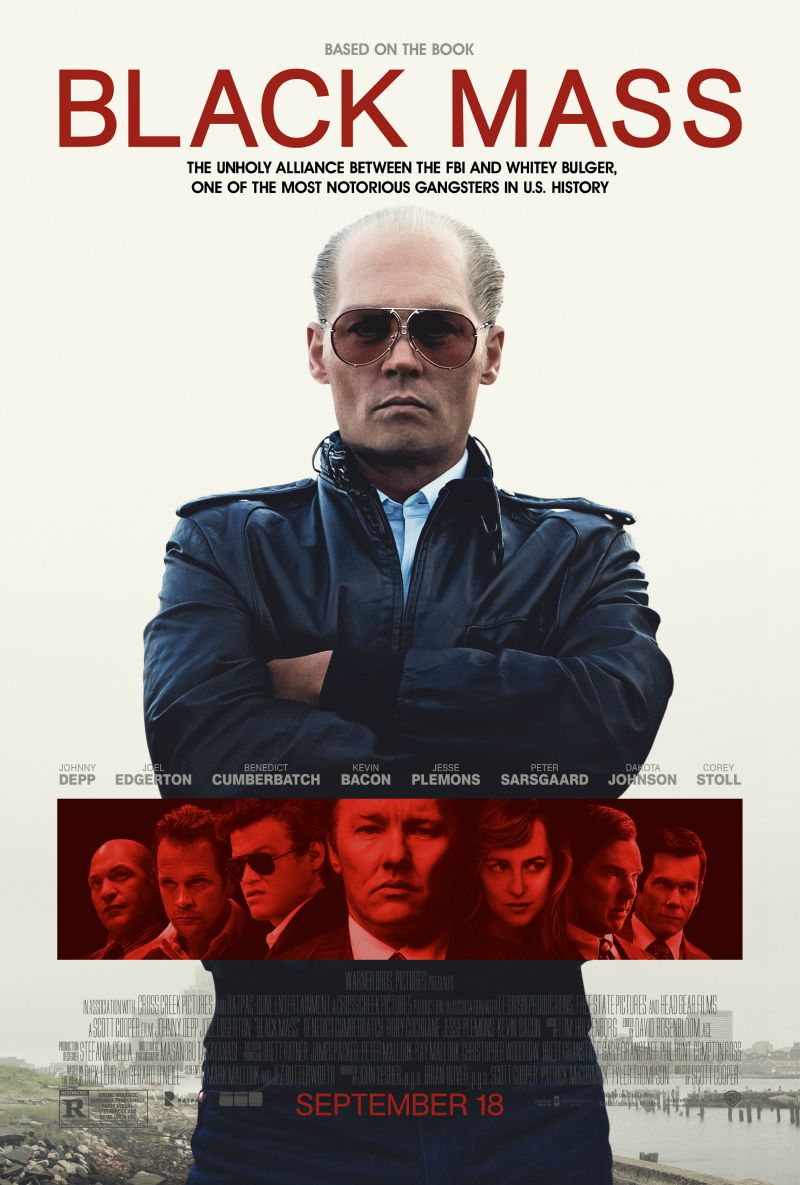
Black_Mass_(film)_poster

You know how sometimes you watch a movie and you’re happy because you know it’s a good movie but, at the same time, you end up feeling slightly disappointed because, as good as it may be, it never quite becomes the great movie that you were hoping for?

That was kind of my reaction to Black Mass.

Black Mass tells the true story of James “Whitey” Bulger, the gangster who controlled the Boston underworld from the late 70s to the mid-90s.  Bulger was both famous and feared for his ruthless brutality and his willingness to murder just about anyone.  Bulger was also famous for being the brother of Billy Bulger, a powerful Democratic politician.  When it appeared that Whitey was finally on the verge of being indicted, he vanished into thin air and, for 2 decades, remained missing until he was finally captured in Florida.  Whitey Bulger is now serving two life sentences.

Black Mass is a solid gangster film.  We watch as Whitey (Johnny Depp) takes over Boston and essentially murders anyone who gets on his nerves.  Helping Whitey out is a local FBI Agent, John Connolly (Joel Edgerton), who grew up in South Boston with the Bulger brothers.  While Connolly originally only appears to be using Whitey as an informant to help take down the Italian mob, it quickly becomes obvious that Connolly envies the power and influence of both Whitey and Billy (played by Benedict Cumberbatch).  Soon, Connolly has become something of a Bulger groupie and is protecting Whitey from prosecution and even leaking him the names of anyone who attempts to inform on Bulger’s crime.

Indeed, the film’s best scenes are the ones in which it is shown how the FBI’s determination to take down the Mafia allowed the far more violent Bulger to move into their place.  Bulger was a criminal who worked for and was protected by the U.S. government and, as such, his story serves as a metaphor for a lot of what is currently messed up about America.  While I appreciated the time that Black Mass devoted to exploring Whitey’s relationship with the FBI, I do wish it had spent more time exploring his relationship with his brother, Billy.  The film places most of the blame for Whitey’s reign of terror on the FBI but it defies common sense not to assume that Whitey was also protected by his well-connected, politically powerful brother.

Black Mass contains all of the usual gangster film tropes.  There are sudden and violent executions.  There are drug addicted criminals who turn out to be less than trustworthy.  (Poor Peter Sarsgaard.)  There’s the usual talk of honor and respect.  Beefy men with pockmarked faces stand in the shadows and shout random insults at each other until someone finally snaps.  And, of course, we get the countless scenes where Bulger’s demeanor goes from friendly to threatening and we’re left wondering if he’s going to smile or if he’s going to kill someone.  It may all be a little bit familiar but director Scott Cooper handles it all well and keeps things watchable.

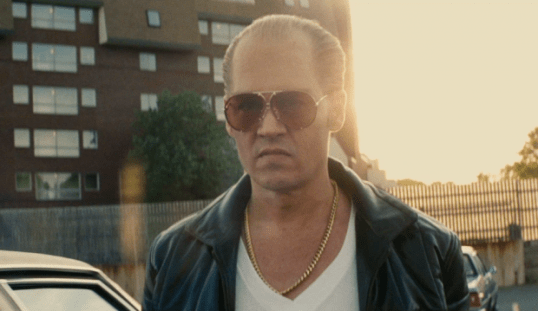
In this 122-minute film, there are exactly two scenes in which Whitey is in any way sympathetic.  In one scene, he breaks down after the death of his son and, in the other, he deals with the death of his mother.  These are the only two scenes in which Whitey shows any hint of humanity.  Otherwise, Bulger is presented as being almost pure evil.  He’s no Michael Corleone, trying to go straight and making excuses for the family business.  Nor does he possess the enjoyable flamboyance of Scareface‘s Tony Montana or The Departed‘s Frank Costello.  Instead, he’s a pure sociopath and  the film’s most effective shots are the ones that focus on Whitey’s expressionless gaze.  They say that the eyes are the windows to the soul and one only has to look into Bulger’s to see that they are windows without a view.

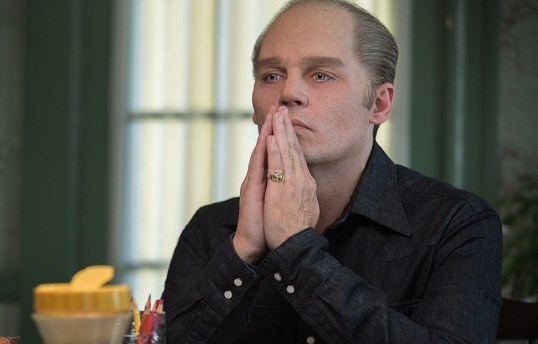
johnny-depp-2

Johnny Depp deserves all the credit in the world for making Whitey into a compelling character.  Wisely, Depp underplays Whitey’s most threatening scenes.  He rarely raises his voice and the only time he loses control of his emotions is when he’s confronted with something — like the death of his son — that even he can’t change.  Otherwise, Depp plays Whitey as always being in control.  (It’s mentioned, at one point, that Whitey was the subject of 50 LSD experiments while serving time in prison and Depp plays Whitey as if he’s always staring at something that nobody else can see.)  It’s his confidence that makes Whitey Bulger an interesting character.  You may not like him but you can’t look away because you know that he’s literally capable of anything.  Ever since the trailer for Black Mass was first released, Depp has been at the center of awards speculation.  Having seen the film, I can say that the Oscar talk is more than deserved.  He’s even better than people like me thought he would be.

Depp is so good that he overshadows the rest of the cast.  There’s a lot of good actors in this film, including Kevin Bacon, James Russo, Peter Sarsgaard, Corey Stoll, Jesse Plemons, and Rory Cochrane.  But few of them get as much of a chance to make an impression as Johnny Depp.  Much as Whitey dominated Boston, Depp dominates this film.  Joel Edgerton has several great moments as the not-as-smart-as-he-thinks-he-is Connolly but even he is thoroughly overshadowed by Depp’s performance.  (That said, I did appreciate the fact that Edgerton’s too-eager-to-please Connolly came across like he might be a cousin to The Gift‘s Gordo the Weirdo.)

As I said at the beginning of this review, Black Mass is good but it was never quite as great as I was hoping it would be.  There’s a few too many scenes where you get the feeling that Scott Cooper woke up the day of shooting and said, “Let’s Scorsese the shit out of this scene.”  As a result, Black Mass sometimes struggles to escape from the shadow cast by Goodfellas, Casino, The Departed, American Gangster, and the countless other mob films that have been released over the past few decades.  Black Mass is well-made and will forever be remembered for Johnny Depp’s amazing lead performance but it never quite reaches the status of a classic.

Finally, on a personal note, I did enjoy the fact that Black Mass dealt with the Irish mob.  I’m a little bit torn in my loyalties because I’m Irish-Italian but, if I ever had to pick a mob to which to serve as a cheerleader, I would go Irish Mafia all the way!

Sláinte!

bm


Trailer #2: Black Mass


BlackMass

One of this year’s most-anticipated films (well, at least when it comes to award season) has a new trailer.

Black Mass stars Johnny Depp in the role of the infamous gangster Whitey Bulger who, as the film’s tagline states, became the most notorious gansgter in U.S. history. This is bold claim considering other gangsters in U.S. history such as Lucky Luciano, Bugsy Siegel, Vito Genovese and Meyer Lansky to name a few.

What makes this film so interesting is the fact that we finally get to see Depp return to acting real, complex characters instead of just acting like a character these past decade. Plus, have you seen this cast supporting Depp: Benedict Cumberbatch, Kevin Bacon, Joel Edgerton, Corey Stoll and Jesse Plemons just for starters.

Black Mass is set for a September 18, 2015 release date.

Film Review: Wild (dir by Jean-Marc Vallee)


reese-witherspoon-wild-slice

Wild opens with Cheryl Strayed (played by Reese Witherspoon) standing on the edge of a cliff.  She has been hiking for days and, because her hiking boots are too small, she’s limping and in a great  deal of pain.  She takes off a boot and a sock and stares at her bloody big toe.  With trembling fingers, she removes what is left of her big toenail.  And then, she throws her boot over the edge of the cliff while screaming, “FUCK YOU!”

And, from that moment, Wild had me.

For the next two hours, I sat there and I was absolutely enthralled as Cheryl, an aspiring writer and a recovering drug addict who was still struggling to come to terms with the death of her mother (played, in heart-breaking flashbacks, by Laura Dern), hiked her way from the Mexican border up to the Canadian border.  I watched as she learned how to survive in the wilderness, how she cautiously learned to trust some of her fellow hikers, and as she dealt with sexist rangers and creepy hunters.

And there were a lot of reasons why Wild held me so enthralled.  There was Reese Witherspoon’s performance, for one thing.  Reese is on screen during every minute of Wild and, for a lot of that time, she’s alone with her thoughts and her emotions.  She gives an amazingly focused performance, one that should regain her some of the respect that she sacrificed by appearing in movies like This Means War and publicly asking, “Do you know who I am?”  Both the film and Reese’s performance resist the temptation to idealize Cheryl.  Instead, both the film and the performance feel real and because Cheryl comes across as a real person (flaws and all), it makes her journey and her achievement all the more powerful.

I couldn’t help but relate to Cheryl.  Like her, I’m an aspiring writer.  Like her, I’m still learning how to deal with the loss of my mom.  Like her, I have trust issues.  Like her, I am sometimes too stubborn for my own good.  Like her, I like to leave quotes in guest books.  Like her, I always pack a few paperbacks before I go on a trip and I like to write in my journal.  Like Cheryl, I’m a survivor and I’m proud of it.

Unlike Cheryl, however, I’ve never gone hiking and I doubt if I ever will.  As much as I loved Wild (and it’s definitely one of my favorite films of 2014), it didn’t leave me with any great desire to go on a hike.  That’s largely because of that first scene.  When Cheryl threw away her boots and screamed, I thought to myself, “That would so be me.”  Of course, the difference is that Cheryl did that after hiking for a month.  I would probably end up doing that after the 2nd day.  And then I’d turn around, go back home, and spend the weekend watching Netflix.

But here’s the thing: Wild is not really about hiking.  Wild is about the journey.  What’s important is not that Cheryl hiked but that Cheryl accomplished what she set out to do.  No matter how difficult it got, no matter how many people told her she should give up, Cheryl walked from Mexico to Canada.  By the end of the film, I felt like, if Cheryl could do that even with boots that were too small, than there was nothing that I could not do.

As a result, Wild is not only one of the best films of 2014.

It’s the most empowering as well.