Horror Film Review: The Seduction (dir by David Schmoeller)


Get to know your neighbors, people!

That’s really the main message that I took away from the 1982 film, The Seduction.  In The Seduction, Morgan Fairchild stars as Jamie Douglas.  Jamie is a anchorwoman for a local news channel in Los Angeles.  She has an older boyfriend named Brandon (Michael Sarrazin).  She has a sex-crazed best friend named Robin (Colleen Camp).  She has a beautiful home in the Hollywood Hills.  She’s doing wonderfully for someone whose main talent is the ability to read what’s on the teleprompter.  Much like Ron Burgundy, she’ll read whatever is put on that teleprompter without even thinking about it.  Some might say that indicates that Jamie is a fairly vacuous character and …. well, they’re right.  She is.

Jamie starts receiving flowers at work and mysterious phone calls from someone named Derek.  Derek (Andrew Stevens) is a fashion photographer.  He’s young.  He’s handsome.  He’s charismatic.  His assistant, Julie (Wendy Smith Howard), is absolutely in love with him.  In fact, Derek would seem to have it all but he’s obsessed with Jamie.  Soon, he’s breaking into Jamie’s house so that he can watch her undress and then confronting her at the mall.  At one point, he shows up in her living room and starts taking pictures of her.  Jamie screams.  Brandon beats him up.  After Derek leaves, Jamie and Brandon go to the police and ask if there’s something that they can do about Derek.  The police say that there are not many options because Derek has not technically broken the law …. uhm, what?  I get that things were different in the 80s but I still find it hard to believe that showing up in someone else’s living ro0om without an invitation and then refusing to leave would have been considered legal back then.  As you probably already guessed, Derek’s obsession soon turns lethal.

Perhaps the weirdest thing about The Seduction is that Derek is basically Jamie’s neighbor but she doesn’t ever seem to realize it.  Watching this film, there were time when I really had to wonder if maybe Jamie was just an idiot.  As well, throughout the film, Jamie reports on an unknown serial killer who is terrorizing Los Angeles.  The killer is dubbed the Sweetheart Killer and, when I watched this film, I wondered if the Sweetheart Killer and Derek were one in the same.  I don’t think that they were but, still, why introduce an unknown serial killer without providing any sort of resolution?  It’s all indicative of just how sloppy the plotting on The Seduction truly was.  That’s especially true of the ludicrous ending of the film.  A murder is committed in Jamie’s hot tub and when Jamie calls the police to report it, she’s put on hold.  Meanwhile, Derek buries the body in Jamie’s backyard and somehow manages to do it without really breaking a sweat or being noticed by anyone.  Derek’s big secret turns out to be not that much of a shock.

Morgan Fairchild’s performance isn’t great but that’s largely because she’s stuck with a character who is never allowed to behave in a consistent manner.  Andrew Stevens is a bit more convincing as Derek, playing him as a photographer who doesn’t need cocaine because he’s already get his obsessive personality keeping up at nights.  Michael Sarrazin, as Brandon, bellows nearly all of his lines and gives a performance that just shouts out, “Why did I agree to do this movie!?”  He’s amusing.  As for director David Schmoeller, he did much better with both Tourist Trap and Crawlspace.

Seriously, though, a lot of the horror and drama in this film could have been avoided by Jamie just getting to know her neighbors.  I’ve been very lucky to have some very good neighbors over the years.  When my Dad passed away, my neighbors Hunter and Hannah checked in on my nearly every day afterwards and let me use their hot tub whenever I wanted to.  Neighbors, they can be pretty special.

Retro Television Reviews: Fantasy Island 4.3 “The Skater’s Edge/Concerto of Death/The Last Great Race”


Welcome to Retro Television Reviews, a feature where we review some of our favorite and least favorite shows of the past!  On Tuesdays, I will be reviewing the original Fantasy Island, which ran on ABC from 1977 to 1986.  Almost the entire show is currently streaming is on Youtube, Daily Motion, and a few other sites.

This week, Fantasy Island loses a fantasy.  Read on to find out the details and remember, “Smiles, everyone!  Smiles!”

Episode 4.3 “The Skater’s Edge/Concerto of Death/The Last Great Race”

(Dir by Cliff Bole and Vince Edwards, originally aired on November 8th, 1980)

When this episode originally aired, it was a special two-hour episode of Fantasy Island, one that featured three fantasies as opposed to the usual two.

In Skater’s Edge, Charlie Johnson (Charlene Tilton) is a farm girl from Missouri who dreams of being a world class figure skater.  She comes to the Island to compete in the Fantasy Island Skating Competition.  Mr. Roarke gives Charlie a pair of magic skates that he claims belonged to figure skater Sonja Henie.  As long as Charlie is wearing the skates, she is the greatest skater in the world.  She takes the competition by storm and she also wins the heart of coach Mike O’Brien (Dack Rambo).  Unfortunately, in doing so, Charlie upsets Mike’s protégé, Laura Henderson (Peggy Fleming).  Laura steals Charlie’s skates but, after Mr. Roarke talks to her about the importance of friendship and fair play, Laura returns the skates to Charlie. Charlie gets a perfect score from the judges but, even more importantly, she learns a lesson in humility and she’s happy when Laura is named the winner of the competition.  Laura has the Fantasy Island championship but Charlie has got Mike.

In Concerto of Death, Dennis Cole plays Jeremy Hale, who comes to the island with his wife (Mary Ann Mobley).  Jeremy’s brother was a talented concert pianist who was murdered.  Jeremy wants to play as well as his brother but he also wants to solve his murder.  Roarke gives Jeremy an emerald ring that glows a deep green when Jeremy plays his piano.  Roarke warns Jeremy that his brother’s ghost might try to possess him and seek violent revenge against those who he blames for his death.  The scenes involving Jeremy being possessed feature Jeremy being suffused by a green glow and yes, it’s kind of silly but it’s still fun in the way that cheap special effects often are.  Eventually, Jeremy realizes that his brother was killed by Carla Marco (Erin Gray) and it ends with the police taking away Carla and Jeremy’s guest cabin burning to the ground.  That cabin burned down to the ground at least once per season.

Finally, in The Last Great Race, Dick Shawn and Juliet Mills play a couple who are divorcing.  They go on a race with the winner getting the majority of their possessions.

You may notice that I don’t have much to say about The Last Great Race.  This is because the Race fantasy was edited out of this episode when it went into syndication.  Unfortunately, all of the versions that I’ve found of this episode online are of the syndicated version.  So, I guess The Last Great Race is just going to be the lost fantasy of Fantasy Island.

It’s hard to judge this episode because, in the syndicated version, it’s very obvious that a lot has been removed.  It makes things feel a bit disjointed with the scene transitions often coming abruptly.  Charlie and Mike seem to fall in love in record time and Laura declaring herself to be Charlie’s friend seems odd because we haven’t really seen them interact before Laura steals her skates.  Meanwhile, the story with Jeremy also feels rushed with the final confrontation between Jeremy and the murderer seeming to come out of nowhere.

That said, it’s kind of a fun episode.  The skating scenes feature an obvious stunt double for Charlene Tilton and it’s hard not to be kind of charmed by how obvious it all is.  (You can get dizzy as the scene cuts from close-ups of Tilton’s face and close-ups of the stunt double’s legs.)  The supernatural story makes no sense but the silly special effects made me smile.  The episode ends with Mr. Roarke causing snow to fall on Fantasy Island but, in typical Roarke fashion, he makes sure that it only falls on Tattoo.  Roarke has a good laugh while Tattoo screams in terror.  Seriously, those two hate each other so much.

Retro Television Reviews: Fantasy Island 4.1 “The Devil and Mandy Breem/The Millionaire”


Welcome to Retro Television Reviews, a feature where we review some of our favorite and least favorite shows of the past!  On Tuesdays, I will be reviewing the original Fantasy Island, which ran on ABC from 1977 to 1986.  Almost the entire show is currently streaming is on Youtube, Daily Motion, and a few other sites.

This week, season 4 begins with …. THE DEVIL!

Episode 4.1 “The Devil and Mandy Breem/The Millionaire”

(Dir by Vince Edwards, originally aired on October 25th, 1980)

The fourth season of Fantasy Island opens with Mr. Roarke and Tattoo once again upset with each other.

When a man named Fred Catlett (Arte Johnson) wrote to Mr. Roarke and said that his fantasy was to become an instant millionaire, Roarke turned down his fantasy for …. reasons, I guess.  Seriously, becoming an instant millionaire sounds like a typical fantasy and I seem to remember that it’s one that Roarke has granted for other guests on the series.  I’m not sure why Roarke decided that poor, meek Fred Catlett was somehow unworthy of his fantasy.

For whatever reason, though, Roarke does turn down the fantasy.  So, imagine his surprise when Fred shows up on the island!  Tattoo explains that he decided to give Fred his fantasy.  Roarke tells Tattoo that he’ll receive no help and no money from him.  Tattoo is shocked and I’m wondering if this means that Fred will get a refund.  I mean, Fantasy Island is not cheap.  Actually, if Fred already had enough money to come to Fantasy Island, that does make his fantasy seem a little bit weird.  It seems like you have to be a millionaire to get your fantasy in the first place.

Roarke, I should add, is a hypocrite because he totally suspends the rules for this week’s other guest.  Mandy Breem (Carol Lynley) has come to the Island with her fantasy being that she wants the Island to save her life.  However, Mandy refused to explain all of the details of her fantasy until she came to the Island.  Roarke allows her to come, despite not knowing what she wants.  If Tattoo did something like that, Roarke would never let him hear the end of it.

So, what is Mandy’s fantasy?  A year ago, Mandy’s husband (Adam West) underwent a surgery.  Fearful of his life, Mandy made a deal with …. THE DEVIL!  She agreed that, if he saved her husband’s life, she would give up her soul in a year’s time.  Well, that year is coming to a close and Mandy has come to Fantasy Island, hoping that she can somehow get out of the deal.  The Devil (played by a dapper Roddy McDowall) has followed her and soon, Roarke must confront the Lord of Darkness for the sake of Mandy’s soul.

This is a really fun story, largely because the performance of Roddy McDowall as the devil.  Wearing a black suit and a white tie and delivering all of his lines with just the right mix of menace, sarcasm, and camp McDowall is the ideal trickster.  The smoky confrontation between Roarke and the Devil is the highlight of the episode, with both Montalban and McDowall both seeming to relish they drama of the moment.  Ricardo Montalban once said that, while the show’s producers wanted to keep Roarke as enigmatic as possible, he always envisioned Roarke as being a fallen angel who was doing his penance on Fantasy Island.  And, indeed, there is a hint of that in his confrontation with the Devil, with the show suggesting that this is neither the first nor the final time that the two shall meet.

As for the other fantasy, Tattoo’s solution is to steal a magic lamp and give it to Mike.  Mike rubs the lamp and wishes for a million dollars.  A briefcase full of money flies through the sky and lands in front of him.  Mike is convinced the magic worked but actually the briefcase was tossed out of a moving car and now, three thieves (Arlene Golonka, Ross Martin, and Joe Turkel) want their money back!  It all works out in the end.  Despite Roarke’s earlier refusal to grant Fred his wish, this was ultimately a typical Fantasy Island fantasy.  While it really couldn’t compete with Mr. Roarke facing off against the Devil, it did, at least, give Tattoo something to do.  One gets the feeling that this episode was specifically conceived so that both Ricardo Montalban and Herve Villechaize could get their chance in the spotlight without having to actually interact with each other.  And it works out wonderfully, with Tattoo’s silly antics providing a nice balance to the more dramatic stuff involving Mr. Roarke.

All in all, even if it’s obvious that Ricardo Montalban and Herve Villechaize were still not getting along behind the scene, this was a fantastic start for season 4!

Film Review: The Mad Bomber (dir by Bert I. Gordon)


Haunted by the death of his teenage daughter and the subsequent collapse of his marriage, William Dorn (Chuck Conners) feels that society is changing too quickly.  He misses the days when people were polite and followed the law.  Now, he’s upset that he can’t even walk around Los Angeles without seeing people littering.  The waitress at the local diner has forgotten the importance of smiling while taking her customer’s order.  Hospitals are full of doctors who don’t care about their patients.  The colleges are full of long-haired drug pushers.  His ex-wife is attending a consciousness raising seminar.  William has had it with the 1970s so he decides to start blowing stuff up.

William starts to wander around Los Angeles.  Usually, he’s carrying a brown paper sack and, inside the sack, he’s got a ticking time bomb.  He always wears the same suit and thick glasses and yet, somehow, no one ever seems to notice or remember him.  Even though all of his bombs are timebombs, they still go off within seconds of him planting them, which means that he’s usually only standing a few feet away with they explode.  William also sends the police tape-recorded manifestos without making any effort to disguise his voice.  William may not be the smartest criminal around but that still doesn’t stop him from terrorizing the city.

Detective Geronimo Minelli (Vince Edwards) is determined to track down the mad bomber, even if it means yelling at everyone that he meets.  Minelli is one of those intense detectives who doesn’t care about what the Supreme Court has to say about the rights of suspects and the accused.  Unfortunately, the only witness who can identify the bomb is George Fromley (Neville Brand), a sex offender who doesn’t want to admit that he saw the bomber blow up a hospital because he was busy assaulting one of the patients at the time.  Can Minelli convince Fromley to provide a physical description of the bomber?  And will William Dorn ever realize that it’s probably not a good idea to store a bunch of ticking time bombs in his basement?

First released in 1972 and also known as The Police Connection, Bert I. Gordon’s The Mad Bomber is unique amongst Gordon’s films in that it doesn’t feature any giant animals or killer bugs.  In this film, the monsters are all human and don’t have any convenient excuses for their behavior.  Though Neville Brand does a good job with the role, George Fromley is still probably one of the most unlikable and despicable characters to ever appear in the movie.  Meanwhile. Vince Edwards plays Minelli as being the type of cop who is one bad day away from massively violating someone’s civil rights during a traffic stop.  The film does build up some sympathy for William Dorn, with still shots of his daughter used to show us what’s going through Dorn’s mind as he plants his bombs.  But then it tosses all that sympathy away by having him target a meeting of feminists, apparently because he blames them for his wife leaving him.

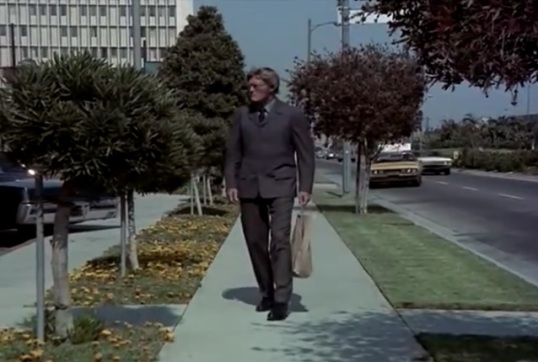
The main problem with the film is that we’re expected to believe that someone who looks like this would be able to walk around Los Angeles and plant bombs without anyone noticing.

That’s nothing against Chuck Conners, who does a good job of portraying William’s frustration with the world.  But still, it’s hard to believe that no one is going to notice a dude who is nearly seven feet tall and who is carrying a ticking shopping bag.

Flaws and all, The Mad Bomber is a watchable and occasionally even an engrossing film.  It’s certainly one Gordon’s better efforts and Gordon does a good job of creating and maintaining a properly ominous atmosphere, even if it sometimes hard to take seriously the sight of Chuck Conners, lumbering around in his suit and trying to discreetly drop off bombs.  In many ways, it’s a film that still feels relevant today. William, like so many. is trying to forcefully stop the world from changing around him.  He’s a man who has lost anything and has decided that it’s the fault of everyone else.  (In many ways, he’s like Rainn Wilson in Super, ragefully reacting to a world is not as simple as he believes it should be.)  The Mad Bomber may not be as much fun as Gordon’s giant monster films but it’s still a film that has something to say.

The Fear (1995, directed by Vincent Robert)


Psychology student Richard (Eddie Bowz) wants to conduct a study.  After getting permission from the head of his department, Dr. Arnold (Wes Craven!), Richard gathers together a group of students and takes them to his family’s cottage.  He introduces the group to “Morty,” a life-sized wooden dummy who Richard has had ever since he was a child.  Morty, Richard explains, was carved by a Native American shaman and was then stolen by Richard’s grandfather.  Each member of the group is told to confess their greatest fear to “Morty.”  Even Richard takes part, confessing that he was scared of Morty when he was growing up.

File this one under “it seemed like a good idea at the time,” because the weekend quickly heads south.  Richard’s uncle (Vince Edwards) shows up unannounced with his new girlfriend, Tanya (Anna Karin).  Members of the group start to disappear and one of them is assaulted at a Christmas carnival, leading the group to suspect that one of them might be the rapist who has been attacking women on campus.  Morty starts to show up in an unexpected rooms in cottage and it appears that everyone’s fears are starting to come true!

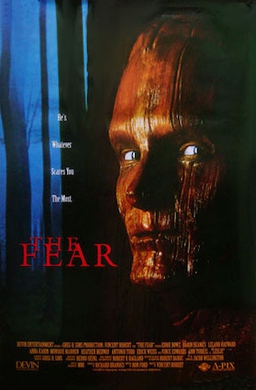
The Fear is one of those films that used to show up on late Cinemax but I mostly remember it because it was one of those movies that always seemed to be on display at our local Blockbuster.  The VHS cover featured Morty giving someone the side-eye and looking dangerous.  Morty is the best thing about the movie.  Just looking at him is unsettling.  Why would Richard be stupid enough to tell people to confess their fears to Morty?

Morty is creepy but the movie doesn’t seem to know what to do with him.  Sometimes, Morty is evil and can move on his own and even seems to be capable of possessing someone.  Other times, the movie seems to suggests that everything that’s happening is just in Richard’s head and Morty is just a wooden dummy.  The story becomes impossible to follow as every member of the group is revealed to have a secret and Richard is finally forced to admit that there is something that he’s even more scared of than Morty.  (If, as the film suggests, Morty is mostly after Richard, why does Morty first waste so much time on the other members of the group?)  The Fear is not without ambition.  It takes the therapy scenes seriously and Eddie Bowz does seem like he’s trying to give a believable performance as Richard.  It seems like the people involved wanted to make a good movie.  But once everyone’s fears start to come true and the movie moves into a ridiculous subplot about Richard and his stepsister, the movie is too disjointed to work.  It doesn’t help that most of the fears are too mundane to really translate into an imaginative death scene.  By the end of it all, not even Morty’s that scary anymore.

Film Review: Firehouse (1973, directed by Alex March)


Firefighter Shelly Forsythe (Richard Roundtree) has just been assigned to a new firehouse and, from the minute he shows up, it’s trouble.  Not only is he resented for taking the place of a popular (if now dead) firefighter but he’s also the first black to have ever been assigned to that firehouse.  Led by angry racist Skip Ryerson (Vince Edwards), the other firemen immediately distrust Forsythe and subject him to a grueling hazing.  However, Forsythe is determined to prove that he’s just as good as any white firefighter and refuses to be driven out.  While the firehouse simmers with racial tensions, a gang of arsonists is setting buildings on fire.

Firehouse does not have much of a plot but what little it does have, it deals with in a brisk 72 minutes.  Forsythe shows up for his first day.  Everyone hazes him.  Forsythe gets mad.  There’s a big fire.  And then the movie ends, without resolving much.  Ryerson is still a racist and Forsythe is still mad at almost everyone in the firehouse.  The characters are all paper thin and most of the fire fighting scenes are made up of grainy stock footage.  What does make the film interesting is the way that it handles the causal racism of almost every white character.  Ryerson, for instance, comes across as being an unrepentant racist but the film suggests that this is mostly due to him being too stubborn to change his ways and that Ryerson’s not that bad once you get to know him.  When Andrew Duggan’s fire chief instructs Forsythe not to take any of the constant racial remarks personally, Firehouse portrays it as if Duggan is giving good and reasonable advice.  The mentality was typical for 1973 but wouldn’t fly today.

One reason why Firehouse ends so abruptly is because it was a pilot for a television series.  At the time Firehouse aired, it had been only two years since Roundtree starred as John Shaft and NBC hoped that to recapture that magic on a weekly basis.  However, it would take another year before the Firehouse television series went into production and, by that time, Roundtree had left the project.  In fact, with the exception of Richard Jaeckel, no one who appeared in the pilot went on to appear in the short-lived TV series.

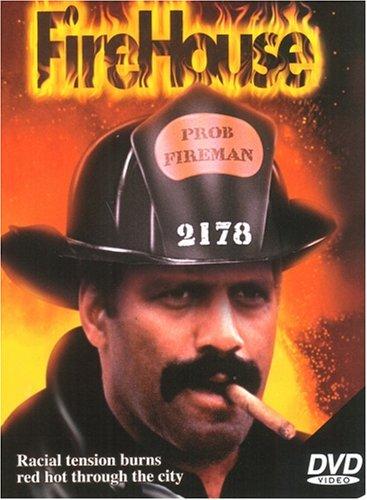
The DVD of Firehouse is infamous for featuring a picture of Fred Williamson on the cover, in which Williamson is smoking a cigar and wearing a fireman’s helmet.  Williamson does not appear anywhere in Firehouse and I can only imagine how many people have sat through Firehouse expecting to see a Fred Williamson blaxploitation film, just to discover that it was actually a Richard Roundtree television pilot.  Firehouse probably would have been better if it had starred Fred Williamson.  Roundtree’s good but sometimes, you just need The Hammer.

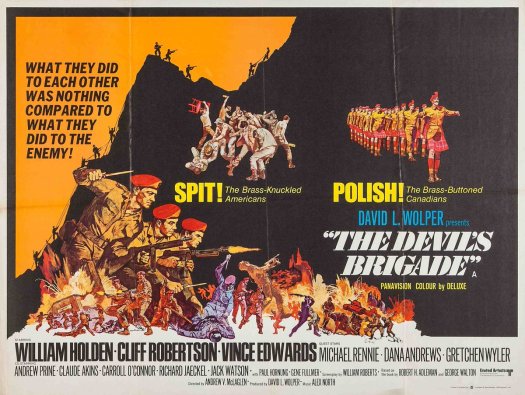
Special Memorial Day Edition: THE DEVIL’S BRIGADE (United Artists 1968)


gary loggins's avatarcracked rear viewer

In the wake of 1967’s THE DRITY DOZEN came a plethora of all-star, similarly themed films. THE DEVIL’S BRIGADE is one of those, though just a bit different: it’s based on the true-life exploits of the First Special Service Force, a collection of American misfits straight from the stockades and the crack, highly disciplined Canadian military, forging them into one cohesive fighting unit.

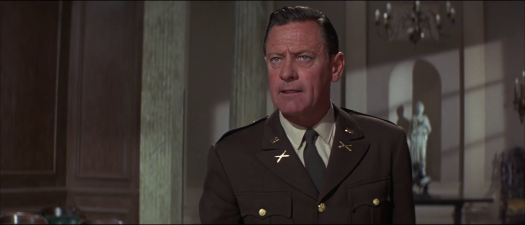
William Holden  heads the cast as Lt. Col. Robert Frederick, tasked with putting the units together. His seconds-in-command are the cigar chomping American Major Brecker (Vince Edwards) and proud Canadian Major Crown (Cliff Robertson). The Americans, as rowdy a bunch of reprobates as there ever was, include Claude Akins , Luke Askew, Richard Jaeckel, and Tom Troupe, while the Canadians are represented by the likes of Richard Dawson, Jeremy Slate, and Jack Watson , war movie vets all.  Andrew Prine is also aboard as an AWOL…

View original post 365 more words

A Quickie In Space: Space Raiders (dir by Howard R. Cohen)


Space Raiders

Last Saturday was Roger Corman’s 88th birthday and what better way to celebrate than to watch one of the many low-budget but undeniably entertaining films that the great man has produced?

That’s just what I did on Saturday with my Late Night Movie friends.  The movie we watched was an obscure 1983 science fiction film called Space Raiders.  Now, technically, this film was directed by Howard Cohen but, from the first frame, it was obviously a Roger Corman film.  It was also a lot of fun.

Space Raiders takes place in the distant future, at a time when intergalactic corporations have colonized planets with sullen children and space criminals spend their spare time hanging out in dank space stations.  From the minute the film opens with a scene of robots doing menial labor in a factory while a the factory foreman assures the human workers that the next company picnic will take place on a planet where it doesn’t rain, there’s little doubt that the main message of Space Raiders is that the future sucks.

10 year-old Peter (David Mendelhall) lives on the planet of Proycon III (which, if nothing else, is a great name for a planet).  Neglected by his wealthy parents and apparently being the only child on Proycon III, Peter spends his spare time sneaking into robot-filled factories and capturing space bugs.  That’s what Peter is doing when he witnesses a daring raid by a group of — wait for it — space raiders!  Led by the surly but kind-hearted Hawk (Vince Edwards), the raiders steal a spaceship from the factory.  What they don’t realize is that Peter (and the bug that he had just captured seconds before the raid) has stowed away on the ship.

At first, Hawk is not enthusiastic about Peter being on the ship and Peter just wants to get home.  However, as the space raiders deal with both intergalactic cops and alien gangsters, Hawk and the kid start to bond and Peter gets to know the rest of the crew.

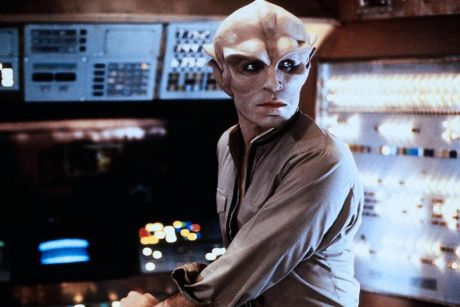
Now, to be honest, the majority of Hawk’s crew were pretty interchangeable but my friends and I quickly decided that our favorite was the one that we named Capt. Forehead (played by Thom Christopher).  Capt. Forehead was an alien who had psychic powers and who carried himself with the wounded dignity of a head waiter having a bad night.  It was hard not to like him.

Captain Forehead

Anyway, Peter’s parents want their son back and, since they work for an evil corporation, they have no problem hiring evil mercenaries to get their son back.  It all leads to a lot of people shooting lasers at each other and exploding spaceships.

Now, honestly, we can get all technical and picky about whether or not the plot of Space Raiders made any sense or whether or not any of the actors gave good performances.  We can even talk about the logic of the scene where Peter –upon realizing that Hawk is on a different spaceship than him — responds by attempting to yell, “HAWK!” across the far reaches of space.

But you know what?

That’s missing the point.

In the way that only a low-budget science fiction film produced by Roger Corman can be, Space Raiders was a lot of fun.  The movie moved quickly, the aliens were fun to look at, and the special effects were charmingly cheap.  Flaws and all, Space Raiders had more humanity than Man of Steel, more humor than Gravity, and it was a lot shorter than Avatar.

Watch it below and see for yourself.