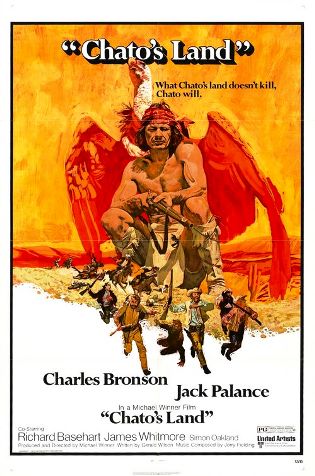
A Movie A Day #170: Chato’s Land (1972, directed by Michael Winner)


Don’t mess with Charles Bronson.

That’s the main lesson that can be taken away from Chato’s Land.  In this western, Bronson plays Chato, an Apache who enters the wrong saloon and is forced to shoot a racist sheriff in self-defense.  Former Confederate Captain Quincey Whitemore (Jack Palance) forms a posse to track Chato down but soon discovers that his posse is not made up of the best and brightest.  Instead, most of them are sadistic racists who just want to kill Apaches.  Despite Whitemore’s efforts to stop them, the posse rapes Chato’s wife and kills his best friend.  Chato trades his white man’s clothes for a loin cloth and sets out for revenge.

Chato’s Land is historically significant because it was the first of many films that Charles Bronson made with Michael Winner.  The most famous Bronson/Winner collaboration was Death Wish, which also featured Charles Bronson as a man who seeks revenge after his wife is raped.  What is surprising about Chato’s Land is how little screen time Bronson actually has.  Most the film is spent with the posse, which is full of familiar faces (Richard Jordan, Simon Oakland, Victor French, Ralph Waite, and James Whitmore all report for duty).  It actually works to the film’s advantage, making Bronson even more intimidating than usual.  There’s never any doubt that Chato is going to kill every member of the posse but since almost every member of the posse is loathsome, that’s not a problem.

It’s possible that Chato’s Land was meant to be an allegory for the Vietnam War, which is probably giving Michael Winner too much credit.  (In an interview, the author of Death Wish, Brian Garfield, once shared an anecdote about Winner inserting a shot of three nuns into Death Wish and bragging about how the shot was meaningless but that it would fool the critics into thinking he was making a grand statement about something.)  Like most of Winner’s films, Chato’s Land is good but not great.  There are parts of the movie that drag and Jack Palance and Charles Bronson don’t get to share any big scenes together, which seems like a missed opportunity.  Bronson, who was always underrated as an actor, gives one of his better performances as Chato.  Chato does not say much but Bronson could do more with one glare than most actors could do with a monologue.  In Europe, Bronson was known as Il Brutto and Chato’s Land features him at his most brutal.

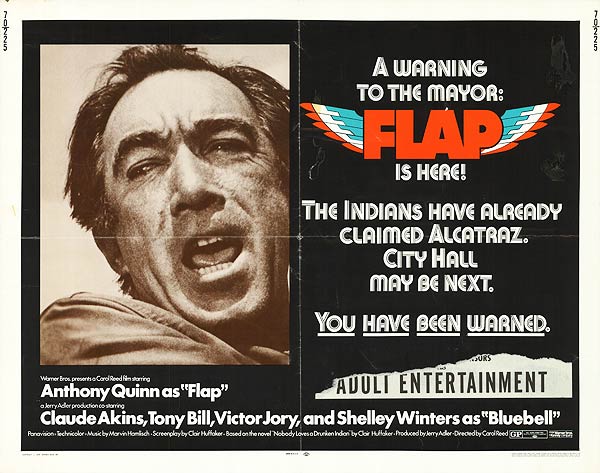
This Eagle Doesn’t Fly: FLAP (Warner Brothers 1970)


gary loggins's avatarcracked rear viewer

flap1

FLAP is an attempt by director Sir Carol Reed to jump on the late 60’s/early70’s “relevance” bandwagon by depicting the modern-day mistreatment of the American Indian. It’s a seriocomic character study that struggles to find it’s identity, and as a result fails at both comedy and drama.

FLAP is Flapping Eagle, an ex-soldier living back on the reservation who’s “pissed off at everybody”. He’s a hard drinking man, as is just about all the Indians here, feeding into the stereotypical “drunken Indian” image. Flap’s had enough of the noise coming from construction workers building a highway project right next to the rez, and causes a fracas between the hardhats and the Indians, damaging a bulldozer in the process. Native Wounded Bear (who has a correspondence school law degree) points out the highway is gong through sacred burial ground, which turns out not to be the case. Everyone’s up in arms, especially local…

View original post 461 more words

Film Review: There Was a Crooked Man… (1970, directed by Joseph L. Mankiewicz)


Crooked_manI first saw There Was A Crooked Man as a part of TCM’s tribute to the great actor Warren Oates.  Warren Oates was rarely cast in the lead but, as a character actor, he appeared in supporting roles in several great films.  Unfortunately, There Was A Crooked Man is not one of them.

Directed by Joseph L. Mankiewicz and written by the screenwriting team of Robert Benton and David Newman (best known for writing Bonnie and Clyde), There Was A Crooked Man is meant to be a comedic western.  Outlaw Paris Pittman (Kirk Douglas) is arrested while visiting a bordello.  Paris is sent to an Arizona prison, where everyone tries to get him to reveal where he has hidden the stash from a $500,000 robbery.  Pittman uses everyone’s greed to manipulate them into helping him attempt to escape.  Standing in Pittman’s way is the new warden, a liberal reformer played by Henry Fonda.

There Was A Crooked Man is a long movie that features a lot of familiar faces.  Burgess Meredith plays The Missouri Kid, who has been in prison for so long that he is now an old man.  Hume Cronyn and John Randolph play a bickering gay couple who eventually become a part of Pittman’s scheme to escape.  Even Alan Hale, the skipper from Gilligan’s Island, shows up as a guard named Tobaccy!  There Was A Crooked Man is a big movie but it’s also not a very good one.  It’s not serious enough to be a good drama but it’s not funny enough to be a good comedy either.

At least the movie has Warren Oates going for it.  Oates plays Harry Moon, a prisoner who is drafted into Pittman’s escape plot.  It is a typical Warren Oates supporting role but he steals every scene that he appears in.  Even in the smallest of roles, Warren Oates was worth watching and he’s the best thing about There Was A Crooked Man.

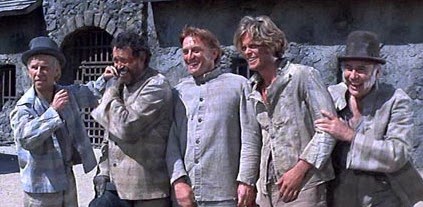
Hume Cronyn, Warren Oates, Kirk Douglas, Michael Blodgett, and John Randolph in There Was A Crooked Man

Hume Cronyn, Warren Oates, Kirk Douglas, Michael Blodgett, and John Randolph in There Was A Crooked Man