Horror on the Lens: Baffled! (dir by Philip Leacock)


Hi there and welcome to the October Horrorthon!

This is our favorite time of the year here at the Shattered Lens because October is horror month.  For the past five years, we have celebrated every October by reviewing and sharing some of our favorite horror movies, shows, books, and music!

A part of the tradition of Horrorthon is that we begin every day in October by sharing a free movie.  Now, I should warn you that most of these movies will come from YouTube and you know how YouTube is about yanking down videos.  So, if you’re reading this in 2024 and wondering where the promised movie disappeared to … well, you should have watched it in 2017!

Let’s start this October off with Baffled!, an entertaining little made-for-TV movie from 1973.  Leonard Nimoy plays a race car driver who suddenly starts to have psychic visions of a woman who lives in what appears to be a gothic manor.  The woman is in some sort of danger.  Nimoy, of course, would rather just race cars but a parapsychologist (Susan Hampshire) convinces him that he has to figure out what his visions mean.

Now, to be honest, Baffled! is not a particularly scary movie.  Some of Nimoy’s visions are spooky but there’s nothing in this movie that’s going to give you nightmares.  Though it may not be horrifying, Baffled! is a lot of fun.  Apparently, it was meant to be a pilot for a TV series.  If it had been picked up, I guess Nimoy and Hampshire would have been helping out a new guest star every week.  Nimoy seems to be having a lot of fun playing a psychic race car driver and he and Susan Hampshire have a really sweet and enjoyable chemistry.

I watched Baffled! with the TSL’s own Patrick Smith and the other members of the Late Night Movie Gang.  We all really enjoyed it and I hope you will too:

http://www.youtube.com/watch?v=09JTgUcvyGE


Ride Away: John Wayne in John Ford’s THE SEARCHERS (Warner Brothers 1956)


gary loggins's avatarcracked rear viewer

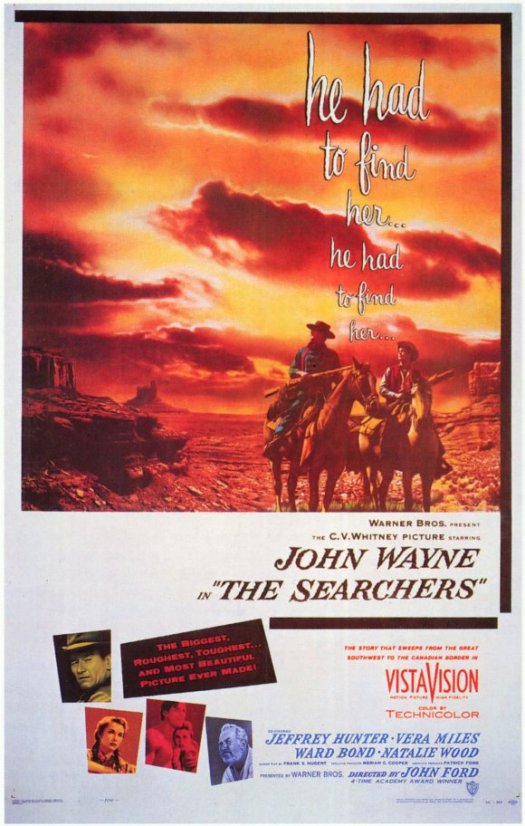
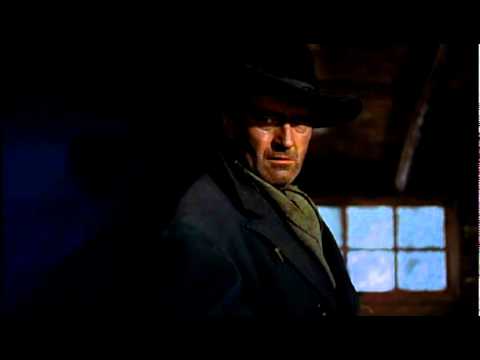
John Ford’s  THE SEARCHERS is without question an American Film Classic. I’d even go as far as saying it’s my second all-time favorite film, directly behind CASABLANCA. Every shot is a Remington Old West masterpiece, every actor perfect in their role, large or small, and not a minute of footage is wasted. The film has also stirred up quite a bit of controversy over time for John Wayne’s portrayal of the main character Ethan Edwards.

The plot is structured like Joseph Campbell’s “Hero’s Journey”, but let’s get it out of the way right now: Ethan Edwards is no hero. He’s a mean, bitter, unreconstructed Confederate who’s been on the shady side of the law since war’s end. When he returns to his brother Aaron’s homestead, he makes no bones about his distaste for “half-breed” Martin Pawley (really an eighth Cherokee). His hatred of Native Americans even extends to their dead, as…

View original post 1,096 more words

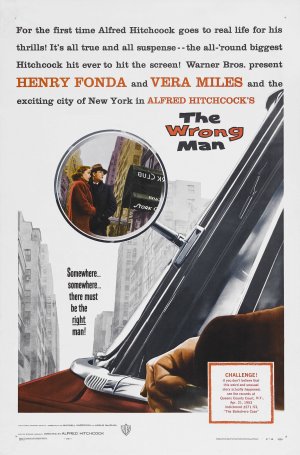
Lisa Marie Does The Wrong Man (dir by Alfred Hitchcock)


Since today is Alfred Hitchcock’s birthday, I figured why not take a few minutes to recommend one of his films that you may not have seen.  First released in 1956 but still painfully relevant today, The Wrong Man is one of Hitchcock’s best but it’s also one of his most underrated.

The Wrong Man deals with a common Hitchcock theme — i.e., an innocent man has been accused of a crime and, despite all of his efforts, cannot seem to convince anyone of his innocence.  The difference between The Wrong Man and something like Saboteur or Frenzy is that The Wrong Man is based on a true story.

Manny Ballestro (Henry Fonda) is a struggling musician.  He makes $85 a week, playing in a small jazz club.  But even though he may not be rich, he’s happy.  He loves his job.  He loves making music.  Even more importantly, he loves his wife, Rose (Vera Miles).  But Rose needs to have her wisdom teeth removed and it’s going to cost $300.  (As a sign of how much things have changed, I would have been relieved if it had only cost me $300 to get my wisdom teeth taken out.)  Desperate for money, Manny tries to borrow money on his wife’s life insurance plan.  What Manny doesn’t know is that the insurance office has been held up twice by a man who bears a vague resemblance to him.  A clerk calls the police and Manny soon finds himself being taken down to the police station.

Two detectives say that they need Manny’s help but they don’t tell him why.  But Manny knows he’s innocent of any crime and he believes that the police are on his side and he agrees to help.  When they tell him to walk into a liquor store, he does so.  When they take him to a deli, he goes in there as well.  When they demand to know why he was trying to borrow money on his wife’s life insurance, he tells them.  When they ask him about his financial difficulties, he tells them about that as well.  Why shouldn’t he?  He’s innocent and the police are just doing their job, right?  And when the cops finally ask him to copy down a few words that were used in the note that the robber slipped the clerk at the insurance company, Manny does so.  And when they then ask him to take part in a line-up, he does that as well…

And when Manny is arrested and charged with a crime … well, that’s when he finally understands that the system is not on his side.  His wife manages to hire a reputable attorney, Frank O’Connor (Anthony Quayle), to defend him but it quickly becomes obvious that the world has already decided that Manny is guilty.  When Manny and his wife try to track down some people who could provide Manny with an alibi, they discover that two of them are dead and one of them cannot be found.  For once, in a Hitchcock film, it’s not a case of conspiracy.  Instead, it’s just bad luck.

And, through it all, Rose continues to blame herself.  In fact, she is so wracked with guilt that she has a nervous breakdown.

It all leads to an amazingly disheartening courtroom scene.  As quickly becomes obvious, the judge has little interest in what’s happening in his court.  Even worse, the jury is unconcerned with the evidence.  Most of them are just annoyed at the inconvenience and punishing Manny seems like the perfect way to release their own frustrations…

It’s a bleak picture of the American justice system.  Watching The Wrong Man today, it’s tempting to say that the film is just a reflection of society in the 1950s and that things have changed today.  But really, have they?  True, the police may now be required to read someone their rights when they’re arrested.  A suspect can now ask for a lawyer.  We’ve got laws against entrapment and all the rest.  But that doesn’t matter.  We still live in a society where people are still widely presumed to be guilty, even after they’ve been found innocent in a court of law.  We still live in a society where the wrong man can have his life ruined because of one mistake.

The Wrong Man doesn’t get as much attention as some of Hitchcock’s other films.  In many ways, it’s an atypical example of his work.  Hitchcock was notorious for his dark sense of humor and his habit of waving away most plot points as just being mere “macguffins.”  With the exception of two scenes, both of which are meant to depict Manny’s mental state, The Wrong Man is filmed in a documentary style, one that occasionally seems more like Sidney Lumet than Alfred Hitchcock.  There’s next to no humor, nor are there any big or flamboyant twists.  In short, The Wrong Man finds the director of Psycho, Vertigo, and Rear Window at his most sincere.  It takes some getting used to.

But, once you do get used to it, The Wrong Man emerges as a powerful and bleak portrait of two innocent people at the mercy of a soulless system.  It’s a must see so be sure to see it!

The-Wrong-Man-poster

Embracing the Melodrama Part II #68: Mazes and Monsters (dir Steven Hilliard Stern)


M_M_DVDIt’s amazing the things that you find when you randomly search the DVD section of Half-Price Books.  For instance, I found a very cheap DVD of the 1982 made-for-TV film Mazes and Monsters and I simply had to buy it.

Why?

Well, just look at the cover above.  Look at the ominous castle.  Look at the shadowy dragons flying around it.  Look at that Shining-style maze.  Look at the ominous tag line: “Danger lurks between fantasy and reality.”  And especially be sure to look at Tom Hanks gazing serenely over it all.

“Wow,” I thought, “Tom Hanks fights a dragon?  This is something that I’ve got to see!”

Well, there are no dragons in Mazes and Monsters.  There are a few monsters but they’re only briefly seen figments of Tom Hanks’s imagination.  The film is about a group of college students who obsessively play an RPG called Mazes and Monsters.  When one of the students (an annoying genius who wears wacky hats and is played by an actor with the surprisingly poetic name of Chris Makepeace) suggests that they play Mazes and Monsters “for real” in some caverns near the college, it leads to Robbie (Tom Hanks) have a mental breakdown.  Soon, Robbie is convinced that he’s actually a monk.  He breaks up with his girlfriend because he doesn’t want to violate his vow of celibacy.  (Of course, the real fantasy is that a college student obsessed with playing Mazes and Monsters would have a girlfriend in the first place but anyway…)  He keeps seeing imaginary minotaurs lurking in the shadows.  Finally, he runs off to New York on a quest to find “the great Hall.”  It’s up to his friends to find him and hopefully impart an important lesson about the dangerous reality of RPG addiction.

Or something.

Listen, to be honest, if not for Tom Hanks, there would be no reason to watch Mazes and Monsters.  It’s poorly acted.  It’s written and directed with a heavy hand.  There’s some nice shots of downtown New York City but otherwise, it’s visually drab.

But, because Tom Hanks is in it and he’s playing a role that demands that he go totally over-the-top in his performance, Mazes and Monsters is totally worth watching.  If you’ve ever wanted to see Tom Hanks wander around New York City while dressed like a monk, this is the film for you.  If you’ve ever wanted to see Tom Hanks start to tremble while explaining that, as a monk, he’s not allowed to kill minotaurs, this is the movie for you.  Most of all, if you’ve ever wanted to see Tom Hanks shrieking, “THERE’S BLOOD ON MY KNIFE!” while standing in an old school phone booth, this is definitely the movie for you!

Seriously.

Considering that Tom Hanks is currently viewed as being some sort of elder statesman of American film (and, even more importantly, Hanks seems to view himself as being some sort of national treasure), there’s something oddly satisfying about seeing him before he became THE Tom Hanks.  It’s good to be reminded that, at one time, he was just another young actor doing his best in a crappy made-for-TV movie.

http://www.youtube.com/watch?v=6XhxFVF9SZU

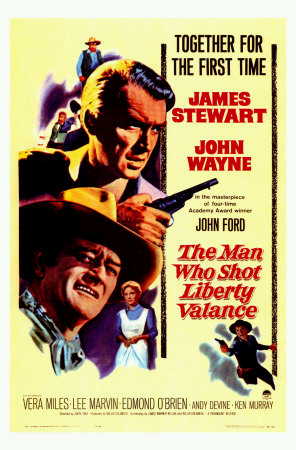
Shattered Politics #18: The Man Who Shot Liberty Valance (dir by John Ford)


The_Man_Who_Shot_Liberty_Valance“When the legend become fact, print the legend.” — Maxwell Scott (Carleton Young) in The Man Who Shot Liberty Valance (1962)

Though I understand and respect their importance in the history of both American and Italian cinema, I have never really been a huge fan of westerns.  Maybe its all the testosterone (“A man’s got to do what a man’s got to do…”) or maybe it’s all the dust but westerns have just never really been my thing.

However, I will always make an exception for The Man Who Shot Liberty Valance, which is not just a great western but a great film period.

But you already knew that.  It’s a little bit intimidating to review a film that everyone already knows is great.  I even opened this review with the exact same quote that everyone uses to open their reviews of The Man Who Shot Liberty Valance.  To a certain extent, I feel like I should have found a quote that everyone hasn’t already heard a thousand times but then again, it’s a great quote from a great film and sometimes, there’s nothing wrong with agreeing with the critical consensus.

The Man Who Shot Liberty Valance opens with a train stopping in the small western town of Shinbone.  The residents of the town — including newspaper editor Maxwell Scott (Carleton Young) — are shocked when Sen. Rance Stoddard (James Stewart) and his wife Hallie (Vera Miles) get off the train.  Sen. Stoddard is considered to be a front-runner to become the next Vice President of the United States.  Scott is even more shocked to discover why the Stoddards are in town.  They’ve come to Shinbone to attend the funeral of an obscure rancher named Tom Doniphon (played, in flashback, by John Wayne).

Sitting in the funeral home with Doniphon’s coffin (and having reprimanded the local mortician for attempting to steal Tom’s boots), Rance tells Scott why he’s come to pay respect to Tom Doniphon.  We see, in flashback, how Rance first came to Shinbone 25 years ago, an idealistic lawyer who — unlike most of the men in the west — refused to carry a gun.  We see how Rance was robbed and assaulted by local outlaw Liberty Valance (a wonderfully intimidating and bullying Lee Marvin), we discover how Rance first met Hallie while working as a dishwasher and how he eventually taught her how to read, and we also see how he first met Tom Doniphon, the only man in town strong enough to intimidate Liberty Valance.

At first, Rance and Doniphon had an uneasy friendship, epitomized by the condescending way Doniphon would call Rance “pilgrim.”  Doniphon was in love with Hallie and, when he attempted to teach Rance how to defend himself, he was largely did so for Hallie.  Rance, meanwhile, was determined to bring law and society to the west.

And, eventually, Rance did just that.  When Shinbone elected two delegates to the statehood convention in the territory’s capitol, Rance attempted to nominate Doniphon for the position but Doniphon refused it and nominated Rance instead, explaining that Rance understood “the law.”  When Liberty Valance attempted to claim the other delegate spot, Rance and Doniphon worked together to make sure that it instead went to newspaper editor Dutton Peabody (Edmond O’Brien).  And when Liberty Valance attempted to gun Rance down in the street, Rance shot him.

Or did he?

That’s the question that’s at the heart of The Man Who Shot Liberty Valance.  However, as a film, The Man Who Shot Liberty Valance is far less interested in gunfights than it is in politics.  Perhaps the most important scene in the film is not when Rance and Liberty meet out on that dark street.  Instead, it’s the scene at the statehood convention where the reformers (represented by Rance) and the cattlemen (represented by John Carradine) battle over who will be the territory’s delegate to Washington.  Between John Carradine orating, the horses riding in and out of the hall, Edmond O’Brien drinking, James Stewart looking humble, and John Wayne glowering in the background, this is one of the best political scenes ever put on film.

When Rance first arrives in the west, there is no political system in place.  With the exception of the ineffectual town marshal (Andy Devine), there is no law.  The peace is kept by men like Tom Doniphon and, oddly enough, by Liberty Valance as well.  (Whether he realizes it or not, Shinbone’s fear of Liberty has caused the town to form into a community.)  What little official law there is doesn’t matter because the majority of the Shinbone’s citizens can’t read.

When Rance arrives, he brings both education and the law.  He makes Shinbone into a town that no longer needs Liberty Valance but, at the same time, it no longer need Tom Doniphon either.  Hence, it’s Rance Stoddard who goes from dishwasher to U.S. Senator while Tom Doniphon dies forgotten.  Rance represents progress and unfortunately, progress often means losing the good along with the bad things of the past.

(It’s no coincidence that when Rance and Hallie return to Shinbone, the first person that they see is the former town marshal, who no longer wears a star and who, we’re told, hasn’t for years.  Time has passed by.)

It’s a bittersweet and beautiful film, one that features four great performances from Stewart, Wayne, Marvin, and Vera Miles.  Personally, I like to think that maybe Sen. Stoddard had a daughter who married a man named Smith and maybe they had a son named Jefferson who later made his way to the Senate as well.

It would be fitting.