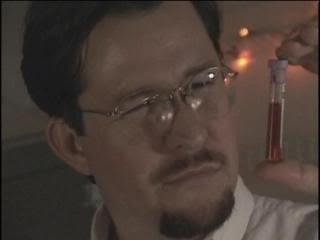
In 2003’s This Darkness, Dr. Van Helsing VII (played by the film’s director Dylan O’Leary) is a world-famous genetic engineer who is developing a serum that can cure all known diseases and perhaps grant immortality. Meanwhile, cheerleaders and surfers are being attack in broad daylight and having their blood drained. Among those killed is the daughter of Van Helsing’s friend Ron, who happens to own a martial arts studio. Could all of these events be connected? Your guess is as good as mine but eventually, a vampire named Tarquin does show up and demands that Van Helsing create a mate for him.
I’ve always found low-budget ambition to be very likable and, by that standard, This Darkness is probably one of the most likable films that I’ve seen. The film’s script has a few interesting ideas, O’Leary makes for an unconventional but effective hero, and the film actually looks pretty good for its budget. Especially towards the end of the film, This Darkness makes effective use of some unconventional locations. Add to that, it’s hard not to admire the everything-but-the-kitchen-sink approach that O’Leary took to putting his film together.
Add to that, how can you not enjoy a film directed by someone with as Irish a name as Dylan O’Leary?
Two posts in one month? What sort of madness is this? Well, I’ve been drinking a lot, so makes sense that I should attempt to ramble here where I have free reign to do so. But never mind that, what’s important here is that in addition to my aforementioned Another, if you’re going to watch another horror anime this month, you should give serious consideration to Hellsing Ultimate.
Now, let’s be clear on one important fact. I’m talking about the OAV series, as opposed to the TV series which came out 3 years prior to the much better OAV series. The main problem with the TV series was that it came out when the manga was proving to be popular, however, Kouta Hirano was a very slow writer. In fact, the manga was only a 10 volume series, yet it ran from 1997 until 2008. For the math challenged among us, that’s 11 years to release 10 volumes of manga. To give you all a very relevant comparison, another series that I’ve wrote about, One Piece, also started in 1997. To date, One Piece has produced 67 volumes. Even if we say that Eiichiro Oda is a freak of nature, most normal mangaka would produce three times what Kouta Hirano did in the same amount of time. The point being that the original TV series came out early on in the run of the manga, so the ending has absolutely nothing like the manga. Now, the OAV series was able to take its time and wait on the source material. Hence, why I’m insisting that if you watch any Hellsing show, you should make it the OAV series. It’s much more faithful to the manga, and while that doesn’t mean the TV series is bad, when compared against the original it just doesn’t hold up.
So, the long and short of Hellsing is that vampires are real. Very real. So what is your average person to do against such a threat? Don’t expect your average army to save you. Oh no, what you need is what the British government has. You need the Hellsing Organization. What makes the Hellsing Organization able to handle these freaks of nature better than your average army? Well, they have themselves a trump card known as Alucard. Anyone that has ever played a Castlevania game should know that name, but if you don’t, well then beware because I”m about to drop a very obvious spoiler on you. See, Alucard is actually Dracula backwards. GASP! So, now do we understand why the Hellsing Organization is badass? But Alucard is not the sort who cares to do all the work himself. Not that he can’t, just he’s not above recruiting those in whom he sees potential. And doesn’t every master want a pupil? That’s largely why he “recruits” Seras Victoria as his student by turning her into a vampire as well. In the TV series, Seras is shown almost as the main protagonist, while in the OAV series she shares the spotlight with Alucard and their boss, Integra Hellsing.
But it’s no fun if the protagonist is unbeatable and has no rival. Well, enter Father Anderson. Not only is he opposed to Alucard, but his group is entirely opposed to the whole Hellsing Organization. See, the Hellsing Organization basically represent the Anglican Church, while Father Anderson represents the Catholic Church. But this isn’t some regular human that miraculously is able to hang with a vampire. Oh no, Father Anderson has a few tricks up his sleeve. I could go on, but I’d say this video best sums up what kind of man he is.
But all that is just a taste of what’s to come. A huge part of the divergence between the TV series and the OAV is that the overall villain is not really described in the TV series. In the OAV, we find out that who the Hellsing Organization is ultimately fighting is not the Catholic Church as was hinted at this that video, but rather remnants from the Nazi party. Yes, if the Nazis had access to this kind of army, World War II might have turned out vastly different. Make no mistake though, this in no way tries to make the Nazi party out to be cool. Every person involved with the Nazis are batshit insane. It’s hard to say that there’s a “good guy” here, but certainly the Nazis are not them. But isn’t that the worst kind of villain? The ones who are fully aware that what they’re doing is pure evil and they just plain don’t care? That’s exactly how the Nazis here are portrayed. They’re not supposed to be misguided idealists, or innocents brainwashed against their will. No, they know what they’re doing, what they represent, yet they don’t care. They love it and embrace it, and they are shown to be completely nuts. And frankly, that’s the only way this could work, because Alucard and the Hellsing Organization themselves are not, nor are they trying to be, paragons of virtue. I mean, they rely on the power of vampires, and while Seras occasionally has some qualms about what she does, Alucard never cares if so called innocents are killed in the pursuit of his enemies. The entire lack of caring for human life makes it very difficult to label any one group as good or evil.
So, I’ll readily admit that as far as “Oh hell, I just wet myself” type of horror goes, this doesn’t really fit the bill. But really, do most people consider Dracula to be a horror movie? Most would. This is in the same vein as that. It’s horror in that “Look at all these people being slaughtered, isn’t that horrible?” sort of way, and not in the freak you out sort. The fact remains that this is a very well written anime. Also, a fun fact is that this shares a link with another manga/anime, High School of the Dead. It may not be readily apparent, but look at the character names in HSotD and then look at the name of the author of Hellsing. See if there are any similarities.
All in all, Hellsing is a very entertaining show, and it could at times be considered gore porn more than a horror anime. But, there’s little doubt that either way it’s definitely an anime worth watching.
“[I am] a new superstition entering the unassailable fortress of forever. I am legend.” – Robert Neville
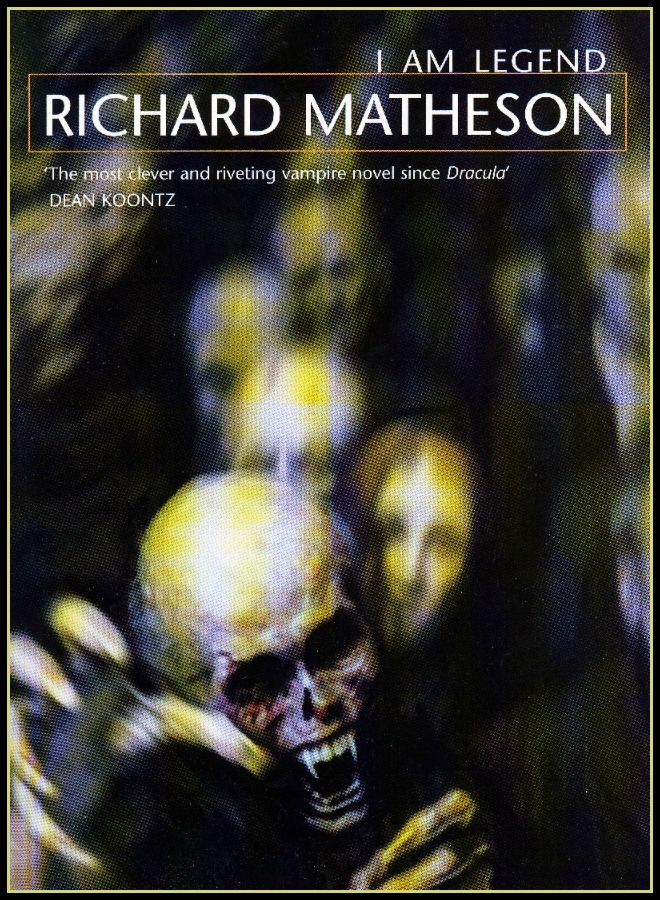
In 1954, Richard Matheson published a novel that would influence so many future generations of science-fiction and horror writers and film directors. Matheson’s body of work prior to 1954 could be summed up as good but nothing too exciting. His work thus far overlapped such pulp genres as horror, science-fiction and fantasy. This style would be the hallmark of his brand of story-telling. It would be in his novel I Am Legend that his unique style of combining different genres that Matheson would have his greatest and most epic work to date.
I Am Legend takes the vampire tale and brings it out of the shadows and darkness, so to speak. Set in the late 1970’s, I Am Legend begins its tale with humanity pretty much on the quick path to extinction due to a pandemic where the bacterium or virus involved caused symptoms very similar to what folklore had called vampirism. The protagonist of this tale was one Robert Neville. An unassuming man living in a Los Angeles suburban neighborhood who might just be the only living human being, or at least the only un-infected one, on the face of the planet. Neville’s been reduced to a day-to-day routine of defending his fortified home from the vampire-like infected humans who’ve tried attacking him and his home once night falls. This routine has become so ingrained in Neville that it starts him on a downward spiral to utter despair. He knows that he might just be the only human left and the prospect of such an idea almost becomes too much for his psyche. It’s this growing despair which gradually causes Neville to make little mistakes in his routine that puts him in greater levels of danger from those turned who see him as nothing but cattle.
His attempts to solve the mystery of why he’s the only one not affected by the disease becomes his way of keeping himself sane. Neville’s work in trying to find the answer leads him to take chances in keeping a vampire survivor alive and bound instead of just killing it outright. His experiments ranges from disproving the myths surrounding the vampire creature and acknowledging the scientific and/or psychological explanations to certain behavioral traits of these nocturnal creatures.
Neville’s studies on captured vampires tell him why certain things like garlic and sunlight causes such an extreme reaction on these creatures. Why do they have a certain invulnerability towards bullets but not a stake through the heart is one question he tries to answer through his research. He even surmises that the vampires aversion to crucifix was more psychological than anything supernatural. Neville arrives at this after observing a vampire’s reaction to a Star of David was similar to the reaction of another one towards the crucifix.
It’s events such as these which puts I Am Legend in a category all by itself. It still uses themes of horror which the vampires fulfill to great effect, but it also does a great job of taking the vampire tale out of the supernatural realm and into the scientific and logical. Neville’s attempts to keep himself sane, as his loneliness begin to weigh on his psyche and health, through these studies and experiments adds a level of the science-fiction to this tale. It’s the combination of these two genres which makes I Am Legend such an epic tale in scope yet it’s not that which gives the tale its heaviest impact. It’s Neville himself, more to the point, his desperate situation of being the last man on earth weighing on his mind. This tone gives this apocalyptic vampire tale such an intimate feel that the reader hopes and wishes for some sort of peaceful end to Neville; better yet, some hope that he might find clues that he might not be the last.
As the story moves forward, the line between who is human, who is monster and who is the true survivor become blurred as Neville’s forays into the city for supplies lead him to a community of others who have not succumbed to the monstrous effect of the pandemic. It’s this discovery that gives Neville a semblance of hope which momentarily lifts the heavy weight of inevitability from his mind. But not everything is at it seems at first glance. Neville finds this out as his encounters with this thriving community continue to give him more and more insight as to how they’ve survived. The climactic end to this tale has become such a classic ending that any other resolution wouldn’t have worked. The end worked as the best possible ending to Matheson’s tale. It also gives the books title a deeper and more profound meaning to it.
I Am Legend will continue to go down in literary history as one of the best examples of fantastic literature. It’s seemless blending of horror, science-fiction and the apocalyptic gives the tale both an epic and intimate feel and tone. It’s not wonder the very themes and premise of this story has influenced such horror writers and filmmakers as Stephen King (The Stand, Salem’s Lot) and George A. Romero (Night of the Living Dead, Dawn of the Dead, Day of the Dead). I Am Legend takes the vampire tale out of the shadows and darkness it usually in habits and brings it out to the light of science and logic with surprising results. A true classic piece of writing from Richard Matheson and one that still stands as the benchmark for apocalyptic tales.
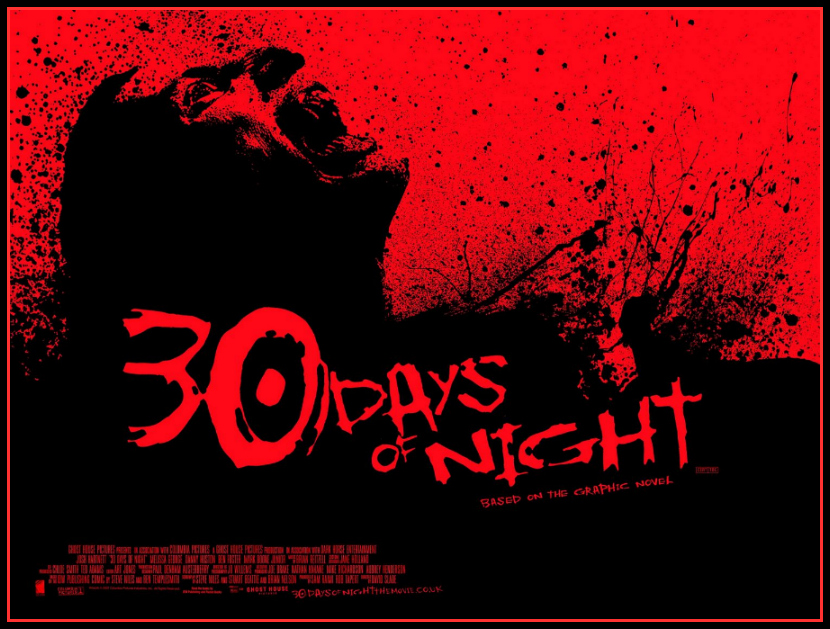
30 Days of Night is pretty much a siege movie with heavy elements of horror and gore. Siege movies always succeed and fail depending on whether the tension and dread built up from the beginning of the film suspends the audience’s disbelief. Siege films like The Thing and Romero’s Living Dead trilogy works well because right from the get-go we see the tension build not just on the location the cast are put in but within the besieged survivors as well. Survival becomes that much more difficult due to human frailties and an inability to work together bringing the whole group down. The monsters outside are bad enough, but sometimes it’s the survivors themselves who must share the blame.
David Slade’s (director of the excellent Hard Candy) movie does a very good job of bringing the initial tension and dread the comic brought to life in its first chapter. The story takes place in Barrow, Alaska which happens to be located within the Arctic Circle. This location allows it a very peculiar yearly event of having pitch-black night which lasts for a period of an entire month. The movie begins just as the town of Barrow prepares for this month-long prolonged night. Most of the town decide to move down south for the month where the night doesn’t last as long, but enough stay in Barrow to give it a semblance of life and activity.
The build-up of the characters in 30 Days of Night marks one of the weaknesses in the film. There’s barely much characterization in distinguishing one Barrow, Alaskan from another. The lack in character development from all the characters whether human or vampire doesn’t invest the film with anyone we want to see make it out through the night and into dawn. Even Danny Huston, a very underrated and overly capable actor in past films fails to elevate his lead vampire character Marlowe beyond it’s genre trappings. Known only as The Stranger in the credits, Ben Foster’s Renfield-like character edges between caricature and genuine creepiness in his performance. Foster knows he’s in a genre movie and has fun with the character. He’s the only one to truly take on his character and roll with it.
I now get to the subject of the vampires themselves. Most vampire movies seem enamored in portraying the vampire as some sort of seductive, fashion-obsessed, or in the case of the Anne Rice-type anachronistic in their dress, with an unnatural immortality they either live as hedonistically as possible or bemoan their cursed existence. Then there’s the more recent trend that Twilight has brought into the vampire mythology and it’s not good. There’s never been a true portrayal of the vampire as a pure, hunger-driven monster with an appetite to match their status as one of folklore and legend’s top-tier boogeymen. Slade goes for speed and agility in his vampires instead of hypnotizing and mesmerizing their victims. The vampires in this movie owes much to the frenetic and over-amped infecteds of 28 Days Later.
The attack itself and the subsequent siege worked well enough in the early going. There were some great overhead shots of the town’s people losing it’s fight during the initial feeding frenzy as the camera shoots the scene high overhead. The only thing Slade had a misstep in terms of the siege itself was after those first couple of nights. The rest of the 30 days didn’t seem to show enough desperation on the faces and bodies of the last few survivors. Really, the only way the audience even knew a couple weeks have passed were the caption telling them how many days into the month-long night has passed. I think with some better editing and a better sense of structure in the middle section of the movie to show time actually progressing the movie would’ve been better on so many levels.
All in all, 30 Days of Night was just good enough to be a fun watch. The premise itself was original and put a new spin on the vampire genre that has rarely been tapped. The performances were pretty average with no one bringing the whole film down with a misstep performance or raising the bar with a great one. The final product had a chance to be something great, but just ends up being a good and original take on the vampire story with elements of Night of the Living Dead.
If you’re following the news then you probably heard that Dallas got hit with like a 100 inches of snow yesterday. Seriously, more snow fell yesterday than has even fallen in recorded history (or, at the very least, in my recorded history). You want to talk about Snowmageddon? Well, we had a Snowpocalypse.
The neighborhood on Friday morning (picture taken by Erin Nicole Bowman)
So, I spent most of yesterday cooped up inside with my sister and our cat and once we got over the whole fun of being able to go outside and scream, “SNOW DAY!” at the top of our lungs, there really wasn’t much to do. So, in an attempt to fight off cabin fever, I raided my DVD collection and we ended up watching one of the old Christopher Lee-as-Dracula-films from Hammer Studios. Specifically, we ended up watching Dracula A.D. 1972.
The film opens in 1872 with a genuinely exciting fight on a runaway carriage that ends with the death of both Count Dracula (Christopher Lee) and his nemesis, Prof. Van Helsing (Peter Cushing). However, as Van Helsing is buried, we see one of Dracula’s disciples (played by Christopher Neame, who had an appealingly off-kilter smile) burying Dracula’s ashes nearby. The camera pans up to the clear Victorian sky and, in a sudden and genuinely effective jumpcut, we suddenly see an airplane screeching across the sky.
Well, it’s all pretty much downhill from there. Suddenly, we discover that a hundred years have passed and we are now in “swinging” London. The city is full of red tourist buses, hippies wearing love beads, and upright policemen who always appear to be on the verge of saying, “What’s all this, then?” We are introduced to a group of hippies that are led by a creepy guy named Johnny Alculard (also played — quite well, actually — by Christopher Neame). One of those hippies (Stephanie Beacham) just happens to be the great-great-granddaughter of Prof. Van Helsing. Apparently, she’s not really big on the family history because she doesn’t notice that Alculard spells Dracula backwards. Then again, her father (played by Peter Cushing, of course) doesn’t either until he actually writes the name down a few times on a piece of a paper.
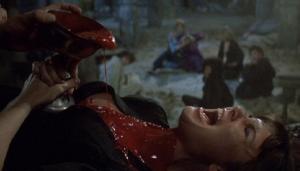
Anyway, the film meanders about a bit until finally, Alculard convinces all of his hippie friends to come take part in a black mass. “Sure, why not?” everyone replies. Well, I don’t have to tell you how things can sometimes get out-of-hand at black mass. In this case, Dracula comes back to life, kills a young Caroline Munro, and eventually turns Johnny into a vampire before then setting his sights on the modern-day Van Helsings.
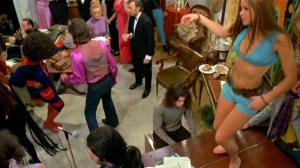
Dracula A.D. 1972 was Hammer’s attempt to breathe some new life into one of its oldest franchises and, as usually happens with a reboot, its critical and (especially) commercial failure ended up helping to end the series. Among even the most devoted and forgiving of Hammer fans, Dracula A.D. 1972 has a terrible reputation. Christopher Lee is on record as regarding it as his least favorite Dracula film. And the film definitely has some serious flaws. Once you get past the relatively exciting pre-credits sequence, the movie seriously drags. There’s a hippie party sequence that, honest to God, seems to last for about 5 hours. As for the hippies themselves, they are some of the least convincing middle-aged hippies in the history of fake hippies. You find yourself eagerly awaiting their demise, especially the awkward-looking one who — for some reason — is always dressed like a monk. (Those crazy hippies!) But yet…nothing happens. All the fake hippies simply vanish from the film. Yet, they’re so annoying in just a limited amount of screen time that the viewer is left demanding blood. Add to that, just how difficult is it to notice that Alculard is Dracula spelled backwards? I mean, seriously…
To a large extent, the charm of the old school Hammer films comes from the fact that they’re essentially very naughty but never truly decadent. At their heart, they were always very old-fashioned and actually quite conservative. The Hammer films — erudite yet campy, risqué yet repressed — mirrors the view that many of my fellow Americans have of the English. For some reason, however, that Hammer naughtiness only works when there’s the sound of hooves on cobblestone streets and when the screen is populated by actors in three-piece suits and actresses spilling out of corsets. Dracula A.D. 1972 did away with the support of the corset and as a result, the film is revealed as a formless mess with all the flab revealed to the world.
Still, the film isn’t quite as bad as you may have heard. First off, the film — with its middle-aged hippies — has a lot of camp appeal. It’s the type of film that, once its over, you’re convinced that the term “groovy” was uttered in every other scene even though it wasn’t. As with even the worst Hammer films, the film features a handful of striking images and Christopher Neame is surprisingly charismatic as Alculard.
As with the majority of the Hammer Dracula films, the film is enjoyable if just to watch the chemistry between Christopher Lee and Peter Cushing. Both of these actors — so very different in image but also so very stereotypically English — obviously loved acting opposite of each other and whenever you see them on-screen together, it’s difficult not to enjoy watching as each one tried to top the other with a smoldering glare or a melodramatic line reading. As actors, they brought out the best in each other, even when they were doing it in a film like Dracula A.D. 1972. In this film, Cushing is like the father you always you wished you had — the stern but loving one who protected you from all the world’s monsters (both real and cinematic).
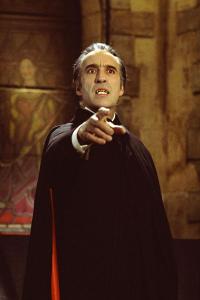
As for Lee, he’s only in six or seven scenes and he has even fewer lines but, since you spend the entire film wondering where he is, he actually dominates the entire movie. Lee apparently was quite contemptuous of the later Hammer Dracula films and, oddly enough, that obvious contempt is probably why, of all the Draculas there have been over the years, Lee’s version is the only one who was and is actually scary. F0rget all of that tortured soul and reluctant bloodsucker crap. Christopher Lee’s Dracula is obviously pissed off from the minute he first appears on-screen, the embodiment of pure destructive evil. And, for whatever odd reason, the purity of his evil brings a sexual jolt to his interpretation of Dracula that those little Twilight vampires can only dream about. Even in a lesser films like Dracula A.D. 1972, Christopher Lee kicks some serious ass.
So, in conclusion, I really can’t call Dracula A.D. 1972 a good film nor can I really suggest that you should track down a copy of the DVD. I mean, I love this stuff and I still frequently found my mind wandering whenever Cushing or Lee wasn’t on-screen. However, it’s not a terrible movie to watch if you happen to find yourself trapped in the house by a mountain of snow.
Yes, I hear the sound of everyone starting to protest and rest assured, I’m not planning on using my space here to start blogging about The Bachelor (though I guess I could if I ever like got really pissed off at men in general…) It just happens that The Bachelor is what I watched last night and it featured a vampire.
Why Was I Watching It?
Because, God help me, I love it so. Everyone has at least one irrational love. I love crappy reality TV, especially if it gives me an excuse to get all catty and show my claws. Meow!
What’s It About?
Since this was the 1st episode of the new season, we met our new bachelor and discovered that he’s an old bachelor — it’s the return of Brad Womack! For those of you who don’t follow these things (and I assume that’s everyone involved with this site except for me), Brad was the Bachelor a few seasons ago. He’s the one who, after he picked his bride, then dumped her on national TV and decided he wanted to marry the girl who came in second. Then he dumped that girl too.
Anyway, Brad’s been in therapy for 3 years and in this episode, he explains that this all happened because he didn’t have a good relationship with his Dad, therefore establishing himself firmly as yet another little boy with daddy issues. (Pardon me while I gag.)
Once Brad’s got that all cleared up, he meets the poor girls who are competing to be his wife and he basically spends the majority of the episode saying, “I just want another chance because I have daddy issues.” You got another chance, you toadsucker. Shut up about your freaking childhood! Fortunately, there’s hope on the horizon because of a vampire named Madison.
What Worked?
First off, everyone spent a lot of time — and I mean A LOT OF TIME — trash-talkin’ Brad. I mean, everyone! The girls, the show’s host, and finally even Brad himself, all they could talk about was how much of a loser the guy is. And you know what? He is. Which is why it’s going to be fun to watch him basically put himself through Hell all over again.
Plus, the girl with fangs got a rose and I imagine that’s probably because the show’s producers thought she’d be good for ratings but who cares? She’s got fangs!
What Didn’t Work?
Well, the show is like sooooo totally shallow and reality TV is just the devil’s programming and it’s all evidence of how stupid people are and blah blah blah blah. Just insert your own boring, anti-reality television diatribe in here. And then pat yourself on the back because, yeah, you’re really like the first person who has ever said any of that crap. I mean, obviously, you’re a freaking genius. Good job, you elitist toadsucker.
“Oh My God! Just Like Me!” Moment
Not that long ago, I used to dress in all black and wear a studded choker. I also renamed myself Pandora DeSaad and wrote poetry about slitting my wrists and watching the blood circle down the drain of the sink. That got kinda tedious after a while and I moved on. Still, even if I hadn’t, I would still hope that I would be allowed to appear on the Bachelor.
Lessons Learned:
None. There were no lessons to be learned from this. The show was pure trash with no redeeming value. That was kind of the point.
So, we finally have hit the goal of 500th post for the site’s first year.
I had thought to commemorate this achievement by writing up a film review or maybe one of the other writers post something appropriate, but I thought what better way to do this than post something about zombies.
Zombies have been big again of late. The recent premiere season of the TV adaptation of The Walking Dead and the continuation of the original comic book series it’s based on. The TV series’ success has brought the topic of zombies back to the forefront with fans and non-fans sharing a common appreciation for this horror sub-genre which has remained the dirty, stepchild cousin to the more glamorous and fantasy-fulfilling monsters calling themselves vampires.
Vampires have been in the general public’s consciousness due to the popularity of the Twilight book and film series not to mention the TV shows True Blood and The Vampire Diaries. These three franchises have made the vampires sexy and popular once again. While they’re not the silk and lace types popularized by author Anne Rice during the 80’s they still portray the vampires as dangerous, but also conflicted and over-emotional creatures who curse their lot as much as embrace it.
Zombies on the other hand have began their inevitable decline after the market was flooded by legion of sub-par books and films. For every Dawn of the Dead (remake) and Shaun of the Dead we got stuff like Day of the Dead (remake) and direct-to-DVD titles such as Zombie Wars and Last Rites. But thanks to the Robert Kirkman’s critically-acclaimed and very popular zombie comic book series and it’s subsequent TV adaptation by showrunner Frank Darabont the zombies have had a major resurgence that brought the question of which was better: zombies or vampires.
These two monsters have their histories both in entertainment and in folklore. The vampire legend and myth could trace itself back to the beginning of human history as early human civilizations always had in their stories and own legends creatures risen from the grave to drink the lifeblood of those still living. There’s Lilith of the Judeo-Christian faiths who some attribute to being the mother of all vampires. There’s also Cain himself who many thought was the progenitor of the original vampire myth. Every major religion both past and present have had their version of the vampire, but while they’ve remained as stories told to warn children of the dangers of the night they were never truly told as part of entertainment. Only in the past hundred or so years have vampires begun to make their mark on the realm of entertainment.
Zombies on the other hand have always been the younger sibling. It’s history has it’s basis on local religious folklore from African slaves brought over to work the plantations of Imperial colonies in the West. The zombies of these West Indies folklore were not the flesh-eating creatures we now know, but just another form of slavery. The flesh-eating aspect of the zombies would not make it’s appearance until a filmmaker from Pittsburgh decided to make his recently risen dead to become flesh-eaters. Night of the Living Dead gave birth to the zombies that’s turned legions of readers and monster aficionados into fans of the monster. A monster who wasn’t as strong or as sexy as the vampire, but much scarier and quite more apocalyptic in its nature. It’s this apocalyptic aspect of the zombie monster which keeps this younger monster from becoming fully eclipsed by it’s more older sibling the vampire.
Now, a question was brought up by the websites Zombie Ammo and Vampybit.Me about the topic on vampires and zombies. With the current popularity of these two monsters there was bound to be a debate on who would win in a match-up between the two monsters for domination of the world.
In one corner we have vampires who retain their intellect and have increased all their senses and even given supernatural abilities. They also remain living dead who need the blood of the living to survive with their faculties intact. No blood means having to waste away into a sort of limbo where death doesn’t truly come but also living death becomes a paralyzing curse only to be lifted with infusion of this life giving blood.
In the other corner we have zombies who are literally mindless with only the primal instinct to feed the only motivation for their existence. But feed on living flesh they must and their hunger has no limit. Their literally a locust on a global scale which would scour the planet of all living things. It doesn’t matter whether the flesh is human or animal but it has to be the warm, living flesh that feeds them. In the end, zombies would become the extinction-level event for humanity.
So, who would win in such a battle for domination.
Vampires need humans. While their appetites ultimately kills their human victims they do try to keep their feeding in moderation. While there are stories and films that paints a world where vampires rule the planet openly they still maintain slave-colonies and/or human farms where they allow their human cattle to breed and multiply thus their food source remains constant. Human extinction is not what vampires want, but control of humanity instead. Controlling their food and harvesting them in an efficient manner. Only a select few would be turned into vampires. Humans who are willing to serve their undead lords would protect them during the daytime and become Renfield overseers over those humans who do not feel the same.
Zombies on the other hand do not care whether their appetites have been sated by a recent feeding. They will continue to feed as long as a living human and/or animal is in their reach. They would gorge themselves to the infinite for that’s what their instinct drives them to do. Human won’t be able to reason or subjugate themselves upon these monsters. These monsters do not have the wherewithal to ration their food source. The fact that death itself (any death whether through zombie, accident or natural) would just add to their geometrically increasing numbers.
How can humanity find a way to stave off extinction in the face of such a surge of death?
The answer to that is the answer to who would win between vampires and zombies. An answer that some may not agree with (being a zombie fan I’m actually surprised I came to this conclusion), but is the correct one when the question was logically looked at.
Vampires would win over zombies.
I say this because despite the vampires having lesser numbers they would have the intellect and know-how to defeat the legions of walking dead. They do this not out of the goodness of their unbeating hearts, but out of necessity. A necessity that ties their existence with the continued existence of humanity. A humanity that becomes extinct due to a zombie apocalypse would inexorably lead to the very downfall of the vampires themselves.
Vampires on skill alone would be able to destroy any zombies they come across. The fact that their flesh are cold and they’re not living makes them invisible to the zombies. They don’t want to feed on dead flesh because if they did then they would turn on each other instead. This aspect of the vampire keeps them upright and ready to fight.
With their food source endangered by this upstart monster the vampire would have no choice but to protect this valuable resource. As we’ve seen with the more popular types of vampire stories and film it is that vampires are small in numbers, global and ruled over by a council of elders who governed clans of vampires. They impose rule of vampiric law to make sure that their kind remain secret from the world at-large and/or keep their numbers down to better keep the vampiric plague from becoming a wildfire that would scour the planet of life.
It would be up to these governing bodies of vampires to make sure humanity doesn’t succumb to any form of zombie apocalypse. The level of survival for humanity from such an apocalypse will depend on how quickly vampires marshall their meager, but powerfu forces to stave off the inevitable tide of walking dead. They could respond right away and stop the tide before it becomes a global pandemic or their response would be slow and bring humanity to the brink.
In the end, vampires would do whatever it takes to keep humanity from joining the likes of the dinosaurs and mammoth. Whether it’s using their own supernatural-given abilities to destroy zombies by the score and hundreds. Or they could reveal themselves to humanity as vampiric saviors and giving them a choice: become extinct by way of an unchecked zombie apocalypse or allowed to be ruled by a vampiric elite who would protect them from this tide.
It’s a lousy choice for humanity, but one that I think they would choose for the latter (until they find a way to defeat both and keep themselves whole). The prospect extinction is a powerful motivator for a species and choosing to continue one’s species even under the rule of a parasitic race is a better choice than dying out under the teeth and clawed nails of the walking dead.
As you can tell I’m a huge fan of both (though I lean more towards zombies) and have thought about this topic on more than one occasion. This site has seen many posts about zombies though not enough about vampires which would need to be remedied. There’s the ongoing reviews of The Walking Dead in both it’s comic book and TV series form. There was also the reviews of this past summer’s anime series hit which also dealt with the zombie apocalypse but with a level of T&A involved to spice things up a bit. I speak of Highschool of the Dead.
Feel free to leave comments about what you think the conclusion I arrived at. Who do you think will win out between vampires and zombies? Which of the two do you like to read and watch more of? If there was a zombie apocalypse would you try to survive on your own or submit yourself to a vampiric protector and hope they don’t run out of their own supply of blood?
I don’t really know much about The Vampire and the Ballerina, other than it was released in 1960 and it’s an Italian film, but — after watching a few clips on YouTube — this movie has become my new Holy Grail. What that means, of course, is that King Arthur will continue to weaken and Mordred shall continue to conquer England until my freaky, mismatched, Irish eyes catch sight of this movie in its entirety.
If you’ve read enough of my previous posts, you can probably guess why this movie appeals to me. First off, it’s Italian. Second off, it apparently features at least one vampire. And, of course, the main reason is that apparently it’s got something to do with ballet.
Back when I still thought I was going to grow up to be a professional dancer, I have to admit that I went through a very long period of time where my *ahem* fantasies were pretty much dominated by dark, tortured men with fangs who drank blood to survive. So just seeing the title The Vampire and The Ballerina is like a serious jolt from the past for me.
(Though from the clips I’ve seen on YouTube, the vampire in question is not exactly material for an erotic interlude…)
Anyway, from what I’ve seen of The Vampire and the Ballerina, here’s the scene I keep coming back to. Yes, it is a dance sequence but it’s not exactly ballet. In fact, I have yet to see any signs of ballet in any of the clips I’ve found on YouTube but I figure it must have a ballet subplot. I mean, titles never mislead!
As for why I like it — well, there’s the endearing quaintness of the fact that leotards and tights were once considered to be daring and risqué. There’s a shamelessness to it as well that I think perfectly defines everything I love about Italian films. You can almost hear the director saying, “Did we get her ass in that shot?” And the dance itself is such a combination of stupid and brilliant that it reminds me — in a good, nostalgia-filled way, of just about every modern dance recital I was ever featured in.
I have to admit that there’s a part of me that wishes I had been alive in 1960 so I could have caught a plane to Italy and been one of these dancers. Why not? I love to dance, I’ve been told I have a nice ass, and occasionally, I guess, I do kinda sorta maybe act out just to get attention. Seriously, with all of that in mind, I would have been great for this film. Or, seeing as how I have yet to see the entire film, this sequence.
Unfortunately, I was born a good six decades or so too late. However, even though it’s too late for me to star in the movie, I still believe that one day soon I will sit down and I will watch an entire, uncut showing of The Vampire and The Ballerina.
And on that day, the fate of England will be determined…
“I mean, in a sense we’re all vampires. We drain energy from other life forms. The difference is one of degree. That girl was no girl. She’s totally alien to this planet and our life form… and totally dangerous.” — Dr. Hans Fallada
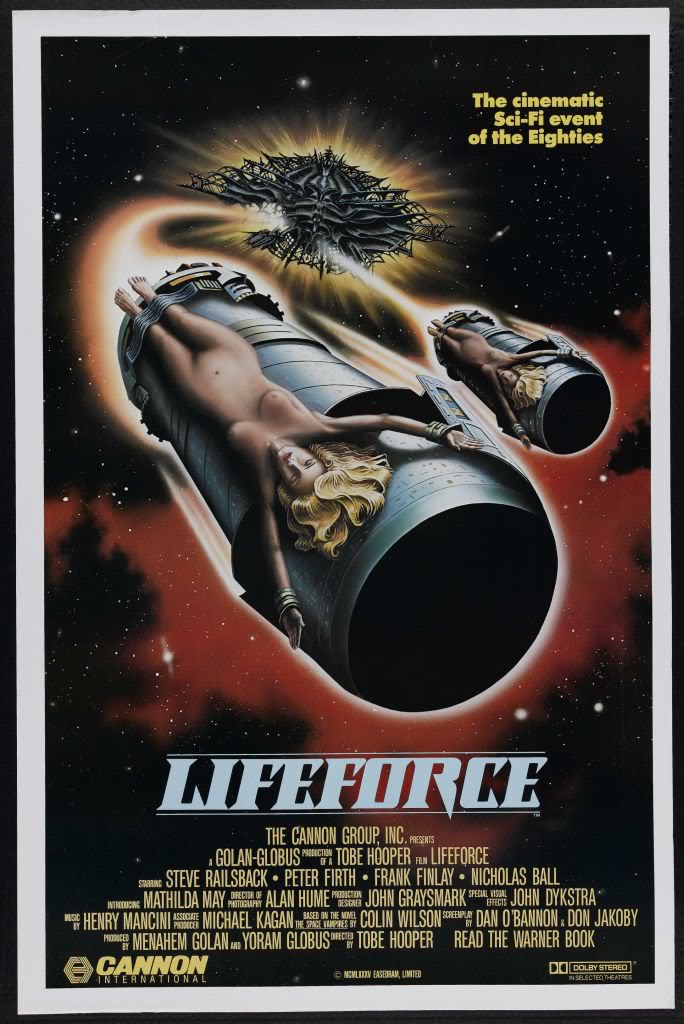
1985’s Lifeforce, directed by Tobe Hooper, was critically panned and barely registered at the box office. Yet in the decades since its release, something curious has happened: the film has gathered a loyal cult following among fans of science fiction and horror. Hooper’s film fuses so many genre conventions that it resists classification—too strange for pure sci-fi, too grandiose for standard horror. The result is a striking and eccentric reinvention of the vampire myth, a lavish but uncanny blockbuster that feels imported from an alternate cinematic timeline.
The film begins squarely in the realm of science fiction. Conceived during the public fascination with Halley’s Comet ahead of its 1986 return, Lifeforce rode the wave of comet-themed media flooding the decade. Most were cheap cash-ins. Hooper’s film stood out for its ambition and its visual scale.
Coming off Poltergeist, Hooper received an unusually large budget—a far cry from the lean, feral energy of The Texas Chainsaw Massacre. The story follows the crew of the shuttle Churchill as they discover a massive alien spacecraft hidden in the comet’s tail. Inside, frozen in suspended animation, are three humanoid figures. The ship’s dignified name feels ironic, even doomed; considering what’s to come, Demeter might have been more fitting. Like the sailors of Stoker’s novel, these astronauts inadvertently ferry an ancient predatory force home—yet this time, the threat arrives from the stars.
The horror unfolds once the crew retrieves its mysterious “specimens.” Members die in gruesome succession until only one survivor, Colonel Tom Carlsen (Steve Railsback), escapes in a pod back to Earth. Railsback’s performance is an intriguing mix of unhinged emotion and grim conviction. His intensity suits a film that constantly walks the line between pulp spectacle and cosmic tragedy.
When the story shifts to London, Lifeforce transforms into a supernatural thriller with procedural undertones. Peter Firth’s Colonel Colin Caine becomes the viewer’s compass: calm, authoritative, and determined to impose order on mounting chaos. As London succumbs to panic and outbreak, his steady professionalism anchors the outlandish events. His partnership with Railsback’s haunted, psychic Carlsen gives the middle act its volatile energy.
Among the supporting cast, Frank Finlay leaves one of the strongest impressions as Dr. Hans Fallada, a scientist fascinated by death and metaphysical energy. He serves as both philosopher and investigator, treating the vampiric invasion as a riddle of life itself. His restrained curiosity lends weight to scenes that might otherwise descend into absurdity. While the city collapses, Fallada studies the phenomenon with eerie calm, treating catastrophe as an experiment in cosmic entropy.
Patrick Stewart also makes a memorable, if brief, appearance as Dr. Armstrong, the head of a psychiatric hospital linked to the Space Girl’s psychic presence. His role builds to the film’s most grotesque and bizarre sequence: an exchange of minds, sudden possession, and an unnervingly intimate kiss with Railsback. The moment condenses everything Lifeforce represents—erotic, macabre, and unconcerned with boundaries. Stewart brings a gravitas that makes the absurd strangely compelling, a counterweight to Railsback’s volatility and Mathilda May’s silent allure.
May, as the unnamed Space Girl, says little but dominates the film through presence alone. She embodies an alien ideal of beauty and destruction, gliding through scenes with a composure that’s both sensual and predatory. Her nudity, much debated at the time, plays less as exploitation and more as elemental symbolism—the human body as an expression of both creation and death, desire and annihilation.
Supporting figures from the British military and government round out the ensemble, emphasizing the film’s descent into bureaucratic chaos. Michael Gothard’s Kane, a Ministry of Defence officer struggling to reconcile logic with the inexplicable, captures the helplessness of institutional order collapsing under cosmic threat. His pragmatic exchanges with Firth highlight competing instincts between reason and survival.
As the infection spreads, Lifeforce expands into a vision of urban apocalypse that fuses British science fiction and American spectacle. London becomes a nightmare tableau—crowds of shriveled corpses feed on energy while arcs of blue plasma swirl through the sky. The city’s fall evokes both George A. Romero’s zombie apocalypse and the metaphysical unease of Nigel Kneale’s Quatermass stories. Amid the insanity, Finlay and Firth remain the emotional touchstones, keeping the audience oriented as narrative logic begins to dissolve.
For all its ambition, however, Lifeforce suffers from erratic pacing and tonal whiplash. The first act unfolds with deliberate, moody wonder, then abruptly veers into frenzied exposition and psychic melodrama once the story reaches Earth. The balance between unsettling mystery and outright spectacle often collapses under its own weight. Scenes that should evoke cosmic terror sometimes tip into unintended camp, particularly in the dialogue-heavy middle stretch. Hooper’s direction, though visually imaginative, occasionally struggles to maintain coherence amid the script’s shifting identities—part creature feature, part disaster epic, part metaphysical drama. The editing, especially in the theatrical cut, undercuts tension with rushed transitions that leave emotional beats hanging. Railsback’s manic performance, while strangely compelling, can also verge on excess, blurring the line between conviction and chaos.
Tonally, the film wavers between awe and amusement. For some viewers, its earnest delivery will read as self-parody; for others, its collision of erotic horror and science fiction grandeur gives it a singular vitality. Lifeforce’s flaws are inseparable from its daring. It dares to fail boldly, and in that failure finds a kind of messy transcendence—larger than reason, too strange to fade.
In the end, Lifeforce lingers as one of the strangest hybrids of its era: part gothic fable, part erotic horror, part apocalyptic science fiction. It was too eccentric to find mainstream success, yet its sincerity and scope give it lasting resonance. The ensemble performances and tonal daring hold the film together, transforming potential chaos into something mythic—a story about possession, contagion, and humanity’s fatal pull toward the unknown.
Beneath its spectacle, the film engages in a deeper dialogue between gothic and cosmic horror traditions. Its characters represent a spectrum of responses to the incomprehensible: Fallada’s intellectual curiosity, Firth’s stoic resolve, Railsback’s frenzy, and May’s serene seduction. Together they form a portrait of human fragility in confrontation with the infinite. Where gothic horror finds fear in the collapse of reason, cosmic horror finds it in the vast indifference of the universe.
By fusing these lineages, Lifeforce becomes a mythic apocalypse that feels both intimate and vast—an encounter between flesh and void, terror and temptation. Its fusion of genres, ideas, and performances ensures its peculiar power endures, a reminder that some of the strangest failures of 1980s cinema are also its most visionary.
Sometimes, I feel that there are only two types of people in the world. There’s the minority who appreciate the dreamlike atmosphere and sensual obsessions that dominate the vampire films of French director (and genius) Jean Rollin.
And then there’s the majority who don’t. We refer to this majority as being “the idiots.”
As for me, Jean Rollin is one of my favorite directors. I’ve previously reviewed his low-budget masterpiece, Night of the Hunted, on this site. I hope, in the future, to review even more of his films.
For now, I’d just like to share a scene from one of his later films, the hauntingly beautiful and elegiac Two Orphan Vampires.
Rollin is a director best known for spending the past five decades making films in which he continually and obsessively returns to a few key themes: the importance of memory, a nostalgia for the innocence of youth mixed with the knowledge that youthful innocence could also be destructive, a fascination with the beach, an obvious love of architecture (Rollin films old castles the way that an American director might film an action sequence), and — most notoriously — the use of two female protagonists who are usually portrayed as possessing a very strong, sister-like bond even though it’s rare that they actually are blood-related.
A good deal of Rollin’s current following comes from men who feel that there’s an erotic element to Rollin’s portrayal of female friendship. And to an extent, they’re right. But to an even greater extent, it doesn’t matter. Regardless of why the relationships between Rollin’s protagonists exists, the important thing is that they are portrayed as sharing an unbreakable bond. Whether they’re linked by lust, friendship, or just memory, Rollin’s women are bonded by a very true, very real love and that’s what makes his movies special to me.
This is what the scene below is all about. The two orphan vampires of the title are two teenage sisters. During the day, they are blind but when the sun goes down, they can not only see but they become vampires as well. Two Orphan Vampires is a surprisingly sad and haunting look at their attempts to survive in a world that has no place for them. In the scene below, after failing in several attempts to get the blood they need to continue to live, each sister resorts to drinking the blood of the other. To me, every thing that Rollin had directed before was leading up to this scene.
(This scene is also prototypical Rollin in that the budget is obviously low, the actors are more than adequate but, at the same time, are obviously not professionals, and the English dubbing is poorly done. And yet the scene itself — especially when seen in the larger context of both the entire film and Rollin’s movies as a whole — is actually more sincere and memorable than the majority of what is produced by the mainstream. In short, this is pure Rollin in that you either get it or you don’t.)


 Through the Shattered Lens