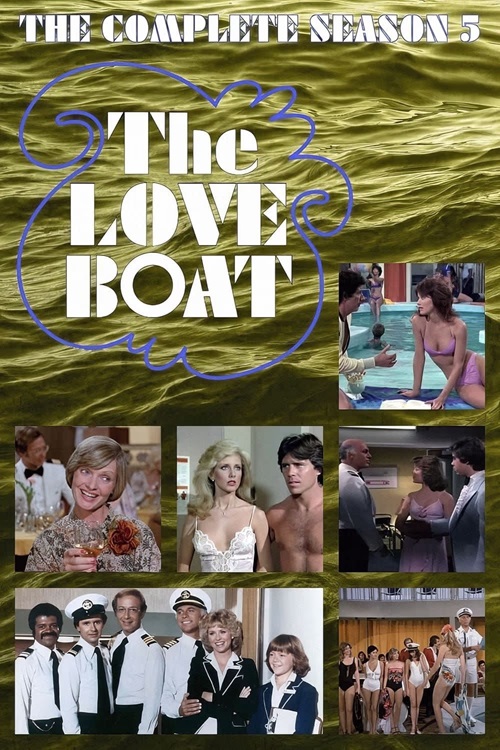
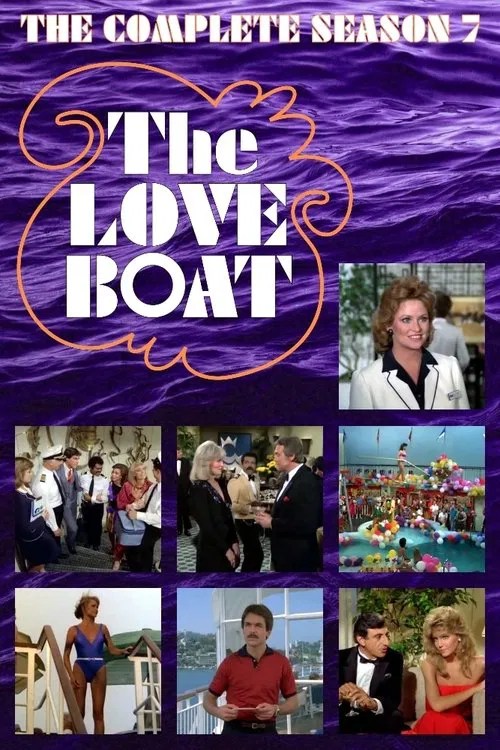
Retro Television Review: The Love Boat 5.22 and 5.23 “Pride of the Pacific/The Viking’s Son/Separate Vacations/The Experiment/Getting to Know You”


Welcome to Retro Television Reviews, a feature where we review some of our favorite and least favorite shows of the past!  On Wednesdays, I will be reviewing the original Love Boat, which aired on ABC from 1977 to 1986!  The series can be streamed on Paramount Plus!

This week, a special two-hour Love Boat sets sail for Alaska and adventure!

Episode 5.22 and 5.23 “Pride of the Pacific/The Viking’s Son/Separate Vacations/The Experiment/Getting to Know You”

(Dir by Roger Duchowny, Originally aired on March 6th, 1982)

The Pacific Princess is sailing to Alaska!

The Sea Princess, commanded by the strict and haughty Gunner Nordquist (Ted Knight), is also sailing to Alaska.  Steve Bloom (Sonny Bono) of the Cruise Ship Association has arranged for a series competitions between the crews of the two ships.  At each stop, the rival crews will compete in races, tree-sawing, tug-of-war, and wrestling.  The crew that wins the most competitions will receive a trophy.  All of the passengers are really excited about it, though I’m not sure why.  I would not want to spend my vacation watching a bunch of strangers take part in a competition that has nothing to do with me.

Gunner is determined to win.  Stubing is determined to have fun.  Or, at least, he is until his crew is absolutely humiliated during the second competition.  When he learns that Gunner has brought in a bunch of ringers, Stubing becomes determined to win at all costs.  Only the tears of Vicki can reveal to Stubing that he’s becoming a monster.  Stubing realizes that he’s been pushing too hard and he apologizes to his crew.  At the final stop, Stubing suggests a dog sled race between him and Gunner.  Gunner agrees.  Steve Bloom says it’s okay.  The crowd is excited for some reason.  In the end, Gunner wins the dog sled race and the competition but only because Stubing kindly refuses to take advantage of an accident that occurs during the race.  Gunner announces that the trophy properly belongs to Stubing and his crew.  Gunner also says that it’s okay if his son (Woody Brown) wants to become a cruise director instead of a navigator.  I’m glad that all worked out….

Actually, this whole storyline made no sense to me.  Beyond the fact that the passengers were oddly excited about the whole thing, I really didn’t see the point of making the members of the crew compete in stuff like tug-of-war and wrestling.  Wouldn’t it have made more sense to compete to see who could be the first to reach the next port?  I appreciated that at least some of this episode was shot on location.  The Alaskan scenery was lovely but the whole competition storyline was just weird.

There were other storylines, of course.  A couple played Charles Nelson Reilly and Charlotte Rae spent the entire cruise in their cabin, getting to know each other because they fell in love at first sight and they wanted to make sure they can handle marriage.  (I can think of one big reason why Charlotte Rae marrying Charles Nelson Reilly might not work out but, this being The Love Boat, it never comes up.)  Two Harvard researchers (John James and Mary Crosby) tried to come up with a pill that would make shy Dave (Douglas Barr) irresistible to women.  Both of those stories were pretty boring.  John James was handsome so the show had that going for it.

Slightly more interesting was the story of Harry Meacham (Tom Bosley) and his wife, Dorothy (Michele Lee).  As they’re in the process of divorcing, Harry sails on The Sea Princess while Dorothy board the Pacific Princess.  Of course, Doc makes his move as soon he realizes the Dorothy will soon be single.  While Dorothy has a chaste fling Doc, Harry has a chaste fling with massage therapist Britta (Priscilla Barnes).  Eventually, Harry and Dorothy realize they still love each other.  Awwww!  Yay!  This story was sweet.

Otherwise, this was not the most memorable cruise to Alaska that the Love Boat has ever taken.  Next week, let’s hope for no musicals and no athletic competitions.  Come on, Love Boat, we all know why we’re here!

Retro Television Reviews: Death Cruise (dir by Ralph Senesky)


Welcome to Retro Television Reviews, a feature where we review some of our favorite and least favorite shows of the past!  On Sundays, I will be reviewing the made-for-television movies that used to be a primetime mainstay.  Today’s film is 1977’s Death Cruise!  It  can be viewed on Tubi and YouTube.

The thing with the Love Boat is that it promises something for everyone.  It’s a place where you set a course for adventure and put your mind on a new romance.

The same cannot be said of the Death Cruise.

Death Cruise opens with three couples winning an all-expenses paid trip on a luxury liner.  None of the couples are in a happy marriage.  Sylvia Carter (Polly Bergen) is tired of her husband, Jerry (Richard Long), and his philandering ways.  Elizabeth Mason (Celeste Holm) is frustrated with David Mason (Tom Bosley) and his loud dinner jackets.  Mary Frances Radney (Kate Jackson) is fed up with James (Edward Albert) and his smug refusal to start a family.  Of course, it’s not just martial problems that connects these passengers.  It’s also the fact that someone on the boat is stalking and killing them, one-by-one.  Can Dr. Burke (Michael Constantine) and Captain Vettori (Cesare Danova) track down the killer before it’s too late?

Death Cruise is an enjoyably twisty little murder mystery.  It aired in 1974, a good two years before the first Love Boat pilot film appeared on television.  However, both Death Cruise and The Love Boat were produced by Aaron Spelling so the two productions definitely have a shared DNA.  The Love Boat is basically Death Cruise with the addition of a laugh track and considerably less murder.  That said, I have my doubts as to whether Doc Bricker would have been as effective a detective as Dr. Burke.

One of the most interesting things about Death Cruise is how little anyone on the boat really seems to care about the fact that the passengers are turning up dead.  In fact, one widower is asking a widow to be his date to dinner within a few hours of the deaths of their spouses.  Of course, the murderer makes sure that dinner date is canceled but it’s still hard not to wonder whatever happened to an appropriate time of grieving.  Then again, I guess if you’re on a boat for a weekend, you just do whatever feels right at the moment.

(And certainly, if they were on The Love Boat, the walking HR nightmares that was Doc Bricker wouldn’t have wasted any time asking the widows to come by his office for a examination.)

Of the victims and suspects, Richard Long and Edward Albert are memorably sleazy while Tom Bosley plays up just how annoyed he is with the whole situation.  Michael Constantine is a good detective and the movie’s final twist is nicely executed.  Personally, when it comes to cruises, I will always prefer the safety and romance of The Love Boat but Death Cruise was an entertaining nautical diversion.

Who Is The Black Dahlia? (1975, directed by Joseph Pevney)


In 1947 Los Angeles, the body of 22 year-old Elizabeth Short is discovered in an empty lot.  Short, who was nicknamed The Black Dahlia because she always wore black, was an aspiring actress who was violently tortured before being chopped in half.  Her murder remains one of Hollywood’s most infamous unsolved crimes.

In this made-for-television movie, Ronny Cox and Efrem Zimbalist, Jr. play the two detectives who are assigned to investigate Short’s murder.  Though they struggle to find any clues identifying who could have killed Short, they do learn about her life and how she went from being a naïve innocent who came to Hollywood with stars in her eyes to being a hardened and cynical woman who may have been supporting herself through sex work when she was murdered.  The film makes use of frequent flashbacks, in which Elizabeth Short is played by Lucie Arnaz.  Her friends and acquaintances are played by familiar television faces like Henry Jones, Mercedes McCambridge, June Lockhart, Brooke Adams, Donna Mills, and Tom Bosley.  Also be sure to keep an eye out for Sid Haig, playing a tattoo artist.

What Elizabeth Short went through over the course of her short time in Hollywood was probably too graphic to be put on television in the 70s but this movie still does a good job of recounting the basic facts of her life and murder.  Because the film is based on fact, no one is ever arrested for Short’s murder.  The only suspect is a doctor who turns out to have an alibi.  The movie instead focuses on Short trying make it in Hollywood and discovering that it’s a cruel town.  Lucie Arnaz was far better than I was expecting in the role of Elizabeth and brought a lot of vulnerability to the role.  The film ended with a title card, asking anyone who had information about the murder of Elizabeth Short to call the LAPD.  The case remains open to this day.

Cleaning Out The DVR: Wicked Stepmother (dir by Larry Cohen)


Weird movie, this one.

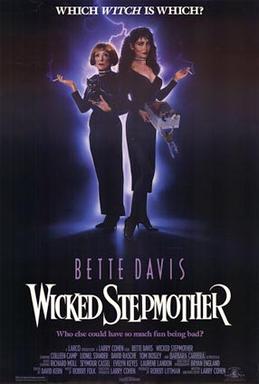
The 1989 film, Wicked Stepmother, was Bette Davis’s final film.  She was cast as Miranda, an enigmatic woman who meets and marries a man named Sam (Lionel Stander).  Sam’s daughter, Jenny (Colleen Camp) and her husband, Steve (David Rasche), are stunned to come home from a vacation just to discover Miranda living in their house.  Miranda chain-smokes, despite Jenny and Steve asking her not to.  Miranda cooks and eats meat, despite Jenny being a vegetarian.  Miranda brags about her sex life which freaks Jenny out even though I suppose really old people do occasionally have sex.  When it becomes apparent that Miranda is a witch who seduces and shrinks her victims, Jenny decides that something must be done.

Wicked Stepmother was not only Bette Davis’s last starring role but it was also the last production that she ever walked out on.  Early on in filming, she announced that she didn’t like the script, she didn’t like the way she was being filmed, and that she didn’t like the director, venerable B-move maestro Larry Cohen.  For his part, Cohen said that Davis left the movie because she was in bad health but she didn’t want to announce that to the world.  In Cohen’s defense, Davis does appear to be rather frail in the movie and often seems to be having trouble speaking.  (Davis has a stroke a few years before appearing in Wicked Stepmother.)  Davis died just a few months after Wicker Stepmother was released so I tend to assume that Cohen was correct when he said that the main reason Davis left the film was because of her health.  That doesn’t mean the script wasn’t bad, of course.  But, in the latter part of her career, Davis appeared in a lot of badly written movies.  She did Burnt Offerings, afterall.

Regardless of why she left, Davis’s absence did require that Wicked Stepmother work around her character.  But how do you do that when Bette Davis was literally the title character?  This film’s solution was to bring in Barbara Carrerra as Priscilla, Miranda’s daughter.  It turns out that Miranda and Priscilla both inhabit the body of a cat but only one of them can use the body at a time.  So, when Priscilla is in the cat, Miranda is among the humans.  When Miranda is in the cat, Priscilla is …. well, you get the idea.  In the film, Priscilla leaves the body of the cat and then refuses to reeneter it because “I’m having too much fun.”  So, whenever we see the cat glaring in the background, we’re meant to assume that we’re actually seeing Miranda in the background.

Got it?

Now, believe it or not, the whole thing with the cat is probably the least confusing thing about Wicked Stepmother.  Jenny can’t convince Steve that Miranda and Priscilla are actually witches.  Steve actually has sex with Pricilla and is shocked when Priscilla starts to turn into a cat but the whole incident is never mentioned again and Steve quickly goes from being an adulterous jerk to a loyal husband.  Sam goes on a game show and, with Priscilla’s help, wins a lot of money even though the questions that he answered were so simple that he shouldn’t have needed the help of a witch’s spell.  (“Who won the election of 1876?” is one question.  The correct answer, by the way, is Rutherford B. Hayes.  Screw you, Samuel Tilden.)  Jenny gets some help from a cop, a private detective, and a priestess of some sort.  The whole thing ends with a big magical battle that involves Barbara Carrera mouthing pre-recorded Bette Davis dialogue.

None of it makes any sense.  The special effects are incredibly cut-rate.  It’s hard not to regret that Bette Davis didn’t go out on a better film.  And yet, when taken on its own terms, Wicked Stepmother itself is oddly likable.  Colleen Camp is sympathetic as Jenny, which is saying something when you consider that Jenny is written to be a humorless vegetarian.  Lionel Stander appears to be having fun as Sam.  Larry Cohen was a good-enough director that, even though he couldn’t save the film from its own bad script and miniscule budget, the movie itself is never boring.  It’s cheap and stupid but its watchable in the same way that Michael Scott’s Threat Level Midnight was watchable.  It may not be particularly good but you just can’t look away.

Night Gallery 1.4 “Make Me Laugh/Clean Kills And Other Trophies”


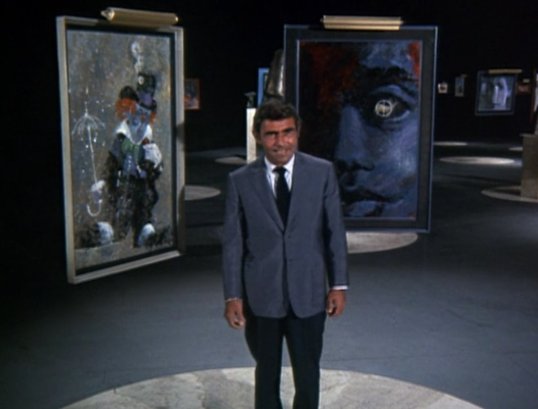
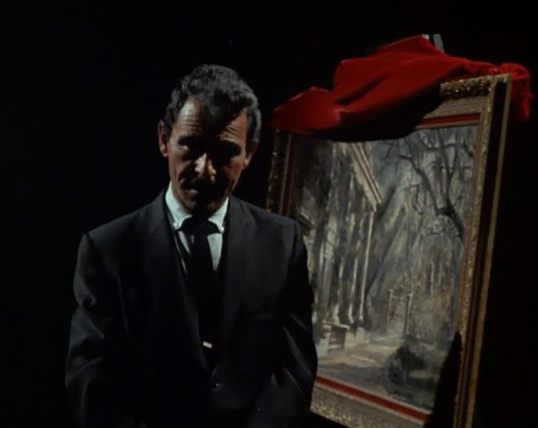
The fourth episode of Night Gallery originally aired on January 6th, 1971.  It was the first episode of the new year and it continued to open with Rod Serling walking through a most curious museum, inviting us to take a look at the macabre paintings on display and consider the stories behind them.

This episode featured two stories.

Make Me Laugh (dir. by Steven Spielberg, written by Rod Serling)

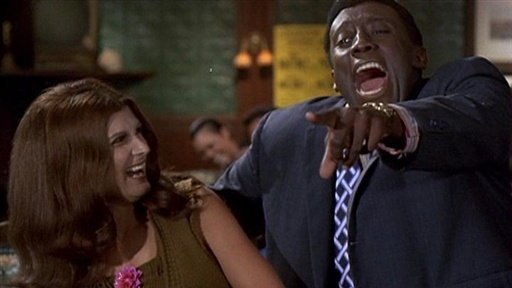
Jackie Slater (Godfrey Cambridge) is a comedian who can’t make anyone laugh.  He’s just been fired from his latest job and even his loyal agent (Tom Bosley) is suggesting that it might be time to throw in the proverbial towel.  While Jackie drowns his sorrows at a bar, he’s approached by a man named Catterje (Jackie Vernon).  Chatterje explains that he can cast miracles but, because he’s not very good at his job, the miracles often have unintended consequences.  “I don’t care!”  Jackie says, “I’ll take the risk!”  Jackie wants people to laugh at him.  Jackie gets his wish but it turns out that he should have listened to Chatterje’s warning.

This segment was directed by Steven Spielberg, back when he was just starting his career and he was largely working in television.  Spielberg also directed Eyes, which was a highlight of the Night Gallery pilot.  Unfortunately, his direction of Make Me Laugh is a bit less successful than his work on Eyes.  Spielberg’s direction features none of the inspired touches that made Eyes so successful.  Part of the problem may be that this story takes place in the word of comedy and comedy has never been a topic for which Spielberg has shown much affinity.

Make Me Laugh does feature a good lead performance from Godfrey Cambridge.  Otherwise, this segment is largely forgettable.

Cleans Kills And Other Trophies (dir by Walter Doniger, written by Rod Serling)

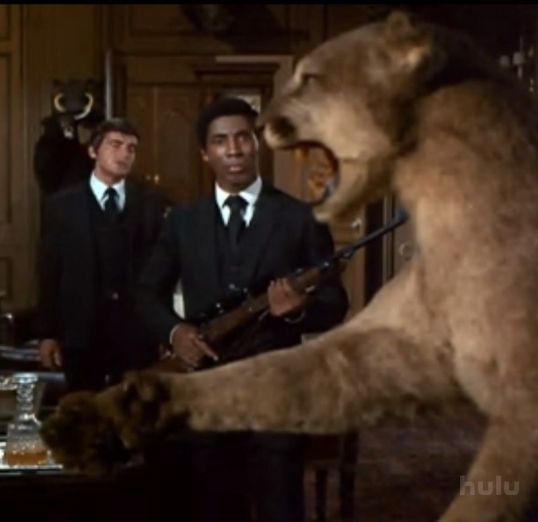
Raymond Massey plays Col. Archie Dittman, a wealthy racist who is obsessed with hunting and killing.  He even has a study full of the mounted heads of all of the animals that he’s killed.  Archie’s son, Archie, Jr. (Barry Brown), has just graduated from college and has no interest in hunting.  Col. Dittman demands that his son go on a hunt or risk being disinherited.  What the colonel fails to take into consideration is that both his bloodlust and his racism has offended his butler (Herbert Jefferson, Jr.) and that his butler has a magic-related revenge in mind.

Clean Kills and Other Trophies is hardly subtle but it does create and maintain a properly ominous atmopshere.  Raymond Massey gives a wonderfully villainous performance and it’s hard not to be amused by the fact that his son is wearing a peace signal prominently on his lapel, as if the segment’s director took one look at it and said, “What’s one thing that we can do to make the themes of this segment even more heavy-handed?”  The segment ends on a note that is so entertainingly over-the-top that it’s hard not to love it.

This episode was uneven.  Make Me Laugh does’t quite work but Cleans Kills and other Trophies is good enough to make up for the disappointing segment that precedes it.

Previous Night Gallery Reviews:

  1. The Pilot
  2. The Dead Man/The Housekeeper
  3. Room With A View/The Little Black Bag/The Nature of the Enemy
  4. The House/Certain Shadows on the Wall

Film Review: Night Gallery (dir by Boris Sagal, Barry Shear, and Steven Spielberg)


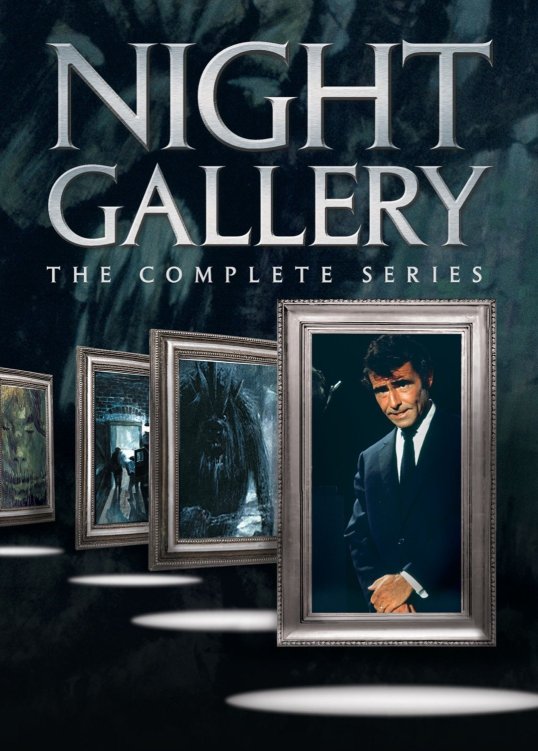
Night Gallery was a horror anthology series that aired on NBC in the early 70s.  Each episode featured Rod Serling, of Twilight Zone fame, serving as the curator of a museum where all of the paintings have a somewhat macabre theme.  (One could even say that the museum was a …. wait for it …. night gallery!)  Serling would give each painting a properly pithy introduction and then the audience would see the story behind the artwork.  It was a bit like the Twilight Zone, except the Night Gallery episodes were in color, they were all horror-themed, and, for the most part, they steered away from social commentary.  The series ran from 1970 and 1973 and it still airs in syndication and on some of the retro stations.  (I believe it currently airs on Comet TV.)  Even if it wasn’t as consistently good as Twilight Zone, it’s still a pretty fun little series.

Two Christmases ago, I was gifted  Night Gallery: The Complete Series on DVD.  Though I’ve watched several episodes from the DVD, I recently realized that I have never actually sat down and watched every episode in order.  With the world currently shut down due to the pandemic (a development that, if we’re going to be honest, sounds like something Rod Serling would have used on the Twilight Zone), I figured what better time to watch the entire series then now?

I started out by watching the Night Gallery pilot film.  This originally aired on November 8th, 1969, a full year before Night Gallery became a weekly series.  It features three different stories (all written by Rod Serling) of the macabre.  As with every episode of the subsequent series, each story is introduced by Serling standing in front of a painting.  In the pilot, though, the museum is rather bare and the painting’s are a bit minimalist.  I have to admit that, as a lover of the baroque, I was a bit disappointed in that aspect of the pilot.

But what about the stories themselves?  Read on!
The Cemetery (dir by Boris Sagal)

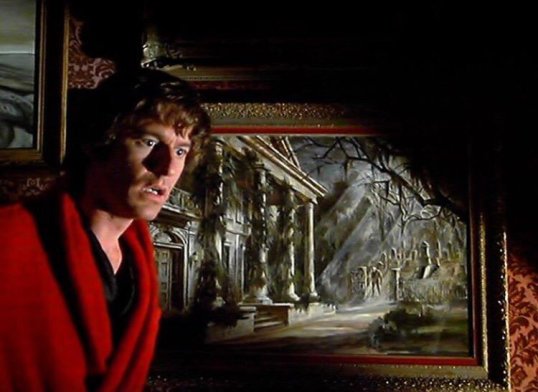
The first story was The Cemetery, a cheerfully gruesome little tale that featured Roddy McDowall and Ossie Davis.  McDowall plays Jeremy, a spoiled young man who murders his uncle so that he might inherit the dead man’s estate.  At first, it looks like McDowall’s plot is a complete success but then McDowall notices a painting of the family graveyard hanging above a staircase.  (To be honest, it seems odd to hang a painting of a graveyard in the foyer but I guess that’s something old rich people do.)  The painting keeps changing.  One minute, the painting looks normal.  The next minute, it features a newly dug grave.  And then something emerging grave.  And then something heading towards the house….

Is Jeremy losing his mind or is the painting warning him that his uncle has risen from the dead and is seeking revenge!?  You’ll probably be able to guess the answer long before poor Jeremy but no matter.  This is a fun little horror story and it benefits from two enjoyably arch performances, from McDowall and, in the role of a butler who may have an agenda of his own, Ossie Davis.
Eyes (dir by Steven Spielberg)

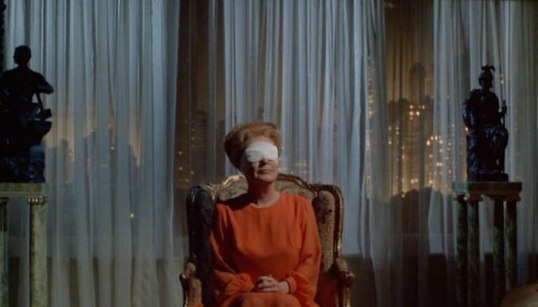
Of the three stories presented in the pilot, Eyes probably gets the most attention from critics because it not only stars Joan Crawford in one of her final performances but it was the professional directorial debut (if you don’t count Amblin’) of 22 year-old Steven Spielberg.  Spielberg apparently had some issues dealing with the veteran crew members, many of whom didn’t like the idea of taking orders from a 22 year-old.  (It probably didn’t help that pictures from that era suggest that Spielberg looked several years younger than his age.  Let’s just say that it’s easy to understand why he eventually grew that beard.)  I’d like to think that Joan Crawford yelled at everyone and defended Spielberg and maybe even Rod Serling came down with Luca Brasi and said, “You’re going to the give this kid the respect he deserves or your brains are going to be all over that union contract.”  I don’t know if that’s true but it’s a nice thought.

That said, Eyes is pretty good.  Even if the crew doubted him, Spielberg proved himself as a director with this story.  It’s about a hateful and selfish woman (Joan Crawford) who happens to be both rich and blind.  She has manipulated a doctor into performing an experimental operation that will allow her to see.  The only catch is that the operation will only be good for 22 hours and a donor (Tom Bosley, as a bookie who is in trouble with the mob) will be required to give up his eyes so that Crawford can have those 22 hours.

On the one hand, this is very-much a Rod Serling-type tale.  It’s easy to imagine Eyes, with its belief in karma and its final macabre twist, as a Twilight Zone episode.  At the same time, Spielberg very much brings his own signature style to the film, livening up dialogue-heavy scenes with interesting camera angles and getting good performances from Crawford, Barry Sullivan, and Tom Bosley.  Eyes is a clever story but, for modern viewers, the most interesting thing about it will be discovering that, even at the age of 22, Spielberg already had a clear directorial style.
The Escape Route (dir by Barry Shear)

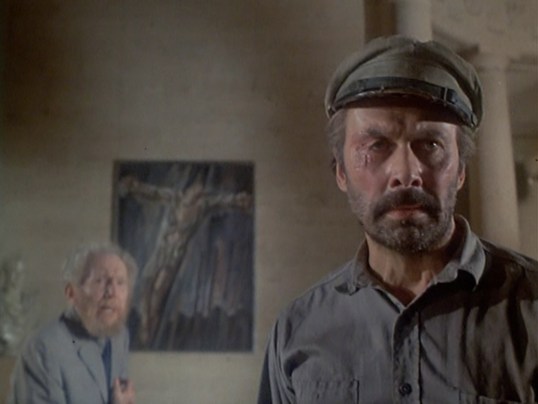
The Escape Route is about an Nazi war criminal named Joseph Strobe (played by Richard Kiley) who is hiding out in South America and spending all of his time nervously looking over his shoulder.  One day, he enters a museum where he finds himself drawn to two paintings.  One painting features a man who has been crucified in a concentration camp, which we learn was Strobe’s trademark back when he, himself, was a camp commandant.  The other painting features a fisherman in a peaceful setting.  Even though Strobe imagines himself as the peaceful fisherman, his attention keeps getting redirected to the painting of the concentration camp.  Soon, Strobe realizes that a survivor of the camp (played by Sam Jaffe) is also in the museum and that he is studying the painting as well.

Compared to Eyes and especially The Cemetery, The Escape Route may seem like a rather low-key story but it has a power that sneaks up on you.  Hiding out (as many real-life Nazi war criminals did) in South America, Strobe is full of excuses for his past and he may indeed be sincere in his wish that he had just become a fisherman as opposed to a brutal Nazi.  But, in the end, Strobe can neither escape his past nor his final punishment.  Justice cannot be escaped, no matter how hard Strobe tries to outrun it.  In the end, there is no escape for the wicked.  Richard Kiley and Sam Jaffe both give excellent performances.  The Escape Route will stick with you.

As a series, Night Gallery was a bit uneven but the pilot stands as a classic of its type, featuring three short films that all deserve to be remembered.

As for me, I’m going to try to watch an episode or two a day.  I may review a few more Night Gallery episodes here on the Shattered Lens.  As I said, the series itself was a bit uneven and not every episode is as good as the pilot.  Still, there’s definitely some gems to be found in the Night Gallery and I’ll share them as I come across them.
Horror On TV: Kolchak: The Night Stalker 1.20 “The Sentry” (dir by Seymour Robbie)


Tonight on Kolchak….

There’s something on the loose underneath Chicago!  Could it be a …. killer lizard!?  Kolchak’s on the story!

Sadly, all good things must come to an end and this was the final episode of Kolchak: The Night Stalker.  Darren McGavin, of course, would later go on to epitomize the ideal middle American father when he played The Old Man in A Christmas Story.

This finale originally aired on March 28th, 1975.

I hope you have enjoyed this October’s trip down Kolchak Lane!

A Blast From The Past: The Making Of It’s A Wonderful Life (dir by Sandra Moiseeff)


Now that you’ve either seen the film or listened to the radio adaptation of It’s A Wonderful Life, how about a documentary about how this classic film came to be in the first place?

The Making Of It’s A Wonderful Life was apparently made for television and was broadcast in 1990.  Hosted by actor Tom Bosley, it’s a warm and appreciative look at a much beloved classic.

And here it is!