Marine Captain David Berman (Tim Ryan, who looked a lot like Bruce Willis) gets a transfer to Paris so that he can track down Dieter Krugman, a Nazi war criminal who killed his grandparents and crippled his mother (Teresa Wright). He is told that Krugman is now living under the name of Felix Altmann. David confronts Altmann at a health spa but, when someone else shoots Altmann, David is framed for the crime. Luckily, Perry Mason (Raymond Burr) is an old friend of the family’s. He and Ken Malansky (William R. Moses) hop on the first plane to Paris and Perry starts to read up on the Uniform Code of Military Justice so that he can defend David. Della (Barbara Hale) stays behind in Denver but Perry calls her a few times.
This was a good entry in the Perry Mason film series. The mystery was intriguing and the acting — from Ian Bannen, Ian McShane, Terry O’Quinn, Yvette Mimieux, and Paul Freeman — was excellent all around. Especially good was Teresa Wright as David’s mother. Some of her scenes were chilling and she gets a great moment at the end of the movie. Raymond Burr is as good as always but, for the first time, William R. Moses really feels like he belongs in the movie. This is the first time that I’ve seen Ken without wishing he was Paul.
It’s too bad Della had to stay back in America. I bet she would have enjoyed seeing Paris with Perry.
4 Or More Shots From 4 Or More Films is just what it says it is, 4 shots from 4 of our favorite films. As opposed to the reviews and recaps that we usually post, 4 Shots From 4 Films lets the visuals do the talking!
One of the all-time great directors in the history of cinema, Alfred Hitchcock, was born on this day in 1899. Today, I celebrate this master filmmaker with some images from some of his best films. Enjoy!
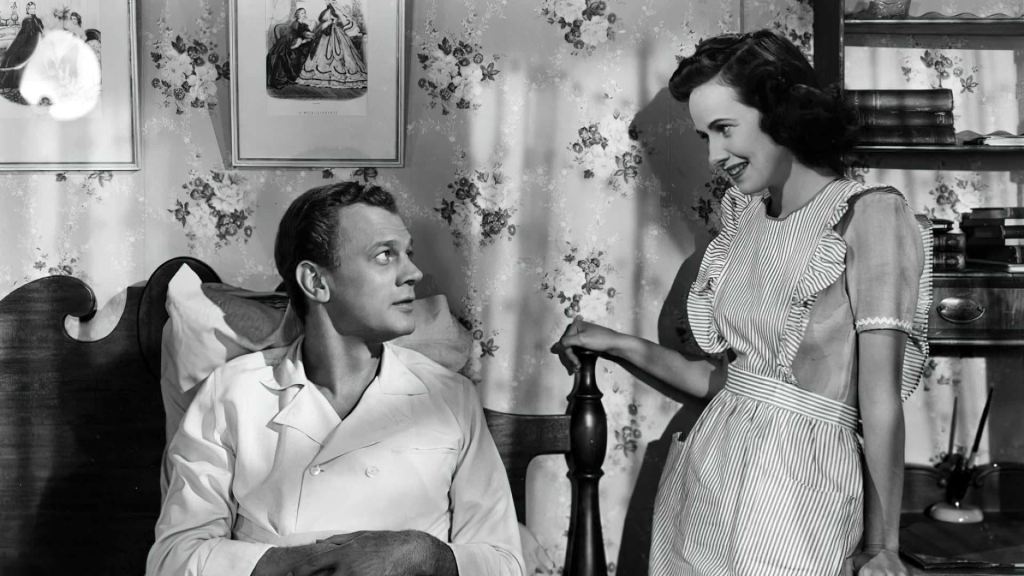
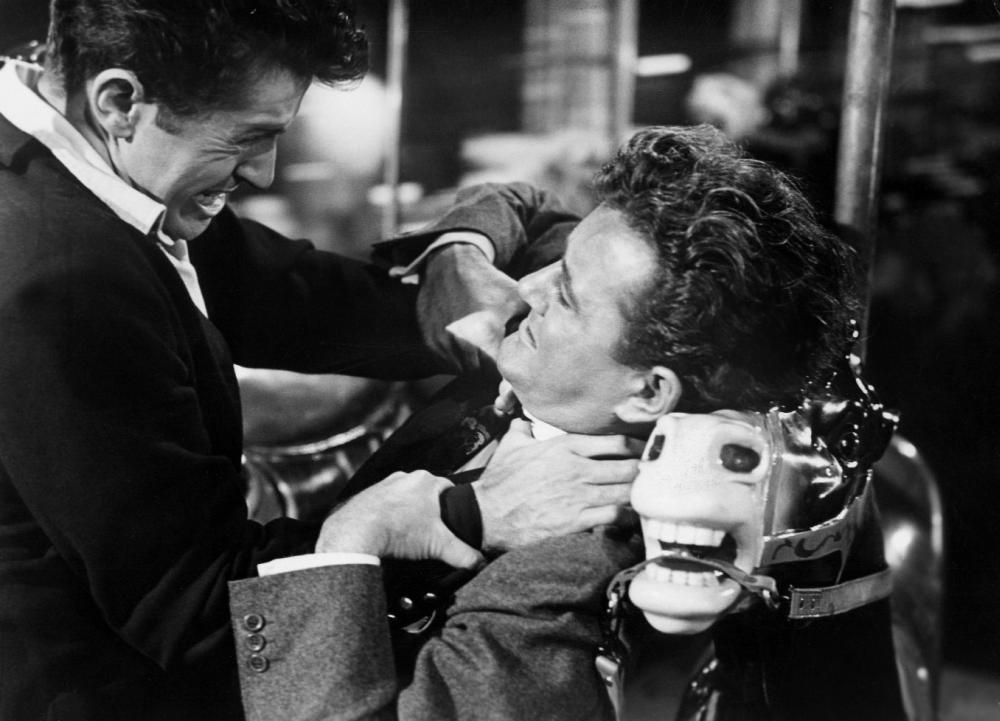
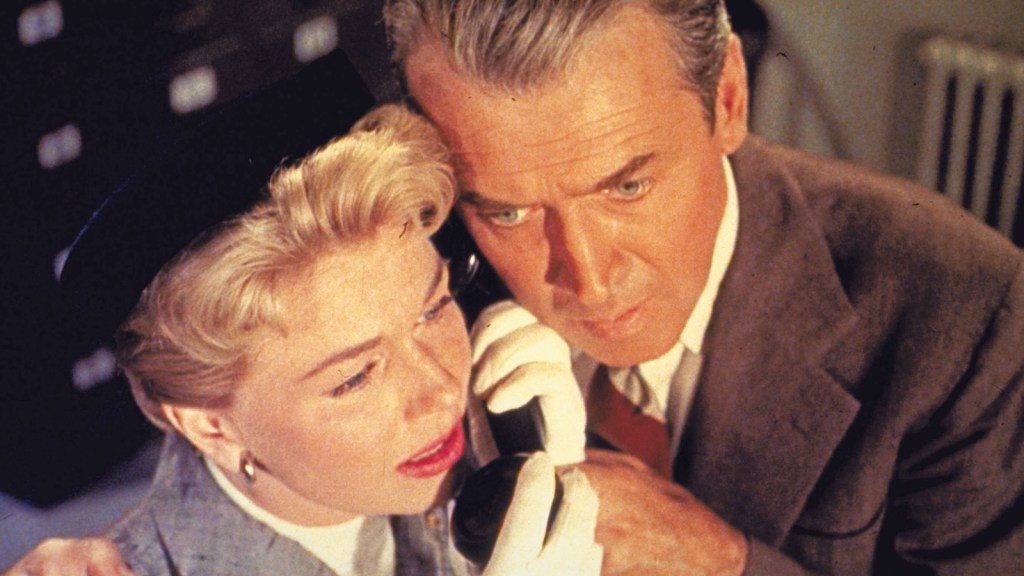
Shadow of a Doubt (1943)Strangers on a Train (1951)The Man Who Knew Too Much (1956)Frenzy (1972)
Welcome to Retro Television Reviews, a feature where we review some of our favorite and least favorite shows of the past! On Saturdays, Lisa will be reviewing The American Short Story, which ran semi-regularly on PBS in 1974 to 1981. The entire show can be purchased on Prime and found on YouTube and Tubi.
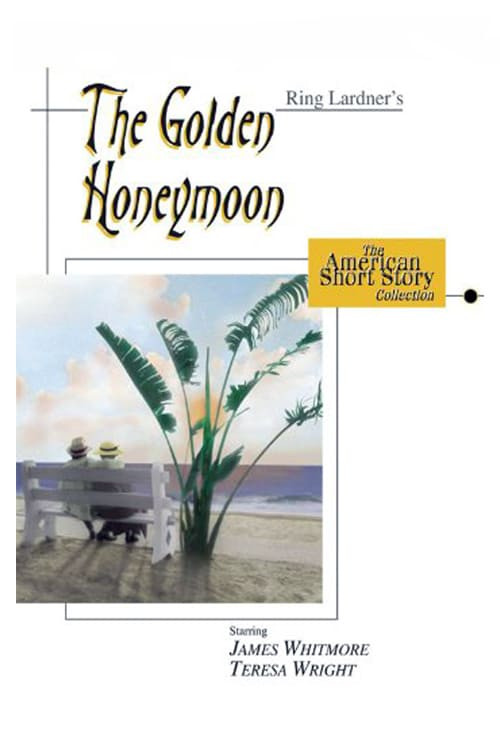
Episode #10: The Golden Honeymoon (1980, directed by Noel Black)
Hey, guest reviewer here! Don’t worry, Lisa will return next week. Next week’s episode has got Eric Roberts in it and she told me there’s no way she’s going to miss that!
This episode is an adaptation of a short story by the author Ring Lardner, who was a member of the Algonquin Round Table and whose son won an Oscar for writing the script for the movie version of M*A*S*H. TheGoldenHoneymoon about an old couple (James Whitmore and Teresa Wright) who celebrate their 50th anniversary by going on a “golden honeymoon” to Florida. While there, they meet the wife’s old flame (Larry Loonin) and Whitmore feels like he has to win his Wright all over again. Whitmore and Loonin play a lot of different games, like shuffleboard and checkers. You know you don’t want to get between a group of elderly people playing checkers! Wright gets frustrated with Whitmore but they make up by the end of the episode. They bicker but they love each other.
I have not read the original short story on which this episode is based. Ring Lardner was famous for his wit and he probably could have found a lot of comedic moments in two old romantic rivals having an intense checkers game. The episode itself reminded me of those films that my high school English teachers would always show in class. “You are going to love this,” the teacher always says and then the members of the class sit there in stony silence as they watched the slowest, most visually static program imaginable. This episode was not just boring. It was PBS boring.
I don’t want to be to negative, though. I like both James Whitmore and Teresa Wright. Whitmore was the elderly prisoner in The Shawshank Redemption. Teresea Wright was in several classic Golden Age films. In The Golden Honeymoon, they were believable as an old married couple, who constantly argue but still clearly love each other.
On this date in 1905, the great actor Joseph Cotten was born in Petersburg, Virginia. A longtime friend and collaborator of Orson Welles, Cotten was one of the most dependable leading men of the 40s and 50s, an actor with the charisma of star and the talent of an artist.
Today’s scene that I love comes from Alfred Hitchcock’s 1943 masterpiece, Shadow of a Doubt, and it features Teresa Wright and Joseph Cotten. Wright plays Charlie. Cotten plays her beloved uncle, who is also named Charlie and who might very well be a serial killer. In this scene, Uncle Charlie drags his niece to a seedy bar, where he confesses that, as she earlier deduced, he is a suspect in a murder investigation. With a mixture of charm and intimidating, Charlie tries to convince his niece to keep his secret to herself.
Welcome to Retro Television Reviews, a feature where we review some of our favorite and least favorite shows of the past! On Sundays, I will be reviewing the made-for-television movies that used to be a primetime mainstay. Today’s film is 1974’s The Elevator! It can be viewed on YouTube!
Marvin Ellis (Roddy McDowall) hates his job. He’s been assigned to be the manager of a new high-rise office building. Parts of the building are still under construction but that hasn’t stopped the company that owns it from selling out office space. When Mrs. Kenyon (Myrna Loy) comes by and asks to look at the top floor penthouse, Ellis agrees. In public, Ellis is always friendly and always courteous. It’s only under the most stressful of circumstances that Ellis reveals that he feels as if the building has been built of out lies and cheap material.
Ellis and Kenyon soon find themselves in a stressful situation when they are trapped in an elevator. Of course, they’re not alone in the elevator. There’s also Dr. Reynolds (Craig Stevens), his wife (Teresa Wright), and his mistress (Arlene Golonka). And then there’s Robert Peters (Barry Livingston), a teenager who has inherited a fortune. And finally, there’s Eddie Holcomb (James Farentino). Eddie has a suitcase full of money that he’s stolen from an office in the building. He’s also got a loaded gun. And, perhaps worst of all, he has an intense fear of tight places. The longer that he’s trapped in the elevator, the worse his claustrophobia becomes.
Because the building isn’t really finished yet, the elevator’s alarm button doesn’t really work. Other than the passengers trapped inside, the only people who know about the stalled elevator are Eddie’s partners-in-crime. Irene (Carol Lynley) is Eddie’s girlfriend and she just wants to get the situation resolved with as little violence as possible. Pete (Don Stroud) is Eddie’s sociopathic friend. Pete is not only determined to rescue Eddie and retrieve the suitcase. He’s also determined to take care of any potential witnesses by killing everyone on the elevator.
The Elevator is a disaster film, along the lines of Airport and The Towering Inferno. Due to the hubris of a faceless corporation, a group of people find themselves trapped in a potentially catastrophic situation. Some of them react with bravery. Some of them react with cowardice. All of them get a chance to reveal a bit of who they are on the inside. Some might say that being trapped in an elevator is not quite as bad being trapped in a fiery skyscraper or being a passenger on a airplane that’s being held hostage by a mad bomber. Technically, they’re right but I am also going to admit right now that I absolutely hate elevators and I try to avoid them whenever I can. I always say that this is because running up and down several flights of stairs is a good way to keep my legs looking good and certainly that’s part of it. But an even bigger reason is that I dread the thought of being stuck in a confined space with a bunch of strangers. If I was on an elevator that was stuck between floors, I would probably lose my mind. I have a hard enough time just standing in line for longer than 3 minutes. As directed by Jerry Jameson, The Elevator does as good job of capturing the feeling of being trapped in a small space. It’s not a film to watch if you have claustrophobia.
As for the cast, Myrna Loy is a delight as the eccentric Mrs. Kenyon. And seriously, how can you dislike any film that gives Roddy McDowall a monologue about how much he hates skyscrapers? It’s an entertaining, if undemanding, film. After watching The Elevator, I’ll keep taking the stairs.
After going away to college, Carl Dixon (25 year-old Michael Douglas, in his film debut) has returned to his rural hometown. Though Carl comes from a family with a long military tradition, he’s against the war in Vietnam and is considered to be a hippie by his family. As soon as his stern father (Arthur Kennedy) sees Carl, he sits him down in the kitchen and, after declaring that no one is going to mistake his son for a girl, cuts his hair. Meanwhile, Carl’s mother (Teresa Wright) stays out of the conflict between her husband and her son while Carl’s older brother (Peter Strauss) continues to resent Carl for the accident that injured his spinal cord and kept him from going off to war.
Carl has an announcement to make. Despite being against the war in Vietnam, he’s joined the army. He will soon be going overseas, where he’ll get a chance to be a hero and where he says he hopes to love the enemy. No one in his family can understand his decision, though they certainly spend a lot of time talking about it. Carl can’t explain it either, though he certainly keeps trying. Eventually, Carl ends up going for a swim with a local girl (Deborah Winters), smoking weed with a woman who lives in a cave with a mummified baby, and painting the family barn with a mural that’s supposed to explain it all.
Hail, Hero! is an extremely talky film that wants to say something about the war in Vietnam but it doesn’t seem to know what. The film’s too sincere in its confusion to be a disaster but it’s also too muddled to really be effective. Carl is opposed to the war but he drops out of college and enlists because it’s what his father would have wanted him to do but his father doesn’t seem to be impressed with the decision and Carl doesn’t seem to like his father to begin with so why volunteer for something that you find to be immoral? The film would have been effective if Carl had been drafted into the war and had to choose between reporting for duty or fleeing to Canada. But having him drop out of college and volunteer to serve makes it more difficult to sympathize with him when he talks about how opposed he is to the war.
If the film gets any attention today, it is probably because of Michael Douglas in the lead role. This was Douglas’s film debut. He was 25 when he made the film and he was already a dead ringer for his father. Unfortunately, he doesn’t give a very good performance. He’s miscast in the lead role. Carl Dixon is supposed to be insecure and conflicted. Insecure is not something that comes to mind when you think about Michael Douglas. Instead, Carl just comes across as being petulant and self-righteous. Hail, Hero! tries to say something about the war in Vietnam but Carl Dixon’s the wrong messenger.
Gary Cooper. Joan Fontaine, Mary Astor, and Donald Crisp at the 1942 Oscars.
Continuing our look at good films that were not nominated for best picture, here are 6 films from the 1940s.
Shadow of a Doubt (1943, dir by Alfred Hitchcock)
Amazing, Alfred Hitchcock never won the Best Directing Oscar. In fact, it was rare that his films were even nominated. (Though Rebecca did win Best Picture, it could be argued that film’s style was as much to due to David O. Selznick as it was to Hitchcock.) One of the best of Hitchcock’s unnominated films was Shadow of a Doubt. With its dark sense of humor and wonderful performances from Joseph Cotten and Teresa Wright, Shadow of a Doubt was Hitchcock at his best. It was also, perhaps, a bit too darkly subversive for the Academy.
Detour (1945, dir by Edgar G. Ulmer)
The ultimate film noir nightmare, Detour was actually well-received when it was originally released, though it would take a while for the film to be recognized as a true classic. Still, there was no way that the Academy was going to nominate a low-budget B-movie about a guy who hitchhikes across America and manages to accidentally kill two people. Detour was far too nightmarish and surreal for the Academy but it’s remained one of the most influential films ever made.
Gilda (1946, dir by Charles Vidor)
Another classic film noir, Gilda is the film that, for many, will always define Rita Hayworth. Through the film was a financial and critical success, it was ignored by the Academy. The success of this film and the popularity of Hayworth’s performance led to the fourth atomic bomb to ever be detonated being named Gilda. Rita Hayworth was reportedly not happy to hear it.
Black Narcissus (1947, dir by Michael Powell and Emeric Pressburger)
One of the most visually stunning films ever made, Black Narcissus won Oscars for Best Cinematography and for Art Design but it received no other nominations, not even for the outstanding performances of Deborah Kerr and Kathleen Byron, as two nuns who have very different reactions to the Himalayas.
Out of the Past (1947, dir by Jacques Tourneur)
A world-weary private investigator (Robert Michum) is hired by a slick and psychotic gangster (Kirk Douglas) and ordered to track down the gangster’s girlfriend (Jane Greer). So beings this rather melancholy and introspective film noir, one that is distinguished by wonderfully shadowy photography and which features one of Mitchum’s best performances. Sadly, the Academy recognized neither the film nor Mitchum’s performance.
Portrait of Jennie (1948, dir by William Dieterle)
This haunting and dream-like fantasy stars Joseph Cotten as a painter who meets, paints, and falls in love with a mysterious woman (Jennifer Jones) who may not be what she seems. The film was apparently not a huge success when it was first released but, seen today, it’s hard not to get swept up in the film’s romantic sadness. Though it received a nomination for Best Cinematography, it was otherwise ignored by the Academy.
Now, before anyone asks, this is not the Oscar-nominated original with Edmund Gwenn and Natalie Wood. Nor is it the 90s remake with Richard Attenborough and that girl who gives a hundred interviews a year about how she doesn’t care about being famous.
Instead, this is a 46-minute made-for-TV production from 1955! It stars the one and only Thomas Mitchell (you’ll remember him as Uncle Billy from It’s A Wonderful Life) as the man who might be Santa Claus!
Even though this version may not be quite the holiday masterpiece that the original is, I still like it. You really can’t go wrong with Thomas Mitchell as Santa.
“People all say that I’ve had a bad break. But today … today, I consider myself the luckiest man on the face of the Earth.”
— Lou Gehrig (Gary Cooper) at the end of The Pride of the Yankees (1943)
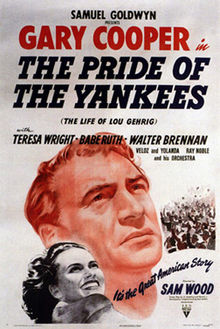
After airing Foreign Correspondent earlier tonight, TCM followed up by showing the 1943 best picture nominee, The Pride of the Yankees. Knowing that Pride of the Yankees was going to be a baseball film and that I know next to nothing about baseball, I recruited my sister, the Dazzling Erin, to watch the movie with me. Erin loves baseball and I knew that she would be able to explain anything that went over my head.
Well, I absolutely loved watching this movie with my sister but it turns out that The Pride of the Yankees isn’t really much of a baseball movie. True, it’s about a real life baseball player. Several actual players appeared as themselves. About 85% of the film’s dialogue deals with baseball and probably about 70% of the film features characters playing some form of the game. But the film never goes into any great detail about baseball or how it’s played. There’s no talk of strategy or rules or deeper meaning or anything else. Going into the film, I knew that baseball was a game that involved throwing, swinging bats, and running. And it turns out that was all that I needed to know.
The Pride of the Yankees is less about baseball and more about celebrity. It’s a biopic of Lou Gehrig, who today is best known for his battle with ALS, a disease that is also known as Lou Gehrig’s disease. Lou Gehrig died on June 2, 1941 and The Pride of the Yankees was released just a year later. Watching the film, it’s obvious that Gehrig was a beloved figure, the type of celebrity who, if he were alive today, would probably be the center of stories like, “Lou Gehrig Did Something This Weekend And It Was Perfect.” Watching the film, it easy to imagine how traumatic it must have been for the nation when a beloved athlete like Lou Gehrig died at the age of 37.
As a result, The Pride of the Yankees is less a biopic and more a case for canonization. From the minute that the film’s Lou Gehrig appears on-screen, he is presented as being the type of saintly athlete who, by promising to hit two home runs in one game, inspires a crippled child to walk. Lou is modest, kind, unpretentious, and never gets angry. Over the course of the film, he takes care of his mother, displays a worthy work ethic, and marries Eleanor. He and Eleanor have a perfect marriage without a single argument or a hint of trouble, except for the fact that Lou sometimes gets so busy playing baseball with the local children that he’s late coming home. There’s not a hint of sadness in their life, until Lou suddenly gets sick.
And really, it should not work. If ever there’s ever been a film that should be painfully out-of-place in our more cynical times, it would be The Pride of the Yankees. However, the film still works because Lou is played by Gary Cooper and Eleanor is played by Teresa Wright. These two excellent performers bring their considerable talents to making overly sentimental scenes feel credible. Gary Cooper was 40 years old when he made The Pride of the Yankees and there’s a few scenes — especially the ones where Lou is supposed to be a student at Columbia University — where Cooper is clearly too old for the role. But, for the most part, Gary Cooper did a great job as Lou Gehrig. Cooper is especially memorable when Lou first starts to show signs of being ill. Watching Lou struggle to swing a bat, I was reminded of a horse struggling to stand on an injured leg. It was almost painfully poignant.
The Pride of the Yankees was nominated for 11 Academy Awards, including best picture. However, it lost to another sentimental film that featured Teresa Wright, Mrs. Miniver.
Mrs. Miniver, which won the Academy Award for Best Picture of 1942, is often treated somewhat dismissively by film historians. The film tells the story of the Minivers, an upper middle class British family whose peaceful lives are changed forever by the start of World War II. When the film initially went into production, the U.S. was still a neutral country. As shooting commenced, the U.S. edged closer and closer to entering the war and, as a result, the script was continually rewritten to make Mrs. Miniver even more pro-British and anti-German than before. The finished film was released four months after the attack on Pearl Harbor, by which point Mrs. Miniver had gone from being domestic drama to being both a celebration of British resilience and the Allied war effort. “If the Minivers can do it,” the film told audiences, “why can’t you?” As a result, Mrs. Miniver is often described as being merely effective propaganda.
Well, Mrs. Miniver may indeed be propaganda but it’s amazingly effective propaganda. I recently DVRed it off of TCM and I have to admit that, as a result of those previously mentioned film historians, I wasn’t expecting much. But I was in tears by the end of the film. Yes, World War II has long since ended. And yes, I could watch the movie and see all of the tricks and the heavy-handed manipulations that were employed to get the desired emotional response from the audience but it didn’t matter. The film is so effective and so well-acted that you’re willing to be manipulated.
(Of course, it helps that there’s not much nuance to World War II. As far as wars go, WWII was as close to a fight between good and evil as you can get. If you can’t celebrate propaganda that was designed to defeat the Nazis, then what can you celebrate?)
As for the film itself, Greer Garson plays Kay Miniver, matriarch of the Miniver Family. Her husband, Clem (Walter Pidgeon) is a successful architect. When we first meet Kay and Clem, the only thing that they have to worry about is the annual village rose show. (Henry Travers — who everyone should love because he played Clarence in It’s A Wonderful Life — plays the eccentric stationmaster who is determined to win with his rose.) However, that all changes when they go to church and the vicar (Henry Wilcoxin) announces that Great Britain has declared war on Germany.
Life changes. Soon, Kay must hold her family together while bombs are falling from the sky. When Clem is away, helping out with the Dunkirk evacuation, Kay comes across a wounded German flyer (Helmut Dantine) in her garden. The flyer demands that Kay give him food and when she does, he snarls that the Third Reich will be victorious. He then passes out from his injuries, allowing Kay to take his gun and call the police. (Reportedly, this scene was rewritten and reshot several times, with the German becoming progressively more hateful with each new version.)
Kay’s son, Vincent (Richard Ney), joins the Royal Air Force. He also falls in love with Carol Beldon (Theresa Wright), the daughter of the aristocratic Lady Beldon (Dame May Whitty). Over the concerns of Lady Beldon, Carol marries Vincent and she becomes the second Mrs. Miniver. They do so, despite knowing that Vincent will probably be killed before the war ends.
Of course, there is tragedy. People who we have come to love are lost, victims of the German onslaught. Throughout it all, the Minivers (and, by extension, the rest of Great Britain) refuse to give into despair or to lose hope. The film ends with them singing a hymn in a church that no longer has a roof and listening as the vicar tells them why they will continue to fight.
And yes, it’s all very manipulative but it’s also very effective. I did cry and the film earned those tears. In many ways, Mrs. Miniver is perhaps most valuable as a time capsule. It’s a film about World War II that was actually made during the war and, as such, it provides a window into the attitudes and culture of the time. But, if the film is valuable as history, it’s also just as valuable as a well-made melodrama.
I’m not sure if I would say that Mrs. Miniver deserved to defeat Kings Row for best picture of 1942. But it’s still an undeniably good film.




 Through the Shattered Lens