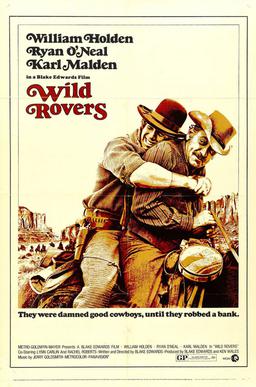
 In Montana, Walter Buckman (Karl Malden) runs his ranch with an iron hand, warning his neighbor, Hansen (Sam Gilman) not to even think of allowing his sheep to graze on his land. Walter has two sons, hot-headed John (Tom Skerritt) and the laid back and good-natured Paul (Joe Don Baker). When Walter learns that two of his ranch hands — aging Ross Bodine (William Holden) and young Frank Post (Ryan O’Neal) — have robbed a bank and are heading down to Mexico, he sends John and Paul to bring them back. Walter is a big believer in the law and he’s not going to allow any of his people to get away with breaking it.
Ross is a veteran cowboy, who only robbed the bank after Walter withheld his pay to cover the damage of a saloon fight between Ross and Hansen’s men. Frank is the wilder of the two. He looks up to Ross and Ross is protective of Frank, even if he has a hard time admitting it. Ross and Frank are heading down to Mexico so Ross can retire in peace. Instead of going straight to Mexico, though, they make the mistake of stopping by a small town so Frank can play a little poker and visit the town’s brothel.
Wild Rovers was Blake Edwards’s attempt to make an epic, revisionist western and he includes plenty of shots of the sun setting over the mountains as well as several violent shoot-outs that are shot in Peckinpah-style slow motion. Unfortunately, the story itself isn’t really strong enough to support Edwards’s ambitions and all of the shots of the countryside, while nice to look at, don’t really add up too much. Wild Rovers was also a troubled production, with MGM slashing Edwards’s original three-hour film down to 106 minutes and advertising it with a poster featuring O’Neal hugging Edwards from behind, making the film look like a buddy comedy in the style of Butch Cassidy and the Sundance Kid (or an early version of Brokeback Mountain) as opposed to a violent and elegiac western. (In 1986, a director’s cut was released, which ran for 136 minutes.) If you only know Blake Edwards from his Pink Panther movies, the grim and tragedy-filled Wild Rovers will come as a surprise.
One thing that Wild Rovers does have going for it is a good cast. William Holden and an energetic Ryan O’Neal are a solid team and Karl Malden, Tom Skerritt, Rachel Roberts, James Olson, and Moses Gunn all give good performances too. This movie also provides Joe Don Baker with a sympathetic role and he’s very likable as the laid back Paul Buckman. It’s not the type of role that Baker often got to play and it’s obvious that a lot of scenes between John and Paul were cut from the film but, in the truncated version, Joe Don Baker’s Paul Buckman becomes the moral center of the film’s story.
Wild Rovers was a disappointment at the box office, one of many that Edwards suffered in the 70s before he and Peter Sellers brought back Inspector Clouseau.

 Missouri during the Civil War. All young men are being forcibly constricted into the Union army, leaving those who want to avoid service with only two options: they can either disguise themselves as a woman and hope that the soldiers are fooled or they can head out west. Drew Dixon (Barry Brown) opts for the latter solution but his plans hit a snag when he’s robbed and pistol-whipped by Jake Rumsey (Jeff Bridges). When Drew coincidentally meets Jake for a second time, he immediately attacks him. Jake is so impressed that he insists that Drew join his gang of thieves.

