Cliff Spab (Stehpen Dorff), his friend Joe Dice (Jack Noseworthy), and teenager Wendy Pfister (Reese Witherspoon) are in the wrong convenience store at the wrong time and end up being taken hostage by a group of masked terrorists who have guns and video cameras. For 36 days straight, their ordeal is broadcast live on television. They become the number one show in the country and Cliff’s nihilistic attitude makes him a star. When the terrorists threaten to kill him, he spits back, “So fucking what!?” Alienated young people take up S.F.W. as a personal chant and credo. When Joe finally fights back, both he and the terrorists are killed in the shoot-out. Wendy and Cliff are now celebrities, even though they don’t want to be. Released into the real world, Cliff has to deal with everyone wanting to make money off of him. His alienation has been turned into a product. He just wants to be reunited with Wendy but his fans want him to tell them how to live their lives. Fandom turns out be a fickle beast.
Earlier this morning, I came across a news item that Jefery Levy, the director of S.F.W., had died at the age of 67. S.F.W. used to show up frequently on cable in the 90s but I hadn’t thought about it in years. When I first saw S.F.W., I didn’t care much for it. Cliff came across as being a poseur and Stephen Dorff came across like he was way too impressed with himself. With John Roarke playing everyone from Phil Donahue to Sam Donaldson and Gary Coleman appearing as himself, the movie seemed like it was trying too hard to be outrageous. Looking back on it now, though, I realize S.F.W. may not have been a good movie but it was still a very prophetic movie. What seemed implausible in the 90s — like the 36-day live stream from inside the convenience store hostage situation and Cliff Spab’s fans switching their allegiance to a self-righteous virgin who yells that everything matters while trying to assassinate him — feels far too plausible today.
In 1994, S.F.W. and Jefery Levy predicted the 2020s. The only thing it got wrong was having Cliff Spab not wanting to be a famous. Today, Cliff Spab would probably be presenting the Best Podcast award at the Golden Globes.
1980’s The Final Countdown opens with a series of stunning overhead shots of Pearl Harbor. Warren Lasky (Martin Sheen), a systems analyst for Tideman Industries, is sent by his mysterious employer to observe operations on the USS Nimitz. Captain Yelland (Kirk Douglas), the commanding officer of the Nimitz, is polite to Lasky, even if he doesn’t quite understand why he’s been sent. For that matter, Lasky’s not sure what he’s supposed to do either. When the Nimitz is surrounded by a sudden storm and programs from 1941 start playing over the radio, Yelland suspects that it’s some sort of test and that Lasky has been sent to see how they react. However, when two Japanese airplanes are spotted overhead, it becomes clear that the Nimitz has somehow traveled through time. The date is December 6th, 1941 and, in just 24 hours, the Japanese are going to attack Pearl Harbor.
Commander Dick Owens (James Farentino) argues that it would be dangerous to try to change history by attacking the approaching Japanese fleet. However, it appears that the Nimitz has already changed history by saving the life of U.S. Senator Samuel Chapman (Charles Durning), who Owens believes would have been Roosevelt’s running mate in 1944 if he hadn’t been killed the day before Pearl Harbor. With Chapman demanding that Pearl Harbor be warned and Lasky arguing that the Nimitz should try to change history by preventing the attack, Captain Yelland has a decision to make.
The Final Countdown was made with the full support of the U.S. Navy. The production was allowed to film on the Nimitz and, outside of the main stars, the crew of the Nimitz played themselves. As a result, there’s a lot of awkward line deliveries amongst the minor characters but there’s also an authenticity to the film that elevates the story. Even when it becomes obvious that the Nimitz has traveled back to 1941, the crew handles things in a professional manner. One comes into the film expecting a good deal of panic and freaking out and instead, the movie offers up a ship of people who play it cool and who get the job done and it’s kind of nice to see. As for the professional actors, they all play their parts well enough. Charles Durning gets to bluster a bit as the senator and Katharine Ross (playing the senator’s secretary) looks like she’d rather be anywhere but on a aircraft carrier but Kirk Douglas, Martin Sheen, James Farentino, and Ron O’Neal all give solid, if not particularly memorable, performances.
The film asks an interesting question. Would you change history? For that matter, can history actually be changed? If the Nimitz prevented the attack on Pearl Harbor, would it have changed history for the better (as Lasky suggests) or would it have just kept America out of the war for a longer period of time? Would Japan have given up its plans to attack America or would its leaders have tried again? On a personal note, I’ve been to Pearl Harbor and it’s a moving experience. It’s hard not to look down at the remains of the USS Arizona and not feel something. I remember that, when I looked down at the Arizona, the first thing that I felt was anger that a ship that was sunk in an unprovoked attack also served as the tomb so many men who served their country. But then I felt a certain pride in the fact that, in the 1940s, America didn’t take that attack lying down. America didn’t make excuses or surrender. America stood for itself and kicked some ass and the world was and is better for it.
As for The Final Countdown, Don Taylor’s direction is fairly stolid (Taylor was no visual stylist) and there’s never really any explanation as to why the Nimitz went into the past in the first place. That said, I enjoyed the film. The premise is an intriguing one and the final twist works far better than one might expect. The Final Countdown is a good film that gets the job done.
I’m on Day 4 of my discussion of Charles Bronson’s DEATH WISH series in chronological order. This series has brought me countless hours of entertainment over the last 40 years, so enjoy and let me know your thoughts!
DEATH WISH 4: THE CRACKDOWN was a bit of a missed opportunity in my early years of Bronson fandom. Let me explain. In the mid-80’s I became Charles Bronson’s biggest fan, an honor I possibly share with a few others. As a part of that fandom, a 14-year-old Brad would scour every available source for information about my hero, which at that time was mainly the entertainment section of the Arkansas Democrat, my grandma’s tabloids, and, when I could get a ride, the magazine rack at the Hastings Entertainment Superstore. This in-depth search for information eventually lead to me discovering that DEATH WISH 4: THE CRACKDOWN would be playing at the movie theater in Conway, AR in November of 1987. I was so excited that I might actually get to see Charles Bronson on the big screen for the first time ever. Unfortunately, there were several factors working against me. First, it was rated R, so I was completely dependent on an adult taking me. Second, it was released in November which was in the heart of basketball season, and the only thing that was above Bronson in my life was the basketball court, especially since my dad was my coach. And third, my parents would only consider taking me to the movies on “dollar night,” which was Tuesday and almost always conflicted with my basketball game schedule. I remember driving by the theater and seeing DEATH WISH 4: THE CRACKDOWN listed on the marquee and longing to go see it. Alas, the stars, and the factors above, all aligned against me, and I would not be able to watch the film during its 2-week run in Conway, Arkansas. At this point in his career, Cannon would give Bronson’s films a short theatrical release and then release them to the home video market where Bronson was still a true moneymaking superstar. DEATH WISH 4 earned the equivalent in today’s dollars of around $20,000,000 at the box office before going on to sale over 100,000 VHS cassettes to rental stores. It was Bronson’s most successful rental release of the franchise.
DEATH WISH 4: THE CRACKDOWN opens with Paul Kersey (Charles Bronson) having nightmares about the man he has become after a decade of meting out vigilante justice. He has moved back to Los Angeles where he keeps himself busy with his work as an architect, as well as his relationship with his new lady friend, Karen (Kay Lenz). When Karen’s daughter Erica dies of a drug overdose, Kersey immediately finds the drug dealer who sold her the stuff and shoots him dead. Unfortunately, soon after it seems that someone has pictures of Kersey doing his vigilante deeds, and he finds himself being coerced by millionaire Nathan White (John P. Ryan) into pitting the two primary criminal drug organizations against each other in a turf war in an attempt to get them to take each other out. Nathan White’s own granddaughter had been destroyed by drugs, and this is his way of getting back at the criminals responsible for her death. Kersey begins killing drug dealers, suppliers, day laborers, security detail, you name it; if you’re associated with drugs in any way, whether it be at a video store, fish packing plant, fine restaurant, or skyscraping apartment complex, you are fair game for death. Kersey is able to sufficiently convince the heads of the competing drug organizations that they are at war with each other. This all culminates at the oil fields, where Kersey, armed with a high-powered rifle, is perched above the meeting of the two gangs. With one fateful shot, he is able to ignite the all-out war he and Nathan White have been looking for. Finally, the streets of Los Angeles are free from the drugs that are sucking the life out of its citizens, right. Or are they?
It was on VHS in April of 1988 that I finally got to see DEATH WISH 4: THE CRACKDOWN. It’s the first movie in the series not directed by Michael Winner. J. Lee Thompson took over the reins and created a slick action film that lacked the odd, but interesting touches that Winner provided, but made up for it with stronger craftmanship. DEATH WISH 4 is a balls to the wall action extravaganza that barely rests long enough for the audience to catch their breath. My personal favorite scene of the film is the oil field shootout that produced some really cool, iconic images of Bronson walking with his rifle as he was finishing off the bad guys. I’ve heard DEATH WISH 4 referred to as the “lost Death Wish” film because it is spoken of less than parts 1, 2, or 3, and that may even be true, but it’s actually a very strong entry in the series.
As Paul Harvey might say, this is the “rest of the story” of me finally getting to see Charles Bronson on the big screen. After DEATH WISH 4 ended its run, I don’t know of another Bronson film playing at my local theater from that point forward, and I would have to settle to watch MESSENGER OF DEATH, KINJITE, THE INDIAN RUNNER, and DEATH WISH V all on home video. Then, in the summer of 2022, I became aware that the Mahoning Drive-In in Lehighton, PA was programming a Charles Bronson night featuring THE MECHANIC, MR. MAJESTYK and DEATH WISH 3. My wife and I drove 17 hours from our home in Arkansas to watch those three movies on the big screen. It was the greatest “movie-night” of my life and something I’ll never forget. So, all’s well that ends well!
BONUS: Jesse Dabson had a part in DEATH WISH 4: THE CRACKDOWN. Jesse was interviewed on the THIS WEEK IN CHARLES BRONSON PODCAST, where he told my partner Eric Todd, and fellow Buchinsky Boys Chris Manson and Ryan Voss, about his experiences working on DEATH WISH 4, as well as other projects like PLATOON LEADER and ONE FALSE MOVE. Give it a listen if you get a chance!
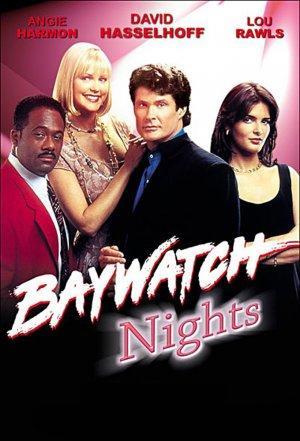
Welcome to Late Night Retro Television Reviews, a feature where we review some of our favorite and least favorite shows of the past! On Tuesdays, I will be reviewing Baywatch Nights, a detective show that ran in Syndication from 1995 to 1997. The entire show is currently streaming on You tube!
This week, the stars align and David Hasselhoff finally meets …. THE YAKUZA!
Episode 1.17 “Code of Silence”
(Dir by Charles Bail, originally aired on March 16th, 1996)
While her mother has a desperate conversation on a nearby payphone, young Mariko (Nicole Iiada) wanders onto the beach and spots a sea gull who has gotten tangled up in a fishing net. Fortunately, Mitch Buchannon drives up in his red Baywatch jeep and is able to set the sea gull free. Unfortunately, no sooner has the sea gull flown away then a bunch of Yakuza pull up and promptly kidnap Mariko’s mom.
Is there a detective in the house?
Why, yes, there is!
Well, kinda….
This is yet another episode of Baywatch Nights in which Mitch gets involved in a case as a result of being a lifeguard as opposed to being a private investigator. Indeed, if not for the presence of Angie Harmon, there would be little to distinguish this from an episode of Baywatch. While watching the last few episodes of Baywatch Nights‘s first season, you really can tell that the producers were desperate to bring over the audience that was watching just plan Baywatch. If the first half of the first season was all about David Hasselhoff wearing suits and providing hard-boiled narration, the second half is more about getting everyone onto the beach as quickly as possible.
As for this week’s case, it turns out that the kidnapped woman is a geisha who has a computer disk that the Yakuza wants. While the members of the Yakuza are busy threatening her with all sorts of violence, Mitch is teaming up with her grandfather (played by Soon-Tek Oh) and trying to discover where she’s being held. When Garner and Mitch find out about the Yakuza’s secret headquarters, they launch an assault. You might think that this would be difficult, seeing as how the members of the Yakuza are all ruthless martial artists. Well, it turns out that karate is no match for Mitch’s fists. The ancient art of combat falls before the power of the Hoff.
Somewhat inevitably, the episode ends with Mitch being given two samurai swords by Soon-Tek Oh. When Mitch says that he can’t accept such an expensive gift, Soon-Tek Oh says that no one gets the swords as a gift. Instead, they must be earned by truly displaying the spirit of the samurai. Mitch looks truly touched while Angie Harmon suppresses a laugh.
David Hasselhoff vs. The Yakuza! Well, we all knew it was going to have to happen at some point. That said, I don’t think the Hoff was dealing with first-grade Yakuza. It seems like the Yakuza sent the B-team to California. Well, that was their mistake. It didn’t take much effort for the Hoff to track them down and defeat them and in fact, it felt almost too easy. The Yakuza probably thought the Hoff would be too busy recording a new album to care. Again, their mistake.
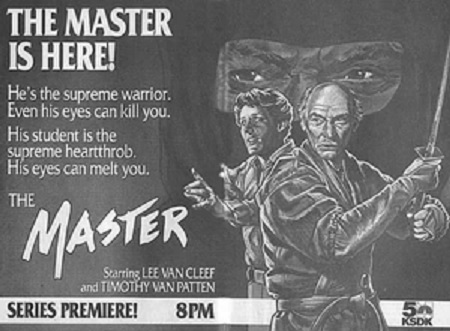
Welcome to Retro Television Reviews, a new feature where we review some of our favorite and least favorite shows of the past! On Fridays, I will be reviewing The Master, which ran on NBC from January to August of 1984. Almost all nine of the show’s episodes can be found on Tubi!
The adventures of John Peter McAllister and Max Keller continue!
That’s right, the search for McAllister’s daughter is still on and Max is still learning how to be a ninja. But, before we get to their latest adventure, it’s time to enjoy the opening credits!
Episode 1.2 “Out-of-Time Step”
(Dir by Ray Austin, originally aired on January 27th, 1984)
“Hi, I’m Max Keller and this is how I spend my mornings….” Max Keller tells us in voice over as we watch footage of Max (Timothy Van Patten) balancing on a rope that’s been tied between two trees. Yes, Max is still our narrator and John Peter McAllister (Lee Van Cleef) is still training him to become a ninja. Max is also still traveling in his van and with his hamster.
At the end of the previous episode, Max and McAllister were heading down to Atlanta to search for McAllister’s daughter. At the start of this episode, we discover that they are in San Francisco, investigating a lead that McAllister’s daughter may have danced at a club called Truffles. So, did they go to Atlanta or did they just change their mind and decide to stick around California? More to the point, did NBC say, “Hey, we’re not paying for you people to go out of state?”
Anyway, Truffles turns out to be a club that’s owned by Charlie Patterson (Charles Collins), a former film star who has fallen on hard times. (Charles Collins was a real-life dancer and when Patterson watches footage of a screen test that his character supposedly did for a Hollywood production, the footage is actually of Collins performing in a 1936 film called Dancing Pirate.) Patterson has two daughters. Kelly (Shanna Reed) is a dancer who thrills the club’s patrons every time she steps out onto the stage. The other, Jill (Lori Lethin), uses a wheelchair. Jill tells Charlie that he’s “an ex-hoofer with two daughters, one who wheels and one who does cartwheels.”
Upon arriving at Truffles, Max and McAllister discover that Charlie is being intimidated by Chinatown gangster, Johnny Chan (Brian Toshi) and Chan’s main enforcer, Mr. Lika (Soon-Tek Oh). Mr. Lika spots McAllister’s medallion and realizes that McAllister is a trained ninja. McAllister spots Mr. Lika’s ring and realizes that Mr. Lika is a member of the Yakuza. This establishes a mutual respect between the two of them, one that inevitably leads to a final battle between Soon-Tek Oh and Lee Van Cleef’s stunt double.
Of course, McAllister does more than just fight Mr. Lika. He also encourages Jill to stand up from her wheelchair and take a few steps. And when Johnny Chan has Kelly kidnapped, he and Max rescue her. (But not before Johnny shouts at her, “You’re a dancer! DANCE!”) It leads to a lot of action scenes but it doesn’t bring them any closer to McAllister’s daughter.
This episode wasn’t bad, largely because Soon-Tek Oh and Lee Van Cleef got a chance to face off. Even if all of the actual fighting was done by Van Cleef’s stunt double, it’s still undeniably fun to watch these two icons glare at each other and exchange tough guy dialogue. Plus, there was a lot of dancing! I always appreciate any show that finds room for more than one dance number, even if they are obviously lifted from Flashdance.
As I mentioned earlier, this episode ended with McAllister and Max nowhere close to finding McAllister’s daughter. But Max promised that they could keep looking. I’m sure they’ll find her. It’s not like America is that big.
That’s what they say about John Steele, the man who Martin Kove plays in 1987’s Steele Justice. John Steele served in Vietnam and he was one of the best and most fearless members of the special forces. On the final day of the war, he was on the verge of arresting the corrupt General Kwan (Soon-Tek Oh) until Kwan suddenly announced that the war was over and the Americans were leaving. Steele laughed, shrugged, and turned his back on Kwan and started to walk away. Was Steele planning on just walking back to America? Well, regardless, Kwan shot Steele and his friend in the back. Fortunately, Steele survived. Steele may be stupid but he’s strong.
Years later, both Steele and Kwan are now living in California. Kwan is a prominent businessman who is also the secret leader of the Vietnamese mafia. Naturally, his main henchman is played by Al Leong. If Al Leong’s not working for you, are you even evil? John Steele has not been quite as successful. He was a cop until he got kicked off the force. Then he got a job transporting horses across California. Despite his cool guy name, John Steele doesn’t seem to be that good at anything that doesn’t involve killing people.
But then Kwan murders Steele’s best friend and former partner, Lee (Robert Kim). In fact, Kawn not only murders Lee but he also kills Lee’s entire family. The only survivor is Lee’s daughter, Cami (Jan Gan Boyd), a piano prodigy who is supposed to be 14 years old even though she’s being played by someone who is in her 20s. Steele and Lee’s former boss, Bennett (Ronny Cox), gives Steele permission to track down the people responsible for Lee’s death.
John Steele sets out to destroy Kwan. The film gives us a lot of reasons to be on Steele’s side but it’s hard not to notice that a lot of innocent people end up getting killed as a result of Steele’s vendetta. Any time that Steele goes anywhere, Kwan’s people attack and a bunch of innocent bystanders get caught in the crossfire. For example, Steele’s ex, Tracy (Sela Ward), agrees to look after Cami. It turns out that Tracy is a music video director and, of course, she takes Cami to work with her. The video shoot turns into a bloodbath, with even the members of the band getting gunned down. And yet, not even Tracy seems to be particularly disturbed by that. One might think that Tracy would at least sarcastically say something like, “Hey, John, thanks for getting the band killed before I got paid,” but no. Tracy just kind of laughs it all off. At no point does Steele or Bennett or really anyone seem to feel bad about all of the people who get killed as a result of the decision to unleash John Steele. Those people had hopes and dreams too, you know.
I really like Martin Kove on Cobra Kai. I love how his portrayal of the over-the-hill and burned-out John Kreese manages to be both intimidating and pathetic at the same time. I’ve also seen a number of interviews with Kove, in which he’s discussed his career as an exploitation mainstay and he always comes across as being well-spoken and intelligent. That said, Martin Kove appears to be totally lost in Steele Justice, unsure if he should be playing John Steele as a grim-faced avenger or as a quick-with-a-quip action hero. Whenever Steele is angry, Kove looks like he’s on the verge of tears. Whenever Steele makes a joke, Kove smiles like an overage frat boy who, while cleaning out his old storage unit, has just discovered his long lost copy of Bumfights. It’s a confused performance but, to be honest, no one really comes out of Steele Justice looking good. This is a film that features a lot of talented actors looking completely and totally clueless as to why they’re there.
On the plus side, Steele Justice did give this world this totally intimidating shot of Martin Kove, preparing to be get and give justice. Recruit him? No, just unleash him!
To quote The Main With No Name, “When a man’s got money in his pocket, he begins to appreciate peace.”
Two years have passed since Paul Kersey (Charles Bronson) last visited and cleaned up New York. He is back in Los Angeles, the president of his own successful architectural firm. Now a rich man, he has retired from killing criminals, though he still has dreams where he shoots muggers in parking garages. Paul has a new girlfriend, journalist Karen Sheldon (Kay Lenz). When Karen’s teenage daughter, Erica (Dana Barron), dies of a cocaine overdose, it’s time for Paul to get his gun out of storage and blow away a drug dealer.
Shortly after shooting that drug dealer, Paul finds a note on his front porch. “I know who you are,” it reads. Paul then gets a call from a mysterious man (John P. Ryan) who identifies himself as being a reclusive millionaire named Nathan White. Nathan explains that his daughter also died of a cocaine overdose. He wants to hire Paul to take out not just the drug dealers but also the men behind the dealers, the bosses. Using his vast resources, Nathan has prepared a file on every major drug operation in Los Angeles. He offers to share the information with Paul.
“I’ll need a few days to think about it,” Paul says but we all know he’s going to accept Nathan’s offer just as surely as we know that Nathan White has an ulterior motive that won’t be revealed until the movie’s final twenty minutes.
For the first time, Paul is no longer just targeting muggers and other street criminals. This time, Paul is going after the guys in charge and trying to bring an end to drug trade once and for all. (The idea that the best way to win the war on drugs was just to kill anyone involved in the drug trade was a very popular one in the late 80s.) L.A.’s two major drug cartels are led by Ed Zacharias (Perry Lopez) and the Romero Brothers (Mike Moroff and Dan Ferro). Along with their own activities, Paul and Young work the turn the two cartels against each other.
It’s not just the criminals that have changed in Death Wish 4. Paul has changed, too. Paul used to just shoot criminals and run away. In Death Wish 4, he gets more creative. He sneaks into Zacharias’s mansion and bugs the phone so that he can keep track of what’s going down. When it comes time to kill a table full of drug dealers (one of whom is played by Danny Trejo), Paul doesn’t shoot them up. Instead, he sends them a bottle of champagne that explodes when they open it. By the end of the movie, Paul is blowing away the bad guys with a grenade launcher! How many former conscientious objectors can brag about that?
The biggest difference between Death Wish 4 and the films that came before it is the absence of director Michael Winner. Winner and Bronson had a falling out following Death Wish 3 and, as a result, Winner had little interest in returning to the franchise. Instead, Winner was replaced by J. Lee Thompson, who had already directed Bronson in several other Cannon films. As a result, Death Wish 4 is less “heavy” than the previous Death Wish films. Whereas Winner’s direction often felt mean-spirited and exploitive, Thompson plays up the film’s sense of airy adventure.
Though it barely made a profit at the box office and has been dismissed by critics, Death Wish 4 is an enjoyable chapter in Paul’s story. If you’re looking for mindless 80s mayhem, Death Wish 4 gets the job done with admirable efficiency. It would have made a great ending for the franchise but Bronson would return to the role one last time.
Goddamn, dude. Chuck Fucking Norris. Even when the movie is terrible, Chuck is cool.
That is especially relevant when it comes to a movie like Missing In Action 2: The Beginning. Produced by Cannon Films and shot back-to-back with the first Missing in Action, The Beginning was supposed to come out first. However, Menahem Golan and Yoram Globus took a look at the two movies and realized that The Beginning would work better as the 2nd film in the series. They were right though some post-production tinkering did lead to some serious errors in continuity.
(Not that anyone watching a Golan/Globus production would be worrying about continuity.)
Did you ever wonder how James Braddock (Chuck Norris) became a POW in the first place? No? Missing In Action 2 is going to show you how it happened anyway. It turns out that he and his men were captured, in 1972, by the Viet Cong when their helicopter crashed into a lake. At the start of the movie, Chuck only has a mustache. If Chuck had been fully bearded, there is no way the VC could have captured him. After Chuck and his men have spent ten years in a jungle prison, where they are forced to pick poppies for a French heroin drug lord, Chuck has grown a full beard and is finally strong enough to escape from the prison, rescue his men, and defeat the sadistic camp commandant (Soon-Tek Oh) in hand-to-hand combat. None of it is surprising but there’s enough weird stuff, like the prostitutes that the French drug dealer flies into the camp and the Australian journalist who shows up out of nowhere and is executed ten minutes later, to keep it interesting. Chuck is as stiff as always but he’s good in the action scenes and gets to show off some sweet karate moves towards the end of the movie. Supposedly, Chuck viewed the Missing in Action films as a tribute to his brother, Wieland, who was killed in Vietnam.
The continuity error has to do with the amount of time that Braddock and his men spend in the camp. After Chuck is captured in 1972, the film inserts some footage of Ronald Reagan giving a speech about the men who never returned from Vietnam. A narrator says that the Americans are still wondering what happened to the thousands of soldiers who were reported as being MIA in Vietnam. The implication is that Chuck and company spent ten years in the POW Camp, which means that they escaped in 1982. Since it is said, in Missing in Action, that it has been ten years since Chuck escaped, that means that Missing in Action actually took place in 1992. But if Chuck and the boys escaped and returned to America in 1982 then why, in 1992, was everyone so convinced that all the POWs were released immediately after the Vietnam War?
Fortunately, Chuck Norris is so cool that it doesn’t matter what year it is.
Seven strangers are invited to a remote island by a mysterious billionaire named Osiris. There is a doctor, a dancer, an auto mechanic, a mercenary, a football player and his agent, and a member of the Yakuza. The auto mechanic points out that, in Egyptian mythology, Osiris judged mankind’s sins. For some reason, none of the seven think twice about going to the island but, once they arrive, they soon discover that they should have. Osiris is willing to give them seven million dollars but to get it, they have to reach the other end of the island without being killed by Osiris or his men.
Of the many movie adaptations of The Most Dangerous Game, this is probably the worst. The cast, which includes Michael Beck, Marc Singer, Jenny Seagrove, Mitch Ryan, John Pleshette, Soon-Tek Oh, and Roddy McDowall, isn’t bad but the script is terrible, full of overwrought dialogue and plot holes. Across the island, Osiris has left clues that are designed to trigger flashbacks and lead to each member of the seven explaining what it is that they did in the past. But for that to work, Osiris would have to know exactly what route the seven of them were going to use to cross the island and he would also have to know who would still be alive by the time that they came across each clue. Also, whenever they come across the clue, everyone stands around and wastes valuable time arguing about it. Considering that there are armed men trying to kill them, no one seems to be in that much of a hurry to make it to the other side of the island. The flashbacks themselves are interesting in how clumsily they are put together. 40ish Marc Singer plays himself as a senior in high school.
Like Hitler’s Daughter, Deadly Game was originally made for the USA network. The first time I saw it was in the UK where, for some reason, it seemed to air frequently during the mid-1990s. (Possibly this was because it starred quintessential Hollywood Brit Roddy McDowall. That’s the only reason I can think of.) It’s now on YouTube, for anyone who wants to sit through it.
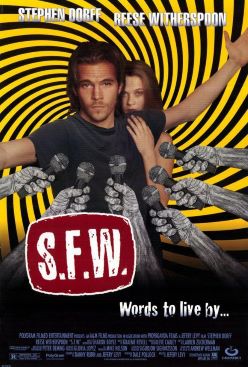 Cliff Spab (Stehpen Dorff), his friend Joe Dice (Jack Noseworthy), and teenager Wendy Pfister (Reese Witherspoon) are in the wrong convenience store at the wrong time and end up being taken hostage by a group of masked terrorists who have guns and video cameras. For 36 days straight, their ordeal is broadcast live on television. They become the number one show in the country and Cliff’s nihilistic attitude makes him a star. When the terrorists threaten to kill him, he spits back, “So fucking what!?” Alienated young people take up S.F.W. as a personal chant and credo. When Joe finally fights back, both he and the terrorists are killed in the shoot-out. Wendy and Cliff are now celebrities, even though they don’t want to be. Released into the real world, Cliff has to deal with everyone wanting to make money off of him. His alienation has been turned into a product. He just wants to be reunited with Wendy but his fans want him to tell them how to live their lives. Fandom turns out be a fickle beast.

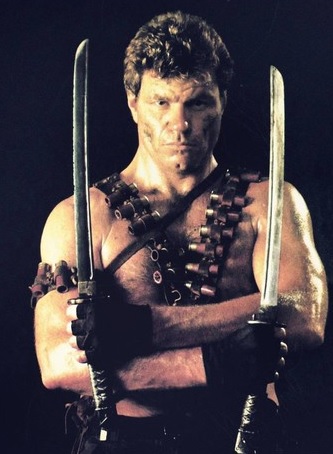
 To quote The Main With No Name, “When a man’s got money in his pocket, he begins to appreciate peace.”
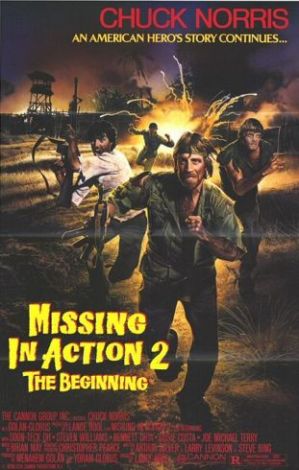 Goddamn, dude. Chuck Fucking Norris. Even when the movie is terrible, Chuck is cool.
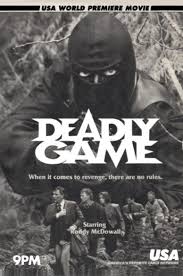 Seven strangers are invited to a remote island by a mysterious billionaire named Osiris. There is a doctor, a dancer, an auto mechanic, a mercenary, a football player and his agent, and a member of the Yakuza. The auto mechanic points out that, in Egyptian mythology, Osiris judged mankind’s sins. For some reason, none of the seven think twice about going to the island but, once they arrive, they soon discover that they should have. Osiris is willing to give them seven million dollars but to get it, they have to reach the other end of the island without being killed by Osiris or his men.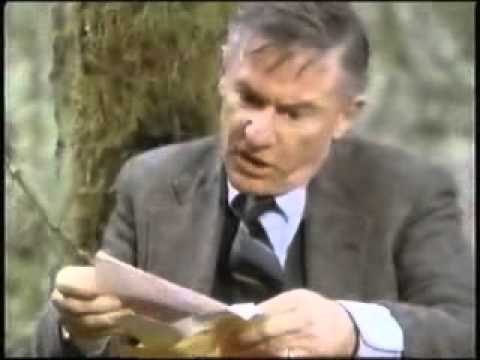
 Through the Shattered Lens