Film Review: Any Which Way You Can (dir by Buddy Van Horn)


In this 1980 sequel to Every Which Way But Loose, Philo and his orangutan Clyde are still living next door to Orville (Geoffrey Lewis) and his mother (Ruth Gordon).  Philo is still working as a truck driver but he’s becoming far better known as a bare-knuckles brawler.  In fact, when another famous fighter named Jack Wilson (William Smith), moves to the area, everyone assumes that Jack wants to challenge Philo.  It turns out that Jack’s actually a pretty nice guy.  He and Philo become jogging buddies.

Remember Lynn Halsey-Taylor (Sondra Locke), the extremely self-centered singer who broke Philo’s heart in the first film?  Well, she’s back and she’s changed her ways.  When she and Philo meet in a bar, Lynn apologizes to him for her past behavior and soon, she and Philo are a couple again.  Booo!  Seriously, Eastwood and Locke somehow have even less chemistry here than they did in the first film.  (Again, Locke and Eastwood were in a relationship at the time, which makes their total lack of chemistry even more interesting to consider.)  Everyone in the film is surprisingly forgiving of Lynn, considering that she was portrayed as being nearly sociopathic in the previous film.  Even Clyde seems to be happy to have her back.  Of course, Clyde gets to have a romance of his own, with another orangutan.  Clyde has sex with his partner while Philo and Lynne fool around in the room next door.  It’s …. kind of weird.

Anyway, the Mafia really wants Philo and Jack to fight so they decide to kidnap Lynn in order to force the fight to happen.  Instead, Jack and Philo team up to rescue Lynn and to put those gangsters in their place.  That might sound dramatic but this film is very much a redneck comedy so these are probably the least intimidating mafia soldier that I’ve ever seen.  Just as the previous film’s outlaw bikers (and they also make a return appearance in this film) were too buffoonish to be truly menacing, the same is true of the Mafia in this film.

In the end, Philo and Jack do have a fight but it’s under their own terms and, afterwards, they accompany each other to the hospital.  It’s kind of a nice moment, really.  Even after beating the hell out of each other and causing more than a few broken bones, Philo and Jack are still friends.  It’s a nice touch that Jack was played by William Smith, who was a bit of a low-budget version of Clint Eastwood.

Indeed, with Geoffrey Lewis relegated to a supporting role and Sondra Locke abducted by the mafia, the friendship between Philo and Jack becomes the heart of the film and if there is really anything that makes this film memorable, it’s the scenes that Eastwood shares with William Smith.  These two tough guys actors seem to have a natural understanding of each other and their friendship and mutual respect feels real.  They may fight but it’s only out respect for each other.  It’s a shame that Eastwood and Smith didn’t team up for more films.

Any Which Way You Can is an amiable comedy.  It’s not as much fun as Every Which Way But Loose.  Beverly D’Angelo’s Echo is missed but she was presumably busy filming Coal Miner’s Daughter at the time.  The film works best as a buddy movie.  Clint Eastwood, William Smith, Geoffrey Lewis, and an orangutan.  What a team!
Film Review: Every Which Way But Loose (dir by James Fargo)


In 1978’s Every Which Way But Loose, Clint Eastwood plays Philo Beddoe.

Philo’s an ordinary guy with beautiful hair and a way with throwing punches.  He’s a truck driver.  He enjoys a cold beer.  He enjoys country music.  He makes some extra money by taking part in bare-knuckle brawls.  Everyone says that he could be the next Tank Murdock, a legendary fighter.  Philo is just a simple, blue collar guy who lives in a small house, next door to his best friend Orville (Geoffrey Lewis) and Orville’s profanity-loving mother (Ruth Gordon).  Philo also owns an orangutan named Clyde.  He saved Clyde from being sent to live in a “desert zoo.”

(Actually, now that I think about it, most blue collar guys don’t own monkeys but whatever.  Clyde’s cute and Eastwood’s Eastwood.)

When Philo meets a country singer named Lynn Halsey-Taylor (Sondra Locke), he is immediately smitten.  When Lynn disappears and leaves Philo a cryptic note, Philo decides to go looking for her.  Clyde, Orville, and Philo hit the road.  Along the way, Orville meets and picks up a woman named Echo (Beverly D’Angelo).  This is a road movie so, of course, Clyde, Orville, Philo, and Echo have their adventures on the way to Colorado.  They end running afoul both a corrupt cop and a gang of buffoonish bikers.  Philo enters a fight whenever they need money and one occasionally gets the feeling that Eastwood took this role to show off the fact that, for someone approaching 50, he still looked good without a shirt on.  And good for him!  Because, seriously, Clint does look good in this movie….

I have to admit that, for all of my attempts at sophistication, my roots are in the country and I’ve traveled down enough dirt roads that I find it hard to resist a good redneck story.  And really, there aren’t many films that as proudly and unashamedly redneck than Every Which Way But Loose.  It’s a film that has a laid back, take-it-as-it-comes vibe to it.  Philo may be looking for Lynn but he seems to be okay with taking a few detour along the way.  There’s no real sense of urgency to any part of the movie.  Instead, Every Which Way But Loose was made for people who like a cold beer at the end of the day and who find Ruth Gordon to be hilarious when she curses.  Myself, I don’t drink.  That’s one part of the country lifestyle that passed me over.  But I did enjoy seeing Ruth Gordon cuss out the Nazi biker gang.

Eastwood, Lewis, and D’Angelo have a likable chemistry and the monkey’s cute.  Unfortunately, Sondra Locke isn’t particularly well-cast in the role of Lynn.  (Considering that she was in a relationship with Eastwood, it’s amazing how little chemistry they have in this movie.)  As I watched the film, it occurred to me that it probably would have worked better if Locke and D’Angelo had switched roles.  Locke’s character is supposed to be a femme fatale type but she gives a boring performance and, as a result, the revelation that Philo has misjudged her doesn’t really carry any emotional weight.

That said, this film features some beautiful shots of the wilderness, a charming romance between Lewis and D’Angelo, and a shirtless Clint Eastwood beating folks up.  That’s more than enough to please this secret country girl.

Days of Paranoia: The Gauntlet (dir by Clint Eastwood)


In 1977’s The Gauntlet, Dirty Harry is sent….

Oh wait, sorry.  This is not a Dirty Harry movie.  It sure feels like a Dirty Harry movie but it’s not.  And really, the character that Clint Eastwood plays in this movie, Phoenix Detective Ben Shockley, is different from Dirty Harry Callahan.  Shockley is a cynical (and single) detective who does things his own way.  He’s got that in common with Callahan.  But Shockley is also an alcoholic and that’s something that Harry would never allow himself to become.  Harry may be unpredictable but he’s disciplined and he’s always in control.  The other big difference is that Shockley has a little more faith in his fellow cops than Harry does.  As a result, Shockley gets set-up in a trap that Harry would have seen coming from miles away.

Shockley is sent to Las Vegas to pick up a prostitute named Augustina and bring her back to Arizona.  Augustina — who goes by Gus — is played by Sondra Locke.  This was the second film that Eastwood and Locke made together.  As a result of preparing for today’s Eastwood marathon, I watched all of the Eastwood/Locke films.  The Gauntlet features Locke’s best performance opposite Eastwood.  (She was good in The Outlaw Josey Wales but her role was also fairly small and simple.)  As opposed to her later films, Locke actually has a good deal of romantic chemistry when Eastwood in this film and, even more importantly, she actually seems invested in the role.  She plays Gus as being a feisty asskicker.  It doesn’t matter that she’s in jail or that she’s handcuffed or that she’s been escorted to another state.  Gus isn’t going to let anyone tell her what to do.   It’s impossible not to root for both her and Shockley in this film.

Of course, it turns out that Shockley has been set up.  Phoenix Police Commissioner Blakelock (William Prince) and District Attorney John Feyderspiel (Michael Cavanaugh) both have their own reasons for not wanting Gus to make it to Phoenix and they’re both willing to sacrifice Shockley to get to her.  They assumed that Shockley, being an alcoholic, would be easy to defeat.  Did they not consider that, alcoholic or not, Ben Shockley is played by Clint Eastwood?  Every attempt that is made to stop him just makes Shockley all the more determined to get Gus to Phoenix.  The film becomes a particularly violent take on It Happened One Night, going as far as to have Gus and Shockley take over a bus on their way to Phoenix.

Ah, the bus.  The Gauntlet climaxes with a scene in which literally thousands of bullets are fired into a bus that Shockley and Gus are driving through Phoenix.  It’s an exciting sequence, one that’s so gloriously over-the-top that you can’t help but feel that Eastwood was poking fun at his own persona.  At the same time, the sequence also works as a commentary on the blind obedience necessary for an authoritarian to come to power.  The cops who have lined up to shoot at the bus open fire when they’re ordered to, without asking why a bus has to be riddled with bullets.  Eastwood manages to mix a healthy dose of paranoia with his satire.

Though the plot (much like the bus) is riddled with holes, The Gauntlet‘s an entertaining film.  Between Eastwood and Locke’s chemistry and the explosive action sequences, The Gauntlet is a film you can’t look away from.

Film Review: The Outlaw Josey Wales (dir by Clint Eastwood)


Towards the end of 1976’s The Outlaw Josey Wales, Josey (played by Clint Eastwood) says, “I guess we all died a little in that damned war.”

He’s referring to the American Civil War and the film leaves you with no doubt that Wales knew what he was talking about.  A farmer living in Missouri, Josey Wales wasn’t involved in the Civil War until a group of guerillas, the Redlegs, raided his home and killed his family.  Seeking vengeance, Wales joined the Bushwackers, a group of Confederate guerillas that were led by the infamous “Bloody Bill” Anderson.  After Anderson’s death and the South’s surrender, Senator James H. Lane (Frank Schofield) offers amnesty to any of the Bushwackers willing to surrender and declare their loyalty to the United States.  Fletcher (John Vernon), the leader of the surviving Bushwackers, thinks it’s a good idea and his men eventually agree to surrender.

Everyone except for Josey Wales.

Fletcher tells Josey that he’ll be an outlaw and that Lane will send his men to capture and execute him.  “I reckon so,” Josey Wales replies.  It’s not that Josey was particularly a fan of the Confederate cause.  Instead, having lost his family and his home and having seen hundreds of men killed, Josey no longer cares.  He’s got a death wish, something that becomes apparent when he later sneaks over to Lane’s camp and discovers that the leader of the Redlegs, Terrill (Bill McKinney), has been made a captain in the Union Army.  The surrendering Bushwackers, with the exception of Fletcher and a young man named Jamie (Sam Bottoms), are gunned down as they swear allegiance to the United States.  Joey springs into action, hijacking a Gatling gun and mowing down soldiers.  It’s a suicidal move and Josey appears to be willing to die, until he sees that Jamie has been wounded.  Josey and Jamie go on the run, pursued by soldiers and bounty hunters.

It sounds like the start of typical Clint Eastwood film and, make no mistake about it, The Outlaw Josey Wales features everything that most people have come to expect from Eastwood.  Josey Wales is an expert shot, often firing two guns while charging forward on his horse.  Josey has a way of words, explaining the purpose of getting “plain man dog mean” and telling a bounty hunter that there are better ways to make a living.  The main difference, though, is that Josey is no longer seeking revenge.  He’s lost his family and his home and he knows nothing is going to bring them back.  He sought revenge during the Civil War and saw so many people killed that, much like Jimmy Stewart in Broken Arrow, he just wants to disappear from civilization.

The problem is that men like Lane and Terrill have no intention of letting Josey Wales disappear.  The sociopathic Terrill sees it as almost being his God-given duty to kill Josey Wales and anyone else that he dislikes.  The bounty hunters are also after Josey Wales.  As Fletcher explains it, bounty hunting is the only way that many former soldiers can make money and feed their families.  As Josey moves through the southwest, his legend grows.  Every town that Josey stops in, he hears stories about the growing number of men that he has supposedly killed.

Josey also discovers that he can’t do it all alone.  He soon finds himself as a part of a new family, a collection of misfits that don’t have a home in Senator Lane’s America.  Lone Waite (Chief Dan George) is an elderly Cherokee man who suggests that Josey head for Mexico.  Little Moonlight (Geraldine Keams) is a Navajo woman who Josey rescues from two bounty hunters.  Sarah Turner (Paula Trueman) and her granddaughter, Laura Lee (Sondra Locke), are rescued from Comancheros.  Josey negotiates the release of two of Sarah’s ranch hands and befriends Chief Ten Bears (Will Sampson) while doing so.  Slowly, Josey comes out of his shell and starts to embrace life once again.  Josey goes from searching for death to searching for peace.

It’s one of Eastwood’s best films, ending on a note of not violence but instead sad regret.  It’s not only a portrait of a man learning to embrace life but it’s also a portrait of a country trying to figure out how to come back together after the bloody savagery of the Civil War.  Some, like Fletcher and Josey, want to move on.  Others, like Terrill, don’t have an identity beyond fighting and killing.  Eastwood gives a good performance but, as a director, he gives every member of the cast a chance to shine.  If you only know John Vernon as Dean Wormer from Animal House, his sad-eyed performance here will be a revelation.

Originally, The Outlaw Josey Wales was meant to be directed by Phillip L. Kaufman but Eastwood felt that Kaufman was taking too long to set up his shots and worrying about details that really didn’t matter.  Reportedly, while Kaufman was away from the set, spending hours searching for a historically-correct beer bottle to be used in a bar scene, Eastwood directed the scene himself and then convinced producer Robert Daley to fire Kaufman and allow Eastwood to direct the film.  (Kaufman also objected to the script’s anti-government subtext but seriously, that’s pretty much the subtext of every film that Eastwood has ever been involved with.)  The DGA later instituted a rule that, on productions in which the director was fired,  the replacement could not be a member of his crew or an actor in the cast but that was too late to help out Kaufman.

(Rumor has it that another reason Kaufman was fired was because he and Eastwood both “liked” Sondra Locke.  This was the first of six films that Eastwood and Locke would do together.)

To be honest, I think it worked out in the film’s favor.  It’s a little surprising that someone other than Eastwood was ever considered as director to be begin with, so perfectly does the story and the lead character fit with Eastwood’s persona.  Eastwood captures both the beauty of the untouched land and also the bloody violence of combat.  In many ways, this film almost feels like a prequel to UnforgivenThe Outlaw Josey Wales is Eastwood at his best.

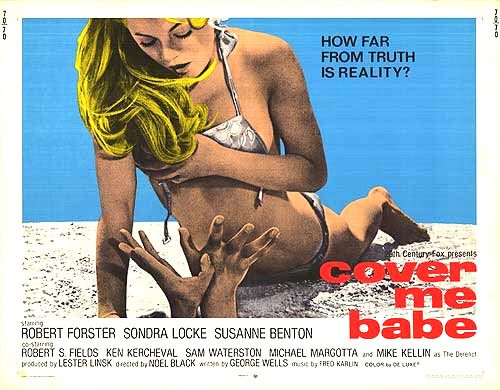
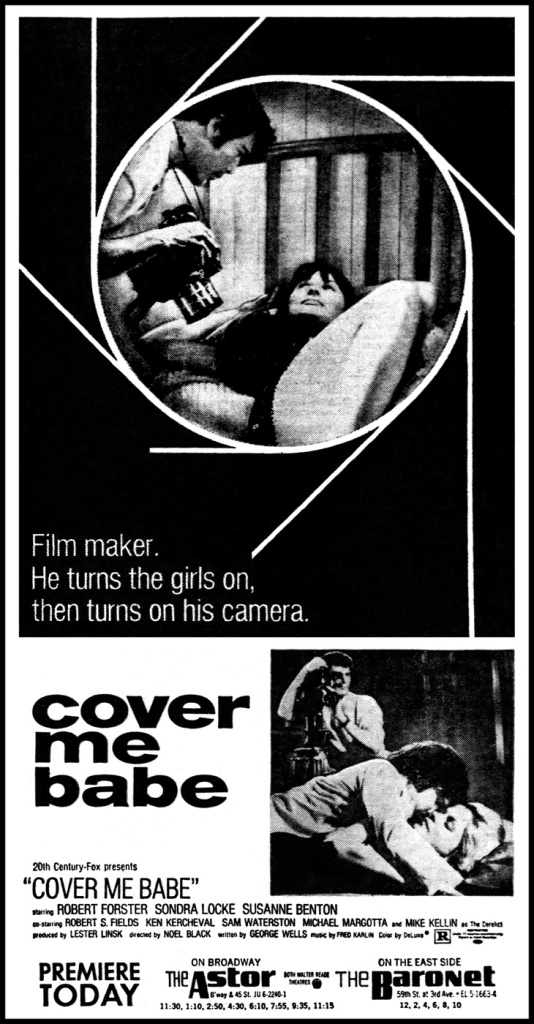
Film Review: Cover Me, Babe (dir by Noel Black)


I don’t know if I’ve ever come across a non-horror film that featured a more off-putting lead character than Tony, the protagonist of 1970’s Cover Me, Babe.

A film student, Tony (Robert Forster, even in 1970, who was too old for the role) aspires to make avant-garde films.  Everyone in the film continually raves about how talented Tony is.  The footage that we see, however, tends to suggest that Tony is a pretentious phony.  The film opens with footage of a student film that Tony shot, one that involves his girlfriend, Melisse (Sondra Locke) sunbathing in the desert and getting groped by a hand that apparently lives under the sand.  It was so self-consciously arty that I assumed that it meant to be satirical and that we were supposed to laugh along as Tony assured everyone that it was a masterpiece.  And, to be honest, I’m still not sure that Cover Me, Babe wasn’t meant to be a satire on film school pretension.  I mean, that explanation makes about as much sense any other.  (Hilariously enough, Tony’s film had the same visual style as the film-within-a-film around which the storyline of Orson Welles’s The Other Side of the Wind revolved.  At least in the case of Welles, we know that his intent was satirical.)

Tony is not only pretentious but he’s also a bit of a prick.  He treats Melisse terribly and he manipulates everyone around him.  He wanders around the city with his camera, filming random people and then editing the footage together into films that feel like third-rate Godard.  He answers every criticism with a slight smirk, the type of expression that will leave you dreaming of the moment that someone finally takes a swing at him.  Tony’s arrogant and he treats everyone like crap but, for whatever reason, everyone puts up with him because …. well, because otherwise there wouldn’t be a movie.  Of course, eventually, everyone does get sick of Tony because otherwise, the movie would never end.

A Hollywood agent (Jeff Corey) calls up Tony and offers to get him work in Hollywood.  Tony is rude to the guy on the phone.  Tony meets a big time producer who could get Tony work.  Tony’s rude to him.  Guess who doesn’t get a job?  Tony has to get money to develop his latest film from one of his professors so he’s rude to the professor.  Guess who doesn’t get any money?  Tony cheats on his loyal girlfriend.  Tony’s cameraman (played by a youngish Sam Waterston) walks out when Tony tries to film two people having sex.  By the end of the movie, no one wants anything to do with Tony.  Tony goes for a run on the beach.  He appears to be alienated and disgruntled.  We’re supposed to care, I guess.

The problem with making a movie about an arrogant artist who alienates everyone around him is that you have to make the audience believe that the artist is talented enough to justify his arrogant behavior.  For instance, if you’re going to make a movie about a painter who is prone to paranoid delusions and obsessive behavior, that painter has to be Vincent Van Gogh.  He can’t just be the the guy who paints a picture of two lion cubs and then tries to sell it at the local art festival.  You have to believe that the artist is a once-in-a-lifetime talent because otherwise, you’re just like, “Who cares?”  The problem with Cover Me, Babe is that you never really believe that Tony is worth all of the trouble.  The film certainly seems to believe that he’s worth it but ultimately, he just comes across as being a jerk who manipulates and mistreats everyone around him.

That said, from my own personal experience, a lot of film students are jerks who treat everyone them like crap.  So, in this case, I think you can make the argument that Cover Me, Babe works well as a documentary.  The fact of the matter is that not every film student is going to grow up to be the next Scorsese or Tarantino or Linklater.  Some of them are going to turn out to be like Tony, running along the beach and wondering why no one agrees with him about George Stevens being a less interesting director in the 50s than he was in the 30s.  As a docudrama about the worst people that you’re likely to meet while hanging out on campus, Cover Me, Babe is certainly effective.  Otherwise, the film is a pretentious mess that’s done in by its unlikable protagonist.  Everyone in the film says that Tony has what it takes to be an important director but, if I had to guess, I imagine he probably ended up shooting second unit footage for Henry Jaglom before eventually retiring from the industry and opening up his own vegan restaurant in Vermont.  That’s just my guess.

The poster has little to do with the film.

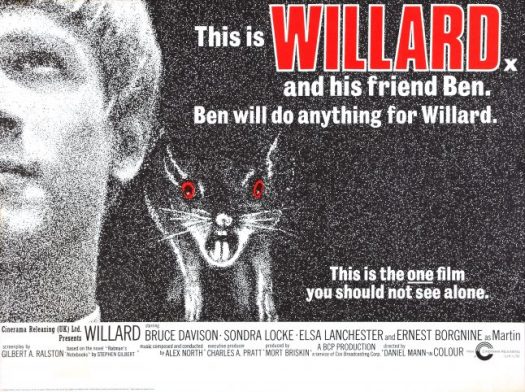
Creepy Crawlies: WILLARD (Cinerama 1971)


gary loggins's avatarcracked rear viewer

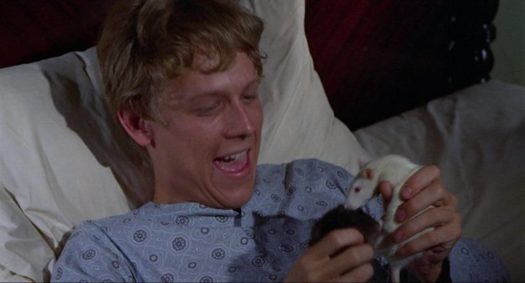
Rats are not cute’n’cuddly little creatures. They’re disgusting, disease-infested vermin that should be avoided at all costs. But don’t tell that to WILLARD, title character in this 1971 chiller that started a regular revolution of “animals run amok” horror movies. Bruce Davison, later to become one of his generation’s finest actors (SHORT EYES, THE LATHE OF HEAVEN, LONGTIME COMPANION), is a regular rodent Dr. Doolittle here, not only talking to the animals, but handling them fondly while he trains them to kill his enemies. Rats – yuck!

Willard Stiles is a lonely loser who shares a rambling, decrepit manse with his  domineering mother (Elsa Lanchester) and works for bullying boss Martin (Ernest Borgnine ), who stole the family business from Willard’s late father. Office temp Joan (Sondra Locke) feels sorry for Willard, but the socially awkward nerd is uncomfortable around people, preferring instead to spend time with the rats in…

View original post 365 more words

Well-Structured Destruction: Clint Eastwood in THE GAUNTLET (Warner Brothers 1977)


gary loggins's avatarcracked rear viewer

(First off, feast your eyes on the incredibly cool Frank Frazetta poster! Then read on… )

Clint Eastwood’s  directorial credits include some impressive films: THE OUTLAW JOSEY WALES, PALE RIDER, UNFORGIVEN, MYSTIC RIVER, MILLION DOLLAR BABY. While 1977’s THE GAUNTLET may not belong on that list, I feel it’s a very underrated movie deserving a second look. Clint and his lady love at the time Sondra Locke star in this character study of two damaged people disguised as an action comedy, essentially a chase film loaded with dark humor.

Clint plays Ben Shockley, an alcoholic Phoenix cop sent to Las Vegas to extradite Gus Mally, “a nothing witness in a nothing trial”. Gus turns out to be a woman, a hooker in fact, set to testify against a Phoenix mobster. Ben’s suspicions are roused when he learns Vegas oddsmakers are giving 50-1 they don’t make it to Phoenix alive, confirmed…

View original post 582 more words