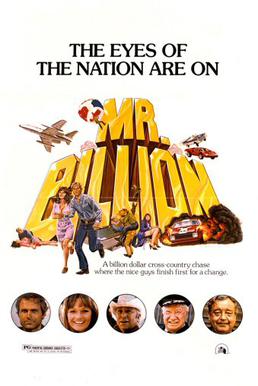
Lisa Reviews A Film That Was Not Nominated For Any Oscars: Mr. Billion (dir by Jonathan Kaplan)


The 1977 film Mr. Billion tells the story of Gudio Falcone (played by Terence Hill, whose real name is Mario Girotti).  Guido has got a pretty good life going in Italy.  Everyone in his village loves him.  He works as an auto mechanic.  When we first see him, he speeding around in a red sportscar.  When he returns to the garage, he smiles and says, in Italian, “Just like Steve McQueen.”  Guido may not be rich but he’s happy.

But that’s all about change!

Well, not the happy part.  Guido is pretty much always happy.  But he’s about to get rich.  It turns out that Guido is the last surviving relative of Antonio Falcone.  Years ago, Antonio immigrated to America and founded Falcon Motors.  The company eventually made Antonio one of the richest men in the world.  Unfortunately, the big Falcon Motors sign eventually fell off the company’s headquarters and it landed right on top of Antonio.

Everyone’s upset about Antonio’s death.  Well, everyone but the company’s vice president, John Cutler (Jackie Gleason).  John was naturally expecting that he would be named Antonio’s successor and that he would also inherit all of Antonio’s money.  Instead, Antonio’s will leaves everything to Guido!

Why?

Because, apparently, Guido never asked Antonio for anything more than a “pair of American cowboy boots.”

Cutler and his sleazy attorney (William Redfield) are soon on the next flight to Italy.  When they find Guido, they make sure to compliment him on his cowboy boots.  They explain to Guido that he has twenty days to go San Francisco and sign the proper papers.  If he’s any later than 20 days he’ll lose the money.  Of course, that shouldn’t be a problem since Guido can fly over anytime that he wants…

Except Guido refuses to fly!  No, he says that if he’s going to go to America, he’s going to arrive there the same way that Antonio did.  He is going to take a boat to New York City and then ride a train all the way to California.

Did you guess that the very next scene would be Guido standing on the dock of a cruise ship, staring at the Statue of Liberty?  And did you also also guess that, upon disembarking, he would immediately find himself besieged by reporters, one of whom declares him to now be the world’s most eligible bachelor?  If so, good work.

But here’s the big question.  Did you also predict that John Cutler would attempt to sabotage Guido’s trip to California and that the sabotage would involve hiring a private detective (Valerie Perrine)?  Even more importantly, did you predict that the detective would eventually end up falling in love with simple but honest Guido?

Because that’s totally what happens!

At the time that Mr. Billion was made, Terence Hill was a huge star in Europe but was barely known in the United States.  He was best known for appearing in a series of comedic Spaghetti Westerns with Bud Spencer, the majority of which featured Hill as a lazy but likable ne’er do well.  In Mr. Billion, Hill is cast as the exact opposite, as an earnest man-of-the-people who is so nice that it’s almost painful.  Add to that some major tone problems (the film cannot make up its mind if it wants to be a comedy, an action film, or a romance) and you have a pretty forgettable movie.

And that’s kind of a shame because Terence Hill showed some legitimate charm in the lead role.  The role may have been underwritten but all Hill had to do is flash that winning smile and it didn’t matter.  It’s unfortunate that Hill didn’t get a more appropriate vehicle for his American debut.

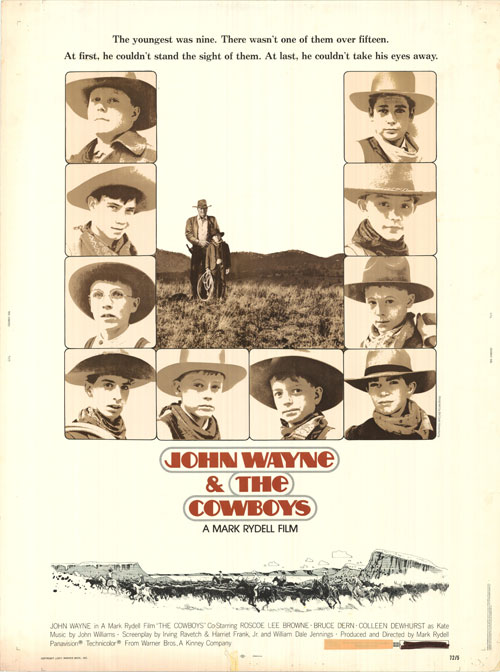
Young Frontier: John Wayne in THE COWBOYS (Warner Brothers 1972)


gary loggins's avatarcracked rear viewer

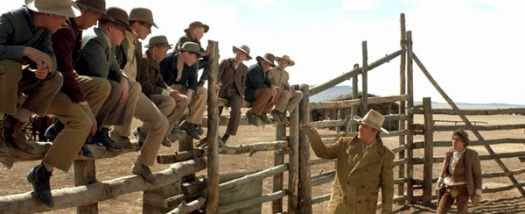
THE COWBOYS is not just another ‘John Wayne Movie’ from the latter part of his career. Not by a long shot. Duke had read the script and coveted the part of Wil Andersen, who’s forced to hire a bunch of wet behind the ears adolescents for a 400 mile cattle drive across the rugged Montana territory. Director Mark Rydell wanted George C. Scott for the role, but when John Wayne set his sights on something, he usually got what he wanted. The two men were at polar opposites of the political spectrum, and the Sanford Meisner-trained Rydell and Old Hollywood Wayne were expected to clash. They didn’t; putting their differences aside, they collaborated and cooperated  to make one of the best Westerns of the 70’s.

Andersen’s regular hands have all deserted him when gold is discovered nearby, leaving the aging rancher in the lurch. He heads for Boseman to look…

View original post 797 more words

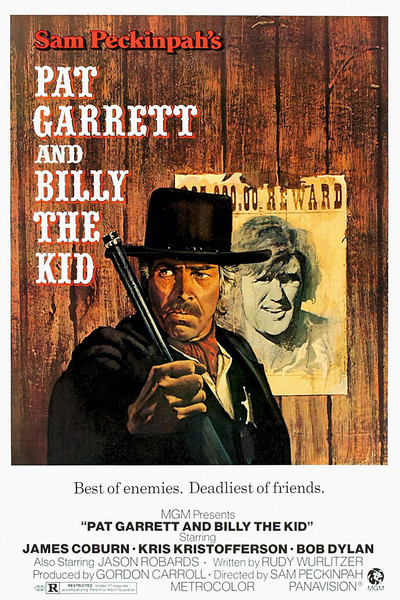
Knockin’ On Heaven’s Door: PAT GARRETT AND BILLY THE KID (MGM 1973)


gary loggins's avatarcracked rear viewer

(PAT GARRETT AND BILLY THE KID airs tonight at 11:45 EST on TCM. Do yourselves a favor… watch it!)

PAT GARRETT AND BILLY THE KID was director Sam Peckinpah’s final Western, and as usual it’s about more than just the Old West. It’s about the new breed vs the old establishment, about the maverick auteur vs the old studio guard, and about his never-ending battle to make his films his way. The fact that there are six, count ’em, SIX different editors credited tells you what MGM honcho James Aubrey thought of that idea! They butchered over 20 minutes out of the movie, which then proceeded to tank at the box office. Fortunately for us, PAT GARRETT AND BILLY THE KID has been restored to its full glory, and we can enjoy Peckinpah’s original artistic vision.

I’m not going to try to make excuses for Peckinpah; he was a legitimate pain in the ass, a…

View original post 616 more words

A Movie A Day #154: The Day They Hanged Kid Curry (1971, directed by Barry Shear)


Welcome to the Old West.  Hannibal Heyes (Pete Duel) and Kid Curry (Ben Murphy) are two of the most wanted outlaws in the country, two cousins who may have robbed trains but who also never shot anyone.  After being promised a pardon if they can stay out of trouble for a year, Heyes and Curry have been living under the names Joshua Smith and Thaddeus Jones.

During a trip to San Francisco to visit his old friend, a con artist named Silky O’Sullivan (Walter Brennan), Heyes is told that Kid Curry is currently on trial in Colorado.  When Heyes goes to the trial, he discovers that the accused (Robert Morse) is an imposter and that the real Kid Curry is watching the trial from the back of the courtroom.  It turns out that the man of trial is just an attention seeker , someone who is so desperate for fame that he is willing to be hanged to get it.  At first, Curry thinks this is a great thing.  After the imposter hangs, everyone will believe that Curry is dead and they’ll stop searching for him.  Heyes, however, disagrees, especially after the imposter starts to implicated Heyes in crimes that he didn’t commit.

Obviously inspired by Butch Cassidy and the Sundance Kid, Alias Smith and Jones was one of the last of the classic TV westerns.  Though I originally assumed that it was the show’s pilot, The Day They Hanged Kid Curry was actually the first episode of the second season.  With commercials, it ran 90 minutes.  Because of its extended running time, The Day They Hanged Kid Curry was not included in Alias Smith and Jones‘s standard rerun package.  Instead, it was edited to remove the show’s usual opening credits and it was then sold as a motion picture, despite the fact that it is very obviously a television show.

As long as no one is expecting anything more than an extended television episode, The Day They Hanged Kid Curry is okay.  I have never been a big Alias Smith and Jones fan but this episode’s plotline, with Robert Morse confessing to crimes he didn’t commit just so he can have a taste of fame before he dies, feels prescient of today’s culture.  For classic western fans, the main reason to watch will be the chance to see a parade of familiar faces: Slim Pickens, Henry Jones, Paul Fix, and Vaughn Taylor all have roles.  Most important is familiar Western character actor and four-time Oscar winner, Walter Brennan, as Silky O’Sullivan.  This was one of Brennan’s final performance and the wily old veteran never loses his dignity, even when he’s pretending to be Kid Curry’s grandmother.

As for Alias Smith and Jones, it was a modest success until Pete Duel shot himself halfway through the second season.  Rather than retire the character of Hannibal Heyes, the show’s producers replaced Pete Duel with another actor, Roger Davis.  One day after Duel’s suicide, Davis being fitted for costumes.  This move was not popular with the show’s fanbase and Alias Smith and Jones was canceled a year later, though it lived on for years in reruns.

A Movie A Day #56: The White Buffalo (1977, directed by J. Lee Thompson)


whitebuffalo1977The year is 1874 and James Otis (Charles Bronson) is traveling through the Dakota Territory.  Everywhere that James Otis goes, someone tries to shoot him.  This is because James Otis is actually the infamous Wild Bill Hickcock and everyone this side of Deadwood has a reason to want him dead.  Hickcock has returned to the territory because he is losing his eyesight and he fears that he may be dying.  Hickcock has been having nightmares about a giant albino buffalo and believes that it is his destiny to either kill it or be killed himself.
Meanwhile, a young indian chief (Will Sampson) is also seeking the White Buffalo.  The buffalo previously attacked his village and killed his son.  The chief must now get revenge or lose his power in the tribe.  He is now known as Worm.  Before the buffalo attack, his name was Crazy Horse.

Crazy Horse eventually teams up with Hickcock and a one-eyed hunter named Charlie Zane (Jack Warden).  They work out an uneasy alliance but who, of the three, will finally get the chance to kill the buffalo?

When Dino De Laurentiis produced The White Buffalo, he was hoping to combine the popularity of Jaws with the star power of Charles Bronson.  It should have been a hit but instead, The White Buffalo was one of the many flops that temporarily killed the western as a commercial genre.  (Before there was Heaven’s Gate, there was The White Buffalo.)  The reason why is obvious: while audiences loved to watch Bronson shoot muggers in New York, they were less willing to sit through a pseudo-intellectual western version of Moby Dick that featured more conversation than gunplay.  The obviously fake buffalo did not help matters.

I still like The White Buffalo, though.  Because of the movie’s cheap sets, fake snow, and some inconsistent rear projection work, The White Buffalo is sometimes so surreal that it could pass for a Spaghetti Western.  (When I saw Bronson, Sampson, and Warden huddled in a cardboard cave while it fake snowed outside, I immediately thought of Sergio Corbucci’s The Great Silence.)  Charles Bronson, always an underrated actor, gave one of his best performances as the haunted Hickcock.  The White Buffalo was, up until his small role in Sean Penn’s The Indian Runner, the last time that Bronson would allow himself to appear as anyone other than Charles Bronson on-screen.

When watching The White Buffalo, keep an eye out for several Hollywood veterans in minor roles.  Kim Novak plays a prostitute.  Stuart Whitman is a thief.  Slim Pickens drives a stagecoach.  Clint Walker’s an outlaw and Ed Lauter plays the younger brother of Gen. Custer.  The town’s undertaker is John Carradine.  The cameos don’t add up too much but it’s still good to see everyone.

Surely, Leslie Nielsen can’t be the bad guy: The Sheepman (1958, directed by George Marshall)


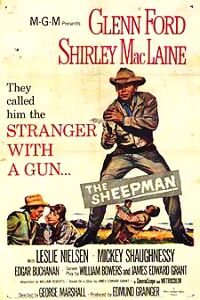
Thesheepman At the start of The Sheepman, reformed gambler and gunslinger Jason Sweet (Glenn Ford) shows up in the middle of cattle country. He has won a herd of sheep in a poker game and he is planning on grazing them on the nearby public land. Knowing that he will face opposition from the local cattle ranchers, Jason asks the local towns people to direct him to the town bully. After Jason beats up Jumbo (Mickey Shaughnessy), Jason is invited to meet Jumbo’s boss, Col. Stephen Bedford (Leslie Nielsen).
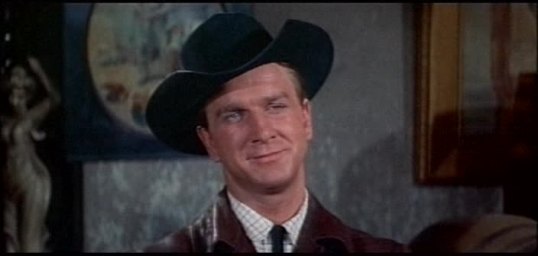
As soon as Jason meets Bedford, he realizes that he is not a colonel and his name is not Bedford. Instead, he is an old friend from Texas, a former gambler and outlaw named Johnny Bledsoe. Like Jason, Bledsoe has also gone straight and is now the most powerful man in town. He is also engaged to marry a local girl named Dell Payton (Shirley MacClaine), to whom Jason has taken a liking.  Bledsoe tells Jason to take his sheep somewhere else and when Jason refuses, Bledsoe threatens to have him, Dell, and his sheep killed.

Wait a minute, Leslie Nielsen is playing a bad guy?

Surely, you can’t be serious!

I am serious. And don’t call me Shirley.

(Sorry, had to do it.)

Leslie Nielsen is best remembered for being the deadpan comedian who could deliver the most ridiculous of lines with a totally straight face and who helped to make Airplane one of the funniest movies ever made. But before Nielsen recreated himself as a comedic actor, he was a dependably stiff supporting player and occasional leading man who appeared in nearly 100 dramatic pictures. The Sheepman is one of his “serious” roles.

Today, it is always strange to see one of Nielsen’s dramatic performances. Johnny Bledsoe is a standard western villain and Nielsen does okay with the role but, because his serious performances shared the same style as his comedic performances, it was impossible not to think of Dr. Rumack saying, “I just want to tell you both good luck. We’re all counting on you,” even while Johnny Bledsoe was offering to pay the outlaw Chocktaw (Pernell Roberts) to track down and kill Jason and his sheep.

The Sheepman is an average western and, as always, Glenn Ford is a good hero. But ultimately, the most interesting thing about it and the main reason to see it is to witness Leslie Nielsen doing his thing before he officially became the funniest man in the world.  Leslie Nielsen was not a terrible dramatic actor but watching The Sheepman made me all the happier that he eventually got to show the world his true calling.

Leslie Nielsen in The Sheepman (1958)

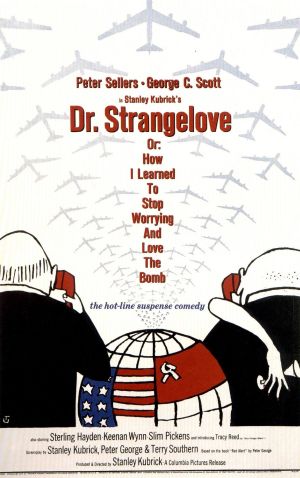
Shattered Politics #22: Dr. Strangelove Or How I Learned To Stop Worrying and Love the Bomb (dir by Stanley Kubrick)


Dr._Strangelove_poster

“Gentlemen!  You can’t fight here!  This is the war room!” — President Merkin Muffley (Peter Sellers) in Dr. Strangelove: Or How I Learned To Stop Worrying And Love the Bomb (1964)

The next time you hear someone bragging about how their favorite politician is an intellectual who always acts calmly and rationally, I would suggest that you remember the example of President Merkin Muffley, one of the many characters who populate the 1964 best picture nominee, Dr. Strangelove or How I Learned To Stop Worrying and Love the Bomb.

As played by Peter Sellers, Merkin Muffley is the epitome of rational political action.  Speaking in a steady (if somewhat muffled) midwestern accent and always struggling to remain calm and dignified, Muffley keeps order in the War Room as the world edges closer and closer to apocalypse.

Just consider, for example, this scene where President Muffley calls the Russian leader (the nicely named Dimitri Kissoff) and explains that a little something silly has happened.

As Muffley explains in the above scene, Gen. Jack D. Ripper (Sterling Hayden) has gone crazy.  Convinced that the Russians have been sapping his precious bodily fluids, Gen. Ripper has ordered a nuclear strike on Russia.  Unfortunately, Russia has built a Doomsday Machine that, should Russia be bombed, will destroy the world.

While Muffley is at fist skeptical about a doomsday machine, his advisor, Dr. Strangelove (also played by Peter Sellers), explains that the doomsday machine not only exists but that it’s actually a pretty good idea.  The wheelchair-bound Dr. Strangelove speaks in a German accent and appears to have lost control over the left side of his body.  At random moments, his left arm shoots up in a Nazi salute.  At other times, his hand tries to strangle him.  Making these surreal moments all the more memorable is the fact that nobody in the War Room seems to notice or question them.

And, while it’s always tempting to dismiss a character like Dr. Strangelove as being an over-the-top caricature, the fact of the matter is that, following the end of World War II, several Nazi scientists ended up working for the U.S. government.  In many ways, the U.S. space program was the creation of a bunch of real-life Dr. Strangeloves.

Of course, President Muffley and Dr. Strangelove aren’t the only roles played by Peter Sellers in this film.  Sellers also plays Lionel Mandrake, a British officer who — as the result of an office exchange program — happens to be at Burpelson Air Force Base at the same time that Gen. Ripper orders the attack on Russia.

As famous as his Sellers’s performances as Dr. Strangelove and President Muffley may be, I actually think Mandrake is his best performance in the film.  In many ways, Mandrake is the audience’s surrogate.  He’s the one who gets to hear Ripper’s rambling explanation for why he launched an attack on Russia.  He’s the one who has to try to convince the hilariously unhelpful Col. Bat Guano (Keenan Wynn) to help him find a quarter so he can call the Pentagon.

(“You’re gonna have to answer to the Coca-Cola company,” Guano says, before shooting open a Coke machine to get change.)

Sellers plays Mandrake as a parody of the traditional, stiff upper lip British army officer.  Not only does that allow some great humor as Mandrake keeps a calm demeanor while listening to Ripper’s increasingly crazed monologue but it also allows Mandrake to be the only sane man in the movie.

(Of course, the whole point of Dr. Strangelove is that the world’s become so insane that one sane man can not make a difference. )

Sellers earned a best actor nomination for playing three different roles and he deserved it but, for me, the two best performances in the film come from Slim Pickens and George C. Scott.

Pickens, of course, is the bomber pilot who ends up riding an atomic bomb like a bull in a rodeo.  As a character, Maj. Kong may be a bit too much of a spot-on stereotype but Pickens brings such sincerity to the role that it doesn’t matter.  Oddly enough, you feel almost happy for him when he rides that bomb to his death.  You know that’s exactly how he would have wanted to go out.

And then there’s George C. Scott, playing the role of Gen. Buck Turgidson.  From the safety of the War Room, Turgidson looks forward to nuclear war and worries when President Muffley invites the Russian ambassador to join them.  (“But he’ll see the big board!” Turgidson exclaims.)  Turgidson is both hilariously stupid and hilariously confident.  Perhaps my favorite Turgidson moment comes when he trips, falls, and stands back up without once losing his paranoid train of thought.

(Though he doesn’t have a big role, James Earl Jones makes his film debut in Dr. Strangelove.  The way he delivers the line “What about Major Kong?” makes me laugh every time.)

50 years after it was first released, Dr. Strangelove remains a comic masterpiece of a nightmare, a film that proves that political points are best made with satire and not sermons.